INTRODUCTION
In the last half century some populations of ommastrephid squids have been responsible for invasion and increasing range into new areas (Rodhouse, Reference Rodhouse2008). Such can be particularly dramatic when species cross ecological barriers to colonise new habitats (Chown et al., Reference Chown, Huiskes, Gremmen, Lee, Terauds, Crosbie, Frenot, Hughes, Imura and Kiefer2012).
Range expansion and contraction in ommastrephid squid is associated with characteristically high variability in their population dynamics (Rodhouse, Reference Rodhouse2008). These range shifts can be difficult to observe directly. It is therefore necessary to make use of additional sources of information, such as the diets of predators, and to test hypotheses arising from the use of such information.
Examples of range shifts in ommastrephid squid include the expansion of the normally tropical to sub-tropical jumbo flying squid Dosidicus gigas into Alaskan waters (Field et al., Reference Field, Baltz, Phillips and Walker2007), the increased abundance of Japanese flying squid Todarodes pacificus in Japanese waters during warmer years (Sakurai et al., Reference Sakurai, Kiyofuji, Saitoh, Goto and Hiyama2000; Rodhouse, Reference Rodhouse2008) and the inter-annual variability in the distribution of the short-finned Illex argentinus along the Patagonian Shelf (Waluda et al., Reference Waluda, Griffiths and Rodhouse2008).
Illex argentinus is a Sub-Antarctic and temperate water squid (Roper et al., Reference Roper, Sweeney and Nauen1984; Arkhipkin, Reference Arkhipkin2013) which occurs predominantly in the south-west Atlantic, specifically on the Patagonian Shelf where it is commercially exploited by a major international fishery (Rodhouse et al., Reference Rodhouse, Dawe and O'Dor1998; Sacau et al., Reference Sacau, Pierce, Wang, Arkhipkin, Portela, Brickle, Santos, Zuur and Cardoso2005; Rodhouse, Reference Rodhouse2013). However, I. argentinus has also been observed in the Antarctic Polar Frontal Zone (APFZ) (Rodhouse, Reference Rodhouse1991; Rodhouse et al., Reference Rodhouse, Dawe and O'Dor1998). This region is north of the Antarctic Polar Front (APF), which is a significant ecological barrier between the south-west Atlantic and the colder waters of the Southern Ocean (Collins & Rodhouse, Reference Collins, Rodhouse, Southward, Young and Fuiman2006). Furthermore, I. argentinus beaks have been observed in the diets of grey-headed, Thalassarche chrysostoma; black-browed, T. melanophris; and wandering, Diomedea exulans, albatrosses during the breeding season at Bird Island, South Georgia (Rodhouse et al., Reference Rodhouse, Clarke and Murray1987; Rodhouse, Reference Rodhouse1991; Xavier et al., Reference Xavier, Rodhouse and Croxall2002, Reference Xavier, Tarling and Croxall2006). Bird Island is located south of the APF and the available tracking data suggested that these albatross species caught I. argentinus while foraging in the Southern Ocean during their breeding season (Xavier et al., Reference Xavier, Rodhouse and Croxall2002, Reference Xavier, Tarling and Croxall2006). These observations led to the hypothesis that albatrosses catch I. argentinus in the Southern Ocean and that I. argentinus might be transported across the APF in gyres (e.g. subtropical gyres originating in the warmer waters of the Brazilian current) or core rings (Xavier et al., Reference Xavier, Tarling and Croxall2006).
Stable isotope analysis has been successfully used to study the spatial distribution of cephalopods in the Southern Ocean (Cherel & Hobson, Reference Cherel and Hobson2005, Reference Cherel and Hobson2007; Cherel et al., Reference Cherel, Gasco, Duhamel, Duhamel and Welsford2011). We used this approach to evaluate the hypothesis that albatrosses at Bird Island catch I. argentinus in the Southern Ocean (i.e. that I. argentinus can occur in Southern Ocean waters). We analysed stable isotopes values of carbon (δ13C) in I. argentinus beaks obtained from the diets of the three albatross species and compared these values with those for the beaks of cephalopod species endemic to the Patagonian Shelf (Octopus tehuelchus) and the Southern Ocean (Alluroteuthis antarcticus). These reference beaks were also obtained from the diets of predators.
MATERIALS AND METHODS
The lower beaks of I. argentinus were collected from the stomach contents of black-browed, grey-headed, and wandering albatross chicks at Bird Island, South Georgia (Xavier et al., Reference Xavier, Rodhouse and Croxall2002, Reference Xavier, Trathan, Croxall, Wood, Podesta and Rodhouse2004). Immediately after a chick had been fed by a returning parent, the chick was inverted over a bucket and its stomach contents collected (Xavier et al., Reference Xavier, Croxall and Reid2003a). The beaks were collected from black-browed (n ≈ 30) and grey-headed (n ≈ 40) albatross chicks at the end of the chick-rearing period in 1999 and from wandering albatross chicks during the chick-rearing periods in 2007, 2008 and 2009 (Table 1). The beaks were kept in 70% ethanol until further analyses.
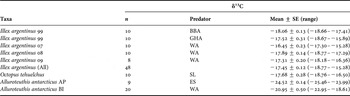
Stable isotope values of carbon (δ13C), of Illex argentinus, Alluroteuthis antarcticus and Octopus tehuelchus beaks sampled from Antarctic predators.

A. antarcticus and O. tehuelchus as reference values for Antarctic waters and Patagonian Shelf, respectively (99 – 1999, 07 – 2007, 08 – 2008, 09 – 2009, sampling years; AP, Antarctic Peninsula; BI, Bird Island), number of lower beaks analysed (n), predator where the beaks were found (BBA, Black-browed albatross; GHA, Grey-headed albatross; WA, Wandering albatross; SL, South American sea lion; ES, Elephant seal) (SE, standard error).
Beaks were also collected for O. tehuelchus, a reference cephalopod species for the Patagonian Shelf (Storero et al., Reference Storero, Narvarte and González2012; Norman et al., Reference Norman, Finn, Hochberg, Jereb, Roper, Norman and Finn2014) and A. antarcticus, a reference species for the Southern Ocean (Rodhouse et al., Reference Rodhouse, Xavier, Griffiths, De Broyer, Koubbi, Griffiths, Raymond, Udekem d'Acoz, Van de Putte, Grant, Gutt, Held, Hosie, Huettmann, Post and Ropert-Coudert2014). Octopus tehuelchus beaks were collected from fresh scats of the South American sea lion (Otaria flavescens) from the rookery at Punta Bermeja, Rio Negro Province, Argentina (41°S 63°W) (Bustos et al., Reference Bustos, Daneri, Volpedo, Harrington and Varela2014) in November 2005. Alluroteuthis antarcticus beaks were collected from the stomach contents of adult wandering albatrosses (subjected to stomach lavage) at Bird Island in 2009 (Xavier et al., Reference Xavier, Croxall, Trathan and Wood2003b) and from the stomach contents of Southern elephant seals (Mirounga leonina) (immobilized by injection of ketamine hydrochloride and subjected to stomach lavage following Antonelis et al., Reference Antonelis, Lowry, DeMaster and Fiscus1987) at Stranger Point, Isla 25 de Mayo/King George Island, South Shetlands (62°S 58°W) during the moulting season of 1995/96 (Daneri et al., Reference Daneri, Carlini and Rodhouse2000).
Cephalopods were identified from the morphology of their beaks following Xavier & Cherel (Reference Xavier and Cherel2009).
Whole lower beaks were cleaned, dried and milled to a fine powder. The ratio of stable isotopes of carbon was measured using a Continuous Flow Isotope Ratio Mass Spectrometer (CFIRMS). The results are presented in δ notation as deviations in the proportion of 13C from the standard reference in parts per thousand (‰), calculated using the equation:
 $${\delta ^{{\rm 13}}}{\rm C}\, = \,\left[ {({\rm Rsample}\,/\,{\rm Rstandard}) - {\rm 1}} \right] \times {\rm 1}000$$
where Rsample is the ratio 13C/12C in the sample and Rstandard the ratio 13C/12C in the international reference standard, Vienna Pee-Dee Belemnite (0.0112372). Replicate measurements of internal laboratory standards (acetanilide) indicate measurement errors <0.1‰. Data were statistically analysed using R (R Core Team, 2013).
RESULTS
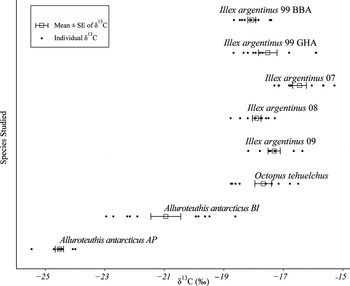
The δ13C values for I. argentinus from albatrosses at Bird Island ranged from −18.77 to −15.28‰ (Table 1; Figure 1). These values were similar to those from O. tehuelchus (−18.76 to −16.50‰), our reference species from the Patagonian Shelf. In contrast, the mean values for our Southern Ocean reference species, A. antarcticus, were more negative with specimens from Antarctic Peninsula (A. antarcticus AP; −25.46 to −23.99‰) more negative than those from Bird Island (A. antarcticus BI; −22.95 to −18.16‰). Only a single δ13C value from A. antarcticus overlapped with some samples of I. argentinus and analysis of variance confirmed statistically significant differences in δ13C values between groups (F 7, 69 = 5.005; P < 0.001).
Mean (±SE, standard error) stable carbon isotope values of Illex argentinus beaks found in the diet of Antarctic predators (BBA – Black-browed albatrosses, and GHA – Grey-headed albatrosses, the other I. argentinus were caught by wandering albatrosses) in different years (99–1999, 07–2007, 08–2008, 09–2009), Alluroteuthis antarcticus (AP, Antarctic Peninsula and BI, Bird Island) and Octopus tehuelchus as reference values for Antarctic waters and Patagonian Shelf, respectively.

Illex argentinus δ13C values were similar to those for O. tehuelchus with the exception of I. argentinus caught in 2007 (Tukey's pairwise comparisons, P = 0.04). These 2007 values were also significantly different from those for I. argentinus caught in 1999 from black-browed albatrosses (BBA) and 2008 (Tukey's pairwise comparisons between: 2007 and 2008, P = 0.008; 2007 and 1999 BBA, P = 0.002). Alluroteuthis antarcticus δ13C values were significantly different from all of those for the other two cephalopod species. Alluroteuthis antarcticus values were also significantly different between sampling locations (Tukey's pairwise comparisons between A. antarcticus obtained from the Antarctic peninsula predators (A. antarcticus AP values) and A. antarcticus obtained from Bird island predators (A. antarcticus BI) (P < 0.01).
DISCUSSION
The hypothesis that albatrosses at Bird Island catch I. argentinus in the Southern Ocean (i.e. that I. argentinus can occur naturally in Southern Ocean waters) is not supported by our data. Our results show a clear distinction between the mean δ13C values for I. argentinus and those for the Southern Ocean reference species, A. antarcticus. Conversely, there was considerable overlap between the mean values for I. argentinus and those for the Patagonian Shelf reference species, O. tehuelchus. Therefore, although I. argentinus often occurs in the diets of Southern Ocean predators (Rodhouse et al., Reference Rodhouse, Clarke and Murray1987; Xavier et al., Reference Xavier, Tarling and Croxall2006; Xavier & Cherel, Reference Xavier and Cherel2009), our stable isotope values from the beaks of I. argentinus collected from albatross stomach samples suggest that the albatrosses forage for I. argentinus on the Patagonian Shelf. This is consistent with the known foraging ecology of wandering albatrosses breeding at Bird Island, which regularly forage at the Patagonian Shelf and feed on I. argentinus (Xavier et al., Reference Xavier, Trathan, Croxall, Wood, Podesta and Rodhouse2004).
A previous study, combining satellite tracking and stomach sampling data, suggested that wandering albatrosses might have caught I. argentinus in Southern Ocean waters during some short trips around South Georgia (Xavier et al., Reference Xavier, Trathan, Croxall, Wood, Podesta and Rodhouse2004). However, the tracked wandering albatrosses were not stomach washed prior to these foraging trips and it is possible that they already had I. argentinus in their stomachs. It is also possible that the albatrosses could have consumed I. argentinus used as bait by fishing vessels that operate in the South Georgia region (Xavier et al., Reference Xavier, Tarling and Croxall2006). Stable isotope analysis is a useful tool for assessing the origin of the I. argentinus beaks, confirming that they originate from warmer waters.
The presence of I. argentinus in the diets of grey-headed and black-browed albatrosses is more puzzling as tracking data suggest that, during their breeding period at Bird Island, they generally forage in Southern Ocean waters south of the Antarctic Polar Front (APF), except during the incubation period, when they may extend their foraging range to the Patagonian Shelf and slope (Phillips et al., Reference Phillips, Silk, Phalan, Catry and Croxall2004). It is unlikely that grey-headed and black-browed albatrosses consumed bait from fishing vessels in the Southern Ocean because licensed long-line vessels do not operate in the South Georgia area during chick rearing (Phillips et al., Reference Phillips, Ridley, Reid, Pugh, Tuck and Harrison2010). It is therefore likely that grey-headed and black-browed albatrosses may also extend their foraging range to warmer waters during the late chick-rearing period in some breeding seasons. Further tracking studies, concentrating on this period would be useful to test this conclusion.
In conclusion, our study shows that I. argentinus found in the diets of albatrosses at Bird Island originated from warmer waters of the Patagonian Shelf. Therefore, our results suggest that it might be relatively common for albatrosses that breed at Bird Island to forage on the Patagonian Shelf where I. argentinus is most abundant. Consequently, this region is likely to be more important to albatrosses breeding at South Georgia than previously thought and this may have conservation implications. Numerous fisheries operate on the Patagonian Shelf, including longline fisheries known to be responsible for incidental mortality to albatrosses (Favero et al., Reference Favero, Khatchikian, Arias, Silva Rodriguez, Cañete and Mariano-Jelicich2003). A detailed evaluation of how dependent Southern Ocean seabird populations are on that region for food is therefore recommended. Although our analysis confirms the Patagonian Shelf origin of I. argentinus collected from albatrosses at Bird Island in multiple years, it does not exclude the possibility that some of these specimens might have been caught in colder waters (e.g. APFZ waters). Future studies analysing the stable isotope signature of the most recent deposition of keratin in the beaks (from the edges of the beaks) would be able to assess this.
ACKNOWLEDGEMENTS
The authors would like to acknowledge Dr Vlad Laptikhovsky and Dr Alexander Arkhipkin for their revisions and comments.
FINANCIAL SUPPORT
This research was supported by the Ministry of Science and Higher Education, Portugal (Fundação para a Ciência e a Tecnologia), the British Antarctic Survey's Natural Environment Research Council core-funded Ecosystems programme, the Scientific Committee for Antarctic Research (SCAR) AnT-ERA, Portuguese Polar Program PROPOLAR and Integrating Climate and Ecosystem Dynamics of the Southern Ocean (ICED). Rui P. Vieira was sponsored by the Caixa Geral de Depósitos Grant Programme ‘Nova Geração de Cientistas Polares’ and is currently supported by a doctoral grant from the Portuguese Science Foundation (SFRH/BD/84030/2012) and partially by European Funds through COMPETE and by National Funds through the Portuguese Science Foundation (FCT) within project PEst-C/MAR/LA0017/2013 and Filipe R. Ceia by a post-doctoral fellowship (SFRH/BPD/95372/2013).