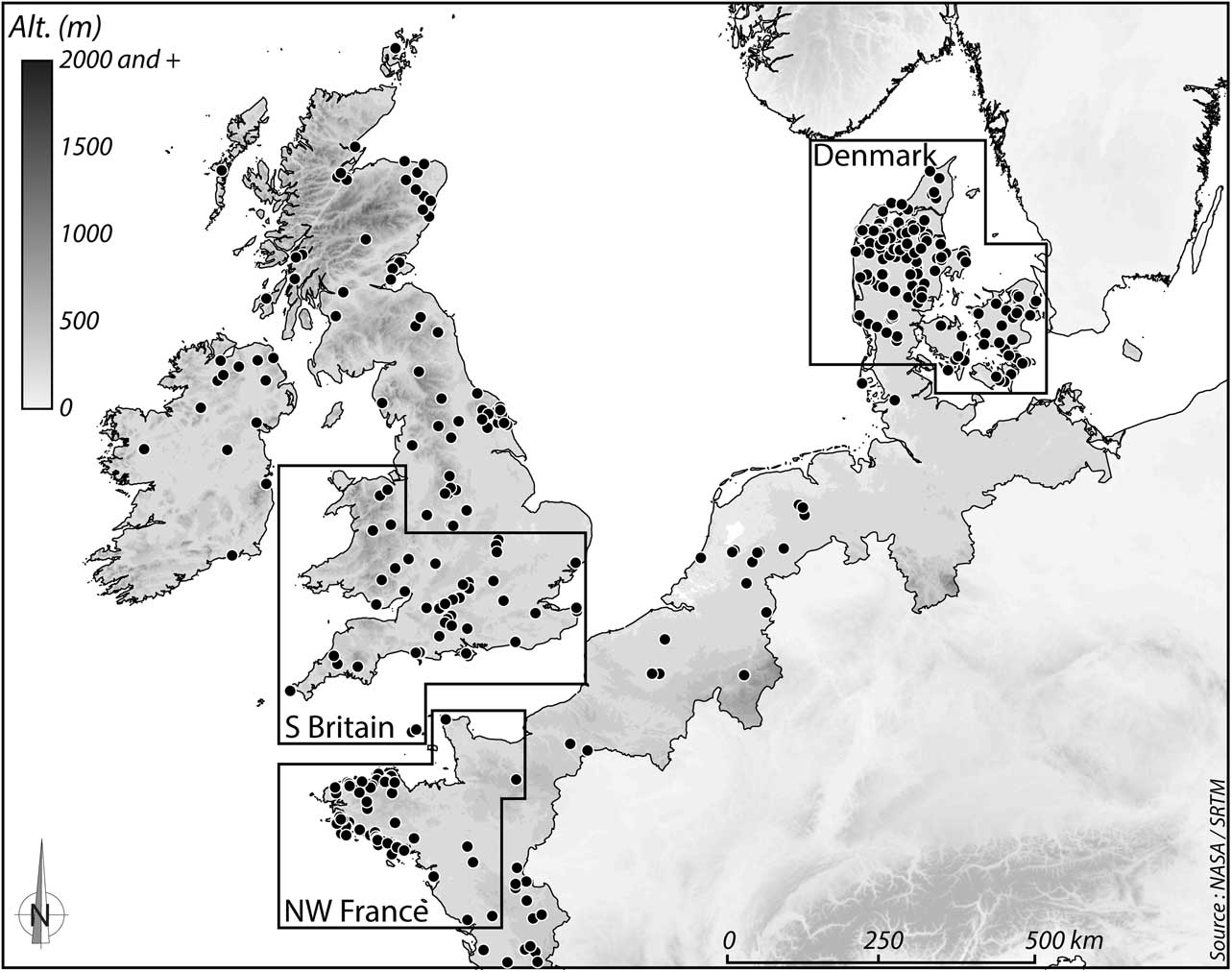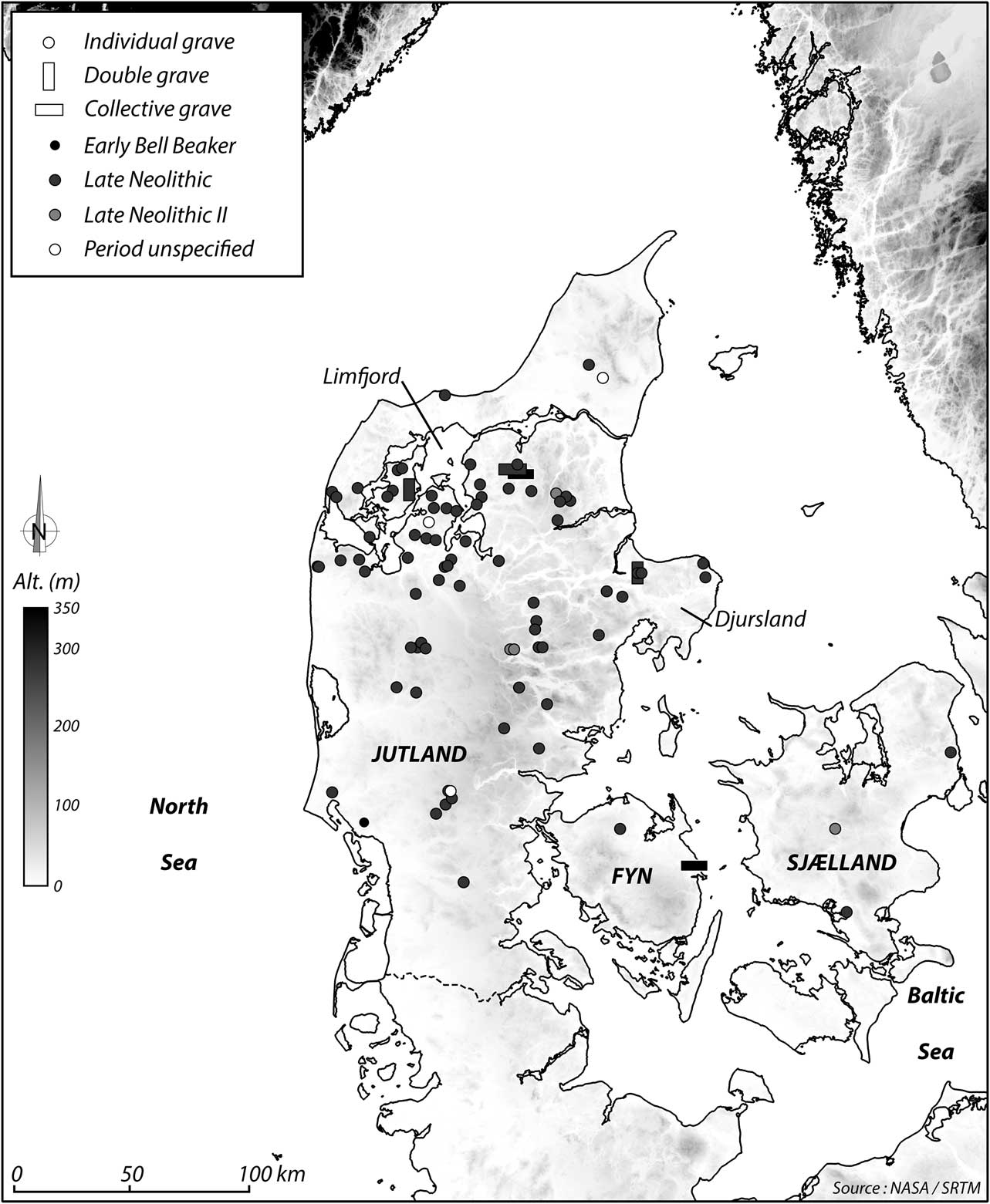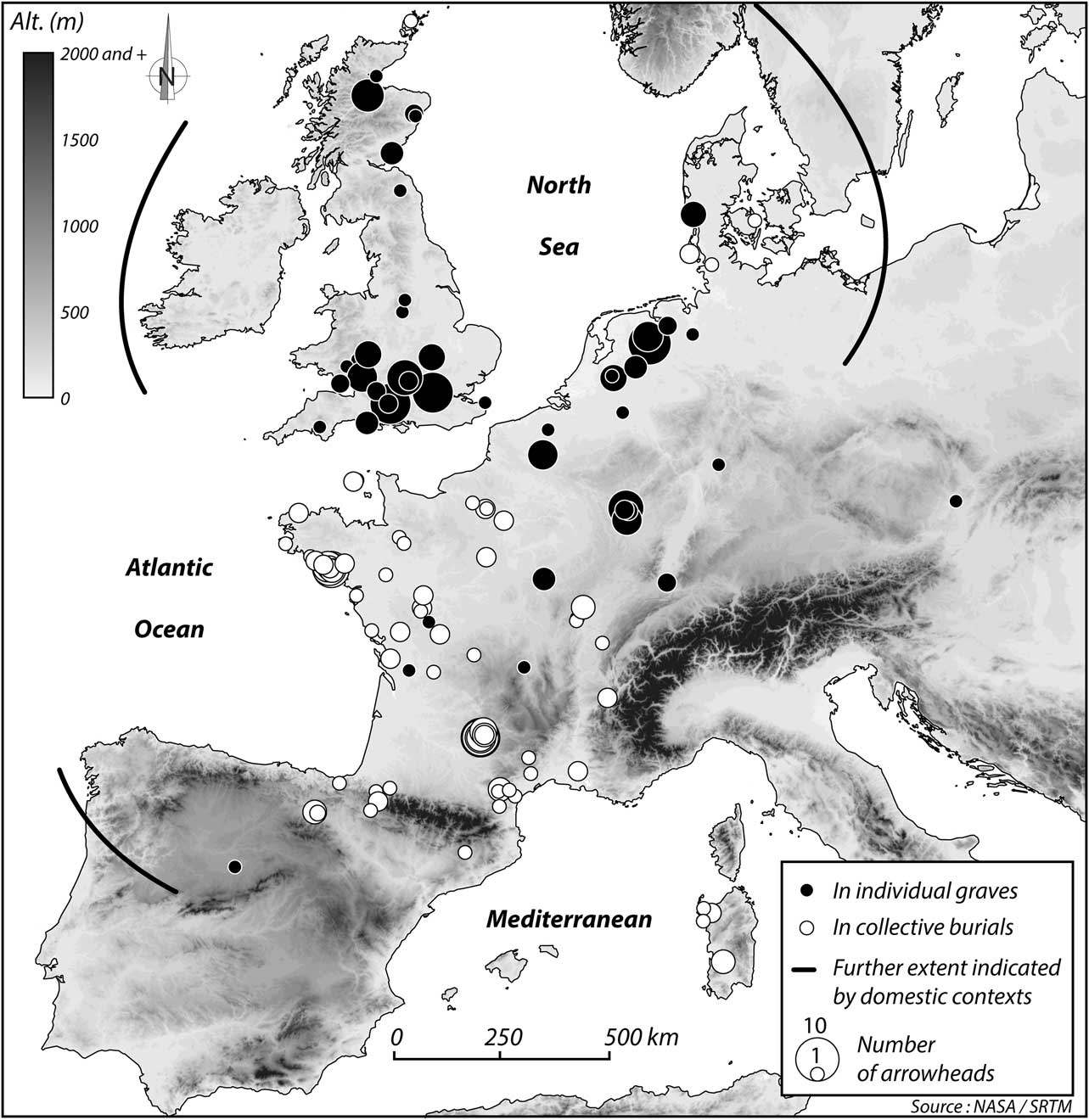


In 1985, the exhibition Symbols of Power at the Time of Stonehenge (Clarke et al. Reference Clarke, Cowie and Foxon1985) gathered together, for the first time, artefacts from graves and hoards from both sides of the Channel and around the North Sea, the so-called ‘Northern Mediterranean’ (Briard Reference Briard1987). This exhibition demonstrated that there had been a degree of community of symbols across these regions. Prominent among the featured artefacts were flint arrowheads. The time of Stonehenge corresponds to the Late Neolithic, the Chalcolithic, and the Early Bronze Age in Britain. This sanctuary, first used as a burial ground (inter alia), was periodically re-arranged between c. 2600 bc and 1700 bc until it reached the monumental form that we know today (Parker Pearson et al. Reference Parker Pearson, Cleal, Marshall, Needham, Pollard, Richards, Ruggles, Sheridan, Thomas, Tilley, Welham, Chamberlain, Chenery, Evans, Knüsel, Linford, Martin, Montgomery, Payne and Richards2007; Reference Parker Pearson, Chamberlain, Jay, Marshall, Pollard, Richards, Thomas, Tilley and Welham2009). The period shortly after the sarsen trilithons were erected saw the appearance, over a large part of Europe, of Bell Beaker pottery and associated practices and then, a few generations later, the introduction of bronze metalworking. The significance of archery equipment and, in particular, of arrowheads has long been recognised, with Childe highlighting its prominence in Bell Beaker contexts as long ago as Reference Childe1929, and others remarking on Early Bronze Age examples in north-west France (Martin Reference Martin1900) and southern Britain (Piggott Reference Piggott1938), and on Late Neolithic examples in Denmark (Sarauw Reference Sarauw2007a). Each of these regions has a concentration of graves containing arrowheads, often finely shaped, and at first glance this suggests that certain individuals were accorded the same symbolic representation for the afterlife (Fig. 1). Some of these arrowheads – certain exquisite examples of which have only been found in graves – raise the question about their status: were they goods made for the funeral (Giot et al. Reference Giot, Briard and J., Pape1995, 67), or everyday objects, or objects that had some other special significance over and above their use as grave goods? In order to explore this topic, we have tried to address three main questions: how were these arrowheads made? What were their functions? And what do these arrowheads tell us about Bell Beaker and post-Beaker Early Bronze Age societies? The approach used to answer these questions is an integrated study of arrowhead typology, raw material use, technology, and use-wear. This contribution will conclude by reconsidering the place of the arrowheads in exchange networks in Atlantic Europe.
Distribution map of graves with arrowheads dating to 2500–1700 bc along the Channel and around the North Sea, showing the three main concentrations presented in this article (after Nicolas 2009; 2015)

CONTEXTS & CHRONOLOGY
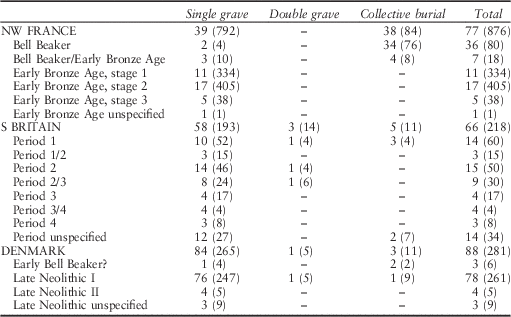
Many arrowheads have been found from the 19th century onwards, with their rate of discovery varying according to the nature of the fieldwork undertaken: 19th century finds tend to come from antiquarian and other explorations of barrows and megaliths, while 20th and 21st century finds mostly come from rescue/development-led or research-orientated excavations, with many being found in graves that have no covering mound. For the current study, a corpus of 1375 arrowheads was collated (Appendix S1). These come from 231 graves (Table 1), but exclude 274 arrowheads from 92 graves in Denmark, since these are mainly from collective burials or single graves which cannot be dated closely within our period of interest (Nicolas Reference Nicolas2016a). In the following text, alphanumeric references to individual arrowheads relate to entries in the corpus.
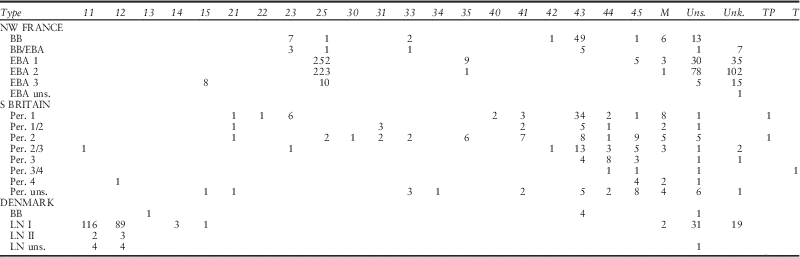
Inventory of graves with arrowheads by place & period. number of arrowheads is given in brackets after number of graves

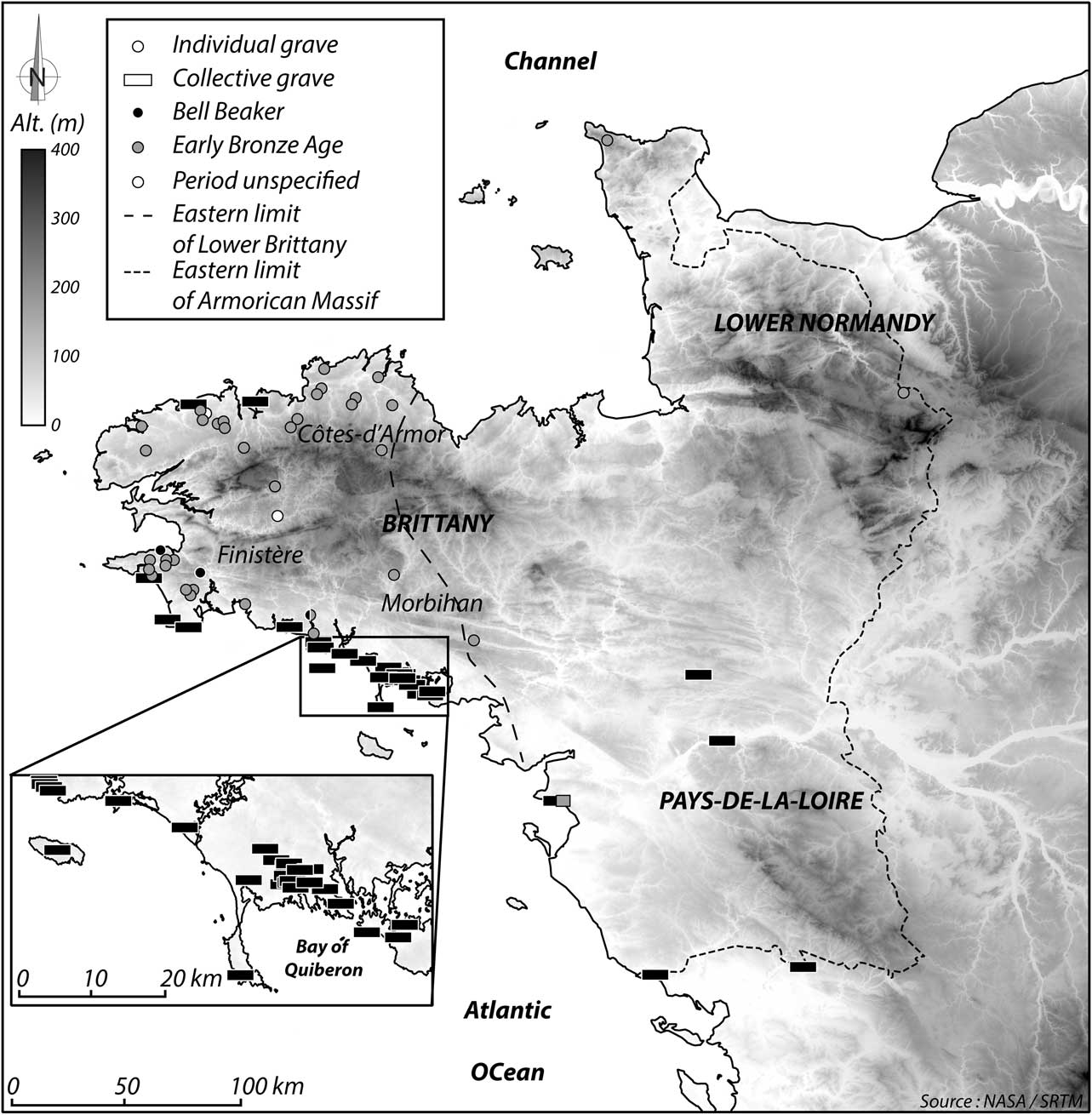
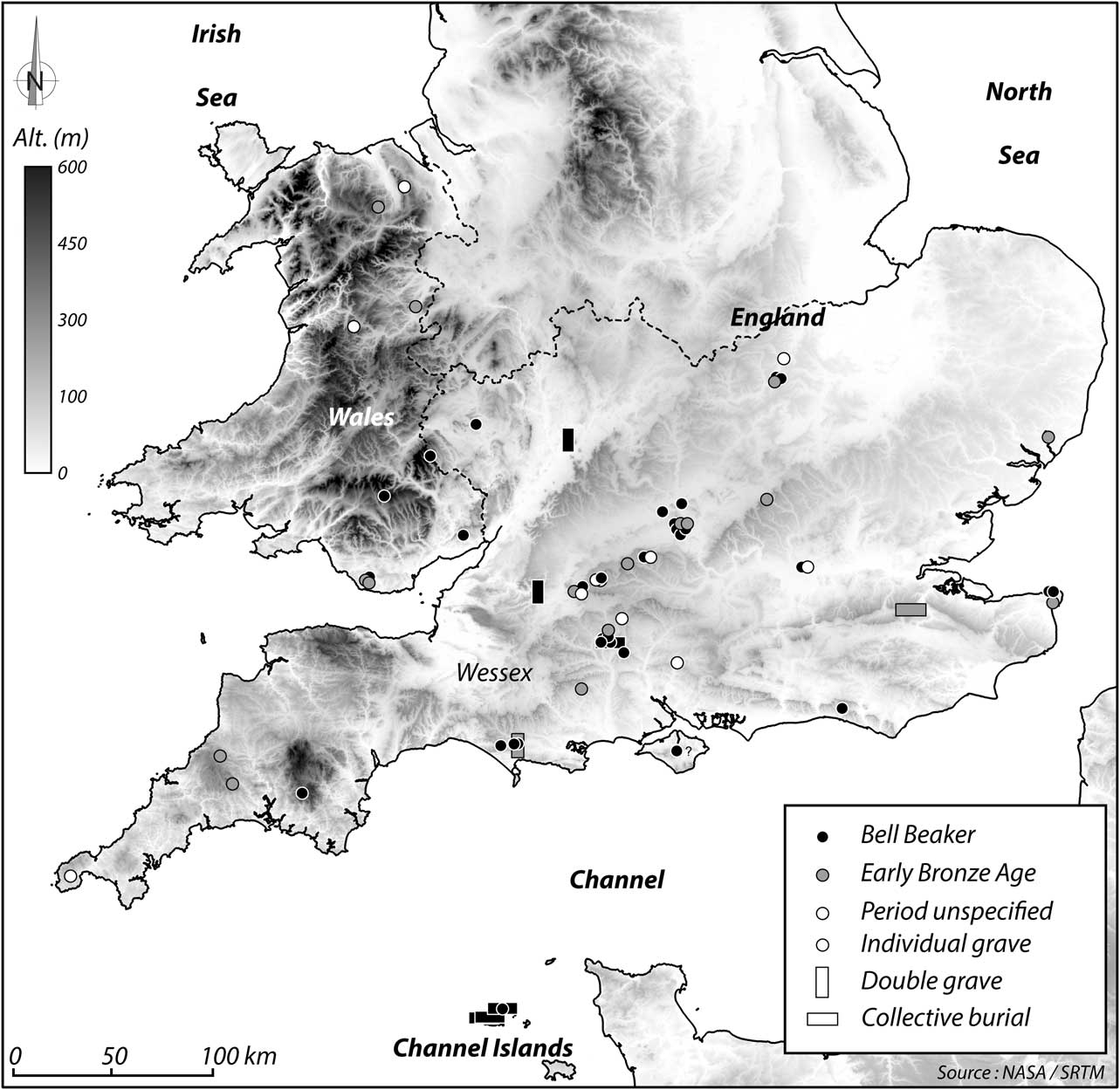
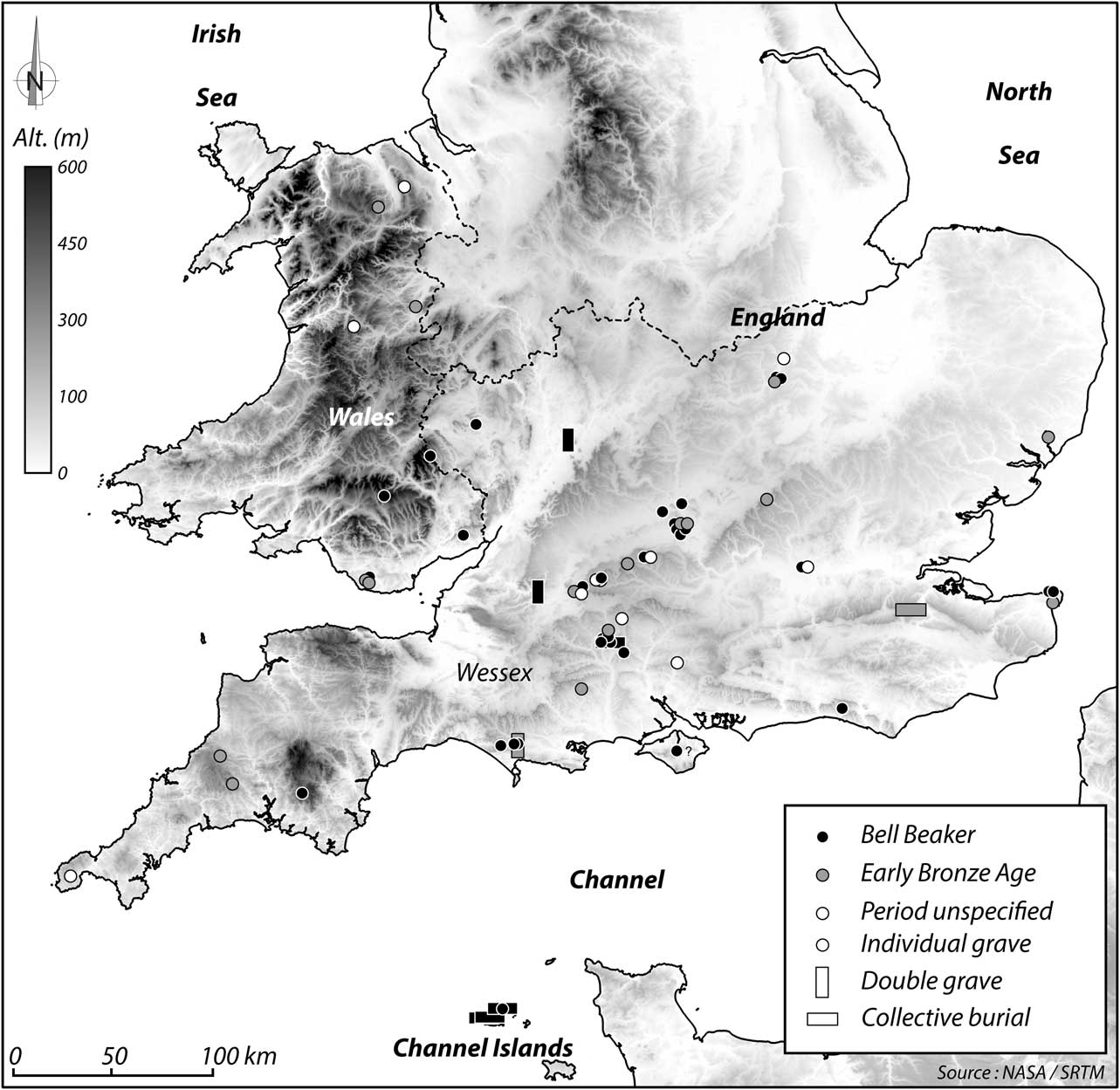
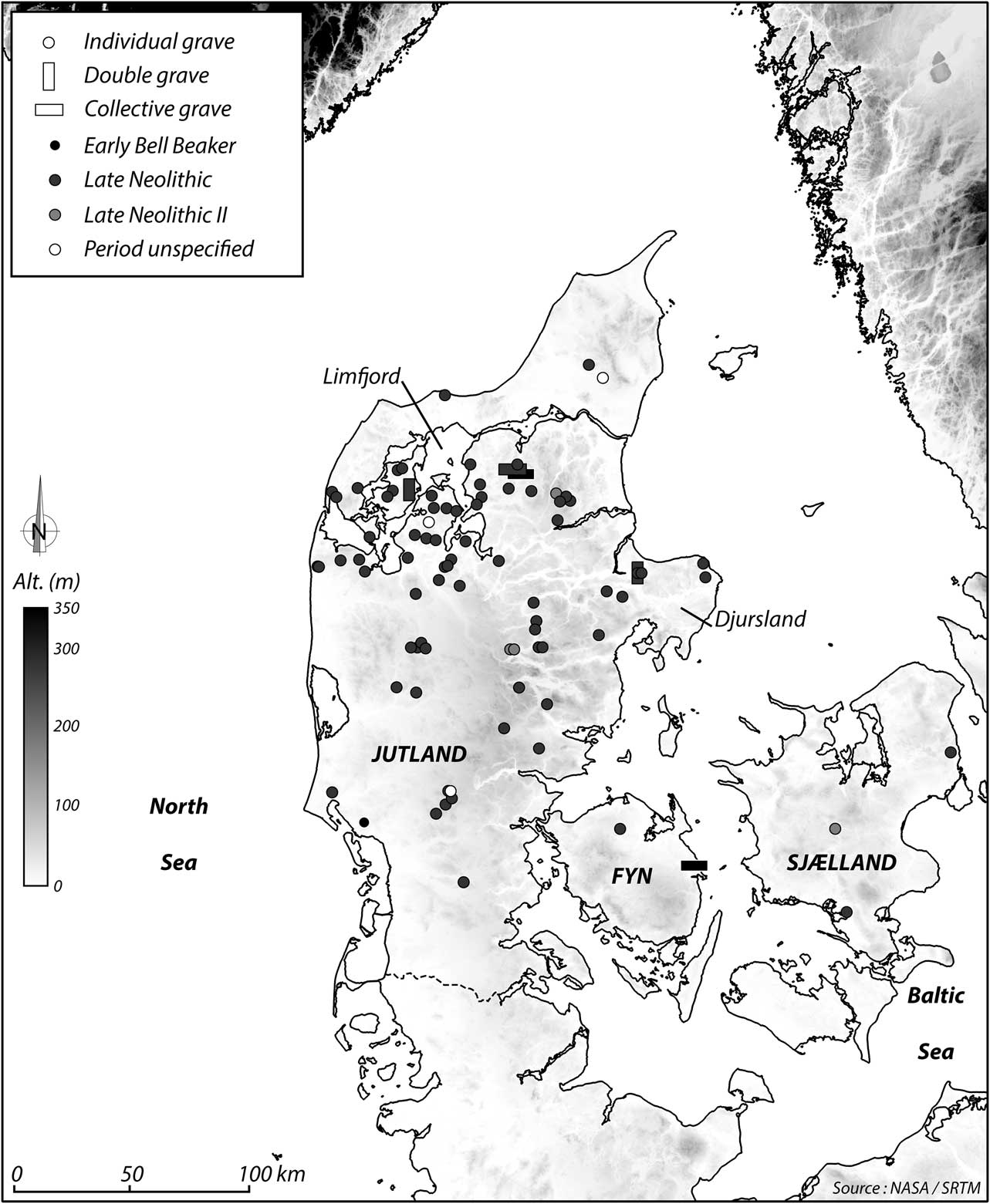
The find contexts for the arrowheads vary between the three study areas. In north-west France, Bell Beaker funerary practice overwhelmingly featured the re-use of older megalithic monuments (Salanova Reference Salanova2003; Fig. 2). This practice also existed in the Channel Islands (Kinnes & Grant Reference Kinnes and Grant1983) and occasional examples are also known from southern Britain (as at Sales Lot, Gloucestershire: Smith & Brickley Reference Smith and Brickley2009, 139), although none was associated with arrowheads (Fig. 3). The re-use of older megalithic monuments is well-known in Denmark (Vandkilde Reference Vandkilde2007), but it can be hard to determine which arrowheads were deposited in them during the Late Neolithic, and which during the Early Bronze Age, except in case of some recently-excavated sites (see Fabech Reference Fabech1986). In Brittany, a few individual graves are known for the Bell Beaker period. Some of these, covered by round barrows, are clearly precursors of those seen in the Early Bronze Age Armorican Tumulus Culture: this culture is characterised by the spread of the practice of individual interment, either in flat graves or under round barrows (Briard Reference Briard1984; Nicolas et al. Reference Nicolas, Pailler, Stephan and Gandois2013; Fig. 2). Some of these Early Bronze Age barrows are large (up to 6 m high and 60 m in diameter), especially those in which flint arrowheads have been found – the so-called ‘princely’ graves (Briard Reference Briard1991). In southern Britain, the practice of individual interment is the predominant rite during both the Chalcolithic period and the Early Bronze Age, with flat graves (and graves with very small mounds) predominating in the former, and mounded graves in the latter (Case Reference Case2004a; Fig. 3). We should note, however, the collective Bell Beaker grave known as the ‘Boscombe Bowmen’ grave in Amesbury, Wiltshire (UK-38). In Denmark, individual graves with arrowheads, generally under barrows, form part of a range of Late Neolithic funerary practices (Sarauw Reference Sarauw2007a; Vandkilde Reference Vandkilde2007; Fig. 4). Finally, we could mention the few double burials that have been found in southern Britain and in Denmark (Monkton Farleigh 2, UK-48; Bredon Hill, UK-53; Allestrup Vest, grave Eh, DK-29); this custom is also attested in Brittany (for example Le Goffic & Peuziat Reference Le Goffic. and Peuziat.1991). The mortuary practice in most of these graves had been inhumation, although in southern Britain cremation gained in popularity over the course of the Early Bronze Age. When bones are preserved – and the acid soils of north-west France and Denmark mean that this is a relatively rare occurrence – the body is generally crouched (ie contracted) in Britain and Brittany (Briard Reference Briard1984; Case Reference Case2004a; Shepherd Reference Shepherd2012) and placed in an extended position on its back in Denmark (Vandkilde Reference Vandkilde2007). The skeletal remains are overwhelmingly those of adult males. The rare exceptions comprise three graves containing the remains of a child (Lord of the Manor 1, grave 6, UK-19; Barrow Hills, grave 5274, UK-31; Solbakkegård IV, grave GP, DK-31) and one containing an adult female skeleton (QEQM Hospital 2, UK-21). However, in the case of the woman it is clear that the arrowhead had not been a grave good, but rather the probable cause of her death, as it was found inside the skull.
Distribution map of graves with arrowheads dating to 2500–1700 bc in north-west France
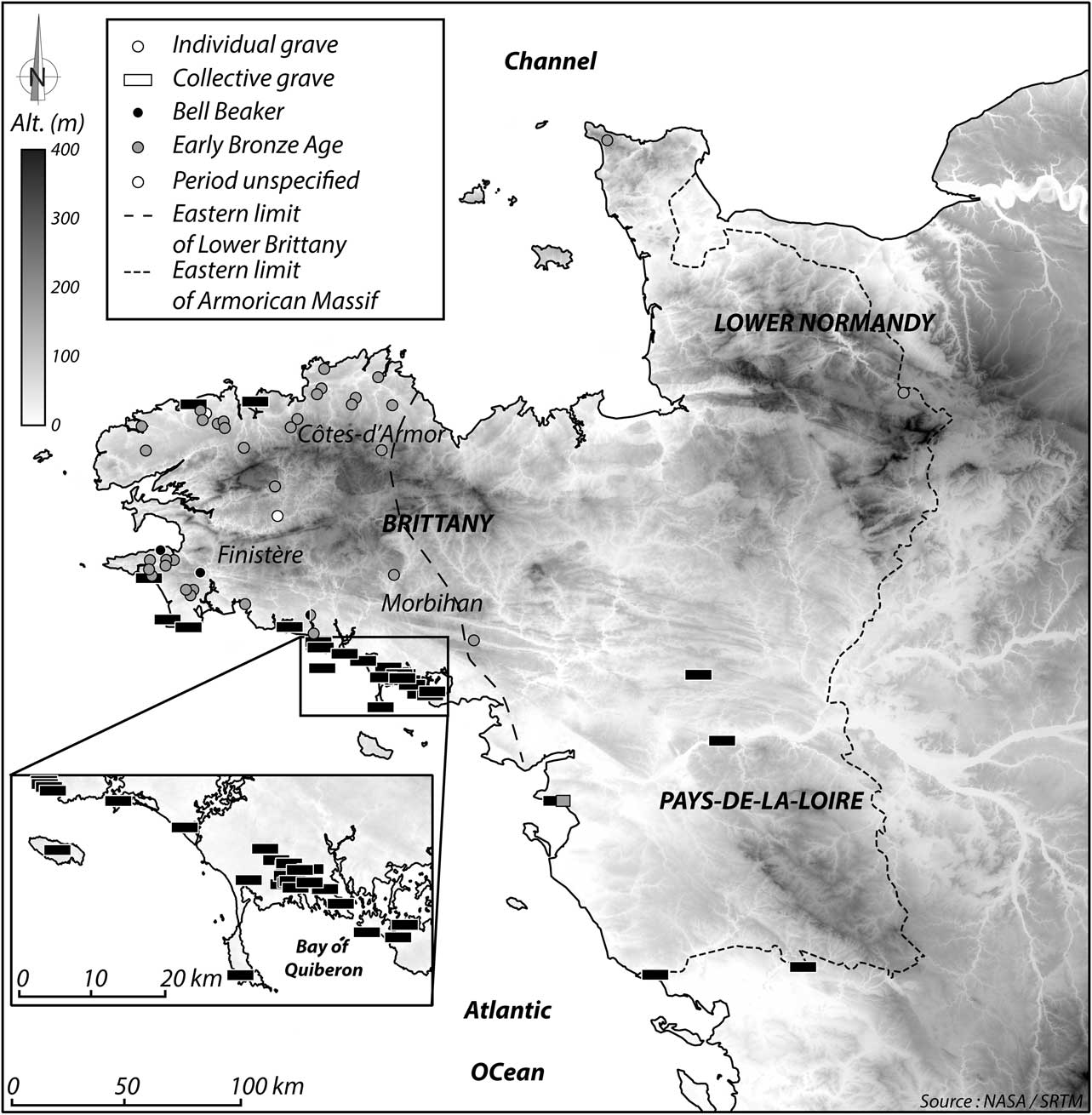
Distribution map of graves with arrowheads dating to 2500–1700 bc in southern Britain
Distribution map of graves with arrowheads dating to 2500–1700 bc in Denmark
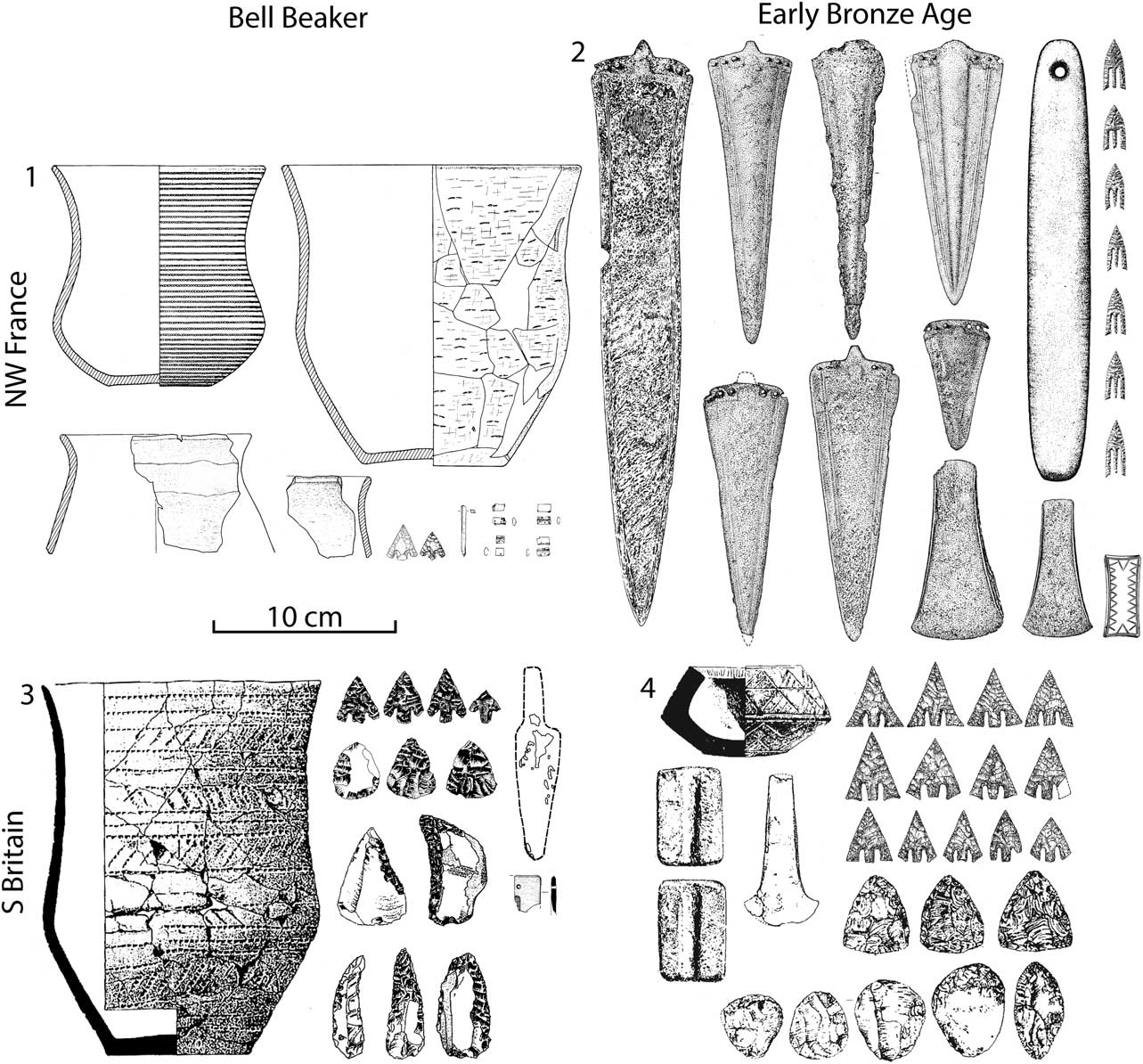
Examples of grave goods associated with arrowheads from Bell Beaker, post-Beaker Early Bronze Age, & Danish Late Neolithic contexts in the study areas. 1. Low-Carinated & undecorated Bell Beakers, flint arrowhead, arsenical copper awl, & gold-sheet ornaments from Neolithic megalithic grave with lateral entrance in Goërem, Gâvres, Morbihan, Brittany (FR-56). 2. Copper alloy Armorican daggers & low-flanged axeheads, large slate whetstone, flint arrowheads, & sheet-gold bracer-ornament from La Motta barrow, Lannion, Côtes-d’Armor, Brittany (FR-01). 3. Low-Carinated Bell Beaker, flint arrowheads & preforms, flint tools, copper dagger, & fragment of shale wristguard from Wellington Quarry flat grave, Marden, Herefordshire (UK-15). 4. Accessory vessel (cup), copper alloy low flanged axehead, sandstone arrowshaft smoother, flint arrowheads, flint bifacial points (preforms?), & flint tools (scrapers & knife) from Breach Farm barrow, Llanbleddian, Vale of Glamorgan, Wales; note dagger and chisel not shown (UK-60) (1: after L’Helgouac’h Reference L’Helgouac’h1970, 2: after Butler & Waterbolk Reference Butler and Waterbolk1974, 3: after Harrison et al. Reference Harrison, Jackson and Napthan1999, 4: after Grimes Reference Grimes1938)

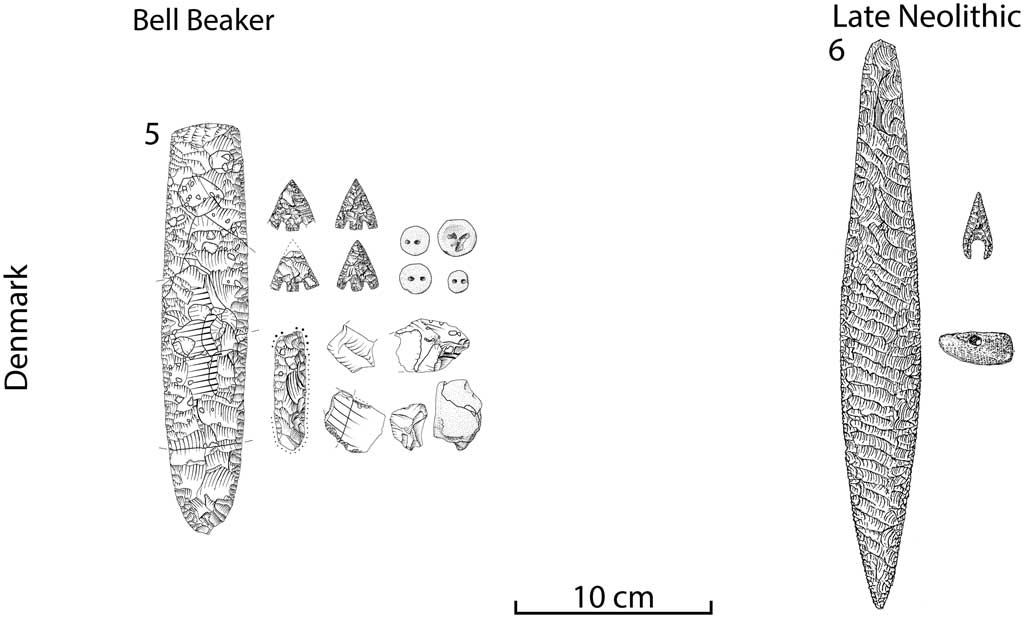
5. Flint dagger (‘Madkniv’), flint arrowheads, strike-a-light, flakes & pebble, & amber V-perforated button from pit containing cremated remains in Solbakkegård IV, Grave GP, Bryndum, Ribe (DK-31). 6. Flint dagger (type IC), flint arrowhead, & amber bead from Odby barrow, Grave A, Odby, Struer (DK-66). (5: drawings C. Nicolas, 6: after Ebbesen Reference Ebbesen1995)

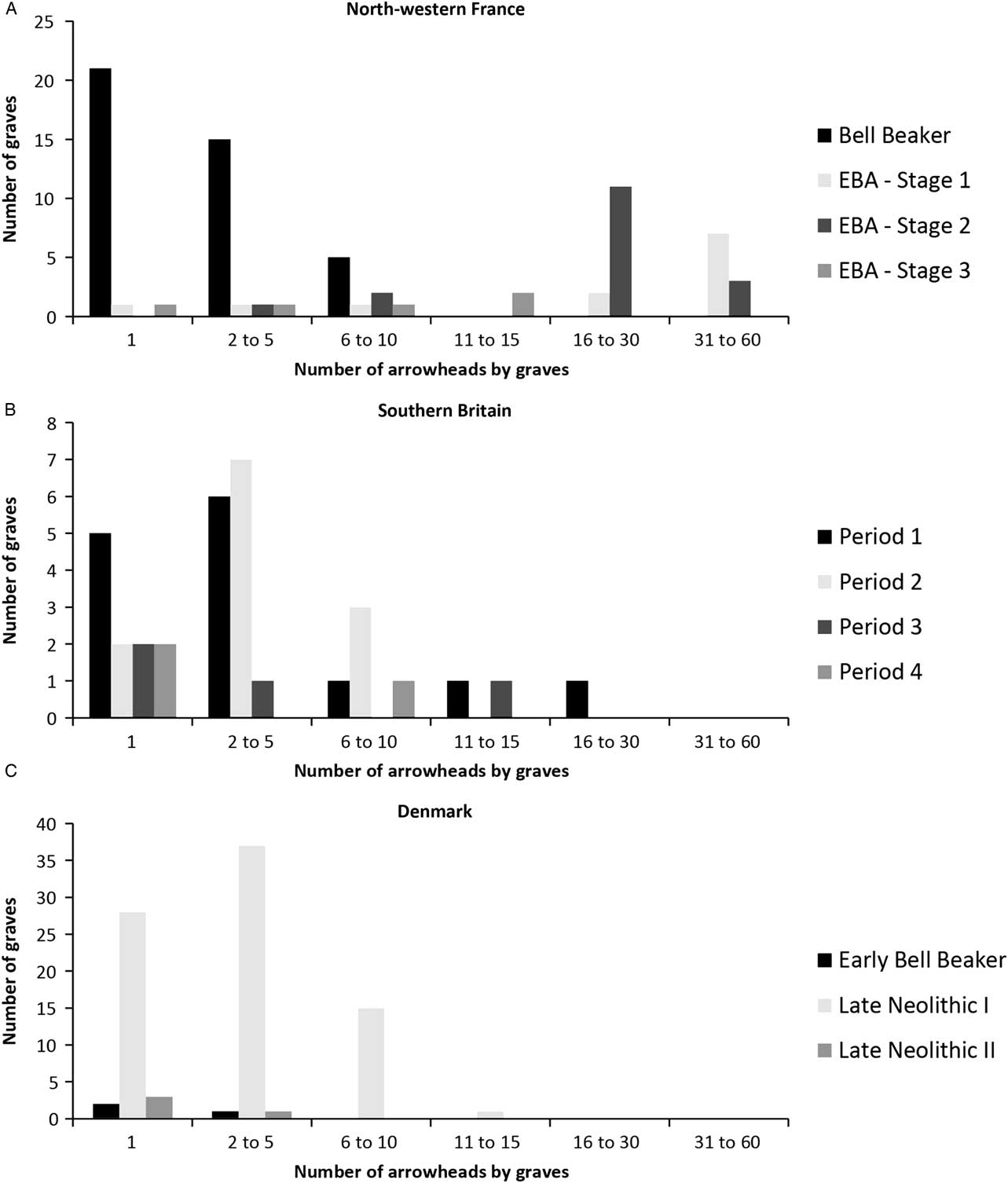
Bell Beaker arrowheads are generally part of the Beaker ‘set’ of grave goods (including Beakers, weapons, ornaments, and tools) but these objects are rarely found all together (Salanova Reference Salanova2007; Woodward & Hunter Reference Woodward and Hunter2015). Arrowheads are a relatively frequent Beaker-associated grave good, being found in between 12% and 20% of graves (Clarke Reference Clarke1970; Nicolas Reference Nicolas2016a; forthcoming; Woodward & Hunter Reference Woodward and Hunter2015; Fig. 5.1, 3 and 5). In Danish Late Neolithic contexts, arrowheads are generally associated with flint daggers and very occasionally with stone tools, pottery, or amber or bronze ornaments (Sarauw Reference Sarauw2007a; Fig. 5.6). In the county of Ribe – which is by no means the richest findspot area in Denmark – up to 13% of Late Neolithic graves have yielded arrowheads (Siemen Reference Siemen2009). In these Bell Beaker and Danish Late Neolithic contexts, the number of arrowheads per individual is generally between one and five, and only rarely more than that; the exceptional Amesbury Archer grave contained 17, plus a triangular point (UK-37; Fig. 6). By contrast, arrowheads are less frequently found in Early Bronze Age graves in north-west France and southern Britain, occurring in fewer than 5% of graves (Briard Reference Briard1984; Longworth Reference Longworth1984; Nicolas Reference Nicolas2016a; Woodward & Hunter Reference Woodward and Hunter2015). However, in Brittany the number of arrowheads found in graves is large – generally over 16, and up to 60 in a single grave (Fig. 6A). In this region, arrowheads are generally associated with abundant and precious grave goods: copper alloy daggers (up to ten per grave) ornamented with tiny gold nails and housed in fine decorated sheaths, copper alloy axes, objects of gold and silver, and some exotic finery and long whetstones (Martin Reference Martin1900; Briard Reference Briard1984; Needham Reference Needham2000a; Nicolas et al. Reference Nicolas, Stevenin and Stephan2015a; Fig. 5.2). In southern Britain, Early Bronze Age arrowheads are found in similar numbers to those from Bell Beaker graves (Fig. 6B). They are mainly found together with pottery – Food Vessels, Collared Urns, or accessory vessels (‘cups’) – and, to a lesser extent, with metalwork (namely daggers, an axehead, a chisel, and awls), with stone and bone tools, and with a few ornaments (Gerloff Reference Gerloff1975; Longworth Reference Longworth1984; Woodward & Hunter Reference Woodward and Hunter2015; Fig. 5.4). Finally, arrowheads are frequently found scattered in graves but are sometimes grouped in different parts of the grave (perhaps as several sets) or else in a single bundle, suggesting perhaps the possible former presence of a quiver. In the Early Bronze Age graves in Brittany, arrowheads were apparently deposited in wooden boxes made of oak (Briard Reference Briard1970) and in one case they seem to have been carefully wrapped in fabric and animal skin (Prigent Reference Prigent1881); in other cases, we cannot exclude the possibility that some arrowheads had indeed been deposited in a quiver.
Number of arrowheads in the graves in north-west France, southern Britain and Denmark

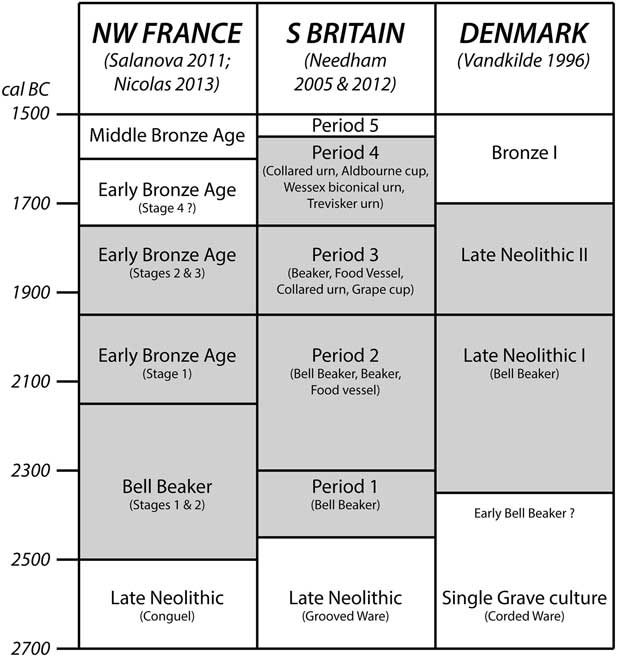
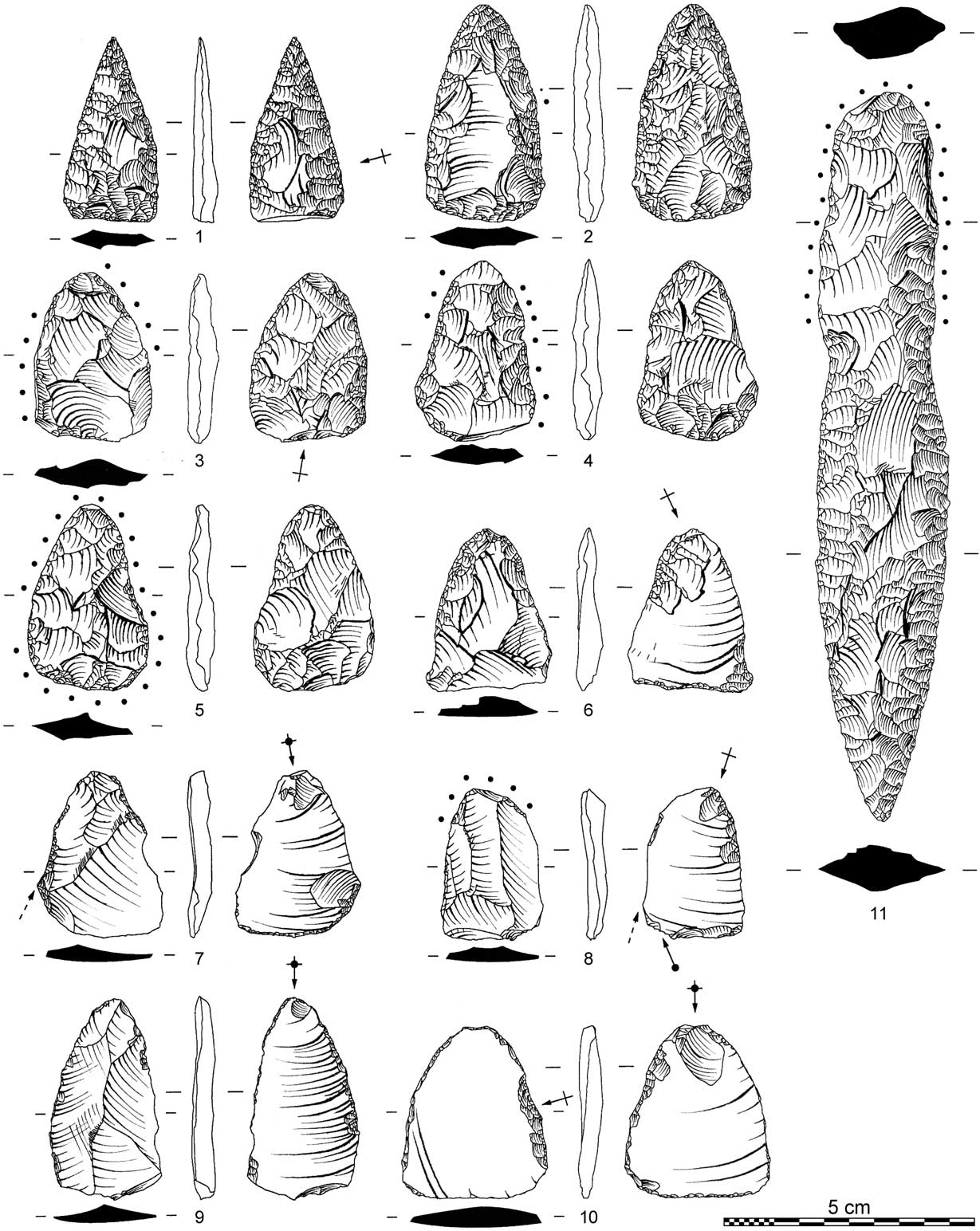
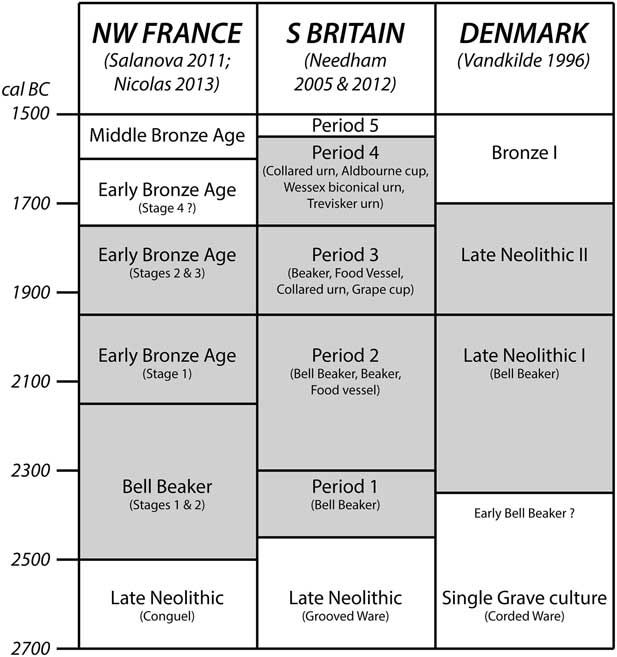
The chronological framework used in this study is based on the main syntheses established for the period 2500–1700 bc (using both absolute and relative chronology) by Laure Salanova in France (Reference Salanova2011), by Stuart Needham in Britain (2005; Reference Needham2012) and by Helle Vandkilde in Denmark (Reference Vandkilde1996; Fig. 7). In Denmark, the Bell Beaker period corresponds mainly to the Late Neolithic I, but a few finds (such as Maritime Beakers) could date to an earlier phase contemporaneous with the late Single Grave Culture (ie, the Corded Ware; Sarauw Reference Sarauw2007b). For Brittany, the chronology of the Early Bronze Age graves – the so-called Armorican Tumulus graves – has been established by means of seriation of specific artefacts, coupled with the few reliable radiocarbon dates that exist (Needham Reference Needham2000a; Nicolas Reference Nicolas2016a). In southern Britain, the currency of Beaker use extended from the Chalcolithic into the beginning of the Early Bronze Age (Needham Reference Needham2005).
Chronological framework
ARROWHEAD DISTRIBUTION, RAW MATERIALS AND SHAPE, FROM BRITTANY TO DENMARK
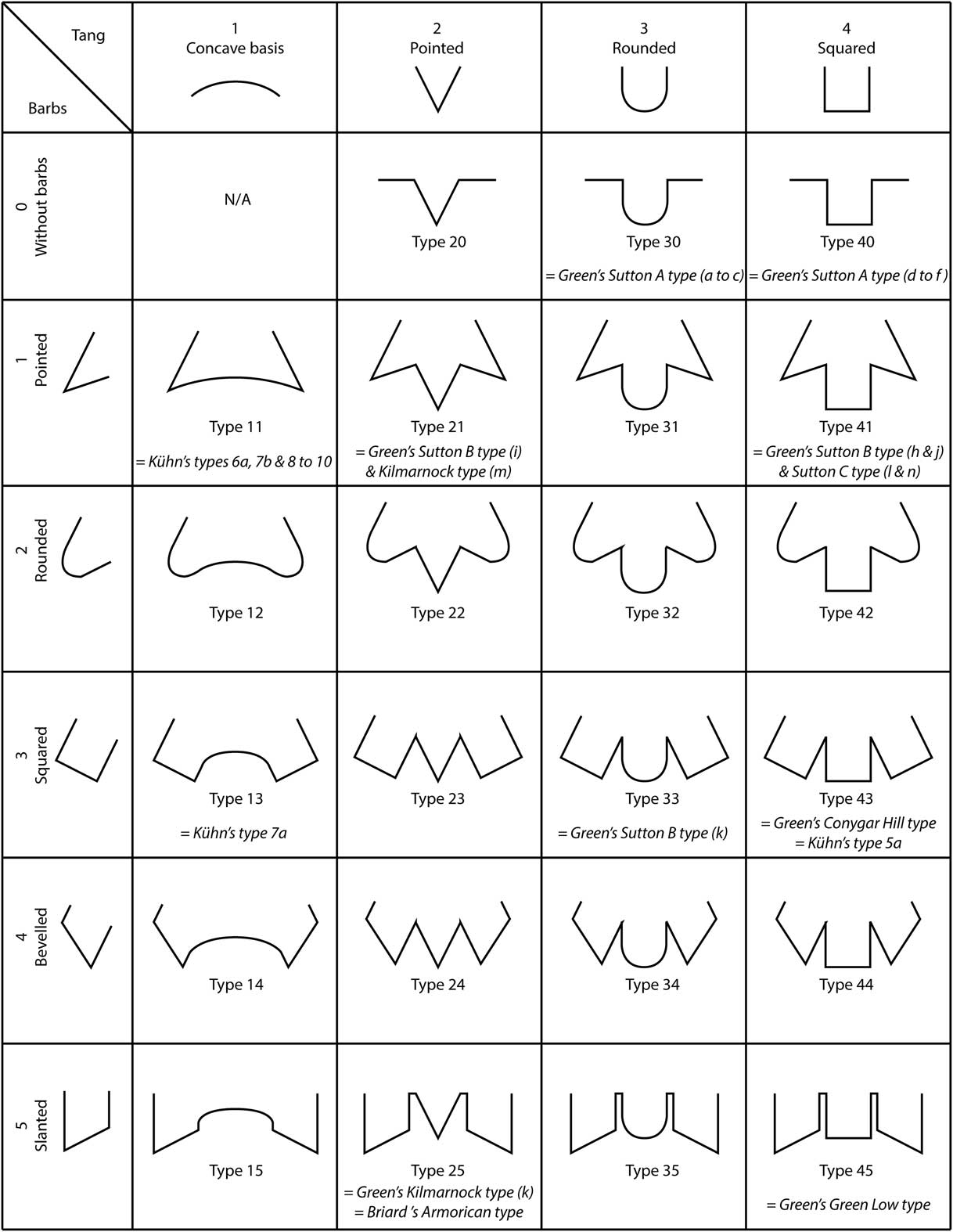
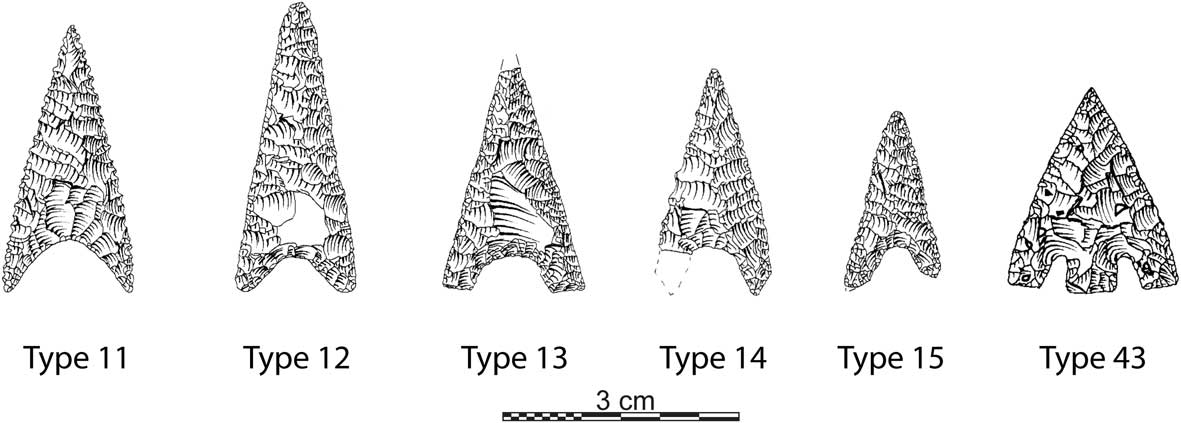
The arrowheads in this corpus are all of the piercing variety except for a single transverse arrowhead (Barrow Hills, Radley, grave 5274, UK-31). All have a concave base or a tang, the latter almost invariably associated with barbs of various lengths. A specific typology has been developed, based on the general morphology of the base (concave vs. tanged, tang shape as pointed, rounded, or squared), and of the barbs (pointed, rounded, squared, bevelled, or slanted). This typology has been established to account the diversity of arrowheads in the areas of study, with correspondence to previous typologies (Briard & Giot Reference Briard and Giot1956; Kühn Reference Kühn1979; Green Reference Green1980; Fig. 8).
Schematic representation of types of barbed-and-tanged and hollow-based arrowheads

North-west France
For north-west France, funerary arrowheads are mainly found in Brittany and follow very specific patterns. On the one hand, most of Bell Beaker arrowheads have been found in the area of Carnac (ie the coastal Morbihan department). This trend reflects both the flourishing of the Bell Beaker culture in this area (Salanova Reference Salanova2000) and the intensity of investigations carried out during the 19th century and the first half of the 20th century. On the other hand, for the Early Bronze Age, the distribution of the ‘Armorican Tumulus’ culture is limited to Lower Brittany (ie the western part of the region, corresponding to the extent of Breton speaking in the 19th century; Fig. 2). Only a few arrowheads have been found in peripheral areas (ie Normandy and the mouth of the Loire). At this time, the Carnac area seems to have been less intensively occupied and no Early Bronze Age arrowheads have been found in any grave there (Nicolas 2016b).
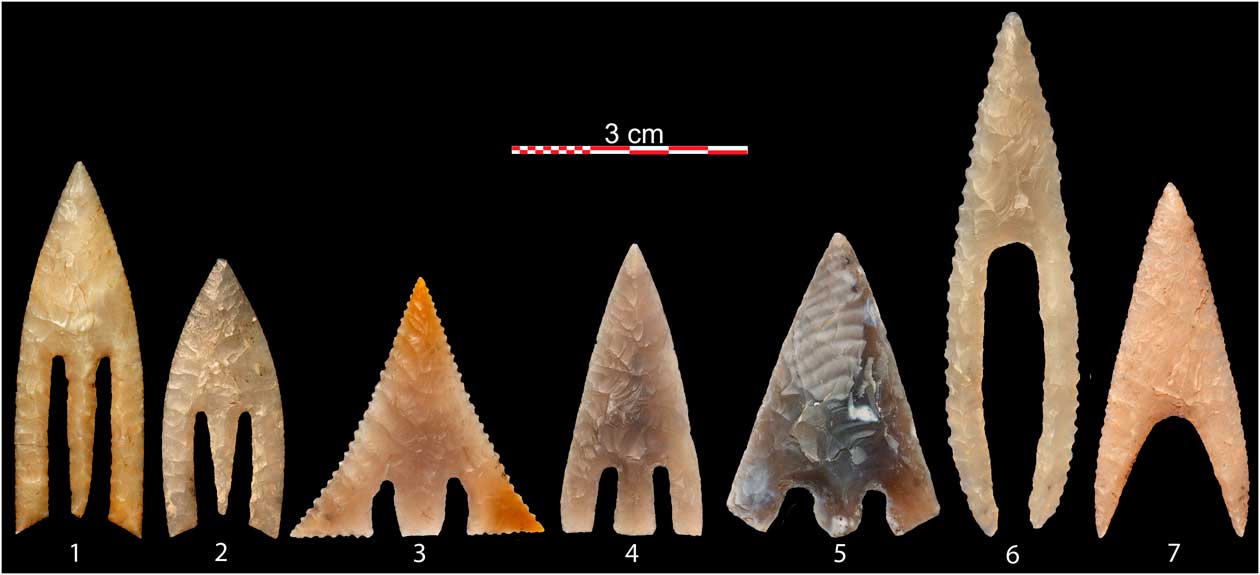
North-west France corresponds in large part to the Armorican massif, which lacks primary deposits of flint. There, arrowheads are mostly made of imported raw materials, contrary to the rest of the lithic industries which are made principally of local raw materials (Nicolas et al. Reference Nicolas, Rousseau and Donnart2015b). Bell Beaker arrowheads are mainly made from Upper Turonian flint from the Grand-Pressigny area, from probably Lower Turonian flint from the Cher valley, from possibly Santonian flint from Poitou-Charentes and from other exogenous flint of unknown origin. Local raw materials have also been used (namely Eocene sandstone, microquartzite, and sea pebble flint). Early Bronze Age ‘Armorican arrowheads’ seem to be overwhelmingly made from Lower Turonian flint from the Cher valley, especially its high quality honey-coloured and translucent variety (Fig. 9.1–2). The few exceptions have been made from Upper Turonian flint from the Grand-Pressigny area, probably Bajocian/Bathonian flint from the Anglin valley, a few other imported raw material of unknown origin, and rock crystal (Nicolas Reference Nicolas2016a; Nicolas & Guéret Reference Nicolas and Guéret2014).
Some of the most exquisite arrowheads in north-west France (1–2), southern Britain (3–5) and Denmark (6–7). 1. La Motta (FR-01). 2. Graeoc 2 (FR-39). 3. Breach Farm (UK-60). 4. Conygar Hill (UK-06). 5. Snail Down (UK-45). 6. Vust (DK-69). 7. Kjeldsminde (DK-25). (photos: C. Nicolas)

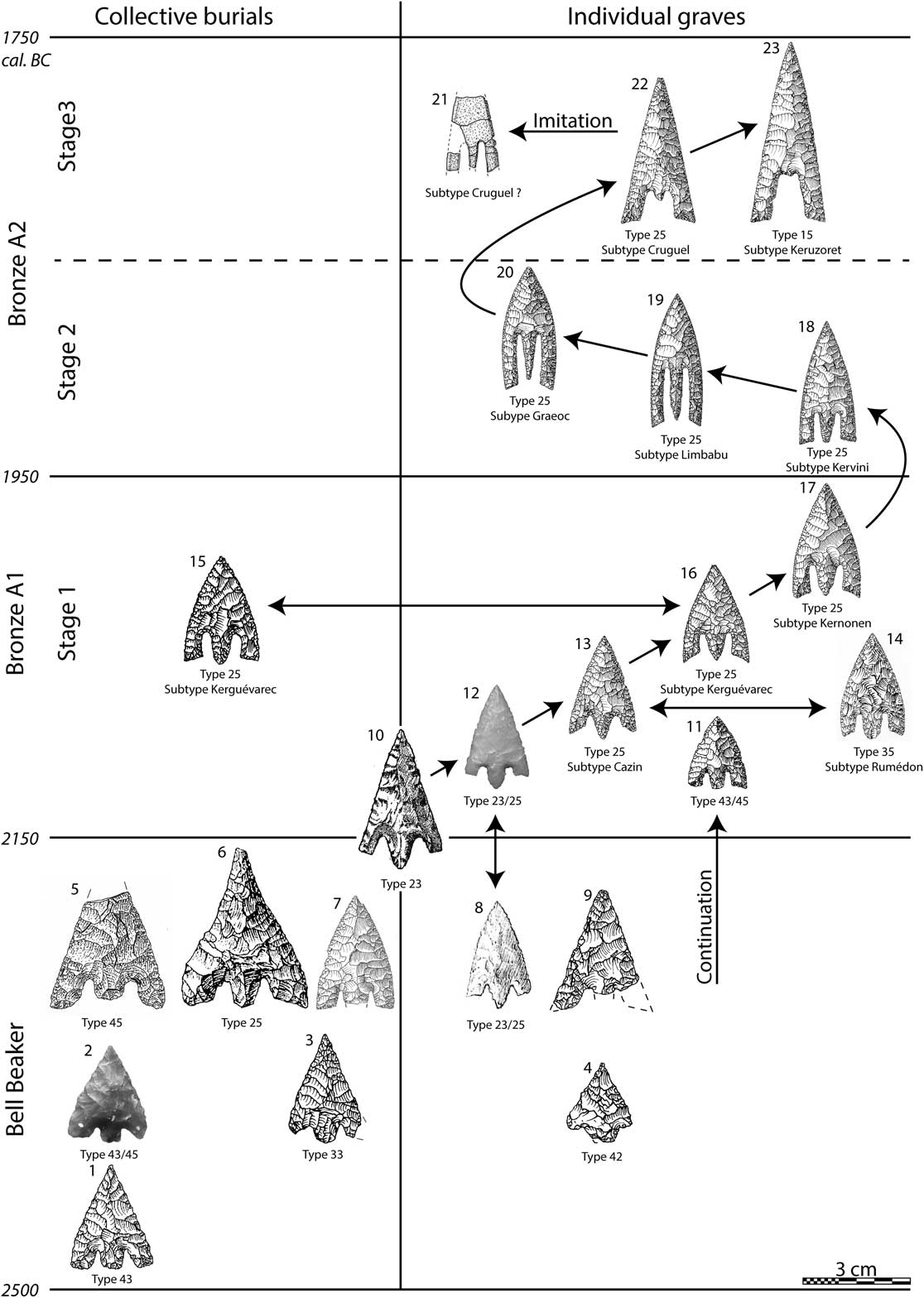
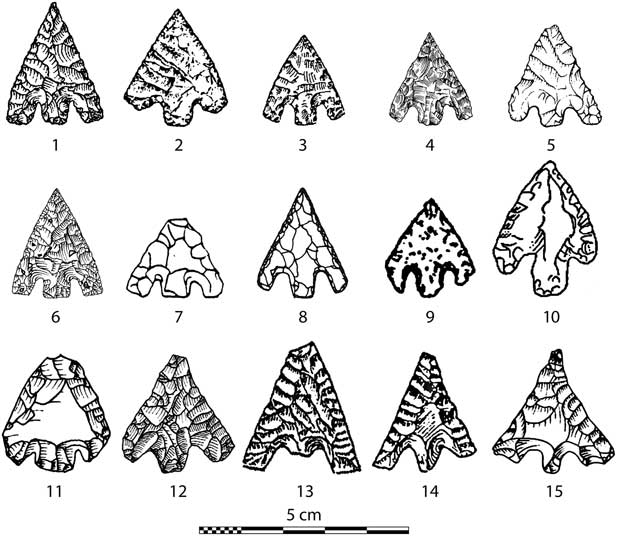
During the Bell Beaker period, arrowheads with squared barbs and tangs (type 43) predominate (Table 2). Their shape is mainly triangular or subtriangular (with slightly convex edges) and, rarely, triangular with concave edges (ie, Eiffel tower shaped) or ogival. Types with a squared tang or squared barbs (types 23, 33, 42 and 45) are rarer and seem to be variations of this main type. One arrowhead combines elements of types 43 and 45 (ie squared tang, one barb squared and the other barb slanted; Fig. 10.2). Several barbed-and-tanged arrowheads found in collective or individual burials have slanted barbs (Fig. 10.5–9). These are associated with differently-shaped arrowheads, of ogival or ace-of-spades shape with a pointed tang (Fig. 10.6–8). Their presence in individual graves dated to the Late Bell Beaker period (FR-18 & FR-34) suggests that this kind of arrowhead is an evolution of the classical Bell Beaker arrowhead with squared barbs and tang (type 43).
Interpretative scheme of the typological evolution of Bell Beaker and Early Bronze arrowheads in north-west France. 1. Kercadoret (FR-62). 2. Kernic (FR-22). 3. Kerlagat (FR-49). 4 & 9. Coatjou-Glas (FR-18). 5. Le Run (FR-40). 6. Er-Roh/Kermarker (FR-59). 7. Barnenez (FR-32). 8. Kermenhir (FR-34). 10. Lothéa (FR-37). 11 & 13. Cazin (FR-26). 12. Fao-Youen (FR-20). 14. Rumédon (FR-04). 16 & 17. Kerguévarec (FR-31). 18. Crec’h-Perros (FR-02). 19. Limbabu (FR-38). 20. Graeoc 2 (FR-39). 21. Saint-Fiacre (FR-64). 22 & 23. Keruzoret (FR-29). (1, 3–5, 7, 9, 11, 13 & 15–23: drawings C. Nicolas, 2 & 12: photos C. Nicolas, 6: after Le Rouzic Reference Le Rouzic1934, 8: after du Chatellier, departmental archives, Quimper, 10: after Bertrand Reference Bertrand1891, 14: after Briard et al. Reference Briard, Cabillic, Marguet and Onnée1982)

Inventory of types of arrowheads by place & period

BB: Bell Beaker; EBA: Early Bronze Age; Per.: Period; LN: Late Neolithic; M: Mixed type; Uns: Unspecified type; Unk: Unknown type; TP: Triangular point; T: Transverse arrowhead
Arrowheads with a pointed tang and squared barbs (type 23) are transitional between Bell Beaker and Early Bronze Age arrowheads (Fig. 10.10). They are found in Bell Beaker individual and collective graves. The Lothéa barrow (FR-37), which has yielded grave goods related to both the Bell Beaker period and the Early Bronze Age, contained three arrowheads of type 23. The ten type 23 arrowheads that have been found in north-west France borrow the squared barbs and mostly triangular shape from their Bell Beaker predecessors and prefigure the pointed tang of Early Bronze Age arrowheads (Table 2). Three arrowheads of various types have a pointed tang, one squared barb and one slanted barb (type 23/25). These have been found in one Late Beaker mound in Kermenhir (FR-34; Fig. 10.8) and in the earlier barrows of the Early Bronze Age in Fao-Youen and Kerhué-Bras (FR-20 and FR-21; Fig. 10.12).
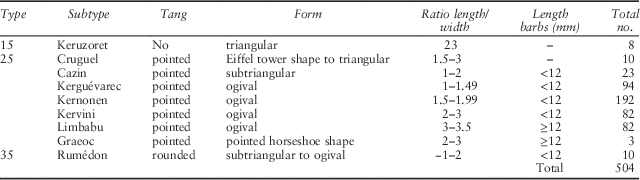
During the Early Bronze Age, the so-called ‘Armorican arrowheads’ are the rule (Briard & Giot Reference Briard and Giot1956). These comprise three main types, all with slanted barbs associated with a pointed tang (type 25), or more exceptionally a rounded tang (type 35) or a hollow base (type 15). A further nine subtypes have been defined according to the shape of the arrowhead (triangular, subtriangular, ogival, or pointed-horseshoe shape), the length/width ratio and the length of the barbs (Nicolas Reference Nicolas2016a; Nicolas & Guéret Reference Nicolas and Guéret2014; Table 3). During chronological stage 1, the short and subtriangular arrowheads (Cazin subtype) tend to develop towards short (Kerguévarec & Rumédon subtypes) or medium-length ogival forms (Kernonen subtype). During stage 2, the previous arrowheads evolve towards ogival and elongated points with short barbs (Kervini subtype) or more spectacular long barbs (up to 23 mm; Limbabu & Graeoc subtypes; Fig. 9.1–2). Arrowheads with longer barbs (the Limbabu & Graeoc subtypes) are mainly found in north-western Brittany – the old county of Léon – suggesting the existence here of a local workshop of the finest arrowheads; other local workshops could have supplied the rest of Brittany. During stage 3, the arrowheads are triangular in shape with a tang (Cruguel subtype) or alternatively a concave base (Keruzoret subtype). The subtype Keruzoret could be interpreted as the result of the loss of the tang while knapping, rather than as an intentionally hollow-based form; indeed some examples have a tiny ‘stump’ instead of a true tang (Fig. 10.23). Two triangular specimens made from sheet copper alloy may be interpreted as being imitations of flint arrowheads (Fig. 10). This loss of know-how that is expressed by the inability to knap a long tang and by making metal copies seems to mark the end of the production of Armorican arrowheads.
Description and inventory of subtypes of armorican arrowheads in north-west france

Southern Britain
Graves with arrowheads tend to concentrate in southern England, being more scattered in other parts of southern Britain (ie the south-west peninsula, Kent and East Anglia, and Wales). The greater intensity of research in the area around Stonehenge partly accounts for this pattern.
In southern Britain, arrowheads are made of Cretaceous flint, generally brown and translucent, and available locally in most cases (Barber et al. Reference Barber, Field and Topping1999; Fig. 9.4–5). When preserved, the cortex is thin and granular, suggesting procurement in chalk-decalcification clays. In Wales, where primary deposits of flint are lacking, a selection of high quality flints seems to have been used, such those used for the fine arrowheads of Breach Farm (UK-60; Fig. 9.3).
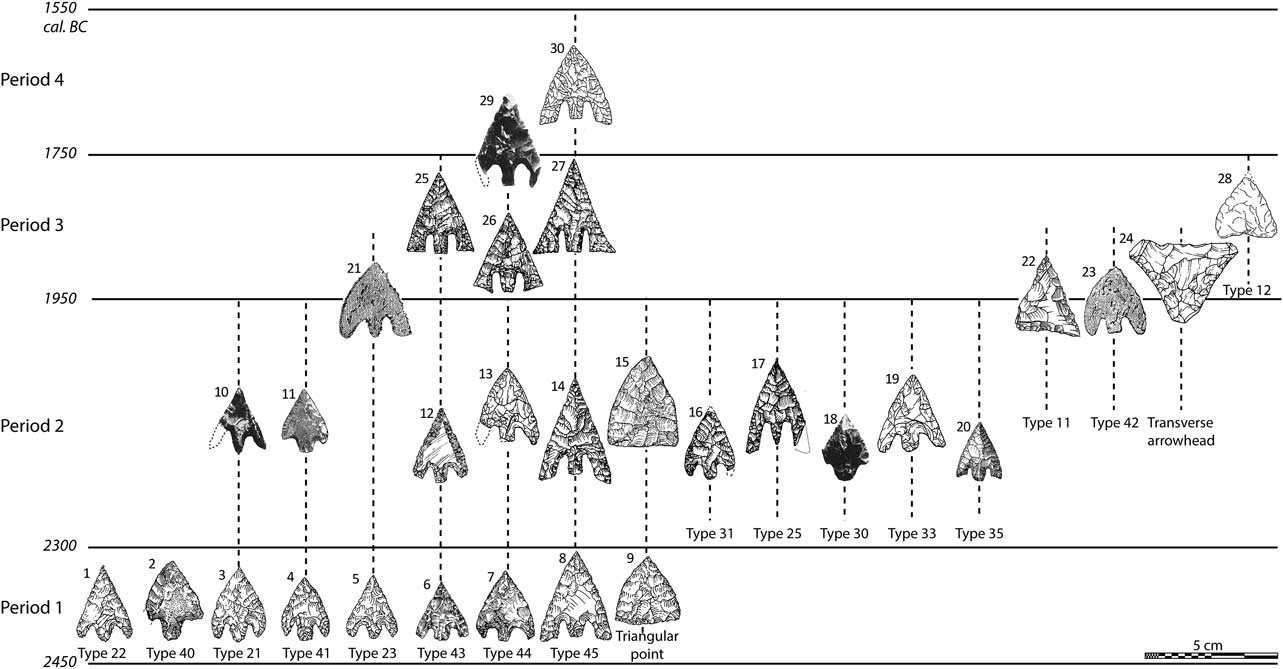
Based on Needham’s periodisation of the British Chalcolithic and Early Bronze Age (2005; Reference Needham2012), the typochronology of arrowheads in southern Britain shows two general trends (Table 2; Fig. 11). The first involves barbed-and-tanged arrowheads with a squared tang (types 43, 44, & 45), which occur in most of the periods. Within this group, there are chronological patterns: more than half of the examples with squared barbs (type 43) belong to Needham’s period 1, whereas those with slanted barbs (type 45) are more common during period 2, and those with bevelled barbs (type 44) are more frequent during period 3. Furthermore, arrowheads of period 1 are generally shorter (up to 30 mm length), with short barbs (up to 7 mm length). The second trend encompasses a wider variety of types, some of which are well dated. Examples with a pointed tang (types 21, 22, 23, & 25) and the rare bifacial triangular points mainly relate to periods 1 and 2. Those with a rounded tang (types 30, 31, 33 and 35) or with slanted barbs (types 25 and 35) are generally found in period 2. Hollow-based (types 11 and 12) and transverse arrowheads are known in periods 3 and 4; but we should bear in mind that transverse arrowheads are also known during the Neolithic (Green Reference Green1980, 111–14). Hollow-based arrowheads are scarce in Britain but they are relatively abundant in Ireland, where they are clearly of Beaker introduction and continue to be used during the Early Bronze Age (Woodman et al. Reference Woodman, Finlay and Anderson2006, 134).
Typochronology of Chalcolithic and Early Bronze arrowheads in southern Britain. 1, 3–5 & 8–9. Amesbury Archer (UK-37). 2 & 7. Stanton Harcourt (UK-34). 6. Mucking 137 (UK-11). 10 & 18. Sutton 268, Inhumation 1 (UK-62). 11. Plym Valley (UK-05). 120 Raunds, Barrow 5, F 47179 (UK-25). 13 & 19. Barrow Hills, Grave 4660 (UK-30). 14. Lambourn, Barrow 31 (UK-01). 15. Raunds, Barrow 1, F 30476 (UK=24). 16. StonehengeArcher (UK-39). 17. Nodgham (UK-17). 20. Les Fouaillages (UK-56). 21 & 23. Tring 30 (UK-16). 22. Durrington G67 (UK-46). 24. Barrow Hills, Grave 5274 (UK-31). 25–27. Breach Farm (UK-60). 28. Wanborough I (UK-49). 29. Sutton 268, Cremation C (UK-61). 30. Barrow Hills, Grave 203 (UK-28). (1, 3–5, 8 & 9: after Fitzpatrick Reference Fitzpatrick2011, 2 & 7: after Grimes Reference Grimes1944, 6: Mucking after Jones & Jones Reference Jones and Jones1975, 10, 18 & 29: after Fox Reference Fox1943, 11: after Worth Reference Worth1900, 12 & 15: after Harding & Healy Reference Harding and Healy2011, 13, 19, 24 & 30: after Barclay & Halpin Reference Barclay and Halpin1999, 14, 17, 20 & 22: drawing C. Nicolas, 21 & 23: after Anon. 1787, 25–27: after Grimes Reference Grimes1938, 28: after Smith Reference Smith1927)

Period 1 arrowheads vary but the differences between types are minor, since the barbs and tang do not always have a highly distinctive shape. However, later arrowheads are more finely shaped. During period 2, arrowheads show the greatest variability among grave goods; this increasing diversity could be related to the ‘Fission horizon’ defined by Stuart Needham (Reference Needham2005), which is characterised by enhanced diversity in pottery types and in funerary assemblages in general. Compared with arrowheads of the previous period, the examples of periods 3 and 4 are less heterogeneous but are also rarer. Only the appearance of hollow-based arrowheads during periods 2 and 3 enriches this picture somewhat, which is largely dominated by barbed-and-tanged arrowheads (Fig. 11).
Denmark
In Denmark, Late Neolithic graves with arrowheads are mainly located in northern Jutland, especially around the Limfjord and on the Djursland peninsula. This distribution corresponds closely with the regional distribution of the Bell Beaker culture and so these graves could be related to this culture, even if Beakers are only rarely found in graves (Sarauw Reference Sarauw2007a; Reference Sarauw2007b).
In Denmark, high quality flint is found in abundance in the Cretaceous chalk and Danian limestone in the northern and eastern parts of the country and in the glacial deposits that cover the whole of this area (Högberg & Olausson Reference Högberg and Olausson2007). The main varieties used for arrowheads are translucent and brown or honey-coloured (Fig. 9.6–7). Almost no vestige of cortex could be observed, which would have helped to locate the source of these flints. Arrowheads are frequently associated with flint daggers, which are made of similar flint (Apel Reference Apel2001; Sarauw Reference Sarauw2007a) although the flint had been used in a different way. The production of daggers was principally constrained by the size of the available flint nodules, and so one finds the use of variable quality flint, containing coarse inclusions of various sizes. Arrowhead production, by contrast, required only a small amount of flint and arrowheads are mostly made using the best quality nodular flint, knapped so as to avoid the main inclusions.
Only a few typical Bell Beaker arrowheads with squared barbs and a squared tang (type 43) have been found in Denmark. Four come from one grave containing the cremated remains of a child in Solbakkegård IV (DK-31), where they were associated with a flint dagger, four V-perforated amber buttons, and some flints (namely one strike-a-light, one retouched flake, three other flakes, and a pebble). The dagger corresponds to the ‘Madkniv’ type B, one of the oldest types of Danish flint dagger (Nielsen Reference Nielsen1974; Sarauw Reference Sarauw2007a), possibly a local imitation of the Grand-Pressigny dagger with a squared end (Spahn type; Delcourt-Vlaeminck Reference Delcourt-Vlaeminck2012; Nicolas Reference Nicolas2016a). This grave, along with some Maritime Bell Beakers, could belong to an early stage of Bell Beaker presence in Denmark, contemporaneous with the late Single Grave Culture (Figs 7 and 12). A fifth type 43 arrowhead was found in a cist at Juelsberg (DK-59).
Typology of Bell Beaker and Late Neolithic arrowheads in Denmark (drawing C. Nicolas)

Other funerary arrowheads are exclusively hollow-based, and mostly associated with pointed or rounded barbs although the variation in barb shape can be so slight as to make the differentiation seem quite tenuous, even arbitrary (Table 2; Fig. 12). These arrowheads are both heterogeneous and monotonous: indeed, their morphology is highly variable without specific trends being apparent. Torben Sarauw (Reference Sarauw2007a) has proposed a category of asymmetrical arrowheads, with one barb longer than the other. However, rather than being the product of a specific tradition, such pieces could have been the result of knapping accidents, like those of the Keruzoret subtype in north-west France. The hollow-based arrowheads are mainly subtriangular; rarer forms are triangular with or without curved barbs, ogival, and Eiffel tower-shaped. Some are particularly elongated (with a length/width ratio exceeding 2:5). Barbs are generally quite short (c. 5–11 mm), rarely longer (but up to 37.4 mm! Fig. 9.6).
These arrowheads are mainly associated with type I daggers (and most frequently with the exquisite parallel-flaked type IC) and occasionally with type II daggers, so they can be dated to the Late Neolithic I (Lomborg Reference Lomborg1973; Apel Reference Apel2001; Sarauw Reference Sarauw2007a). A few examples, associated with daggers of types IV or V, could belong to the Late Neolithic II. During this period, daggers were less frequently deposited in graves (Fabech Reference Fabech1986) and so it is harder to recognise Late Neolithic II arrowheads, since associated daggers constitute their main dating evidence. No chronological patterns could be observed between Late Neolithic I and II and Bronze Age hollow-based arrowheads (Ebbesen Reference Ebbesen2004, 126).
TECHNOLOGY
All of the arrowheads in this study had been knapped by bifacial reduction from various flakes, namely flakes of plein débitage, cortical flakes and occasionally Kombewa flakes or older patinated flakes. Arrowhead blanks were worked in several ways (according to the orientation of the axis of débitage) and give the appearance of having been a selection of flakes of the appropriate size, constituting non-standardised débitage. A similar phenomenon has been noted by R. Furestier (Reference Furestier2007) in his study of Bell Beaker lithic industries in south-eastern France. For Denmark, Jan Apel (Reference Apel2001, 221) has suggested that flakes resulting from the production of large bifacial artefacts such as daggers could have formed regular blanks fit for knapping arrowheads.
Several graves with arrowheads from southern Britain (Wellington Quarry, UK-15; Aldwincle, barrow 1, UK-22; Raunds, barrow 1, F 30426, UK-24; Amesbury Archer, UK-37; Breach Farm, UK-60) and southern Jutland (Vorbasse 20a, DK-34; Slavgård, barrow 13, DK-35; Ål, DK-36) have yielded some bifacial pieces, or just roughed out flakes, which could correspond to preforms of arrowheads. Around ten have been found in one grave (Fig. 13). These reflect several stages in the manufacture process, according to the progress of knapping:
-
∙ slightly roughed-out blank with short and semi-abrupt retouch, often abraded (only observed in Denmark). This kind of ‘bevelling’ of the edge could have been done to reinforce the edges before flaking (Fig. 13.6–10);
-
∙ preform flaked by direct percussion or pressure-flaking; such preforms are generally ogival in order to leave sufficient margins for pressure-flaking (Fig. 13.2–5);
-
∙ pressure-flaked preform, which has the final form before the barbs and tang or concave base have been knapped (Fig. 13.1).
Grave goods from the Late Neolithic I grave of Ål (Vester Horne, Ribe; DK-36), probably illustrating the different stages of arrowhead production. 1. Pressure-flaked preform with final shape (stage 3). 2–5. Ogival preform flaked by direct percussion or pressure (stage 2). 6–10. Slightly roughed-out blank (stage 1). 11. Associated flint dagger (type I-A/B) (drawings C. Nicolas)

The fact that preforms in various stages of production have been deposited in graves suggests that they were knapped in different times and/or places. This segmentation of the chaîne-opératoire is attested elsewhere, in south-east France, for making Bell Beaker arrowheads (Furestier Reference Furestier2007) and in Denmark for dagger production (Apel Reference Apel2001).
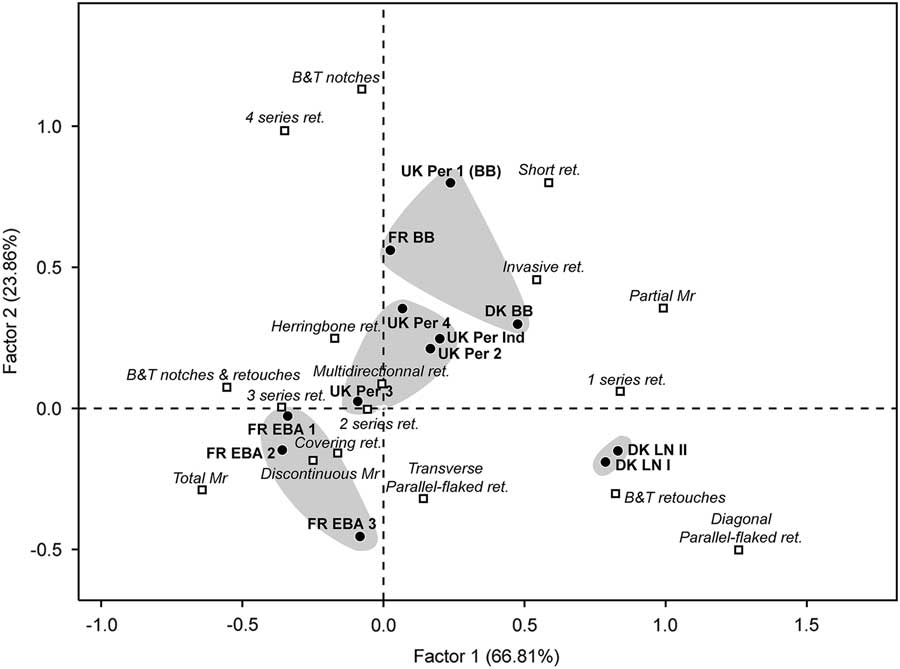
The extent and combination of retouch, the number of series of retouch (successions of several removals), and the ‘microretouch’ of edges (ie retouch under 2 mm in length, to finish the shape), vary chronologically and geographically and show a continual evolution towards a refinement of the knapping process, with increasingly extensive retouch across the surfaces. Furthermore, several methods are used for knapping the barbs and tang or the hollow base: notching, retouch, or a combination of the two techniques. Finishing is achieved by means of a microretouch (<2 mm length), which shapes the edges partially (<50%), discontinuously (50–80%) or totally (>80%). Factorial correspondence analysis allows us to see certain trends, revealing different technical customs (Fig. 14). Regionally-distinctive styles of arrowhead could be observed for each region during the Early Bronze Age (in southern Britain and north-west France) and the Late Neolithic (in Denmark), but Bell Beaker arrowheads show more cross-regional similarity. Some technical characteristics are ubiquitous, such as the use of covering, transverse parallel-flaked retouch, of multidirectional or herringbone retouch, of one, two or three series of retouch and of discontinuous microretouch of the edges. Other technical characteristics are more specific (without being exclusive or dominant):
-
∙ Bell Beaker arrowheads: short or invasive retouch, barbs and tang knapped by notching, partial ‘microretouch’;
-
∙ Danish Late Neolithic arrowheads: barbs knapped by retouch (linked with the knapping of a concave base), diagonal parallel-flaked retouch (which occurs occasionally but may be linked with similar retouch on daggers);
-
∙ southern British Early Bronze Age arrowheads: herringbone retouch;
-
∙ north-west French Early Bronze Age: total ‘microretouch’ (demonstrating great care in the finishing of arrowheads).
Factorial correspondence analysis of methods of retouch according to time and place. Abbreviations: BB: Bell Beaker. EBA: Early Bronze Age. LN: Late Neolithic. Per: Period. B&T: Barbed-and-tanged. Ret.: Retouch. Mr.: Microretouch

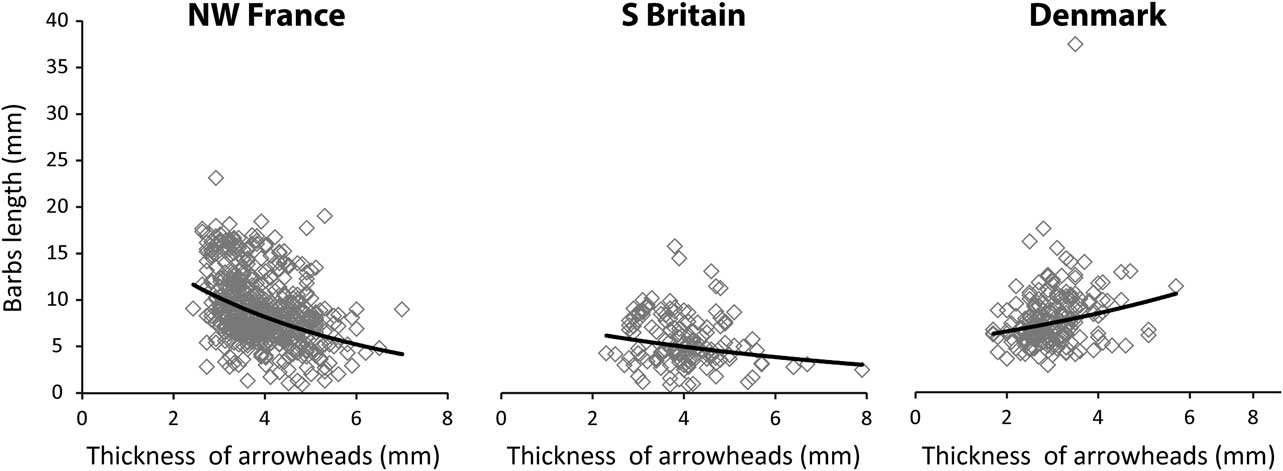
Knapping the barbs and tang is certainly the most crucial stage in making arrowheads. It involves effecting two simultaneous breaks in the flint so as to avoid weakening the piece. Each removal requires the use of controlled pressure, sufficient for flaking but directed to avoid plunging. The longer the barbs and tang, the greater is the risk of breaking them in an unfortunate movement. Moreover, the knapping of long barbs and tang requires skilful shaping, using performs that are both elongated and thin. In north-west France and, to a lesser extent, in southern Britain, the longer the barbs, the thinner the arrowheads (Fig. 15). The advantage of using a thin preform is obvious: the knapper has less thickness to remove with less pressure, and therefore the preform is more manageable and less likely to break. Incidentally, it is no coincidence that all of the knapping accidents (n=21) that we have observed are plunging removals located on the barbs and tang (excluding more ubiquitous breaks). One can also argue that other knapping accidents (plunging or hinged removals while shaping, the ‘Siret’ accidental break) were either minor and easily fixed or else too extensive, resulting in the abandonment of the preform. In contrast to the north-west French and southern British arrowheads, Danish arrowheads do not display any similar pattern: here, the longer the barbs, thicker the arrowhead (Fig. 15). Indeed, for making hollow-based arrowheads, the knapper was less constrained and had more free space to retouch the barbs.
Diagrams of barb length and thickness on arrowheads found in north-west France, southern Britain, & Denmark

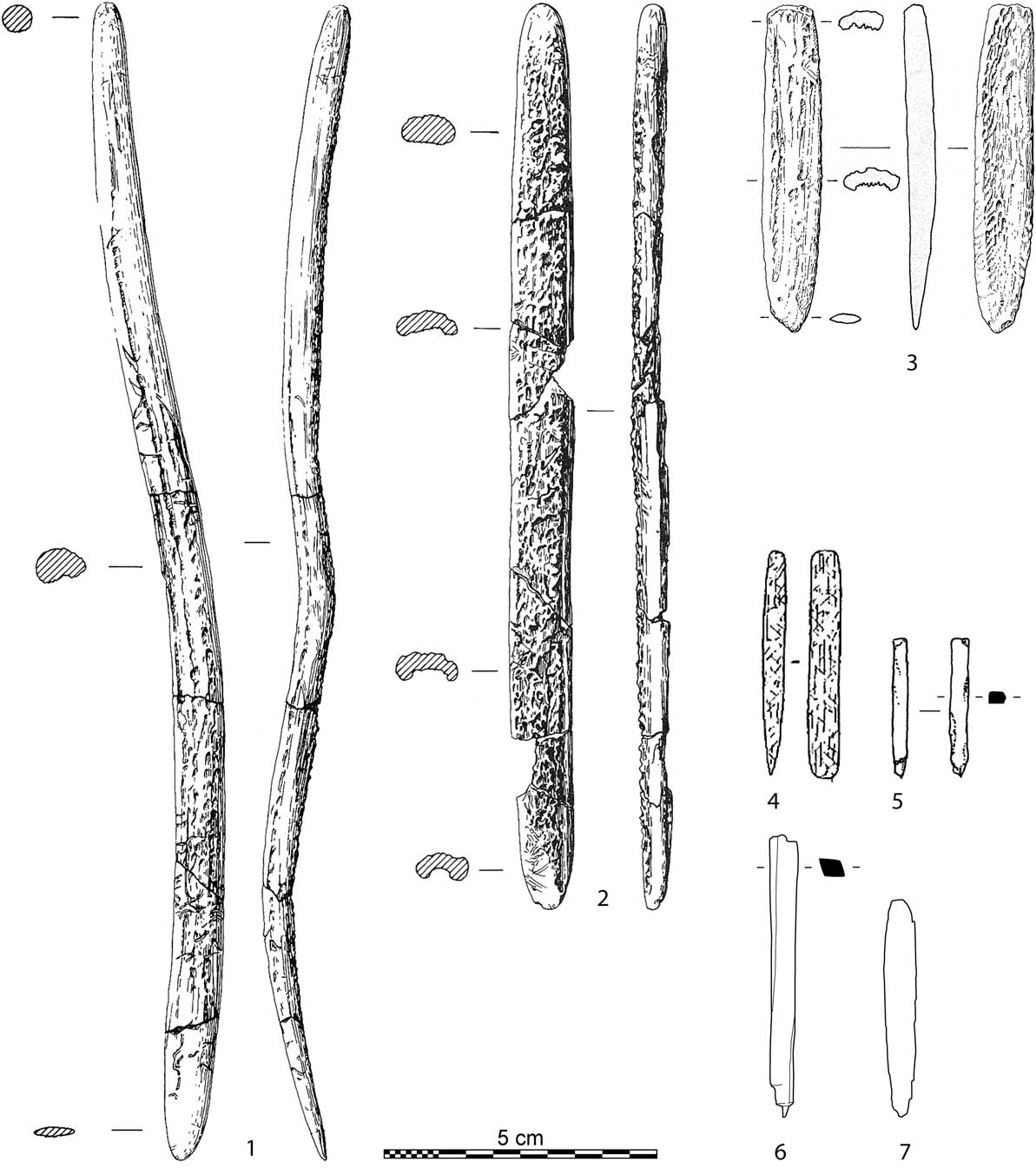
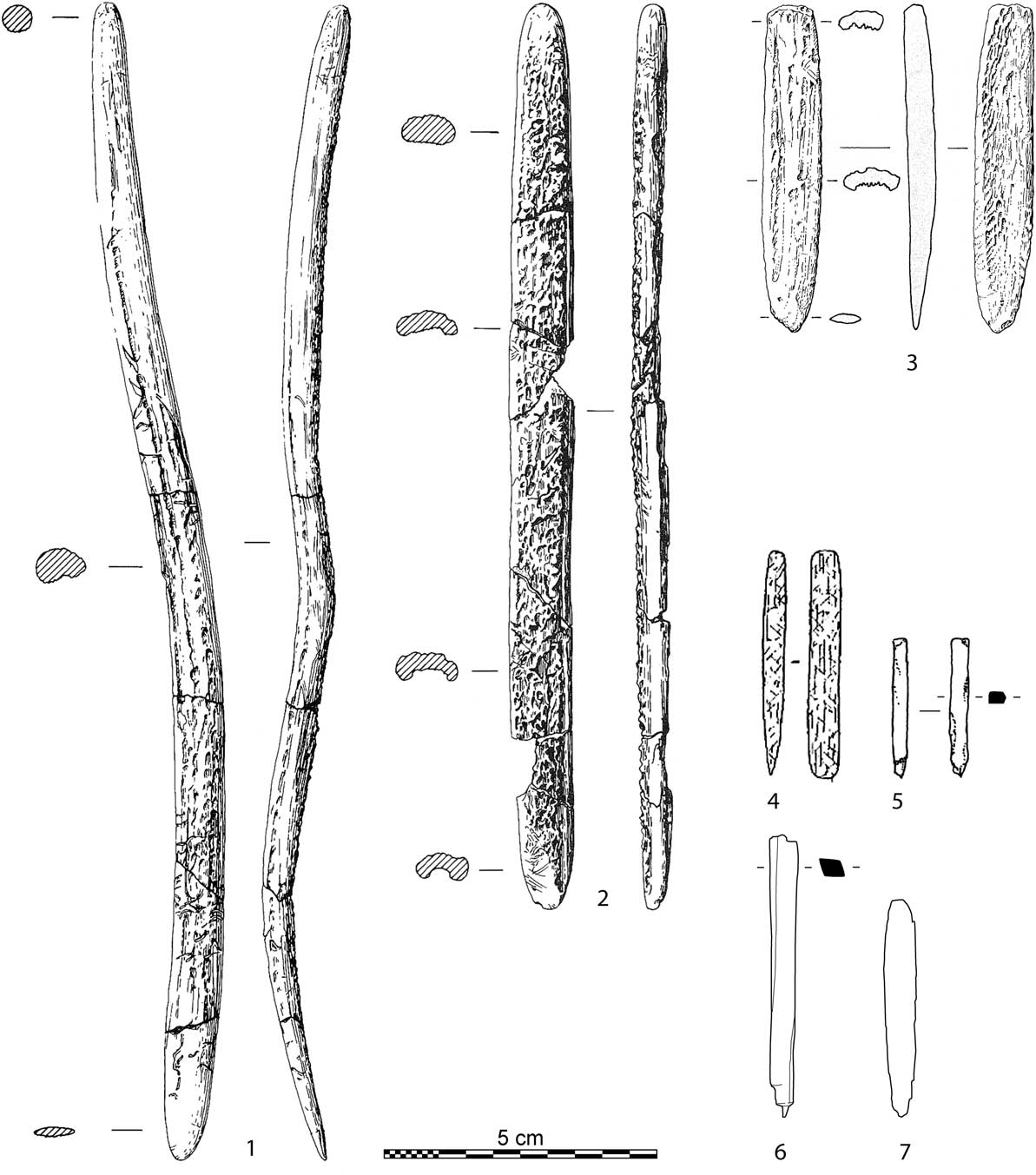
Regarding knapping tools, the scale-retouch seen on preforms and on some finished arrowheads will probably have involved the use of soft hammers for the first stage of manufacture. For pressure flaking, both animal bone or antler tools and copper awls could have been used. In Britain, several antler tools known as ‘spatulae’ that have been found associated with arrowheads could have been used as pressure-flakers, especially for knapping the barbs and tang (Olsen Reference Olsen1989) even if other, more debatable uses have also been proposed (Barclay & Halpin Reference Barclay and Halpin1999, 236). These ‘spatulae’ are found elsewhere in Europe in Bell Beaker contexts, mostly associated with arrowheads (Matthias Reference Matthias1964; Kamieńska & Kulczycka-Leciejewiczowa Reference Kamieńska and Kulczycka-Leciejewiczowa1970; Turek Reference Turek2004). The shorter ‘spatulae’, like the one from the Amesbury Archer grave (UK-37; Fig. 16.3), are closely similar to the pressure-flaker tool, its function demonstrated by use-wear analysis, that is known from Late Neolithic contexts around the Alps (Maigrot Reference Maigrot2003, 200). However, the utility of larger ‘spatulae’ (c. 22–34 cm in length) is more questionable and experimentation is needed to explore their feasibility as knapping tools (Fig. 16.1–2). It is clear that copper awls had been used, as well as those of bone or antler. On north-west French and southern British Early Bronze Age and Danish Late Neolithic arrowheads, the presence of tiny pressure points less than 1 mm in size points towards the very probable use of copper awls (Jacques Pelegrin, pers. comm.). On a few Armorican arrowheads, greyish-green traces attest to their use (Nicolas & Guéret Reference Nicolas and Guéret2014). Furthermore, a few copper awls have been found in graves containing Bell Beaker arrowheads in north-west France (Fig. 16.4–7) and also in Scotland (Henshall & McInnes Reference Henshall and McInnes1968). One hafted example of a copper awl has been found in Savoy in a grave dated to the late 4th millennium bc associated with, among other items, 34 flint arrowheads and two flint daggers (Rey et al. Reference Rey, Perrin, Bressy and Linton2010). However, the bronze awls that have been found in British Early Bronze Age burials can hardly be related to the manufacture of arrowheads. They are generally quite long and very thin, and in the few cases where their delicate handle made of bone or wood has survived, this appears to be too fine to be suitable for knapping (see Hoare Reference Hoare1812, pl. xv; Annable & Simpson Reference Annable and Simpson1964; Barclay & Halpin Reference Barclay and Halpin1999, 138). Rarely found with arrowheads (Longworth Reference Longworth1984, 59–60), and usually associated with females (Woodward & Hunter Reference Woodward and Hunter2015), these bronze awls seem more likely to have been used as piercers (Needham Reference Needham1999, 192). However, a thicker copper alloy awl has been found together with eight barbed-and-tanged arrowheads, a sandstone tool (hand abrader or whetstone?), flint tools, and flakes in pit 1770 of Kingsmead Quarry, Horton, Berkshire (not listed in Appendix S1, as not demonstrably a funerary site; Wessex Archaeology 2009, 16). These artefacts, datable to the Early Bronze Age, could correspond to a tool kit of an arrow maker. Experiments carried out by Frédéric Leconte, an amateur knapper, are in agreement with these observations and suggest the use of harder bronze awls for knapping the longer barbs of the Armorican arrowheads (Nicolas Reference Nicolas2016a). It is quite certain that the long barbs and tang could not have been knapped without the use of metal tools. More generally, the development of barbed-and-tanged arrowheads in Western Europe seems to be linked with the use of copper, which facilitated their production (Nicolas & Vaquer Reference Nicolas and Vaquer2015).
Examples of probable tools used for retouching arrowheads. 1–3. Antler spatulae from England (scale 1:2). 4–7. copper alloy awls from Brittany. 1–2. Easton Lane (UK-13). 3. Amesbury Archer. 4. La Pierre-Levée (FR-76). 5. Tumulus de la Motte (FR-43). 6. Goërem (FR-56). 7. La Pierre-Couvretière (FR-41). (1–2: after Fasham et al. Reference Fasham, Farwell and Whinney1989, 3: after Fitzpatrick Reference Fitzpatrick2011, 4: after Joussaume Reference Joussaume1976, 5: drawing C. Nicolas, 6: after L’Helgouac’h Reference L’Helgouac’h1970, 7: after L’Helgouac’h Reference L’Helgouac’h1975)
HAFTED AND SOMETIMES DEADLY ARROWHEADS
Most arrowheads found in graves were once hafted, as attested by the presence of apparent adhesive residue when preservation conditions are optimal. Black–brown remains have been observed quite frequently where the soil is acid. In Brittany, Early Bronze Age cists that are well sealed and covered by a large cairn or barrow have undoubtedly favoured the preservation of adhesives and of organic material in general (eg, wood from the grave chamber and from grave goods and animal skin from dagger sheaths). In these contexts, some 45% of arrowheads show the supposed remains of adhesive. (In contrast, no such case has been documented for Bell Beaker arrowheads). In Denmark, 13% of arrowheads have traces of what had probably been adhesive. In the chalky soils of southern England no arrowhead has produced such traces, except at Lambourn, barrow 31 (UK-01), but a few possible examples have been noted in two graves in Wales (Breach Farm, UK-60; Gray Hill, UK-63).
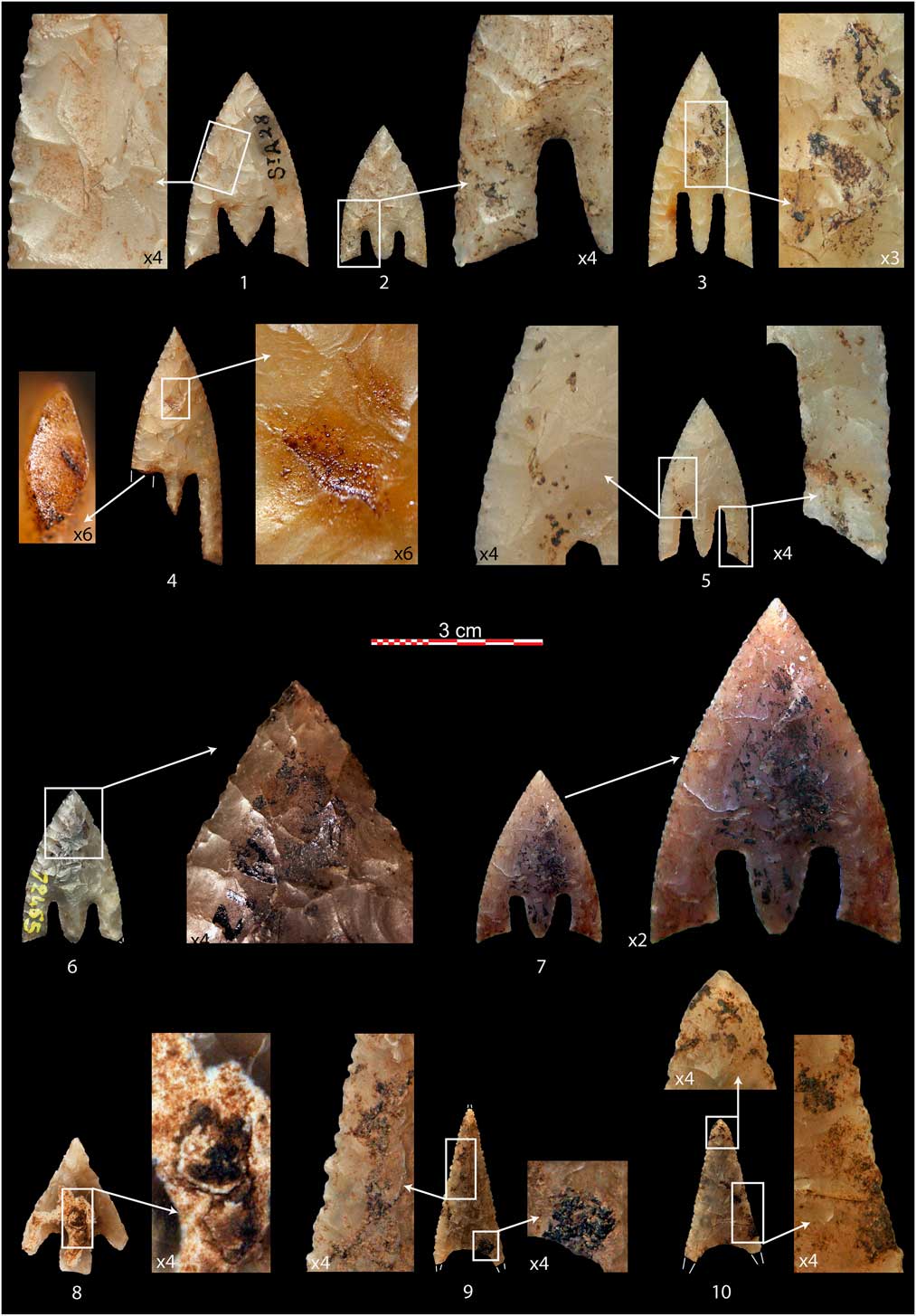
The best-preserved traces of adhesive are those of the Armorican arrowheads. During some ancient and more recent excavations, several archaeologists observed the survival of shafts, glue, and binding threads (for example Le Pontois Reference Le Pontois1890). The remains of the shaft bindings have disappeared since the arrows were excavated but the traces of glue have been better preserved. These are visible to the naked eye in the form of brown–black deposits, sometimes associated with a brown film, and can be identified as traces of glue, according to their appearance and distribution (Fig. 17). The surface appearance of these brown-black deposits is generally matte and sometimes greasy (Fig. 17.3). In most cases, this brown–black matter can be observed only sporadically on the surface of the arrowheads. Often, it is well-preserved in small cavities such as those left by hinge fractures (Fig. 17.3). Preliminary analyses using infrared spectroscopy carried out by Maxime Rageot (University of Nizza Sophia Antipolis) has confirmed that the brown–black matter attached to the three arrowheads found in the burial of Prat-ar-Simon-Pella (FR-15) is indeed the remains of glue. The chemical signature matches that of plant tar or resin, perhaps of birch tar (Martine Regert, pers. comm).
Macroscopic remains of glue on arrowheads. 1. Brun-Bras (FR-07). 2 & 4. Rumédon (FR-04). 3. Graeoc 2 (FR-39). 5. Unknown origin, France (Kerhué-Bras, FR-21 ?). 6. Gray Hill (UK-63). 7–8. Vester Egebjerg (DK-38). (1–4 & 6–8: photos C. Nicolas, 7: photo Y. Pailler)
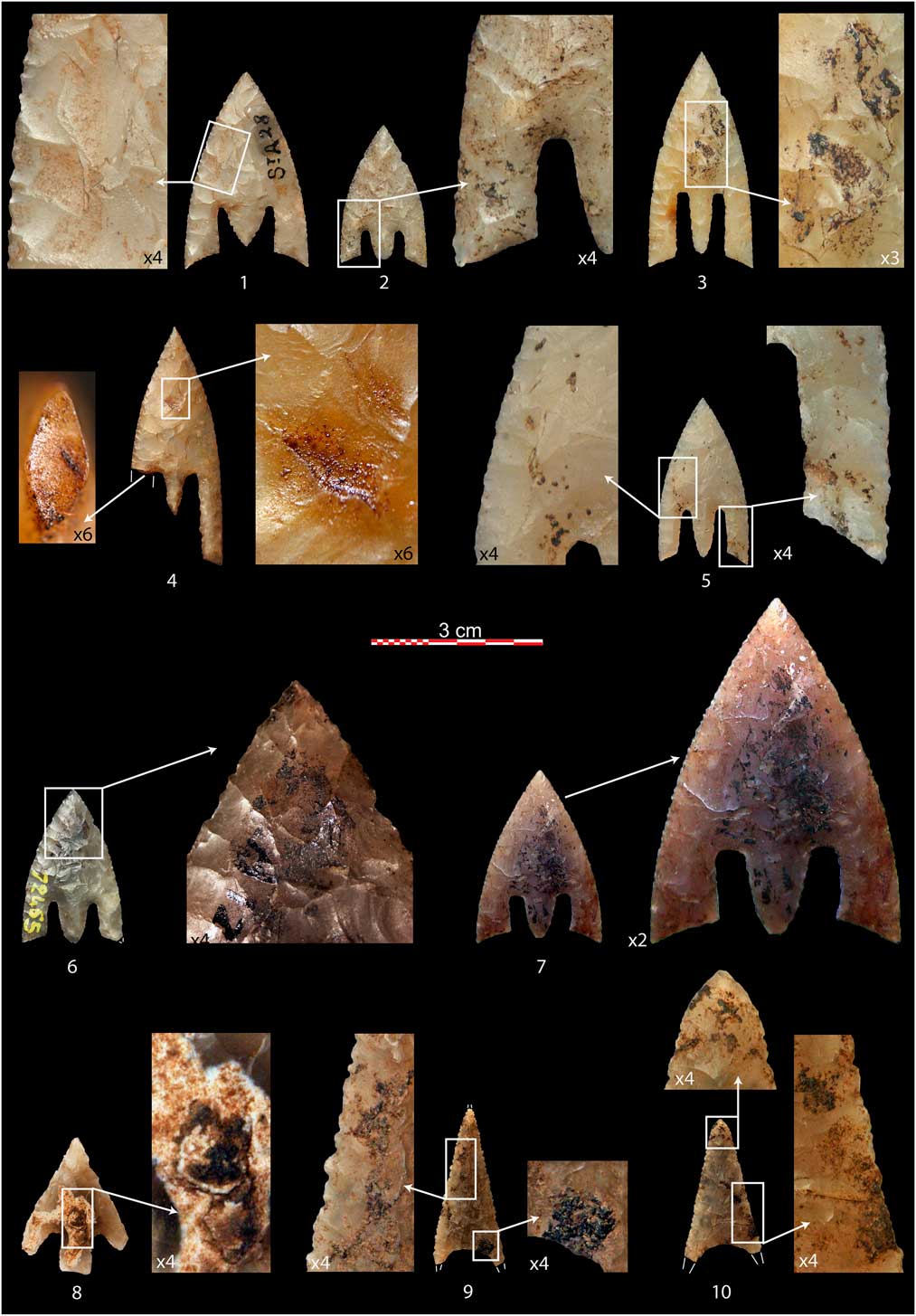
In some cases, the brown–black matter covers not only the barbs (Fig. 17.2) but also the entire surface of the arrowhead: the remnants of glue are present close to or on the edges of the arrowheads (Fig. 17.1–2) and sometimes even close to the tip (Fig. 17. 4–5). Traces of glue are occasionally located in the centre of the arrowhead (Fig. 17.4–5) or on a break (Fig. 17.4), the latter suggesting that the break existed prior to the hafting of the arrowhead. A few arrowheads from Denmark and Wales show a similar pattern of extensive adhesive coverage (Fig. 17.6–8). Several examples can also be cited of hollow-based arrowheads of Bell Beaker or Early/Middle Bronze Age date in Central Europe, Denmark and Netherland that have glue covering the entire surface except for a strip 2–3 mm wide at the cutting edge (for example Pernička Reference Pernička1961; Butler Reference Butler1990). With this kind of hafting, the long barbs of the Armorican arrowheads would have become totally invisible. Under the microscope remnants of glue can be recognised on these arrowheads as thin crackled deposits or as small pellets on the surface. On one such deposit it was possible to observe linear and parallel marks possibly left by a non-braided binding thread (Nicolas Reference Nicolas2016a; Nicolas & Guéret Reference Nicolas and Guéret2014).
In Brittany and Denmark, parts of the arrowheads have blunt edges. This is rarely visible with a naked eye but can be felt with one’s fingertip. These blunt edges are mainly located on the barbs, but sometimes extend up to half way along the sides and are exceptionally found on the tip. This blunt-edged characteristic was observed in the present study on many of the of French Bell Beaker arrowheads (37.2%) and on a quarter of Danish Late Neolithic arrowheads (26.7%), while Southern British finds it was noted on just on two arrowheads, from the Amesbury Archer grave (UK-37; Nicolas Reference Nicolas2016a). Blunted barbs have also been noticed occasionally on some Dutch Bell Beaker arrowheads (van Gijn Reference Gijn2010). It is not possible to determine, from macroscopic inspection alone, whether this blunting results from hafting use-wear or from deliberate abrasion. The latter could have served several functions, including preventing the bowstring from being cut as the arrow was shot and facilitating the withdrawal of the arrowhead from the prey (Gassin Reference Gassin1996, 117–18).
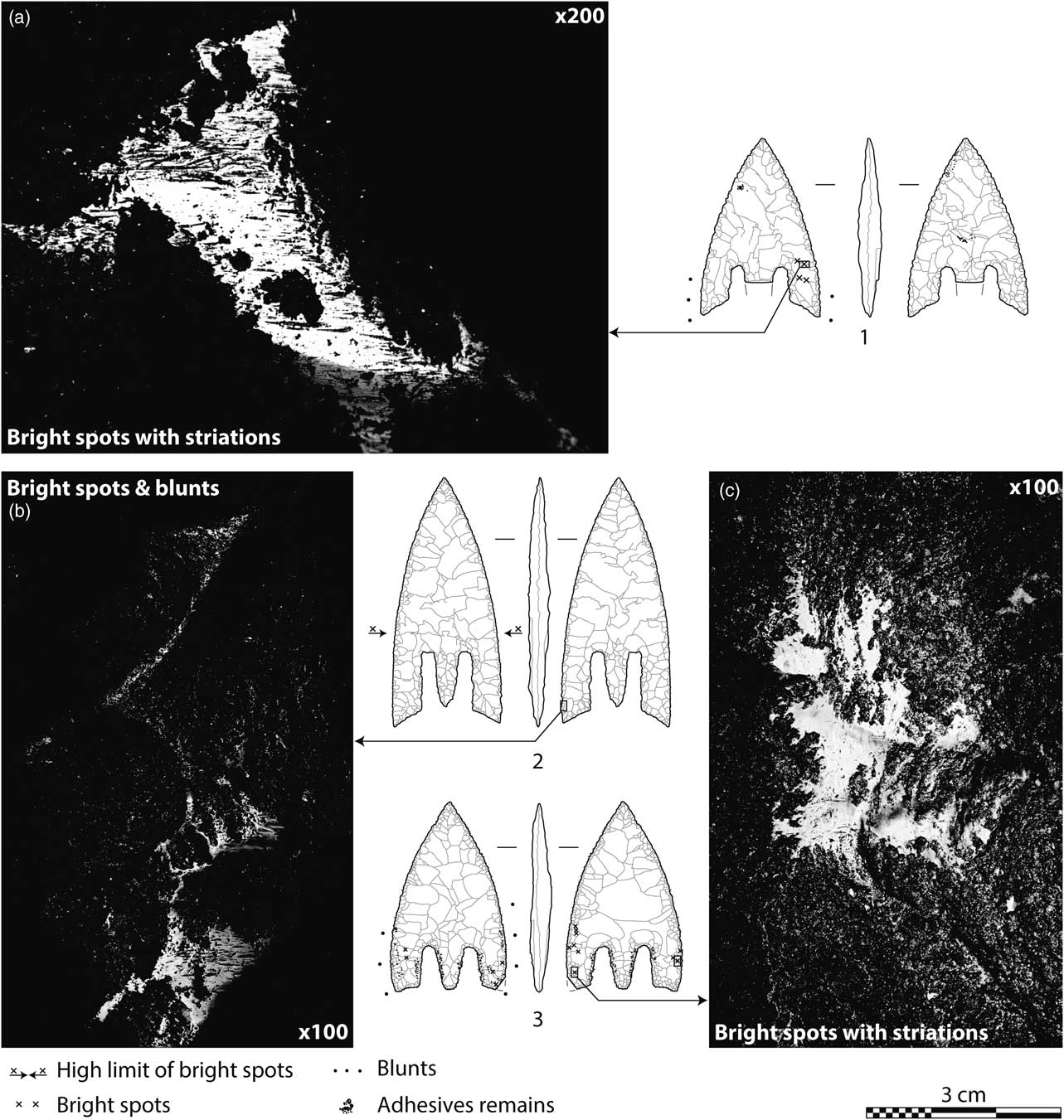
Use-wear analysis has been carried out with Colas Guéret (University of Paris 1) on recently excavated Armorican arrowheads. (For further details, see Nicolas Reference Nicolas2016a; Nicolas & Guéret Reference Nicolas and Guéret2014). This study has shown that these blunt areas are not only located on the edges but also on the arris of the flake scars where they are associated with bright spots (Fig. 18B), which are sometimes even visible to the naked eye. These bright spots are generally located on the barbs and, on rare occasions, extend over the half of the arrowhead. They often have short and wide striations, the latter being parallel and at right-angles to the arrowheads’ long axis (Fig. 18). To judge from their distribution, these blunt and bright spots result most probably from transversal and repeated movements of the arrowhead in its haft. Equally, with regard to the blunt areas, the absence of a clear orientation, their ‘smoothness’ and their location indicate that they developed progressively, and this would seem to be linked to the binding threads that helped to secure the arrowhead in position. This would imply quite a loose hafting which enabled the piece to move in a sideways manner (to judge from the direction of the striations). It should therefore be concluded that, from a practical point of view, the hafting of these Armorican arrowheads was of poor quality and not destined to ensure efficient shots. The hafting of the Armorican arrowheads thus seems to be symbolic rather than functional and it lasted long enough to produce bright spots and blunt areas. Moreover, this pattern of use-wear, coupled with the presence of glue traces, suggest that, once hafted, the long barbs of the Armorican arrowheads were probably not visible.
Bright spots and blunt areas on Armorican arrowheads. 1. Brun-Bras (FR-07). 2. Prat-ar-Simon-Pella (FR-15). 3. Crec’h-Perros-Guirec (FR-02) (drawings C. Nicolas, a: photo C. Nicolas, b–c: photos C. Guéret)

A few of the arrowheads studied have diagnostic impact fractures, corresponding to step- or hinge-terminating bending fractures (>2 mm) or spin-off fractures. (For a detailed description of fracture types, see Fischer et al. Reference Fischer, Vemming Hansen and Rasmussen1984; Gassin Reference Gassin1996). Two such fractures have been found on French Bell Beaker arrowheads (Mané-Roh-en-Tallec, FR-52; Luffang, FR-54), four on British Early Bronze Age arrowheads (Barrow Hills, grave 203, UK-28; Stonehenge Archer, UK-39; Sarn-y-bryn-caled, UK-66), and two on Danish Late Neolithic arrowheads (Østbirk, grave 4, DK-56; Hvinningdal III, grave B, DK-80). The absence of such fractures on Armorican arrowheads (except for undiagnostic features, such as tiny step- or hinge-terminating bending fractures or burination of the tip) is particularity significant given the large number of arrowheads in question (778) and this supports the hypothesis that they had been non-functional display items.
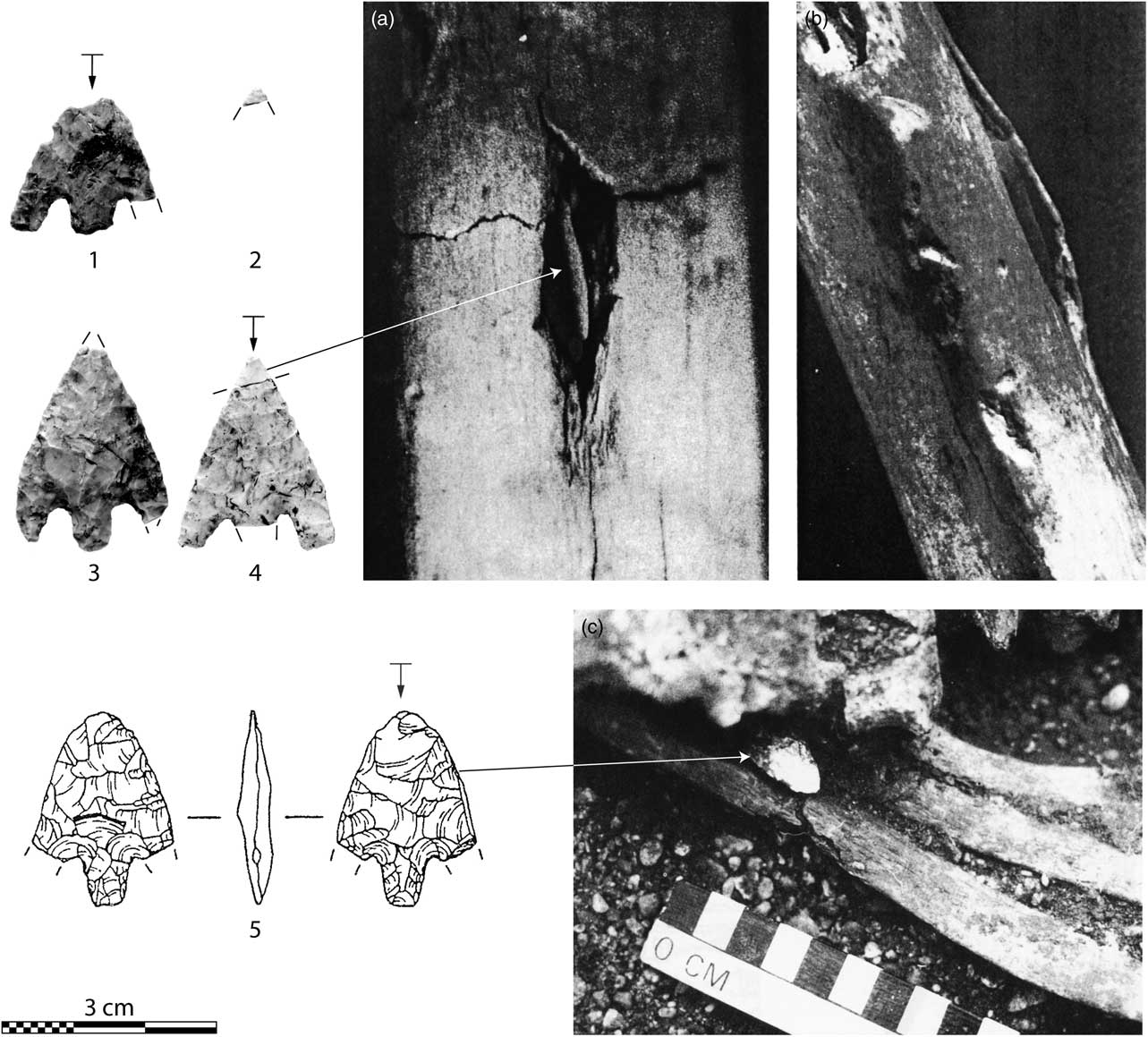
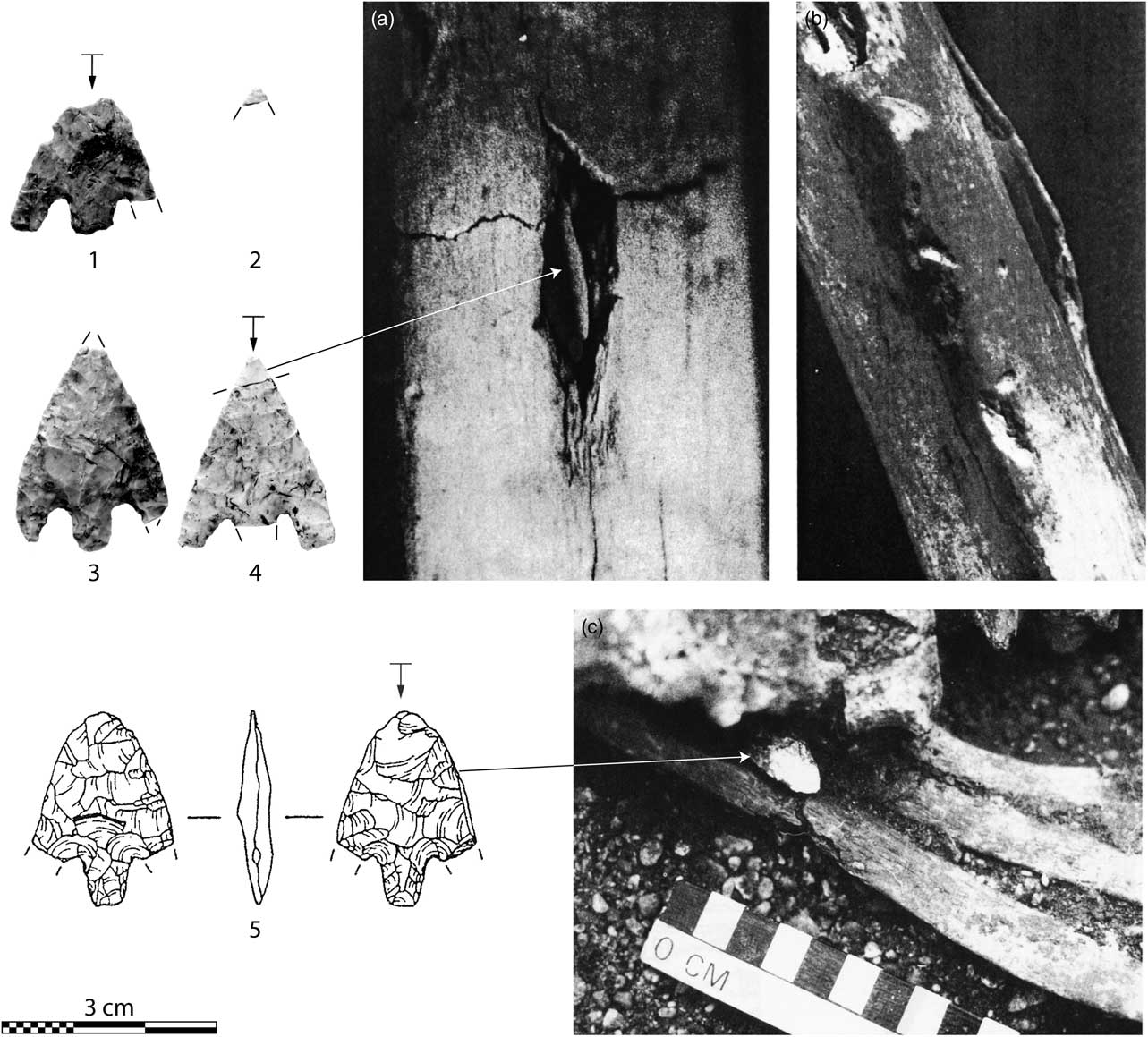
Where skeletons are preserved, as in southern England, it is clear that some arrowheads (impacted or not) had definitely been used to deadly effect. In grave 203 in Barrow Hills, Radley (UK-28), one arrowhead with a clear impact fracture and two broken barbs was located between the vertebrae and ribs (Fig. 19.5). In the ditch of Stonehenge, the so-called ‘Stonehenge Archer’ was found with four arrowheads between his pelvis and chest, of which one has an impacted fracture and two have snap fractures – the tip of one of them found stuck into one rib. The fourth is represented by only a tiny tip (Fig. 19.1–4). Three further ribs have cut-marks, probably made by arrows shot at short range (Evans et al. Reference Evans, Atkinson, O’Connor and Green1984). These four deadly arrowheads attest to a brutal killing: the ‘Stonehenge Archer’ was indeed on the wrong side of the bow. Indeed, the findspot context (in the ditch and close to the entrance of Stonehenge) hints that this might even have been a sacrificial killing. The specific position in which the body was lying, largely on its back, is not typical for Bell Beaker burial practices (Case Reference Case2004a). This exceptional case evokes the concept of ‘overkill’, a practice known ethnographically, whereby the use of violence over and above that required to kill a person was carried out in order to achieve the honour and prestige of shooting an enemy, display hatred, and enraging the survivors (Keeley Reference Keeley1996; Smith & Brickley Reference Smith and Brickley2009, 111). A similar scenario (involving a sacrificial victim) has been proposed for cremated remains found in the middle of the Sarn-y-bryn-caled timber circle (UK-66). Finally, a possibly deadly arrowhead, albeit lacking any impact fracture, has been recovered in the skull of the aforementioned adult female at QEQM Hospital, Margate (UK-21).
Deadly arrowheads. The arrowheads of the Stonehenge Archer (UK-39) all have breaks on the tip, of which (1) is a spin-off fracture diagnostic of impact, (2) is a fragment of tip and (3–4) have breaks at the tip. The tip of the fourth one was found in a rib of the individual (a–b). In grave 203 of Barrow Hills, Radley (UK-28), one arrowhead with a bending fracture diagnosticof impact was found jammed between vertebrae and ribs (1–4: photos C. Nicolas, a–b: after Evans et al. Reference Evans, Atkinson, O’Connor and Green1984, 5 & c: after Barclay & Halpin Reference Barclay and Halpin1999)
Even taking into account the undiagnostic impact fractures, the incidence of evidence for arrowheads in graves having been shot appears to be quite low (<3%; Nicolas Reference Nicolas2016a). However, some variables are unknown: on the one hand, impacted arrowheads could have been deposited as grave goods, while on the other, some arrowheads lacking impact fractures could nevertheless have arrived in the grave lodged into human flesh. Overall, however, it appears more likely that funerary arrowheads had almost all been deposited as grave goods, as part of a symbolic representation of the deceased. In Bell Beaker contexts across Europe, studies have noted a similar pattern, with evidence for impact being either absent or very rare (van Gijn Reference Gijn2010; Sosna Reference Sosna2012; Soriano et al. Reference Soriano, Gibaja and Vila2015).
ARROWS OF HUNTING, WAR & POWER
Ethnographic examples demonstrate that arrowheads vary greatly according to their use, especially as regards the contrast between hunting animals and killing people, with the latter requiring more complex arrowheads as it is more important to kill a human than an animal (Pétrequin & Pétrequin Reference Pétrequin and Pétrequin1990). The great diversity and complexity of Late Neolithic arrowheads found in and around France could indeed reflect this functional division (Pétrequin & Pétrequin Reference Pétrequin and Pétrequin1990; Fouéré Reference Fouéré1994; Saintot Reference Saintot1998; Honegger Reference Honegger2006; Renard Reference Renard2010). However, there are some arrowheads that do not fit this pattern: these were clearly conceived as display items.
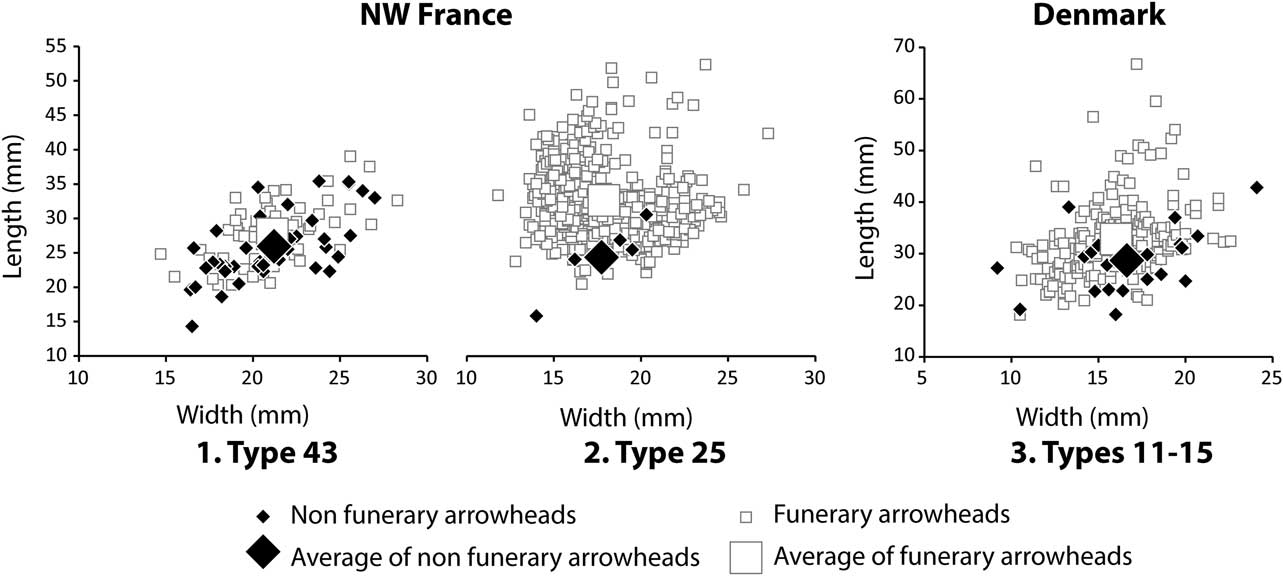
In north-west France, for the Bell Beaker period and the Early Bronze Age, non-funerary arrowheads are more diverse than those found in graves: while the latter are mostly of barbed-and-tanged shape, the former also include transverse, leaf-shaped, and hollow-based forms, and also include rougher forms of barbed-and-tanged arrowhead (Nicolas Reference Nicolas2016a). The examples found in graves had thus been specially selected. While few arrowheads have been found in domestic contexts, it is clear that arrowhead shape underwent a relatively rapid evolution in this area (Fig. 10). For the Bell Beaker period, there are no differences in the size and quality of knapping between squared barbed-and-tanged arrowheads (type 43) found in funerary and non-funerary contexts (Fig. 20.1). During the Early Bronze Age, non-funerary Armorican arrowheads are relatively rare and they are clearly smaller than those found in graves (Fig. 20.2). The latter are definitely the result of specialised production.
Diagrams of length and width illustrating the sizes of arrowheads according to their type in north-west France and Denmark

In southern Britain, there is no clear picture of non-funerary arrowheads. There is a great continuity of the same types (but varying in size) through the Chalcolithic period and the Early Bronze Age (Fig. 11). In the case of barbed-and-tanged arrowheads that lack contextual information, it is not easy to date these precisely and reliable domestic contexts are scarce (Allen Reference Allen2005; Woodward Reference Woodward2008). Therefore, there is limited scope for comparing the size of arrowheads from funerary and non-funerary contexts, even if examples from ‘ceremonial’ sites (graves, enclosures, henges) seem to be fancier than those from non-‘ceremonial’ sites (Devaney Reference Devaney2005). Indeed, some finely-shaped arrowheads (Fig. 9.3–5) do not seem to have any equivalent outside funerary contexts. However, the few domestic contexts that exist demonstrate that the main types are barbed-and-tanged (including the classical types 43 and 45), but the range also includes some types (namely oblique and leaf-shaped arrowheads) that do not appear in graves but they could be residuals from earlier Neolithic activity (see detailed references in Nicolas Reference Nicolas2016a). No certain example of a transverse arrowhead has been identified in Chalcolithic and Early Bronze Age settlements but the few examples known from graves suggest that they may have formed part of the everyday range of forms (for example UK-31).
In Denmark, many Bell Beaker settlements are known (Sarauw Reference Sarauw2007b; Reference Sarauw2008), and from these contexts come the same kinds of hollow-based arrowhead as are found in contemporary graves (see detailed references in Nicolas Reference Nicolas2016a). Their dimensions are similar but slightly smaller in settlements than in graves (Fig. 20.3), with the larger arrowheads generally being found in graves (Fig. 9.6–7). A similar pattern has been observed for flint daggers (Sarauw Reference Sarauw2006; Reference Sarauw2008). In settlements, additional arrowhead types are known, such as transverse arrowheads, triangular points, or points with concave proximal edges. Arrowheads with squared barbs and tang are also known outside burials (Ebbesen Reference Ebbesen1979).
So, in the three study areas, it appears that specific types of arrowhead were abstracted from the ‘everyday quiver’ for use in graves, or in some cases were subject to a specific production. This raises the question: were people selecting hunting arrows, or those used for interpersonal combat (or a combination of the two) – and/or were some or all of them purely for show? And is it possible to distinguish between these categories on the basis of formal or technological characteristics? As far as identifying hunting arrowheads is concerned, to judge from the ethnographic evidence mentioned above, it may be that the relatively simple types (for example transverse arrowheads and rough barbed-and-tanged examples) had been produced for this purpose. During the Bell Beaker period (and probably also during the Early Bronze Age), wild species are fairly marginal in the faunal spectra of France and Central Europe (Lemercier Reference Lemercier2011; Kyselý Reference Kyselý2012). This is not, however, to minimise the social value of hunting in these societies: hunting was primarily a prestigious practice, rather than just a strategy for obtaining food. In the exceptional find from Holloway Lane (London), different parts of one aurochs were deposited together with six fine barbed-and-tanged arrowheads (Cotton et al. Reference Cotton, Elsden, Pipe and Rayner2006), indicating a kind of ritualised prestigious hunting. However, some barbed-and-tanged arrowheads have also clearly been used in human combat, as noted above. Piercing points are more frequently found stuck into human bones than transverse arrowheads during the 4th and 3rd millennia bc (Dias-Meirinho Reference Dias-Meirinho2008). It should also be noted that the arrowheads carved on the famous Bell Beaker stelae from the Petit-Chasseur cemetery (Sion, Switzerland; Corboud 2009) are of the piercing type. Finally, some types of barbed-and-tanged arrowhead – those that are rarely found in settlements – give the impression of having been produced for specific purposes and, in the case of the Armorican examples, used as display items. Therefore, it can be hard to assign a definitive function to every type of arrowhead. Furthermore, the fact that some of these types occur only in graves suggests that the primary purpose of depositing arrowheads with certain individuals was to signal social status, the arrowheads acting as ‘object-signs’ and, in some cases, as symbols of power. In this respect, Bell Beaker arrowheads are not only part of a ‘symbolical hunting equipment’, as argued by Humphrey Case (Reference Case2004b), but expression of prestige gained during hunting or war and social status, probably hereditary as suggested by children burials with weapons (Turek Reference Turek2000), including arrowheads and dagger in the case of the grave GP of Solbakkegård IV (DK-31; Fig. 5.5).
CRAFT SPECIALISATION & SOCIAL INEQUALITY
Craft specialisation is a difficult issue to address for prehistoric societies, where the only evidence we have for the modes of production comes from finished products, with or without the waste left from their manufacture. Ethnography and history provide us with examples of many ways of production (Costin Reference Costin1991), both specialised and non-specialised, that are not easily identifiable from the finished products alone. Nevertheless, the quality of knapping and the contexts of production and consumption of arrowheads allow us to envisage several scenarios for their production, from the knapper working to make arrowheads for his own use to the specialised craftworker practising in a workshop.
In Bell Beaker contexts, arrowheads do not show a high level of technical expertise, even though they appear to have been worked significantly better than the rest of the lithic industry (Fouéré Reference Fouéré1994; Bailly Reference Bailly2002; Furestier Reference Furestier2007; Nicolas et al. Reference Nicolas, Rousseau and Donnart2015b). While arrowheads required a higher degree of skill to manufacture than most other lithic artefacts, the requisite level of skill would have been attainable by a person knapping on an occasional basis. For example, the Amesbury Archer’s arrowheads (UK-37) display a low degree of morphological standardisation and a low degree of expertise, suggesting that his set of arrowheads could have been made by a non-specialist. Preforms and one antler spatula deposited in the same grave suggest that the Amesbury Archer knapped his own arrowheads. This suggests that during the currency of Bell Beaker use hunters, or rather warriors, maintained their own quiver of arrows and were buried with their own equipment. This pattern does not exclude the possibility that some knappers acquired greater skill than others (Wiessner Reference Wiessner1983); in these cases one could speak of ‘experts’ as defined by Jacques Pelegrin (Reference Pelegrin2007). They could derive a certain prestige from this competence and could exchange some of their arrowheads, but without getting a real benefit in return for their (low) investment. The existence of this kind of skilled knapper could then be a step towards craft organisation of arrowhead production. In Bell Beaker contexts, the recurrence of archery equipment in graves and its depiction on the stelae of the Petit-Chasseur cemetery (Gallay Reference Gallay1995) suggest the existence of a warrior class displaying itself through ‘object-signs’ (Bailly Reference Bailly2002; Lemercier Reference Lemercier2011).
In the Danish Late Neolithic, arrowheads show a low degree of standardisation – ie great morphological diversity – and highly variable levels of technical expertise, ranging from those that had been produced quickly to others that had been carefully worked. Several contexts of production show that they were first roughed out in workshops and then finished in settlements, with mined flint being used in some cases (see detailed references in Nicolas Reference Nicolas2016a; Apel Reference Apel2001). Arrowhead preforms are never found alone and are always accompanied by other bifacially-reduced preforms (for daggers, axeheads, and sickles). Arrowheads are generally in the minority in these industries and so they were not the main objective of the production. Moreover, the hypothesis that arrowheads could have been knapped from flakes resulting from the production of larger bifacial objects (Apel Reference Apel2001) would imply that they were a by-product of this other activity. Arrowhead production in Denmark thus seems to be a secondary craft, with little effort invested owing to the low gain from production. It could have served to provide training for apprentices learning the skill of bifacial knapping. This is not, however, to deny the existence of exceptional examples that had been made by master knappers (Fig. 9.6–7). In the Danish graves, arrowheads are regularly associated with flint daggers, which once again seem to represent the personal equipment of warriors (Sarauw Reference Sarauw2007a).
In Brittany, Early Bronze Age Armorican arrowheads appear to be very standardised, comprising sets of homogeneous type or even of subtype, and to have required a high level of know-how for their manufacture. Experiments carried out by Frédéric Leconte suggest that several years of daily practice were required to master the production of the finest pieces. Different skill levels observed in individual arrowhead sets, and even on a single arrowhead at different stages of the chaîne-opératoire, suggest the involvement of several knappers, with varying degrees of expertise (Nicolas Reference Nicolas2016a). It is likely that they were organised in workshops, with a minimum of one master and one or several journeymen or apprentices. Such organisation is necessary for maintaining a high level of know-how and for transmitting this over generations (Apel Reference Apel2001; Pelegrin Reference Pelegrin2002). The limited distribution of these products and the high level of know-how involved in their manufacture suggest that this craftsmanship could not have been developed without the support or the control of an elite. This elite could have facilitated access to raw materials and could have supported craftsmen. In this scenario, Armorican arrowhead knappers could be considered as specialists producing for the elite, working either in a dispersed manner or grouped together under the elite’s direct control (Costin Reference Costin1991). There is little doubt that the Armorican arrowheads, buried in their dozens in monumental and richly equipped graves, were intended for the chiefs in Brittany (Briard Reference Briard1984). The large number of Armorican arrowheads (up to 60) deposited in each of these graves exceeds the size of arrow sets found in most Neolithic graves This kind of over-provisioning (Überausstattung) is also frequent in Germany and, to a lesser extent, in Wessex (Hansen Reference Hansen2002). These fancy Armorican points, which were not designed to be shot but to be displayed, definitely count as ‘precious objects’ as defined by Maurice Godelier (Reference Godelier1999). Furthermore, these display items were kept exclusively for chiefly use (no classical Armorican arrowheads having been found outside the graves) and they were not exchanged with Wessex elites, even though Armorican ceramics and copper alloy daggers were found there as grave goods (Needham Reference Needham2000a). In these respects, Armorican arrowheads could be considered as sacred objects, ie, inalienable goods which do not fit into the logic of a gift economy (Godelier Reference Godelier1999). These sacred objects generally have a mythical origin, as items reportedly inherited from distant ancestors or given by divinities. In this respect, Armorican arrowheads, derived from earlier patterns (Fig. 10), could be interpreted as a clear reference to the ancestors and the representation of the Bell Beaker warrior. In some historical contexts when social hierarchy exceeds divisions on the basis of sex, family and clan, these kinds of sacred objects become for the elite a real means of social reproduction and of intercession with the gods (Godelier Reference Godelier1999; Pétrequin et al. Reference Pétrequin, Cassen, Errera, Klassen and Sheridan2012), which would explain the prominent place of Armorican arrowheads in elite burials.
In southern Britain, the mode of production is less obvious for the Early Bronze Age: sets of arrowheads are smaller, and fewer examples exist than in Brittany. Nevertheless, the remarkable character of some arrowheads suggests a craft specialisation similar to that hypothesised for Brittany (Fig. 9.3–5). Without being dominant, arrowheads are part of the prestige goods of the Wessex elites.
CONCLUSION: ARROWHEADS IN ATLANTIC NETWORKS
Between 2500 bc and 1700 bc, arrowheads were definitely ‘object-signs’ signalling the social status of their owner, whether they were made by that individual himself (as seems to be the case for Bell Beaker-associated arrowheads) or by more or less specialised craftsmen (in post-Beaker contexts). The functional properties of arrowheads play a secondary role to this display of identity: the Armorican arrowheads provide an exaggerated demonstration of this. Furthermore, arrowheads constitute broader signs of cultural expression and reflect interactions on a large geographic scale, especially in the Atlantic area.
Atlantic exchange networks are well known through a set of items which circulated or were copied over long distances. During the currency of Bell Beaker use, the distribution of maritime Bell Beakers decorated with shell impressions (Drenth & Salanova Reference Drenth and Salanova2012), copper Palmela points (Harrison Reference Harrison1977; Labaune Reference Labaune2010), domed V-perforated buttons (Barge-Mahieu Reference Barge-Mahieu1981), gold ornaments (Taylor Reference Taylor1980; Éluère Reference Éluère1982; Hernando Gonzalo Reference Hernando Gonzalo1983; Needham Reference Needham2011; Nicolas et al. Reference Nicolas, Pailler, Stephan and Gandois2013), and amber ornaments (du Gardin Reference Gardin1998) attest to contacts stretching from Portugal to Denmark, especially between the Tagus river and the Gulf of Morbihan. During the last quarter of the 3rd millennium, gold lunulae (Taylor Reference Taylor1970) and long, arsenical copper daggers (Needham Reference Needham2000b; Nicolas Reference Nicolas2016a) attest to the maintenance of these exchange networks. During the early 2nd millennium amber, faience, jet and jet-like ornaments, precious cups, Armorican vases à anses, and daggers show Atlantic connections within the Channel, the North Sea, and the Irish Sea regions (Briard Reference Briard1984; du Gardin Reference Gardin1996; Sheridan & Shortland Reference Sheridan and Shortland2004; Needham Reference Needham2000a; Reference Needham2009). The elite of the Armorican Tumulus culture and its counterpart across the Channel is likely to have been the driving force behind the dynamics of these exchanges, constituting a ‘maritory’, to use Stuart Needham’s term (2009). Lithic industries played a role in these Atlantic networks, and we can see the copying of arrowhead types at the scale of Atlantic Europe and indeed more widely.
Bell Beaker arrowheads in the west
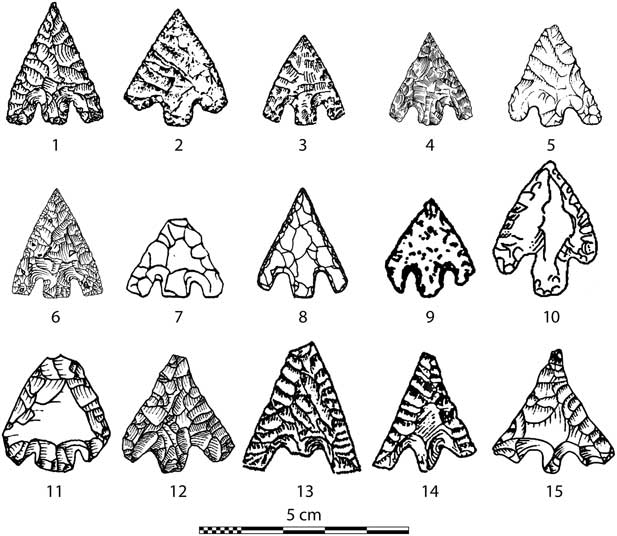
Arrowheads with squared barbs and tang (type 43) have been long recognised to be typical of the users of Bell Beakers. They are found mainly in north-western Europe (Bailly Reference Bailly2014). The genesis of this type has formed part of the debate about the origin of Bell Beaker use, being cited in support of both the ‘Dutch model’ (Lanting & van der Waals Reference Lanting and Waals1976) and the ‘Portuguese model’ (Case Reference Case2004b). However, type 43 is still unknown in Portugal and is generally scarce in the Iberian Peninsula as a whole. Building on previous work by Maxence Bailly (Reference Bailly2014), we have listed 310 arrowheads of type 43 from 141 graves in Europe, avoiding variations of this type (ie, types 23, 33, 43, 44, and 45; Nicolas Reference Nicolas2016a; Fig. 21). These are distributed mostly in north-western Europe and especially along the Atlantic coast. Further non-funerary discoveries complete this distribution in Ireland (O’Kelly Reference O’Kelly1973), in Galicia (in Zas parish, A Coruña; Prieto Martinez, pers. comm.), in Tuscany (Cocchi Genick Reference Cocchi Genick2001), in north-eastern Germany (Schirren Reference Schirren2009), in Norway (Skjølsvold Reference Skjølsvold1977; Østmo Reference Østmo2005), and in Sweden (Montelius Reference Montelius1917). All over Europe, these arrowheads are quite homogeneous in shape and size (Fig. 22.1–10), even if this trend encompasses some variations, as attested in north-west France and southern Britain.
Distribution map of arrowheads with squared barbs and tang (type 43) in Europe, according to funerary contexts

Examples of barbed-and-tanged arrowheads with squared barbs and tang (type 43) from Bell Beaker contexts in Europe (1–10) and similar arrowheads in Late Neolithic settlements in western France (11–15). 1. Kercadoret, Locmariaquer, Brittany, France. 2. Coppières, Montreuil-sur-Epte, Île-de-France. 3. Emmen, Angelslo, Drenthe, Netherland. 4. Mucking 137, Essex, England. 5. Dornoch Nursery, Dornoch, Scotland. 6. Solbakkegård, Ribe, Denmark. 7. La Buisse, Isère, Rhône-Alpes, France. 8. Borkovany I 1/59, Moravia, Czech Republic. 9. Bingia ʽe Monti, Gonnostramatza, Sardinia, Italy. 10. San Martin, La Guardia, Alava, Pays Basque, Spain. 11–12. Groh-Collé, Saint-Pierre-de-Quiberon, Morbihan, France. 13–14. Le, Camp, Challignac, Poitou-Charentes, France. 15. Les Vaux, Moulins-sur-Céphons, Centre region, France (1 & 6: drawings C. Nicolas, 2: after de Mortillet Reference Mortillet1906, 3: after Lanting Reference Lanting2008, 4: after Jones & Jones Reference Jones and Jones1975, 5: after Ashmore Reference Ashmore1989, 7: after Bill Reference Bill1973, 8: after Dvořák et al. Reference Dvořák, Matějíčková, Peška and Rakovský1996, 9: after Atzeni 1998, 10: after Harrison Reference Harrison1977, 11–12: after Blanchard Reference Blanchard2012, 13–14: after Burnez Reference Burnez2010, 15: after Hamon Reference Hamon2006)
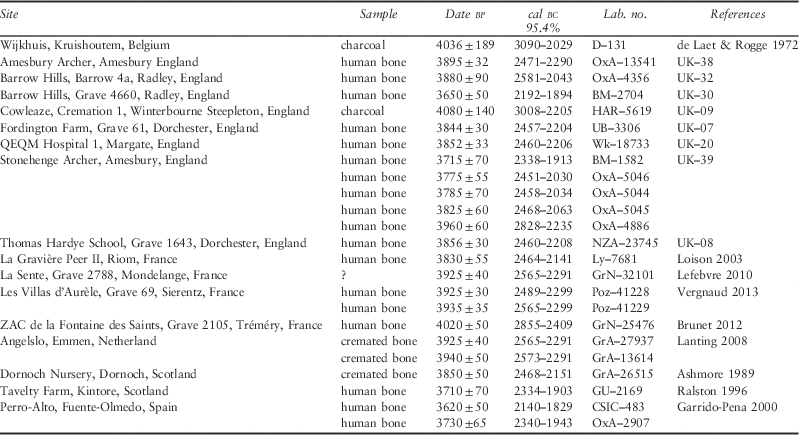
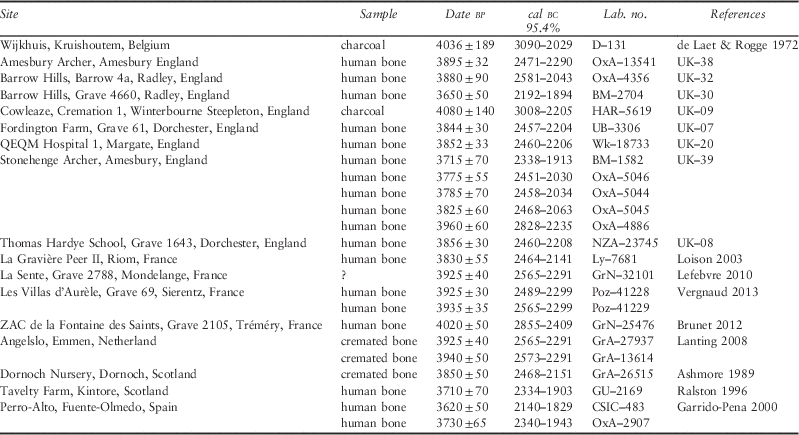
Only a few European regions could claim to be the area of origin of type 43 arrowheads. Britain and Ireland, central Europe, Sardinia, and the Iberian peninsula can be ruled out, as the type is too rare in these regions, and/or was clearly introduced from outside. Fifteen findspots in Europe have yielded a total of 22 radiocarbon dates, mainly on human bone (Table 4); two further sites have provided old and unreliable dates determined from charcoal (D-131, HAR-5619). The oldest radiocarbon dates for this type of arrowhead come from graves in and around the Rhine valley, between c. 2700 and 2300 cal bc. At first glance, these dates could be taken to indicate an origin in the Rhine area and so to support the ‘Dutch model’ of Bell Beaker origins. However, we have to take in account that in south-west Europe reliable contexts are scarce, since Bell Beaker funerary practice there mainly featured the re-use of older collective graves (Guilaine Reference Guilaine2004). In western France, finds from several settlements suggest the existence of similar arrowheads during the Late Neolithic (c. 2900–2600 cal bc), especially in the Artenac culture (Roussot-Laroque Reference Roussot-Laroque1990; Fouéré Reference Fouéré1994; Hamon Reference Hamon2006; Burnez Reference Burnez2010; Blanchard & Guyodo Reference Blanchard and Guyodo2015). The Artenac culture is known too for its abundant production of barbed-and-tanged arrowheads (Fouéré Reference Fouéré1994). It is probably in this area that we should locate the origin of this type of arrowhead. If one accepts Salanova’s argument for the spread of Bell Beaker material culture and practices along the Atlantic façade from Portugal (Salanova Reference Salanova2004), the people involved in its spread could have adopted this type of arrowhead as a result of contact with Artenac communities, as attested by ceramic evidence (Cormenier Reference Cormenier2009). According to this model, versions of the type 43 arrowhead could then have circulated along the Channel and around the North Sea (thereby uniting Britain and Ireland, the Netherlands, and Scandinavia); along the Bay of Biscay (towards northern Spain); and also, at quite an early stage, along continental routes, following major and secondary rivers, towards Central Europe and the Mediterranean. This model accommodates the probability that we are not dealing with a one-way movement of a Bell Beaker ‘package’ from a single centre in Portugal, but rather a syncretic phenomenon, featuring the multi-directional adoption of early Bell Beakers and associated artefacts (Palmela points, domed V-perforated buttons, gold ornaments), across complex networks of contacts (Gallay Reference Gallay2001; Vander Linden Reference Vander Linden2004; Besse Reference Besse2015).
Inventory of radiocarbon dates for squared barbed-and-tanged arrowheads (type 43) in bell beaker graves
Atlantic arrowheads in the Early Bronze Age
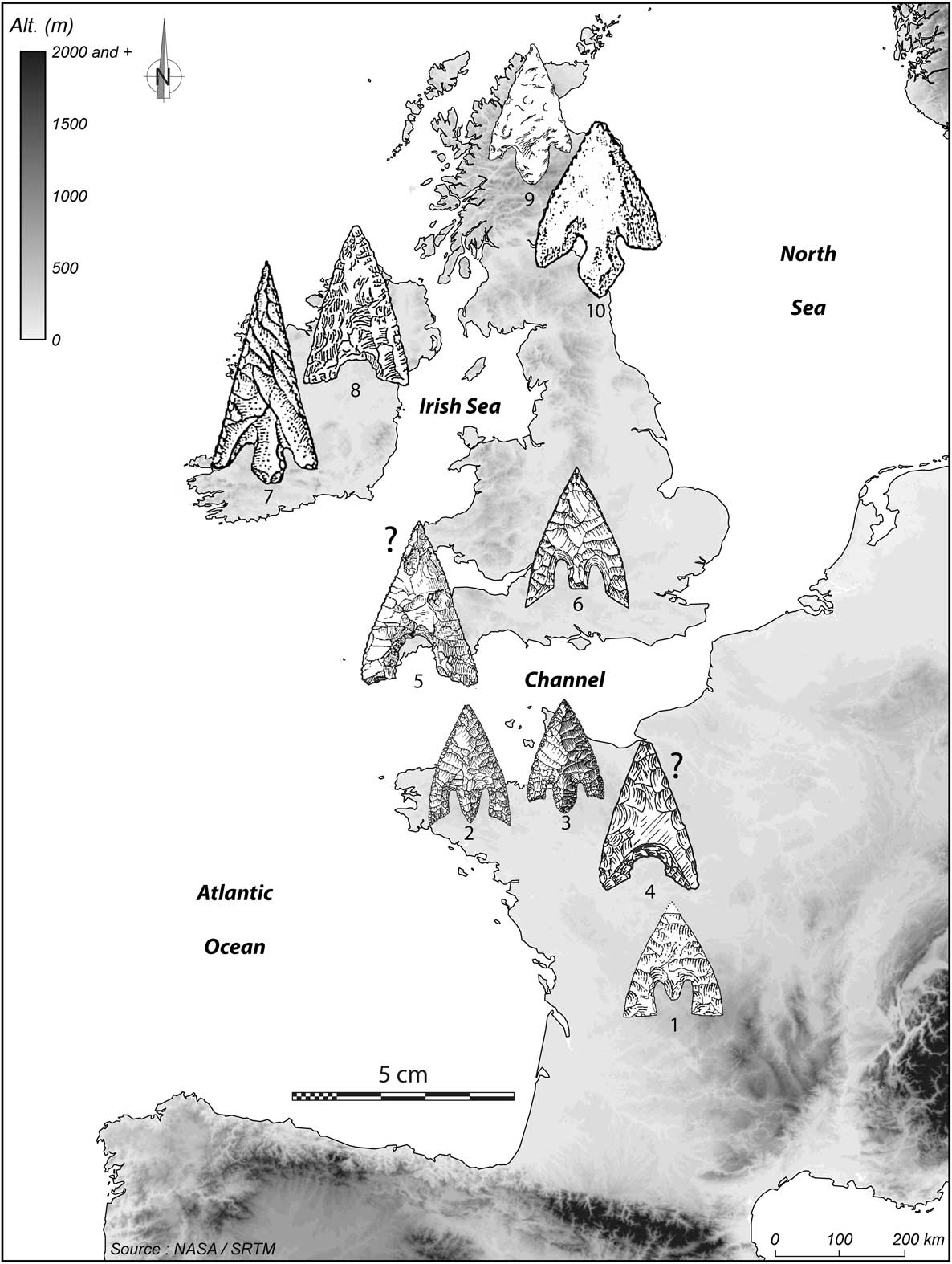
In northern Atlantic Europe, knappers from western France and Britain and Ireland made very specific types of arrowhead featuring slanted barbs, the similarities resulting from gradual convergence or imitation. Slanted barbs are occasionally found in Beaker contexts in north-west France and southern Britain (Fig. 22) but the shape of the Early Bronze Age Armorican arrowheads – with their ogival form, pointed tang, and long barbs – has clearly been copied in north-west France, southern Britain, and Ireland (Nicolas Reference Nicolas2016a). In Brittany, arrowheads with slanted barbs are strictly connected to the elite. In Britain and Ireland, they represent just a small percentage of all barbed-and-tanged arrowheads (6.5%) but they are more frequent in graves (18.9%), especially those that demonstrably date to the Early Bronze Age (31.7%; after Green Reference Green1980). Both in Armorica and in Britain and Ireland, we seem to be dealing with display items.
There are no regionally-exclusive arrowhead types in north-west Europe; there are only general trends. Surprisingly, the main inter-regional difference occurs on the tang, which was designed to be inserted into the shaft and thereby hidden. In Brittany, slanted barbs are mostly associated with pointed tangs (type 25). In Normandy and the Channel Islands, the tang is generally more prominent and rounded (type 35). In southern Britain, the tang is generally squared (type 45). In Scotland, Stephen Green (Reference Green1980) recognised a Kilmarnock type with slanted barbs associated with a prominent and pointed tang. Hollow-based arrowheads with slanted barbs are known in north-west France, England and Ireland (Ashbee Reference Ashbee1958; Villes Reference Villes1987; Woodman et al. Reference Woodman, Finlay and Anderson2006).
Knapping slanted barbs is not straightforward and requires close attention to achieving the desired shape. We know that Early Bronze Age societies in north-western Europe were in regular contact and so, in theory, there should be a shared knowledge of arrowheads morphology. The fact that arrowheads with slanted barbs were made in each of the regions in question supports such a view. The distribution of these arrowheads, which corresponds to the pattern of Atlantic networks (see above), suggests that it is highly likely that some kind of Atlantic cultural complex was operating, similar to that seen during the Late Bronze Age and reflected, for example, in the distribution of specific sword pommel types (Coffyn Reference Coffyn1985; Brun Reference Brun1991). Therefore, it could be argued that Early Bronze Age arrowheads express identity at several scales: that of the individual, his social status, his membership of a community, culture or ethnic group, and his integration at a broader level within the wider Atlantic cultural complex. Arrowheads as such are the ‘object-signs’ of men, as confirmed by ethnographic data and more widely by a cross-cultural ‘ideology of blood’, excluding women from weapons that shed blood (Testart Reference Testart1986). The piercing barbed-and-tanged arrowheads were initially the possession of warriors before becoming symbols of the elite in some areas. The regional variability in tang design may have been one way in which different cultural groups expressed their identity. Finally, the shared use of slanted barbs suggests a way of signalling (inter alia) the affiliation of these societies to the broader Atlantic cultural complex.
Arrowheads with slanted barbs in north-western Europe. 1. Quatre Routes, Marsac, Limousin, France. 2. Kerguévarec, Plouyé, Finistère, Brittany, France. 3. Les Fouaillages, Vale, Guernsey. 4. Le Ménil-de-Briouze, Normandy, France. 5. Tregulland Burrow, Treneglos, Cornwall, England. 6. Wimborne St. Giles G9, Woodyates, Dorset, England. 7. Galgorm Parks, Fenagh, Antrim, Ireland. 8. Unknown origin, Ireland. 9. Kingskettle, Fife, Scotland. 10. Banff, Aberdeenshire, Scotland (1: after Joussaume et al. Reference Joussaume, Fouéré and Crédot2002, 2–3: drawing C. Nicolas, 4: after Verron Reference Verron1980, 5: after Ashbee Reference Ashbee1958, 6: after Annable & Simpson Reference Annable and Simpson1964, 7: after Kavanagh Reference Kavanagh1976, 8: after Buick Reference Buick1895, 9: after Smith Reference Smith1927, 10: after Pennant Reference Pennant1776)
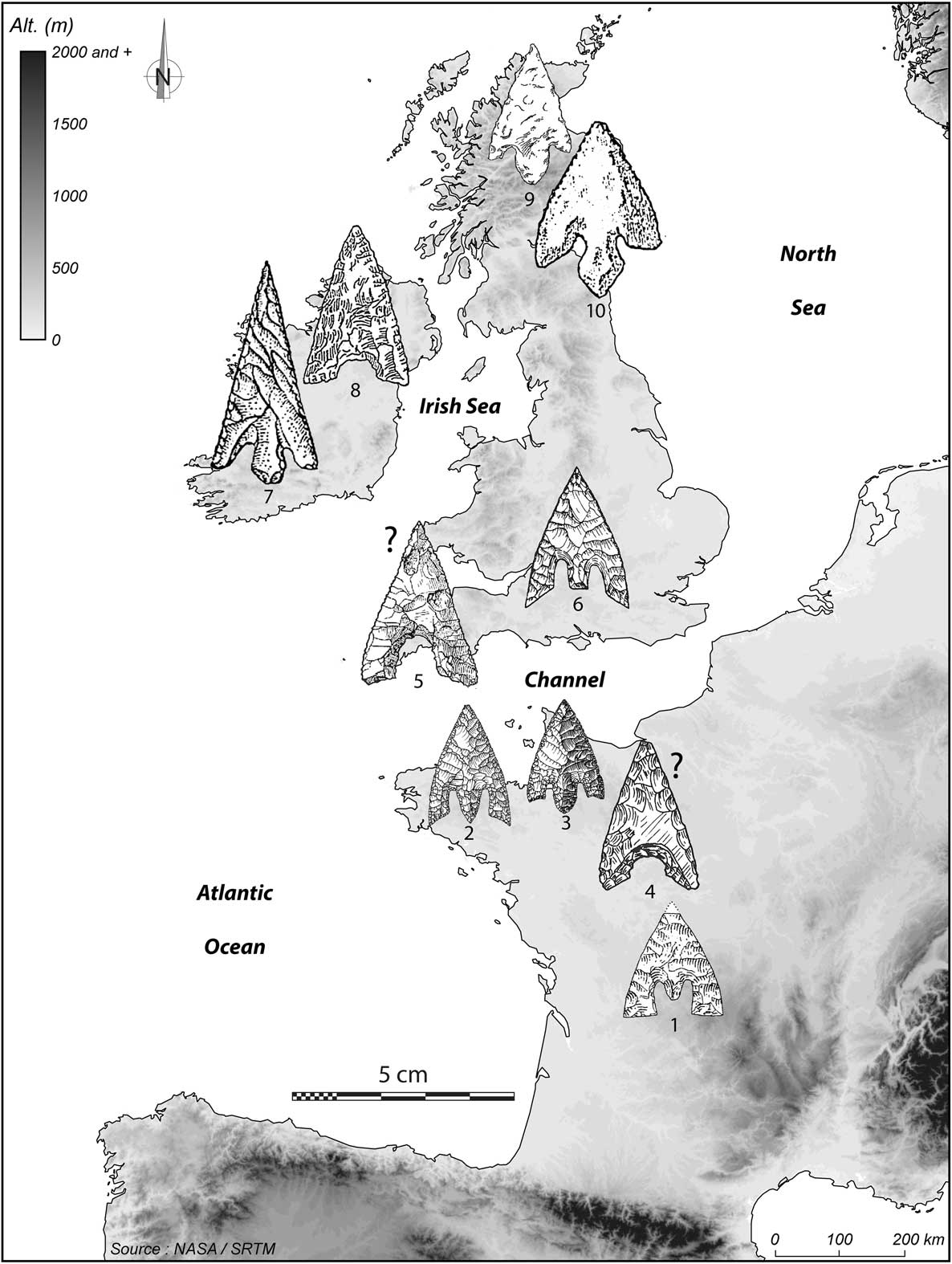
Acknowledgements: This article is the result of my PhD and I am pleased to thank the members of the jury who have helped in finalising this work: François Giligny (University of Paris 1), Laurence Manolakakis (CNRS, UMR 8215), Marie Besse (University of Geneva), Jacques Pelegrin (CNRS, UMR 7055), Annelou van Gijn (Univeristy of Leiden), and Alison Sheridan (National Museums Scotland); the last-named also greatly improved my English and made several useful comments. I am also grateful to Colas Guéret (University of Paris 1) for use-wear analysis of the Armorican arrowheads, as well as to Maxime Rageot and Martine Regert (University of Nizza Sophia Antipolis) for residue analysis. Finally, this work would not have succeeded without the kind assistance of many curators, who are too numerous to be listed here but who will know who they are.
Supplementary material
To view supplementary material for this article, please visit https://doi.org/10.1017/ppr.2017.5