1. INTRODUCTION
The capability approach developed by Amartya Sen, Martha Nussbaum and others has regularly been accused of paternalism and perfectionism (Arneson Reference Arneson2000; Okin Reference Okin2003; Jaggar Reference Jaggar2006; Nelson Reference Nelson2008). By prescribing a list of capabilities, it endorses a specific conception of the good life that cannot be shared by all people in modern pluralist societies. In reply, capability theorists have pointed out that their approach does not require the realization of specific functionings, but only of capabilities to function. This would give people the requisite freedom to choose how to lead their own lives.
The question raised here is whether this response is adequate, more specifically, whether it is always possible to endorse only capabilities, not functionings, and to avoid the charge of paternalism. I will suggest that the promotion of functionings instead of capabilities is potentially pervasive in the capability approach, so that paternalism is a more serious problem for the approach than previously recognized. I will confine my discussion to the use of the capability approach in normative political theory.Footnote 1 The question, therefore, is under which conditions political authorities (governments/states) who would use the capability approach for public policy purposes should decide to promote functionings instead of capabilities. When they do so, they engage in what I will call ‘capability paternalism’. This label is not meant as a condemnation: some instances of paternalism may be justified.Footnote 2
I develop my argument in four stages. First, I distinguish the objections from perfectionism and from paternalism. The latter objection arises when we question the capability theorists’ move from functionings to capabilities, while the former objection may even arise when we accept this move (Section 2). The bulk of the paper concentrates on the objection from paternalism. Second, I discuss the characteristic elements of paternalism and their applicability to the capability approach (Section 3). Third, I reconstruct Nussbaum's discussion of situations in which functionings have to be promoted directly. Many of these situations can be extended to almost all items on a list of basic capabilities, so that an expansionary dynamic threatens. This can bring the capability approach into the difficulty that functionings rather than capabilities have to be promoted on a large scale. Overall, the ‘capability approach’ can effectively become a ‘functionings approach’ (Section 4). To see whether this needs to be the case, I finally discuss several considerations which, taken together, determine how widespread the promotion of functionings will be in a capability theory (Section 5).
2. THE OBJECTIONS FROM PERFECTIONISM AND PATERNALISM
Martha Nussbaum's version of the capability approach posits a list of ten central functionings that citizens should have a capability to realize if they choose to. These include life, bodily health, senses, imagination, thought, etc. The capabilities to achieve these functionings are ‘part of a minimum account of social justice: a society that does not guarantee these to all its citizens, at some appropriate threshold level, falls short of being a fully just society, whatever its level of opulence’ (Nussbaum Reference Nussbaum2006: 75).
Richard Arneson made an important comment on an earlier version of Nussbaum's capability theory:
‘I doubt that a list as expansive as hers is really a list of functionings all of which any person must achieve at some threshold level if her life is to count as attaining a decent or adequate level of well-being. . .one can imagine lives that are high in well-being despite failing to attain any positive amount of some items on Nussbaum's list.’ (Arneson Reference Arneson2000: 48)Footnote 3
Arneson seems to presuppose that for Nussbaum a person must realize all items on her list of functionings (at least up to the threshold level) to lead a good life. This, in combination with the expansive character of the list, would be objectionable. In response, capability theorists have stressed that capabilities, not functionings, are the proper object of political endorsement. As Nussbaum remarked: ‘The conception does not aim at directly producing people who function in certain ways. It aims, instead, at producing people who are capable of functioning in these ways, who have both the training and the resources so to function, should they choose. The choice itself is left to them’ (Nussbaum Reference Nussbaum, Douglas, Mara and Richardson1990: 214; similarly Reference Nussbaum2000: 87; Reference Nussbaum2006: 79). Amartya Sen and others have made a similar point (e.g. Sen Reference Sen, Nussbaum and Sen1993: 40).
The emphasis on capabilities as the relevant source of normative requirements represents the ‘standard move’ in the capability literature. It introduces the notions of personal choice and freedom. This is, according to Ingrid Robeyns, the reason the capability approach can aspire to being called a liberal approach (Robeyns Reference Robeyns2011). Or, in Nussbaum's terminology, it is one of the ways in which her theory respects pluralism (Nussbaum Reference Nussbaum2006: 79).
From here, we can proceed in two ways. If we accept the standard move, we can argue that the approach is still illegitimate, because the identification of specific capabilities (and not others) as moral and political requirements favours some people's conceptions of the good life over others and thus is insufficiently neutral. This is the objection from perfectionism. If, by contrast, we reject the standard move, we can argue that despite its own intentions the capability approach cannot escape the promotion of functionings, at least in some important cases. This denies people the freedom not to choose those functionings. This is the objection from paternalism. These charges are about distinct matters and should not be confused with each other.
It might strike one as awkward that there still is something objectionable even if we do not require the actual realization of all functionings on the list. After all, where the state realizes the basic capabilities, no citizen is coerced – following the standard move – into a specific functioning. Some have tried to make the objection from perfectionism intelligible by saying that all citizens are nonetheless required to contribute to the state's action through taxation. They get a differential benefit from a state acting on the capability approach, while the cost to everyone is equal. Since that differential treatment finds its source in individuals’ different life choices, it would be unjust. People pay for capabilities useless to themselves (Nelson Reference Nelson2008: 100). Another reason for objecting to such perfectionism would be that citizens who have a conception of the good life unsupported by one or more of the ten central capabilities are unfairly disadvantaged. A sports teacher will benefit from a state promoting the capability to play (if only because it helps him get a job), while a computer engineer will find no such support. Here I will remain agnostic on the merits of these charges.Footnote 4 In this paper, I will be exclusively concerned with the objection from paternalism, which has received much less attention in the literature.
This objection is prior to the objection from perfectionism in that it actually questions the success of the standard move. The exclusive focus on capabilities, mandated by the standard move, is almost always defended by reference to respect for persons as choosers of their own ends or life plans. If we give people capabilities without requiring them to realize the corresponding functionings, this leaves them the option of choosing from their capability set those functionings that suit their ends best. Their personal autonomy is violated only when they are coerced into a certain functioning and thereby not allowed to choose not to realize that functioning (Arneson Reference Arneson2000: 61). A theory requiring people to laugh is disrespectful of some person's choices not to laugh. A theory requiring people to have the ability to laugh does respect this choice. Only when the capability theory refrains from advocating functionings does it avoid paternalist implications. The standard move is motivated in large part by the wish to avoid paternalism.Footnote 5 Can it succeed?
3. THE ELEMENTS OF PATERNALISM
I will use the following definition of paternalism:
A theory (or a policy based on it) is paternalist when it interferes with the liberty of a person in order to prevent him from harming himself, either when he would harm himself voluntarily or when he would do so involuntarily.
The three most important elements of this definition are ‘an interference with liberty’, ‘harm to self’, and ‘voluntariness’.
First, the element of an ‘interference with liberty’ is left out of definitions of paternalism which only refer to the motive of preventing harm. Dworkin speaks of paternalism as applying to a class of ‘activities that though defended on paternalistic grounds, are not interferences with the liberty of persons’ (Dworkin Reference Dworkin and Sartorius1983: 21). However, it seems reasonable to say that policies thus motivated somehow interfere with the liberty of the person treated paternalistically. Such interferences are a matter of gradation, ranging from full coercion (when a policy explicitly prohibits individuals to choose as they wish) to lighter means of trying to influence choice (e.g. requiring information about health risks on products). The degree of interference depends on the extent and nature of the options left open to the agent. If someone leaves you only the choice between ‘your money or your life’, this may be labelled as coercion, while as more and more attractive options are left open, the interfering act becomes gradually less coercive.
For the capability approach this is especially relevant, since the realization of functionings (instead of capabilities) is what is labelled as potentially paternalist. When a functioning is realized, an individual is brought into a certain ‘state of being or doing’ (functioning). However, the methods to bring about this state may be more or less intrusive. In the following, I will speak of the ‘promotion’ (rather than ‘realization’) of functionings to reflect this gradual nature of paternalist interferences. The weight put on the question of justification will become correspondingly greater the more interfering the means of promoting a functioning are.
‘Harm to self’, the second element in the definition, refers to a setback to the interests of the harmed agent. Harm occurs wherever an agent's well-being is diminished. Whether his well-being is interpreted in a subjective or an objective manner doesn't matter much for purposes of identifying paternalism, as long as it is possible for the intervening party to know what his well-being consists in. Now, is an agent prevented from harm when a certain type of functioning is promoted with respect to him? For example, imagine a person exposed to extremely funny TV programmes on a screen in an elevator on his way to work, and suppose this enhances his well-being. Is this paternalism? Compare this to a classical case of paternalism, that of preventing the same individual from exiting the elevator before the doors are opened so that he doesn't fall down. In the second case, a diminishment of his well-being is prevented while in the first his well-being has been augmented in a positive sense, albeit against his will.
To call this kind of functionings promotion paternalistic, we need a distinction Feinberg made, between harm-preventing and benefit-promoting paternalism (Feinberg Reference Feinberg1986: 8).Footnote 6 At first sight, capability paternalism seems to be of the latter kind: it occurs when a government forces individuals into a certain kind of functioning, not in order to prevent harm (diminishment of well-being) they would otherwise inflict upon themselves, but rather because they would otherwise miss the increase in well-being resulting from the specific functioning at stake. Isn't this excessively paternalistic?Footnote 7 We must not put too much emphasis on the harm-preventing/benefit-promoting distinction, however. Missing a benefit can also be interpreted as harm; both imply a diminishment of value on a continuous scale, the first on the positive side, the second on the negative. Missing the opportunity to realize many of the central functionings will constitute harm for the person (think only of the capability to be healthy).
‘Voluntariness’, the third element in the definition of paternalism, refers to the nature of the harm inflicted. The disjunctive form of the definition (‘either voluntarily or involuntarily’) accommodates the existence of two forms of paternalism. The first is ‘hard paternalism’, which refers to interferences ‘necessary to protect competent adults, against their will, from the harmful consequences even of their voluntary choices and undertakings’. By contrast, soft paternalism authorises interferences ‘to prevent self-regarding harmful conduct when but only when that conduct is substantially nonvoluntary, or when temporary intervention is necessary to establish whether it is voluntary or not’ (Feinberg Reference Feinberg1986: 12; similarly Dworkin Reference Dworkin1988: 124). Soft paternalism is mostly considered to be a liberal form of intervention: if individuals are unable to make a voluntary choice about the matter, then their personal autonomy is respected by preventing the harm from happening (some even doubt whether this is paternalism at all).Footnote 8 Similarly, if individuals are unable to make a voluntary choice about the promotion of one of their specific functionings, then on soft paternalist grounds we can promote this functioning with respect to them. As we will see, this distinction is important to the capability approach as well, in classifying the different cases where functionings promotion is at stake.
4. FIVE CATEGORIES OF FUNCTIONINGS PROMOTION
I will now argue that the promotion of functionings may turn out to be unavoidable for more cases than the appeal to the standard move seems to suggest. In particular, I will reconstruct and build upon Nussbaum's account in Women and Human Development (Reference Nussbaum2000) of cases for which she admits we may have to diverge from the standard move and promote actual functionings.Footnote 9 Nussbaum treats these cases essentially as ‘exceptions to the rule’. I will argue, however, that they suggest that a more widespread promotion of functionings is entailed by the capability approach than commonly acknowledged.
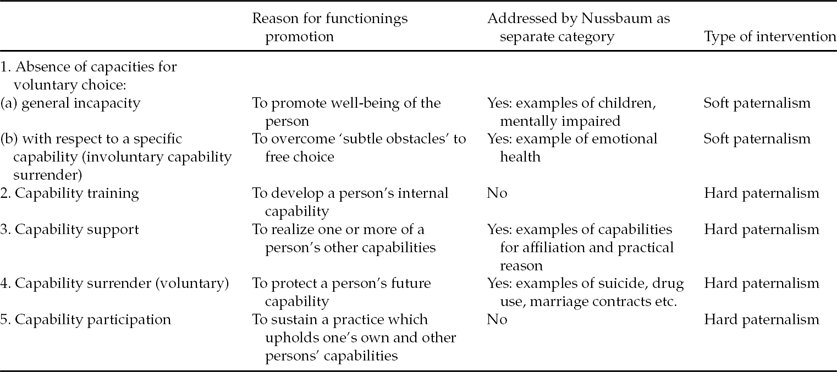
Nussbaum's text points to three categories of cases (the labels are mine). While discussing these, I will distinguish two more categories whose separate nature Nussbaum insufficiently acknowledges, so that a typology of five categories of functionings promotion emerges (for overview, see Table 1 at the end of the section).
Five Categories of Functionings Promotion

Category 1: Absence of capacities for voluntary choice
Nussbaum states: ‘If we aim to produce adults who have all the capabilities on the list, this will frequently mean requiring certain types of functionings in children’ (Nussbaum Reference Nussbaum2000: 89–90; similarly Reference Nussbaum2006: 171–3). Here the promotion of functionings is presented as instrumental to the development of adult capabilities. However, it is not entirely clear whether Nussbaum really wants to confine this ground for promoting functionings to the development of adult capabilities. In Frontiers of Justice, she remarks: ‘Compulsory functioning is justified both by the child's cognitive immaturity and by the importance of such functioning in enabling adult capabilities’ (Nussbaum Reference Nussbaum2006: 172). She proceeds by defending the promotion of functionings for people with severe mental impairments, who are often adult or, when still children, will not have more capacities of choice as adults. Given these remarks, it seems that there are two different types of situation at stake. On the one hand, there is functionings promotion in the absence of the possibilities of a free (or considered, or rational) choice. This gives rise to the classical soft paternalist justification for paternalist intervention. If individuals are unable to make choices, someone else will have to step in and protect their well-being. But cases where functionings promotion is a prerequisite to adult capability development are a completely separate matter.Footnote 10 I propose to put these into a separate category and call them instances of capability training.
Category 2: Capability training
Such cases arise where it is hard to possess a capability without having exercised (trained) the corresponding functioning. This has nothing to do with the absence of capacities for choice. As Nussbaum herself conceded, ‘developing an internal capability usually requires favourable external conditions; indeed it very often requires practising the actual function’ (Nussbaum Reference Nussbaum2000: 185). Nussbaum suggests that such training is necessary only for a limited time, the training period, which would cease once, in an adult, the capabilities have been developed to a sufficient extent. But the training for many capabilities may have to extend beyond childhood. The image of two stages separated in time, childhood and adulthood, is misleading; the substantive question is whether the capability has been acquired, not whether childhood has ended. Moreover, the image of training for a capability and then ‘having’ it for the rest of one's life is itself too schematic. Capabilities aren't objects one possesses as long as the original act of acquisition isn't somehow reversed – they are opportunities, abilities and skills that one can also lose in case one doesn't practice them. They require regular re-training over the course of a lifetime to prevent their loss.
Category 3: Capability support
Nussbaum mentions a second type of situation: ‘Even where adults are concerned, we may feel that some of the capabilities are so important, so crucial to the development or maintenance of all the others, that we are sometimes justified in promoting functioning rather than simply capability, within limits set by an appropriate concern for liberty’ (Nussbaum Reference Nussbaum2000: 91).Footnote 11 Let us call these ‘supportive functionings’, for their role in supporting the realization of other capabilities. Here the problem is one of judging when a functioning is vital to the realization of other capabilities.
Nussbaum mentions three examples. The first is that of health and safety regulations. She says that ‘They are understood to be justified because of the difficulty of making informed choices in all these areas, and the burden of inquiry such choices would impose on citizens, as well as by the thought that health and safety are simply too basic to be left entirely to people's choices. (. . .) We may also feel that health is a human good that has value in itself, independent of choice, and that it is not unreasonable for government to take a stand on its importance in a way that to some extent (though not totally) bypasses choice’ (Nussbaum Reference Nussbaum2000: 91).
Nussbaum's second example is that of dignity. She says ‘it seems important for government to focus on policies that will actually treat people with dignity as citizens and express actual respect for them, rather than policies (whatever those would be) that would extend to citizens a mere option to be treated with dignity’ (Nussbaum Reference Nussbaum2000: 91–2). According to Nussbaum this may require coercing people so as to prevent them from abasing or humiliating themselves.
Finally, she mentions two capabilities she has given a special place on her list: affiliation and practical reason. These ‘suffuse all the other capabilities, making them fully human. So here too we may feel uneasy when adult citizens want to function in a way that ignores these very prominent capabilities, though we are convinced they still have them’ (Nussbaum Reference Nussbaum2000: 92). Hence Nussbaum suggests we can require certain functionings of citizens who otherwise show no wish for affiliation at all (she mentions paying taxes as an example).
Two of these three examples defy the main, ‘supportive’ type of categorization she herself gave. Her first example, the difficulty of making informed choices about health care, exemplifies a fallback into the first type of situation (absence of voluntary choice). Her second example, dignity, also does not relate the value of functionings promotion to the realization of other capabilities, but merely to the realization of that capability – dignity – itself. It is only with the third example, affiliation and practical reason, that we can see an instance of one functioning having a supportive role towards another capability. Let us therefore concentrate on cases structurally similar to Nussbaum's third example.
I think that, to a certain extent, cross-linkages can be identified between almost all of the capabilities on Nussbaum's list. It is hard to see why only Nussbaum's examples of affiliation and practical reason would qualify for a supportive role. For instance, to ‘have attachments to things and people’ (the functioning of emotion) is most certainly conducive to ‘being able to form a conception of the good’ (the capability of practical reason), as Nussbaum herself defended in other work on the empathic qualities of decision makers (Nussbaum Reference Nussbaum1995). Or, ‘moving freely from place to place’ (the functioning of bodily integrity) seems on many occasions a precondition for ‘being able to participate effectively in political choices’ (capability of control over one's environment). Or, ‘using the senses, to imagine, think and reason’ (functioning of senses, imagination and thought) is often required for ‘being able to live with and toward others’ (capability of affiliation).
In complex ways, all of these capabilities could be constructed as necessarily connected to each other. This makes the category of supportive functionings into a potentially very expansive one. Consequently, the overall scheme threatens to become one in which the realization of actual functionings must be required for all of Nussbaum's ten central capabilities.Footnote 12
Category 4: Capability surrender
Nussbaum introduces a third type of situation: ‘In another group of cases, we may suspect that the absence of a function is really a sign that the capability itself has been surrendered’ (Nussbaum Reference Nussbaum2000: 93). Nussbaum makes a subdivision into two variations. First, in some situations the absence of a functioning points to ‘subtle obstacles’ to the capability in question. Let us describe these as cases of involuntary capability surrender. For example, ‘Emotional health is an area in which we can usually make such inferences from absence of functioning to absence of capability: if a person always shows suspicion and fear of other people, we usually infer damage to the capacity for love, rather than saying that this person, though able to love, has made a choice not to’ (Nussbaum Reference Nussbaum2000: 93). The same is true, Nussbaum judges, for other cases in which participation in social roles is lacking. This may provide a case for affirmative action with regard to jobs and ‘[e]ven compulsory voting would not be ruled out, if we were convinced that requiring functioning is the only way to ensure the presence of a capability’ (Nussbaum Reference Nussbaum2000: 93). I propose we treat this category of involuntary capability surrender as a subset of our first category (absence of voluntary choice). Whereas Nussbaum's first category referred to a general incapacity for making voluntary choices, here we face situations where individuals are unable to make free choices with respect to one specific capability.
Nussbaum contrasts this with situations of voluntary capability surrender, where surrender happens ‘apparently without coercion’. Here, too, she favours government intervention, such as in prohibitions of suicide or of certain provisions in marriage contracts, laws against drug use, seat-belt and helmet laws, prohibitions on the sale of bodily organs, etc. The list defies easy categorization. Unfortunately, she is not very clear about the reason why voluntary capability surrender is to be judged problematic in these and other cases, just as she leaves open how to trade off the value of the current exercise of choice when an individual surrenders a capability against the (dis)value of the future unavailability of this capability.
Category 5: Capability participation
Finally, we have to add a separate category Nussbaum doesn't mention, but which is suggested by a closer consideration of some of her examples of involuntary capability surrender, i.e. those of affirmative action and voting. She argues that an absence of voters is problematic when it points to subtle obstacles for citizens to vote. But even if abstention were completely voluntary, it might create a reason for functionings promotion. This is an example of a situation in which making available a capability requires an ongoing practice in which at least a certain number of individuals participate to a certain extent. How can there be a viable practice of voting (guaranteeing people the capability to vote) in the first place if only few would decide to make use of it and actually vote? Any decision-making system that doesn't arouse sufficient levels of popular participation is in danger of collapsing. At a minimum, we need a political culture exercising social pressure on citizens to make use of their vote, not merely opening the formal opportunity. Similarly, how can there be a practice of healthcare, with physicians waiting in hospitals for patients to come in, if nobody ever enters these hospitals and asks to be cured? Doctors would soon look for other jobs and the practice would be abandoned, making unavailable the capability for all. Somehow, an adequate level of participation in these practices has to be assured. That means nothing less than acknowledging the importance of a certain level of functioning itself: if the capability is to be present at all, both for oneself and for others, participation in these practices is required.Footnote 13 Let us call this category capability participation.
To be sure, direct coercion will not often be required, as in many cases voluntary participation will be at a sufficient level. In those cases, non-coercive government incentives to stabilize this level of participation will be sufficient. Nonetheless, there can be situations in which this is not the case. As has been frequently argued in the capability literature, people can be victims of adapting their preferences to circumstances, coming to see deprivation as normal and unavoidable. Similarly, cultural and other obstacles may prevent them from desiring and striving for participation in the social practices that we have in mind here, so that the level of participation is inadequate. In those cases, more or less coercive government incentives will have to be present.Footnote 14 Moreover, the threat of interference always looms in the background in case voluntary participation turns out to be insufficient. In that sense, there already is a restriction of one's freedom, hence paternalism, since there would be interference if too many people were to give up participation in the practice.Footnote 15 As with the categories of capability support and capability training, this may turn out to be true for many or even all of the capabilities on a standard list. Here too, far from being the exception to the rule, functionings promotion might get caught in an expansionary dynamic.
The upshot
Three categories of functionings promotion have been explicitly addressed by Nussbaum (absence of capacities for voluntary choice, capability support and capability surrender). I have argued that two more should be acknowledged: capability training (which arose as an off-shoot of Nussbaum's first category) and capability participation. Table 1 lists all five categories.
The absence of voluntary choice gives rise to the most general category of functionings promotion, relating to a generalized incapacity on the part of the agent. The other four categories refer to more specific situations. Capability training and capability surrender require functionings promotion to ensure that an individual has the capability to achieve that same function (by developing it and not surrendering it for future use). Capability support requires functionings promotion to realize another capability for the same individual. Capability participation, finally, relates one individual's functioning to practices sustaining one's own and other individuals’ capabilities.
I leave it open whether this list of categories is exhaustive. More important for present purposes is the fact that at least three of these categories (capability training, support and participation) are potentially highly expansionary. They may require functionings promotion for many or even all of the basic capabilities on a list like Nussbaum’s.
5. DIAGNOSIS: IS THE CAPABILITY APPROACH A ‘FUNCTIONINGS APPROACH’ IN DISGUISE?
If we accept that functionings promotion is to some extent unavoidable for the categories presented above, just how paternalist will a capability theory need to be? In this final section, I will argue that at least three theoretical factors play an important role (there may be more): the level at which thresholds are set, the extensiveness of the capability list, and the extent to which individual responsibility for capability losses is accepted. Each of these factors suggests a way of curbing the expansionary dynamic that threatens to turn the capability approach into a ‘functionings approach’, prescribing functionings promotion on a large scale.
First, it matters a great deal where the threshold level for each specific capability is set. This is most obvious with respect to our category of capability training. If, for example, the threshold for Nussbaum's capability to be ‘able to use imagination and thought in connection with experiencing and producing self-expressive works and events of one's own choice, religious, literary, musical, and so forth’ is set at such a level that people should be able to appreciate complicated artistic performances (say, opera or tragedy), a good deal more paternalism will be required than when this capability is just related to simpler artistic expressions (say, folk songs and Hollywood movies). Since such an artistic appreciation arguably requires continuous nourishment over a lifetime, this will require (more or less compulsory) artistic education by government, for children and adults alike (at least, if one takes a certain position on the third factor, see below). Similarly for the category of capability support: if a higher level of Nussbaum's supportive functionings of affiliation and practical reason is judged necessary for enjoying other capabilities, more paternalist intervention will be necessary to guarantee that people achieve these functionings up to the required level.
Second, a more extensive list of basic capabilities will require more extensive paternalism, as it will simply apply to more items. A two-item capability list will generate fewer items that require capability training, fewer functionings that support other capabilities, and fewer instances of capability participation than a ten-item list. Obviously, the nature of the capabilities also matters: some are more demanding on each of these dimensions than others. Here we see an important interdependence between the two issues distinguished earlier, perfectionism and paternalism. A capability theory with a more extensive list prescribes a more comprehensive vision of the good life. It is more perfectionist in that it specifies in more detail what adequate human flourishing means for different spheres of human existence. Such a more perfectionist list generates more instances of paternalism as well.
Third, the extent to which individual responsibility for capability losses is built into the theory also matters.Footnote 16 Note that each of the categories of functionings promotion – with the exception of the first one – demands a hard paternalist interference with liberty. Agents in these situations are supposed to be capable of choosing whether or not to achieve a specific functioning. If the state interferes with agents’ own decisions whether or not to achieve such a functioning, it will go against their voluntary choices. It will overrule the agent's own judgment that a certain capability is of no value for leading her life as she judges it best. The implication is that if one assumes – as I have implicitly done so far – that paternalism is necessary or unavoidable in all these cases, one has already decided that realizing the capability by promoting the functioning (taking for granted the disrespect of individual choice) is more important than respecting the individual's choice not to achieve a functioning (with capability loss as a consequence). But this is not self-evident. One can either stimulate or even enforce artistic education for adults so that they have the capability to appreciate art (even if they would not themselves choose to have such education), or one can leave such interventions behind and accept the ensuing loss of artistic capabilities. The capability approach is faced with a dilemma, and any capability metric alone doesn't provide an answer as to which way to go (Robeyns Reference Robeyns, Deneulin and Shahani2009; Anderson Reference Anderson, Brighouse and Robeyns2010).
One consideration that may help a capability theory deal with these issues is that we have a gradually differentiated set of interferences with liberty at our disposal (see Section 3). One need not apply full coercion in all cases, but one can settle for a middle road, encouraging people to achieve a functioning but not coercing them. This respects choice to some extent while still upholding something of the capability theory's ambition to realize all of its basic capabilities. Admittedly, this doesn't answer the question of when to apply which kind of intervention. Here, other theoretical resources would have to be adduced to provide a definite answer. For example, if we diverge from Nussbaum's position and adopt a hierarchically structured list of capabilities, it seems reasonable to take a more coercive stand for the most important capabilities and to be less restrictive for less important ones. Whether such a hierarchy is a good idea depends primarily on theoretical considerations beyond the issue of paternalism itself. Another example is that we may want to give more room to individual responsibility with respect to the categories of capability training, surrender and support, but be more coercive with respect to capability participation. The problem with the latter category, as we saw, is that individuals depend for the capabilities available to them on the participation of other individuals in certain practices. Thus arguably we have a collective responsibility to others that should be balanced against our individual freedom not to participate. Such a collective responsibility is lacking where it is just our own future capability set that is at stake if we do not achieve a particular functioning.
These are some tentative considerations that may help us think about how to deal with paternalism in a normative capability theory for political purposes, and about how to keep an expansionary dynamic with respect to the promotion of functionings in check. I have said very little about the objectionable character of paternalism itself, about the desirability of restricting paternalist intervention to a small set of cases, or about possible grounds of its justification. I have merely diagnosed in which kinds of situation a call for functionings promotion is to be expected and which theoretical features of a given capability theory will influence the extent of paternalist intervention to be applied. This makes the present observations relevant to different capability theories. Although I have focused on Nussbaum's discussion of the promotion of functionings, the problem of paternalism is just as relevant for competing alternatives. Any capability theory will have to confront the issue of paternalism.