Historical background
The community of healthcare professionals caring for patients undergoing transplantation has traditionally been rigorous in its approach to tracking patients longitudinally and identifying attributable morbidity, mortality, and outcomes. Historically, survival has been the sole benchmark for the success of transplantation of the heart, lung(s), or heart and lungs. However, as rates of survival for cardiac transplantation have been improving, the rate of complication-free survival has taken on increasing importance, in particular the development of renal disease and graft vasculopathy.Reference Showengertdt1 The survival improvements have not been as dramatic for transplantation of the lung(s), continuing the reliance on survival as the key measure of outcome. The complexity of patients who undergo thoracic transplantation continues to increase. Having valid and comparable definitions of morbidity will permit the generation of accurate estimates of the incidence of these complications. The addition of ABO incompatible cardiac transplantation, transplantation for complex congenital cardiac disease, and the increasing use of ventricular assist devices as a bridge to transplantation, makes the awareness of the incidence of complications beyond mortality vital.
Consensus definitions
This Multi-Societal effort is focused on the development of standardized definitions of complications related to the transplantation of thoracic organs. An operative or procedural complication is any complication, regardless of cause, occurring (1) within 30 days after surgery or intervention in or out of the hospital, or (2) after 30 days during the same hospitalization subsequent to the intervention. Operative and procedural complications include both intraoperative/intraprocedural complications and postoperative/postprocedural complications in this time interval. While it is understood that chronic graft failure and chronic rejection are unlikely to be operative complications based on the above two requirements, it is nevertheless important to develop consensus definitions for these terms.
The definitions of rejection following heart and lung transplantation have been developed by the International Society for Heart and Lung Transplantation in the following publications:
• a publication from 1996 titled “A Working Formulation for the Standardization of Nomenclature in the Diagnosis of Heart and Lung Rejection: Lung Rejection Study Group, The International Society for Heart Transplantation”,Reference Yousem, Berry and Cagle2 and
• a publication from the International Society for Heart and Lung Transplantation from 2005 titled “Revision of the 1990 Working Formulation for the Standardization of Nomenclature in the Diagnosis of Heart Rejection”.Reference Stewart, Winters and Fishbein3
In 2005, a consensus definition of primary graft failure following lung transplantation was developed by the International Society for Heart and Lung Transplantation.Reference Christie, Carby and Bag4
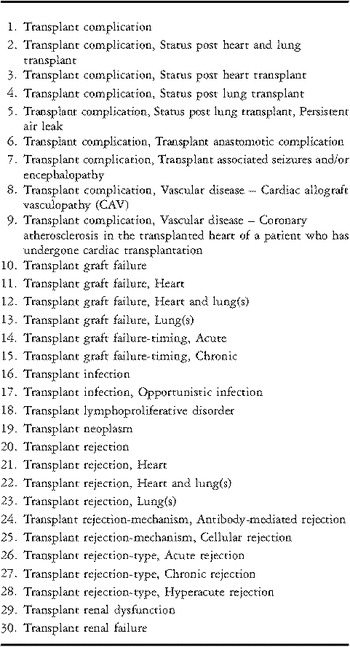
Table 1 lists the terms in the final list of complications related to the transplantation of thoracic organs developed by The Multi-Societal Database Committee for Pediatric and Congenital Heart Disease. The official definition for each of these terms is listed in Part 4 of this Supplement. The following subset of this list will now be defined and discussed, with official definitions from the Multi-Societal Committee placed in quotation marks:
Complications related to the transplantation of thoracic organs: term from the Multi-Societal Database Committee for Pediatric and Congenital Heart Disease.

The above terms are all defined in Part 4 of this Supplement.
• Transplant complication, Vascular disease – Cardiac allograft vasculopathy (CAV)
• Transplant graft failure
• Transplant rejection
• Transplant rejection-mechanism, Antibody-mediated rejection
• Transplant rejection-mechanism, Cellular rejection
• Transplant rejection-type, Acute rejection
• Transplant rejection-type, Chronic rejection
• Transplant rejection-type, Hyperacute rejection
• Transplant renal dysfunction
• Transplant renal failure.
Transplant complication, Vascular disease – Cardiac allograft vasculopathy (CAV)Reference Billingham5–Reference Grattan, Moreno-Cabral, Starnes, Oyer, Stinson and Shumway9
“Cardiac allograft vasculopathy (CAV) is characterized by the proliferation of vascular smooth muscle cells in the allograft and concentric intimal thickening. The etiology of CAV is both immune and non-immune and may be related to ischemia at the time of transplant, humoral rejection, multiple episodes of cellular rejection, and cardiovascular risk factors. CAV leads to significant morbidity and mortality after transplant leading to the possibility of arrhythmogenic sudden death. CAV is diagnosed by the presence of coronary angiographic findings, intravascular ultrasound (though limited in younger donors), and the presence of wall motion abnormalities during dobutamine stress echocardiogram.”
Transplant graft failure
“For thoracic organ transplantation (heart, lung, or heart and lung transplantation), transplant graft failure will be defined as the need for mechanical circulatory support or mechanical cardiopulmonary support and/or relisting for transplant”
This high level definition is utilized rather than physiologic indices, as it is less affected by clinician bias.
Transplant rejection
“Transplant rejection is defined as evidence of rejection after transplantation. Heart transplant rejection is defined as intensification of immunosuppression associated with an abnormal biopsy (equal to or greater than grade 2R by the International Society of Heart and Lung Transplantation [ISHLT]) and/or new-onset hemodynamic abnormalities confirmed by echocardiography. Rejection in a heart-lung transplant recipient is defined as intensification of immunosuppression associated with an abnormal biopsy (equal to or greater than grade 2R by the International Society of Heart and Lung Transplantation [ISHLT]) and/or new-onset hemodynamic abnormalities confirmed by echocardiography. Lung transplant rejection is defined as intensification of immunosuppression associated with clinical characteristics of rejection and/or an abnormal biopsy with histologic classification of Grade A by the International Society of Heart and Lung Transplantation [ISHLT] in the acute setting, and by the development of bronchiolitis obliterans in the chronic setting.”
Transplant rejection-mechanism, Antibody-mediated rejection
“Antibody-mediated rejection (AMR) is defined as rejection where donor specific antibodies are involved in the rejection process. AMR can happen early post-transplant from pre-formed antibodies, or from the persistence of these antibodies later on after transplant, or from the de novo development of donor specific antibodies. AMR results in the pathohistological findings of C4d deposition, endothelial cell activation, and interstitial edema with cell injury. Antibody induces rejection acutely through the fixation of complement, resulting in tissue injury and coagulation. In addition, complement activation recruits macrophages and neutrophils, causing additional endothelial injury. Antibody and complement also induce gene expression by endothelial cells, which is thought to remodel arteries and basement membranes, leading to fixed and irreversible anatomical lesions that permanently compromise graft function.”
Transplant rejection-mechanism, Cellular rejection
“Cellular rejection is defined as rejection where graft antigens are recognized by T cells which mediate this rejection. This recognition of antigen by T cells results in activation of these cells. Activated T cells cause the graft cells to lyse or produce cytokines that recruit other inflammatory cells, eventually causing necrosis of allograft tissue.”
Transplant rejection-type, Acute rejection10, Reference Snell, Boehler and Glanville11
“In acute rejection, graft antigens are recognized by T cells; the resulting cytokine release eventually leads to tissue distortion, vascular insufficiency, and cell destruction. Histologically, leukocytes are present, dominated by equivalent numbers of macrophages and T cells within the interstitium. These processes can occur within 24 hours of transplantation and occur over a period of days to weeks. ([http://www.emedicine.com/ped/topic2841.htm], accessed July 20, 2006). Acute rejection usually begins after the first week of transplantation, and most likely occurs to some degree in all transplants (except between identical twins). It is caused by mismatched HLA antigens that are present on all cells. HLA antigens are polymorphic; therefore, the chance of a perfect match is extremely rare. The reason that acute rejection occurs a week after transplantation is because the T-cells involved in rejection must differentiate and the antibodies in response to the allograft must be produced before rejection is initiated. These T-cells cause the graft cells to lyse or produce cytokines that recruit other inflammatory cells, eventually causing necrosis of allograft tissue. Endothelial cells in vascularized grafts are some of the earliest victims of acute rejection. The risk of acute rejection is highest in the first 3 months after transplantation, and is lowered by immunosuppressive agents in maintenance therapy. However, acute rejection can occur at any time after transplantation. The onset of acute rejection is combated by intensification of immunosuppression with episodic treatment. ([http://biomed.brown.edu/Courses/BI108/BI108_2004_Groups/Group04/Rejection_overview.htm], accessed July, 20, 2006). Acute cardiac rejection is diagnosed in the situation of new cardiac failure symptoms with associated hemodynamic compromise, or new echocardiographic findings of cardiac dysfunction, with or without histologic evidence of rejection. Acute rejection requires rescue therapy with pulse dose steroids, anti-thymocyte globulin, and antibody directed therapy including plasmapheresis. Acute lung rejection is defined by the International Society of Heart and Lung Transplantation (ISHLT) as Grade A rejection according to a revised clinical update of the 1996 lung allograft rejection working formula. This formulation utilized Grades A through D to define rejection, with grade A being the “gold standard” for the assessment of acute allograft rejection, though it must be interpreted in the setting of the clinical findings. In the 2007 update to the above working formulation, Grade A rejection is stated as being “robust and reproducible”, though the other grades have fallen short of this measure and their clinical correlations have been minimal.”
Transplant rejection-type, Chronic rejection12, 13
“Chronic rejection occurs months to years after transplantation. In chronic rejection, pathologic tissue remodeling results from peritransplant and posttransplant trauma. ([http://www.emedicine.com/ped/topic2841.htm], accessed July 20, 2006). It is characterized by graft arterial occlusions, which results from the proliferation of smooth muscle cells and production of collagen by fibroblasts. This process, termed accelerated or graft arteriosclerosis, results in fibrosis that can cause ischemia and cell death. ([http://biomed.brown.edu/Courses/BI108/BI108_2004_Groups/Group04/Rejection_overview.htm], accessed July, 20, 2006). This process of chronic rejection is not an acute postoperative entity. Chronic rejection is dominated by the response of the transplanted organ tissue itself. Chronic rejection typically occurs after hospital discharge from the transplantation. Therapy for chronic rejection involves intensification of baseline immunosuppressive regimen, followed by the addition of steroids, anti-thymocyte globulin and total lymphocyte irradiation in refractory cases. Chronic cardiac transplant rejection is the presence of graft dysfunction and/or cardiac allograft vasculopathy and may occur months to years after transplantation. For cardiac transplantation, this disease is often manifest as coronary artery disease (CAD) and is known as “transplant graft vasculopathy” or “cardiac allograft vasculopathy (CAV)” ([http://www.clinicaltrials.gov/ct/show/NCT00042614], accessed July 20, 2006). Chronic rejection after cardiac transplantation involves new electrocardiographic (ECG), lab, or other clinical findings consistent with myocardial infarction and/or coronary arterial changes on catheterization lab angiography, CT angiography, or intravascular ultrasound, in addition to persistent findings of histologic rejection on biopsy. Chronic rejection of the lung allograft is defined as a fibrosing process affecting the lung, which primarily affects the conducting airways and the pulmonary vasculature. The process affecting the conducting airways has been labeled bronchiolitis obliterans, while that affecting the pulmonary arteries and veins has been named graft atherosclerosis/graft phlebosclerosis. ([http://path.upmc.edu/divisions/pulmpath/bron02.htm], accessed July 22, 2006). Chronic rejection after lung transplantation is defined as an acute drop in FEV1 of 20% from baseline pulmonary function tests recorded in the first 6 months after transplant. In addition chronic rejection after lung transplantation is characterized by the development of bronchiolitis obliterans.”
Transplant rejection-type, Hyperacute rejection
“Hyperacute rejection occurs usually within the first 24 hours after transplantation and is caused by pre-existing host antibodies to the transplanted organ. Recipients are more prone to have pre-formed reactive antibodies to the Human Leukocyte Antigens (HLA) of other individuals after previous blood transfusions, pregnancies, transplantations, or even exposure to allograft material such as cryopreserved aortic and pulmonary homografts. These preformed anti-graft antibodies bind to antigens present in the graft endothelium. Antigen recognition activates the complement system and is associated with an influx of neutrophils. Endothelial cells and platelets are also induced to shed lipid particles from their membrane that promote coagulation. The resulting inflammation prevents vascularization of the graft. The graft then suffers irreversible damage from ischemia. ([http://biomed.brown.edu/Courses/BI108/BI108_2004_Groups/Group04/Rejection_overview.htm], accessed July, 20, 2006) Hyperacute rejection is usually immediate, and complete graft failure is usually recognized at or near the time of organ reperfusion. For cardiac transplantation, this process occurs at or near the time of initial aortic cross clamp removal and is followed by 1) initiation of mechanical circulatory support and relisting for transplant and/or 2) death.”
Transplant renal dysfunction and transplant renal failure
Transplant renal dysfunction and transplant/renal failure are serious complications that have been shown to increase one year mortality following transplantation. The definitions of renal dysfunction and renal failure as complications of congenital cardiac surgery have been previously presented in this Supplement by Welke and colleagues.Reference Welke, Dearani, Ghanayem, Beland, Shen and Ebels14 The renal abnormalities required for this definition are clearly elaborated in that manuscript, although the key difference between the two terms is the requirement of dialysis and/or haemofiltration to define renal failure.
Controversies
Antibody-mediated rejection
Antibody-mediated rejection has been increasingly recognized as a distinct and important aetiology in the pathogenesis of rejection following renal and cardiac transplantation. Its presence following lung transplantation continues to be debated.Reference Snell, Boehler and Glanville11 In antibody-mediated rejection after cardiac transplantation, deposition of C4d can be found on histology. This, however, remains a challenge in lung transplantation as there is no positive control. Magro and colleaguesReference Magro, Pope Harman and Klinger15 reported that C4d deposition following lung transplantation is a marker of the extent of antibody-mediated rejection, but were unable to correlate it to the presence of anti-HLA antibodies. Miller and colleaguesReference Miller, Destarac and Zeevi16 found elevations of C4d in the bronchoalveolar lavage fluids correlated with anti-HLA antibodies, while WallaceReference Wallace, Reed, Ross, Lassman and Fishbein17 found no evidence of C4d staining in lung biopsies. Therefore, the conflicting evidence makes a definitive conclusion challenging, though there appears to be some evidence that antibody-mediated rejection may be occurring following lung transplantation.
It is widely accepted that antibody-mediated rejection occurs following heart transplantation. The presence of antibody-mediated rejection is clearly confirmed in the setting of graft dysfunction associated with the typical histologic abnormalities of antibody-mediated rejection:
• C4 deposition
• endothelial cell activation, and
• interstitial oedema with cell injury.
A patient with the above constellation of findings would likely be treated with antibody directed therapy including plasmapheresis and/or retuximab. There continues, however, to be controversy surrounding patients in whom there is graft dysfunction without evidence of antibody-mediated rejection on biopsy. Divergent opinions exist on this situation, as some clinicians will treat this patient for antibody-mediated rejection. In addition, patients who have a biopsy consistent with antibody-mediated rejection, or are found to have elevated donor specific antibodies, may be treated by an increase in their baseline immunosuppressive regimen, though not usually with aggressive antibody directed therapy.
Lung transplant primary graft dysfunction
Lung transplant primary graft dysfunction is a term with several synonyms including primary graft failure, early graft dysfunction, and reperfusion injury. The definition that the Multi-Societal group utilized is high level, and requires the need for mechanical cardiopulmonary support and/or relisting for lung transplantation. This definition was utilized, as there is little ambiguity in its application, and it is not subject to provider bias, as discussed above. However, a 2004 International Society for Heart and Lung Transplantation Working Group on Primary Lung Graft DysfunctionReference Christie, Carby and Bag4 defined Primary Graft Dysfunction by grading its severity on a 0–3 scale utilizing a combination of the ratio of arterial oxygen level to inspired oxygen level (the PaO2/FIo2 ratio) and the presence of infiltrates consistent with pulmonary oedema. In addition, patients on mechanical cardiopulmonary support were also given a grade of 3. This working group elected to not give a “yes/no” definition to primary graft dysfunction, as they felt their “understanding of PGD is in an early stage and insisted that the first step should be standardization of defining criteria.” Due to the fact that the grading of primary graft dysfunction is in its infancy, the Multi-Societal group elected to utilize the criteria of mechanical cardiopulmonary support and listing for retransplant as the definition, due to its lack of ambiguity and ability to be replicated. The Multi-Societal Committee realizes that the process of deterioration to graft failure is a continuous process. We would use the term “graft failure” to apply to Grade 3 Primary Lung Graft Dysfunction, and we would use the term “graft dysfunction” to the earlier stages that do not necessitate mechanical circulatory support or mechanical cardiopulmonary support and/or relisting for transplantation.
Interactions with cardiovascular system
Complications following thoracic transplantation that lead to interactions with the cardiovascular system typically occur in the setting of dysfunction and failure of the graft. As the health of the graft necessarily predicts the health of the patient, rigorous efforts to reduce the incidence of primary failure of the graft and severe episodes of rejection of the graft are vital. In addition, future research that targets the reduction in these episodes of dysfunction and failure of transplanted organs have the potential to improve dramatically the life of patients following thoracic transplantation, as well as improving the function and survival of the grafted organs.
Acknowledgement
We thank The Children’s Heart Foundation (http://www.childrensheartfoundation.org/) for financial support of this research.