Significant outcomes
-
We find a small increased risk of any mental disorder resulting in a risk difference of 0.47% between caesarean section and vaginal birth, that is unlikely to be of substantial clinical relevance and may be explained by unmeasured confounding.
-
Our findings propose that there is either limited or no impact of birth by caesarean section on the offspring’s risk of developing a mental disorder.
-
This will tip the scale of evidence to the safety of caesarean section and help improve the quality of future reviews and meta-analysis on the subject.
Limitations
-
A limitation of this study is the absence of specific information in the registers on the indications of a planned caesarean section.
-
We had no direct measures on birth complications or neonatal outcomes (e.g., duration, complications, hypoxia, etc.).
-
In addition, although including several important confounders and using advanced statistical techniques, an observational study may always be limited by the potential of unmeasured residual confounding.
Introduction
Caesarean section is the chosen mode of delivery at every fifth birth in Denmark (Bliddal et al., Reference Bliddal, Broe, Pottegård, Olsen and Langhoff-Roos2018) and increasing rates of caesarean sections worldwide have led to investigations of the long-term effects of caesarean section on the offspring’s health (Keag, et al., Reference Keag, Norman and Stock2018; Sandall et al., Reference Sandall, Tribe, Avery, Mola, Visser, Homer, Gibbons, Kelly, Kennedy, Kidanto, Taylor and Temmerman2018). Being born by caesarean section has in both animal and human studies been found to decrease the diversity of the offspring’s microbiota during the first years of life (Hansen et al., Reference Hansen, Andersen, Krych, Metzdorff, Hasselby, Skov, Nielsen, Buschard, Hansen and Hansen2014; Rutayisire et al., Reference Rutayisire, Huang, Liu and Tao2016; Shao et al., Reference Shao, Forster, Tsaliki, Vervier, Strang, Simpson, Kumar, Stares, Rodger, Brocklehurst, Field and Lawley2019). Since gut microbiota alterations have been suggested as a risk factor for mental disorders and to be involved in the regulation of mental health through a bidirectional microbiota–gut–brain link (Zhu et al., Reference Zhu, Hu, Deng, Tan, Qiu, Zhang, Ni, Lu, Wang, Li, Chen, Huang, Xiao, Shang and Wen2021), it has been hypothesised that caesarean section-induced microbiota alterations could increase the risk of mental disorders (Cho and Norman, Reference Cho and Norman2013). Furthermore, caesarean section has also been associated with an increased risk of developing obesity (Kuhle, et al., Reference Kuhle, Tong and Woolcott2015), allergy (Keag, et al., Reference Keag, Norman and Stock2018), asthma (Huang et al., Reference Huang, Chen, Zhao, Wang, Fang and Bao2015) and type 1 diabetes (Cardwell et al., Reference Cardwell, Stene, Joner, Cinek, Svensson, Goldacre, Parslow, Pozzilli, Brigis, Stoyanov, Urbonaitė, Šipetić, Schober, Ionescu-Tirgoviste, Devoti, de Beaufort, Buschard and Patterson2008), which are also associated with increased risks of mental disorders.
Prior studies on the association between caesarean section and mental disorders have focussed on specific mental disorders with mixed results. A recent systematic review and meta-analysis on the association between caesarean section and the risk of neurodevelopmental and psychiatric disorders in the offspring with over 20 million deliveries found increased risks of attention deficit hyperactive disorder (ADHD) by 17% (OR, 1.17; 95% CI, 1.07–1.26; n = 92,426) and autism spectrum disorders by 33% (OR, 1.33; 95% CI, 1.25–1.41; n = 57,753) in children born by caesarean section compared to vaginal birth (Zhang et al., Reference Zhang, Sidorchuk, Sevilla-Cermeño, Vilaplana-Pérez, Chang, Larsson, Mataix-Cols and Fernández de la Cruz2019). Estimates were not significantly elevated for obsessive-compulsive disorder (OR, 1.49; 95% CI, 0.87–2.56; n = 17,295), tic disorders (OR, 1.31; 95% CI, 0.98–1.76; n = 6181), eating disorders (ED) (OR, 1.18; 95% CI, 0.96–1.47; n = 4519) or depression/affective psychoses (OR, 1.06; 95% CI, 0.98–1.14; n = 8095), and there was no association with non-affective psychoses (OR, 0.96; 95% CI, 0.78–1.21; n = 6683). However, the included studies had a high level of unexplainable heterogeneity and there were no studies on specific personality disorders or on the overall risk of mental disorders. Another meta-analysis found that caesarean section was associated with a small increased risk of ADHD (OR, 1.14; 95% CI: 1.11, 1.17) in the offspring; however when pooling data from studies using a sibling control design (Curran et al., Reference Curran, Khashan, Dalman, Kenny, Cryan, Dinan and Kearney2016; O’Neill et al., Reference O’Neill Séad, Curran, Dalman, Kenny, Kearney, Clarke, Cryan, Dinan and Khashan2016; Axelsson et al., Reference Axelsson, Clausen, Petersen, Hageman, Pinborg, Kessing, Bergholt, Rasmussen, Keiding and Løkkegaard2019b, Reference Axelsson, Petersen, Hageman, Pinborg, Kessing, Bergholt, Rasmussen, Keiding, Clausen and Løkkegaard2020), the association diminishes to only a marginally significant increase in ADHD risk (OR, 1.06; 95% CI: 1.00, 1.13) (Xu et al., Reference Xu, Zhang, Zhou, Jiang, Jiang and Zhou2020). In line with this, a very recent cohort study in a Swedish population investigated several neurodevelopmental and psychiatric disorders and similarly only found a very small increased risk, which was attenuated after adjusting for within-familial confounding by the use of sibling comparisons, and the study concluded that the association was very likely due to unmeasured confounding (Zhang et al., Reference Zhang, Brander, Mantel, Kuja-Halkola, Stephansson, Chang, Larsson, Mataix-Cols and Fernández de la Cruz2021). Thus, the conflicting results in the previous literature may be due to differences in study designs, insufficient adjustment for confounding and inappropriate adjustment for variables that lie on the causal pathway which may lead to overadjustment bias and residual confounding that previous studies failed to sufficiently adjust for (Xu et al., Reference Xu, Zhang, Zhou, Jiang, Jiang and Zhou2020). Furthermore, large-scale studies have been lacking on the association between mode of delivery and risk of the entire spectrum of mental disorders.
In this study, we utilised the nationwide Danish registers with up to 36 years of follow-up to investigate caesarean section and the risk of all mental disorders as the primary outcome in an overall group and the risk of specific mental disorders as secondary outcomes. To address the conflicting results in the previous literature, we used three different adjustment models with different levels of confounding and inverse probability weighting to adjust for confounding.
Methods and materials
Study design and population
The present study is a nationwide observational cohort study covering the entire Danish population. Data were obtained from Danish nationwide registers by the use of the unique personal registration number assigned to all Danes at birth by the Danish Civil Registration System (Pedersen, Reference Pedersen2011), permitting linkage between the national registers and including information on parents and siblings from 1968. We identified all individuals born in Denmark between January 1st, 1980 and December 31st, 2015. All individuals were followed from birth to outcome (see below), emigration, death, or end of follow-up on December 31st, 2016, whichever came first (Fig. 1).
Events during follow-up among exposure groups.

Exposure: mode of delivery
Caesarean sections were identified as operational codes for caesarean section procedures (Table S1) matched to offspring within 5 days of birth from the Danish National Patient Register, where information on all patient contacts since 1977 are registered (Andersen et al., Reference Andersen, Madsen, Jørgensen, Mellemkjoer and Olsen1999). Births not identified as “Caesarean Section” were categorised as “Vaginal Birth” (Table S1). Where possible, we categorised caesarean sections as “acute” or “planned” and “prelabour” or “intrapartum”. It was not possible to identify pre-delivery indications for caesarean section.
Outcome: mental disorders
Mental disorders were identified through the Danish Psychiatric Central Research Register, which holds information on all in-patient contacts in psychiatric hospitals since 1969 (Mors, et al., Reference Mors, Perto and Mortensen2011). For a broad assessment of the risk of mental disorders, we identified as the primary outcome any mental disorder (ICD-10: F00-99 or ICD-8: 290-315) that was diagnosed during an in-patient admission. Secondly, we identified specific diagnostic groups (Table S2). We further made a sensitivity analysis by including all in-patient, out-patient and emergency room contacts among people born in 1995 or later.
Confounders and covariates
Data on the following covariates at childbirth were available for the adjusted analyses: Sex and birth year for offspring, parental age at birth of offspring, number of siblings and birth order (Andersen et al., Reference Andersen, Madsen, Jørgensen, Mellemkjoer and Olsen1999). As proxies for socio-economic status or genetic susceptibility of mental disorders, we adjusted for parental highest educational degree (Jensen and Rasmussen, Reference Jensen and Rasmussen2011), parental work status (Pedersen, Reference Pedersen2011) and parental history of any mental disorders (ICD-10: F00-99 or ICD-8: 290-315) prior to childbirth since 1969 (Mors, et al., Reference Mors, Perto and Mortensen2011). We adjusted for paternal and maternal Charlson Comorbidity Index (Charlson et al., Reference Charlson, Pompei, Ales and MacKenzie1987) and the number of paternal and maternal severe infections requiring hospital admission prior to birth of the offspring and available since 1977, and the number of paternal and maternal severe infections requiring hospital admission 35 weeks prior to the day of birth (Andersen et al., Reference Andersen, Madsen, Jørgensen, Mellemkjoer and Olsen1999). We adjusted for confounders measured after exposure: birthweight (Andersen et al., Reference Andersen, Madsen, Jørgensen, Mellemkjoer and Olsen1999), breech presentation (Andersen et al., Reference Andersen, Madsen, Jørgensen, Mellemkjoer and Olsen1999), eclampsia (Andersen et al., Reference Andersen, Madsen, Jørgensen, Mellemkjoer and Olsen1999), 5-min Apgar score (Bliddal et al., Reference Bliddal, Broe, Pottegård, Olsen and Langhoff-Roos2018) and other birth-related factors: gestational age at birth (Bliddal et al., Reference Bliddal, Broe, Pottegård, Olsen and Langhoff-Roos2018), instrument use at delivery (Andersen et al., Reference Andersen, Madsen, Jørgensen, Mellemkjoer and Olsen1999; Bliddal et al., Reference Bliddal, Broe, Pottegård, Olsen and Langhoff-Roos2018) and induction of labour (Andersen et al., Reference Andersen, Madsen, Jørgensen, Mellemkjoer and Olsen1999; Bliddal et al., Reference Bliddal, Broe, Pottegård, Olsen and Langhoff-Roos2018). Full list of linked registers can be found in Table S3. Baseline characteristics of the study population are shown in Tables S4–6.
Models for different levels of confounder adjustment
We adjusted for confounding using models with different adjustment level, which is displayed in Table 1. Model 1 is adjusted for confounders measured before exposure only. Model 2 is adjusted for confounders measured before exposure and specific confounders found based on a literature search (see Figure S1) on perinatal risk factors of mental disorders and of labour by Caesarean section. This model is used for our primary analyses. Model 3 included confounders measured before exposure and confounders that act as indicators of fetal stress before birth though measured after birth (Model 3).
Confounder adjustment progression in the models of this study

Abbreviations: CS = caesarean section; VD = vaginal delivery.
Model 0 is with basic adjustments. Model 1 is adjusted for confounders measured before exposure only. Model 2 includes the confounders we found via a search of previous literature on perinatal risk factors of mental disorders and of caesarean section (supplementary figure S1) plus those from model 1. Model 3 includes all available confounders that were used in the previous literature that also investigated the risk of mode of delivery on a mental disorder as outcome.
Statistical Analyses
The primary analysis evaluated relative and absolute risk contrasts based on estimated risk functions (cumulative incidence) by mode of delivery for developing severe mental disorders requiring treatment or diagnosis at a psychiatric hospital standardised to the joint distribution of confounders. The hazard of mental disorders was estimated using a logistic regression with inverse probability weighting to adjust for confounding, and we used G-methods to adjust for confounding (Robins, et al., Reference Robins, Hernan and Brumback2000; Hernan et al., Reference Hernán, Alonso, Logan, Grodstein, Michels, Willett, Manson and Robins2008; Cole et al., Reference Cole, Hudgens, Brookhart and Westreich2015; Hernán and Robins, Reference Hernán and Robins2020). Delivery-specific 6-degree cubic splines were used to model the hazard in monthly intervals over subject age with linear effect of birth year. Inverse probability weights for confounder adjustment were estimated in a logistic regression model with additive effects of all confounders as coded in Tables S4–6. Missing baseline information was rare (<3%) and affected subjects were excluded from the analyses. Death was treated as a competing event and the cumulative incidence of mental disorder was estimated by integration of the cause-specific hazard for mental disorders using the Nelson–Aalen method (Andersen et al., Reference Andersen, Geskus, de Witte and Putter2012) and 95% confidence intervals were estimated with the two-sample percentile bootstrap method using 1000 bootstrap samples.
In contrast to the often-reported incidence ratios or hazard ratios, the methods applied for estimating risk differences and risk ratios in this paper have a more direct clinical interpretation and also include the potential for a causal effect interpretation under certain assumptions including exchangeability and no unmeasured confounding (Hernán and Robins, Reference Hernán and Robins2020).
Secondary analyses were conducted for the mode of delivery regarding the risk of specific mental disorders. Additionally, sensitivity analyses were conducted on intrapartum versus prelabour caesarean section and acute versus planned caesarean section. Further we looked at the risk of any mental disorder at age 22 when using both in-patient, out-patient and emergency room contacts among people born after 1995 as outcome measures. In addition, we calculated the risks for specific mental disorders. All secondary analyses used the same methods as the primary analysis.
All statistical analyses were performed using R software version 3.6.1 (Team, Reference Team2019).
Results
The cohort consisted of 2,196,687 children born January 1st, 1980 to December 31st, 2015, with 38.5 million observation-years of follow-up from January 1st, 1980 to December 31st, 2016 (see Table S4–6 for characteristics of the study population). A total of 364,908 (16.6%) children were born by caesarean section while 1,831,779 (83.4%) were born by vaginal delivery. A total of 44,352 (2.0%) individuals were diagnosed with a mental disorder during admission to a psychiatric facility during the study period, of which 6,268 (14.1%) had been exposed to birth by caesarean section. During our study period, caesarean section increased from 10.4% in 1980 to 19.2% in 2015. The primary analyses and sensitivity analyses presented below are adjusted for all covariates presented in Table S4–6. Results for confounder adjustment models 1 and 2 (primary analysis) and model 3 are presented separately in a section below.
Caesarean section and the risk of any treated mental disorder
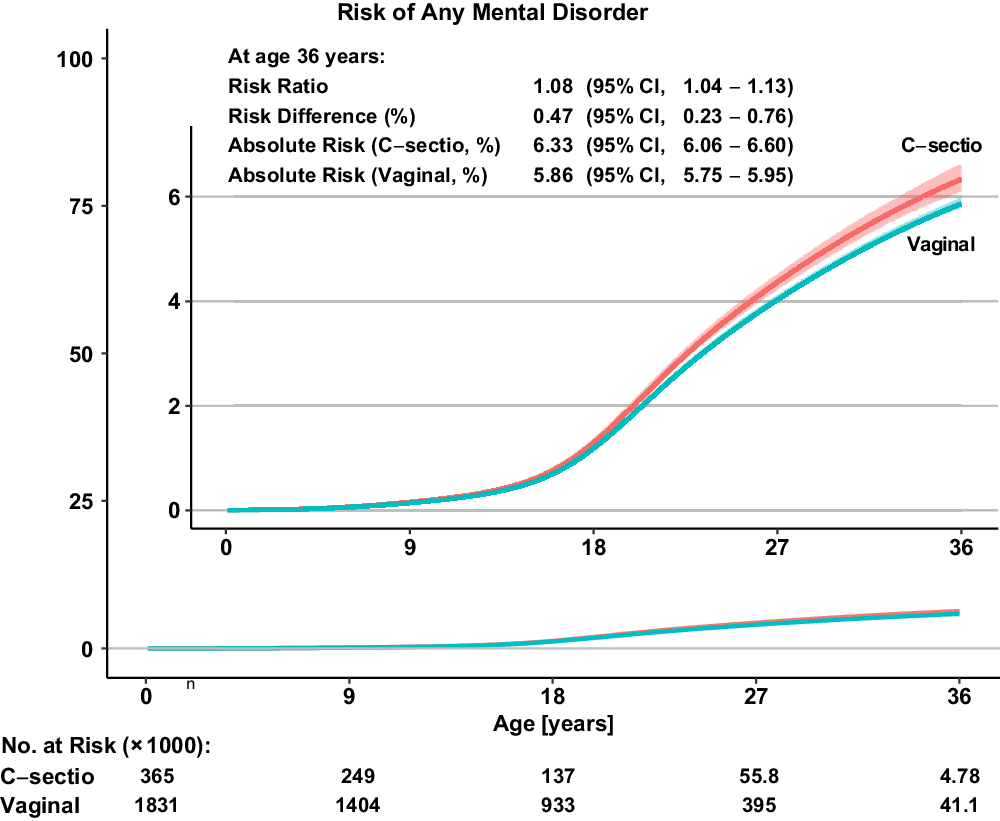
The primary analysis showed that children exposed to birth by caesarean section had an increased risk of 8% for any treated mental disorder (risk ratio (RR), 1.08; 95% CI, 1.04–1.13) compared with children born vaginally (Fig. 2). The absolute risk of developing a mental disorder at age 36 for caesarean section was 6.33% (95% CI, 6.06–6.60) and the absolute risk at age 36 for children born vaginally was 5.86% (95% CI, 5.75–5.95) resulting in an absolute risk difference of 0.47% (95% CI, 0.23–0.76) (Fig. 2).
Risk of any mental disorder on offspring by mode of delivery grouped as either caesarean section or vaginal delivery among 2,196,687 individuals. Legend: Abbreviations: C-section = caesarean section; Vaginal = vaginal delivery; 95% CI = 95% confidence interval; No. = Number. The analyses were adjusted for age, gender, birth decade, parental educational level, parental income, parental work status, parental hospitalisations for infections, Charlson comorbidity index, parental mental disorders, birth order, multiple births, birth weight, breech presentation and preeclampsia/eclampsia.

Caesarean section and the risk of specific mental disorders
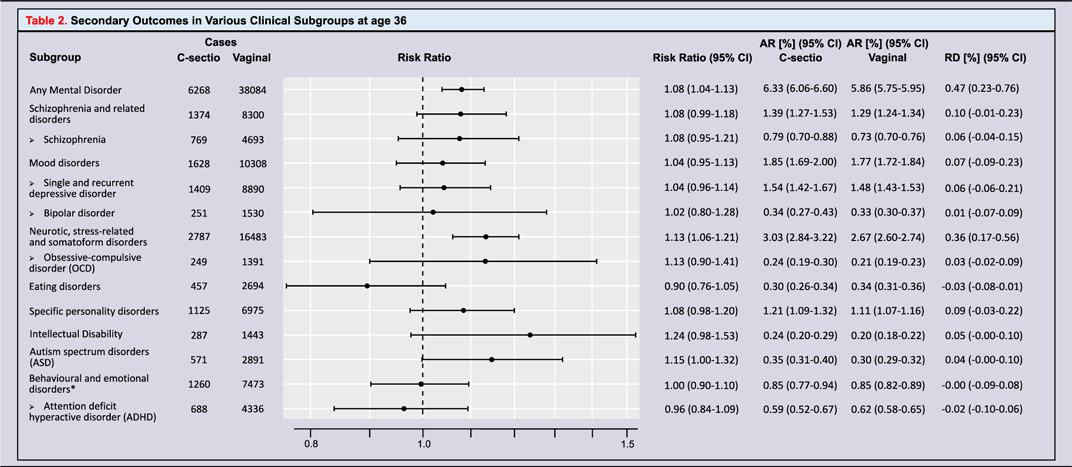
When investigating specific mental disorders, we found that caesarean section was associated with a 15% (relative risk (RR), 1.15; 95% CI, 1.00–1.32) increased RR of autism spectrum disorders, but the risk difference was 0.04% (RD, 0.04; 95% CI, −0.00 to 0.10) (Table 2, Figure S2 and 3). In addition, we found a significantly increased RR for neurotic, stress-related and somatoform disorders of 13% (95% CI, 1.06–1.21) with a risk difference of 0.36% (RD, 0.36; 95% CI, 0.17–0.56). None of the other specific disorders we investigated showed a significantly increased risk, although the point estimate was comparable for Schizophrenia and related disorders (RR, 1.08; 95% CI, 0.99–1.18) and specific personality disorders (RR, 1.08; 95% CI, 0.98–1.20).
Risk of specific categories of mental disorders and specific disorders in offspring after exposure to birth by caesarean section or vaginal delivery

Abbreviations: RR = Risk ratio; AR = Absolute risk; RD = Risk Difference; C-sectio = caesarean section; Vaginal = Vaginal Delivery; 95%-CI = 95% confidence interval.
*…with onset usually occurring in childhood and adolescence.
The definitions of the specific diagnostic codes that the subgroups exist of are listed in Supplementary Table S5.
The analyses were adjusted for age, gender, birth decade, parental educational level, parental income, parental work status, parental hospitalisations for infections, Charlson comorbidity index, parental mental disorders, birth order, multiple births, birth weight, breech presentation and preeclampsia/eclampsia.
Cases = number of subjects with diagnosis of any mental disorder.
Sensitivity analyses
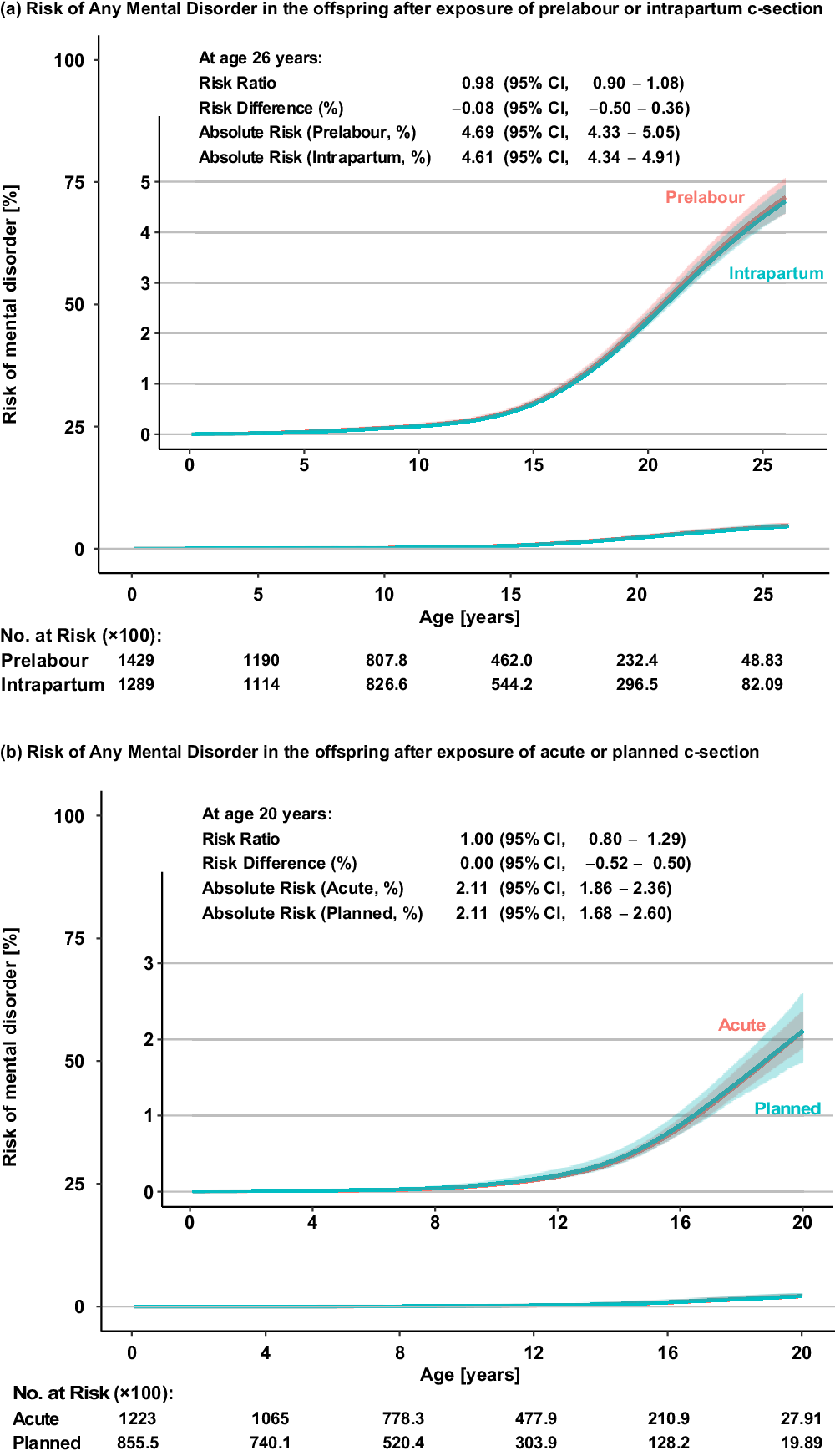
When we included both in-patient, out-patient and emergency room contacts among people born after 1995, we found that the association with the offspring having any mental disorder at age 22 diminished (RR, 1.04; 95% CI, 0.99–1.09) (Table S7). The absolute risk of developing a mental disorder at age 22 for offspring born by caesarean section was 17.82% (95% CI, 17.13–18.93) and the absolute risk at age 22 for offspring born vaginally was 17.06% (95% CI, 16.28–18.60) resulting in an absolute risk difference of 0.77% (95% CI, –0.11–1.42). We found no evidence of an effect of exposure to prelabour caesarean section (RR, 0.98; 95% CI, 0.90–1.08) relative to intrapartum caesarean section (Fig. 3A). Moreover, we found no evidence of an effect of exposure to acute caesarean section (RR, 1.00; 95% CI, 0.80–1.29) compared with offspring exposed to planned caesarean section (Fig. 3B).
(A) Risk of any mental disorder in the offspring depending on the type of caesarean section grouped as prelabour or intrapartum caesarean section. (B) Risk of any mental disorder in the offspring depending on the type of caesarean section grouped as acute or planned caesarean section. Legend: (A/B) Abbreviations: C-section = caesarean section; 95% CI = 95% confidence interval. The analyses were adjusted for age, gender, birth decade, parental educational level, parental income, parental work status, parental hospitalisations for infections, Charlson comorbidity index, parental mental disorders, birth order, multiple births, birth weight, breech presentation and preeclampsia/eclampsia.

Confounder models
The primary analyses using model 2 level confounder adjustment (Table 1) showed that offspring exposed to birth by caesarean section had an increased risk of 8% for any treated mental disorder at age 36 (RR, 1.08; 95% CI, 1.04–1.13) compared with offspring born vaginally. Model 1 showed an increased risk of 10% (RR, 1.10; 95% CI, 1.07–1.14) and model 3 showed an increased risk of 9% (RR, 1.09; 95% CI, 1.03–1.16). When we included in-patient, out-patient and emergency room contacts among people born after 1995, model 1 showed an increased risk of 8% for any treated mental disorder at age 22 (RR, 1.08; 95% CI, 1.05–1.10) but model 2 and model 3 showed no significantly increased risk (model 2: RR. 1.04; 95% CI, 0.99–1.09; model 3: RR 1.03; 95% CI, 0.99–1.07).
Discussion
In this nationwide population-based observational cohort study of over two million children, caesarean section was associated with a small increased RR of 8% of being hospitalised with a mental disorder at age 36 compared with those born vaginally with a small absolute risk difference of 0.47% between the two exposure groups. The clinical relevance of this small excess risk is limited and may be explained by unmeasured confounding such as exposure to hypoxia or other factors causing foetal distress prior to birth. When we included both in-patient, out-patient and emergency room contacts among people born after 1995 as outcome measures, the RR at age 22 was 4%, but with confidence intervals of the RR ranging from a 1% decrease, a small negative association, to a 9% increase. This result also emphasises the limited clinical relevance. We compared intrapartum caesarean section to prelabour caesarean section to look at a proxy of whether the child had been in contact with the maternal vaginal microbiota, as intrapartum caesarean section is likely to cause rupture of membranes allowing contact between maternal vaginal microbiota and the child. But we found no difference in the risk of mental disorders when comparing it to prelabour caesarean section with the child presumably being delivered in intact membranes. Additionally, the risk of mental disorders did not depend on the severity of the caesarean section analysed in the comparison of planned caesarean section versus acute caesarean section, which might indicate differences in the level of a stressful environment for both the child and the parents during birth. We showed, through different levels of confounder adjustment models without using a sibling-control design, the RR to be from 8 to 12%. There was an increase in risk when adjusting for less covariate factors, except for when using model 3 additionally adjusting for gestational period, Apgar score, induction of labour and instrument use at delivery. When looking at specific mental disorders, we particularly found that caesarean section was associated with a 15% increased RR of being diagnosed with autism and a 13% increased RR of neurotic, stress-related and somatoform disorders; however, with small risk differences between the two exposure groups and non-negligible uncertainty.
Our nationwide study represents the first study to date investigating the association between mode of delivery and the risk of the entire spectrum as well as specific mental disorders in the offspring. Previous studies have reported conflicting results when investigating the risk of specific mental disorders following delivery by caesarean section, with some studies indicating that the risk of autism and ADHD may be increased (Zhang et al., Reference Zhang, Sidorchuk, Sevilla-Cermeño, Vilaplana-Pérez, Chang, Larsson, Mataix-Cols and Fernández de la Cruz2019). In contrast, three recent large cohort studies based on the Danish nationwide registers showed no increased risk of affective disorders (Axelsson et al., Reference Axelsson, Petersen, Hageman, Pinborg, Kessing, Bergholt, Rasmussen, Keiding, Clausen and Løkkegaard2020), ADHD (Axelsson et al., Reference Axelsson, Clausen, Petersen, Hageman, Pinborg, Kessing, Bergholt, Rasmussen, Keiding and Løkkegaard2019a) or autism (Axelsson et al., Reference Axelsson, Clausen, Petersen, Hageman, Pinborg, Kessing, Bergholt, Rasmussen, Keiding and Løkkegaard2019b) after being born by caesarean section. A very recent cohort study in a Swedish population looking at several neurodevelopmental and psychiatric disorders similarly only found a very small increased risk, which was attenuated after adjusting for within-familial confounding by the use of sibling comparisons, and the study concluded that the association was very likely due to unmeasured confounding (Zhang et al., Reference Zhang, Brander, Mantel, Kuja-Halkola, Stephansson, Chang, Larsson, Mataix-Cols and Fernández de la Cruz2021). The previous literature has been difficult to compare due to differences in study designs regarding inclusion of confounders and statistical methods. This was also emphasised in a recent meta-analysis that showed high statistical heterogeneity between the included studies (Zhang et al., Reference Zhang, Sidorchuk, Sevilla-Cermeño, Vilaplana-Pérez, Chang, Larsson, Mataix-Cols and Fernández de la Cruz2019). We suspect this to be due to the fact that some studies use minimal adjustment for confounding while others adjust for confounding by the use of sibling models. Due to ethical issues, it is not possible to perform a randomised control trial on birth mode and when the exposure is not random, then there are many factors (confounders) that can attribute to the mode of delivery that may also have contributed to an increased risk of mental disorder in the offspring. Our present study aimed to estimate absolute as well as RRs while adjusting for relevant confounders. To find the relevant confounders, we looked at which factors before the exposure lie on the causal pathway. We then did an extensive search on perinatal risk factors of mental disorders and of caesarean section in order to summarise which risk factors were relevant based on previous literature on perinatal factors. Furthermore, we looked at the previous studies investigating the relationship between birth by caesarean section and mental disorders in order to have a comparable model.
Strengths and Limitations
Our findings are strengthened by several factors, such as the prospective design and the well-validated nationwide registers of the entire Danish population, minimising the risk of selection and recall bias. Another strength is the thorough literature search on perinatal risk factors of mental disorders and of caesarean section for identification of shared risk factors and potential confounders. We made four different models with different levels of confounder adjustment to illustrate the results when adjusting for basic factors (model 0), factors only before exposure (model 1), shared risk factors (model 2) and further potential birth-related confounders measured after exposure, but that act as indicators of fetal stress before birth (model 3).
A limitation of this study is the absence of specific information in the registers on the indications of a planned caesarean section; however, we found no difference in the risks when comparing the different types of caesarean sections, which indicates that the indications behind the caesarean section are of less importance to our result. Furthermore, we had no direct measures on birth complications or neonatal outcomes (e.g., duration, complications, hypoxia, etc.). In addition, although including several important confounders and advanced statistical techniques, an observational study may always be limited by the potential of unmeasured residual confounding. For our outcome measure, we chose to only include in-patient contacts for uniformity throughout the study period because the registers hold data on out-patient and emergency room contacts since 1995 only. We performed a sensitivity analysis where we included data on both in-patient, out-patient and emergency rooom contacts since 1995 and the difference in risk was smaller. This further highlights the limited clinical relevance of the previously found association.
Conclusion
Birth by caesarean section was associated with only a very small increased risk of any mental disorder in the offspring by 8%; however, this may be explained by unmeasured confounding and the risk difference of 0.47% is unlikely to be of substantial clinical relevance. Moreover, in our sensitivity analyses where we included both in-patient, out-patient and emergency room contacts among people born after 1995, we found that the very small risk increase of birth by caesarean section diminished further to 4% with confidence intervals of the RR ranging from a 1% decrease to a 9% increase. Thus, we conclude that caesarean section may have only a limited impact or no impact on the risk of developing mental disorders.
Supplementary material
To view supplementary material for this article, please visit https://doi.org/10.1017/neu.2022.27
Author contributions
The conceptualisation, visualisation and project administration was contributed by M.E. Benros and O. Köhler-Forsberg. The data curation, formal analysis and methodology was contributed by R. H. Christensen. The supervision was contributed by M. Nordentoft and M.E. Benros. The funding acquisition was contributed by M.E. Benros, O. Köhler Forsberg, M. Nordentoft and A. S. Lerche. The visualisation was contributed by M.E. Benros, R. H. Christensen and A. S. Lerche. The writing of the original draft was contributed by A. S. Lerche. The review and editing of the original draft was contributed by all authors. The underlying data have been accessed and verified by M.E. Benros and R. H. Christensen. The guarantor who accepts full responsibility for the work and the conduct of the study had access to the data and controlled the decision to publish is M.E. Benros.
Financial support
The study was funded by an unrestricted grant from The Lundbeck Foundation (grant number R268-2016-3925). The funding sources had no role in the collection, analysis or interpretation of the data, in writing the manuscript or the decision to publish the findings. The researchers were independent from funders. The corresponding author had full access to all the data in the study and had final responsibility for the decision to submit for publication.
Conflict of interest
All authors have completed the Unified Competing Interest form at www.icmje.org/coi_disclosure.pdf and declare: The study was funded by an unrestricted grant from The Lundbeck Foundation (grant number R268-2016-3925), no financial relationships with any organisations that might have an interest in the submitted work in the previous 3 years, and no other relationships or activities that could appear to have influenced the submitted work.