Introduction
“The very act of inquiring about the quality of life of persons with dementia recognizes them as individuals rather than merely care recipients” (Edelman et al., Reference Edelman, Fulton, Kuhn and Chih-Hung2005)
As there is yet no cure or definitive treatment for dementia, a major focus of care is to facilitate and enhance quality of life (QoL), particularly in the long term care setting (Sloane et al., Reference Sloane, Zimmerman, Williams, Reed, Gill and Preisser2005; Zimmerman et al., Reference Zimmerman, Sloane, Heck, Maslow and Schulz2005a; Reference Zimmerman2005b; Moyle et al., Reference Moyle, McAllister, Venturato and Adams2007; Scholzel-Dorenbos et al., Reference Scholzel-Dorenbos2007; Beer et al., Reference Beer2010; Moyle, Reference Moyle2010; Venturato, Reference Venturato2010) in which the resident with dementia is separated from their own home environment (Moyle, Reference Moyle2010). While there is still no consensus on its precise definition, QoL is generally acknowledged to be a multi-dimensional concept containing both objective (e.g. living situation, functional status) and subjective (e.g. morale, well-being, contentment) components (Logsdon and Albert, Reference Logsdon and Albert1999; Courtney et al., Reference Courtney, Edwards, Stephan, O’Reilly and Duggan2003; Sloane et al., Reference Sloane, Zimmerman, Williams, Reed, Gill and Preisser2005; Scholzel-Dorenbos et al., Reference Scholzel-Dorenbos2007; Venturato, Reference Venturato2010). Thus definitions of the concept tend to be broad, as are the range of factors which are considered to influence it (Courtney et al., Reference Courtney, Edwards, Stephan, O’Reilly and Duggan2003; Sloane et al., Reference Sloane, Zimmerman, Williams, Reed, Gill and Preisser2005). Research over the last two decades has indicated that, due to the results of the aging process and the nature of the long term care environment, factors such as autonomy, choice, and relationships with staff are of particular importance for optimizing the resident's QoL (Courtney et al., Reference Courtney, Edwards, Stephan, O’Reilly and Duggan2003; Edwards et al., Reference Edwards, Courtney and O’Reilly2003). These factors appear to remain important for people with dementia (Maslow and Heck, Reference Maslow and Heck2005; Moyle et al., Reference Moyle, McAllister, Venturato and Adams2007; Venturato, Reference Venturato2010).
Long term care in Australia
Long term residential care forms a substantial component of the Australian aged care system now and into the foreseeable future (Department of Health & Ageing, 2007; Australian Institute of Health & Welfare, 2012), with 2,760 long term care facilities (termed residential aged care facilities (RACFs)) providing care for over 185,000 residents in 2011 (Australian Institute of Health & Welfare, 2012). Government expenditure on these facilities reached almost $9 billion in 2012, compared with $3 billion on community care (Australian Institute of Health & Welfare, 2013). Residents are assessed for their care requirements on admission using the Aged Care Funding Instrument (ACFI), which determines the funding received by facilities and informs their staffing needs; in 2010–2011, 76% of all residents in Australian long term care were classified as needing a high level of care (Australian Institute of Health & Welfare, 2012). Dementia is a major cause for admission to long term care, with more than half of all people admitted having a diagnosis of dementia, rising to 87% for people with high care needs, indicating that much of the care provided in Australian long term care facilities is directed towards residents with dementia.
Investigating QoL in the residential care environment
It is vital that any inquiry into QoL include consideration for self-report, as proxy report does not necessarily capture all relevant aspects of QoL (Edelman et al., Reference Edelman, Fulton, Kuhn and Chih-Hung2005; Maslow and Heck, Reference Maslow and Heck2005; Hoe et al., Reference Hoe, Hancock, Livingston and Orrell2006; Moyle et al., Reference Moyle, McAllister, Venturato and Adams2007; Scholzel-Dorenbos et al., Reference Scholzel-Dorenbos2007; Beer et al., Reference Beer2010; Venturato, Reference Venturato2010; Cahill and Diaz-Ponce, Reference Cahill and Diaz-Ponce2011) and, importantly, while the two scores might be highly correlated, proxy report tends to be lower than self-report (Zimmerman et al., Reference Zimmerman2005b; Hoe et al., Reference Hoe, Hancock, Livingston and Orrell2006; Beer et al., Reference Beer2010). For example, Beer et al. (Reference Beer2010) found a statistically significant 7-point mean difference between proxy and self-reported QoL on the Quality of Life in Alzheimer's Disease scale (QOL-AD) (Logsdon and Albert, Reference Logsdon and Albert1999). However, given the presence of cognitive impairment, if self-reported data are collected in studies of people with dementia, the perspectives of care staff and/or families are usually included as well (Sloane et al., Reference Sloane, Zimmerman, Williams, Reed, Gill and Preisser2005; Zimmerman et al., Reference Zimmerman2005b; Moyle, Reference Moyle2010). To capture QoL issues for people with dementia, increasing attention is being paid to the development of dementia-specific QoL assessment tools (Logsdon and Albert, Reference Logsdon and Albert1999; Scholzel-Dorenbos et al., Reference Scholzel-Dorenbos2007; Venturato, Reference Venturato2010). Researchers have reported that people with Mini-Mental State Exam (MMSE) scores as low as 5 or even 3 out of 30 (equating to severe dementia) are able to provide some information for themselves and use self-report tools (Hoe et al., Reference Hoe, Hancock, Livingston and Orrell2006; Moyle et al., Reference Moyle, McAllister, Venturato and Adams2007; Moyle et al., Reference Moyle, Gracia, Murfield, Griffiths and Venturato2012), although the more universally accepted cut-off for self-report is a MMSE score of 10, equating to moderate dementia (Edelman et al., Reference Edelman, Fulton, Kuhn and Chih-Hung2005; Sloane et al., Reference Sloane, Zimmerman, Williams, Reed, Gill and Preisser2005; Zimmerman et al., Reference Zimmerman2005b; Hoe et al., Reference Hoe, Hancock, Livingston and Orrell2006; Beer et al., Reference Beer2010). Given the multi-dimensional nature of QoL, it is recognized that not all domains of interest can be captured by a single instrument (Moyle, Reference Moyle2010; Cahill and Diaz-Ponce, Reference Cahill and Diaz-Ponce2011), making multi-dimensional assessment vital, particularly for residents with dementia living in long term care (Reimer et al., Reference Reimer, Slaughter, Donaldson, Currie and Eliasziw2004; Maslow and Heck, Reference Maslow and Heck2005; Sloane et al., Reference Sloane, Zimmerman, Williams, Reed, Gill and Preisser2005; Zimmerman et al., Reference Zimmerman2005b; Moyle, Reference Moyle2010; Venturato, Reference Venturato2010). Moyle (Reference Moyle2010) also suggested that mixed methods (qualitative and quantitative design) should be considered with this group to enable optimum depth and breadth of data, while Cahill and Diaz-Ponce (Reference Cahill and Diaz-Ponce2011) suggested that qualitative methods are particularly useful for gaining the perspective of severely cognitively impaired individuals, who might otherwise be unable to participate.
Aims of this study
In a 2005 special issue of The Gerontologist, Zimmerman and colleagues (Sloane et al., Reference Sloane, Zimmerman, Williams, Reed, Gill and Preisser2005; Zimmerman et al., Reference Zimmerman, Sloane, Heck, Maslow and Schulz2005a; Reference Zimmerman2005b) reported on the Collaborative Studies of Long Term Care (CS-LTC) Dementia Care Study, a large, comprehensive study investigating QoL for residents with dementia in long term care settings (Maslow and Heck, Reference Maslow and Heck2005; Zimmerman et al., Reference Zimmerman, Sloane, Heck, Maslow and Schulz2005a). QoL was assessed using three self-completion instruments, three proxy instruments, and three observational tools (Sloane et al., Reference Sloane, Zimmerman, Williams, Reed, Gill and Preisser2005; Zimmerman et al., Reference Zimmerman2005b); one proxy measure was also repeated after six months (Zimmerman et al., Reference Zimmerman2005b). Proxy QoL data were collected from direct care staff members, and self and proxy QoL reports yielded different results. Resident reported QoL was associated with comorbidities and grooming, unlike proxy reported QoL which was considered to be poorer in the presence of greater cognitive impairment, reduced functional capacity, increased behavioral symptoms, and depression (Edelman et al., Reference Edelman, Fulton, Kuhn and Chih-Hung2005; Zimmerman et al., Reference Zimmerman2005b). QoL among residents with dementia was higher in facilities where staff had more dementia-sensitive attitudes and more positive communications with residents (Zimmerman et al., Reference Zimmerman2005b). In this study, QoL declined less over six months in facilities that used specialized workers in the care of residents with dementia, provided more training, and encouraged activity participation (Zimmerman et al., Reference Zimmerman2005b).
The novel findings of CS-LTC Dementia study (Sloane et al., Reference Sloane, Zimmerman, Williams, Reed, Gill and Preisser2005; Zimmerman et al., Reference Zimmerman2005b) inspired our group to investigate the QoL of residents with dementia in the Australian long term care context using similar assessment tools and procedures. This paper describes the protocol of the Australian project which aims to: (1) investigate QoL for residents with dementia in Australian long term care facilities from multiple perspectives; (2) explore the relationships between facility characteristics, staff, family member and resident factors, and QoL for residents with dementia; and (3) assess the effectiveness of self-report instruments for measuring QoL of residents with dementia in long term care. The comparison of QoL information from three perspectives (residents, family members, and care staff) is a novel approach. Additionally, with the inclusion of observational and clinical qualitative data, we intend to gain an in-depth, multi-perspective insight into QoL of residents with dementia living in Australian long term care facilities. It is expected that this will help inform the development of strategies, programs and approaches to care that will optimize the experience of these residents, and ensure that they receive care designed to optimize QoL.
Methods
The study utilizes an exploratory, descriptive, cross-sectional, mixed methods design and forms the first comprehensive, nationally representative study of QoL for residents with dementia in Australian long term care facilities. To gain an in-depth understanding of QoL for residents with dementia and its contributing factors, information is being obtained from four sources:
1. The facility: A facility representative is asked to provide information about policies and procedures regarding care of residents with dementia, and the environment is assessed to determine how supportive it is for residents with dementia.
2. Residents with dementia: If able to reliably report, residents are asked about their own QoL and depression. Information about the residents demographic characteristics, functional status, and nutrition is being collected from their healthcare records or directly by the research assistant.
3. The staff: All care staff are asked how much experience they have in caring for residents with dementia, their approach in providing this care, and how they respond to the challenges of caring for residents with dementia. They are also interviewed about residents they are closely involved in providing care for, reporting on behavioral and psychological symptoms of dementia and as a proxy informant for QoL and depression.
4. Family members: Family members of residents with dementia are asked to indicate how involved the facility allows or encourages them to be in the care of their relative and to answer as proxy for the resident with dementia on QoL and depression.
Sample
The total sample of approximately 530 residents with dementia (and associated family members and care staff) is drawn from 53 long term care facilities. In order to ensure representation of the different types of long term care providers, as well as the different-sized geographic areas, a multi-stage disproportionate stratified random sampling design is being used, based on information from the National Database of Aged Care Services released by the Australian Commonwealth Government (Department of Health & Ageing, 2011). For practical reasons, facilities in the Northern Territory, very small ones (with fewer than 25 beds) and very rural ones (“remote” or “very remote”) according to the Australian Standard Geographical Classification are excluded (Australian Bureau of Statistics, 2006). All remaining long term care facilities (n = 2,524) in the six Australian states and one territory are eligible to participate. The three stages of stratification are state, geographic area type (major city, inner regional and outer regional), and provider type (charitable/religious, public/community, private). The disproportionate nature of the design is reflected in setting the number of facilities chosen per state in advance to 10 per state (except for Tasmania (5), the Australian Capital Territory (ACT) (3), and South Australia (5) which have smaller populations). In addition, the numbers within each state by geographic area type are pre-set with larger numbers coming from major cities, but with guaranteed representation of inner regional and outer regional facilities. Finally, within those strata, diversity is ensured by choosing long term care facilities from different lists by provider type, as limited by the available facilities in the different areas. For example, private for-profit long term care facilities are heavily concentrated (84%) in major cities, so it is recognized from the outset that representation in the sample of this type from inner regional and outer regional areas could be limited.
Once a long term care facility's executive agrees to participate in the study, all staff involved in the care of residents with dementia are invited to complete the staff measures listed below, and a facility representative is asked to complete the facility level measures. Potential participants with dementia are randomly chosen from a list of those meeting the inclusion criteria and enrollment into the study continues until there are at least five participants per facility, up to a maximum of 15 per facility.
Inclusion criteria
Resident with dementia: (1) residing in a long term care facility; (2) resided in the current facility for at least three months; (3) aged over 65 years; and (4) with a recorded diagnosis in their healthcare record of dementia. Staff members: (1) employed by the participating long term care facility for more than three months; (2) involved in the direct care of residents with dementia; (3) work in the facility three or more days per week; and (4) can read and understand English. Staff Proxy Informants: in addition to the above inclusion criteria, staff completing proxy measures must (1) be directly involved in the care of the participating resident with dementia; (2) have known that person for more than three months; and (3) have had contact with the person over the last week. Family Proxy Informants: (1) family member or close friend of the participating resident with dementia; (2) has known the resident for at least 10 years; and (3) has contact with the resident at least once per fortnight.
Exclusion criteria
Facility: (1) located in an area designated as “remote” or “very remote” or (2) total bed (high care or low care) number less than 25. Resident with dementia: Diagnosis of Huntington's disease, Parkinson's disease, or Alcohol Related Dementia. Staff members: Temporary staff (e.g. agency staff) are not included.
Study measures
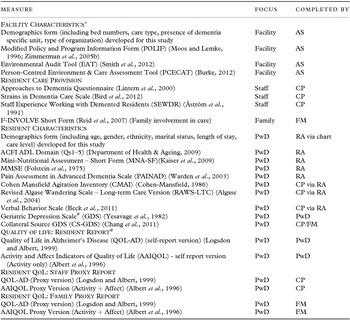
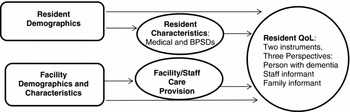
As displayed in Figure 1, data are being collected at multiple levels and from multiple sources, in order to better understand the complex web of factors underlying the QoL of residents with dementia. Resident demographics likely influence their medical (e.g. stage of dementia) and behavioral and psychological characteristics, which in turn influence their QoL. Facility characteristics such as size and organization type may influence facility and staff attitudes towards care provision, which in turn affect residents’ QoL. All quantitative measures are well established and validated with the specific instruments used being listed in Table 1. For example, under facility characteristics, the Modified Policy and Program Information Form (Moos and Lemke, Reference Moos and Lemke1996) is used to measure facility governance and policies.
Study measures

PwD = person with dementia; AS = administration staff; CP = care provider; FM = family member/friend; RA = research assistant (data collector); (#) MMSE scores ≥ 10.
(*) Note: Facility-level data collected once per facility only, not per resident.
Factors underlying resident quality of life for which data were collected.

In measuring QoL, Zimmerman et al. (2005b) and Sloane et al. (2005) used seven different assessments of QoL, all of which are positively reported in the literature. However, administration of so many measures is very resource-intensive, in terms of both researcher and participant time required. For this study the multi-dimensional and multi-perspective focus of QoL was retained yet the number of QoL tools was reduced to the two most widely used and established ones. Both are able to be used for self and/or proxy report and both have a version specific to the long term care environment – the Quality of Life in Alzheimer's Disease scale (QOL-AD) (Logsdon and Albert, Reference Logsdon and Albert1999), and the Activity and Affect Indicators of Quality of Life (AAIQOL) (Albert et al., Reference Albert, Castillo-Castaneda, Sano and Jacobs1996).
Qualitative component
In addition to the above, a qualitative component is being conducted with a sub-sample of 12 participants with dementia with cognitive capacity, incorporating in-depth interviews and observations. A multiple case study approach is being used in this qualitative phase of the national study, with a sub-sample of participants from two facilities in Queensland and two facilities in Victoria. This approach aims to include as much variation across the cases as possible. For efficiency we are drawing a sample from the existing participant pool (i.e. we will not look for new participants) and limiting it to two states. We will use observations of residents with dementia, individual interviews with these participants and their family members and analyze documentation of the resident with dementia's monthly activity schedules. A purposive sample of 12 residents with dementia (3 people per site (6 per State)) aims for variation in gender, age, culture, stage of disease (MMSE not less than 16), as well as sampling of event and time. Choice of facilities aims for variation in major city or regional; public/non-profit/private; small/large facility. Interviews are being digitally recorded and transcribed verbatim.
Observations of the participants (residents with dementia) will be undertaken for five minute intervals for one hour over three randomized time frames. The Resident and Staff Observation Checklist (RSOC) (Sloane et al., Reference Sloane, Mitchell, Preisser, Phillips, Commander and Burker1998) is an unobtrusive observer-rated checklist to determine the activity, behavior, alertness, location, grouping, mobility and restraints, quality of interaction, and appearance of the resident with dementia. The observations do not include observations of the resident in the bathroom or when receiving personal care.
Data security
As this is a multi-site, multi-state study, security and integrity of data requires particular attention. To this end, an online method of data collection is being used so that all data can be directly deposited into a central site for storage and analysis, eliminating the need for multiple handling and minimizing the risk of data loss or errors. All measurement tools have been converted into online survey format; research assistants (RAs) collecting resident data in each state and territory have been issued with iPads with wireless internet connectivity, which enables online submission of data from nearly all sites. Staff and family members can complete their surveys independently on their own computers. For those without access to the internet, paper versions of the questionnaires are distributed, together with Reply Paid envelopes.
Ethical considerations
Ethical clearance has been granted by the human research ethics committees (HRECs) of all participating universities and will be sought from all RACF organizations as required. Informed consent is sought from all participants; to determine the capacity for residents with dementia to provide consent, they first complete the Evaluation to Sign Consent Measure (Resnick et al., Reference Resnick2007), with the knowledge and consent of their legal proxy. Where it is deemed the resident is unable to provide informed consent, proxy consent is sought from his/her legally authorized representative. Before commencement of any interview, assent from the resident with dementia is sought. All data will remain confidential. Long term care staff and family members will not be able to access the resident with dementia's responses to the QoL questionnaires. Electronic data are stored in a password protected file at the primary university, and paper based data are stored in locked filing cabinets. Qualitative data are stored in a locked filing cabinet in the offices of the chief investigator who is leading the qualitative data collection.
Every effort is being made to minimize the participant burden. Travel is not required for any participants; a trained RA interviews the participant with dementia in his/her room or other private area within the facility to enable completion of the self-report measures. Participants may complete the interview after a rest period if needed, and any signs of fatigue or distress results in termination of the interview. Staff and family can complete their components in their own time.
Advisory panel
An advisory panel has been established, including Professor Sheryl Zimmerman (from the original US study), an independent Australian dementia researcher, two nominated members from Alzheimer's Australia and its Consumer Dementia Research Network (CDRN), including a carer and person living with dementia, a psychogeriatrician, a residential aged care manager, a representative from the Minister's Advisory Panel on Dementia and a representative from the Australian Aged Care Quality (previously Aged Care Standards and Accreditation) Agency.
Data analysis
Descriptive statistics (means, standard deviations for continuous level variables and frequencies, and percentages for categorical variables) will be calculated on demographics, facility and staff characteristics, and outcome variables (QoL and depression). The distributions of the QoL measures across the three sources and two different measures will be examined for normality and floor and ceiling effects. The results for these variables will address Aim 1 (investigating QoL). If warranted by the normality of the distributions, the relationships among the three sources and two measures of QoL will be investigated via correlations. These correlations, plus the results on how many residents are able to self-report on their QoL, will address Aim 3. The most complex part of the analysis will be to fill in all relationships displayed in Figure 1 (Aim 2). The relationships between facility, staff and resident with dementia characteristics and QoL will first be tested at the bivariate level with either ANOVAs or correlations, depending on the variables involved. Multivariate models to predict QoL (and/or depression) will be achieved using linear mixed models (or nested models) in order to allow for the inclusion of random effects based on the individual facilities, direct care providers, family members, and residents with dementia. Models predicting self-reported QoL will include random effects for facility and resident with dementia (nested within facility). Models predicting direct care staff reported QoL will include random effects for facility and direct care staff (nested within facility). Models predicting family member reported QoL will include random effects for facility and family member (nested within facility).
Qualitative data will be managed using NVivo. Qualitative data analysis will use grounded theory methodology to identify codes, categories and patterns emerging through line by line analysis. All issues will be initially identified, then through an iterative process and developing conceptual abstraction the major themes and processes described and explained. Triangulation of quantitative and qualitative data will enrich understanding, explain the expected complexities, and increase rigor.
Discussion
In recent years, there has been a greater move towards evaluating quality of care of residents with dementia based on QoL. The World Alzheimer Report 2013 (Prince et al., Reference Prince, Prina and Guerchet2013) identified that “maintaining or enhancing QoL is the ultimate objective” of improving quality of care (p. 6) and that quality of care in long term care facilities is best judged via QoL (p. 11). The report also highlighted a greater need for research in this area as there is currently limited knowledge regarding the factors that influence QoL of residents with dementia. This Australian study is crucial in bridging this knowledge gap and in moving towards establishing QoL as a standardized metric for quality of care.
Other large studies investigating QoL for residents with dementia in long term care facilities have occurred in Canada (Reimer et al., Reference Reimer, Slaughter, Donaldson, Currie and Eliasziw2004; Naglie et al., Reference Naglie2011a; 2011b), Britain (Hoe et al., Reference Hoe, Hancock, Livingston and Orrell2006), and Australia (Moyle et al., Reference Moyle, McAllister, Venturato and Adams2007; Beer et al., Reference Beer2010; Chenoweth et al., Reference Chenoweth2014). However, the CS-LTC Dementia Care study conducted by Zimmerman and colleagues in the US was set apart by its complexity and comprehensiveness (Zimmerman et al., Reference Zimmerman2005b). The current study extends the Zimmerman et al. study, adapts it to the Australian context, and is novel in several aspects:
1. Probability sampling techniques are being used which will produce a nationally representative and diverse sample of Australian long term care facilities. The vast majority of previous studies on the QoL of people with dementia in residential care facilities have used convenience, purposive or other non-probability based sampling techniques. Those that have utilized probability techniques tend to be geographically limited, such as to one state (Abrahamson et al., Reference Abrahamson, Lewis, Perkins, Clark, Nazir and Arling2013). Because our data will be nationally generalizable, it will provide benchmarking data relating to QoL of people with dementia, help to inform dementia care and provide indicators of QoL areas for further research.
2. QoL and depression data are augmented in this study by obtaining proxy data from family members and direct care staff (instead of just from staff). Having three perspectives on the QoL and depression of residents will provide us a unique opportunity to examine the concept of residents’ QoL, as well as the factors which affect it.
3. Our study also includes a qualitative component which involves in-depth interviews of a sub-sample of residents about their own QoL, as well as observations of them in their own environment. These two sources of data will allow a deeper understanding of the daily QoL of the residents studied. They could also flag potential issues with the quality of care that could be affecting QoL, such as the use of restraints.
Feasibility
A number of factors could potentially affect the feasibility and success of this study:
1. Ethics. Although we have obtained ethics authorization from all universities involved, we will need to seek authorization from some individual facilities, provider organizations (with multiple facilities), and state governments before proceeding with data collection. Each ethics committee could have different requirements, increasing the amount of paperwork and negotiations involved. Because we have already obtained university-level authorization, however, we expect to be able to overcome this hurdle to a successful project.
2. Recruitment. In previous studies of long term care facilities, we have encountered difficulties getting through the “gatekeepers” and accessing the person in the facility or organization capable of making the decision of whether to allow research such as this study. After obtaining facility permission, we could potentially be challenged by recruiting eligible residents and appropriate family and staff members who know them well enough to participate in the proxy reporting of QoL.
3. Coordination of the national study. With data being collected in six states and one territory, coordination and reliability of data collection is potentially very challenging. Our response has been to develop a national strategy, with a national project director and separate data collection teams (each led by a state coordinator) for each state/territory involved. Data collectors and coordinators have been trained all at one time on all of the measures involved in the study.
Overall, this study is expected to produce valuable information on aspects of long term care and support that have the potential to sustain and/or improve QoL for residents with dementia.
Conflict of interest
None.
Description of authors’ roles
E. Beattie conceived the study, led the drafting of the protocol, led the review and revision of the overall protocol and assisted in drafting the manuscript. M. O’Reilly conceived the study, drafted the protocol, and drafted the initial manuscript. W. Moyle conceived the study, designed the qualitative portion of the protocol, participated in the review and revision of the protocol and assisted in the drafting of the manuscript. L. Chenoweth participated in the review and revision of the protocol. D. Fetherstonhaugh conceived the study and designed the qualitative portion of the protocol. B. Horner conceived the study and assisted with review and revision of the protocol. A. Robinson participated in the review and revision of the protocol. E. Fielding conceived the study, specifically the quantitative portion of it, conceived the sampling design and statistical analysis and participated in the drafting and revision of the protocol. All authors participated in the critical revision of the manuscript and read and approved the final manuscript.
Acknowledgments
We gratefully acknowledge the intellectual generosity and support of Professor Sheryl Zimmerman, Mary Lily Kenan Flagler Bingham Distinguished Professor in the University of North Carolina's School of Social Work, Chapel Hill, North Carolina, USA during the conceptualization phase of this study. We acknowledge Mitchell McMaster, Senior Research Assistant in the Dementia Collaborative Research Centre: Carers and Consumers, Queensland University of Technology, Brisbane, Australia, for his assistance with drafting the manuscript. This project was funded by the Dementia Collaborative Research Centre: Carers and Consumers.