I. INTRODUCTION
In the esoteric history of capital theory, as originated by Carl Menger (1871) and William Stanley Jevons (Reference Jevons1871) and developed further at great length by Eugen von Böhm-Bawerk (1959), one can find the concept “average period of production” (henceforth APP). It was formulated by Böhm-Bawerk to give concrete expression to the notion of “roundaboutness”—the idea that production projects that “take more time” will, if wisely chosen, be more productive than those that are shorter in duration. For the Austrians, roundaboutness was a crucial manifestation of Adam Smith’s division of labor, thus a key ingredient in the explanation of the prosperity of capital-using economies. Though the idea of roundaboutness continued to exert some influence on economic thinking over the years, the APP all but disappeared. It was, for a while, a matter of some energetic controversy, featuring prominently in the debate between Böhm-Bawerk and his critics, a theme in what became known as one of the famous “capital controversies” that mark significant episodes in the history of capital theory. It had a rocky start and went downhill from then.
At first, it seems to be an intuitive concept. Given that production takes time, it would seem there had to be an APP. But intuition runs into serious difficulties the moment one tries to formulate this idea more precisely and to measure it. Indeed, serious problems arose as soon as Böhm-Bawerk proposed a measure of the APP. His specific formulation was decisively criticized. Nevertheless, the idea of “time embedded in production” continued to exercise the imagination of capital theorists and those working in related areas. Footnote 1 Time is an important, though neglected, aspect of production, and this influences how production is treated in economic models. The (modern) Austrians continue to use the idea in their analyses of economic cycles. The APP makes a (sometimes implicit) appearance through the Mises–Hayek, or Austrian, business-cycle theory (ABCT). This theory has been influential to a greater or lesser degree since the 1930s and the Great Depression, with a notable renewed interest since the 2008 financial crisis.
For those interested in the history of economics, the APP remains an ambiguous and difficult concept and one of dubious relevance. It may be surprising, therefore, to find in that history a formulation of essentially the same concept in a form that avoids the insoluble problems associated with Böhm-Bawerk’s treatment. In his seminal Value and Capital (1939) John Hicks provided a formula that solves these problems. Footnote 2 Yet, it remains almost unnoticed to this day. Hicks’s formulation not only solves Böhm-Bawerk’s problems; it is also a richer concept in that it provides a measure not only of the average amount of time contained in any investment, but also a measure of the elasticity of the estimated present value of the investment to a change in the rate of discount. This same formula was independently discovered by Frederick R. Macaulay (Reference Macaulay1938), was further developed by other financial theorists, and is today a well-known and sometime-used construct in the field of applied finance.
Thus, in this paper we explore the history of the APP, discuss Hicks’s neglected contribution, and show how it has a direct parallel to the well-established concept of Macaulay’s Duration (D) in the financial literature. Hicks’s and Macaulay’s work (and subsequent extensions) provide a more precise definition of the APP that is free of the shortcomings and ambiguities that have historically surrounded this idea. In section II we discuss the origin and development of the APP from Böhm-Bawerk’s initial treatment to Friedrich Hayek’s application to business cycles. In section III we present Hicks’s neglected contribution and explain how it solves key problems present in the Böhm-Bawerk–Hayek treatment. In section IV we turn to the development in the financial literature. Since Hicks’s approach was not taken up by his fellow economists, it is now the case that economics can benefit by applying to capital theory the insights available in the financial literature. In section V we briefly address some modern work showing how ABCT can easily be reformulated in financial terms, making the theory clearer and more tractable. Section VI concludes.
II. ORIGIN AND DEVELOPMENT OF THE AVERAGE PERIOD OF PRODUCTION
Capital and Time
From Carl Menger ([1871] 1976), and also from William Stanley Jevons (1874), we learn that time is inevitably involved in the concept of “capital.” The value of production goods depends on the prospective value of the consumer goods they are expected to produce with the elapse of time. Menger’s approach to production and time served as the basis for Böhm-Bawerk’s subsequent extended development, and for the use by later Austrians (notably Ludwig von Mises and Hayek) of distortions in the time structure of production to explain cyclical phenomena.
According to Böhm-Bawerk, production is a process involving time, in which original (natural) resources are transformed, with the aid of produced means of production, into consumption goods. A more “time-consuming” process of production would not be chosen unless it was more productive in this sense, unless it added sufficiently more value to compensate for the longer “waiting” required. “The disadvantage which attends the capitalist Footnote 3 method of production consists in a sacrifice of time. Capitalist roundaboutness is productive but time-consuming. It yields better consumption goods, but not until a later time” (Böhm-Bawerk Reference Böhm-Bawerk1959, p. 82). Thus, by wisely selecting more roundabout methods of production, increases in value can be obtained, and these have to be weighed against the “cost” of waiting. In addition, however, it is apparent that the returns to greater degrees of roundaboutness must eventually diminish. In summary:
All consumption goods which man produces come into existence through the cooperation of human powers with the forces of nature, which are in part of economic character, in part free natural powers. Man can produce the consumption goods he desires through those elemental productive powers. He does so either directly, or indirectly through the agency of intermediate products which are called capital-goods. The indirect method entails a sacrifice of time but gains the advantage of an increase in the quantity of the product. Successive prolongations of the roundabout method of production yield further quantitative increases though in diminishing proportions. (Böhm-Bawerk Reference Böhm-Bawerk1959, p. 88)
The Average Period of Production
Böhm-Bawerk’s lengthy exposition is generally imprecise. His discussions can be read as informally suggesting general properties of real-world economies using “time-consuming” production goods. Yet, perhaps in order to deal with a variety of criticisms—for example, as to the precise meaning of “roundaboutness”—Böhm-Bawerk attempted to make his observations more formal and exact. To capture the degree of roundaboutness by measuring a period of production from the original factors to the emergent consumption good would be impossible and misleading in the modern world with its vast array of inherited capital goods. One could not, as it were, trace production back “to the moment when the first finger is stirred in the making of the first intermediate product that was later used in the production of the good in question, and as continuing until its final completion” (Böhm-Bawerk Reference Böhm-Bawerk1959, p. 86). And so he introduces the average period of production.
It is more important, as well as correct, to consider the average time interval occurring between each expenditure of originary productive forces and the final completion of the ultimate consumption good. A production method evinces a higher or lower degree of capitalist character, according to whether, on the average, there is a longer or shorter period of waiting for the remuneration of the expenditure of the originary productive forces, labor and uses of land. (Böhm-Bawerk Reference Böhm-Bawerk1959, p. 86)
And he proceeds to define arithmetically the average period of production, which we may succinctly express as follows:
 $$T = {{\Sigma _{t = 0}^n\left {n - t} \right{l_t}} \over {\Sigma _{t = 0}^n{l_t}}} = n - {{\Sigma _{t = 0}^nt \cdot {l_t}} \over N}1$$
where T is the APP for a production process lasting n calendar periods; t, going from 0 to n, is an index of each subperiod; l
t
is the amount of labor expended in subperiod t, and N =
 $\Sigma _{t = 0}^n{l_t}$
is the unweighted labor sum (the total amount of labor time expended). Thus, T is a weighted average that measures the time on average that a unit of labor l is “locked up” in the production process. The weights (n-t) are the distances in time from the emergence of the final output. T depends positively on n, the calendar length of the project, and on the relation of the time pattern of labor applied (the points in time t at which labor inputs occur) to the total amount of labor invested N.
Since this formula is in units of time, it may be added across various processes to yield an overall measure of roundaboutness. In this way Böhm-Bawerk hoped to have solved the problem of measuring roundaboutness, and his intuitive discussion of the nature of capitalist production as an increasing reliance on produced means of production in specialized production processes became associated with this rather specific and limited formula. Though in actuality a small part of his work as a whole, and arguably an aberration in his breadth of vision, it became an element in the prolonged and energetic debates in capital theory.
Criticisms of the APP
The criticisms of the APP are numerous and have been discussed in detail over the years. We mention here only briefly what we regard as the root of all the difficulties: namely, the impossibility of finding a “physical” measure of capital. Footnote 4 Only in very special cases far from real-world situations can a measure be found that is independent of the prices (values) of the individual capital goods or of rates of interest. Even in the case of completely homogeneous identical units of capital and labor—facilitating an unambiguous measure of their totals—the rate of discount will enter any measure of the APP unless only simple-interest discounting is applied, as opposed to compound-interest discounting, which is obviously more appropriate. We examine this in more detail below in connection with Hayek’s triangle. The search for a “physical” measure of capital is one of the two key issues at the bottom of all three of the famous “capital controversies” that occurred during the twentieth century (Cohen Reference Cohen2008 and Reference Cohen2010; Cohen and Harcourt Reference Cohen and Harcourt2003; Felipe and McCombie 2014).
The second issue is the role of time in production. Intuition suggests that if production takes time, there has to be an average period of production. The confounding of these two core issues has arguably resulted in the unfortunate rejection of both of them, though they are two very different propositions, namely:
-
• It is possible to find a measure of capital that is independent of the interest rate.
-
• The role of time in production is crucial and it is possible to measure it.
The first proposition is false. We are concerned with the second proposition. We shall argue that the impossibility of a useful physical measure of capital does not imply the impossibility of a useful measure of the time involved in any production project. As we shall see below, such a measure containing value ingredients does exist.
Capital is often perceived to have a dual nature. On the one hand, it is seen as a collection of heterogeneous capital goods that, in combination, are capable of producing various outputs. On the other hand, it is seen as a homogeneous financial fund that facilitates the movement of productive resources from lower expected return investments to higher expected return investments. The heterogeneous nature of capital goods means that they cannot be added together to obtain a single physical measure of capital as an input into a production process, or, indeed, into a production function for the economy as a whole (the focus of the famous Cambridge–Cambridge debate of the 1950s to the 1970s, with echoes lasting until today). To attempt to use an aggregate measure based on adding together their values entails using the rate of interest to find those values. Then, using that aggregate measure to determine the rate of return on capital (equal to the rate of interest) involves circular reasoning. Footnote 5 Quite simply, it is impossible to find a measure of capital that is independent of the rate of interest. Footnote 6
As a result of the debates with his critics (most notably John Bates Clark), Böhm-Bawerk’s APP fell into some disrepute (though it is still used in a genre of Böhm-Bawerkian mathematical capital and growth theory and is the basis of much reasoning in modern production-function theory; see Lewin [Reference Lewin1999] 2011). Footnote 7
Friedrich Hayek: Application to Business Cycles
The matter was considerably complicated, one might even say confused, by the fact that in his Prices and Production (1931), Hayek lays great emphasis on the structure of production, as conceived of in Austrian capital theory to that date, in explaining the process of a credit-induced business cycle (orginally developed by Mises Reference Mises1912)—what has become known as the Mises–Hayek theory of the business cycle, or the Austrian Business-Cycle Theory (ABCT). To do so he borrows from Böhm-Bawerk’s specification and constructs his own special case (originally conceived by Jevons Reference Jevons1871, ch. VII).
Consider a special case where the flow of inputs (i.e., units of homogeneous labor) is constant over time. If the same amount of labor time, l o , is applied in each period, then,
 $$\Sigma _{t = 0}^n\left( {n - t} \right){l_t} = {1 \over 2}n \cdot \left( {n + 1} \right){l_0}\,and\,\Sigma _{t = 0}^n{l_t} = n \cdot {l_0}$$
and therefore
 $T \approx {n \over 2}$
.
Footnote 8
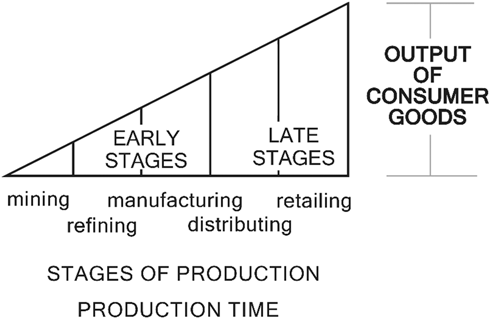
In this simple case each unit is “locked up” on average for half the length of the production period. Hayek (1931) uses a triangle to represent the idea of roundaboutness where the APP is halfway along the base of a triangle. Hayek’s triangle puts together two related concepts: the average period of production and the different stages of production. He presents a simple recursive “supply-chain” model where each stage of production sells its output as input to the next stage of production until the consumption stage is reached at the end of the process. Mining, for instance, precedes refining, which in turn precedes manufacturing, which is followed by distributing and then retailing as the final stage of production before reaching the consumer (Figure 1). The height at the end of each stage shows the value added up to that point in the production process.
Hayekian Triangle.
Source: Garrison ([2001] 2002, p. 47)

The horizontal axis is a measure of labor time. Footnote 9 The assumption is that inputs are applied uniformly over time. If the inputs were not applied uniformly, the graphical simplification would not suffice. It is the amount of labor hours and how long they are locked up that constitute the degree of roundaboutness. With this graphical representation Hayek attempts to capture the vision of Menger, Jevons, and Böhm-Bawerk (and, notably, Knut Wicksell [1911] 1934) about the structure of production and to marry it to a vision of the business cycle developed by Ludwig von Mises (1912).
Hayek’s triangle is intuitive and useful as an expository device. It shows clearly that the degree of roundaboutness (i.e., number of stages of production in this case) that can be sustained depends on the time preferences of consumers. A fall in consumers’ time preferences at the margin (the reluctance to postpone consumption and increase saving) allows stages of production to be added, thus increasing the accumulated value-added at the end of the triangle. In other words, the increase in savings allows a move towards a more capital-intensive structure of production with a higher payoff at the end of the process. The interest rate, which is the slope of the Hayekian triangle, represents the opportunity cost or minimum value-added required by each stage of production to be profitable.
But the simplifications of Hayek’s triangle do not come without challenges. Perhaps predictably, his model invited confusion and contributed to the rejection of Böhm-Bawerk’s capital theory and, with it, the distinctive aspect of the ABCT. The fact that a stage of production is an abstract tool (used to study capital theory) rather than an observable objective reality Footnote 10 adds doubts about Böhm-Bawerk’s roundaboutness story. The same observed reality can be represented by different stages of production (which can be more or less than the five as represented in Figure 1). To define a Hayekian triangle requires a set of subjective assumptions about how to identify separate stages of production, given the available data. In the first place, one (or more) economic activities can be present in different stages. For instance, the supply of energy or financial services is present along the whole production process. What should be the relative position of industries like these two? Second, there is the phenomenon of “looping,” the problem where two different industries supply inputs to each other. The energy market supplies electricity to banks, which in turn provide financial services to the energy sector. Which industry should precede the other as a stage of production? Third, it is possible that an industry identified as being at a particular stage of production may change its relative position over the course of a business cycle. (Andrew Young [2012] offers evidence of this problem for the US between 2002 and 2007.) Fourth, William Luther and Mark Cohen (2013) argue that a stage of production can grow not only vertically (increase in value added) but also horizontally, and this can significantly affect how the effects on the structure of production are interpreted if vertical changes are the only modification assumed to take place. The simplicity embedded in Hayek’s triangle cannot be translated into the complexity of reality without facing non-trivial challenges. Footnote 11
During the 1930s, Hayek had attempted to flesh out the capital theory underlying his approach to business cycles in numerous articles, culminating finally in his book The Pure Theory of Capital, published in 1941, to take account of the many complications that render his simple triangle problematic. Against the backdrop of World War II and the ascendancy of Keynesian economics, Hayek sought to solidify his contention that the collapse was due to inappropriately low central-bank-induced interest rates that distorted the structure of production; and that the unemployment that ensued was a result of the unsustainable structure of heterogeneous capital goods that had been constructed. As Keynes had pointed out, in a monetary economy individual acts of saving and individual acts of investment are separate and may be inconsistent. Keynes and Hayek disagreed about the implications of this. For Keynes, this was a reason to doubt the stability of financial markets and the capacity of the economy to self-correct. For Hayek, as with the classical economists, interest-rate movements were necessary and sufficient to coordinate the plans of savers and investors.
This coordination, however, was disrupted if the central bank engaged in credit expansion to reduce interest rates. As Hayek saw it, the implications of this are that credit-induced (as distinct from savings-induced) low interest rates provided a false signal that caused a lack of coordination between savers and investors—specifically, the low interest rates provided an incentive for reduced saving and increased investment, with the gap being closed by an elastic money supply. Given the fall in saving, or, by implication, the increase in consumption, the amount of investment is insufficient to supply current consumption demands. But it is not so much that investment is insufficient as that it is the wrong kind of investment, investment in production projects that are too “long,” too “capital intensive.” This required him to provide a firm understanding of how one determines the “length” of any investment project, the investment period, and how this relates to the “amount” of capital invested in it, and, furthermore, to show that the lower the interest rate, the greater the investment period/capital intensity that would result from the investment decisions of entrepreneurs.
In using the Austrian theory of capital, and its particular formulation by Böhm-Bawerk, as the foundation for developing a theory of the business cycle, Hayek thus became committed to a particular framework that was perhaps more complex and problematic than necessary and resulted in the rejection or ignoring of the ABCT over the decades. His examination of the complexities of capital showed that, even in equilibrium, it was impossible to attach an unambiguous meaning to the concept of ‘average period of production’ or to show that such a quantity was monotonically related to the interest (discount) rate. While he was able to decisively confirm the importance of time for a thorough understanding of production decisions, and while he was able, under some restrictive assumptions, to give clear meaning to the notion of the multiple investment periods involved in any ongoing investment project—connecting inputs to outputs over time—he was forced to abandon the attempt to characterize investment projects in the form of a single magnitude like the APP.
As at first contemplated, this study was intended as little more than a systematic exposition of what I imagined to be a fairly complete body of doctrine which, in the course of years, had evolved from the foundations laid by Jevons, Böhm-Bawerk and Wicksell. I had little idea … that some of the simplifications employed by the earlier writers had such far-reaching consequences as to make their conceptual tools almost useless in the analysis of more complicated situations. The most important of these inappropriate simplifications … was the attempt to introduce the time factor into the theory of capital in the form of one single relevant time interval—the ‘average period of production.’ (Hayek Reference Hayek1941, pp. 3–4; see also pp. 92–93)
Where does this leave the ABCT? A recent appraisal of Hayek’s business-cycle theory suggests that, in essence, it consists of three related propositions (Backhouse Reference Backhouse and Feser2006, pp. 42–43):
-
1. “that the capital-intensity of a production process can be measured by the period of production”;
-
2. “that it suggests a presumption that rises in the rate of interest will cause shorter production processes to be adopted and vice versa”; and
-
3. “that changing from one process to another does not involve simply having ‘more’ or ‘less’ capital: it involves using different capital-goods.”
We shall argue that, while indicative of the doctrinal context in which the ABCT developed, proposition 1 is unnecessary insofar as capital intensity is not synonymous with period of production, and that a measure of average period of investment exists in which capital intensity is but one ingredient (interpreted as a measure of financial capital committed) of this measure. With this modification, propositions 2 and 3 remain intact. Furthermore, though the common (universal?) conception of the ABCT is that it is the connection between the rate of interest and the period of production (investment) that matters, we shall show that it is the connection between the interest rate and the capital (net present) value of the project that matters, and that the coherent measure of the investment period that we identify is also a measure of the sensitivity of such a relation (between interest rates and net present value). To see this we must take note of the neglected contribution of John Hicks.
III. THE NEGLECTED CONTRIBUTION OF JOHN HICKS
An early contribution to the concept of the APP to which the economics literature, and the Austrian literature in particular, has paid little or no attention was one by John Hicks, who reformulated Böhm-Bawerk’s APP in a more satisfactory manner. Hicks realized that the APP cannot be satisfactorily measured in physical terms. Böhm-Bawerk’s attempt to do so in fact contradicts the essential insight of the Austrian School of Economics that the value of any resource input depends always only on the value of the output that it (in combination with other inputs) is expected to produce. Trying to characterize a production process without recourse to the concept of input value faces inescapable problems. Yet, Hicks much admired the capital theory of the Austrians and sought in Value and Capital to clarify and rehabilitate the APP as a defensible and revealing value construct rather than a physical one.
Hicks’s formulation ([1939] 1947, p. 186) proceeds as follows: The capital value (CV) of any stream of T payments (cash flows) is given by
 $$CVT = \Sigma _{t = 1}^T{{C{F_t}} \over {{{\left {1 + {c_t}} \right}^t}}} = \Sigma _{t = 1}^T{f^t}C{F_t}2$$
where the CF
t
are the future earnings payments expected by the investor, the cash flows, and the
 ${f^t} = {1 \over {{{(1 + {c_t})}^t}}}$
are the discount ratios, c
t
being the appropriate t-period discount rate. Hicks calls
 ${f^t}$
the discount ratio; we may refer to it as the discount factor. If we simplify with the common convention that c = c
1
= c
2
= … = c
T
(using an identical discount rate for all periods, so that
 $f = {1 \over {(1 + c)}}$
),
Footnote 12
we may calculate the elasticity of this CV with respect to
 $f$
as
 $${E_{CV,f}} = {{E\left( {CV\left( T \right)} \right)} \over {E\left( f \right)}} = {1 \over {CV\left( T \right)}}\left[ {{f^1}C{F_1} \cdot 1 + {f^2}C{F_2} \cdot 2 + \ldots + {f^t}C{F_T} \cdot T} \right]$$
or
 $${E_{CV,f}} = {{\mathop \sum \nolimits_{t = 1}^T {f^t}C{F_t} \cdot t} \over {CV(T)}}$$
where E is the elasticity (or d log) operator. This follows from the rule that the elasticity of a sum is the weighted average of the elasticities of its parts.
 ${E_{CV,f}}$
turns out to have a number of interesting interpretations.
First, and obviously,
 ${E_{CV,{f_t}}}$
provides a measure of the sensitivity of the value of the project (investment) to changes in the rate of discount, or (inversely) in the discount factor. So, if the discount rate is affected by interest rates targeted by monetary policy, the relative valuations of the components of the productive capital structure will be unevenly affected by monetary policy unless the heroic assumption of equal elasticities for all sectors is assumed. Those components of existing production processes that have a higher
 ${E_{CV,f}}$
will be relatively more affected; for example, a fall in the discount rate (perhaps provoked by a fall in the federal funds and other interest rates) will produce a rise in the value of high-
 ${E_{CV,{f_t}}}$
projects relative to those with lower ones.
But, second,
when we look at the form of this elasticity we see that it may be very properly described as the Average Period [AP] of the stream [of earnings]; for it is the average length of time for which the various payments are deferred from the present, when the times of deferment are weighted by the discounted values of the payments. (Hicks [Reference Hicks1939] 1947, p. 186, italics in original; see also pp. 218–222)
This, in a nutshell, is a reformulated APP in terms of the time values of the inputs. It is a measure of the average “duration” of value in the project. A fall in the discount rate will raise duration and a rise will reduce it. Footnote 13 The APP, correctly understood as Hicks’s AP, is the discount factor elasticity of capital value. And as we shall see, Hicks’s AP is identical to the concept (independently) discovered in 1938 by Macaulay, known as Macaulay’s Duration. Footnote 14
During his long and productive career, John Hicks returned time and again to the subject of capital theory (1965, 1973), but never again used or elaborated on the AP idea. In the last such foray, in the 1970s, he explicitly forswears the need to use any measure of a time period of production. He constructs a general flow-input–flow-output-value model that obviates the need for a measure of a single investment period. Reflecting on his earlier work, Hicks explains why Böhm-Bawerk’s approach must be rejected (“some very characteristic features of the old Austrian theory have to be abandoned”) and then refers to his AP construct (Hicks Reference Hicks1973, p. 9n2; italics added):
There remains the interesting question of why Roundaboutness works, under Böhm-Bawerk’s assumption, but not otherwise. The answer was given in my Value and Capital (1939), Chapter XXVII.
On the point-input–point-output assumption, it is a condition of equilibrium that wa = pR-t, where w is the wage of labor, a is the labor coefficient, p the price of the product, and R = 1 + the rate of interest. Then –d(log w)/d(log R) = t, so that it is the elasticity of the curve relating w to R. This elasticity, as we shall see, is an index which survives, and retains its importance, in the case of the generalized process. In Böhm-Bawerk’s case, but in that case only, it is equal to t—the degree of Roundaboutness.
Though I had got so far as that, already in 1939, I did no more than put forward the argument as a criticism of the old Austrian theory. It was not until many years later that I perceived that I was in fact putting the theory into a much more useful form. Footnote 15
The text to which this refers suggests, however, that Hicks knew full well at that time (1939) the potential importance of his AP formulation as a viable alternative to Böhm-Bawerk’s problematic APP.
[T]he Austrian period of production will not do; nevertheless, Böhm-Bawerk was not talking complete nonsense. His theory was valid enough for the cases he was considering; it ought to be possible to find a generalized concept which will meet [the] objections [against the APP] and will yet include Böhm-Bawerk’s argument as a special case. We ourselves need not go far to find such a concept; we have it in our hand already. … an average period which is proof against these objections. We shall proceed to show that it was this which the Austrians were looking for. (Hicks [Reference Hicks1939] 1947, p. 219; italics added)
In summary, Böhm-Bawerk developed a problematic measure of the APP using one homogeneous physical input: units of labor. This was an expansion of an idea found in Jevons ([1871] 1888), illustrated with a triangular diagram. Hayek (building on Wicksell) used this triangle to promote the ABCT. In the meantime, Hicks had offered a similar idea to capture the sensitivity of the value of investments (the discounted present value) to changes in the discount rate. Not only can Böhm-Bawerk’s and Jevons’s–Hayek’s treatment be interpreted as simple and special cases of Hicks’s more general formulation, but Hicks’s approach happens also to be a valid measure of the APP. While Hicks’s approach was not continued in economics, it was independently further developed in financial management.
IV. AP IN THE FINANCIAL LITERATURE
Macaulay’s Duration and Related Concepts Footnote 16
The concepts of Macaulay’s Duration (D) and Modified Duration (MD) are well known and have interesting applications, especially in bond valuation and portfolio strategy. Whereas Hicks was dealing with capital values in general, Macaulay was concerned about the market value of bonds—that is, with bond prices. The economics is, however, no different. The D is identical to Hicks’s Average Period (or
 ${E_{CV,{f_t}}}$
) and is understood to measure the weighted average time (usually in years) until all of the cash flows (CF) of a bond are received. The time at which each yearly payment occurs is weighted by the present value of the corresponding CF, discounted at the appropriate opportunity cost c in terms of the price of the bond (P). The D’s value is between zero and maturity (T).
 $$D = {{\mathop \sum \nolimits_{t = 1}^T {f^t}C{F_t}.t} \over {CV(T)}}$$
where the terms are as previously defined. Note that in the particular case of a zero-coupon bond, D equals the number of years until maturity. Footnote 17 Modified Duration, MD, is closely related: it is a linear approximation of the sensitivity of the price of the bond to changes in the yield-to-maturity—the rate at which the bond is valued at par. The MD is measured as the percent change in the price of the bond when r changes by one unit. The MD is, then, the semi-elasticity of the bond price P with respect to r. The MD and its relation to D can be represented by the following expression: Footnote 18
 $$MD = {{dlogCV} \over {dr}} = {{ - D(r)} \over {1 + r}}$$
where D(r) is the duration of the investment evaluated at the yield-to-maturity, r. Thus, in general, while D is a measure of the elasticity of CV with respect to the discount factor f, MD is a measure of the (semi) elasticity of CV with respect to r (or analogous to c used earlier).
A revealing formulation of D, expanding CF t , is as follows,
 $$D = {{\mathop \sum \nolimits_{t = 1}^T {f^t}\left( {{g_t} - {c_t}} \right){K_{t - 1}} \cdot t} \over {CV(T)}}$$
where g
t
is the rate of compound increase of value for period t, K
t
is the financial capital invested in period t, and c
t
is understood as the opportunity cost of investing that capital.
 $\mathop \sum \nolimits^ {K_{t - 1}}$
, relative to the value of the project, is thus a measure of the financial “capital intensity” of the project, and D rises, ceteris paribus, when K rises. But D is not a measure of capital intensity in the sense usually intended (for more detail, see Cachanosky and Lewin Reference Cachanosky and Lewin2014).
Hicks and Macaulay together show two aspects of the duration concept. Most obviously, it is a measure of time—average value-time—associated with the project’s capital value. But, notably, as explained, it is also an elasticity: the elasticity of CV with respect to the discount factor. The MD taps into this latter aspect. The MD indicates the proportional change in capital value with respect to a particular absolute change in the discount rate. As developed by Frank Redington (Reference Redington1952), MD addresses the question of interest-rate risk and how assets and liabilities can be matched so as to hedge this risk or remove it entirely (immunization). Seen in this way, duration is thus a window into the incentives facing investors regarding the time-value composition of their investment portfolios (including productive physical-capital combinations).
Both elasticity measures, however, are developed for small (infinitesimal) changes. In the face of discernable discrete interest-rate changes, they do not yield an exact measure of the responsive change in CV. The reason is simple. As Hicks points out, D as a measure of elasticity depends on value: the time value of money. The D itself will change with the discount rate (as should be obvious since the formula contains present values). This is a “second-order” effect of a change in the discount rate that can be ignored only for small changes. As a practical matter—for example, for portfolio management—it cannot be ignored. One must then add in this second-order effect. This phenomenon is known as the “convexity” (C) of the asset in question.
A bond with a larger convexity has a price that changes at a higher rate when there is a change in the r than a bond with a lower convexity. The C is important in portfolio management because two bonds can have the same MD but different values of C. A sinking fund bond with a shorter maturity can have the same MD as a zero-coupon bond with a longer maturity. Therefore, the same change in the discount rate affects to a different extent the price of each bond because these two bonds have a different C even if they have the same MD. Footnote 19
As indicated, then, the different financial notions of duration are well known in the financial management literature, but seem not to have been applied at all in economics, beyond the contributions of Hicks and some early remarks of Paul Samuelson (Reference Samuelson1945), and not at all in macroeconomics. Footnote 20
V. A FINANCIAL REFORMULATION OF THE MISES–HAYEK BUSINESS-CYCLE THEORY
The problems of roundaboutness go beyond the scope of capital theory and debates in the history of economic thought. As we stated and as is well known, the concept of roundaboutness is at the core of the ABCT and is its distinctive aspect. So, a rejection of roundaboutness suggests a rejection of ABCT’s insights. Recent endorsements of the ABCT as a theory to better understand what went wrong in the subprime crisis, tellingly, are mostly silent about the effects on roundaboutness implicit in the theory (Cachanosky and Salter 2016).
Hicks’s framing of roundaboutness as duration shows that this is not a mysterious concept and that it can have a well-defined meaning, one that is widely used without controversy in the field of finance. If roundaboutness can be framed in financial terms, and stripped of its ambiguities and irregularities, then the ABCT can also be reframed in financial terms. Footnote 21 If we picture the ABCT effects in financial terms, then the distinctive aspect of the theory becomes straightforward. To the extent that an expansionary monetary policy successfully reduces the relevant discount rates, Hicks’s and Macaulay’s formulation shows that the present values of different investment projects are affected to a different extent. To maintain otherwise, the heroic assumption that all investment projects share the same cash flow is required. Note that, expressed in financial terms, the ABCT does not need to argue for changes in relative prices of final goods as is frequently claimed (i.e., Cantillon Effects). The same set of relative prices, by appearing at different points in time (as expected by the investor), would be affected differently in present-value terms when the discount rate is modified. In other words, the non-neutral effects of a credit expansion manifest in the present value of different investment projects, and not (necessarily) because of changes in the relative prices that make up the cash flows at different points in time.
There are two important points worth emphasizing. First, because a reduction in the discount rate increases (in relative terms) the present value of projects with longer cash flows (higher D) more than the present value of projects with shorter cash flows (lower D), entrepreneurs who believe the low discount rate is going to persist long enough will be willing to outbid more conservative entrepreneurs in the market for factors of production (this constitutes the boom). Footnote 22 Second, insofar as we can imagine comparing Ds across individual investors, this results in an increase of the aggregate D of the economy; the economy as a whole becomes “too roundabout” as the market share of resource allocation goes from projects with shorter to longer expected cash flows. To clarify, “too roundabout” means that projects have a positive present value at the lowered discount rate, but are unprofitable, or less so, at the market equilibrium discount rates. For an economy with n sectors, the aggregate D can be expressed as follows:
 $$D = \mathop \sum \limits_{j = 1}^n {\omega _j} \cdot {D_j}$$
where
 ${D_j}$
is the duration of the j sector and
 ${\omega _j}$$T = {n \over 2} + {1 \over 2}$
is the share of the present value of each sector with respect to the present value of all projects.
Footnote 23
Therefore, as resources are reallocated from projects with low D to projects with high D, the aggregate D of the economy increases.
The opposite effect occurs when the central bank increases interest rates. Now, the projects with higher D see the present value decrease more (in relative terms) than the projects with lower D. Resources now must be reallocated from higher roundabout projects to less roundabout projects (this constitutes the bust). Unless capital goods are assumed to be homogeneous, this reallocation of resources is expected to take time and be costly. It is this meandering of resources that constitutes the boom and bust in the ABCT.
VI. CONCLUSION
Austrian capital theory tried to capture the intuitive and basically undeniable importance that time plays in economic life, but arguably was diverted down a blind alley with Böhm-Bawerk’s APP. Böhm-Bawerk attempted a purely physical measure of roundaboutness to capture the length of the production process. Such a measure is a chimera. But the intuition is strong, and the idea survived and reappeared at various points in the history of capital theory. Almost unknown to economists, an alternative value measure of roundaboutness has existed at least since Hicks’s formulation of his average period in 1939, which, coincidentally, was exactly the same measure discovered by the financial actuary Frederick Macaulay in 1938, called by him “Duration.” Macaulay’s D, more richly interpreted as Hicks’s AP, is a measure that more appropriately captures what the Austrians struggled to express over many years in their capital theory and in their analysis of the business cycle. It remains to be seen whether this will provide a basis for future work along these lines.
Hicks’s AP, as a measure of the average duration of investment in a project, makes no reference to the physical form of the varied inputs involved in any production project or of the categories into which these are divided (like capital or labor). Thus, it remains free of the difficulties associated with such categorization or with the connections between such inputs and the outputs they jointly produce, including the possibility of ambiguity in the rankings of alternative production techniques (combinations of inputs) under different circumstances. These complexities of capital theory are thus seen to be all but irrelevant for a rigorous a priori explanation of the importance of time in entrepreneurs’ production decisions and, therefore, of their connection to interest-rate policy. The theoretical framework thus developed provides a firm basis for empirical investigation along these lines.