




No CrossRef data available.
Article contents
Executive control of learning and memory in children with bilateral spastic cerebral palsy
Published online by Cambridge University Press: 16 December 2005
Abstract
Executive control of learning and memory was examined in children with bilateral spastic cerebral palsy (SCP). We hypothesized that SCP-related brain damage would disrupt executive but not associative aspects of learning and memory. To test this hypothesis, the California Verbal Learning Test–Children's Version was administered to 16 children with bilateral SCP and 19 control children ranging from 6 to 18 years of age. Controlling for general verbal ability, the groups did not differ in initial learning and retention of information over time, suggesting that associative learning and memory processes subserved by medial temporal brain regions were relatively intact in children with SCP. In contrast, impairments in learning over repeated trials, strategic processing, and inhibition in the SCP group pointed to disruptions in prefrontally-mediated executive aspects of learning and memory. The inhibitory deficit was more pronounced in younger children with SCP, suggesting a developmental delay in this ability. (JINS, 2005, 11, 920–924.)
Information
- Type
- BRIEF COMMUNICATIONS
- Information
- Journal of the International Neuropsychological Society , Volume 11 , Issue 7 , November 2005 , pp. 920 - 924
- Copyright
- © 2005 The International Neuropsychological Society
INTRODUCTION
The precise location and degree of brain damage associated with bilateral spastic cerebral palsy (SCP) may vary considerably from child to child. That said, damage to the white matter tracts surrounding the ventricles (periventricular leukomalacia) is frequently present (Okumura et al., 1997). There also is some evidence that dopaminergic pathways may be disrupted in children with SCP (Brunstrom et al., 2000), and additional damage may occur in the basal ganglia, thalamus, and hippocampus (Johnston et al., 2001).
The integrity of white matter and dopaminergic pathways is especially important in terms of cognitive abilities subserved by prefrontal cortex due to the extensive and complex interconnectivity between this and other brain regions (e.g., Thatcher, 1997). Critical periods of cognitive development correspond with the elaboration of white matter connections between frontal and distal brain regions. The resulting connectivity enhances the efficiency of integrative information processing, such that prefrontally-mediated executive abilities play an increasingly prominent role in cognition as children age (Levin et al., 1991). It has been hypothesized that the white matter damage associated with some neurodevelopmental disorders contributes to impairments in prefrontally-mediated executive abilities due to disruptions in the interplay between prefrontal and other brain regions (e.g., Christ et al., 2003). In addition, dopamine disregulation can lead to impairments in prefrontally-mediated executive abilities (e.g., Diamond, 1998).
It has been suggested that frontal brain regions mediate higher-order, executive aspects of memory such as strategic processing, whereas medial temporal brain regions mediate simple, associative aspects of memory (e.g., Moscovitch & Umilta, 1990; Shimamura, 2002). Consistent with this, impairments in executive, but not associative, aspects of learning and memory have been identified in populations of children with frontal stroke related to sickle cell disease (Brandling-Bennett et al., 2003) and children with frontal dysfunction related to phenylketonuria (White et al., 2001).
We hypothesized that the brain damage associated with SCP results in impairments in prefrontally-mediated, executive aspects of learning and memory. Associative aspects of learning and memory (e.g., initial learning and retention of information over time), however, were hypothesized to remain relatively spared. To evaluate this hypothesis, we administered a list-learning task to children with bilateral SCP and control children.
METHODS
Research Participants
A total of 16 (6 female, 10 male) children with bilateral SCP who ranged from 6 to 18 years of age (M = 12.5; SD = 5.4) were recruited through the Pediatric Neurology Cerebral Palsy Center at St. Louis Children's Hospital. All children experienced medical complications related to premature birth, and all were diagnosed with SCP between 1 and 3 years of age. Twelve of the children were ambulatory, with three of these requiring cane or crutches. The four remaining children were able to take a few steps with maximal assistance. Their performance was compared with that of 19 control children (11 female, 8 male) recruited from the St. Louis community who ranged from 7 to 18 years of age (M = 11.4; SD = 4.3). The two groups did not differ in terms of age or gender (p > .1 in both instances). No child had a history of major medical, learning, or developmental disorder unrelated to SCP. Although clinical presentation (i.e., SCP) and perinatal risk factors (e.g., prematurity) were consistent with white matter injury, neuroimaging data were not available to confirm the nature of the brain injury.
The Picture Vocabulary subtest of the Woodcock-Johnson Psycho-Educational Battery–Revised (Woodcock & Johnson, 1989) was administered to estimate general intellectual ability. Standard scores for the SCP group ranged from 69 to 124 (M = 93.3; SD = 16.1). For the control group, standard scores ranged from 95 to 136 (M = 114.0; SD = 14.0). Scores of the control group were significantly higher than those of the SCP group, t(33) = 4.08, p < .001. No child met diagnostic criteria for mental retardation (American Psychiatric Association, 1994), as all children demonstrated a higher level of adaptive functioning than required for the diagnosis.
Procedure
Memory was evaluated using the California Verbal Learning Test–Children's Version (CVLT-C, Delis et al., 1994), which was a component of a larger neuropsychological test battery (additional data from this battery are reported in Christ et al., 2003). Learning, retention, strategic processing, and recognition of a 15-item word list (List A) were assessed. Words comprising the list represented 3 semantic categories (things to play with, things to wear, and fruits). To evaluate learning and retention, free recall of List A following a single presentation (Trial 1), free recall of List A following 5 presentations (Trial 5), free recall of a new 15-word list (List B), and free recall of List A following short and long delays were examined. Strategic processing was assessed by calculating a ratio reflecting raw semantic cluster scores (i.e., the number of times a word from a given semantic category was reported immediately following another word from that category) to the number of words correctly reported for Trial 1, Trial 5, short-delay free recall, and long-delay free recall. Cued recall (i.e., the number of words reported after presenting semantic category cues for List A) following short and long delays also was reflective of strategic processing. Recognition memory was evaluated using number of recognition hits and number of recognition false positives. Finally, the total number of intrusions and perseverations across all trials was examined to evaluate spontaneous errors.
RESULTS
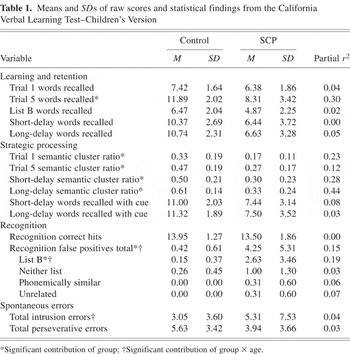
Means and standard deviations for raw group (control, SCP) scores from the CVLT-C are listed in Table 1. Normative data were not available for the oldest of our participants (i.e., 17 and 18 years of age) and were not utilized in analyses. Inclusion of an age- and sex-matched control group, however, allowed us to evaluate performance without reference to normative data.
Means and SDs of raw scores and statistical findings from the California Verbal Learning Test–Children's Version

Hierarchical regression analysis was used to examine the contribution of group to the variance in CVLT-C scores. Age and standard scores from the Picture Vocabulary test were entered in the first step of all analyses. Picture Vocabulary scores were included to control for differences between the SCP and control groups in general verbal ability. Group was entered into the second step of the analyses. To understand cognitive compromise in children fully, it is necessary to discern whether identified impairments remain static, resolve, or emerge during development. As a result, the interaction between age and group was entered into the last step of all analyses.
In some instances, the effects of earlier learning or recall on subsequent learning, retention, or strategic processing were not evident in the raw scores. For example, to evaluate learning over repeated trials (i.e., Trial 5 recall), it is necessary to control for initial learning (i.e., Trial 1 recall). In instances such as this, the appropriate control variable from the CVLT-C was entered into the regression before group.
All findings are reported in terms of the unique variance in CVLT-C scores accounted for by group or by the interaction between group and age after the contributions of age, Picture Vocabulary, and CVLT-C control variables have been removed. That is, results from partial correlations are reported. Statistically nonsignificant results reflect findings for which p > .05.
Learning and Retention
Initial learning of novel word lists was assessed by examining free recall on Trial 1 of List A and free recall of List B. In neither instance did group account for a significant proportion of the variance in recall above and beyond that accounted for by age and general verbal ability.
Learning over repeated presentations was evaluated by examining free recall on Trial 5 of List A, controlling for initial learning on Trial 1. Group accounted for 30% of the variance in Trial 5 recall (p < .001), reflecting poorer learning for children with SCP compared with the control group. To assess retention over time, free recall following short and long delays was evaluated, controlling for recall on the last learning trial (i.e., Trial 5). Neither result was significant, demonstrating comparable retention for the SCP and control groups. There were no significant interactions between group and age for any learning and retention variables.
Strategic Processing
Two aspects of performance were examined to assess strategic processing: semantic clustering and cued recall. Group accounted for 23% (p < .005), 12% (p < .05), 28% (p < .005), and 44% (p < .001) of the variance in semantic cluster ratios from Trial 1, Trial 5, short-delay free recall, and long-delay free recall, respectively. Group, however, failed to make a significant contribution to cued recall at short and long delays after controlling for the number of words freely recalled. These results reflect poorer use of the internally generated semantic clustering strategy for the SCP group, although use of the externally provided cuing strategy was relatively intact. There were no significant interactions between group and age for any strategic processing variables.
Recognition
Recognition hits and false positives were also analyzed. Recognition hits represent the correct identification of words from List A and reflect memory encoding and storage. The contribution of group to recognition hits was not significant.
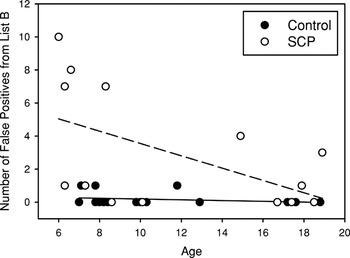
Recognition false positives represent the incorrect identification of foils and reflect failures to inhibit the intrusion of irrelevant information. The interaction between age and diagnosis accounted for a significant proportion of the variance in total false positives (15%) and false positives from List B (16%; p < .05 in both instances). Significant variance in other subtypes of false positives (e.g., phonemically similar foils) was not accounted for by group. As depicted in Figure 1, the interactions were driven by a larger number of false positives in younger than older children with SCP; false positives for the control group did not change as a function of age. These findings indicate that previously presented irrelevant information interfered with recognition efforts more so for younger than older children with SCP.

Number of false positives from an interference memory list (i.e., List B) as a function of age for children with SCP and control children.
Spontaneous Errors
Group did not contribute a significant proportion of variance in perseverative errors. The interaction between group and age, however, accounted for 21% (p < .01) of the variance in intrusion errors, reflecting a larger number of intrusions at younger ages for children with SCP. As was the case for recognition discriminability, these results show that younger children with SCP have difficulty preventing irrelevant information from interfering with memory efforts, which is indicative of an age-related deficit in inhibitory control.
DISCUSSION
Our results support the hypothesis that children with SCP experience impairments in prefrontally-mediated executive aspects of learning and memory that are more pronounced than difficulties they may have in associative aspects of learning and memory, which are mediated by medial temporal brain regions. Controlling for Picture Vocabulary, the groups did not differ in initial learning and retention over delays, as well as recognition hits, suggesting that associative aspects of learning and memory were less affected than executive aspects of learning memory in children with SCP. This is similar to findings from previous research showing intact performance by children with SCP on tests of initial learning of word pairs (Schatz et al., 1997) and lists of unrelated words (White et al., 1994).
In comparison with controls, however, children with SCP failed to spontaneously and efficiently use a strategic clustering strategy to facilitate learning and memory; as such, these children learned fewer words over repeated trials. Of note, cued recall was comparable for the SCP and control groups, indicating that children with SCP were able to effectively use an executive strategy to facilitate recall when external support for doing so was provided.
Although longitudinal study will be required to address the issue fully, our results suggest that children with SCP may experience a development delay in another executive aspect of learning and memory, the ability to inhibit interfering information from intruding on memory performance. This was apparent in two instances. First, at younger ages, children with SCP demonstrated impaired recognition due to the intrusion of words from a secondary memory list. Second, at younger ages, children with SCP demonstrated an increase in spontaneous intrusion errors during free recall. We previously identified impairments in inhibition of a prepotent motor response in children with SCP (Christ et al., 2003). Taken together, these results point to an age-related impairment in inhibition of irrelevant information, whether the information is externally or internally generated. The present finding of age-related impairment in inhibitory control has significant implications for assessment, pointing to the necessity of repeatedly evaluating inhibitory control as children with SCP age rather than relying on evaluation at a single point in development.
Our present and past (Christ et al., 2003) findings are consistent with the assertion that children with SCP experience impairments in prefrontally-mediated aspects of executive strategy use and inhibition. Additional research, however, is necessary to further evaluate this hypothesis. For example, it is possible that children with SCP experience impairments in other cognitive abilities (e.g., sustained attention) and disruption in related neural systems (e.g., norepinephrine system, Pliszka et al., 1996) that could have contributed to the pattern of performance observed in the present study. Further, the present pattern of sparing and impairment may have been influenced by the psychometric properties of our measures (Chapman & Chapman, 1978); failure to find SCP-related impairment on select measures may reflect insensitivity to group differences rather than comparable ability. Future research using a more comprehensive test battery is necessary to rule out these possibilities.
Given that all of the children with SCP who participated in the present study were born prematurely, it is worth considering whether our findings may be generalized to all preterm children. Complications related to a premature birth frequently result in neurological compromise and neuropsychological impairment (for a review, see Allen, 2002). Of particular relevance, Taylor et al. (2000) reported impaired list learning and inhibition (as evidenced by increased intrusion and false positives recognition errors) on the CLVT-C in preterm children with very low birth weight. Poor list learning remained apparent even after excluding preterm children with clear evidence of neurological injury (as evidenced by cerebral ultrasound). Taylor et al. did not evaluate the spontaneous use of semantic clustering. Related work by Isaacs et al. (2000) suggests that reduced hippocampal volumes may contribute to the learning difficulties experienced by preterm children. Along with our findings, those of Taylor et al. suggest similarities in the learning and memory abilities of children with SCP and preterm children without SCP.
Our results have implications for the rehabilitation of learning and memory impairments in children with SCP. In designing rehabilitation approaches, it should be kept in mind that deficits in executive aspects of learning and memory were the most pronounced under the most demanding memory conditions. For example, although spontaneous use of an internally generated executive clustering strategy was impaired, use of an externally provided cued recall strategy was relatively intact. Poorer recognition discriminability resulted, at least in part, from interference of items from a secondary memory list rather than spontaneous interference by items that were not presented during administration of the CVLT-C, suggesting difficulty discriminating between sources of information. Spontaneous intrusion errors occurred, but only during the most demanding form of memory assessment, free recall.
These findings suggest that children with SCP may benefit from external support for their learning and memory efforts, such as assistance in identifying and implementing recall strategies. Avoiding the presence of extraneous information during learning and recall may facilitate performance by limiting opportunities for failures in inhibitory control. Finally, given converging findings of an age-related impairment in inhibitory control, it may be especially helpful to begin interventions as early as possible during childhood.
ACKNOWLEDGMENTS
The authors thank Janice E. Brunstrom, M.D., of the Departments of Neurology and Cell Biology at the Washington University School of Medicine for referring participants with SCP to the study and for providing diagnostic information. We also thank Maren Losh, Melissa Armstrong, and Jennifer Burbridge for contributing to data collection and management.
References
REFERENCES
Allen, M.
(2002).
Preterm outcomes research: A critical component of neonatal
intensive care.
Mental Retardation & Developmental Disabilities Research
Reviews,
8,
221–233.Google Scholar
American Psychiatric Association.
(1994).
Diagnostic and statistical manual of mental disorders.
Washington, DC:
American Psychiatric Association.
Brandling-Bennett, E.,
White, D.,
Armstrong, M.,
Christ, S., &
DeBaun, M.
(2003).
Patterns of verbal long-term and working memory performance reveal
deficits in strategic processing in children with frontal infarcts related
to sickle cell disease.
Developmental Neuropsychology,
24,
423–434.Google Scholar
Brunstrom, J.,
Bastian, A.,
Wong, M., &
Mink, J.
(2000).
Motor benefit from levodopa in spastic quadriplegic cerebral
palsy.
Annals of Neurology,
47,
662–665.Google Scholar
Chapman, L. &
Chapman, J.
(1978).
The measurement of differential deficit.
Journal of Psychiatric Research,
14,
303–311.Google Scholar
Christ, S.,
White, D.,
Brunstrom, J., &
Abrams, R.
(2003).
Inhibitory control following prenatal brain injury.
Neuropsychology,
17,
171–178.Google Scholar
Delis, D.,
Kramer, J.,
Kaplan, E., &
Ober, B.
(1994).
California Verbal Learning Test: Children's version
manual.
San Antonio, TX:
Psychological Corporation.
Diamond, A.
(1998).
Evidence for the importance of dopamine for prefrontal functions
early in life. In
A. Roberts &
T. Robbins (Eds.),
The prefrontal cortex: Executive and cognitive functions (pp.
144–164).
New York:
Oxford University Press.
Isaacs, E.,
Lucas, A.,
Chong, W.,
Wood, S.,
Johnson, C.,
Vargha-Khadem, F., &
Gadian, D.
(2000).
Hippocampal volume and everyday memory in children of very low birth
weight.
Pediatric Research,
47,
713–720.Google Scholar
Johnston, M.,
Trescher, W.,
Ishida, A., &
Nakajima, W.
(2001).
Neurobiology of hypoxic-ischemic injury in the developing
brain.
Pediatric Research,
49,
735–741.Google Scholar
Levin, H.,
Culhane, K.,
Hartmann, J.,
Evankovich, K.,
Mattson, A.,
Harward, H.,
Ringholz, G.,
Ewing-Cobbs, L., &
Fletcher, J.
(1991).
Developmental changes in performance on tests of purported frontal
lobe functioning.
Developmental Neuropsychology,
7,
377–395.Google Scholar
Moscovitch, M. &
Umilta, C.
(1990).
Modularity and neuropsychology: Modules and central processes in
attention and memory. In
M. Schwartz (Ed.),
Modular deficits in Alzheimer-type dementia (pp.
1–59).
Cambridge:
MIT/Bradford.
Okumura, A.,
Kato, T.,
Kuno, K.,
Hayakawa, F., &
Watanabe, K.
(1997).
MRI findings in patients with spastic cerebral palsy II: Correlation
with type of cerebral palsy.
Developmental Medicine & Child Neurology,
39,
369–372.Google Scholar
Pliszka, S.,
McCracken, J., &
Maas, J.
(1996).
Catecholamines in attention-deficit/hyperactivity disorder:
Current perspectives.
Journal of the American Academy of Child & Adolescent
Psychiatry,
35,
264–272.Google Scholar
Schatz, J.,
Craft, S.,
Koby, M., &
Park, T.
(1997).
Associative learning in children with perinatal brain injury.
Journal of the International Neuropsychological Society,
3,
521–527.Google Scholar
Shimamura, A.
(2002).
Memory retrieval and executive control processes. In
D. Stuss &
R. Knight (Eds.),
Principles of frontal lobe function (pp.
210–220).
London:
University Press.
Taylor, H.,
Klein, N.,
Minich, N., &
Hack, M.
(2000).
Verbal memory deficits in children with less than 750 g birth
weight.
Child Neuropsychology,
6,
49–63.Google Scholar
Thatcher, R.
(1997).
Human frontal lobe development: A theory of cyclical cortical
reorganization. In
N. Krasnegor,
G. Lyon, &
P. Goldman-Rakic (Eds.),
Development of the prefrontal cortex (pp.
85–113).
Baltimore:
Paul Brooks.
White, D.,
Craft, S.,
Hale, S., &
Park, T.
(1994).
Working memory and articulation rate in children with spastic
diplegic cerebral palsy.
Neuropsychology,
8,
180–186.Google Scholar
White, D.,
Nortz, M.,
Mandernach, T.,
Huntington, K., &
Steiner, R.
(2001).
Deficits in memory strategy use related to prefrontal dysfunction
during early development: Evidence from children with
phenylketonuria.
Neuropsychology,
15,
221–229.Google Scholar
Woodcock, R. &
Johnson, M.
(1989).
Woodcock-Johnson Psycho-Educational Battery: Revised.
Allen, TX:
DLM Teaching Resources.
Means and SDs of raw scores and statistical findings from the California Verbal Learning Test–Children's Version
Number of false positives from an interference memory list (i.e., List B) as a function of age for children with SCP and control children.
 You have
Access
- 49
- Cited by