Introduction
The photographic recording of aspects of Arctic expeditions began with daguerrotype portraits by John Beard of Sir John Franklin(1786–1847) and his companions made before the departure of Erebus and Terror in 1845 (Wamsley and Barr Reference Wamsley and Barr1996: 295–316; Gordon 2003: 39–69). The earliest prints, from plates actually exposed in the Arctic, known to survive are the two calotypes taken by Dr William Thomas Domville RN (1822–1879), surgeon of HMS Resolute during the Edward Belcher expedition, 1852–1854, and now in the National Maritime Museum. During the pleasure cruise of the American artist William Bradford in the Canadian Arctic in 1869, photographs were made by John Dunmore and George Critcherson, of Black's Studio, Boston. Published in London in 1873, they were the first Arctic photographs to reach the public domain and they remain some of the finest polar images ever captured by the camera. The book was a limited edition of 300 copies each containing 141 albumen prints, derived from large wet plates developed on board ship (Bradford Reference Bradford1873).
Just two years later in 1875, George Rexworthy De Wilde sailed to the Arctic with Sir Allen Young RNR. The latter had been sailing master of Fox commanded by Sir Leopold McClintock in 1857–1859. In turn Young commanded Fox in the North Atlantic Telegraph Expedition of 1862. De Wilde joined Young in Pandora, a former despatch gunboat purchased from the Admiralty which was a barquentine-rigged vessel equipped with an 80 H.P. engine (Credland Reference Credland2013a: 556–559). The aim was to reach the north magnetic pole, and if possible negotiate the northwest passage as well as continue the search for remains of the Franklin expedition at King William Island. Young's volume which appeared in 1876 includes 12 of De Wilde's photographic prints, pasted in, and although they are in a private edition of limited circulation they are the first Arctic images from a British expedition to be published (Young Reference Young1876).
The results show that De Wilde was competent with a camera in the demanding climatic conditions of the Arctic but apart from the prints published in Allen's book we know of no further involvement by him in photography whether in the Arctic or anywhere else. He was a mature man of 42 or 43 when he headed north, and he probably regarded his contribution as a photographer simply an adjunct to his other skills with pencil, pen and brush. We know that Young was interested in photography (see below) and perhaps it was he who persuaded De Wilde to take a camera, or maybe it was Young's own equipment.
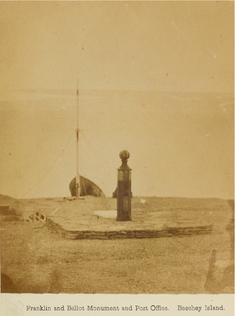
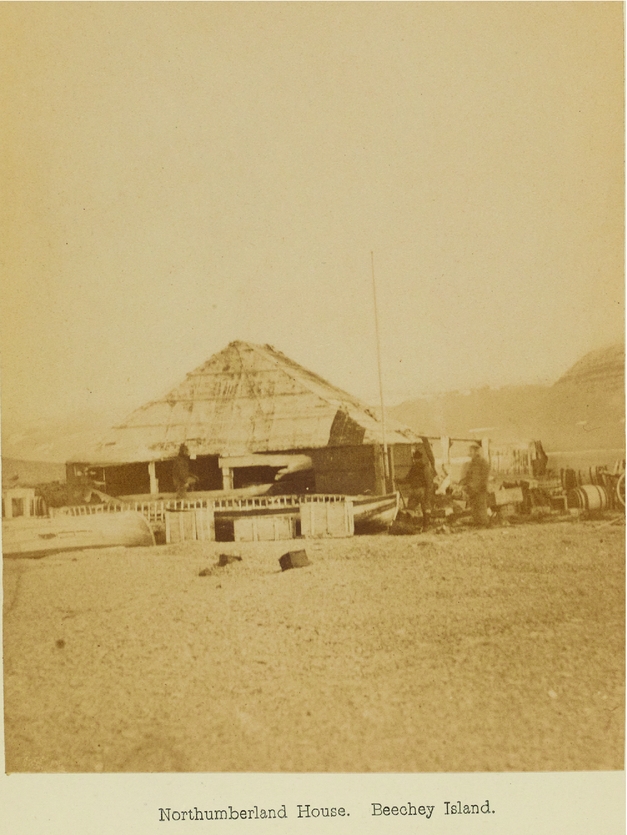
The privately published volume with De Wilde's prints, is, as noted, only the second book to be illustrated with Arctic photographs. Young records that on the Greenland coast ‘Our artist’ took a view of the glacier near Tallart Bank, north of Frederickshaab and made hydrographic sketches of the coast near Holsteinborg at the beginning of August (Young Reference Young1876: 11, 15). It is not until the 26 August on Beechey island that any mention is made of the use of the camera, ‘Our artist was busily employed all day in taking photographs of every object of interest’ (Young Reference Young1876: 43). The latter included the monument to Franklin and Bellot, as well as Northumberland House, the refuge built by Belcher. Finally in Peel Sound on 27 August, ‘Our artist took more photographs and sketches while we were fast to the floe’ (Young Reference Young1876: 45) and on 2 September their passage blocked by ice Pandora turned and headed for home.
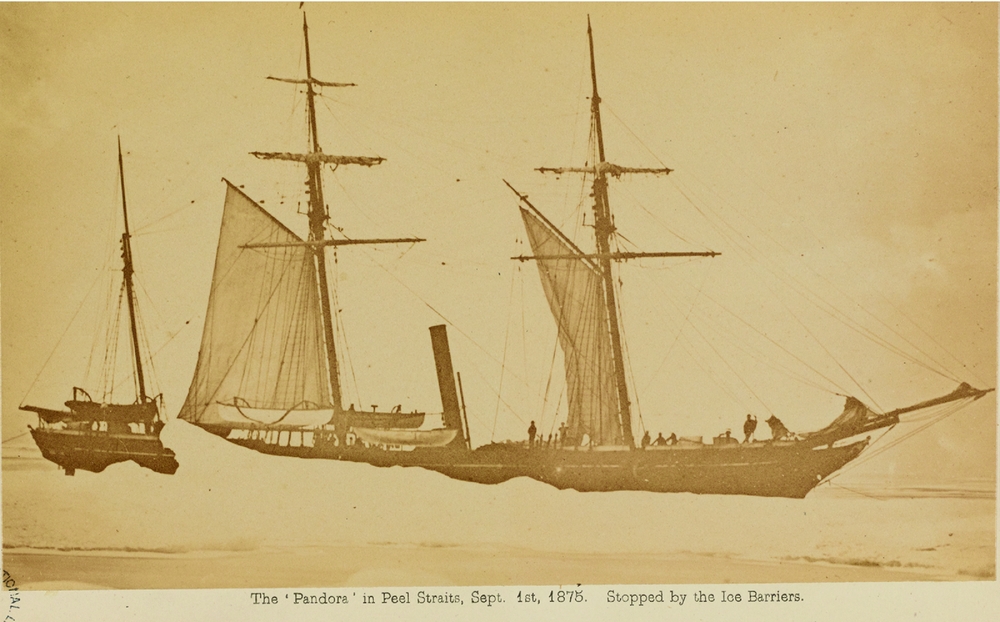
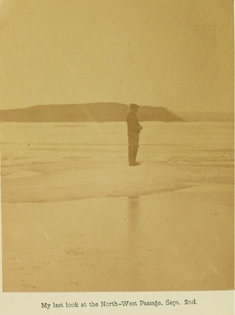
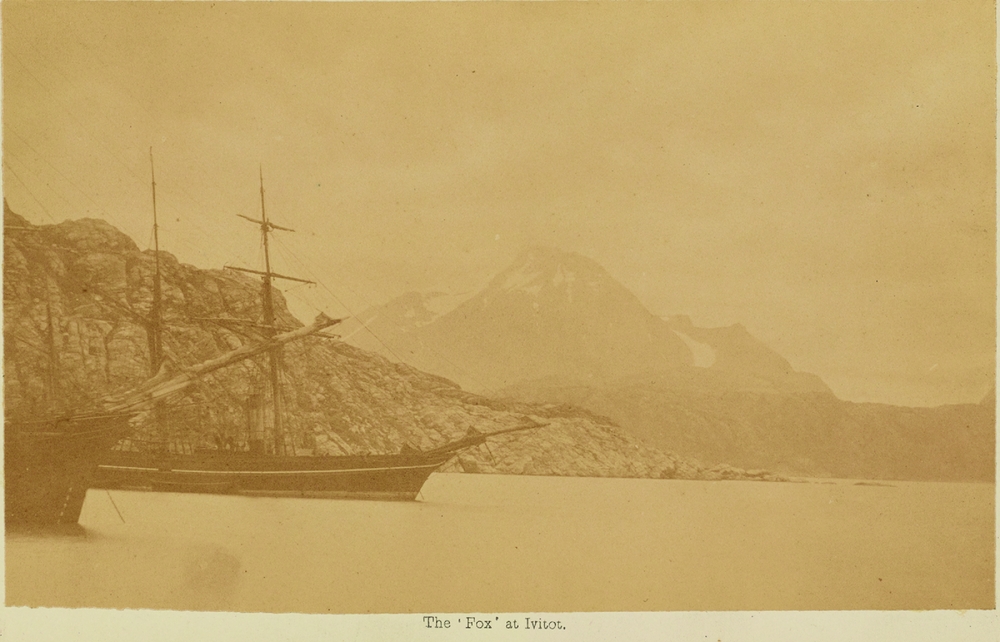
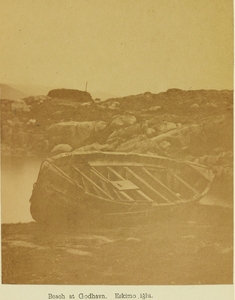
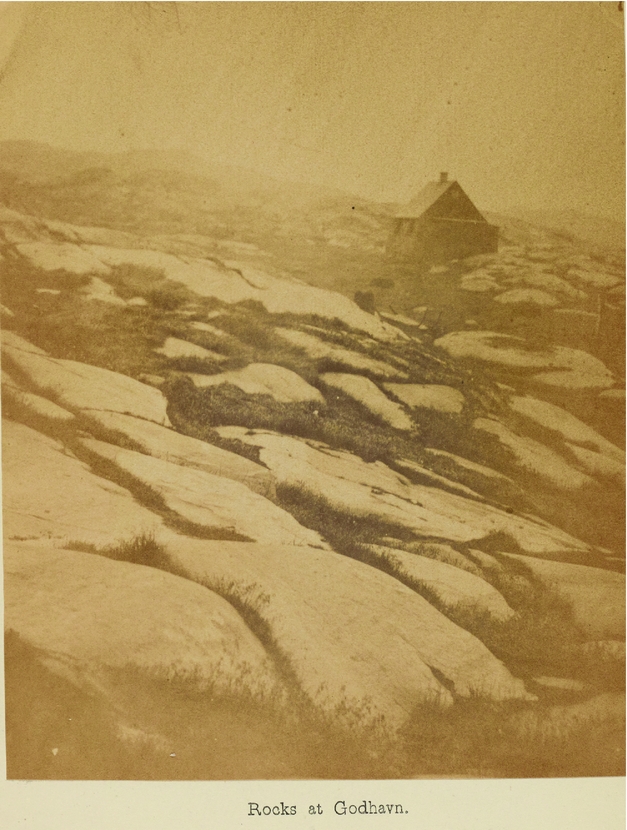
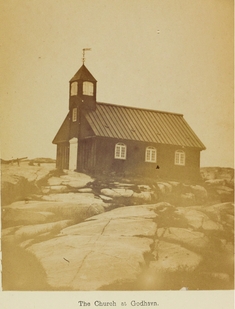
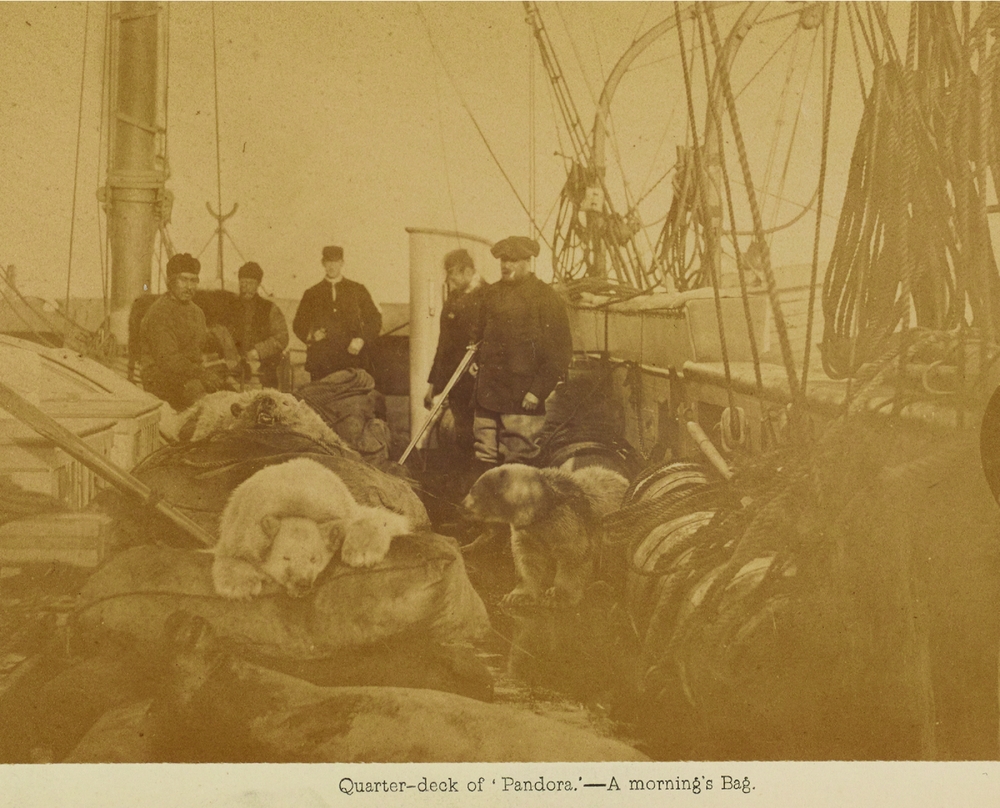
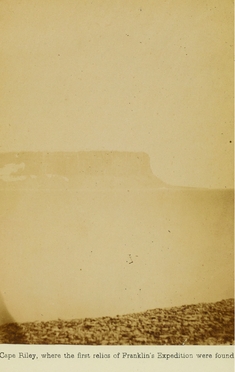
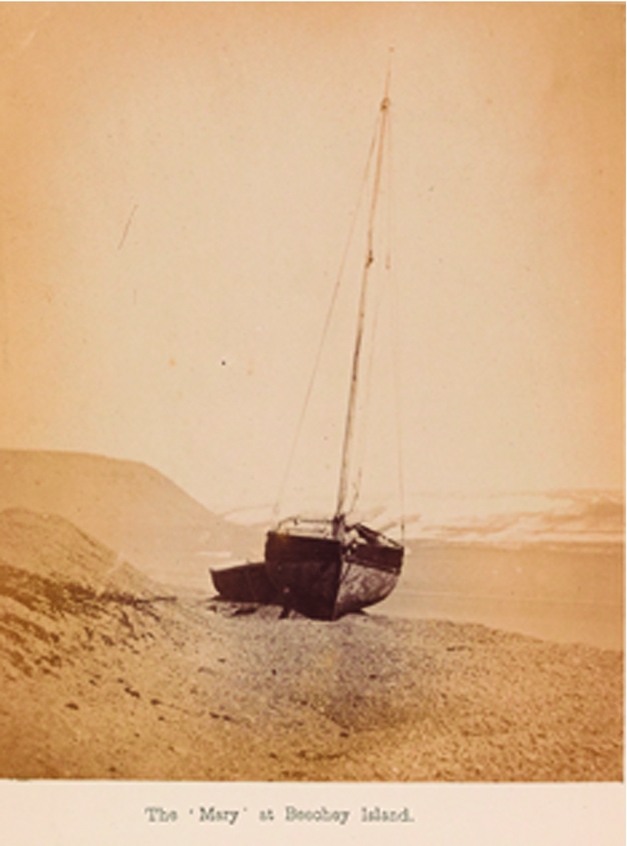
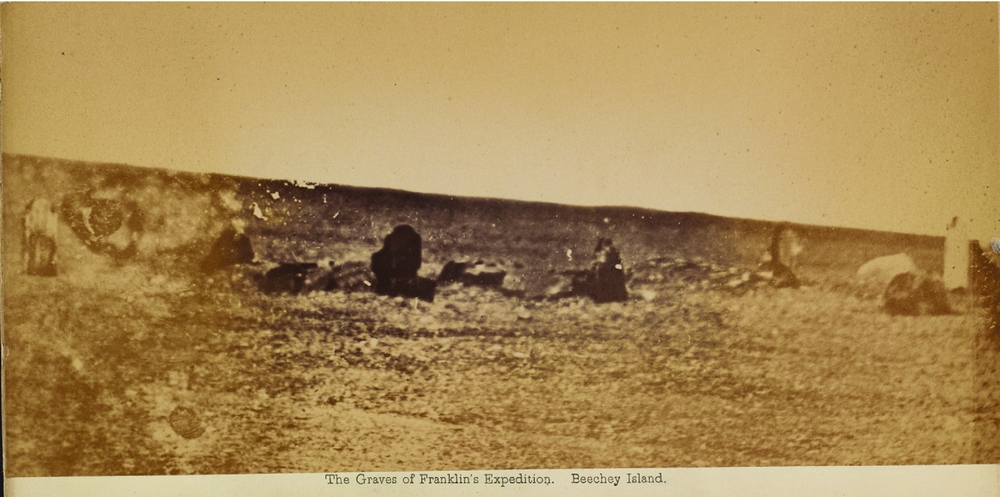
The frontispiece is a photograph of Pandora stopped by the ice barrier on 1 September 1875, and the final image in the book, taken the day after, shows Young taking his last look at the northwest passage (Figs. 1,2). They were prevented by the ice barrier from proceeding any further than 88º30’ W. There are four pictures taken in Greenland, at Ivitut (site of a cryolite mine) and at Godhavn (Figs. 3,4,5,6). The next is on the quarter deck displaying the collection of game bagged on one morning (Fig. 7), though the date is not recorded, and apart from the pictures from Peel Sound no dates are given. Cape Riley (Fig. 8) is followed by four photographs on Beechey Island relating to Franklin and the various relief expeditions (Figs. 9,10,11,12).
‘The Pandora in Peel Straits [sic], Sept.1st 1875. Stopped by the ice barriers’ (frontispiece).

‘My last look at the North-West Passage, Sept.2nd’’ (p.56).

’The Fox at vitot’(p.6).

‘Beach at Godhavn. Eskimo iglu’(p.16).

‘Rocks at Godhavn’(p.16).

‘The church at Godhavn’ (p.17).

‘Quarter-deck of Pandora- a morning’s bag’(p.32).

‘Cape Riley where the first relics of Franklin's expedition were found’(p.40).

‘The Mary at Beechey Island’(p.40).

‘The graves of Franklin's expedition, Beechey Island’(p.41).

‘Franklin and Bellot monument and Post Office, Beechey Island’(p.42).

‘Northumberland House. Beechey Island’(p.43).

Sadly no detail is given of the type of camera used, or what kind of plates, or any information of exposure times, filters, dark room facilities aboard ship, or any technical detail whatsoever. We know from the Bradford expedition and Grant's experiences (see below) that it was possible, but extremely difficult, to use wet plates in the Arctic, and the latter preferred Liverpool dry plates.
Because techniques for reproducing photographic images on the printed page were not widely available in the 1870s De Wilde's pioneering work has been forgotten, hidden in a volume with a limited circulation and now exceedingly scarce. He did however make engravings of some of the subjects for a book aimed at a wider readership, which also appeared in 1876, the same year as Young's volume.
Entitled Under the northern lights it was an account of the first Pandora expedition written by Januarius Aloysius MacGahan, a reporter with The New York Herald. The image of Northumberland House is reproduced as an engraving in MacGahan's book (1876: 206; Fig. 13), also the photograph of the yacht Mary, left there by Sir John Ross in 1851 during another Franklin search (MacGahan Reference MacGahan1876: 209; Fig. 14). There are a number of engravings of the Inuit that were encountered, but it is not known whether any of these derive from unpublished photographs, or from the drawings he made while in the Arctic.
Engraving of ‘Northumberland House’ by De Wilde; from Under northern lights, 1876.

Engraving of yacht Mary by De Wilde; from Under northern lights.

MacGahan had been on board ship representing James Gordon Bennett Jnr. (1841–1918), proprietor of that newspaper, a notable philanthropist and one of the sponsors of the voyage (MacGahan Reference MacGahan1876). The expedition was jointly financed by Young himself, Bennett, Lt. F. Innes Lillingston (second in command), and Lady Franklin..
MacGahan also describes De Wilde's activities at the entrance to Peel Sound, he ‘busied himself making sketches and photographs of the ice, the ship, and the coast of North Somerset.’ Later at La Roquette Island, Young ‘Pirie, Beynen, De Wilde, and myself got into a boat and rowed off towards the island. We first landed on a floe, where Mr. De Wilde made a photograph of the island, and Mr. Pirie took observations for the dip of the needle, which he found to be here 89º 30’’(MacGahan Reference MacGahan1876: 223, 262–263).
Life of De Wilde
De Wilde is described in the crew list simply as ‘artist’. An obituary in the Northampton Mercury, 23 February 1906, tells us that early in life he had been under the tuition of the Dalziel Bros., the engravers who worked with many eminent artists to reproduce their paintings in books and magazines. Afterwards he:
rose to some eminence as a wood engraver, as well as developing considerable qualities as a painter and as a very able delineator of scientific and natural objects. For this reason he was selected by the Royal Geographical Society to accompany an expedition to the Arctic regions, where he went as an artist to portray the natural characteristics of the localities visited.
His work included illustrating fossils and there is a letter from him in the Geological Magazine (De Wilde Reference De Wilde1868) replying to a criticism (made in the previous month) of a depiction of Heterophylla corals.
De Wilde came from a line of artists starting with his grandfather Samuel De Wilde (1751–1832), a theatrical portrait painter whose own father was born in Holland. His father George (1804–1871) was inclined to art but became a writer; he was a friend of Leigh Hunt, became editor of the Northampton Mercury and was a founder of the Northampton city museum and art gallery (Mayes Reference Mayes1971).
De Wilde was clearly first and foremost an artist; there is no record of him exhibiting his photographs, and he was a never a member of the Royal Photographic Society. Indeed it was photography, and the ability to print images from process blocks, which were to render the skills of a wood engraver superfluous. He turned instead to designing and executing work in bronze and precious metals. He was a partner with James Frederick Garrad as art metal workers in A. Newman & Co., a business union dissolved 6 March 1888.
He designed the filigree ironwork cross, font rail, and chancel screen for St. Matthews Church, in his home town of Northampton. His obituary says that he worked extensively for Queen Victoria at Osborne House and elsewhere, and for Princess Louise. These pronouncements have not been confirmed by the custodian of Osborne House or the staff of the Royal Collections, although this is probably the result of incomplete indexes of the various craftsmen and designers involved in royal projects. De Wilde, eldest son of George James De Wilde, though latterly resident at Mortlake, Surrey, is variously reported as dying in Brighton, Sussex, or Steyning in the same county, on 18 February 1906, in his 74th year (Northampton Independent, 24 February 1906).
Later events
Young commanded Pandora on a second voyage to the Arctic in 1876, This time De Wilde was replaced by William Grant, aged 25, a gentleman of means who had taken up photography whilst at Oxford University, and making his first of many voyages to the Arctic. His was to be a major contribution to recording the polar regions, including the first pictures of Novaya Zemlya.
After this second expedition in 1876 Young produced a public edition describing both voyages, the illustrations being engravings based on the original photographs of De Wilde and Grant. Those images not copied from photographs were worked up mainly, if not entirely, by Walter William May (1831–1896), Grant's uncle, an illustrator and former naval officer with excellent polar experience. A member of the Royal Institute of Painters in Watercolours, he exhibited at the Royal Academy, 1861–1893. Two of the five submissions were Arctic subjects, 1861, ‘Beechey Island, the winter quarters of Sir John Franklin’, and in 1877 ‘Sir Allen Young's yacht Pandora, nipped in the pack in Melville Bay’.
May probably passed on his enthusiasm for the Arctic to his nephew, Grant, who sailed as official photographer in the Dutch expeditions of the research ship Willem Barents 1878, 1879, 1881 and 1883. Grant was also aboard Isbjörn with Sir Henry Gore-Booth (the owner of the vessel) and Albert H. Markham in 1879 (Markham Reference Markham1881), as well as with Benjamin Leigh Smith for a voyage to Zemlya Frantsa-Iosifa in 1880 (Mörzer-Bruyns Reference Mörzer-Bruyns2003: 123–130; Credland Reference Credland2013b: 69–99). His photographs would have been a useful source for some of his uncle's Arctic illustrations.
In Young's Reference Young1879 volume two engravings illustrate the first voyage in 1875, one of Northumberland House, undoubtedly taken from De Wilde's photograph, which had appeared in the 1876 volume. The other is a picture of a man on the ice in Peel Sound, presumably De Wilde, with camera and tripod, his head hidden under a hood (Young Reference Young1879; 55). If this is based on a photograph it indicates the use of a second camera, either operated by another individual (Young?) or set on a timer (Fig. 15). Young himself evidently had an interest in photography, and when (during the second voyage) there was a chance they would have to abandon ship he refers to ‘photographic books’ among ‘all my little valuables’ (Young Reference Young1879: 114).
Engraving of De Wilde, Peel Sound, from Young's Two voyages of the ‘Pandora’, 1879.

De Wilde, had a number of predecessors who had taken pictures in the Arctic, and Young possibly realised that his polar photographs were the first to be published from a British expedition. It is possible, indeed likely, that the inspiration for Young to furnish his book with original photographs, came from the publication, in London, of Bradford's The Arctic regions, just three years before.
Acknowledgements
My thanks to Dr Michael Pritchard, for confirming details of RPS membership, J.P. Carr of the Northampton Museum for searching out material on De Wilde, eventually located in an uncatalogued box of documents, and the staff of the National Library of Scotland for providing reproductions of the De Wilde photographs.