Introduction
Breast cancer is the leading cancer in incidence among women globally. In Malaysia, ethnic Malay women with breast cancer are more likely to present with advanced disease as compared to Chinese and Indian ethnic groups (Ahmad et al., Reference Ahmad, Muhammad and Abdullah2011). Such findings highlight the importance of conducting further research to broaden understanding of the key socio-cultural components that may affect both quality of life (QoL) and health outcomes of Malay women with breast cancer.
Quality of life
There is an increasing literature that has documented the critical importance of QoL assessment for patients with cancer and other chronic life-limiting conditions (Levine et al., Reference Levine, Yoo and Aviv2017). QoL is multifaceted, encompassing physical, social, and psychological function, and domains of health and well-being that make life worth living and enjoyable (Michalos, Reference Michalos2014, p. 5266; Panzini et al., Reference Panzini, Mosqueiro and Zimpel2017). Life-limiting and threatening illnesses, such as cancer, contribute to heightened distress and suffering, impelling researchers globally to better understand factors that contribute to positive QoL and subjective well-being among women with breast cancer (Casellas-Grau et al., Reference Casellas-Grau, Font and Vives2014; Sharif et al., Reference Sharif, Ahadzadeh and Perdamen2017).
Studies have shown that QoL in patients with breast cancer is significantly associated with numerous factors impacted by culture, such as perceived locus of control (Pahlevan Sharif, Reference Pahlevan Sharif2017), spirituality, and religiosity (Panzini et al., Reference Panzini, Mosqueiro and Zimpel2017); mental health indices, including anxiety, depression, and distress (Kandasamy et al., Reference Kandasamy, Chaturvedi and Desai2011; Levine et al., Reference Levine, Yoo and Aviv2017; Pahlevan Sharif, Reference Duggleby, Doell and Cooper2017); sense of coherence (Rohani et al., Reference Rohani, Abedi and Omranipour2015); hope (Soylu et al., Reference Soylu, Babacan and Sever2016); and perceived social support (Eriksson et al., Reference Eriksson, Asplund and Hochwalder2013; Li et al., Reference Li, Yang and Liu2016; Ahaddour et al., Reference Ahaddour, Van den Branden and Broeckaert2017; Levine et al., Reference Levine, Yoo and Aviv2017).
Spirituality, a dynamic dimension of human experience that may contribute to a sense of life meaning, purpose, and connectedness including transcendent perceptions that extend beyond the self is recognized to be integral to the QoL of many people facing cancer (Canada et al., Reference Canada, Murphy and Fitchett2015). While spirituality is often associated with religious beliefs and practices, the role of how spirituality contributes to the enhancement of QoL for women with breast cancer is complex (Swinton et al., Reference Swinton, Bain and Ingram2011). In multicultural research, spirituality and religiosity have been positively associated with various aspects of QoL (Wildes et al., Reference Wildes, Miller and de Majors2009; Umezawa et al., Reference Umezawa, Lu and You2012; Sterba et al., Reference Sterba, Burris and Heiney2014; Al-Natour et al., Reference Al-Natour, Al Momani and Qandil2017). A perceived sense of coherence, a comprehensive intrinsic appraisal that life makes sense with purpose and meaning despite hardship, was a superior predictor of positive QoL as opposed to spirituality and religion in Iranian women with breast cancer (Rohani et al., Reference Rohani, Abedi and Omranipour2015). More research that focuses on race/ethnicity and cultural factors in evaluating these relationships between spirituality and QoL are needed particularly in underrepresented populations (Lim and Yi, Reference Lim and Yi2009; Umezawa et al., Reference Umezawa, Lu and You2012; Al-Natour et al., Reference Al-Natour, Al Momani and Qandil2017).
Several studies have evaluated the role of spirituality in bolstering coping in patients with breast cancer (Schreiber and Brockopp, Reference Schreiber and Brockopp2012; Umezawa et al., Reference Umezawa, Lu and You2012; Gaston-Johansson et al., Reference Gaston-Johansson, Haisfield-Wolfe and Reddick2013). Lower levels of spiritual well-being have been associated with lower QoL; particularly lowered perceptions of psychological well-being across studies (Canada et al., Reference Canada, Murphy and Fitchett2015). Among 150 Jordanian women diagnosed with breast cancer, spiritual well-being was associated with higher QoL (Al-Natour et al., Reference Al-Natour, Al Momani and Qandil2017). In both newly diagnosed cancer patients (Bai et al., Reference Bai, Lazenby and Jeon2015) and terminally ill cancer patients, religious faith played a significant role and was associated with fewer physical and psychosocial symptoms in end-of-life care (Bovero et al., Reference Bovero, Leombruni and Miniotti2016).
Hope, often referred to as a sense of confidence and faith in positive things to come, is associated with an optimistic outlook and may be inspired from spirituality and religious beliefs (Afrooz et al., Reference Afrooz, Rahmani and Zamanzadeh2014). Although hope may be of strong relevance to better understand the role of spirituality in sustaining QoL in patients with cancer, few studies target both spirituality and hope in relation to QoL in this population. In a qualitative study, Barton et al. (Reference Barton, Tate and Lau2018) found that participants who did not endorse either spiritual or religious perspectives still maintained sense of hope, meaning, and purpose for their life. Further, negative religious perceptions, such as that disease is a divine punishment from God, were found to negatively impact hope in Iranian women with breast cancer (Tabrizi et al., Reference Tabrizi, Radfar and Taei2016). Social and family support also contribute to the presence of hope (Afrooz et al., Reference Afrooz, Rahmani and Zamanzadeh2014), with partners and patients demonstrating interdependence in experiencing both hope and higher levels of QoL (Duggleby et al., Reference Duggleby, Doell and Cooper2014). In a study of 55 women with advanced breast cancer, stronger hope was associated with heightened optimism and also less realistic and accurate perceptions of treatment intent and prognosis. The study did not evaluate hope in the context of spiritual perceptions (Soylu et al., Reference Soylu, Babacan and Sever2016). A qualitative study found that patients with terminal cancer held both hope and hopelessness as a dialectic, with acceptance of the illness and pain symptoms in balance (Sachs et al., Reference Sachs, Kolva and Pessin2013). Few studies among cancer patients have evaluated the contribution of spirituality to QoL indirectly through increased hope, i.e., the mediational effect of hope (Gibson and Parker, Reference Gibson and Parker2002; Visser et al., Reference Visser, Garssen and Vingerhoets2010). Therefore, to add to the understanding of the role of hope in perceived QoL, we evaluated whether the level of hope has a mediating influence on the association between spirituality level and QoL in Malaysian women with breast cancer.
Studies have evaluated the role of life experiences including educational background as a contributor to QoL and spiritual well-being in patients with cancer (Schou et al., Reference Schou, Ekeberg and Sandvik2005; Peuckmann et al., Reference Peuckmann, Ekholm and Rasmussen2007). evel of education has been viewed as a proxy for socio-economic status (Mielck et al., Reference Mielck, Reitmeir and Vogelmann2013) and as a basic predictor of QoL especially among patients with breast cancer (Ganz et al., Reference Ganz, Desmond and Leedham2002; Yan et al., Reference Yan, Yang and Hao2016). Higher socio-economic status has been linked to quality of care that patients’ receive (Yan et al., Reference Yan, Yang and Hao2016) which may also impact QoL among patients. Another study found that patients with advanced breast cancer with less education had higher levels of hope but had a lack of awareness and unrealistic understanding of the treatment intent (Soylu et al., Reference Soylu, Babacan and Sever2016). Further, in a study conducted among patients with cancer from Iran, patients who were illiterate and less educated were found to be less likely to experience hope (Afrooz et al., Reference Afrooz, Rahmani and Zamanzadeh2014).
Educational advancement with exposures to secular perspectives may invoke questioning of religious tenets and contribute to spiritual uncertainty and existential angst (Dworsky Reference Dworsky2013). When individuals who have religious conflicts are diagnosed with cancer, negative religious coping characterized by concerns about divine punishment, existential struggles, and lack of connection with a religious community may impair QoL and increase psychiatric distress (Trevino et al., Reference Trevino, Balboni and Zollfrank2014). In an Islamic society, more women are achieving college education and attain successful careers (Al-Natour et al., Reference Al-Natour, Al Momani and Qandil2017) despite a predominantly patriarchal religious-centric cultural orientation. Research has demonstrated that ethnic patients with breast cancer who maintain adherence to traditional religious beliefs derive spiritual strength from their religious practices in the face of an uncertain future (Lagman et al., Reference Lagman, Yoo and Levine2014; Al-Natour et al., Reference Al-Natour, Al Momani and Qandil2017). Although educational status is impactful in other studies, it is unclear whether years of advanced formal education in Malay women would impact hope and perceived spiritual well-being. Given the distinctive uniqueness of Malay women with breast cancer and the limited research that has been conducted, the current study evaluated spirituality, overall QoL, and hope with among Malay women with breast cancer. Given much of the work conducted with Muslim women with cancer in this area have been qualitative in nature; the present research evaluated the constructs using a quantitative approach.
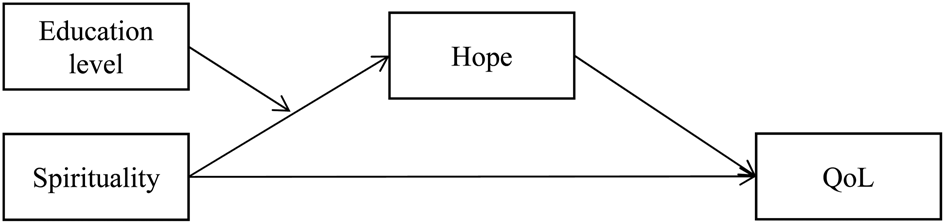
In the study, we hypothesize that education level moderates the relationship between spirituality and overall QoL in women with breast cancer.
Figure 1 shows the research model. In addition, the following five hypotheses were tested:
-
H1. Spirituality has a positive relationship with overall QoL.
-
H2. Spirituality has a positive relationship with hope.
-
H3. Hope has a positive relationship with overall QoL.
-
H4. Hope mediates the relationship between spirituality and overall QoL.
-
H5. Education level moderates the relationship between spirituality and hope.
Mediation-moderation model.

Materials and methods
Design
A cross-sectional correlational design was used to examine the proposed mediated-moderation relationships among spirituality with QoL and hope and the moderating effect of education on this relationship. Using convenience sampling, 157 Malay Muslim women who were diagnosed and status post-treatment for breast cancer were approached. Among them, 145 patients agreed to participate in the study. The sample was recruited from the outpatient clinic of a major tertiary cancer center. After obtaining written informed consent, participants completed surveys in a consultation room away from other distractions. Data were derived from a broader project on the quality of life of cancer patients (Pahlevan Sharif and Ong, Reference Pahlevan Sharif and Ong2018).
Participants
Inclusion criteria are listed as follows: (1) diagnosis of breast cancer; (2) female; (3) at least 18 years old; (4) no history of psychiatric illness, and/or anti-anxiety or antidepressant medications. Exclusion criteria were (1) history of other cancers (2) lack of capacity to read and write to complete the respective study surveys. Power analysis based on a fixed model of linear multiple regression analysis was conducted using G*Power (Faul et al., Reference Faul, Erdfelder and Buchner2009). Findings demonstrated that a sample size of 70 was sufficient to achieve an alpha less than or equal 0.05 and power greater than or equal to 80% for one sample.
Participants were recruited from an outpatient oncology clinic in Kuala Lumpur when they presented for routine follow-up appointments. The sample was composed of 111 married (76.6%), 17 single (11.7%), and 17 divorced women. With regard to educational level, 83 (57.2%) of the participants had completed primary or secondary school, 35 (24.1%) had a diploma or professional certificate, 22 (15.1%) had a university degree, and 5 (3.6%) had a postgraduate certificate. The average age of the sample was 50.6 years (SD = 9.65). The average time since initial diagnosis was 3.0 years (SD = 1.98).
Measurements
A questionnaire consists of the English and Bahasa Melayu versions of the instruments was prepared using the forward–backward translation technique.
Spirituality
Spirituality was measured by the 20-item Beliefs and Values Scale, an instrument specifically developed to quantify degree of spirituality that was translated to the Malay language with psychometrics and validity evaluated in a pilot study. The scale incorporates a 7-point Likert scale with items ranging from strongly disagree to strongly agree. Examples of items include: “I believe I have a spirit or soul that can survive my death,” “I believe in a personal God,” and “I believe in life after death.” The scale is suitable for studies in psychiatry and medicine (King et al., Reference King, Jones and Barnes2006). The Beliefs and Values Scale was developed specifically to extend beyond the socio-cultural context of religiously oriented beliefs to capture spiritual perceptions in a broader sense. The scale has displayed high test–retest consistency (weighted Kappa = 0.5) as well as high reliability and internal consistency (King et al., Reference King, Jones and Barnes2006). Cronbach's alpha of the scale in the current study was 0.94.
Quality of life
QoL was evaluated with the 16-item McGill Quality of Life Questionnaire, a validated scale developed for patients with advanced disease (Cohen et al., Reference Cohen, Mount and Strobel1995, Reference Cohen, Mount and Bruera1997). Items are measured on an 11-point Likert scale that ranges from 0 to 10. Four QoL components entailing physical (three items), psychological (four items), existential (six items), and social support (two items), as well as a single-item scale to measure global QoL, are assessed. The summed score of all items represents the overall QoL (range 0–160). Cronbach's alpha coefficient for all QoL factors was higher than 0.70 in the current study.
Hope
This study measured hope using the Herth Hope Index (Herth, Reference Herth1993) consisting of 12 items (e.g., “I have a positive outlook toward life” and “I have short and/or long range goals.”). Participants responded to the questions on a 4-point Likert scale ranged from 1 (strongly disagree) to 4 (strongly agree). In the present study, Cronbach's alpha coefficient of the scale was 0.54 that increased to 0.84 after excluding two reversed items. Given the instrument was reduced by two items, a psychometric analysis was conducted to confirm similarities between the original instrument and the version applied in this study.
Statistical analysis
SPSS v. 22 and the PROCESS package were used for data analysis. Frequencies and percentages were assessed to quantify the categorical variables, and means and standard deviations (SD) were calculated for continuous variables. We first evaluated the data for normality of distributions including an assessment for potential outliers. A two-step approach endorsed by Hayes (Reference Hayes2013) was utilized to investigate education as a moderator on the relationship between spirituality with QoL and hope. To estimate the standard errors of path coefficients, bootstrapping with 1,000 replications was implemented. Bootstrapping, a nonparametric distributional assumption-free method, was used as it is able to estimate standard errors and confidence intervals (CIs) more reliably (Pahlevan Sharif and Sharif Nia, Reference Pahlevan Sharif and Sharif Nia2018). Thus, the study investigated whether the strength and direction of the relationship between spirituality and QoL with hope was dependent on the participants’ education level (Pahlevan Sharif and Sharif Nia, Reference Pahlevan Sharif and Sharif Nia2018). The moderation analysis was used to identify “for whom” the hypothesized relationship is stronger (Frazier et al., Reference Frazier, Tix and Barron2004). The tests were two-tailed with p-value of 0.05 deemed to be statistically significant.
Results
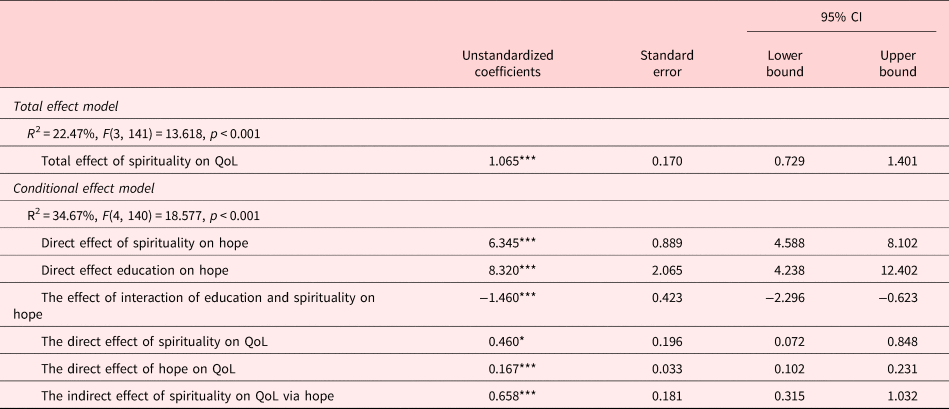
Findings showed a significant positive relationship between spirituality and QoL (b = 1.065, p < 0.001) providing support for H1. Assessment of the conditional effect model, controlled for the effects of age and time since diagnosis, indicated that there were significant positive relationships between spirituality and hope (b = 6.345, p < 0.001) and between hope and QoL (b = 0.167, p < 0.001) supporting H2 and H3, respectively. Moreover, the indirect relationship between spirituality and QoL through hope was positive and significant (b = 0.658, p < 0.001). Also, the direct association between spirituality and QoL in the conditional model was significant (b = 0.460, p < 0.05). This suggests hope partially mediated the relationship between spirituality and QoL supporting H4 (see Table 1).
The results of assessing total and conditional effect models

* p < 0.05 (two-tailed).
*** p < 0.001 (two-tailed).
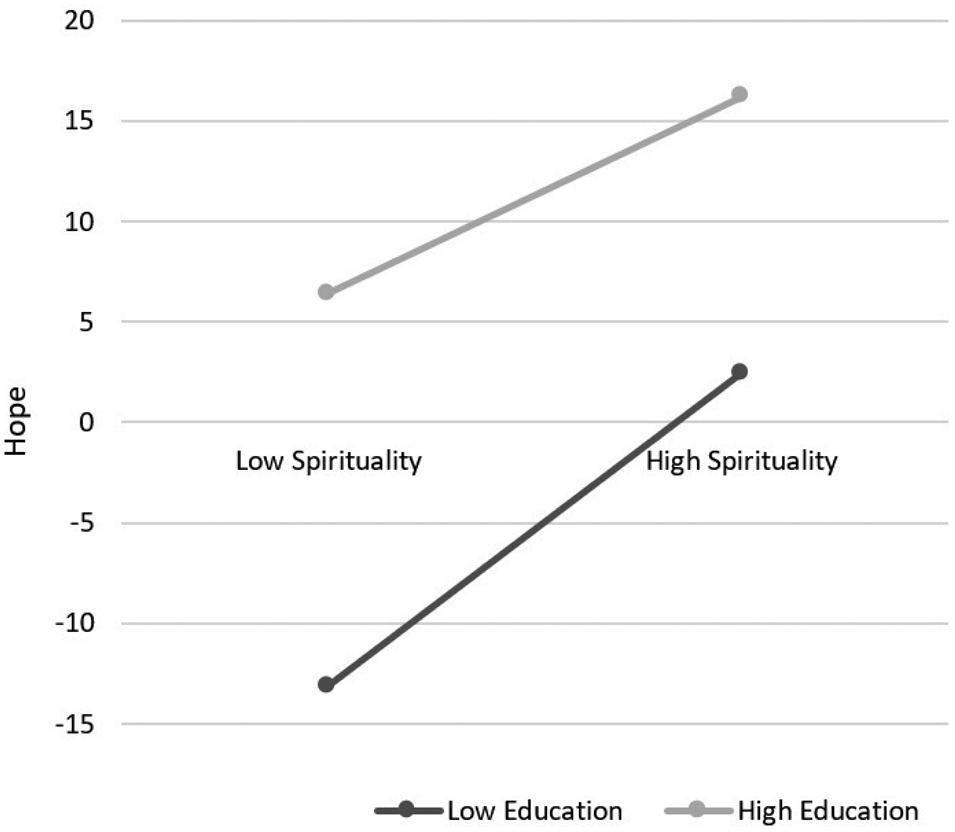
Hypothesis 5 (H5) evaluated whether education level moderated the relationship between spirituality and hope. Findings demonstrated that the interaction effect of education and spirituality on hope was statistically significant (b = −1.460, p < 0.001), indicating that higher education level significantly dampened the positive relationship between spirituality and hope (see Figure 2). The model explained 48.93% and 34.67% of the variance of hope and QoL, respectively.
The moderating effect of education level on the relationship between spirituality with hope.

Discussion
The study investigated relationships among spirituality, hope, and general QoL, the mediating role of hope in the relationship between spirituality and QoL, and sought to identify the potential role of education in buffering the relationships between spirituality and hope in Malay women diagnosed with breast cancer. In line with past literature (Wildes et al., Reference Wildes, Miller and de Majors2009; Sabado and Tanjasiri, Reference Sabado and Tanjasiri2010; Visser et al., Reference Visser, Garssen and Vingerhoets2010; Ahmad et al., Reference Ahmad, Muhammad and Abdullah2011; Delgado-Guay et al., Reference Delgado-Guay, Hui and Parsons2011; Jafari et al., Reference Jafari, Zamani and Farajzadegan2013; Lazenby et al., Reference Lazenby, Khatib and Al-Khair2013; Al-Natour et al., Reference Al-Natour, Al Momani and Qandil2017), findings indicated positive relationships between spirituality and QoL in this sample of Malay women with breast cancer. Such findings suggest that spirituality is salient in undergirding perceived health and well-being in this sample. The role of spirituality may contribute a coherent anchor to frame the life context and illness experience.
This study extends emerging literature on Muslim women with breast cancer (Ahmad et al., Reference Ahmad, Muhammad and Abdullah2011). In studies conducted in Islamic contexts, religion was taken into account as a manifestation of spirituality. From an Islamic perspective, spirituality links actions to the purpose of life. The diagnosis and treatment of breast cancer could contribute to doubts about perceived religious beliefs and values particularly if there is skepticism about religious tenets (Tabrizi et al., Reference Tabrizi, Radfar and Taei2016). In Islam, for many people, illness may be perceived as a divine test that “pain and illness may erase sin” and that God, the universal being, is the only source of cure. Such beliefs may foster pursuit of a closer relationship with God and a surrendering of the cancer to the will of God who as the omnipotent power can be trusted and knows best (Tabrizi et al., Reference Tabrizi, Radfar and Taei2016). Although the study did not directly address religiosity, a sense of spirituality may infer an inward relationship whereby perceptions of “God” derived religiously enhance the active integration of the illness into a coherent understanding that improves a sense of QoL.
Hope was also related to overall QoL, suggesting that sense of hope fosters overall well-being. The findings contribute to the existing evidence on the mediating role of hope between spirituality and QoL, indicating that perceived hope could further improve the general QoL of those Malay women with breast cancer who possess higher spirituality. To our best knowledge, this study is the first to examine whether hope creates a bridge between spirituality and overall QoL among Islamic women with breast cancer. A previous study that tested the importance of hope as a mediator between psychological distress and life satisfaction in a community sample of patients with cancer found that hope partially mediated the association between psychological distress and life satisfaction, while the path between psychological distress and health status was not significant with hope (Rustoen, et al., Reference Rustoen, Cooper and Miaskowski2010). Our findings suggest that spirituality was an antecedent for hope which, in turn, played a significant role in overall QoL. Malay women with breast cancer who have integrated spiritual beliefs into their daily life may experience less hopelessness and a more improved overall QoL.
Education level played a moderating role in the relationship between spirituality and hope, suggesting that the link between spiritual beliefs and overall QoL through perceived hopefulness was more evident in less educated women. Other research has found that patients with less education have a less realistic portrayal of life expectancy that in turn fostered hope (Matthews et al., Reference Matthews, Jagger and Miller2009). However, illiterate patients with breast cancer from Iran were found to have reduced hope in another study (Afrooz et al., Reference Afrooz, Rahmani and Zamanzadeh2014). The role of education level in contributing to lowered hope and quality of life in Malay women who have less spiritual beliefs is likely complex. It is plausible that increased literacy contributed to heightened knowledge about prognosis. Given our study did not examine stage of disease and other important factors associated with illness perceptions, we cannot extrapolate beyond these intriguing findings. However, the findings suggest that more educated patients could plausibly be less adherent to traditional religious beliefs and practices that would promote more surrender to forces outside personal control that could foster hope and thus potentially improve QoL in the face of a life-threatening stressor. Individuals who are more educated may struggle with traditional tenets and need more sophisticated dialogue about how personal spirituality can be strengthened, especially if cultural customs have been set aside, in the face of life-limiting and threatening stressors.
This study has important limitations. First, we recognize that there is blurring between spirituality and religiosity themes in this study. While we used a measure of spirituality reflective of perspectives broadened beyond the dominant socio-cultural perspective, we recognize that the Malay culture is prescribed the Islamic religion at the state level which reduces the ability to separate these often closely related constructs. While religiosity and spirituality are often associated, they can be expressed independently (Aten and Leach, Reference Aten and Leach2009). The cross-sectional design makes it impossible to infer causality between spirituality and overall QoL. Therefore, future longitudinal studies are needed to determine any improvements of QoL following increases in level of spirituality over time. Second, our study was conducted among a self-selected convenience sample of Malay females with breast cancer in a specific geographic region; thus, results are not generalizable to populations that differ in relation to gender, religion, and other illnesses. Future research that extends the inquiry to a larger more diverse population is recommended. Although a growing body of quantitative evidence is developing on the relationships among spirituality, hope, and QoL, these constructs are subjective and deeply personal, suggesting that research incorporating mixed methods approaches could shed more insight. Further, we did not examine dispositional characteristics such as optimism or the role of perceived social support which may impact hope in patients with life-threatening illness. Therefore, this exploratory research calls for further deeper investigation on perceptions of spirituality and the role of hope over the illness trajectory in women with breast cancer, especially in a multicultural context. Further, given a sense of hope is associated with heightened QoL, research that evaluates strategies to generate hope in individuals with lowered spirituality is recommended.
Another limitation of the study is the lack of ability to examine the role of body image in contributing to findings from the current study. Research has shown that women's experiences with breast cancer are embodied, impacted by gender and also culture (Thibeault and Sabo, Reference Thibeault and Sabo2012). It is plausible that perceived body image impacted participants' perceptions of spirituality and hope, particularly for those women whose self-worth is invested in physical appearance (Przezdziecki et al., Reference Przezdziecki, Sherman and Baillie2013). Building self-compassion has been linked to better mental health outcomes among women facing breast cancer (Przezdziecki et al., Reference Przezdziecki, Sherman and Baillie2013) and may be one avenue for building post-traumatic growth although there has been a lack of focus on such issues in Malay populations.
There has been increased interest in the development of “spiritual interventions” for patients with cancer (Canada et al., Reference Canada, Murphy and Fitchett2015; Nuraini et al., Reference Nuraini, Andrijono and Irawaty2018). While there remains limited study of what such interventions entail, these approaches emphasize incorporating the understanding of religious values to positively impact QoL in patients with cancer (Jafari et al., Reference Jafari, Zamani and Farajzadegan2013; Al-Natour et al., Reference Al-Natour, Al Momani and Qandil2017). For Muslim patients with cancer, such approaches capitalize on the most common cultural coping strategies. Supportive discussion groups whereby patients with breast cancer can build relationships and describe factors associated with a loss of hope, such as social isolation, beliefs about cancer as punishment from God, and other socio-cultural challenges relative to facing breast cancer in the context of advancing education, may also promote hope in the Muslim context (Tabrizi et al., Reference Tabrizi, Radfar and Taei2016). In practice settings, health care providers can work to ensure that spiritual assessments are conducted. Such an assessment could be used to determine whether appropriate spiritual guidance coincident with cultural beliefs could improve QoL and foster hopefulness. Most importantly, a personal individualized strategy that incorporates compassion, nonjudgmental acceptance, and social support is of essence (Tabrizi et al., Reference Tabrizi, Radfar and Taei2016).
An important strength of the study is the delineation of potential pathways whereby spirituality may impact QoL and hope in Malay women with breast cancer. Despite growing awareness of the importance of cultural factors such as religiosity in supporting patients with life-limiting disease, such as cancer, more research that evaluates the mechanisms undergirding links among spirituality, the fostering of hope and general QoL are needed.
Conclusion
Our findings of the role of advancing education in contributing to lessened hope in relation to the power of spirituality emphasize the importance of skilled and personalized spiritual counseling in the respective socio-cultural religious context. It is critical to ensure that the care of patients with breast cancer is individualized and that it takes into consideration different religious and spiritual beliefs, as well as varying education levels, particularly in a specific cultural context. The support for women with breast cancer needs to be tailored towards their beliefs and needs.
Conflict of interest
The authors have no conflicts of interest relevant to this article to disclose.
Ethical approval
All study procedures were reviewed and approved by the ethical committee of Mazandaran University of Medical Sciences (Ethical code: IR.MAZUMS.REC.1396.10393). Participants provided written informed consent after receiving information about the study objectives, the confidential nature of all surveys and protection of anonymity, and that the study was voluntary and they could withdraw at any time.