

DISCUSSION POINTS
-
• The extent to which climate change is both a new threat and a threat multiplier for biological extinctions is underappreciated.
-
• The transition from fossil fuels to carbon-neutral systems must accelerate to avoid severe biological consequences that impact people.
-
• It is unlikely that the transition will be accomplished fast enough without economic incentives and international agreements among the chief greenhouse gas emitters.
Introduction
Massive amounts of energy production are essential not only to maintain functioning of the global society at current levels but also to avoid a crash of the growing human population (now above 7 billion) back to preindustrial levels (less than a billion people). Reference Barnosky1 The human species alone now uses more than 760 exajoules of energy per year (as of 2010), which approaches what was available to be shared by all terrestrial species on Earth prior to inventions that allowed us to augment the global energy budget. The global energy budget without human intervention was constrained to what could be produced by photosynthetic processes, that is, so-called net primary productivity (NPP), which is fundamentally plants converting heat energy to chemical energy that can in turn be utilized by other living things. Now, humans annually require some one third of all the energy provided by NPP on land, co-opting that from use by other species, plus an additional 550 exajoules we produce mainly from burning fossil fuels. Reference Del Grosso, Parton, Stohlgren, Zheng, Bachelet, Prince, Hibbard and Olsen2–Reference Smil8
This puts the global society in a double bind. On the one hand, our very survival at current numbers depends on energy production. On the other hand, relying on fossil fuels to the extent we do now is known to change climate such that people already are bearing significant costs and will almost certainly incur considerably more in the next few decades. So far, these costs have been reckoned primarily in terms of direct human impacts: such as destruction of property from sea level rise, wildfires, and storms or loss of agricultural productivity. Costs in human lives and livelihoods also are often cited, for instance from increased frequency of heat waves; loss of water sources for highly populated areas as winter snows falter or glaciers disappear; or submergence of communities as sea level rises. All of these impacts already are being felt and have high likelihood of intensifying by mid-century and causing damage that will affect at least hundreds of millions of people. Reference Stocker, Qin, Plattner, Tignor, Allen, Boschung, Nauels, Xia, Bex and Midgley9–Reference Edenhofer, Pichs-Madruga, Sokona, Farahani, Kadner, Seyboth, Adler, Baum, Brunner, Eickemeier, Kriemann, Savolainen, Schlömer, von Stechow, Zwickel and Minx11
A growing body of research has also begun to document impacts of anthropogenic climate change on nonhuman species. Reference Cahill, Aiello-Lammens, Fisher-Reid, Hua, Karanewsky, Ryu, Sbeglia, Spagnolo, Waldron, Warsi and Wiens12–Reference Urban26 Already observable are movements of thousands of species—plants, insects, birds, mammals, reptiles, amphibians, and fish—out of areas where their preferred climate has changed and toward areas where conditions are more suitable. Generally these involve dispersal to cooler areas that occur upslope or toward the poles. Reference Root, Price, Hall, Schneider, Rosenzweig and Pounds16,Reference Parmesan18,Reference Parmesan and Yohe19,Reference White, Alley, Archer, Barnosky, Foley, Fu, Holland, Lozier, Schmitt, Smith, Sugihara, Thompson, Weaver, Wofsy, Dunlea, Mengelt, Purcell, Gaskins and Greenway21,Reference Moritz, Patton, Conroy, Parra, White and Beissinger27 In a few plant and animal species, populations appear to be experiencing evolutionary change stimulated by local climate changes. Reference White, Alley, Archer, Barnosky, Foley, Fu, Holland, Lozier, Schmitt, Smith, Sugihara, Thompson, Weaver, Wofsy, Dunlea, Mengelt, Purcell, Gaskins and Greenway21,Reference Heerwaarden and Sgrò28,Reference Moritz and Agudo29
However, it remains unclear whether these observed biotic responses can continue to compensate for the increasing pace and magnitude of climate change that is projected under business-as-usual emissions scenarios. Under such conditions, the rate at which species would have to adjust, either by movement into new areas or evolutionary adaptation, would have to exceed at least tenfold any response they have shown to past climate changes, including those that took the world from the last ice age to our present interglacial time. Reference Diffenbaugh and Field20,Reference Blois and Hadly30 Except for the anthropogenic global warming underway now, that glacial–interglacial transition was the most rapid climate change for at least 50 million years. It encompassed the same amount of warming (about 5 °C) that is projected under business-as-usual scenarios, but at a rate that was an order of magnitude slower. Even so, in the Americas at least, the combination of climate change and growing human populations caused extinction of more than half of the large-bodied mammal species. Reference Brook, Barnosky and Hannah31
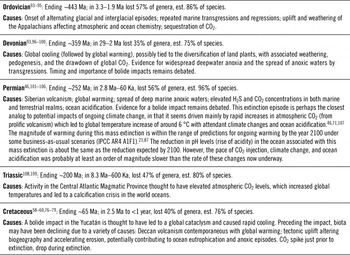
Taking a longer view, each of the Earth's past so-called “Big Five” mass extinctions (Table 1) involved climate disruptions to at least some degree, including major changes to the carbon cycle with attendant modifications of the oceans and atmosphere, Reference Barnosky, Matzke, Tomiya, Wogan, Swartz, Quental, Marshall, McGuire, Lindsey, Maguire, Mersey and Ferrer32 as is the case currently and as is expected to increase in the near future. Moreover, recent work indicates that the amount of climate change projected under business-as-usual scenarios will be more than many species can cope with, significantly increasing already too-high extinction rates to the extent that the Sixth Mass Extinction would be inevitable.
The past “Big Five” mass extinction events.

Here, I review this evidence, which on balance indicates that the extinction threat of anthropogenic climate change is underappreciated. Business-as-usual greenhouse gas emissions all but guarantee that the Sixth Mass Extinction would be unstoppable by mid-century, just thirty-five years into the future, at which point the accelerated species-loss trajectory would be locked in. I also comment on the extent to which the global energy system would have to transform by 2050 to minimize chances of a major extinction scenario.
Previous mass extinctions
Mass extinctions are times when extinction rates accelerate so much that evolution of new species cannot keep up, resulting in the loss of the majority of species known over a geologically short interval of time. This happened only five times in the past 540 million years (Table 1). The minimum magnitude of species-loss that signifies a mass extinction is typically taken to be around 75%. The maximum estimated loss exceeds 90%; this occurred at the Permian–Triassic event (abbreviated P–Tr), which had climate-induced extinction drivers analogous to today's situation (Table 1). A “geologically short” interval of time can range from nearly instantaneous, in the case of the asteroid strike that provided the coup-de-grace at the Cretaceous–Paleogene (K–Pg) event, to 2 million years (or even more) as exemplified by the Devonian event (Table 1). Generally, geologic dating in deposits millions of years old has not been able to resolve time finer than within a few hundred thousand years, in best cases within a few tens of thousands of years, so past mass extinctions may well have taken place within shorter intervals than the time spans given in Table 1.
The key point illustrated by past mass extinctions is that they are extremely rare events in the entire history of complex life on Earth—only five times in the past 540 million years (Table 1)—but that they do happen. Therefore they can happen again. While the proximate causes of each may differ, they all have in common major perturbations to atmospheric chemistry (notably changes in the carbon cycle), ocean chemistry (notably acidification and anoxia), changing climate, and changing ecological dynamics that occurred rapidly with respect to the millions of years of more stable conditions under which the species of the time had evolved and to which they were adapted. Such is also the case presently.
Background versus mass extinction rates
The normal fate of all species is to go extinct eventually, much as the normal fate of a person is to die, so extinction per se is not unusual. Mass extinctions (Table 1), however, are times when so many species go extinct near the same time that biodiversity crashes; this is analogous to a given population of humans crashing because of, say, a disease pandemic such as the infamous Black Plague that killed some 30–60% of Europe's population in the mid-1300s.
The normal background rate of extinction for species—analogous to the normal death rate in a population of people—has been estimated by various techniques that rely on recording the first and last appearances of all known fossil taxa (hundreds of thousands of fossilized species that lived over the past 600 million years or so), then using those taxonomic life spans to calculate an average background extinction rate. Reference Barnosky, Matzke, Tomiya, Wogan, Swartz, Quental, Marshall, McGuire, Lindsey, Maguire, Mersey and Ferrer32 Typically, extinction rates are expressed in species extinct per million species per year, called extinctions per million species-years, abbreviated E/MSY. Reference Pimm, Abell, Brooks, Gittleman, Joppa, Raven, Roberts and Sexton14,Reference Barnosky, Matzke, Tomiya, Wogan, Swartz, Quental, Marshall, McGuire, Lindsey, Maguire, Mersey and Ferrer32–Reference Ceballos, Ehrlich, Barnosky, García, Pringle and Palmer35 Using primarily invertebrate marine species to derive a background rate suggests normal extinction rates range between 0.1 and 1.0 E/MSY. For mammals, which have the most comprehensive data set that exists for any taxonomic group, background extinction rates appear to be higher, around 1.8 E/MSY. Reference Barnosky, Matzke, Tomiya, Wogan, Swartz, Quental, Marshall, McGuire, Lindsey, Maguire, Mersey and Ferrer32,Reference Ceballos, Ehrlich, Barnosky, García, Pringle and Palmer35
In contrast, the Big Five Mass Extinctions exhibit extinction rates that are much faster than any estimated background rates. Measured over geological time, the rates at times of mass extinction appear to be at least near 10 E/MSY; such a rate assumes that the ∼90% species loss that characterized the P–Tr event took place over some 60,000 to 100,000 years. If, however, one assumes that a mass extinction such as the P–Tr took place in as little as five hundred years (an interval of time too small to document by current geologic dating techniques), the extinction rate would exceed 1000 E/MSY. Reference Barnosky, Matzke, Tomiya, Wogan, Swartz, Quental, Marshall, McGuire, Lindsey, Maguire, Mersey and Ferrer32
Current extinction rates and causes
Estimates of extinction rates over the past century vary from less than 10–1000 E/MSY or even more, and those numbers have been used to infer that current extinction rates are some 5–1000 times higher than normal background rates. Reference Pimm, Abell, Brooks, Gittleman, Joppa, Raven, Roberts and Sexton14,Reference Barnosky, Matzke, Tomiya, Wogan, Swartz, Quental, Marshall, McGuire, Lindsey, Maguire, Mersey and Ferrer32–Reference Ceballos, Ehrlich, Barnosky, García, Pringle and Palmer35 The wide range of estimates derives from analyzing different taxa, using different methodologies to assess current extinctions, making different assumptions when calculating background rates, and using different techniques in comparing a rate calculated from measuring extinctions over a short interval of time (tens to hundreds of years) against one calculated over a long interval of time (hundreds of thousands to millions of years). Reference Barnosky, Matzke, Tomiya, Wogan, Swartz, Quental, Marshall, McGuire, Lindsey, Maguire, Mersey and Ferrer32,Reference Ceballos, Ehrlich, Barnosky, García, Pringle and Palmer35 However, all estimates of current extinction rates—even the lowest ones—are extremely elevated compared to even the highest background rates estimated from the fossil record, Reference Ceballos, Ehrlich, Barnosky, García, Pringle and Palmer35 and higher than the geologically constrained elevated rates that led to the previous Big Five Mass Extinctions. Reference Barnosky, Matzke, Tomiya, Wogan, Swartz, Quental, Marshall, McGuire, Lindsey, Maguire, Mersey and Ferrer32 Even the lowest current rates estimated, if they continued, would lead to 75% species loss—that is, a Big Five-style mass extinction—within about five centuries, possibly in as little as 250 years. Reference Barnosky, Matzke, Tomiya, Wogan, Swartz, Quental, Marshall, McGuire, Lindsey, Maguire, Mersey and Ferrer32 The overwhelmingly strong evidence that current extinction rates are elevated well above background levels have given rise to the recognition that a Sixth Mass Extinction is in the beginning stages and can only be avoided by concerted, stepped-up conservation efforts. Reference Barnosky6,Reference Pimm, Abell, Brooks, Gittleman, Joppa, Raven, Roberts and Sexton14,Reference Dirzo, Young, Galetti, Ceballos, Isaac and Collen24,Reference Seddon, Griffiths, Soorae and Armstrong25,Reference Barnosky, Matzke, Tomiya, Wogan, Swartz, Quental, Marshall, McGuire, Lindsey, Maguire, Mersey and Ferrer32,Reference Ceballos, Ehrlich, Barnosky, García, Pringle and Palmer35
Climate change introduces a new extinction threat
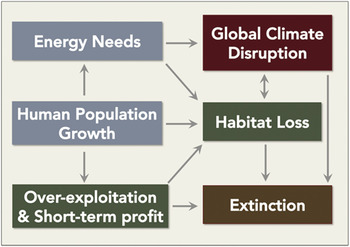
The elevated current extinction rates noted in the section “Current extinction rates and causes” do not take the impacts of global climate changes now underway into account. Up until now, the major drivers of elevated extinction have been the human impacts of direct destruction and fragmentation of habitats and overexploitation of economically valuable species. Anthropogenic climate change, if continued under the present trajectory of greenhouse gas emissions, not only adds a significant, entirely new threat to mix, but also adds a threat multiplier that exacerbates previously recognized extinction drivers (Fig. 1). Often the multiple drivers of extinction are discussed as if they are distinct from one another, but in reality, they strongly interact (Fig. 1). For example, each person added to the world requires food, water, money, and the raw materials needed to provide goods and services, the production of which ultimately drives habitat loss, overfishing, heightened poaching, and so on. At the same time, as the human population grows, the human species has to produce more energy, which, at least as presently done, increases habitat destruction and loss through direct impacts, such as roads needed to develop new energy fields, and indirect impacts, notably the build-up of greenhouse gases and consequent climate change that make present habitats unsuitable for the species that have lived there over previous millennia.
Current extinction drivers and how they interact. Climate change multiplies extinction risk overall by both adding a new direct threat (changing climate to new states faster than species can move or adapt) and by exacerbating the losses from previously recognized threats. The feedback arrow between climate disruption and habitat loss reflects that climate-triggered reduction of rainforests or deforestation by logging or other direct human impacts also decreases carbon sequestration considerably, thus increasing greenhouse warming. Reference White, Alley, Archer, Barnosky, Foley, Fu, Holland, Lozier, Schmitt, Smith, Sugihara, Thompson, Weaver, Wofsy, Dunlea, Mengelt, Purcell, Gaskins and Greenway21

Recognizing extinction
Species are composed of groups of individuals sorted mainly by geography into distinct breeding populations. Typically, there is some exchange of individuals from one population to another, which promotes spread of traits throughout large parts of a species geographic range. Extinction of a species becomes highly likely when the number of its populations and individuals falls below a critical number or when exchange of individuals between effectively small populations is no longer possible. Long-term persistence of populations typically requires thousands of individuals. Thus, it is not the disappearance of the last individual of a species that guarantees a species is extinct; rather, it is falling below some critical number of individuals. In this sense, extinction is cryptic Reference White, Alley, Archer, Barnosky, Foley, Fu, Holland, Lozier, Schmitt, Smith, Sugihara, Thompson, Weaver, Wofsy, Dunlea, Mengelt, Purcell, Gaskins and Greenway21 ; long before the last individual disappears, the species can become a “dead species walking.” Reference Jablonski37
For many species, the drivers of habitat destruction and/or overexploitation already have reduced population numbers to near or below critical viable thresholds over three decades or less, as demonstrated by the International Union for the Conservation of Nature's (IUCN) current recognition of nearly one third (more than 20,000 species) of all assessed species as threatened with extinction. 38 Available information in fact suggests that calculating extinction rates by recognizing the number of populations lost, rather than the number of species, would result in extinction rates that are an order of magnitude higher than the rates indicated by only considering species in which the last individual has actually died (which are the rates given in the section “Current extinction rates and causes”). Reference Hughes, Daily and Ehrlich39 For example, nearly half of mammal species that were once widespread have had their populations and geographic ranges reduced by at least 50%, Reference Ceballos and Ehrlich40 and over the last forty years, 50% of all vertebrate wildlife has been killed. 41
In this context, it is important to recognize that climate change as early as mid-century can produce both cryptic extinctions—species that are doomed by reduction to small numbers of individuals, even though they may linger on for a few decades more—and observable extinctions, that is, disappearance of the last individual. The cryptic extinctions—the irreversible diminishment of populations and numbers of individuals—ultimately are as serious as the loss of the last individual, even though they are much harder to detect. It is such cryptic extinctions that can lock in the Sixth Mass Extinction, even though loss of the last individuals of species may come later.
How climate change causes extinctions
Climate change is known to trigger extinctions through four pathways: (i) direct impacts of an abrupt climatic event, such as flooding of a coastal ecosystem by storm surges as sea level rises due to melting glaciers and thermal expansion; (ii) gradual changes in a climatic parameter until a critical biological threshold is exceeded across most or all of a species geographic range; (iii) interactions of climatic impacts with nonclimatic extinction drivers, such as habitat fragmentation, overharvesting, or pollution; and (iv) climate-triggered change in biotic interactions, such as loss of a species upon which many others depend (like keystone or mutualist species), climatically induced increases in disease or pest species (such as the bark-beetle outbreaks now destroying millions of acres of western USA conifer forests), or seasonal changes that break down critical links in the food chain or in reproductive cycles (called phenologic changes, such as a mismatch between the timing of plants blooming and the emergence of insects that depend on the plants). Reference White, Alley, Archer, Barnosky, Foley, Fu, Holland, Lozier, Schmitt, Smith, Sugihara, Thompson, Weaver, Wofsy, Dunlea, Mengelt, Purcell, Gaskins and Greenway21
Why anthropogenic climate change increases extinction risk
It is the rate, magnitude, and uniqueness of anthropogenic climate change, combined with severely fragmented habitats that essentially trap species in place, that set up especially potent conditions for widespread extinction.
Rate of climate change
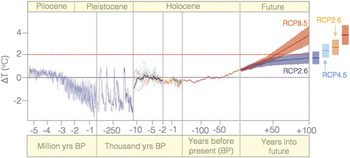
Species alive today have never experienced climate changes that are as fast as those now being caused by greenhouse gas emissions, and which will continue over the next few decades at least (Fig. 2). The ongoing and projected rate of change is at least an order of magnitude faster than any species has experienced in at least 66 million years. Reference Diffenbaugh and Field20,Reference Blois and Hadly30 Speed limits on evolution and inhibited dispersal capabilities given current habitat fragmentation mean that many species will neither be able to adapt fast enough if they remain where they now live, nor disperse to more favorable areas if such areas exist (see below).
Fluctuations in mean annual temperature through the past 5 million years compared to mean global temperature for the period 1960–1990 (purple dashed line), and to the IPCC AR5 projections of future temperature rise. Colored lines for each RCP show estimated mean temperature rise, and shaded areas show likely range. Reference Stocker, Qin, Plattner, Tignor, Allen, Boschung, Nauels, Xia, Bex and Midgley9 The red dotted red line marks 2 °C of warming, which is above the mean global temperature experienced by virtually all extant vertebrate species and populations, and also outside the range experienced by many invertebrates and plants. Instrumental records from weather stations supply the data back to about the year 1900 (the past 115 years). Various kinds of paleoclimate proxies, including tree rings, ice-cores, and oxygen-isotope records, provide the temperature reconstructions prior to that time. The illustration is modified from one presented in Ref. Reference Moritz and Agudo29 utilizing information from http://commons.wikimedia.org/wiki/File:All_palaeotemps.png. Future projections are the IPCC RCP from the AR5 Summary for Policy Makers Figure SPM.7. Reference Stocker, Qin, Plattner, Tignor, Allen, Boschung, Nauels, Xia, Bex and Midgley9 The text also refers to the IPCC AR4 emissions scenarios B1, A2, and A1F1. For comparison, the B1 emissions scenario is estimated raise global temperature about 1.2 °C by 2050 and 1.8 °C by 2100 (likely range 0.3–0.9 °C); A2: ∼1.5 °C by 2050 and 3.4 °C by 2100 (likely range 2.0–5.4 °C); A1F1: 4.0 by 2100 (likely range 2.4–6.4 °C).

Magnitude of climate change
It now seems almost certain that by 2050 mean global temperature will increase by at least 2 °C, and by 2100, under current emission trajectories, it will likely be more than 4 °C hotter [the Representative Concentration Pathways (RCP) 8.5 trajectory Reference Stocker, Qin, Plattner, Tignor, Allen, Boschung, Nauels, Xia, Bex and Midgley9 ], possibly more than 6 °C (if the IPCC AR4 A1F1 scenario 42 prevails). For perspective, a 2 °C warmer world is hotter than Earth has seen in more than 5 million years, 4 °C is hotter than the world has been in about 14 million years, and a 6 °C rise would make it hotter than it has been in 50 million years. Reference Blois and Hadly30 Most animal species and many plant species alive today only evolved within the past 5 million years, so they have never existed under climatic conditions that will be common by mid-century, especially if warming exceeds 2 °C. Reference Alroy43–Reference Avise, Walker and Johns45 The magnitude of warming the world would experience if business-as-usual emissions scenarios continue until the end of this century would resemble that which occurred in conjunction with the end-Permian mass extinction 252 million years ago, when more than 90% of Earth's known species died out (Table 1). Reference Barnosky6,Reference White, Alley, Archer, Barnosky, Foley, Fu, Holland, Lozier, Schmitt, Smith, Sugihara, Thompson, Weaver, Wofsy, Dunlea, Mengelt, Purcell, Gaskins and Greenway21,Reference Payne and Clapham46
Unique climatic conditions
In a given locale, global warming is manifested as climatic changes that include not only annual mean temperature and precipitation but also such biologically important parameters as new combinations of temperature and precipitation in certain seasons, the frequency of extreme weather events, such as heat spells, droughts, or floods, new seasonal norms, and the relative changes in daytime versus nighttime temperatures. Reference Stocker, Qin, Plattner, Tignor, Allen, Boschung, Nauels, Xia, Bex and Midgley9,Reference Field, Barros, Stocker, Dahe, Dokken, Ebi, Mastrandrea, Mach, Plattner, Allen, Tignor and Midgley10,42 At the population level, virtually all animals and plants living today have a genetic code that is fine-tuned to the prevailing conditions of just the last 2 million years, which means that by mid-century (at the latest), they will be experiencing conditions that are outside the realm of what 2 million years of evolution has adapted them to. This is true also for humans, which only appeared as a species 160,000 years ago; by 2070, possibly earlier, the planet will be hotter than Homo sapiens has ever seen it, even if the lower IPCC emissions trajectories prevail (Fig. 2).
Insufficient dispersal capabilities
For species that find themselves in areas that are changing such that the local climate is no longer suitable for them, a typical response that averts extinction is dispersal to a region where the climate is more favorable. Reference Barnosky6,Reference Cahill, Aiello-Lammens, Fisher-Reid, Hua, Karanewsky, Ryu, Sbeglia, Spagnolo, Waldron, Warsi and Wiens12–Reference Harnik, Lotze, Anderson, Finkel, Finnegan and Lindberg15,Reference Solomon, Battisti, Doney, Hayhoe, Held, Lettenmaier, Lobell, Mathhews, Peirrehumbert, Raphael, Richels, Root, Steffen, Tebaldi, Yohe, Wardent, Brown, Dunlea, Reidmiller, Freeland, Payne and Bearrs17,Reference White, Alley, Archer, Barnosky, Foley, Fu, Holland, Lozier, Schmitt, Smith, Sugihara, Thompson, Weaver, Wofsy, Dunlea, Mengelt, Purcell, Gaskins and Greenway21,Reference Barnosky, Matzke, Tomiya, Wogan, Swartz, Quental, Marshall, McGuire, Lindsey, Maguire, Mersey and Ferrer32,Reference Foden, Butchart, Stuart, Vié, Akçakaya, Angulo, DeVantier, Gutsche, Turak, Cao, Donner, Katariya, Bernard, Holland, Hughes, O’Hanlon, Garnett, Sekercioglu and Mace36 However, the velocity of climate change, Reference Diffenbaugh and Field20,Reference Loarie, Duffy, Hamilton, Asner, Field and Ackerly22 which is the speed at which the geographic position of the mean temperature that now characterizes habitats will move across the landscape, may exceed the dispersal capabilities of many species. An initial study (using IPCC AR4 scenarios 42 ) indicated that shifting of species' ranges to track how climate space will move by 2050–2100 would require organisms now living in regions that occupy about 29% of Earth's land to disperse faster than what occurred at the last glacial–interglacial transition. Reference Loarie, Duffy, Hamilton, Asner, Field and Ackerly22 As noted above, until the current anthropogenic warming episode started, the last glacial–interglacial transition was the fastest rate of climate change documented in the geological and paleontological record. It was an orbitally caused (nonanthropogenic) global warming event that occurred some 11,700 years ago, mostly over about 1600 years, Reference Barnosky, Hadly, Bascompte, Berlow, Brown, Fortelius, Getz, Harte, Hastings, Marquet, Martinez, Mooers, Roopnarine, Vermeij, Williams, Gillespie, Kitzes, Marshall, Matzke, Mindell, Revilla and Smith47 and while it was the closest analog to present-day climate change in terms of magnitude of global temperature increase, the rate of warming was much slower and the starting point was much cooler. A more recent study Reference Diffenbaugh and Field20 using IPCC AR5 projections Reference Stocker, Qin, Plattner, Tignor, Allen, Boschung, Nauels, Xia, Bex and Midgley9 indicated that most terrestrial species would have to move at least four times as fast as they did at the glacial–interglacial transition; species distributed over about half of the land surface would have to move eight times faster; those over a third of the land surface would have to move 16 times faster; and those in high-latitude regions would have to move 128 times faster. Whether most affected species are capable of dispersing at such high rates is not well known, as they have never been subjected to such pressures before, and because there are nonclimatic limits to dispersal rates as well, such as biotic interactions and distribution of dispersal corridors. Reference Urban, Zarnetske and Skelly48
However, even if species do have the biological capacity to disperse fast enough to cope with climate change, their routes and/or destinations are blocked by human-dominated landscapes they cannot traverse. Nearly 50% of Earth's land has been transformed by humans in major ways—agriculture, roads, cities, dams, etc.—making it unsuitable for many climate-threatened species to utilize either as living area or as migration corridors. Reference Barnosky, Hadly, Bascompte, Berlow, Brown, Fortelius, Getz, Harte, Hastings, Marquet, Martinez, Mooers, Roopnarine, Vermeij, Williams, Gillespie, Kitzes, Marshall, Matzke, Mindell, Revilla and Smith47,Reference Foley, Ramankutty, Brauman, Cassidy, Gerber, Johnston, Mueller, O’Connell, Ray, West, Balzer, Bennett, Carpenter, Monfreda, Polasky, Rockström, Sheehan, Siebert, Tilman and Zaks49,Reference Hooke, Martín-Duque and Pedraza50 It is the interaction between climate change and habitat fragmentation, which traps species in regions that become climatically lethal, that poses particularly high risks for rapidly accelerating extinction rates as anthropogenically caused climate change continues.
Evolutionary speed limits
It seems unlikely that evolutionary adaptation can rescue most species that become imprisoned in unfavorable climate zones, because of limits on the speed at which favorable mutations can arise and spread. Reference White, Alley, Archer, Barnosky, Foley, Fu, Holland, Lozier, Schmitt, Smith, Sugihara, Thompson, Weaver, Wofsy, Dunlea, Mengelt, Purcell, Gaskins and Greenway21 However, species characterized by large numbers of individuals and a diverse gene pool can be expected to exhibit some evolutionary response, because strong selection pressures induced by a changing climate can result in culling variants less adapted to the new climate conditions. This shifts the population mean toward variants that are more favored by the new conditions. Examples of this response to climate change already have been observed in plants, mammals, fish, and insects, although not commonly. Reference White, Alley, Archer, Barnosky, Foley, Fu, Holland, Lozier, Schmitt, Smith, Sugihara, Thompson, Weaver, Wofsy, Dunlea, Mengelt, Purcell, Gaskins and Greenway21,Reference Heerwaarden and Sgrò28,Reference Moritz and Agudo29,Reference Kovach, Gharrett and Tallmon51,Reference Reale, McAdam, Boutin and Berteaux52
Selection on such existing variation can only drive evolutionary change so far though—if selection continues in the same direction (e.g., being able to withstand higher temperatures in summer), eventually there are no more variants that have the capacity to respond, at which point extinction of the population is inevitable. The only way to avoid that eventuality is if new genetic mutations are simultaneously occurring at a rate that matches the intensity of selection. Because mutations that change genes are random and slow, the only kinds of species in which mutations can keep pace with the intensity of selection that is likely to occur over the next several decades are those species that produce prodigious numbers of individuals with very rapid generation times. Reference White, Alley, Archer, Barnosky, Foley, Fu, Holland, Lozier, Schmitt, Smith, Sugihara, Thompson, Weaver, Wofsy, Dunlea, Mengelt, Purcell, Gaskins and Greenway21,Reference Barnosky23,Reference Moritz and Agudo29
These considerations suggest that while species such as flies, rodents, and weedy plant species may well have the evolutionary capacity to keep pace with ongoing and projected climate change, most of the species in IUCN threatened categories will not, because they already have some combination of diminished population sizes, reduced genetic variation, relatively long generation times, and/or produce relatively small numbers of offspring with each generation. Already showing signs of diminishing populations from climate change are species of plants such as coastal redwood trees, insects such as butterflies, many vertebrate species, and invertebrates such as corals, oysters, and scallops. Reference White, Alley, Archer, Barnosky, Foley, Fu, Holland, Lozier, Schmitt, Smith, Sugihara, Thompson, Weaver, Wofsy, Dunlea, Mengelt, Purcell, Gaskins and Greenway21
Quantitative estimates of added extinction risk from climate change
The IUCN has evaluated extinction risk for 100% of mammal (5513 species), bird (10,425), and amphibian species (6417), 100% of reef-building scleractinian corals (837 species), and about 45% of reptile species (4419 of 9789 species). The vertebrates and reef-building corals are the most comprehensively evaluated taxonomic groups in terms of extinction risk, hence I focus on them to illustrate the extent to which climate change dramatically increases extinction.
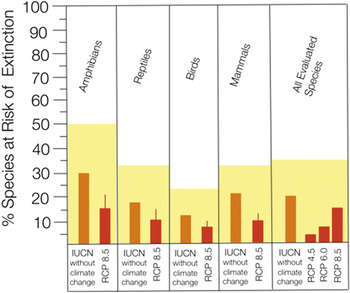
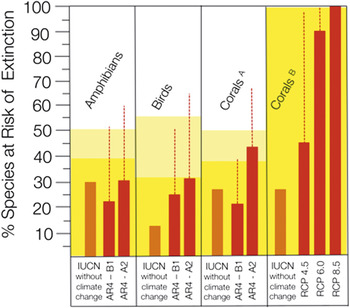
Figures 3 and 4 indicate the percentages of IUCN-assessed species in these groups that are threatened with extinction from causes other than climate change (orange bars), and compare them with percentages of species for which recent analyses indicate high risk of extinction primarily from the anthropogenic climate change underway now (red bars). Three different methods of quantifying risk are represented. The first (Fig. 3) is a Bayesian Markov chain Monte Carlo random-effects meta-analysis of 131 studies that encompassed thousands of species. Reference Urban26 The percentages of species indicated to be at risk from climate change by this method probably represent a conservative assessment because most of the underlying studies were based on species distribution models, which do not generally take into account biotic interactions, and which usually assume uninhibited dispersal, both of which tend to indicate higher climate-caused extinction risks when they are considered. Reference Urban26 Underestimation can also result in cases where not all species in a taxonomic group have been assessed—as is the case for reptiles. Even so, under the RCP 8.5 emissions outlook, Reference Stocker, Qin, Plattner, Tignor, Allen, Boschung, Nauels, Xia, Bex and Midgley9 the percentage of species for which climate change alone would plausibly trigger extinction by the end of this century ranges from ∼10–15% of birds, reptiles, and mammals, up to ∼20% of amphibians. When all taxa considered in the meta-analysis were lumped together—birds, reptiles, mammals, amphibians, fish, invertebrates, and plants—about 16% of species appeared at risk of extinction under the RCP 8.5 projection, about 8% under RCP 6.0, and 5% of species under RCP 4.5 (Fig. 3). Reference Urban26
Comparison of percentages of evaluated species threatened with extinction by all causes except climate change [orange bars; data from IUCN Red List 2014.3 (Ref. 38)] with those for which climate change is expected to become a major extinction threat by the year 2100 (red bars, data from Ref. Reference Urban26). The vertical red lines indicate the 95% credible interval for the upper bound of species put at risk of extinction from climate change by 2100 under various RCPs. Reference Stocker, Qin, Plattner, Tignor, Allen, Boschung, Nauels, Xia, Bex and Midgley9 The “All Evaluated Species” column includes amphibians, reptiles, birds, mammals, fish, invertebrates, and plants. The percentages for species expected to face extinction from climate change are probably conservative, because for the most part they derive from species distribution models that do not take into account inhibited dispersal capabilities given habitat fragmentation, biotic interactions, or organismal physiology. Reference Urban26 The shaded yellow area indicates a summed percentage of extinction threat from all causes, assuming the species affected by climate change are mostly different than those affected by other threats; in fact, there is some overlap, but data required to assess the amount of overlap is not readily available for this data set.

Comparison of percentages of evaluated species threatened with extinction by all causes except climate change [orange bars; data from IUCN Red List 2014.3 (Ref. 38)] with those for which climate change is expected to become a major extinction threat by the year 2100 (red bars). Data for climate-threatened amphibians, birds, and coralsA are from Ref. Reference Foden, Butchart, Stuart, Vié, Akçakaya, Angulo, DeVantier, Gutsche, Turak, Cao, Donner, Katariya, Bernard, Holland, Hughes, O’Hanlon, Garnett, Sekercioglu and Mace36, which used IPCC AR4 (Ref. 42) climate scenarios (B1 and A2 illustrated here). Data for coralsB are from Ref. Reference Ricke, Orr, Schneider and Caldeira53, which used IPCC AR5 RCP Reference Stocker, Qin, Plattner, Tignor, Allen, Boschung, Nauels, Xia, Bex and Midgley9 climate scenarios. These percentages explicitly take into account some aspects of species ability to disperse, biotic interactions, and/or physiologically based adaptive capacity. The dashed red lines for amphibians, birds, and coralsA indicate extinction percentages that would result under the most pessimistic assumptions detailed in Ref. Reference Foden, Butchart, Stuart, Vié, Akçakaya, Angulo, DeVantier, Gutsche, Turak, Cao, Donner, Katariya, Bernard, Holland, Hughes, O’Hanlon, Garnett, Sekercioglu and Mace36, and the top of the thick red bar reflects the most optimistic scenario. The dashed red lines for coralsB indicate extinction under the assumption that the critical aragonite concentration threshold is Ωa < 3.5; the top of the red bar indicates extinction percentage if the reef-building corals could tolerate aragonite concentrations as low as Ωa < 3.0, as detailed in Ref. Reference Ricke, Orr, Schneider and Caldeira53. The dark shaded yellow area indicates the summed percentage of extinction threat for current emissions trajectories (essentially RCP 8.5 or A2) from all causes under optimistic assumptions about species' abilities to respond to climate change; the lighter yellow indicates percentages under pessimistic assumptions.

Figure 4 illustrates the results from analyses Reference Foden, Butchart, Stuart, Vié, Akçakaya, Angulo, DeVantier, Gutsche, Turak, Cao, Donner, Katariya, Bernard, Holland, Hughes, O’Hanlon, Garnett, Sekercioglu and Mace36,Reference Ricke, Orr, Schneider and Caldeira53 that take into account aspects of species biology that affect their vulnerability to climate change, summarized in Ref. Reference Foden, Butchart, Stuart, Vié, Akçakaya, Angulo, DeVantier, Gutsche, Turak, Cao, Donner, Katariya, Bernard, Holland, Hughes, O’Hanlon, Garnett, Sekercioglu and Mace36 as: (a) sensitivity, which is the lack of a species' potential to persist where it now exists as climate changes; (b) exposure, which refers to the extent of change expected in the physical environment as a result of climate change; and (c) adaptive capacity, which is a species' ability (or inability) to cope with climate change by dispersing and/or through microevolutionary change. Such analyses are likely to provide more realistic indications of how many more species will be put at risk of extinction by climate change, by recognizing least some dispersal constraints, some biotic interactions, and some physiological limitations. However, they may still underestimate percentages of species at risk because not all species interactions or climate-response limitations are known. With that caveat in mind, an analysis of 16,857 species determined that 1715–4039 bird species (17–41%), 698–1807 amphibian species (11–29%), and 74–174 coral species (9–22%) not presently considered threatened are highly vulnerable to extinction by climate change presently underway. Reference Foden, Butchart, Stuart, Vié, Akçakaya, Angulo, DeVantier, Gutsche, Turak, Cao, Donner, Katariya, Bernard, Holland, Hughes, O’Hanlon, Garnett, Sekercioglu and Mace36 Adding those to species already at risk from other, nonclimatic threats would mean at least 50% of species would be in danger of extinction by 2100, if current emissions scenarios continued (e.g., those resembling RCP 8.5 or AR4-A2) (Fig. 4). Of the analyzed taxa, 608–851 species of birds (6–9%), 670–933 amphibian species (11–15%), and 47–73 coral species (6–9%) previously considered at risk of extinction by the IUCN from nonclimatic threats are also highly vulnerable to extinction by climate change alone, meaning a very high likelihood of extinction by 2100 for those species. Reference Foden, Butchart, Stuart, Vié, Akçakaya, Angulo, DeVantier, Gutsche, Turak, Cao, Donner, Katariya, Bernard, Holland, Hughes, O’Hanlon, Garnett, Sekercioglu and Mace36
Much more severe threats for reef-forming corals are indicated by studies that specifically examine the effects of ocean acidification, Reference Ricke, Orr, Schneider and Caldeira53 which results from ocean water reacting with increased CO2 in the atmosphere. Reference Ricke, Orr, Schneider and Caldeira53,54 With the increased ocean acidity that results, aragonite saturation in sea water falls. Aragonite saturation is critical to the development of coral skeletons, and available evidence suggests that the aragonite saturation threshold (Ωa) below which reef-building corals cannot survive is between 3.0 and 3.5. Reference Ricke, Orr, Schneider and Caldeira53 Models predict that if the critical threshold is Ωa < 3.5, it will be exceeded for all of the world's coral reefs by the year 2100 under the RCP 8.5 and RCP 6.0 emissions projections, and for about 95–99% of all reefs under the RCP 4.5 projection. Even under the most optimistic outlook of Ωa < 3.0, by 2100 low aragonite concentrations would result in death of about 50% of existing coral reefs under RCP 4.5; about 90% under RCP 6.0, and 100% under RCP 8.5 (Fig. 4, coralsB). Reference Ricke, Orr, Schneider and Caldeira53 Warming ocean waters, in addition to acidification, also directly drive coral extinction. Reference Foden, Butchart, Stuart, Vié, Akçakaya, Angulo, DeVantier, Gutsche, Turak, Cao, Donner, Katariya, Bernard, Holland, Hughes, O’Hanlon, Garnett, Sekercioglu and Mace36,Reference Ricke, Orr, Schneider and Caldeira53,Reference Crowder, Caldwell, Barry, Budd, Cohen, Dunbar, Golbuu, Hoegh-Guldberg, Hughes, Kaufman, Kirkpatrick, Monismith, Palumbi, Pandolfi, Paytan, Richmond, Woodson, Barshis, Kroeker and Kittinger55,Reference Pandolfi, Connolly, Marshall and Cohen56 Widespread coral death has already resulted from only a 0.5–1.0 °C increase above the maxima experienced prior to 1998, causing bleaching of 80% of the reefs in the Indian Ocean, and death of 20%. Reference Barnosky23,Reference Hoegh-Guldberg57 The RCP 8.5 emissions projection would likely increase global temperature by more than 4 °C, whereas the RCP 4.5 and RCP 6.0 trajectories would increase warming about 2–3 °C. Reference Stocker, Qin, Plattner, Tignor, Allen, Boschung, Nauels, Xia, Bex and Midgley9 Given that the 0.8 °C global warming that has already occurred Reference Stocker, Qin, Plattner, Tignor, Allen, Boschung, Nauels, Xia, Bex and Midgley9 resulted in elevated ocean temperatures that killed corals in the 1998 event, elevating global temperature an additional 1–4 °C would be expected to have dire effects. While some coral species are more resistant to heat than others and their genetic basis for adaptations to warm waters have been discovered, Reference Palumbi, Barshis, Traylor-Knowles and Bay58 the one-two punch of both warming and acidification make it likely that even in a 2 °C warmer world, there will be significant loss of coral reefs, and that under emissions trajectories as high as RCP 6.0 or RCP 8.5, coral reefs could all but disappear between 2050 and 2100.
Other methods used to assess climate-induced extinction risk utilize species–area relationships to estimate species numbers as a function of growing or shrinking geographic climate space and expert opinion. Reference Urban26,Reference Rosenzweig, Drumlevitch, Borgmann, Flesch, Grajeda, Johnson, Mackay, Nicholson, Patterson, Pri-Tal, Ramos-Lara and Serrano59 Both of these methods suggest that climate change will cause severe extinction, ranging from 20 (Ref. Reference Urban26)–96% Reference Rosenzweig, Drumlevitch, Borgmann, Flesch, Grajeda, Johnson, Mackay, Nicholson, Patterson, Pri-Tal, Ramos-Lara and Serrano59 of species in analyzed groups.
Greatest extinction risk in biodiversity hotspots
Of particular concern are those regions that sustain high numbers of species whose requisite climate space (combinations of temperature, precipitation, extremes, seasonal variation, etc.) would disappear off the face of the Earth (called “disappearing climates”), or where new combinations of climatic parameters that extant species have never experienced would emerge (called “novel climates”). Reference Williams and Jackson60,Reference Williams, Jackson and Kutzbach61 Disappearing climates and the emergence of novel ones would likely result in the extinction of many species both from direct loss of required habitat, and from the break down of requisite interrelationships between species as extant communities disaggregated and new communities assembled. Under rapidly changing climatic conditions, communities are known to disaggregate because each species responds individualistically, as has been documented for the climate changes that accompanied the last glacial–interglacial transition. Reference Williams and Jackson60–66
Modeling studies indicate that for terrestrial species, such disappearing and novel climates have high potential of accelerating extinctions given current emissions trajectories. Under the IPCC AR4 A2 emissions scenario, 42 by the year 2100, 10–48% of Earth's land surface would see the disappearance of the climatic conditions that exist there today—that is, those climatic conditions would no longer exist anywhere on the planet. Over the same time, novel climates—climatic conditions that no species on Earth experiences today—would emerge over 12–39% of the planet's land. Reference Williams, Jackson and Kutzbach61 The risks are less severe, but still significant, under the IPCC AR4 B1 emissions scenario, which would hold warming to about 2 °C. In this case, both disappearing and novel climates would be evident across 4–20% of the land surface. Reference Williams, Jackson and Kutzbach61
This represents a particularly high risk for triggering many species extinctions because the areas most affected are biodiversity hotspots and areas with endemic species (those with small localized geographic ranges): including the Andes, Central America and the Amazon, southern and eastern Africa, the Himalayas, the Philippines, and Wallacea. Reference Williams, Jackson and Kutzbach61,Reference Post and Brodie67 These areas include most of the world's tropical and subtropical forests, which collectively harbor around two-thirds of all terrestrial animal and plant species; rainforests alone hold about half of the world's terrestrial species. Reference White, Alley, Archer, Barnosky, Foley, Fu, Holland, Lozier, Schmitt, Smith, Sugihara, Thompson, Weaver, Wofsy, Dunlea, Mengelt, Purcell, Gaskins and Greenway21 Less diverse but also at very high risk for severe loss are Arctic and alpine ecosystems, which include such species as polar bears and pikas (a rabbit relative), respectively. Reference White, Alley, Archer, Barnosky, Foley, Fu, Holland, Lozier, Schmitt, Smith, Sugihara, Thompson, Weaver, Wofsy, Dunlea, Mengelt, Purcell, Gaskins and Greenway21,Reference Barnosky23,Reference Post and Brodie67
Severe risks from novel and disappearing climate space also emerge in the oceans. Loss of coral reefs, which are at particularly high risk of extinction from acidification and warming waters as discussed in the section “Quantitative estimates of added extinction risk from climate change”, would also trigger extinction of about 25% of all marine species that depend on the reefs—including >4000 fish species and 9–12% of the world's total fisheries. Reference White, Alley, Archer, Barnosky, Foley, Fu, Holland, Lozier, Schmitt, Smith, Sugihara, Thompson, Weaver, Wofsy, Dunlea, Mengelt, Purcell, Gaskins and Greenway21 Independent of coral reefs, acidification also detrimentally impacts a wide variety of marine species through fatally disrupting development and growth. Reference Solomon, Battisti, Doney, Hayhoe, Held, Lettenmaier, Lobell, Mathhews, Peirrehumbert, Raphael, Richels, Root, Steffen, Tebaldi, Yohe, Wardent, Brown, Dunlea, Reidmiller, Freeland, Payne and Bearrs17,Reference White, Alley, Archer, Barnosky, Foley, Fu, Holland, Lozier, Schmitt, Smith, Sugihara, Thompson, Weaver, Wofsy, Dunlea, Mengelt, Purcell, Gaskins and Greenway21,Reference Pandolfi, Connolly, Marshall and Cohen56,Reference Barton, Hales, Waldbusser, Langdon and Feely68–Reference Munday, Dixson, Donelsona, Jonesa, Pratchetta, Devitsinac and Døvingd75 In addition to the reef-building corals, especially at risk are the thousands of species that rely on calcium carbonate to build their shells, including clams, snails, and many plankton, which form the base of the food chain. Acidity has already increased from a preindustrial levels by about 0.1 pH unit, equating to about a 30% increase. At these levels, oyster and scallop farms in the Pacific Northwest USA have recently experienced die-offs, Reference White, Alley, Archer, Barnosky, Foley, Fu, Holland, Lozier, Schmitt, Smith, Sugihara, Thompson, Weaver, Wofsy, Dunlea, Mengelt, Purcell, Gaskins and Greenway21 and the shells of pteropods (tiny free-swimming snails that provide a primary food source for salmon, mackerel, and herring) are dissolving. Reference Bednaršek, Feely, Reum, Peterson, Menkel, Alin and Hales76 Experimental work that focuses on rearing species in waters with ocean chemistry and temperatures on track to prevail by 2050–2100 indicates fatal results for a variety of species: oysters, silverside fish, cod, sea bass, orange clown fish, and many coral species. Reference Pandolfi, Connolly, Marshall and Cohen56,Reference Barton, Hales, Waldbusser, Langdon and Feely68–Reference Frommel, Maneja, Lowe, Malzahn, Geffen, Folkvord, Piatkowski, Reusch and Clemmesen70,Reference Liu, Huang, Lin and He72–Reference Munday, Dixson, Donelsona, Jonesa, Pratchetta, Devitsinac and Døvingd75
Minimizing climate-triggered extinctions
The studies cited above indicate that while extinctions will probably increase at least some even if overall warming is stabilized at ∼2 °C (the RCP 4.5 emissions projection), raising average global temperature 4 °C (RCP 8.5) or more would likely induce catastrophic species losses. The current trajectory of fossil fuel use is virtually certain to push mean global temperature past the 2° target as early as 2050 and likely will elevate temperatures 4 °C or more in just 85 years, within one human lifetime. Reference Stocker, Qin, Plattner, Tignor, Allen, Boschung, Nauels, Xia, Bex and Midgley9,42
Energy outlooks increasingly recognize that future portfolios will probably see an uptick in renewables and decreasing use of fossil fuels, but nevertheless, nearly all compilations project fossil fuels to remain a principal energy source well into mid-century. For example, the International Energy Outlook 2013 suggests that oil, gas, and coal will continue to supply 80% of the world's energy through 2040, despite some growth in the renewable sector. Under that projection, annual CO2 emissions by 2040 would increase 46%. 77 Exxon expects fossil fuels will supply 75% of energy demand in 2040, and Shell puts the number at two-thirds. Reference Anonymous78
However, to limit temperature rise to 2 °C, it will be necessary to cut global greenhouse gas emissions annually in the neighborhood of about 6.2% per year for the next 85 years. 79 Achieving that amount of reduction in emissions will not be possible by only focusing on the more efficient use of fossil fuel energy, such as substitution of cleaner-burning natural gas for coal in the stationary energy sector, or increasing gasoline or diesel fuel-efficiency in the transportation sector. The only way to achieve the emissions reductions needed to avert high numbers of species extinctions is by a very rapid transformation of the global energy system, from one that relies on fossil fuels as the primary energy source, to one that depends mainly on carbon-neutral energy production. Reference Barnosky6,79
Since climate change is a threat multiplier for extinctions (Fig. 1), Reference Barnosky6,Reference Post and Brodie67,Reference Mantyka-Pringle, Visconti, Marco, Martin, Rondinini and Rhodes80 addressing habitat destruction, overexploitation of species, and human population growth will also help reduce extinctions from climate change and vice versa. However, even if all other drivers were stopped immediately, climate change of the extent that current trajectories indicate is likely to at least double the number of species already at risk of extinction, by the end of this century (Figs. 3 and 4), even without taking into account the major losses that would plausibly result from disappearing and novel climates, and from as-yet unquantified synergies with other extinction drivers. In view of the interacting multiple drivers, it will be essential to accelerate species conservation efforts on all fronts. Reference Barnosky6,Reference Pimm, Abell, Brooks, Gittleman, Joppa, Raven, Roberts and Sexton14,Reference Dirzo, Young, Galetti, Ceballos, Isaac and Collen24,Reference Seddon, Griffiths, Soorae and Armstrong25
Potential for mitigating climate-driven mass extinction
Recent studies point to the technical feasibility of scaling up wind, solar, and wave energy, and potentially next-generation nuclear to levels sufficient to serve the stationary energy sector by 2030. Reference Faiman81–Reference Chu and Majumdar85 For the transportation sector, recent innovations in algal-based or other efficient biofuel production may well be scalable to replace fossil fuels in vehicles (e.g., airplanes) that are not presently possible to convert from liquid fuels Reference Chu and Majumdar85 ; the United States Navy, Air Force, and commercial airlines have already demonstrated feasibility. Reference Barnosky6,Reference Roughead, Carl and Hernandez86 For autos, buses, and trains, electrification already is feasible and becoming more widely deployed. Electrification of the transportation sector will have to be coupled with carbon-neutral power plants, however, to achieve the 2° target.
Major obstacles have been perceived difficulties in refining currently available technologies, revamping infrastructure, economic viability, and political hurdles. However, similarly enormous emplacements of infrastructure and ramping up of nascent technologies have taken place within three to five decades in the past, including a hundred-fold increase in airplane production during World War II, building enough paved roads just in the United States to encircle Earth twice from about 1950–1980, at the same time damming approximately 60% of the world's major rivers, and over the course of thirty years revolutionizing communication systems with computers and mobile phones. Reference Barnosky6,Reference Jacobson and Delucchi83,Reference Jacobson and Delucchi84,Reference Barnosky, Brown, Daily, Dirzo, Ehrlich, Ehrlich, Eronen, Fortelius, Hadly, Leopold, Mooney, Myers, Naylor, Palumbi, Stenseth and Wake87
From an economic perspective, recent analyses suggest that the losses caused by a >2 °C temperature rise will exceed the costs of mitigation that would keep the world below that target, and that delaying action significantly increases mitigation costs. Reference Rogelj, McCollum, Reisinger, Meinshausen and Riahi88,Reference Kahrl and Roland-Holst89 Prevailing estimates of what it would take to keep emissions to <2° entail only modest slowing of global economic growth (as measured by consumption) “of 1–4% (median: 1.7%) in 2030, 2–6% (median: 3.4%) in 2050, and 3–11% (median: 4.8%) in 2100 relative to consumption in baseline scenarios that grows anywhere from 300% to more than 900% over the century.” Reference Edenhofer, Pichs-Madruga, Sokona, Farahani, Kadner, Seyboth, Adler, Baum, Brunner, Eickemeier, Kriemann, Savolainen, Schlömer, von Stechow, Zwickel and Minx11 Those models do not factor in the cost benefits that would derive from mitigating climate change, such as avoiding significant crop losses, minimizing insurance, and personal losses due to increasing extreme weather disasters like hurricanes and floods, and dealing with sea level rise in coastal cities. Even so, the models predict overall economic growth of 1.6–3% per year through the rest of the century. Recent analyses suggest that the economic costs of transforming the electrical grid almost entirely to solar and wind power could be borne by consumers paying an extra 1 US¢/kWh in the United States and Europe, and about 2–5 US¢/kWh in other regions. Reference Faiman81 For perspective, this equates to an increase of about $8.00 per month on the electric bill for a typical household of four people in California.
It is unlikely that the energy landscape can be shifted fast enough to make a difference without legislation and government policies that stimulate the requisite innovations, Reference Chu and Majumdar85 but political disagreements about the extent to which climate change poses societal costs have so far proven difficult to overcome, both within countries and internationally. While some progress is evident, Reference Barnosky, Hadly, Dirzo, Fortelius and Stenseth90 the speed at which divisiveness can be replaced with co-operative efforts will be a key determinant of whether or not greenhouse gas emissions raise global temperature to biologically dangerous levels.
The costs of extinction
Losing a high percentage of nonhuman species inflicts severe economic costs, diminishes ecosystem services that people rely on, and imposes substantial emotional and moral damages. From a dollar perspective, 40% of the world's economy and 80% of the needs of the poor depend on biological resources.
Ecosystem services include the production of crops and timber; purification of water and buffering against storms, floods, and droughts; and maintenance of genetic diversity for future use in agriculture, energy, pharmaceuticals, and other industries. Besides being essential to support human life, ecosystem services have a high dollar value: $125 trillion in 2011, nearly twice the worth of the entire global Gross Domestic Product. Reference Costanza, Groot, Sutton, Ploeg, Anderson, Kubiszewski, Farber and Turnerf91 Generally, the efficacy of ecosystem services increases with increasing biodiversity. Reference Cardinale, Duffy, Gonzalez, Hooper, Perrings, Venail, Narwani, Mace, Tilman, Wardle, Kinzig, Daily, Loreau, Grace, Larigauderie, Srivastava and Naeem92 Past mass extinctions are characterized by losses exceeding 75% of known species; even losing substantially less than that is clearly enough to greatly diminish the ecosystem services critical to human life.
More intangible, but arguably more important to at least millions of people, are the emotional and esthetic values presented by species, especially in their natural habitats. As has been said elsewhere, “an apt metaphor is a Rembrandt or other unique work of art that evokes exceptional human feelings and whose loss would be generally recognized as making humanity poorer.” Reference Barnosky, Brown, Daily, Dirzo, Ehrlich, Ehrlich, Eronen, Fortelius, Hadly, Leopold, Mooney, Myers, Naylor, Palumbi, Stenseth and Wake87
Finally, extinction is forever. Despite ongoing efforts to genetically engineer facsimiles of a few recently extinct organisms, extinction, once it occurs, is permanent. Reference Barnosky6 Losing many species in a short amount of time means the impacts on human society are essentially unfixable; past mass extinctions document that it takes hundreds of thousands to millions of years for species to build back to normal numbers after biodiversity crashes. Reference Barnosky, Matzke, Tomiya, Wogan, Swartz, Quental, Marshall, McGuire, Lindsey, Maguire, Mersey and Ferrer32
Conclusions
It is essential that humans continue producing vast amounts of energy, but doing so with fossil fuels inevitably changes global and local climate to new states faster than many species are adapted to cope with. Even without the rapid rate of anthropogenic warming and attendant climate change now underway, more species and populations are threatened with rapid extinction than has been the case since the dinosaurs died out. The major agents of extinction up to now have been habitat destruction and fragmentation and overexploitation of species. Those pressures have already initiated what could become the planet's Sixth Mass Extinction, unusual times of rapid biodiversity loss when at least 75% of known species die out, after which it takes hundreds of thousands to millions of years for the biosphere to recover.
Anthropogenic climate change adds an entirely new extinction driver that puts hitherto healthy populations and species at risk, and under business-as-usual emissions scenarios would at least double the number of species now threatened with extinction from nonclimatic pressures. At the same time, anthropogenic climate change also acts as a threat multiplier that greatly exacerbates the extinction risks of species already imperiled by other human activities. Particularly at risk are tropical and subtropical regions on land, which support two-thirds of terrestrial species, and coral reefs in the sea, which support a quarter of all marine species. The combination of warming and acidification also promises widespread extinction in the oceans through disrupting developmental pathways in shell-building species other than corals (including most clams and snails) and many other marine organisms.
The reason anthropogenic climate change is such a threat today is because current rates of change exceed the capacity of many species to adapt or move, especially in view of the extensive fragmentation of their needed habitats by human constructs. Moreover, many species have never seen the climatic conditions that are projected for as early as 2050. The magnitude and pace of climate change and related ocean acidification today resembles the changes that helped trigger the loss of an estimated >90% of Earth's known species at the Permian–Triassic extinction 252 million years ago; of further concern is that all the past Big Five Mass Extinctions were accompanied by changes in climate, atmospheric chemistry (particularly in the carbon cycle), and ocean chemistry (Table 1), as is the case today.
Limiting warming to <2 °C will give the best chance of averting the Sixth Mass Extinction, although noticeable losses may occur even below that threshold. Allowing mean global temperature to rise 4 °C or more very likely will make the Sixth Mass Extinction inevitable. Should that happen, severe economic losses, in diminishment of ecosystem services that support human life, and emotional, and moral damages will be incurred.
It is important to note that it is not the disappearance of the last individual that signals a species is doomed; rather, extinction effectively occurs when the numbers of individuals and populations fall below a critical number, turning the species into a “dead species walking.” These cryptic extinctions mean that even if impacted species are still on Earth by mid- or end-century, it does not mean we have avoided the Sixth Mass Extinction if a high proportion of them have lost critical numbers of their populations and individuals. Therefore, tracking population sizes over the next few decades will be essential to monitor the impacts of climate change, even though that is much more difficult than simply compiling presence–absence lists of which species are still on Earth; the presence–absence lists alone can give a false feeling of security.
Avoiding the amount of climate change that will prove fatal to many species will require a rapid transition in the global energy system from one dominated by fossil fuels to one that relies mainly on carbon-neutral energy production. It is still unclear whether people and governments will respond in time to achieve this energy transition, although technological and economic feasibility appears promising. Given the connections between climate change, energy production, human population growth, habitat loss, and overexploitation of species, mitigation efforts that address the latter three drivers also will be essential to slow climate-related extinctions, as will stepped-up efforts of species conservation.
Acknowledgments
Thanks to Brian Swartz for help in compiling Table 1, and to Sally Benson for encouraging me to write this study. Some of the work on this project was accomplished while I was a Cox Visiting Professor at Stanford University Department of Environmental Earth System Science, support from which is gratefully acknowledged. This is University of California Museum of Paleontology Contribution no. 2071.