

The relationship between regime type and foreign direct investment (FDI) remains mired in controversy. Some studies show a positive relationship between democracy and FDI, whereas others do not (cf. Li and Resnick Reference Li and Resnick2003; Jakobsen and de Soysa Reference Jakobsen and de Soysa2006).Footnote 1 We sort out disparate empirical findings in the literature by considering the theoretical relationship between regime type and property rights protections, and how this has changed over time. We expect that their interplay, rather than one in isolation, is responsible for attracting higher levels of FDI. In particular, we argue that the effect of property rights is conditioned by democracy, and that it has time-varying effects.
We argue that democracy influences the impact of property rights through two intertwined mechanisms: (1) democratic institutions provide a coherent logic from which to frame a property rights regime and (2) democracies are better apt than autocracies to legitimately manage conflicts that emerge as different groups win and lose in a dynamic economy (Sunstein Reference Sunstein1997; Chang Reference Chang2003; Mousseau Reference Mousseau2003). Democratic institutions are important because property rights protections are more than stating that firms have a right to private property; enforcement of property rights under changing technological conditions and in dynamic economies must also be addressed. That is, firms consider not only the existing property rights, but how a state’s property rights regime will affect future profits, when deciding where to invest.
The nature of this relationship is especially important as technological dynamism accelerates and new goods and services are created that do not fit neatly within existing legal definitions. Technological dynamism has changed economic arrangements in many states as international businesses respond to changing rates of return that increasingly privilege information and service sectors over natural resource procurement, thus emphasizing varying degrees of skilled labor over cheap workforces (Moran Reference Moran2002; Blanton and Blanton Reference Blanton and Blanton2007). Democratic states, by creating a coherent property rights regime and managing conflict, are able to provide both the stability and flexibility that firms value when deciding where to invest.
We explore whether the effect of property rights on FDI is contingent on the strength of democratic institutions using a non-nested multilevel models with time-varying coefficients. The model is able to capture the changing marginal effect of property rights over time while accounting for unit-level heteroskadasticity. We find that the effect of property rights varies depending on the level of democracy and that this effect has increased over time across all regions.
REGIME TYPE AND FDI
FDI is “a category of cross-border investment associated with a resident in one economy having control or a significant degree of influence on the management of an enterprise that is resident in another economy” (International Monetary Fund 2007, 100).Footnote 2 FDI encourages economic growth and employment (Borensztein, Gregorio and Lee Reference Borensztein, Gregorio and Lee1998) along with technological spillovers (Glass and Saggi Reference Glass and Saggi1998; Baldwin, Braconier and Forslid Reference Baldwin, Braconier and Forslid2005). As a result, states create institutions and policies in order to create more attractive investment climates (Jensen Reference Jensen2008; Biglaiser and Staats Reference Biglaiser and Staats2010).
Previous literature on the relationship between government regimes and FDI has produced conflicting outcomes. Li and Resnick (Reference Li and Resnick2003) claim that democracy has both positive and negative effects on FDI. These duel effects result from competing expectations regarding whether the competitive political environment in democracies encourages FDI or whether the presence of stronger property rights, which are associated with democracy, actually drive the process. The interplay between democracy and property rights, however, and how their effects are conditioned by one another are not clearly specified in the literature.
The argument that democracy reduces FDI contends that democracies are less likely to offer business advantages to multinational corporations (MNCs) than autocracies, because democracies must appease domestic interests in order to remain in power. Conversely, autocracies are better able to make favorable entry-level arrangements with foreign investors, as they have both the interest—seeking private economic benefits for themselves and their selectorate—and the means—their institutions are rarely constrained by electoral consequences or structural veto players—to ignore the public’s concerns (O’Donnell Reference O’Donnell1978; Oneal Reference Oneal1994; Bueno de Mesquita et al. Reference Bueno de Mesquita, Smith, Siverson and Morrow2003).
Though democracies are more constrained in their ability to offer attractive entry incentives to MNCs, their resistance to policy change also provides a benefit. MNCs can use existing domestic institutions to enforce arrangements negotiated with democratic governments, making it more difficult for governments to reverse policies (Jensen Reference Jensen2003). Conversely, autocracies generally provide MNCs with little room for domestic recourse should the government renege on its initial commitments.
Despite the differing expectations found in the literature regarding the impact of regime type on attracting FDI, each position argues that regime type—and its relationship to property rights—is important. Yet, the relationship between regime type and property rights remains unclear.
DEMOCRATIC INSTITUTIONS AND PROPERTY RIGHTS REGIMES
Arguments that democracy encourages FDI often assume that property rights are nested within democratic institutions (e.g., Jensen Reference Jensen2003; Cao and Ward Reference Cao and Ward2014). While democracies and autocracies differ systematically in terms of property rights protections (Li Reference Li2006, 64), the two are not one-in-the-same. Distinctions between democracy and property rights protections are common within the democratization and rule of law literatures (e.g., Gibler and Randazzo Reference Gibler and Randazzo2011; Randazzo, Gibler and Reid Reference Randazzo, Gibler and Reid2016; Chyzh Reference Ciravegna2017). Rather than being nested within democratic institutions, democracy is neither a necessary nor sufficient condition for property right protections. In fact, Gibler and Randazzo (Reference Gibler and Randazzo2011) find that approximately 40 percent of democracies lack independent judiciaries and that some non-democracies have strong property right protections (e.g., Hong Kong, Singapore). Moreover, Olson (Reference Olson1991, Reference Olson1993), McGuire and Olson (Reference McGuire and Olson1996) argue that autocrats with long expectant leadership tenures will provide property rights, an account empirically supported by Clague et al. (Reference Chyzh1996).
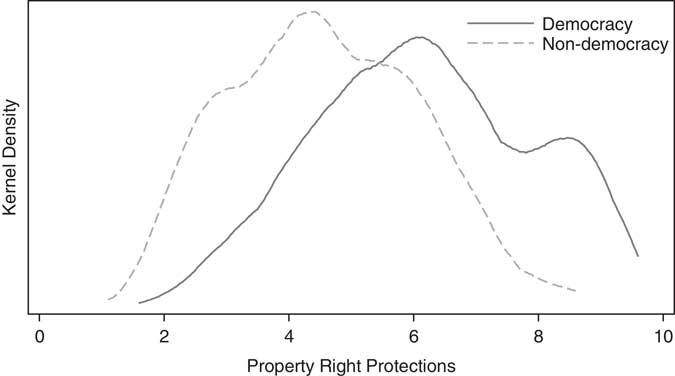
Figure 1 presents a visualization of the overlap of property rights protections and the level of democracy. The figure shows that, while democracies do have higher property rights on average, there is significant variation in the degree of protection. This variation demonstrates that there are both democracies without, and non-democracies with, strong property rights.
Rule of law and democracy Note: Democracy is coded as polity2>6 using Polity IV (Marshall and Jaggers Reference Marshall and Jaggers2016). Property rights measured as the legal system and structure of property rights (Gwartney, Hall and Lawson Reference Gwartney, Hall and Lawson2011).

Not all studies of FDI, however, treat democracy and property rights as the same. Some contend that property rights, rather than democracy, are the primary institutional determinant of FDI (Li and Resnick Reference Li and Resnick2003; Biglaiser and Staats Reference Biglaiser and Staats2010). Biglaiser and Staats (Reference Biglaiser and Staats2010) survey chief executives to examine the microfoundations of FDI and find they place high value on property rights and low value on democracy. These results suggests that any advantage democracies enjoy in attracting FDI may stem from its association with rule of law, rather than the institution of democracy itself.
What remains unclear is how the level of democratization affects the influence of property rights on economic outcomes. Rather than property rights being nested within democratic institutions, or property rights acting independently, we contend that democracy conditions the effect of property rights protections. Democratic regimes enhance the effect of property rights by creating institutions that: (1) provide a coherent logic for the creation and enforcement of legal protections in a property rights regime and (2) manage conflicts that emerge as different groups win and lose in a dynamic economy.Footnote 3 These two roles of democracy are intertwined, as a coordinated economic vision is necessary to address the concerns of groups that lose as the economy changes and discourage subsequent mobilization against the economic arrangements (Chang Reference Chang2003, 52–63; Mousseau Reference Mousseau2003; Hays Reference Haggard and Kaufmann2009).
Consider the example of insurance law. A legal regime regarding insurance law is important given the degree of influence such firms have over economic transactions (Chyzh Reference Chyzh2016, 410–11). It can be unclear if, and to what degree, insurance firms are liable to provide coverage to clients should technological changes alter the existing legal structure within a specific field. Several brief examples illustrate the evolving, complex legal environment that insurance companies face in dynamic economies. Privacy laws, for instance, are undergoing significant changes as companies and governments are able to gather and organize greater quantities of customers’ personal data. The value and legal regulations regarding that data is often unknown at time of collection, representing a risk for insurance companies. Technological advances, moreover, have made it easier for compounding pharmacies to create and sell large volumes of combinational drugs or drugs in altered forms (e.g., change from a pill to a liquid), while regulatory agencies and government laws are still designed to focus on traditional drug manufacturers (Hamburg Reference Hoff and Stiglitz2012). Finally, private and public insurance programs face uncertainty as financial products become increasingly complicated. Rational investors who wish to insure or indemnify their activities thus seek coherent property rights regimes with established methods of conflict management in dynamic economies.
Democratic institutions are often central to creating a strong property rights regime. Mousseau (Reference Mousseau2003, 489–90) suggests that even in complex economies, market norms fail to take hold in the absence of state intervention to enforce contracts. A legitimate governing institution recognized by the majority of economic participants, he argues, is necessary to enforce contracts in an equitable manner. This is necessary to prevent a system in which property rights definitions are open to reinterpretation and readjustment. Democracies, and the institutions they create, offer investors confidence that their property rights will be guaranteed even in a dynamic economy. This stands in stark contrast to autocracies, where property rights may be redefined, reinterpreted, and readjusted depending on who the leader is—and who their supporting elites are (McGuire and Olson Reference McGuire and Olson1996). Even where courts exist to adjudicate disputes and render judgments, there is little redress in autocracies should these simply be ignored by the ruler.
Logic of a Property Rights Regime
Political institutions influence the creation and maintenance of property rights because states “cannot grant property (and other) rights to people in a coherent way, unless it has a certain vision of what it regards as the desirable future” (Chang Reference Chang2003, 55–6). In democratic regimes, the principles regarding this “desirable future” are outlined in foundational legal texts, for example, a constitution. Democracies also have important financial and legal institutions that autocracies either lack or do not permit to act independently. These institutions must adhere to the principle of the existing legal framework (e.g., constitution), ensuring philosophical and legal continuity (Sunstein Reference Sunstein1997, Chapter 8). The larger number of veto players make changes to these basic principles less likely and are thus more likely to delineate property rights in the same manner over time. This creates a common vision of how property rights are assigned and enforced in two ways: first, by restraining the government action in regards to firms and, second, by permitting flexibility within specific bounds with regards to technological and societal change.
The independent financial and legal institutions provide checks on executive power and introduce additional veto players into the process of economic policy formation, including the formation and enforcement of property rights (Zheng Reference Zheng2011). Independent financial and legal institutions improve the investment environment by reducing perceived bias, because even when courts are perceived as acting fairly in disputes between firms, they may still be expected to act in a biased manner in disputes involving the state (Frye Reference Frye2004).
The coherent and consistent legal framework that independent financial and legal institutions provide also allows them to more easily adapt to technological and societal change and generate a coherent set of property laws (e.g., when moving to electronic-based currency exchanges). Chang argues that this results in the state “driv[ing] private sector agents into a concerted action without making them spend resources on information gathering and processing, bargaining and so on” (Reference Chang2003, 53). The state thus provides the foundation and direction in goals that private firms then fulfill. By creating a clear vision, the state is able to lower transaction costs and reduce uncertainty regarding future policy. This promotes investment by strengthening the effectiveness of the state’s property rights.
Managing Emergent Conflicts
In addition to providing a coherent logic regarding the rules regarding property right formation, democracies are also better than autocracies able to manage conflicts that due arise, stemming from their ability resolve disputes via non-violent, legitimate processes (Lijphart Reference Lijphart1977; Danilovic and Clare Reference Danilovic and Clare2007). Democracies provide legitimate methods for groups to air grievances and seek compensation for losses, such as politically relevant legislatures and independent courts. Democratic legislatures often feature compromises and tradeoffs among political parties representing various domestic interests. Independent judiciaries provide non-violent outlets for conflicts to be settled between individuals regarding specific claims. As economies become more robust and interactions with strangers become more regularized, formal legal institutions—in contrast to non-government institutions, and traditional societal means of conflict resolution—take on even greater importance (Mousseau Reference Mousseau2003, 489).
The ability to manage conflict enhances property rights protections under democratic regimes. The manner in which new property rights are allocated during periods of technological dynamism alter relationships among production factors, increasing the likelihood of conflictual outcomes (Kuznets Reference Kuznets1973; Chang Reference Chang2003). When property rights change or are unclear, the subsequent uncertainty increases transaction costs for conducting business among international firms. Uncertainty, in turn, increases financial risk (and insurance premiums) because firms do not know how courts will treat future cases, whether existing contracts are less likely to be fulfilled, or if their costs will change.Footnote 4 The result is an environment where economic development suffers as firms take fewer risks and refrain from committing their resources (Chang Reference Chang2003, 61–2; Frye Reference Frye2004). Moreover, societal groups that lose from changes in the relationship among production factors may seek to prevent their implementation, making the state’s economy less competitive globally (Hays Reference Haggard and Kaufmann2009). If the losing parties mobilize and institutional structures do not exist for these groups to legitimately air their grievances, they may turn to illegitimate means, up to and including violence (Nieman Reference Nieman2011). As a result, strong conflict management institutions affect long-term investment.
In sum, we argue that democracies are better than their autocratic counterparts at creating a property rights regime and managing conflict. We expect that as the level of democracy increases in a state, the more likely we are to see the kinds of institutional innovations that provide for a dynamic property rights regime and the management of emergent conflicts. Autocracies may also contain some of these elements, but not in the same systematic manner that their democratic counterparts have developed. This argument, while drawing on much that is known in the literature, is novel for its combination of the effects of property rights regimes and conflict management within democracies on FDI. Our logic produces the following hypothesis:
Hypothesis 1: The effect of property rights on FDI is conditioned by a state’s level of democracy.
TEMPORAL CHANGE
Next, we argue that the relationship among property rights, democracy, and FDI has increased with technological dynamism. We previously argued that democracies provide a coherent logic for the creation and enforcement of legal protections, and that they manage conflicts that arise as different societal groups “win” and “lose” in a dynamic economy. We expect that this effect increases with the degree of technological dynamism: when dynamism is low there is little need for firms to care about anything other than existing property rights. When dynamism is high, however, firms care not only about existing property rights, but also about what property rights will look like in the future.
Previous scholarship has found that the effect of political institutions on economic outcomes sometimes change over time. For example, Haggard and Kaufmann (Reference Hays1992) argued that while democratic governments of the 1960s and 1970s frequently intervened in the economy and focused on consumption—hurting economic growth—these same regimes increasingly rejected such policies in the 1980s and 1990s. Krieckhaus (Reference Krieckhaus2004) finds that the effect of democracy on economic growth varies over time, exerting a negative effect in the 1960s, a positive effect in the 1980s, and no effect in the 1970s and 1990s. We expect that democracy, through its role in creating property right regimes, exhibits a similar time-varying effect on FDI.
Technological Dynamism
Technological growth has been increasing at faster and faster rates. Moore’s (Reference Moore1965) Law posited a doubling of transistors in an integrated circuit, a prediction that has proven true within the semiconductor industry. Indeed, most digital electronics are linked to Moore’s Law as one example of increasing technological dynamism. This has had an important effect on capital markets. Dreher, Gaston and Martens, note that “innovations and applications of the microchip have led to the emergence and widespread use of the internet and other computer communication systems … [making] it possible to construct global data networks that function as the hardware for the global financial capital market” (Reference Dreher, Gaston and Martens2008, 8–9). Moreover, technological dynamism affects all sectors—though to varying degrees—in terms of the capital costs associated with financing innovations (Strange Reference Strange1996, 9).
We expect that such processes affect all countries, as technological advances made in a firm’s home country will affect transaction costs in other countries as well. Technological innovations are diffused globally through FDI, nearly eliminating differences between home and host countries in recipient industries. MNCs take their technology into host states via their subsidiaries and supply chains in order to streamline production (Glass and Saggi Reference Glass and Saggi1998; Baldwin, Braconier and Forslid Reference Baldwin, Braconier and Forslid2005; Ciravegna Reference Ciravegna2011). Thus, technological changes transmit throughout a globalized industrial sector, amplifying the effect of stable property rights regimes.
Industry Heterogeneity
While technological dynamism affects all industries, there is variation in the relative transaction costs across economic sectors. Some industries require specific physical characteristics (e.g., resource extraction), others intellectual rights (e.g., computing), while still others are a mix of the two (e.g., manufactured goods). Moreover, there has been significant change in the composition of FDI: investment has shifted away from natural resource procurement toward consumer products, manufacturing, and the information and service sectors (Moran Reference Moran2002; Aykut and Sayek Reference Aykut and Sayek2007; Blanton and Blanton Reference Blanton and Blanton2007). Any shifts in the sectoral composition of FDI thus changes how foreign investors view domestic property rights, and with it the impact of property rights regimes.
Firms view property rights with varying degrees of enthusiasm depending on the specific industry and the capital costs associated with financing innovation (Hoff and Stiglitz Reference Hamburg2005). Industries with capital intensive development costs, such as pharmaceuticals and aircraft technologies, benefit more greatly from property rights than those with lower costs, owing to the protection of intellectual properties. The service sector, which typically relies on local human capital, places greater value on strong property rights to create the conditions to encourage growth. These expectations are supported by previous research. Javorcik (Reference Javorcik2004) finds, for example, that weak property rights protects deter investment in technology-intensive sectors, but not other sectors. Similarly, Schulz (Reference Schulz2009) finds that the effect of democracy on FDI depends on the share of FDI in the primary resource sector. The implication, therefore, is that the sectoral composition of FDI affects the degree that a property rights regime has on attracting investment.
Moreover, while firms value property rights protections once they are in a market, they may hold them in less acclaim when attempting to enter a market. In order to extract primary resources, for example, host governments must grant foreign firms access to these resources. States frequently use eminent domain laws and land seizures to grant access to foreign firms, especially for location-specific industries. In some cases, such as in Russia, Czech Republic, and Bulgaria, states have granted special access or sold state-owned assets to private firms with connections to government officials at discounts, in a process referred to as corrupt privatization (Frye Reference Frye2002, Reference Frye2006; Hoff and Stiglitz Reference Hamburg2005). The strengthening of property rights may represent a cost to foreign investors, as these protections favor existing participants who acquired their assets through corrupt privatization. Certain sectors, such as resource extraction, are more likely to utilize eminent domain or to experience corrupt privatization. The degree to which these sectors make up a state’s FDI likely influences the relationship between a state’s property rights regime and FDI. Generally speaking, resource extraction has declined as a proportion of global FDI, and the strength of the average effect of property rights regimes is expected to increase as a result.
In sum, we argue that technological dynamism and the changing composition of FDI results in time-varying effects of property rights regimes. We contend that democracies are uniquely able to address change resulting from technological dynamism, as they can provide a stable, yet flexible property rights regime. While uncertainty increases firms’ transaction costs, a coherent property rights regime can help offset these, increasing a state’s international competitiveness. As the composition of FDI is increasingly weighted toward information-intensive and technologically intensive sectors investment decisions increasingly favor strong property rights regimes. This implies that the effect of democratic property rights regimes should increase over time as technological innovation has increased, and leads to the following hypothesis:
Hypothesis 2: The effect of democratic property rights regimes on FDI has increased over time.
METHODOLOGY
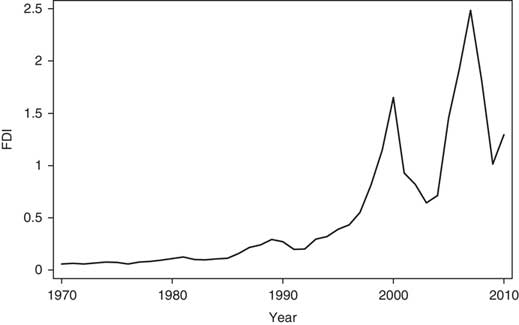
We examine the effects of democracy, property rights, and their interaction on attracting FDI in 149 countries from 1970 to 2009.Footnote 5 While we expect that property rights and democracy are determinants of investment, there are likely also time-specific, and possibly country-specific, effects. One possible temporal factor, for example, is the availability of finance. Figure 2 shows that the amount of FDI has changed greatly over time. While states continue to compete for FDI, the supply has increased substantially as firms are more willing to invest abroad (Strange Reference Strange1996, 10). Ignoring this temporal variation would lead to biased estimates of our theoretically relevant variables.
Aggregated world foreign direct investment (FDI) over time Note: FDI figures are in billions of US dollars.

We use a non-nested multilevel model to account for the cross-sectional time-series structure of the data and (Beck and Katz Reference Beck and Katz2006). A non-nested model is appropriate since neither state nor year is nested within the other (Gelman and Hill Reference Gelman and Hill2007, 2). Our modeling strategy allows us to account for individual observation-level, state-level, and year-level variation. The model is able to simultaneously keep information and efficiency gains from the fixed, partially pooled (individual observation-level) data, in addition to capturing state- and year-specific variation (Gelman and Hill Reference Gelman and Hill2007, 254–75). Our model takes the form:
 $$y_{{ijt}} \, {\equals}\, \mathop{\sum}\limits_{h\, {\equals}\, 1}^p {\beta _{{hi}} x_{{hi}} } {\plus}{\epsilon}_{i} {\plus}\mathop{\sum}\limits_{h\, {\equals}\, 1}^q {\gamma _{{hj}} x_{{hj}} {\plus}\eta _{j} {\plus}\mathop{\sum}\limits_{h\, {\equals}\, 1}^m {\delta _{{ht}} x_{{ht}} {\plus}\nu _{t} } } ,$$
where y is the dependent variable, x h an independent variable, β, γ, and δ are parameters, ε, η, and ν are random components, p, q, and m are the number of h independent variables at each level, and i, j, and t are subscripts for individual, state, and year, respectively. Each of the random components are assumed to follow normal distributes. Finally, all independent variables are mean-centered.
The inclusion of γ hj x hj and δ ht x ht permits time- and country-varying effects for specified variables. While theoretically all explanatory variables specified in the fixed portion of the non-nested model—that is β hi x hi —can be included in the temporal- and spatial-varying random effect portion of the model, in practice doing so dramatically increases the number of parameters that require estimation and is very computationally intensive (Beck and Katz Reference Beck and Katz2006, 191–2).Footnote 6 Therefore, we include only the theoretically relevant property rights regime interaction variable and the property rights constitutive term in this portion of the model. The other constitutive term—democracy—exhibits little temporal variation in its independent effect.Footnote 7
The use of a non-nested multilevel model produces several benefits over other commonly used approaches, such as panel-corrected standard errors (PCSEs) with fixed effects. First, the modeling strategy employed here makes no assumption about temporal trends while also accounting for unit heteroskedasticity. This is important because non-linear temporal trends and heteroskedasticity can mask the relationship between political factors and FDI (King and Roberts Reference King, Keohane and Verba2014, 15–7). Non-nested multilevel models, however, allow us to account for unit-level variation, even if the unit-to-unit heterogeneity is not normally distributed (Beck and Katz Reference Beck and Katz2006, 189–90). This means that the model is able to account for unobserved country effects, as well as controlling for the temporal trends of FDI identified in Figure 2.
Second, our approach allows us to investigate the effect of property rights and democracy in each year and country by over-parameterizing the random effect (spatial and temporal) portions of the model, rather than resorting to the use of a reference category as in ordinary fixed effects models (Gelman and Hill Reference Gelman and Hill2007, 68). Coefficients for each country—including both developing and developed—are easily recovered and displayed to verify trends and identify outliers.
Dependent Variable
There are several measures of FDI used in the literature, and the choice of measurement has been a source of contention (cf. Choi Reference Choi2009; Li Reference Li2009). Jensen (Reference Jensen2003), for example, measures FDI as net FDI inflows as a percent of gross domestic product (GDP) and finds a positive relationship between democracy and FDI. Li and Resnick (Reference Li and Resnick2003), on the other hand, operationalize FDI as net FDI inflows and find that democracy has both positive and negative effects on FDI, with democracy exerting no statistical influence when accounting for rule of law. Choi (Reference Choi2009) replicates the Li and Resnick study, finding that when FDI is measured as net FDI inflows as a percent of GDP, democracy has a positive impact on FDI. Moreover, Choi’s study, as well as work by Jakobsen and de Soysa (Reference Jakobsen and de Soysa2006), highlights the strong effect of outliers as contributing to the regime type-FDI controversy.
While studies using net FDI inflows as a percent of GDP as the dependent variable generally find consistent results, measures constructed from ratios are problematic: a change in either the numerator or denominator can alter the value of the variable, making it difficult to identify which is actually driving the results (Li Reference Li2009, 174). Li (Reference Li2009, 173) adds that the two measures are conceptually distinct: net FDI inflows measures the amount of FDI a state attracts, while net FDI inflows as a percent of GDP demonstrates the importance of FDI to the economy.
We address these issues by measuring FDI as the natural log of net inflows. Net inflows are appropriate because we are interested in the changing effect that property rights regimes have on the amount of FDI that a state attracts, while the natural log transformation reduces the effect of outliers.Footnote 8 Data are obtained from the World Development Indicators (World Bank 2011).
Independent Variables
Our primary independent variables are democracy and property rights. Democracy is operationalized as the Xconst variable from the Polity IV-project (Marshall and Jaggers Reference Marshall and Jaggers2016). Democracy ranges from 1 to 7, with greater values being more democratic. We use this component to represent democracy for a number of reasons. First, Xconst most closely operationalizes our theoretical depiction of democracy. Democratic institutions are expected to provide a coherent logical basis for the creation, interpretation, and enforcement of property rights. Democratic institutions necessarily restrict the executive’s ability to unilaterally expropriate foreign property or change the domestic property rights regime’s structure. Second, Gleditsch and Ward (Reference Gleditsch and Ward1997, 371) find that in the post-1969 period, Xconst is the driving force behind the aggregated polity2 democracy score. Choi (Reference Choi2013) suggests this is because executive constraints are the most easily identifiable signal of a liberal democracy. Moreover, Xconst is the best indicator of a regime’s concentration of power—which is associated with differences in compliance among autocratic regimes to their commitments—with oligarchic regimes behaving more like democracies than personalist regimes (Chyzh Reference Chyzh2014). Finally, by using a single component, we reduce statistical noise generated by including multiple related components.
We measure a state’s respect for property rights using the Legal Structure and Security of Property Rights (LSSPR) measure from the Economic Freedom of the World data set (Gwartney, Hall and Lawson Reference Gwartney, Hall and Lawson2011).Footnote 9 LSSPR ranges from 0 to 10, with higher values reflecting greater property rights protections. Property rights data are available every five years prior to 2000, meaning data exist for 1970, 1975, 1980, 1985, 1990, 1995, and 2000–2008.Footnote 10 Within our data set, the correlation between the democracy and property rights is moderately high (r=0.44).Footnote 11
Like Li and Resnick (Reference Li and Resnick2003), we expect that democracy may have both positive and negative effects on FDI. However, we theorize that property rights affects FDI conditionally through democracy; democracy amplifies the effectiveness of property rights protections by promoting continuity in a property rights regime and this effect has increased over time. While technologically intensive firms may seek states with strong property rights protections, they prefer democracies with strong property rights protections, especially in dynamic technological settings.
We account for this conditional effect by including an interaction between democracy and property rights. The interaction term represents a state’s property rights regime. To test our second hypothesis—that the effect of property rights regimes has increased over time—we allow the slopes for property rights regime to vary temporally in one of our models. We also conduct an analysis with temporally and spatial random slopes to account for possible unit heterogeneity. Lastly, the temporal range of the data allows for several democracy–property rights combinations, ensuring that no one type is driving the results: the absence of both democracy and property rights (e.g., the Philippines during the Fourth Republic), democratization prior to the property right protections (e.g., Poland), property rights prior to democratization (e.g., Chile), and both democracy and property rights (e.g., Great Britain), as well as oscillations for each (e.g., Turkey).
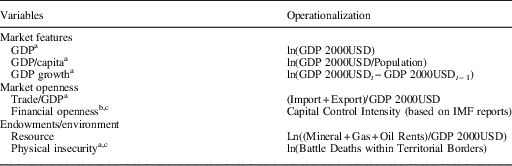
Finally, we include several control variables to account for other determinants of FDI, which are reported in Table 1.Footnote 12 While there are a number of other potentially confounders, most alternative theoretical explanations are accounted for by this set of controls.Footnote 13
Control Variables

Note: GDP=gross domestic product; IMF=International Monetary Fund.
a Source: World Development Indicators.
b Source: Chinn and Ito (Reference Chinn and Ito2008).
c Constant added before logging.
EMPIRICAL ANALYSIS
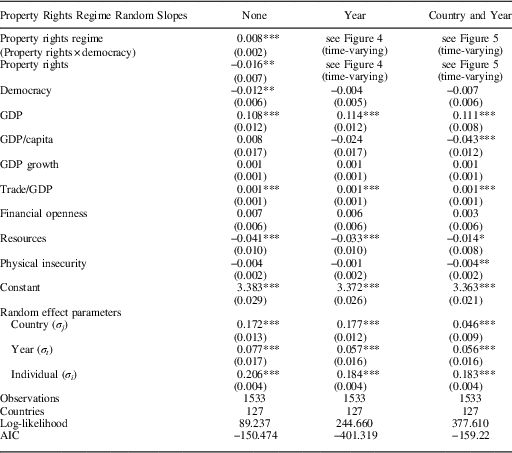
Table 2 reports the estimated fixed and random effects from the non-nested multilevel model. The random effects portion of the table demonstrates the importance of accounting for variation in space and time. The country (σ j ) and year (σ t ) random effects parameters account for, or “soak up,” variation in the statistical model that may otherwise be attributed to the parameter estimates in the fixed portion of the model (σ i ). The country and year random intercepts are able to account for a significant portion of variation across the three models, indicating that the multilevel model is appropriate. Model 1 includes only country and year random intercepts, while Models 2 and 3 include random slopes for property rights regime. The random slopes of the latter two models are presented graphically and discussed below.
Effects of Property Rights Regime on Foreign Direct Investment Using a Non-Nested Multilevel Model of Country and Year

Note: Coefficients are displayed above standard errors (in parentheses). Random effects parameters display the estimated standard error associated with each non-nested group variable, where j is country-, t is year-, and i is individual-level variation. Coefficients for the country- and year-level random slopes in Models 2 and 3 are not displayed in the table and instead are presented graphically in Figures 3 and 4, as their effects are time-varying.
GDP=gross domestic product; AIC=Akaike information criterion.
*p<0.10, **p<0.05, ***p<0.01.
Model 1 is a baseline model that assumes no temporal nor spatially varying effects associated with property rights regime; rather, it takes the average individual effect from the fixed portion of the multilevel model while also estimating the group effects associated with the non-nested levels to provide the average treatment effect for each independent variable. The baseline model identified whether a conditional relationship between property rights and democracy exists when attracting FDI.
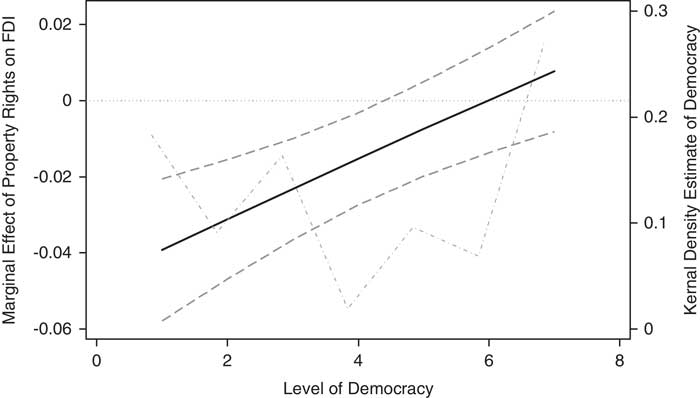
The primary independent variables are part of an interaction, so we cannot interpret them as we would additive regression models (Kam and Franzese Reference Kam and Franzese2007). Since the variables are mean-centered, however, the estimated parameters are at the average level of the other constitutive term, meaning that both democracy and property rights are associated with a negative direct effect on FDI over the full sample. To examine the conditional effect of property rights, we present the marginal effect of property rights at each level of democracy in Figure 3.
Marginal effects of property rights on foreign direct investment (FDI) Note: Dashed lines give 90 percent confidence interval. Light dashed-dot line displays the kernel density estimate. Displayed value is from Model 1 of Table 2.

Figure 3 shows that the marginal effect of property rights on FDI is negative and statistically significant at low values of democracy. This effect becomes statistically insignificant once democracy reaches values of 5 or more. This means that marginal effect of property rights is negative in autocracies and insignificant in democracies. That the effect of property rights is conditional on a state’s level of democracy provides initial support for Hypothesis 1. A kernel density estimate is included (dashed line; legend on the right hand side of the plot) to display the proportion of observations at each level of democracy.
While Model 1 provides support for Hypothesis 1, it treats the interaction and constitutive terms as fixed parameters, rather than as random coefficients. To more fully address the scope of the conditional relationship between property rights protections and democracy, Model 2 adds a random slope for property rights regime. The random slope allows us to consider the marginal effect of property rights on FDI over time, while Model 3 includes random slopes for both country and year. As evidenced from the Akaike information criterion (AIC)—where lower values indicate better model fit to the observed data—the models that include temporal variation outperform the baseline model.Footnote 14 This result provides initiation support for Hypothesis 2, that there is temporal variation in the effect of property rights regimes on FDI. Based on AIC, Model 2—which includes only time-varying effects—provides the best fit to the data. This suggests that while the effect of property rights regimes has changed over time, its effect is relatively consistent across states.
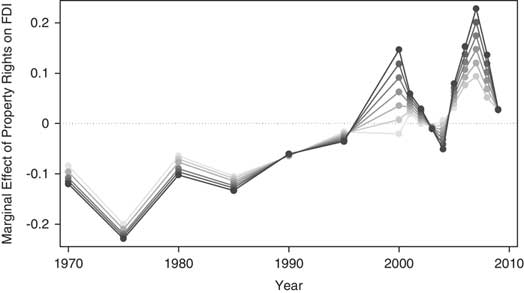
In order to more directly assess Hypothesis 2, we explore temporal trends of the effect of property rights regimes on FDI. Figure 4 displays the marginal effect of property rights for each year at varying levels of democracy, with darker lines indicating greater levels of democracy. The change in the coefficient between years is not constant, but experiences significant variation. This demonstrates the value of treating each year individually rather than assuming a common structure across all years. There is a clear upward trend in the marginal effect of property rights for all regimes types from 1970 to 2009.
Time-varying marginal effect of property rights on foreign direct investment (FDI) at different levels of democracy Note: Displayed value is the marginal effect of property rights when interacted with democracy from Model 2 of Table 2. Darker lines indicate greater levels of democracy.

There appears to be a change-point sometime between 1990 and 2000 on the effect of regime type on attracting FDI. Prior to 1995, while all regime types are associated with a negative effect of how much property rights attract FDI, autocratic regimes appear to have exerted a comparatively weaker effect. After 1995, democratic regimes are associated with a greater marginal effect. This result holds even controlling for the diffusion of economic liberalization during this period. Notably, the post-1995 period is associated with an increasing rate of technological development, particularly within information and communication technologies (Soper et al. Reference Soper, Dermirkan, Goul and Louis2012). The upward trend associated with increased levels of democracy in latter periods provides support for Hypothesis 2. These results hold even after accounting (via temporal random effects) for the increased availability of FDI in the 21st century.
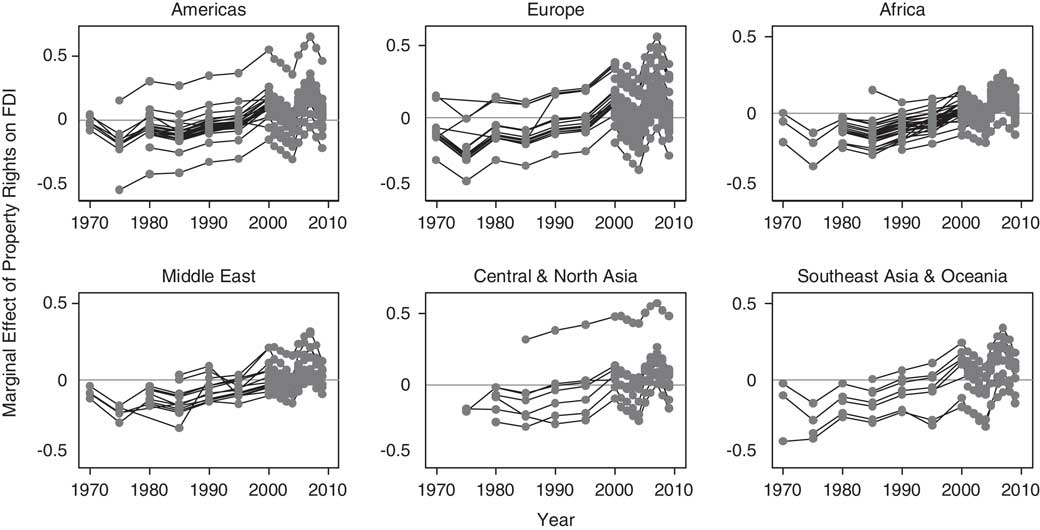
Model 3 accounts for temporal effects while controlling for unit-specific heteroskedasticity (Beck and Katz Reference Beck and Katz2006; King and Roberts Reference King, Keohane and Verba2014). Figure 5 displays the marginal effect of property rights for each country in every year; each line represents a specific country and each dot is an observation point. For ease of interepretation, these results are displayed at the regional level.
Time-varying and country-varying marginal effect of property rights on foreign direct investment (FDI) Note: Displayed value is the marginal effect of property rights when interacted with democracy from Model 3 of Table 2. Table does not display marginal effect for Russia 2007–2009 (1.714, 1.658, 1.603); Turkey 1980 (−1.506), or Uruguay 1980 (0.990), to maximize overall visualization.

The figure demonstrates the marginal effect of property rights increases over time across countries. The trend holds for both developed and developing countries. The result is consistent across all regions, with the marginal effect of most countries being negative at the start of the sample and becoming positive by the end of the period.
To illustrate how the effect of property rights are conditioned by democracy, we look at two post-Soviet states in greater detail: Azerbaijan and Georgia. From 2004 to 2009, Azerbaijan’s property rights score improved from below to above the sample average (4.6–6). This improvement occurred in the absence of democratic institutions (xconst=2). Despite its improvement in property rights, Azerbaijan experiences a decrease in FDI during the period. The marginal effect of property rights (from Model 3) is negative for four of these six years, despite its increasing property rights. Contrast this with Georgia, which improved its property rights (2.5–5.1) in a moderately democratic environment (xconst=5). Georgia’s improvement in property rights, combined with its higher democracy scores, resulted in a positive marginal effect on property rights and attracting more FDI.
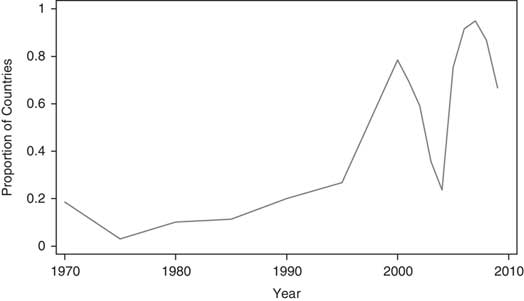
These trends are observed more broadly. Figure 6 displays the proportion of countries with a positive marginal effect associated with property rights. The figure shows that, after an initial decrease from 1970 to 1975, the proportion of countries with a positive marginal effect increases dramatically over time. While there is a drop in the early 2000s, this reduction is quickly reversed.
Proportion of countries with a positive property rights regime coefficient Note: Proportion based on marginal effect of property rights when interacted with democracy from sample in Model 3 of Table 2.

Taken together, the results support our theoretical expectations. Each model demonstrates that the effect of property rights is conditioned by the level of democracy. Model 2 provided evidence that this effect has increased over time, while Model 3 shows this effect holds even after accounting for unit heterogeneity. The positive and growing effect of property rights on FDI permeates all regions and is global in scope.
We conduct several additional sets of analyses to test the robustness of our results: we begin by substituting the LJI rule of law measure as our property rights variable. We also estimate several additional models, using both measures of property rights: we examine a subset of the data with just developing states, account for bilateral investment treaties, use alternative measures of FDI and democracy, re-estimate the model using PCSEs with fixed effects, and include variables to control for variation in the level of technological development across states. We find that our results are robust to these alternative specifications (see Online Appendix).
CONCLUSION
The disparate empirical findings in the literature are largely reconciled through our analytical and empirical approach. Analytically, both those arguing for democracy and autocracy as having a privileged position for enticing FDI are to some degree correct. We contend, however, that the effect of property rights on FDI is conditioned by the institutional structure and legitimacy provided by a country’s regime type and, furthermore, that this effect is time-varying. We find that prior to 1995 all regime types have a negative marginal effect on the relationship between property rights and FDI, but autocratic regimes had a less negative effect. Failing to consider the interaction and temporal dynamics may have therefore led some to find that autocracy promotes FDI compared to democracy. After 1995, we find that democratic regimes have a positive marginal effect on the relationship between property rights and FDI.
Despite claims in the literature that democracy attracts FDI because of its high levels of property rights protections, we know empirically that democracy and property rights are separate concepts. Property rights alone exhibit a clear upward trend over time moving from negative to positive coefficients across both developed and developing economies. Yet, democracy and property rights are intertwined as democratic institutions provide a coherent logic from which to frame the property rights regime and are better apt than autocratic regimes to legitimately manage conflicts that emerge as different groups win and lose in dynamic settings. Thus, democracies are able to provide stability and flexibility in dynamic settings, making them more attractive for FDI.
Our empirical approach also represents an advance in the literature on regime type and FDI. The non-nested multilevel model allows us to more appropriately account for temporal- (and country-) specific effects.Footnote 15 We examine the effect of property rights and regime type on FDI inflows in each country by over-parameterizing the model rather than resorting to a reference category, as is the case with fixed effects models. Moreover, we can explicitly model potential time- and country-level random effects on our primary explanatory variable. This approach also allows us to avoid well-known problems resulting from pooling developed and developing countries in the data set, while simultaneously examining temporal and spatial trends as the focus of the analysis rather than treat them as a nuisance. Thus, we are able to observe whether the interaction of property rights and political regime becomes stronger over time, as technological and economic dynamism has increased.
In terms of policy implications, the results of our analysis indicate that neither democracy nor property rights protections alone are sufficient to attract FDI. Instead, democracies help promote a strong and stable property rights regime. Such property rights regimes provide institutionalized, legitimate means of establishing and modifying property rights as technology and the economy change over time. Within an economically and technologically dynamic context, only democracies are capable of ensuring such protections, and when they do, they are rewarded handsomely through increased FDI.