Implications
Recent papers suggest that vitamin E supplementation of dairy cows causes neutral or adverse effects on the incidence of mastitis, especially when plasma vitamin E concentrations at dry-off are high (>14.5 μmol/l). We have reviewed all relevant papers published in the last 30 years and we present some novel data. The majority of the evidence suggests that high concentrations of plasma vitamin E at dry-off, when combined with vitamin E supplementation at the rate of 3000 IU/cow per day during the dry period, do not represent a risk for increased incidence of mastitis or production of milk with inferior quality.
Background
Vitamin E is the generic descriptor for two families of lipid-soluble compounds – the tocopherols and the tocotrienols. There are four different tocopherol compounds designated by the first four letters of the Greek alphabet (α, β, γ and δ). Tocotrienols also exist in four different forms designated by the same four Greek letters. The most abundant and biologically active tocopherol form in nature is α-tocopherol (Brigelius-Floh and Traber, Reference Brigelius-Floh and Traber1999).
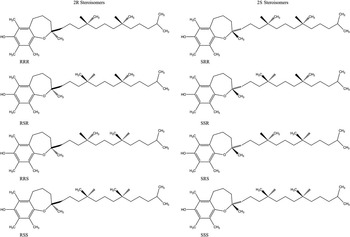
All vitamin E forms consist of a hydroquinol nucleus with an isoprenoid chain (four carbon atoms in a straight chain and a side chain of a single carbon), which is repeated three times in succession (Figure 1). Tocopherols have their side chain completely saturated; in the tocotrienols, the isoprenoid chain is unsaturated at three positions (C3′, C7′ and C11′). It must be noted that all vitamin E forms contain three chiral centers, the C2, in the chromatin ring and the C4′ and C8′ in the phytyl tail. Because α-tocopherol contains three centers of asymmetry, eight possible stereoisomers exist. Four of the eight possible stereoisomers possess the 2R configuration (RRR, RRS, RSS and RSR) and the other four stereoisomers possess the 2S configuration (SSS, SRR, SSR and SRS; Figure 2). In the naturally occurring form of α-tocopherol, all three centers of asymmetry possess the R configuration. This is the reason this form of α-tocopherol is known as RRR-α-tocopherol. In contrast, the synthetic form of α-tocopherol, which is commercially available, contains all the eight possible stereoisomers in equal proportions and it is known as the all-rac form.
Diagrammatic representation of structural characteristics of the major vitamin E forms.

Diagrammatic representation of various stereoisomers of α-tocopherol.

Bioavailability of natural v. the all-rac-α-tocopherol forms
The relative bioavailability of the natural v. the all-rac chemically synthesized form of α-tocopherol is a very important issue, because it will dictate the effective amount of vitamin E supplementation of dairy cows. The relative vitamin activity of the various vitamin E compounds has been questioned for decades. It is generally accepted that the naturally occurring RRR-α-tocopherol is more biologically active than its synthetic all-rac counterpart. The United States Pharmacopeia (1999) defines 1 IU of vitamin E activity as equal to 1 mg of all-rac-α-acetate and 1.49 IU of vitamin E is equal to 1 mg of RRR-α-tocopherol. Thus, the conversion factor of RRR-α-tocopherol concentration to vitamin E activity is 1.49.
Meglia et al. (Reference Meglia, Jensen, Lauridsen and Persson2006) performed analyses of the distribution of the various stereoisomers in plasma and milk, following daily supplementation of dairy cows with 917 mg of all-rac-α-tocopherol or 671 mg of RRR-α-tocopherol. They observed that the RRR-α-tocopherol was the most prevalent form in cows fed the all-rac form, constituting more than 86% of the total plasma α-tocopherol. The remaining portion consisted of the other three remaining synthetic 2R forms, whereas the 2S isomers contributed <1% of the total plasma α-tocopherol. As expected, the proportion of the RRR-α-tocopherol was more than 98% of the total α-tocopherol in both plasma and milk of cows fed the natural RRR-α-tocopherol form. Weiss et al. (Reference Weiss, Hogan and Wyatt2009) investigated the relative bioavailability of the two forms of α-tocopherol in dairy cows and their results were very similar to those of Meglia et al. (Reference Meglia, Jensen, Lauridsen and Persson2006). They found that ∼45% of vitamin E consumed in the diet by cows receiving the all-rac form consisted of 2S isomers but only 8% and 4% of the isomers in plasma and milk were 2S, respectively. Thus, an almost complete discrimination against the absorption of 2S isomers occurs in dairy cows. Because the 2S isomers represent 50% of the eight isomers present in the all-rac-α-tocopherol, Weiss et al. (Reference Weiss, Hogan and Wyatt2009) suggested that 1 g of the all-rac form is essentially equivalent to 0.5 g of the RRR form (1 mg all-rac = 0.5 mg and RRR = 0.75 IU).
Vitamin E and its effects on animal health
Incidence of mastitis – the direct evidence
A great number of studies in the last 30 years investigated whether vitamin E supplementation of dairy cows can decrease the incidence of mastitis. Increased incidence of intramammary infections occurs during the dry period and the early stages of lactation and essentially coincides with the lowest plasma concentrations of plasma vitamin E (Persson Waller, Reference Persson Waller2000). Numerous studies have documented that plasma vitamin E values decrease gradually throughout the prepartum period, reach the lowest values around calving and then increase gradually after calving (Weiss, Reference Weiss1998). Therefore, the crucial time period for vitamin E supplementation in dairy cows is the dry period because it is well accepted that vitamin E supplementation can partially prevent the decline in plasma vitamin E concentrations around calving. There are two ways of supplementing dairy cows with vitamin E: (a) daily dietary supplementation of 1000 to 3000 IU/cow per day and (b) parenteral injections (normally one or two injections of 3000 to 5000 IU during the last 2 weeks before the expected day of calving). Smith et al. (Reference Smith, Harrison, Hancock, Todhunter and Conrad1984) investigated the effect of vitamin E and selenium supplementation on the incidence of clinical mastitis and duration of clinical symptoms. A total of 80 cows were assigned to one of four groups: vitamin E-supplemented group (750 IU/day per cow), selenium-injected group (0.1 mg/kg of BW), vitamin E-supplemented plus selenium-injected group and control. There was no supplementation of vitamin E or selenium for the control group. Analysis of the data revealed that vitamin E supplementation reduced the incidence of mastitis by 37%. Incidence was not affected by selenium. The duration of the symptoms was reduced by 44%, 46% and 62% for the vitamin E-supplemented, the selenium-injected and for the vitamin E-supplemented plus selenium-injected groups, respectively. Thus, vitamin E deficiency increases frequency of infection and duration, whereas selenium affects mainly the duration of the symptoms. Similar results are provided by the same research group in a subsequent study using prepartum heifers (Hogan et al., Reference Hogan, Weiss and Smith1993). In more detail, a prepartum diet (starting 60 days before parturition) was supplemented to provide 2 IU/day of vitamin E/kg of BW and 2 μg/day of selenium/kg of BW. Supplemented primiparous cows were injected at 21 days prepartum with 0.1 mg of selenium/kg of BW. During lactation, the levels of supplementations were changed to 88 IU/day of vitamin E/kg of feed and 0.3 mg of selenium/kg of feed. There was no supplementation of vitamin E or selenium for the control group. Incidence of clinical mastitis was reduced by 57% in supplemented heifers compared with the control group. Furthermore, milk somatic cell count (SCC) in supplemented cows was lower than that of the control group. Weiss et al. (Reference Weiss, Hogan, Todhunter and Smith1997) examined in more detail whether vitamin E supplementation affected the incidence of clinical mastitis in dairy cows. They used three levels of vitamin E supplementation: low (100 IU/cow per day during the dry period and the first 30 days of lactation), intermediate (1000 IU/cow per day during the dry period and 500 IU/cow per day during lactation) and high (1000 IU/cow per day during the first 46 days of the dry period, 4000 IU/cow per day for the remaining 14 days of the dry period, followed by 2000 IU/cow per day during lactation). Selenium was fed to all cows at 0.1 ppm of total dry matter. They found that clinical mastitis affected 25.0%, 16.7% and 2.6% of the quarters during the first week of lactation in cows receiving the low, intermediate and the high level of supplementation, respectively. Thus, vitamin E supplementation reduces the frequency of clinical mastitis. They also concluded that cows with plasma concentrations of vitamin E lower than 3 μg/ml at calving had an ∼10-fold higher probability to develop clinical mastitis than cows with the corresponding value higher than 3 μg/ml. Herds with average plasma vitamin E concentration at calving higher than 3 μg/ml had a lower incidence of veterinary-treated cases of clinical mastitis by 34.8% compared with herds with average plasma vitamin E concentration lower than 3 μg/ml in observational data derived from 14 independent farms (Politis, unpublished observation). Thus, our data support the suggestion originally made by Weiss et al. (Reference Weiss, Hogan, Todhunter and Smith1997), that is, blood α-tocopherol around calving should be higher than 3 μg/ml. Even though a controversy exists, supplementation of dairy cows with vitamin E tends to be more effective in selenium-deficient herds. Bourne et al. (Reference Bourne, Wathes, Lawrence, McGowan and Laven2008) investigated whether parenteral injections of dairy cows with vitamin E during the dry period could affect the rate of mastitis in UK cows. They reported that supplementation of dairy cows with two parenteral injections of 2100 mg of vitamin E 2 weeks before and on the day of calving resulted in a lower rate of mastitis.
A number of studies reported neutral or, more recently, adverse effects of vitamin E supplementation on the incidence of mastitis. Batra et al. (Reference Batra, Hidiroglou and Smith1992) investigated the effect of vitamin E supplementation of dairy cows with 1000 IU/cow per day from the beginning of the dry period up to day 90 of lactation, which was then reduced to 500 IU/cow per day for the remaining of lactation on animal health, but the findings were inconclusive. In fact, they showed that supplementation had neutral effects on the incidence of mastitis; however, on the other hand, it lowered the SCC/ml of milk on day 112 of lactation indicative of better udder health. Leblanc et al. (Reference LeBlanc, Duffield, Leslie, Bateman, TenHag, Walton and Johnson2002) reported that a single parenteral injection of vitamin E (3000 IU/cow) 1 week before the expected day of calving had no effect on the incidence of mastitis in a study involving 21 commercial dairy herds. In another study, daily supplementation of dairy cows with 1610 mg of RRR-α-tocopherol from week 4 before up to week 2 after calving had no effect on the risk for veterinary-treated clinical mastitis or on the levels of SCC/ml in milk when compared with the corresponding values in the unsupplemented control cows (Persson Waller et al., Reference Persson Waller, Hallen Sandgren, Emanuelson and Jensen2007). Bouwstra et al. (Reference Bouwstra, Nielen, Stegeman, Dobbelaar, Newbold, Jansen and van2010) suggested that vitamin E supplementation throughout the dry period has adverse effects on incidence of mastitis postpartum in dairy cows. A total of 296 cows from five commercial dairy herds in the Netherlands were enrolled in this study. The five farms that were selected to participate in this study had high or extremely high incidence of mastitis. The number of clinical cases (rolling year averages) in the five farms were between 32% and 50%. Furthermore, three out of the total five farms that participated in the experiment had high levels of annual bulk SCC levels (>200 000/ml). Herds with low SCC levels (<150 000 SCC/ml) typically have environmental pathogens representing a large proportion of their clinical cases. Cows were divided into two groups of 148 cows each and they received either a low (135 IU/cow per day) or a high vitamin E supplement (3000 IU/cow per day) during the dry period. They reported higher incidence of mastitis in cows receiving the high vitamin E supplement compared with the corresponding value in cows receiving the low vitamin E supplement. In an analogy to human vitamin E studies, the authors suggested that vitamin E supplementation of dairy cows at the rate of 3000 IU/cow per day might be beneficial when plasma α-tocopherol concentrations are low or marginal; however, it might be associated with increased risk of mastitis when the α-tocopherol status of dairy cows at the beginning of the dry period are adequate. Bouwstra et al. (Reference Bouwstra, Nielen, Stegeman, Dobbelaar, Newbold, Jansen and van2010) suggested that both a high level of blood vitamin E during the dry period and a high level of vitamin E levels (>14.5 μmol/l, or 6.25 μg/ml using the factor 2.322 for conversion from μg/ml to μmol/l) at dry-off are the two risk factors for developing clinical mastitis. If we accept the hypothesis proposed that the increase in the frequency of mastitis is related to high levels of blood α-tocopherol, then it would be reasonable to expect that blood α-tocopherol levels in cows with mastitis would have been higher than those in the healthy cows. However, the data presented by Bouwstra et al. (Reference Bouwstra, Nielen, Stegeman, Dobbelaar, Newbold, Jansen and van2010) argue against this hypothesis because there were no statistically significant (P = 0.082 to 0.866) or biologically meaningful differences in blood vitamin E levels between healthy cows and those with mastitis. It is interesting to note that when the P-value approached the level of significance (P = 0.082), blood vitamin E levels in healthy animals were higher (16.43 μmol/l) when compared with the corresponding value in cows with mastitis (15.10 μmol/l) 4 weeks before calving, in the group that received the high level of vitamin E supplementation. One additional issue is related to the suggestion made by the authors, stating that the same trend (more clinical cases for the group that received the 3000 IU/cow per day level of supplementation compared with control cows) was observed in all five farms enrolled in the study. Against this concept, at least one of the five farms that participated in the experiment had fewer quarters with clinical mastitis in the group that received the high level of vitamin E supplementation. Lack of identification of the microorganism causing the intramammary infection (whether the pathogen belonged to the contagious or environmental category) makes interpretation of the results of Bouwstra et al. (Reference Bouwstra, Nielen, Stegeman, Dobbelaar, Newbold, Jansen and van2010) difficult.
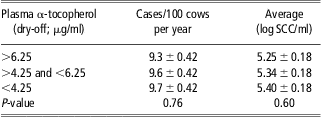
The suggestion that high amounts of plasma α-tocopherol at dry-off when combined with high levels of vitamin E supplementation during the dry period may increase the incidence of mastitis provided the motive to reanalyze data from a number of previously unpublished survey studies, which were mainly carried out in Greece and some of the vitamin E feeding trials carried out in Greece or United States of America between 1994 and 2004 (Politis et al., Reference Politis, Hidiroglou, Cheli and Baldi2001 and Reference Politis, Bizelis, Tsiaras and Baldi2004). Studies included observation data collected in a consistent manner along with implementation of a specific feeding strategy. The objective was to test the hypothesis that high levels of vitamin E at dry-off constitute a risk factor for mastitis. Vitamin E data were collected from six independent dairy herds. The first three dairy herds were located in Greece and were followed up for a period of 3 years. All animals in the three selected herds were supplemented with oral vitamin E throughout the dry period at a level of 3000 IU/cow per day. Corn silage was used in all three farms (42% to 49% on dry matter basis) and the animals had access to green pasture (4 h/day) during the months from March to June every year. In the three farms selected, at least 20% of cows had blood vitamin E >6.25 μg/ml at dry-off to provide the basis for a meaningful comparison of the groups (high and low blood vitamin E levels). Data from three independent vitamin E feeding trials were also included in the analysis. The first two trials were carried out in the United States of America and included supplementation at the 3000 IU/cow per day level starting 4 weeks before the expected date of parturition plus a parenteral injection of 5000 IU 1 week before the expected day of calving. A subset of these data, involving mainly immune parameters, were published (Politis et al., Reference Politis, Hidiroglou, Cheli and Baldi2001). The third vitamin E feeding trial was carried out in Greece and included oral supplementation of 3000 IU/cow per day starting 4 weeks before the expected day of parturition and then reduced to 1000 IU/cow per day postpartum (Politis et al., Reference Politis, Bizelis, Tsiaras and Baldi2004). All farms can be classified as having low incidence of clinical mastitis (<12 cases/100 cows per year) or medium incidence (13 to 26 cases/100 cows per year). A total of 545 dairy cows were divided into three groups: in the first group there were 209 cows with blood vitamin E levels at dry-off lower than 4.25 μg/ml, in the second group 173 cows with blood vitamin E levels that ranged between 4.25 and 6.25 μg/ml and in the third group the remaining 163 cows with the corresponding value higher than 6.25 μg/ml at the beginning of the dry period (dry-off). Data (veterinary-treated cases of clinical mastitis and weekly SCC/ml during the first month of lactation whenever available) were analyzed by least square analysis. The model included the vitamin E level at dry-off (three subclasses, see above), herd, country, year and the effect of cow nested within the herd as a random effect. Mastitis was modeled as a cow-level outcome using logistic regression. Results of the analysis are presented in Table 1. Our data indicate that there were no differences in the incidence of mastitis and the level of SCC/ml in milk between the three groups. Thus, high vitamin E levels at dry-off did not represent a risk factor for developing clinical mastitis, in dairy herds that implemented the 3000 IU/cow per day level of supplementation during the dry period.
Comparison of veterinary-treated clinical mastitis cases and average milk SCC in milk from a total of 545 cows in six herds supplemented with 3000 IU of vitamin E/cow per day in the diet relative to plasma α-tocopherol concentration at dry-off (means and s.e.m.)

SCC = somatic cell counts.
The literature was scrutinized to locate studies with high plasma vitamin E levels at dry-off and during the periparturient period, seeking evidence that might suggest that high vitamin E level is related to adverse effects on incidence of mastitis or immune function. Two survey studies reported high mean blood vitamin E levels (equal or higher than 6 μg/ml) and they both reported no relationship between blood vitamin E levels and the incidence of clinical mastitis (Ndiweni et al., Reference Ndiweni, Field, Williams, Booth and Finch1991; Jukola et al., Reference Jukola, Hakkarainen, Saloniemi and Sankari1996).
The work of others suggests that the effectiveness of vitamin E supplementation may depend on the type of microorganism causing the disease. Allison and Laven (Reference Allison and Laven2000) suggested that vitamin E might be more protective against environmental udder pathogens. Escherichia coli and Streptococcus uberis belong to this particular group of pathogens, and a common characteristic among them is that they do not normally inhabit the skin or the udder, but they have reservoirs in manure or bedding. They usually enter the teat canal around milking, even if teat contamination occurs in the barn. Environmental mastitis was formerly considered to be relatively rare; however, as farmers become more educated and they can reduce the number of contagious mastitic pathogens transmitted from cow to cow during milking, the environmental mastitic pathogens will become much more important. In support of this notion, Persson Waller et al. (Reference Persson Waller, Hallen Sandgren, Emanuelson and Jensen2007) were unable to find an effect of vitamin E supplementation on mastitis incidence in Sweden and attributed this observation to the fact that contagious mastitis pathogens are very common in Sweden.
Mastitis – the indirect evidence (immunity studies)
A number of studies investigated whether vitamin E supplementation affected immune function during the periparturient period. The great majority of these studies provided evidence, suggesting that vitamin E supplementation mitigates the decline in immune function that occurs during the periparturient period. Thus, these studies provide indirect evidence, suggesting that vitamin E supplementation reduces the risk for mastitis by improving immune competency. In more detail, two studies (Hogan et al., Reference Hogan, Weiss, Todhunter, Smith and Schoenberger1992; Weiss et al., Reference Weiss, Hogan, Todhunter and Smith1997) summarized by Weiss (Reference Weiss1998) indicated that dietary (500 IU/day of supplemental vitamin E during the first 30 days of lactation) or parenteral supplementation (two injections of 3000 IU of vitamin E at days 5 and 10 before expected calving) resulted in increased intracellular kill of ingested bacteria by neutrophils. Politis et al. (Reference Politis, Hidiroglou, Batra, Gilmore, Gorewit and Scherf1995 and Reference Politis, Hidiroglou, White, Gilmore, Williams, Scherf and Frigg1996) reported that dietary supplementation of dairy cows with 3000 IU/day from week 4 before up to week 4 after parturition combined with an injection of 5000 IU of vitamin E 1 week before calving prevented the periparturient decline in immune function (superoxide anion production by blood neutrophils and chemotactic responsiveness). In an attempt to study the mechanism of action of vitamin E in more detail at a molecular level, Politis et al. (Reference Politis, Hidiroglou, Cheli and Baldi2001) investigated whether vitamin E supplementation (dietary combined with parenteral) affects gene expression and the amount of the enzyme urokinase-plasminogen (u-PA) activator present on the cell membrane of neutrophils. This enzyme is critical for the ability of neutrophils to extravasate and reach the point of inflammation. Thus, the higher the amount of u-PA on cell membranes of neutrophils, the higher the ability of neutrophils to undergo diapedesis. Data obtained from this study indicated that vitamin E supplementation was associated with increased expression of the u-PA gene in neutrophils along with increased neutrophil membrane-bound u-PA at week 1 after parturition. Thus, vitamin E, by affecting the expression of u-PA gene facilitates movement of neutrophils to the mammary gland during inflammation. Similar results concerning the ability of vitamin E to restore immune competency at calving were obtained by Politis et al. (Reference Politis, Bizelis, Tsiaras and Baldi2004) in a trial carried out in a commercial herd in Greece using dietary supplementation (3000 IU/cow per day) from week 4 before up to week 4 after parturition. This study documents the ability of vitamin E to restore the function of neutrophils in a different environment and a less intensive management system in a country where dairy cows are likely to encounter less oxidative stress than cows in the United States of America. More recently, Weiss et al. (Reference Weiss, Hogan and Wyatt2009) investigated whether supplementation of dairy cows with the all-rac or the natural RRR form could enhance phagocytosis by neutrophils. Cows were divided into three treatment groups. The first group received no supplementation (control) and the remaining two groups received 2275 or 1678 mg/cow per day of the all-rac or the RRR supplements, respectively. They reported that neutrophils from cows receiving the all-rac form had increased neutrophil-associated tocopherol and that they exhibited enhanced phagocytosis resulting in increased number of bacteria killed. In contrast, neutrophils from cows receiving the RRR form had increased concentrations of neutrophil-associated tocopherol, but this was not translated to an effect on phagocytosis. The studies summarized above strongly suggest that vitamin E enhances immune function during the periparturient period in dairy cows. The reason for the differential effects mediated by the all-rac form and the RRR form with respect to phagocytosis remains unknown. There is a major need to identify the exact biological role of all α-tocopherol stereoisomers.
Incidence of retained fetal membranes (RFM)
A great majority of dairy cows expel the afterbirth within 6 to maximum 24 h of calving. The remaining cows that have not shed the afterbirth by 24 h, will be unable to shed until its cotyledon attachments have putrefied. There is growing evidence that overproduction of reactive oxygen species may contribute to a number of disturbances of the metabolism, resulting in the appearance of disorders such as RFM (Kankofer, Reference Kankofer2000). Thus, it was reasonable to investigate whether vitamin E supplementation is related to a reduction of the risk for RFM. The results of published studies are equivocal. Approximately half of the studies have demonstrated positive effects of vitamin E on the incidence of RFM, whereas the rest found no benefit. Allison and Laven (Reference Allison and Laven2000) suggested that vitamin E–selenium interactions may be the critical factor in determining the effectiveness of vitamin E. They suggested that in dairy herds with a history of selenium deficiency and a high incidence of RFM, supplementation of dairy cows with vitamin E combined with that of selenium can reduce the incidence of RFM. Bourne et al. (Reference Bourne, Laven, Wathes, Martinez and McGowan2007) performed a meta-analysis to consolidate the results of studies that have evaluated the effect of vitamin E supplementation during the dry period on the incidence of RFM. The multivariable analysis demonstrated that, overall, vitamin E supplementation was associated with a decrease in the incidence of RFM. Interestingly, the regression model used demonstrated that synthetic vitamin E was associated with a lower risk of RFM compared with natural vitamin E, suggesting that the synthetic form is more effective than the natural counterpart. Leblanc et al. (Reference LeBlanc, Duffield, Leslie, Bateman, TenHag, Walton and Johnson2002) in a well-designed study, which accounted for the effects of parity, season and twins, demonstrated that an increase in plasma α-tocopherol was associated with a reduction in the risk for RFM. In a similar manner, Kolb and Seehawer (Reference Kolb and Seehawer2002) suggested that suboptimal vitamin E status that occurs during periods of reduced intake of green fodder induces an accumulation of lipid peroxides in the placenta, and thus increases the frequency of RFM. They demonstrated that two injections with 3000 IU of vitamin E 21 and 5 days before parturition diminished the frequency of RFM. Bourne et al. (Reference Bourne, Wathes, Lawrence, McGowan and Laven2008) reported that supplementing dairy cows with parenteral injections of 2100 mg of vitamin E 2 weeks before and on the day of calving tended (P = 0.053) to reduce the incidence of RMF, which affected 6.5% and 3.0% of the control and supplemented cows, respectively. Similar results were reported by Erskine et al. (Reference Erskine, Bartlett, Herdt and Gaston1997).
Overall, it seems that vitamin E supplementation of dairy cows results in a reduction in the incidence of RFM, but the effect seems to be more prominent in herds with low selenium levels.
Vitamin E supplementation and milk quality
Vitamin E supplementation affects milk quality in both indirect and direct manners. The term ‘indirect effects’ is used for the reduction in the levels of SCC and the activity of the proteolytic enzyme plasmin in milk observed in cows supplemented with vitamin E. The term ‘indirect’ is used to indicate that there is no direct mechanism through which vitamin E causes these effects but they are rather the side effects of the effect of vitamin E supplementation (i.e. reduction in intramammary infections). The direct effects of vitamin E supplementation include those related to oxidative stability of milk. In this case, the actual milk α-tocopherol that is increased in vitamin E-supplemented cows contributes toward enhanced oxidative stability of milk.
Vitamin E – SCC in milk
An increased absolute SCC value and trends for higher SCC values indicate a high probability for clinical or subclinical mastitis. Thus, a reduction in the SCC levels indicates better udder health. Herds with a high SCC in bulk milk have many infected cows or quarters and milk produced in these herds is considered of inferior quality. The results of studies on the effect of vitamin E supplementation on the level of SCC in milk are equivocal. Politis et al. (Reference Politis, Hidiroglou, Batra, Gilmore, Gorewit and Scherf1995) reported lower levels of SCC/ml of milk for the first 4 weeks of lactation in cows supplemented with vitamin E (oral administration of 3000 IU/cow per day starting 4 weeks before the expected date of parturition and continued up to 8 weeks in lactation, plus one injection of 5000 IU 1 week before the expected day of parturition). Interestingly, selenium was fed to all cows at 0.3 ppm of total dry matter. Similar results were obtained in another study that was undertaken in a commercial farm in Greece implementing oral administration of 3000 IU/cow per day starting 4 weeks before the expected day of parturition and then reduced to 1000 IU/cow per day postpartum (Politis et al., Reference Politis, Bizelis, Tsiaras and Baldi2004). Baldi et al. (Reference Baldi, Savoini, Pinotti, Monfardini, Cheli and Dell'Orto2000) suggested that vitamin E supplementation (oral administration of 2000 IU/cow per day from day 14 before up to day 7 after parturition) reduces SCC by 20% to 30%, compared with the corresponding values of the control that received only 1000 IU/cow per day during the same time period. Nyman et al. (Reference Nyman, Emanuelson, Holtenius, Ingvartsen, Larsen and Waller2008) suggested that higher blood α-tocopherol concentrations around calving were associated with reduced levels of SCC in milk. Batra et al. (Reference Batra, Hidiroglou and Smith1992) and Hogan et al. (Reference Hogan, Weiss and Smith1993) showed reductions in the SCC/ml of milk in cows supplemented with vitamin E (see section ‘Incidence of mastitis – the direct evidence’). In contrast, other studies showed no SCC benefit resulting from vitamin E supplementation or lack of an association between plasma α-tocopherol concentration and SCC levels in milk (Erskine et al., Reference Erskine, Eberhart, Hutchinson and Scholz1987; Ndiweni et al., Reference Ndiweni, Field, Williams, Booth and Finch1991; Jukola et al., Reference Jukola, Hakkarainen, Saloniemi and Sankari1996; Persson Waller et al., Reference Persson Waller, Hallen Sandgren, Emanuelson and Jensen2007).
Vitamin E – milk plasmin levels
Plasmin is the most important proteolytic enzyme in bovine milk. It creates a number of serious problems in dairy products because it has the ability to hydrolyze α-casein and β-casein. Proteolysis caused by plasmin negatively affects the coagulating properties of milk, resulting in both reduced cheese yield and inferior cheese quality. Furthermore, increased plasmin reduces the stability of the long life milk (UHT milk) and it is associated with production of bitter flavors (Ismail and Nielsen, Reference Ismail and Nielsen2010).
Politis et al. (Reference Politis, Bizelis, Tsiaras and Baldi2004) demonstrated that vitamin E supplementation resulted in a reduction in plasmin levels in milk by 30%. Milk having lower levels of plasmin has an increased ability to withstand processing for the manufacturing of essentially all dairy products.
Vitamin E – oxidative stability
Several studies provided evidence that vitamin E supplementation slows down oxidative deterioration of milk (Charmley and Nicholson, Reference Charmley and Nicholson1993; Charmley et al., Reference Charmley, Nicholson and Zee1993; Al-Mabruk et al., Reference Al-Mabruk, Beck and Dewhurst2004). In contrast, Slots et al. (Reference Slots, Skibsted and Nielsen2007) suggested that milk with a high α-tocopherol concentration was more susceptible to oxidation than milk with low α-tocopherol.
The relationship between vitamin E and oxidative stability of milk requires further investigation. This is another topic that dairy manufacturers tend to underestimate. To the best of my knowledge, there is no optimal milk vitamin E concentration established by the dairy industry that will help milk maintain its freshness and block autooxidation processes until milk is consumed. Anecdotal reports suggest that supplementation with 1000 IU/day may be helpful in herds with milk with off-flavors but controlled studies are lacking.
Conclusions
The current NRC requirements (2001) are 73 and 18 mg of all-rac-α-tocopherol/kg of dry matter intake (DMI) for dry and lactating cows, respectively. Taking into account the average DMI in both these periods, dairy cows will receive, if NRC suggestions are followed, a total of 700 to 800 IU/day during the dry period and 350 to 400 IU/day during lactation. These requirements are for the total (supplemental plus vitamin content of feedstuffs). Dry cows will receive ∼200 and 1800 IU/day for diets based on hay and pasture, respectively, assuming an average DMI intake of 10 kg/day. Lactating cows will receive 400, 1500 and 2500 IU/day for diets based on hay, silage and pasture, respectively, assuming an average DMI intake of 20 kg/day (50% forage; Weiss, Reference Weiss1998). However, data concerning vitamin E in silage should be taken with caution as most naturally occurring tocopherols are degraded within a few months of ensilage.
On the basis of the available evidence concerning the effect of vitamin E supplementation of dairy cows and the incidence of mastitis, the level of SCC/ml of milk (as the primary indicator of milk quality) and other milk quality indexes, the following supplementation program is suggested. Because it is not always feasible to determine the vitamin E content of the basal diet, the general recommendation is that dry cows should be supplemented with 1000 to 3000 IU of vitamin E/day and lactating cows with 500 to 1000 IU/day. Cows on pasture do not normally require vitamin E supplementation. Herds with a high incidence of mastitis should utilize the 3000 IU/day level of supplementation to achieve blood vitamin E values higher than 3 μg/ml.