Implications
The inclusion of urea in the diet of ruminants is attractive because of its low cost relative to vegetable sources but its rapid release in the rumen may limit its use. Including urea or a slow rumen release urea as a partial replacement for soyabean and rapeseed meal in the ration of mid-lactation dairy cows had no effect on intake, milk yield, milk composition or diet digestibility, but the efficiency of nitrogen use was improved in animals when offered the slow-release urea compared with the control diet, whereas yield from forage was higher on both treatments containing urea.
Introduction
Sources of non-protein nitrogen (NPN) are attractive to include in the diet of ruminant animals because of their low cost relative to vegetable protein sources. Urea is the most commonly used NPN source and is rapidly hydrolysed in the rumen to ammonia (Johnson and Clemens, Reference Johnson and Clemens1973). Rumen bacteria can, depending on the diet, derive between 40% to 95% of their N from ammonia, the balance being from peptides and amino acids (Nolan, Reference Nolan1993). There is, however, a reluctance to include urea in the diet of high-producing dairy cows due to the potential negative effects of high plasma ammonia and/or urea levels on intake and fertility, or even death by ammonia toxicity if it is inappropriately mixed with the rest of the ration or included at too high a level (Bartley et al., Reference Bartley, Davidovich, Barr, Griffel, Dayton, Deyoe and Bechtle1976). This has lead to the development of several methods aimed at reducing the rate of urea-N release in the rumen that include calcium chloride-bound urea, biuret, isobutylidene diurea, acetyl urea, tung- and linseed-oil-coated urea, formaldehyde treated urea and natural zeolite. Uptake of these slower release NPN sources is dependent on their cost relative to urea and vegetable protein sources, and their effects on microbial growth and animal performance (Sinclair, Reference Sinclair2008). Efficacy of protection techniques is also dependent on not binding the urea too tightly, rendering it unavailable for hydrolysis in the rumen. In addition, certain products such as biuret require a variable period of ruminal adaptation (Johnson and Clemens, Reference Johnson and Clemens1973), which may limit their use.
The majority of studies that have been conducted on slow-release urea sources have focused on high fibre diets fed to low producing animals. For example, Currier et al. (Reference Currier, Bohnert, Falck and Bartle2004) reported that NPN supplementation increased suckler cow weight and condition score at calving, even when fed every other day, although there was little difference between urea and biuret. In beef animals, the addition of zeolite had little benefit over urea alone as an NPN source on animal performance, although fibre digestibility was improved (Sadeghi and Shawrang, Reference Sadeghi and Shawrang2006). In addition, there was little benefit to replacing feed urea with a polymer-coated slow-release urea product on the growth or carcass characteristics of beef animals in the study of Tedeschi et al. (Reference Tedeschi, Baker, Ketchen and Fox2002). Comparatively, few studies have been conducted on the effects of slow-release urea sources in the diet of high-producing dairy cows. Galo et al. (Reference Galo, Emanuele, Sniffen, White and Knapp2003) fed a polymer-coated urea source as a replacement for a combination of urea and vegetable protein and reported little effect on milk production. Similarly, a liquid calcium chloride-bound urea resulted in a comparable level of milk production as soyabean meal but reduced dry matter (DM) intake and consequently improved feed efficiency (Golombeski et al., Reference Golombeski, Kalscheur, Hippen and Schingoethe2006). Recently, a slow-release urea source based on a matrix of urea prills and lipid has been developed (Optigen®; Alltech Inc., Kentucky, USA). Studies in vitro have reported a similar microbial protein yield and efficiency of synthesis when Optigen® replaced soyabean meal, but with an increase in fibre digestion (Sinclair et al., Reference Sinclair, Huntington and Wilde2008). Its effect, however, on the performance of dairy cows is unclear. The objectives of this study were to determine the effect of urea and a slow-release urea (Optigen®) as a partial replacement for soyabean meal and rapeseed meal on the performance, metabolism and whole-tract digestibility in dairy cows.
Material and methods
All the procedures involving animals were conducted in accordance with the UK Animals (Scientific Procedures) Act 1986.
In situ degradability of the urea sources
Two ruminally cannulated wether sheep that were 8 years old and had an average live weight (mean ± s.d.) of 104 ± 4.6 kg were housed on straw under continuous lighting and with free access to fresh wheat straw, water and mineral lick blocks. The animals were fed a concentrate that contained (g/kg) barley 230, molasses 110, molassed sugarbeet feed 100, rapeseed meal 100, soyabean meal 75, maize 75, peas 75, barley distillers grains 70, oat feed 50, sunflower meal 50, palm kernel 30, minerals and vitamins 25 and wheat feed 10 that was predicted to contain 12.0 MJ metabolisable energy (ME)/kg DM and 197 g CP/kg DM. The concentrate was offered in two equal portions at 0900 and 1630 h to provide 1.1 × maintenance energy requirements according to Agricultural and Food Research Council (AFRC, 1993).
Approximately 5.0 g DM of the urea or slow-release urea were accurately weighed into synthetic bags with a pore size of 40 μm. The bags were placed in to the rumen of each sheep 30 min after the morning feed and removed after intervals of 0.5, 1, 2, 4, 7 and 12 h. Following incubation, the bags and contents were washed under a running tap until the water leaving the bags was visibly clear. In addition, synthetic bags containing samples of feed that had not been incubated in the rumen were washed in the same manner to provide a measure of the rapidly soluble component. After washing, bags and contents were frozen at −20°C, freeze dried (Edwards Modulyo, Crawley, Sussex, UK), reweighed and the N content of the residue was determined using a Leco FP-528 (Leco, Stockport, UK).
Animals, diets and experimental procedure
Forty-two Holstein–Friesian dairy cows (9 primaparous and 33 multiparous) that were on average 84 days post calving, yielding 32 (s.d. ± 6.6) kg of milk, weighing 634 (s.d. ± 79.5) kg and with a body condition score (Lowman et al., Reference Lowman, Scott and Somerville1976) of 2.6 (s.d. ± 0.3) were used. Based on recordings taken in the week before commencing the study, animals were stratified according to parity and milk yield and randomly allocated to one of three dietary treatments: control (C); urea (U); or slow-release urea (S).
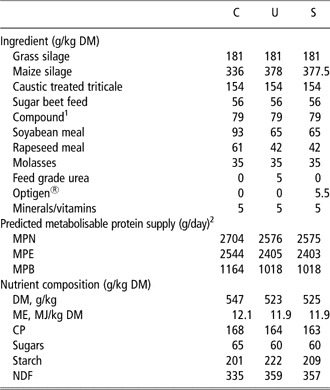
The three dietary treatments were fed in each of three periods of 5 weeks duration in a Latin square design. C cows were offered a total mixed ration based on grass silage, maize silage and straight feeds formulated according to Thomas, (Reference Thomas2004; Table 1). Cows that received U or S were offered the same basal ration with the replacement of 28 g/kg DM of soyabean meal and 19 g/kg DM of rapeseed meal with either 5 g/kg DM of feed grade urea (U) or 5.5 g/kg DM of Optigen® (Alltech Inc., Kentucky, USA) with the proportion of maize silage increasing accordingly. The slow-release urea source is a complex urea–lipid matrix and contained 412 g N/kg. The level of urea inclusion was chosen to supply approximately 100 g/cow per day of feed grade urea as this represented commercial levels used on UK dairy farms. The content of effective rumen degradable nitrogen calculated according to Thomas (Reference Thomas2004) was similar across all three diets. The metabolisable protein supply from by-pass protein was predicted to be 7 g/kg DM higher in diet C, whereas the predicted metabolisable protein content was 6 g/kg DM higher in diet C than either U or S (Table 1).
Ingredient composition, predicted metabolisable protein supply and actual chemical composition of a control diet (C) and with the partial replacement of soyabean meal and rapeseed meal with feed grade urea (U) or a slow-release urea (S)

DM = dry matter; ME = metabolisable energy.
1Compound contained (g/kg DM): dried sugar beet feed 164, wheat feed 147, wheat distillers 106, wheat 107, soyabean meal 101, rapeseed meal 101, palm kernel meal 101, molasses 60, soya hulls 60, minerals and vitamins 43 and vegetable fat 10.
2MPN = metabolisable protein from microbial protein (N limited) and digestible bypass protein; MPE = metabolisable protein from microbial protein (energy limited) and digestible bypass protein; MPB = digestible bypass protein, calculated using a DM intake of 22 kg/day according to Reference ThomasThomas (2004).
The forages and straight feeds were mixed daily using a Keenan Compact forage mixer calibrated to ± 1 kg, and fed through electronic roughage intake feeders (Insentec B.V., Marknesse, the Netherlands) fitted with an automatic animal identification and forage weighing system calibrated to ± 0.1 kg (Sinclair et al., Reference Sinclair, Jackson, Huntington and Readman2005). Fresh feed was offered daily at 0800 h at the rate of 1.05 of ad libitum intake, with refusals collected twice weekly on a Tuesday and Friday. The cows were housed in the same portion of a cubicle building containing Super Comfort and Cantilever cubicles fitted with rubber mats. The cubicles were scraped using automatic scrapers, bedded twice weekly with chopped paper and limed weekly. All cows had continual access to water.
Cows were milked twice daily at approximately 0600 and 1600 h. During the final 7 days of each period milk yield was recorded at each milking and sub-samples taken on four occasions (consecutive am and pm milking on 2 separate days) from each cow for subsequent analysis. The cows were weighed and condition scored after the evening milking during the week before the start of the study and at the end of each period. Forage samples were taken weekly, oven dried at 100°C and the ratio of maize to grass silage adjusted to maintain the desired ratio on a DM basis. Feed samples were taken daily during the collection period and stored at −20°C before analysis. During the final week of each period, blood samples were taken using jugular venipuncture from a sub-sample of six cows per treatment at 0700 h before fresh feed being offered (−1 h) and again post-feeding at 0900 h (+1 h), 1000 h (+2 h) and 1200 h (+4 h), and analysed immediately for plasma ammonia-N as described by Richardson et al. (Reference Richardson, Wilkinson and Sinclair2003). Plasma samples were also separated and stored at −20°C for subsequent analysis of urea, glucose and β-hydroxybutyrate (3-OHB). Whole-tract digestibility was estimated using acid-insoluble ash as an internal marker (Van Keulen and Young, Reference Van Keulen and Young1977). Faecal samples were collected during the final 7 days of each period from five cows per treatment at 1000 and 1600 h and stored at −20°C before analysis.
Chemical analysis
Feed and faecal samples were bulked between days and sub-samples analysed according to the Association of Official Analytical Chemists (AOAC, 2000) for DM (934.01), CP (988.05) and ash (942.05), whereas NDF was analysed according to Van Soest et al. (Reference Van Soest, Robertson and Lewis1991). The ME content of the forages was determined using near infra red reflectance spectroscopy by Sciantec Analytical, Selby, UK, whereas starch was determined according to the Ministry of Agriculture, Fisheries and Food (MAFF, 1982) and sugars by the method of Thomas (Reference Thomas1977). Milk samples were analysed for fat, true protein and lactose using a Lactoscope FTIR spectrophotometer (Delta Instruments B.V., Drachten, the Netherlands) calibrated by the methods of AOAC (2000). Plasma samples were analysed for ammonia, 3-OHB, glucose and urea (Randox Laboratories, County Antrim, UK; kit catalogue no. AM 1015, RB 1007, GL1611 and UR221, respectively) using a Cobas Miras Plus autoanalyser (ABX Diagnostics, Bedfordshire, UK).
Calculations and statistical analysis
Degradability coefficients were calculated by fitting the data obtained for N to the first order model of Ørskov and McDonald (Reference Ørskov and McDonald1979):

where p is the cumulative amount degraded at time t, a is the readily soluble fraction, b is the fraction potentially degraded in the rumen, c is the constant rate of degradation of b and t is in hours.
Data were analysed by ANOVA as a Latin square design using Genstat 13th edition (Payne et al., Reference Payne, Harding, Murray, Soutar, Baird, Glaser, Welham, Gilmour, Thompson and Webster2010). The model used was  where Yijk is observation, μ is overall mean, Ti is treatment, Pj is period, Ak is animal and Eijk is the residual error. Blood data were analysed using repeated measures of ANOVA. Results are presented as treatment means with an s.e.d. and significance was considered at P < 0.05, and a trend when P < 0.10.
Results
In situ degradability and feed analysis
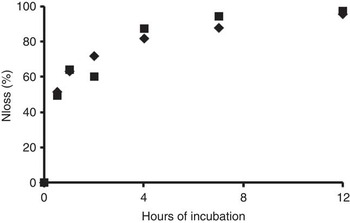
The calculated ‘a’ fraction of the slow-release urea product was 0.08, whereas the potentially degradable ‘b’ fraction was 0.89 and had a rate of release ‘c’ of 0.82/h (P < 0.001, R 2 = 93.2; Figure 1). In contrast, the feed grade urea was immediately and completely soluble. The chemical composition of the diets is presented in Table 1. Dietary CP and ME content were highest in C, whereas starch content in U was 21 g/kg DM higher than C, with S having an intermediate value.
In situ degradability of a slow-release urea source in the rumen of two sheep. Symbols represent values for each individual animal.

Intake and milk performance
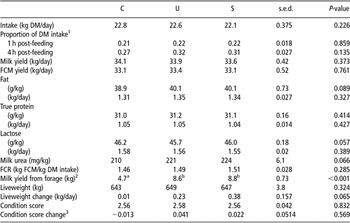
There was no effect (P > 0.05) of treatment on daily DM intake, which averaged 22.5 kg/day (Table 2). Similarly, there was no effect (P > 0.05) of dietary treatment on the proportion of daily DM intake consumed in the first or 4 h following fresh feed being offered. There was no effect (P > 0.05) of treatment on daily milk yield or milk fat yield (kg/day) but there was a trend (P = 0.09) for cows offered either of the diets that contained urea to have a higher milk fat content (average of 40.1 g/kg for U and S v. 38.9 g/kg for C). Fat corrected milk yield did not, however, differ between treatments (P > 0.05). Milk true protein concentration (g/kg) and yield (kg/day) were not affected by treatment (P > 0.05), but milk lactose content (g/kg) tended (P = 0.06) to be lower in cows when offered U than C. Milk urea content was marginally lower (P = 0.07) in cows when offered the control diet compared with either of those receiving urea, although all values were low. There was no effect (P > 0.05) of dietary treatment on food conversion ratio, whereas milk yield from forage was 4 kg/day higher (P < 0.001) in cows when offered U or S compared to C. Average live weight, condition score and mean condition score change were not affected (P > 0.05) by dietary treatment, although there was a trend for cows offered S to have a higher live weight gain (0.38 kg/day) than those receiving C (0.01 kg/day; P = 0.07).
Intake and milk performance of dairy cows offered a control diet (C) or with the partial replacement of soyabean meal and rapeseed meal with feed grade urea (U) or a slow-release urea (S)

DM = dry matter; FCM = fat corrected milk; FCR = food conversion ratio; ME = metabolisable energy.
abWithin a row, means with different superscripts differ by P < 0.05.
1Calculated as the amount of DM consumed within the first or 4 h following fresh feed being offered, expressed as a proportion of the daily DM intake.
2Calculated as milk yield (fat corrected) minus milk yield from concentrates. Milk yield from concentrates was calculated as ME supplied by concentrates divided by the ME content of milk for each cow. Milk ME content was calculated according to Agricultural and Food Research Council (AFRC, 1993).
3Expressed as the difference between the initial and final condition score for each period.
Blood metabolites
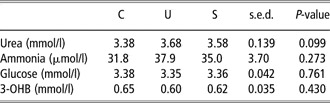
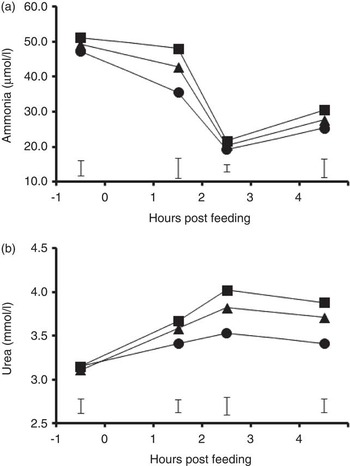
There was no effect of dietary treatment on the mean concentration of any of the blood parameters measured, with all values being within the recommended range (Table 3). There was also no difference (P < 0.05) in plasma ammonia concentrations between treatments at any of the time points, with levels being low throughout the day and decreasing post-feeding (Figure 2a). In contrast, there was a difference (P < 0.05) in hourly urea concentrations, which increased from −1 h to a peak at 2 h post feeding, and were higher (P < 0.05) at 2 and 4 h post feeding in cows when offered U or S compared to C (Figure 2b).
Plasma urea, ammonia, glucose and β-hydroxybutryate (3-OHB) concentrations in dairy cows offered a control diet (C) or with the partial replacement of soyabean meal and rapeseed meal with feed grade urea (U) or a slow-release urea (S)

Hourly plasma ammonia (a) and urea (b) concentrations in dairy cows offered a control diet (●) or with the partial replacement of soyabean meal and rapeseed meal with feed grade urea (▪) or a slow-release urea (▴). Error bars indicate s.e.d.

Whole-tract digestibility and N efficiency
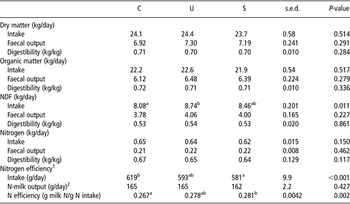
Intake of NDF was higher (P < 0.05) in cows when offered U compared with C, but whole-tract apparent digestibility of DM, organic matter (OM), NDF and N were not affected (P > 0.05) by dietary treatment (Table 4). The intake of N was higher (P < 0.001) in cows when offered C compared with S, with animals receiving U having an intermediate value. There was no effect (P > 0.05) of treatment on milk N output. The efficiency of milk N production was, however, higher (P < 0.05) in cows when offered S than C, with those receiving U having an intermediate value.
Diet digestibility and N efficiency in dairy cows offered a control diet (C) or with the partial replacement of soyabean meal and rapeseed meal with feed grade urea (U) or a slow-release urea source (S)

abWithin a row, means with different superscripts differ by P < 0.05.
1Determined using all study cows.
2N-milk = milk true protein output (g/day)/6.38.
abWithin a row, means with different superscripts differ by P < 0.05.
Discussion
The objectives of a slow-release urea product are to reduce the ruminal rate of N release while ensuring that all of the N is completely available within the rumen. If the rate of release is reduced by too great an extent, then urea may potentially flow out of the rumen and therefore not contribute towards the rumen degradable protein supply. As a consequence, the metabolisable protein supply to the cow may be decreased. All of the N in the feed grade urea was soluble and therefore immediately available. In contrast, the slow-release urea source was successful in reducing the ‘a’ fraction with a coefficient of 0.08, a value comparable to the 0.08 reported for soyabean meal and less than the 0.19 for rapeseed meal (Witt et al., Reference Witt, Sinclair, Wilkinson and Buttery1999). The ‘b’ coefficient for the slow-release urea was 0.89, a value comparable to that reported for soyabean and higher than rapeseed meal (0.89 and 0.58, respectively; Witt et al., Reference Witt, Sinclair, Wilkinson and Buttery1999), whereas the rate of degradation ‘c’ of the slow-release urea at 0.82/h was some 8 to 11 times faster (0.076 and 0.107/h for soyabean and rapeseed meal, respectively; Witt et al., Reference Witt, Sinclair, Wilkinson and Buttery1999). The effective degradable N for the slow-release urea source calculated according to Thomas (Reference Thomas2004) was comparable to feed grade urea (903 and 918 g/kg for the slow-release and feed grade urea, respectively). It can therefore be concluded that the slow-release urea source used here achieved the objective of reducing the ruminal rate of N release compared with feed grade urea, while ensuring a comparable amount of degradable N available for microbial growth.
It is well established that high ruminal concentrations of ammonia and consequently high plasma ammonia concentrations, generated either by intra-ruminal infusions or feeding, result in a slower rate of eating and fewer meals per day and/or a shorter period consuming the first meal (Conrad et al., Reference Conrad, Baile and Mayer1977; Sinclair et al., Reference Sinclair, Sinclair and Robinson2000), although this may not always be related to a reduction in DM intake (Köster et al., Reference Köster, Cochran, Titgemeyer, Vanzant, Nagaraja, Kreikemeier and St. Jean1997; Richardson et al., Reference Richardson, Wilkinson and Sinclair2003). In this study there was no effect of dietary treatment on the pattern of food intake following fresh feed being offered, or daily DM intake, which averaged 22.5 kg. In the study of Sinclair et al. (Reference Sinclair, Sinclair and Robinson2000), intake pattern was altered only in treatments that resulted in peak plasma ammonia concentrations of 300 μmol/l or above, and it is unlikely that the comparatively low levels of plasma ammonia in this study (peak values of 50 μmol/l) were sufficient to elicit any major change in meal pattern or daily intake.
In this study a particularly strong change-over design was employed, with high replication and 5-week periods. The feed grade urea and slow-release urea were included at a level that reflected commercial practice in the United Kingdom (∼100 g/cow per day), and were predicted to provide approximately 0.08 of the dietary CP and 0.11 of the rumen degradable protein supply. In addition, all three diets were formulated to contain a similar effective rumen degradable N content. The lack of a significant difference in milk performance between treatments when approximately one third of the dietary soyabean and rapeseed meal were replaced with feed grade urea or a slow-release urea therefore indicates a successful replacement of vegetable protein with NPN. The lack of a difference may, however, also be attributed to the relatively low rate of inclusion of the supplements, or the level of milk production. In addition, it is also possible that reducing the CP content of the diet without the addition of urea may have resulted in a similar level of performance to animals offered C, although effective rumen degradable N supply would have been in deficit. Silveira et al. (Reference Silveira, Lopes, Oliveira, Gonzales, Siqueira, Bier, Zoni, Giardini, Almeida and Pereira2010) replaced 1 kg/cow per day of soyabean meal with 160 g of the same fat encapsulated urea used here and also reported no significant effect on milk performance. Highstreet et al. (Reference Highstreet, Robinson, Robison and Garrett2010) fed similar levels of urea to those used in this study and reported an increase in milk yield, milk fat and true protein yield in early-lactation dairy cows yielding 36 kg/day when the urea was replaced with a fat encapsulated urea. In contrast, the same dietary treatments offered to mid-lactation cows yielding 28 kg/day resulted in no significant effect (Highstreet et al., Reference Highstreet, Robinson, Robison and Garrett2010). In this study the average milk yield of 34 kg/day was intermediate to the two groups reported by Highstreet et al. (Reference Highstreet, Robinson, Robison and Garrett2010). Similarly, Galo et al. (Reference Galo, Emanuele, Sniffen, White and Knapp2003) replaced a proportion of the dietary urea in the diet of mid-lactation dairy cows with a polymer-coated urea and reported no effect on milk performance. In general, high urea inclusion rates (e.g. 10 to 20 g/kg DM) are associated with a reduction in DM intake and performance (e.g. Brito and Broderick, Reference Brito and Broderick2007; Santos et al., Reference Santos, Santos, Theurer and Huber1998), which may be related to a reduction in digestible, undegradable protein supply (DUP). In this study the predicted reduction in DUP supply of the urea-containing diets was comparatively low at 7 g/kg DM.
There was a trend (P = 0.089) in this study for milk fat concentration to be higher in cows receiving either of the diets containing urea compared with the control. The replacement of 28 g/kg DM of soyabean and 19 g/kg DM of rapeseed meal with the 5 g/kg DM equivalent of urea increased the proportion of forage in the diet and consequently increased NDF concentrations by 11 g/kg DM. Beauchemin (Reference Beauchemin1991) reported a mean increase in milk fat content of 1.1 g/kg per 10 g/kg DM increase in ration NDF content, a value very similar to the increase in milk fat content reported here. Others have reported that milk yield was negatively correlated with the NDF concentration of the diet (Briceno et al., Reference Briceno, Van Horn, Harris and Wilcox1987), but in this study neither milk yield or fat corrected milk yield were affected by dietary fibre concentration.
Regression analysis of N intake with output in faeces, urine and milk indicates an inefficient utilisation of dietary N by dairy cows, with approximately 0.72 of consumed N being excreted in faeces and urine and only 0.28 captured in milk (Castillo et al., Reference Castillo, Kebreab, Beever and France2000). In this study the average efficiency of conversion of dietary N to milk N was also 0.28. Compared with C, the inclusion of the slow-release urea resulted in a small but significant increase in the efficiency of N use for milk production, principally because of a reduction in N intake with no effect on milk true protein output. Using a simple index of dietary milk protein output as a proportion of intake does not account for possible tissue protein accretion or mobilisation, although the trend for an increase in daily live weight gain in cows when offered S compared with C also supports a more efficient use of dietary N on this treatment.
Whole-tract digestibility coefficients N in this study averaged 0.70, 0.71, 0.53 and 0.65 kg/kg for DM, OM, fibre and N respectively, and were comparable to the 0.70, 0.72, 0.55 and 0.68 kg/kg, respectively, reported by Sutton et al. (Reference Sutton, Cammell, Phipps, Beever and Humphries2000) in dairy cows also fed maize silage-based rations. The replacement of preformed amino acids in soyabean and rapeseed meal with urea was predicted to have little detrimental effect on fibre digestion, as the bacterial populations associated with fibre in the rumen have been shown to exclusively use ammonia for their growth requirements (Russell et al., Reference Russell, O'Connor, Fox, Van Soest and Sniffen1992). Indeed, whole-tract fibre digestion was similar across all three dietary treatments, a finding in agreement with Highstreet et al. (Reference Highstreet, Robinson, Robison and Garrett2010) who compared feed grade urea with a fat encapsulated, slow-release urea. Galo et al. (Reference Galo, Emanuele, Sniffen, White and Knapp2003) added a polymer-coated urea source to a basal diet and also reported no effect on NDF digestibility, although ADF digestibility was decreased. In contrast, Sinclair et al. (Reference Sinclair, Huntington and Wilde2008) evaluated the same slow-release urea source as used here and reported a significant improvement in ruminal digestion of fibre in vitro, although reasons for the effect were unclear.
Plasma ammonia levels typically associated with clinical ammonia toxicity range between 500 and 800 μmol/l (Bartley et al., Reference Bartley, Davidovich, Barr, Griffel, Dayton, Deyoe and Bechtle1976; Symonds et al., Reference Symonds, Mather and Collis1981), well in excess of the peak values recorded here at approximately 50 μmol/l. Ammonia produced in the rumen that is in excess of microbial requirement may be absorbed across the ruminal epithelium and converted to urea in the liver (Lobley et al., Reference Lobley, Connell, Lomax, Brown, Milne, Calder and Farningham1995), with the liver having the ability to remove ammonia added to the portal blood up to a maximum of 182 mg/min before peripheral blood concentrations increase (Symonds et al., Reference Symonds, Mather and Collis1981). It can therefore be concluded that in all three dietary treatments evaluated in this study, ammonia uptake by the portal drained viscera was well within the ability of the liver to metabolise it to urea. This is supported by the post-prandial increase in plasma urea, which increased in all treatments post feeding, with levels being significantly higher at 2 and 4 h post feeding in cows when fed the feed-grade urea compared with the control diet, although all values were within the recommended range (Ward et al., Reference Ward, Murray, White and Rees1995). The observation that plasma urea concentrations peaked at approximately 2 h following the main meal is also consistent with that reported by Richardson et al. (Reference Richardson, Wilkinson and Sinclair2003). The difference between treatments in hourly plasma urea concentration cannot be attributed to a lower concentration of rumen degradable N in C, as all diets were formulated to contain a similar effective degradable N content, but do reflect the relative rate of ruminal-N release in the three dietary treatments.
Conclusions
The partial replacement of soyabean meal and rapeseed meal with approximately 100 g/day of feed grade urea or a slow-release urea can be achieved without affecting intake, milk performance or diet digestibility. The efficiency of conversion of dietary N into milk protein was improved in animals when offered the slow-release urea compared with the control diet, with animals receiving urea having intermediate values.
Acknowledgements
The authors would like to acknowledge the technical assistance of D. Ferguson and G. Vince, David Wilde for assistance with diet formulation and to Alltech (UK) Ltd, for financial support.