Introduction
Violence against women (VAW) is a widespread violation in human rights and a major barrier to achieving gender equality throughout the world.Reference Sohrabizadeh 1 The United Nations defines VAW as:
“Any act of gender-based violence that results in, or is likely to result in, physical, sexual, or psychological harm or suffering to women, including threats of such acts, coercion, or arbitrary deprivation of liberty, whether occurring in public or in private life.” 2
Accordingly, VAW is manifested through physical, sexual, emotional, and economical forms. The most global types of VAW are domestic and sexual violence, sexual harassment, and psychological forms of abuse.Reference Sohrabizadeh 1 While VAW takes place in different settings, such as family, general community, and organizations, 3 it is increased in disaster-stricken communities. 4 Considering the context or setting in which disasters occur, the forms of VAW may be various.Reference Enarson 5
In the post-disaster phase, the rate of violent actions against women and girls grows, threatening their short and long-term security. 6 Some literature has reported the aggravation of VAW in the aftermaths of natural disasters. For instance, exacerbations of intimate partner violence were reported after the eruption of Mt. Pinatubo in the Philippines (1991), as well as after the Loma Prieta earthquake in the United States (1989). 7 In addition, 27.0% of female survivors in Hurricane Mitch in Nicaragua (1998) confirmed that assaulting women had been increased in both affected families and the community. 6 After the earthquake of Haiti and the floods of Pakistan (2010), increase in early marriage was reported. 8
Violence against women is rooted in gendered social structure and it cuts across the socio-economical context, educational level, and geographic boundaries.Reference Sohrabizadeh 1 A few studies published in Iranian databases showed that women experience common types of violence before disasters. For instance, a study of 1,800 pregnant women revealed that 60.6% of them experienced various forms of domestic violence, including psychological (60.5%), physical (14.6%), and sexual (23.5%) violence. 9 Another study reported that the most common types of VAW in Arak, Iran included emotional (64.6%), verbal (57.1%), economical (32.3%), and physical (26.8%) abuses.Reference Saidi and Siddegowda 10 Additionally, a survey performed in the city of Marivan, Iran confirmed that approximately one-third of 770 women (32.9%) experienced sexual intimate partner violence.Reference Bayati, Shamsi and Mohammadbeygi 11
On the other hand, Iran is recognized as the highly hazard-prone country suffering from the effects of destructive natural disasters.Reference Yari, Nouri, Rashidian and Nadrian 12 The consequences of natural catastrophes such as immense destruction, breakdown of social security systems, and collapse of social cohesion may result in developing different forms of violence against an affected population, more especially women and girls.Reference Fatemi 13 Regarding this fact, there have been no efforts to identify and report the violated actions against women who had been damaged by natural disasters in Iran. Additionally, no attentions have been paid to the VAW issue in the majority of national disaster plans and Islamic rules of Iran.
Violence against women experiences, cases, and lessons-learned concerning Iran’s disasters have not been investigated, documented, or reported so far. Accordingly, this study addressed the question: “What are the manifestations of violence against women after the natural disasters of Iran?” This qualitative study aimed to explore types of VAW and girls after the recent quakes and floods in Iran.
Methods
Study Design
A qualitative approach was used in this study to gain insight into the personal experiences and views of participants. This qualitative methodology was used to develop further research by identifying additional relevant variables and generating new study questions.Reference Rezaeian 14
Setting
Iran (the Islamic Republic) has more than 70 million peopleReference Gbrich 15 and is a highly hazard-prone country frequently struck by natural disasters.Reference Yari, Nouri, Rashidian and Nadrian 12 Approximately 99.4% of Iranians are Muslim, and their current formal speaking language is Farsi.Reference Gbrich 15 The gender distribution is almost equal (49.6% for women) with dominant positions of men at family, community, and organizational levels. 16 Among literate women (more than 80.0%), approximately 18.4% of them have academic educations and 12.1% of households are headed by women.Reference Gbrich 15
Three provinces of Iran, including East Azerbaijan, Bushehr, and Mazandaran, were chosen for data collection. These regions were damaged by earthquakes and floods between 2012 and 2013. The destructive earthquakes and floods killed more than 350 citizens and caused physical injuries in more than 3,000 people living in these affected regions. In addition, women and children comprised more than 70.0% of all victims. 17 - 19 To gather the required data, native health officials working in the public health centers of the affected regions accompanied the researcher in the field. They provided a list of affected women with their addresses and contact information. Since some citizens of East Azerbaijan were only conversant in Azeri, a colleague who lives in East Azerbaijan translated their sentences into Farsi during interview sessions.
Participants
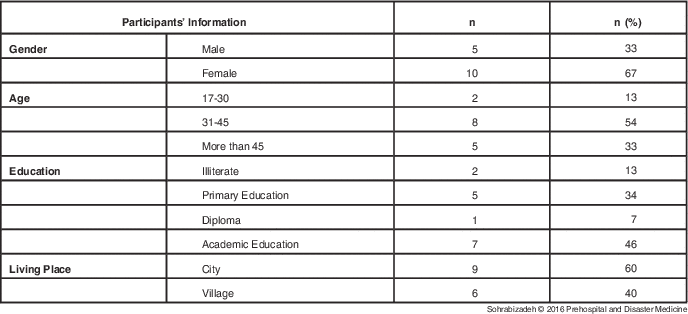
Affected women who represented the experiences on the recent natural disasters, and key informants, were approached for interviews. The number of participants was determined according to saturation principals: that is, until the quality, integrity, and amount of information were sufficient and new concepts did not emerge from data. Data saturation was reached after 14 interviews; however, one additional interview was carried out to make certain that no new concepts developed. A total of 15 participants, including eight affected women as well as seven key informants, were interviewed. A purposive sampling method was used to collect information from participants. Having experience of at least one disaster and tendency to participate in the study were the general inclusion criteria. In addition to the injury and death of family at the time of the quakes and floods, all women experienced damages such as house destruction. The key informants included the specialists and scholars of disaster management who had experience in the disaster areas as health care providers. The participants were between 17 to 55 years old with educational level from illiteracy to academic education (Table 1).
Participants’ Information based on Gender, Age, Education, and Living Place

Data Collection
Data collection took place from January through November 2014. Data were gathered through face to face and unstructured, in-depth interviews which were carried out in the affected regions (East Azerbaijan, Bushehr, and Mazandaran) and key informants’ offices. Each interview lasted between 50 and 100 minutes. The researcher asked any participant: “Explain about your violence experience or story after the quakes or floods.” During interviews, the participants were invited to talk freely about their experiences. Probing was done to motivate the respondents to explain their experiences and feelings in detail. All interviews were performed, audio recorded, and transcribed verbatim in Farsi and confirmed by the participants. Each interview was analyzed immediately and the retrieved information became a guide for further data gathering. Field observation was a complementary method of data gathering conducted by the researcher.
Data Analysis
A qualitative content analysis using Graneheim approachReference Jafari 20 was applied for data analysis. As recommended by Strauss and Corbin,Reference Graneheim and Lundman 21 data gathering and data analysis were carried out simultaneously and iteratively. Several steps were undertaken for data analysis. First, the interviews were combined into one text and read several times to obtain a sense of the whole. Second, sentences of importance were identified and highlighted in the form of meaning units. Third, the meaning units were condensed into shorter units preserving the core content. Fourth, the condensed meaning units were abstracted and labeled with a code. Finally, the various codes were compared to identify differences and similarities and sorted into five categories and two themes. The process was recursive in nature, with the author moving back and forth between the stages of data familiarization and concept development. Word-processing program, Microsoft Word 2007 (Microsoft Corporation; Redmond, Washington USA), was applied to type transcribed interviews. Quotes and example stories were chosen to highlight common opinions and experiences.
Trustworthiness
To ensure trustworthiness of the data, a number of strategies were applied, including credibility, dependency, confirmability, and transferability. Credibility was reached by triangulation strategy such as data, fields, and sampling triangulations. Member and peer check were used for achieving credibility and dependency criteria. In member check, the participants were asked about possible misunderstandings during the interview. Regarding peer check, the data analysis process was monitored independently by one researcher who was not involved in the research process. The resulted codes were compared with the codes which had been extracted by the researcher and revised for identifying the final concepts. Confirmability and transferability of data were provided by personal interest of researcher and offering a detailed documentation of the research process.
Ethical Consideration
This study was approved by the ethics committee of Iran University of Medical Sciences (Tehran, Iran). The ethics committee board confirmed the consent form applied during data gathering. Accordingly, all participants were informed about confidentially of their names and other private information in the related reports and transcripts. In addition, the participants were provided the possibility of leaving their own interview session.
Results
Two main themes were extracted from data, including domestic violence and violence within community. The first theme included three categories: physical, psychological, and sexual violence. Psychological violence and sexual harassment were two categories of violence within community concept. The themes and categories have been explained as below.
Domestic Violence
Affected women faced different kinds of domestic violence after disasters. However, women’s stories implied that this type of violence existed in pre-disasters. The manifestations of the domestic violence included physical, psychological, and sexual violence in the aftermaths of disasters.
Physical Violence
Based on the participants’ experiences, women encountered some aggressive behaviors and physical abuses perpetrated by their husbands, sons, fathers, and other male members of the family. After disasters, affected women suffered from the men’s violated physical actions which negatively influenced women’s coping capacity. In the case of disasters, VAW are considered as men’s reactions to the mental distress which resulted from disadvantaged consequences of catastrophes. One participant said that:
“Based on my experiences in the Bam earthquake, the physical violence against women was increased in the way that brought them hurtful situation. Stressful status of affected men in the aftermaths of the quake played an important role to make/increase such VAW.” (P10)
Psychological Violence
Different aspects of psychological violence took place after disasters. For instance, some men threatened their partners to leave home or divorce in the aftermaths of disasters. Controlling and insulting women, as well as harsh behaviors against women and girls, were reported as other forms of psychological violence in the affected families. Denying the women’s rights to freedom and independency was augmented in the studied regions. Verbal violence was the common issue reported by some damaged women.
Early or forced marriages of the affected girls were aggravated after disasters. According to the participants’ perceptions and experiences, poverty was determined as the most important reason of such forced or early marriages. For instance, in the aftermaths of the quakes, despite the tendency of some young girls to continue their educations and attend in high schools, they were forced to get married by their fathers, brothers, and uncles. In the following paragraph, a young girl described her situation after the earthquake:
“I like going to a high school to get my diploma, and, continue my academic education in a college. Unfortunately, my parents could not afford my school costs after the earthquake, and I have to get married or stay at home.” (P7)
On the other hand, some women believed that early marriage is just a convention which should be obeyed by girls. Based on their perception, young girls should get married in the early age, younger than 18. A young girl said that:
“Is there any problem with early marriage, more especially after the earthquake? All young girls must get married in the range of 14 to 18 years old, then, have a baby!” (P1)
A number of widows stated that they had been humiliated by their sons or daughters after disasters. Destruction of the properties and joblessness after father’s death put all family members in more poverty and misery. However, mothers were considered as the weak and ineffective actors who could not manage their homes in the absence of fathers or male-headed households. A widow repeated her son’s sentences with an upset and worry face:
“Sometime, my adult son told me why you are alive? I wish you had died in the flood instead of my father. Now, I need money to keep my married life and you cannot help me as much as my father.” (P3)
Sexual Violence
Affected men selected the sexual relationships as one way to overcome the mental distress of disasters. Consequently, in spite of women’s unwillingness, married women were increasingly forced by their husbands to have sexual contact. On the other hand, grieved women who lost their children or other family members during natural disasters did not intend to have such sexual relations. Decrease of the intimate partner sexual activity made some men nervous and led them to the sexual violence against their spouses. A key informant explained his related experience after Bam earthquake:
“After the Bam earthquake, affected women did not pay attention to the sexual needs of their spouses. Men complained to me of their wives’ behaviors and asked me to talk to them. Increased sexual violence in the affected families was the consequence of such ignorance.” (P14)
Violence within Community
Increase of VAW in the affected communities was reflected through two types of violence, including psychological violence and sexual harassment.
Psychological Violence
Based on the data, circulating rumors and slanders against widows were reported as the current psychological violence inside the community. This kind of verbal VAW worsened their distresses and tensions after disasters. For instance, some widows who had lost their husbands in disasters declared that their husbands’ relatives passed around harsh words against them. A widow explained her status as the following:
“My father-in-law slandered against me after my husband’s death in the earthquake. He circulated the slander of my remarriage around the community. He tried to damage my reputation in the community, while he had not shown such behaviors before my husband’s death.” (P8)
Based on the participants’ experiences, women who provided health or social services for damaged people were insulted and bothered in the affected regions. This kind of violence against female health providers was done by both affected men and other male relief workers in the damaged areas.
Sexual Harassment
The experience of sexual harassment, such as rape, was too culturally shameful to be discussed by the affected women and girls. This category was extracted based on the key informants’ experiences in disasters. Actually, no rapes were reported in the studied regions and local people emphasized that there have not been any sexual harassments. In other words, they severely denied such sexual VAW in their community. In their opinion, since everyone knows each other in this area, any sexual harassment against women is not possible. A participant reacted to this issue as below:
“No, we never have such harassments in this region. All inhabitants know each other so that sexual violence against women is not possible before and after disasters.” (P6)
Although no rapes were reported in the affected regions, there had been a few reports of rapes after the Bam earthquake. However, other manifestations of sexual harassments against women, such as sexual insult or touching, had been experienced by female health care providers after the recent disasters. One participant described her experiences after the Bam earthquake as below:
“In our country, although we had no reports of rapes after disasters, this sexual violence happened. In the spite of no reports of rapes in the damaged regions, other types of sexual harassments against affected women were increased even among female health relief providers.” (P15)
Discussion
The present study is the first empirical research exploring the different forms of VAW in recent natural disasters in Iran.
Regarding domestic violence, literature shows that in the context of Iran, domestic VAW usually exists in pre-disaster phases. 9 - Reference Bayati, Shamsi and Mohammadbeygi 11 A number of beliefs and perceptions of women may contribute to increase violence victims in disasters. For instance, early marriage was not considered as violence by the affected women. A number of women became accustomed to experiencing violated behaviors within family and community. They suffered from the lack of knowledge and information regarding their right to have a life without violence. Consequently, based on the United Nations definition of violence, 2 VAW is a part of common and daily events of women’s lives in Iran. It seems that major time and energy are required to break the cultural taboo of disseminating VAW reports and confirming the violence as a common issue instead of a shameful matter.
Between one-third and one-half of all individuals exposed to natural disasters develop different types of mental disorders, such as distress, posttraumatic stress disorder, depression, and anxiety.Reference Strauss and Corbin 22 If violence can be considered as one consequence of mental disorders, it will be aggravated after disasters.Reference Fatemi 13 Female populations, including health and social services providers, are primary victims of violence in post-disaster periods. Consequently, affected women and girls face behaviors such as beating, controlling, insulting, forced or early marriage, and sexual violence. It seems that more attention should be paid to the male roles in either perpetrating or decreasing VAW. The importance of the male role in decreasing VAW in Iran results from being a male dominant country in which men benefit from the advantages of accessibility to various resources of community, management, or policy-making opportunities in comparison to women. Thus, men play an important role in order to make vital decisions, allocate resources, and prevent VAW at different levels. 16 Community-based interventions such as training or keeping men informed about the harmful effects of VAW on family and the whole community may change their actions of VAW and girls. Also, community-based projects of VAW prevention can be carried out using the high capacity of the primary health care networks in Iran. In this network, reproductive health services are actively provided for all women and girls who live in various villages and cities.
Based on the study results, psychological violence and sexual harassment against women were reported within the communities. Psychological violence against widows has been declared in the similar studies. 23 , Reference Liang 24 It seems that psychological violence, more especially verbal violence, results from the cultural context in which people have lived. The cultural and societal participation of men, as the main VAW perpetrators, may motivate them to stop violent actions against women, which can lead to a secure and safe community without gender-based violence.
While some forms of sexual harassment, such as touching or sexual insulting, were extracted from the research data, there have not been published reports of rapes in the last natural disasters in Iran. A number of gender and disaster authors confirmed the increase of sexual VAW, more especially rape, in other investigations. 3 , 4 , 7 , 8 It seems that the religious beliefs of the affected people may prevent them from rape. In addition, the families living in the destructed regions know each other completely so that strangers are identified rapidly. On the other hand, no reports of rape cannot confirm that no rapes have taken place in the affected regions. Public beliefs hold that being a victim of rape is a very shameful matter; so, it is preferred by victims to remain silent and not to report such a personal experience.
Violence against women can be considered as a context-based public health emergency. In response to the increase of VAW after disasters, health centers need to be prepared to respond effectively to any VAW, including female service providers. Disasters can provide women with the opportunity of enhancing their capacities to cope with any long-term violence. Hence, VAW should be given high priority by disaster medicine scholars, practitioners, and managers in pre- and post-disaster periods. Further research is needed to explore the barriers of clarifying and reducing VAW issues in disastrous situations.
Limitations
The researcher faced several limitations during the research process. The sensitivity of the research subject was the main limitation of the study. There is a cultural taboo within the Iranian community on openly discussing sexual matters. In fact, talking about this issue is neither suitable nor desirable within the study population. To overcome this limitation, a friendly space and mutual trust were created by the researcher during the interview. There was a language barrier in the affected regions of East Azerbaijan in which Azeri is a native language. To control this limitation, two native colleagues helped the researcher with translating Azeri words into Farsi. As with any qualitative study, the results of this study may not be applicable to other populations that do not share the characteristics of the study population.
Conclusion
Different types of VAW emerged from the present research can be integrated into upcoming disaster medicine plans, public health reforms, and national rules in Iran. Improving women’s knowledge on their rights to have a life with no violence, and participation of both women and men in violence reduction projects, should be considered in all disaster management phases. Furthermore, establishing a violence surveillance system for monitoring, assessing, and reporting violated actions against women and girls at family and community levels is recommended. Finally, providing a secure and safe environment for female health relief providers in disaster affected areas is highly advised.
Acknowledgment
The author gratefully acknowledges the participation of the affected women in the fields of study as well as the collaboration of knowledgeable experts who shared their experiences with the researcher.