To begin with, I would like to express my gratitude to Susan, Reinhard, Lena, Anna and Stefan for inviting me to participate in their workshop around the puzzling theme of Beiläufigkeit in archaeology. Having worked lately with assemblages of objects that, though very much in the spotlight of media, have hitherto fallen into the blind spot of archaeology, I immediately found it inviting to think in terms of Beiläufigkeit, the incidental and the by-passed. And, to no surprise—also given the concept's reluctance to give in fully to either translation or definition—the seminar and discussions in Berlin in April 2018 turned out extremely stimulating, leaving many glitches for further speculation.
The various frictions embedded in the notion of Beiläufigkeit and the paradoxes involved in any attempt to get at it are elegantly captured in the introduction to this discussion. Rather than attempting to frame the concept in any strict way and reduce its ambiguity, the authors have left the tensions hanging, offering a wealth of trajectories—and, indeed, impossibilities—for us to pursue. In the following I will respond to some of their reflections, and by funnelling them through my own work on things adrift I will explore some of the potentials and benefits of thinking in terms of the Beiläufige—especially as pertaining to an archaeology in and of the Anthropocene.
Opening: on grasping a ‘plastic bag’
After its production, they say, an ordinary plastic bag is on average used for five minutes. It may hold our groceries from market to home, and our garbage from home to depository and landfill. Or it may be used to store other things, wanted and unwanted, in hand, closet, attic, back seat. The lifetime of a plastic bag, however, may be far lengthier than ours and may involve many homes, hands, back seats, roadsides, ditches, branches, oceans and beaches.
Drift
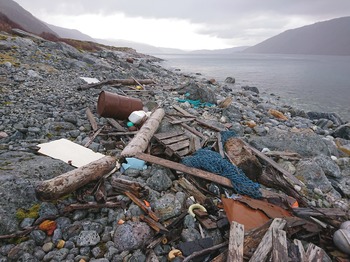
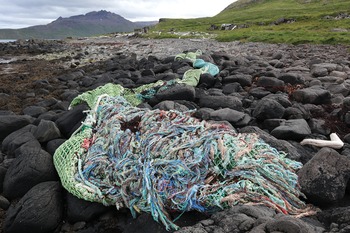
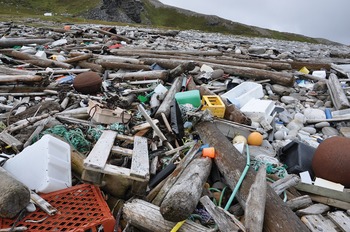
Despite the human-centred naming and despite human actions being at the core of its mounting challenges, the Anthropocene is made manifest not least through material agency and more-than-human relations. Stuff, things, remains, that persist and wander, though forsaken and forgotten. This stubborn legacy takes many forms, one of which is drift matter; seaborne debris drifting with waters and accumulating along coastlines worldwide, there among coves and inlets of sparsely populated regions in northernmost Norway and Iceland (Figs. 1–3). Here, scatters, waves and ridges of things and debris relentlessly build up and dissolve with tides and storms, forming a fleeting, coincidental montage of patterns and contacts. Individual things are driven about, inundated and revealed again, worn by sand and crushed by pebbles. With every tide they turn more sun-bleached and brittle, but remain persistent. Drifting in from places far and near, they may appear to have little to do with each other, and even less so with the ideally pristine shores they have found. And yet they blend and merge so meticulously, forming odd constellations, familiar and unfamiliar at the same time. Seaweed with light bulbs, driftwood with toothbrushes, fish boxes, pebbles, buoys, dead birds and toy cars. Plastic objects with whalebone, polished glass, nylon threads, shell sand, crab claws, car tyres and Christmas trees. And tying it all together is a mass of wreckage: pebbles, sand, dust and fragments of various material, size and colour, but unrecognizable as anything particular.
Drift matter, Ringvassøya, Norway. (Photograph: Þóra Pétursdóttir.)

Drifter, Ingólfsfjörður, Iceland. (Photograph: Þóra Pétursdóttir.)

Montage of drift matter, Sværholthalvøya, Norway. (Photograph: Þóra Pétursdóttir.)

This dense and heavy seam of debris, fleeting, dynamic and constantly becoming, is ominous and vile to most. An unwanted and unnatural intruder in a natural environ. It may appear slightly sardonic, thus, that Rachel Carson's poetic words from her ocean-trilogy give no less meaning on those littered beaches of the present: ‘On all these shores there are echoes of past and future; of the flow of time, obliterating yet containing all that has gone before; … of the stream of life, flowing as inexorably as any ocean current, from past to unknown future’ (Carson Reference Carson[1955] 2015, 225). Rather than future prospect, however, the initial connotation emerging from encounter with drift matter is probably one of utter loss. Loss of path and origin, loss of form, function, meaning and control. Indeed, as hinted at in dictionary definitions, drift refers not merely to movement, but to an object's or subject's deviation from a proposed and anticipated course: a drive or development from one stage to another that is seen rather as unwanted.
Drift matter, in other words, comes across as matter out of place and out of context, and may thus appear to contrast with any sense of Beiläufigkeit. It catches our attention and drives us to action. Nevertheless, the very fleeting presence of drifting things may also be said partly to pass our attention or withdraw from our grasp. Rather than a significant form of thing-being and thus something to be accounted for, it is seen as a mistake. As conventionally (also archaeologically) viewed and dealt with, the only sensible approach to this material, therefore, seems to be curative; an approach that cleans up and makes sense, and which reverses the mess, re-orders and returns things to meaningful origins, functions, and leaking sources. While legitimate and reasonable, however, this retrospective and culture-historical perception is bound to overlook what this material has become (Pétursdóttir Reference Pétursdóttir2017). It sees things merely as what they used to be, where they once belonged, and associated only with whom they used to serve. In other words, though in many cases making up most of these things’ biographies, their drift and post-human presence on the beach—their literal Beiläufigkeit—is here by-passed, reduced to a non-being, unnatural and meaningless.
Working with these intimidating assemblages of drift, I have been driven to contemplate whether there are other ways of nearing and knowing this material—also archaeologically. Given that things like these and their trajectories beyond an apparently meaningful and functional human/cultural sphere are what most evidently signify the current environmental crisis, it appears imperative that our notions of such things and prospects for their being must be reconsidered. That is, taking these constellations seriously for what they are (rather than were) seems to require attentiveness and tolerance for ‘incidentalness’, ambiguity and the unknown; for how things drive astray, resist definition and become other. And what, then, does this imply for an archaeology of the Anthropocene?
Archaeology and the by-passed?
Beiläufigkeit; the incidental, marginal, meaningless, by-passed. Why should archaeology be concerned with such seeming trivialities? In what way could that serve its aim to recover and construct meaningful narratives about the past? And how can such trifles be of importance for archaeology's socio-political role in the present? As pointed out in the introduction to this discussion, the archaeological project may in fact be read as ideally opposed to Beiläufigkeit; its relentless search for meaning in the most incidental shard and fragment renders archaeology incapable of relinquishing things to humbler and even insignificant past contexts and roles, where they may have been ‘just the casual object next door’. This quest, the authors note, has become even more conspicuous with the ontological turn and leanings towards New Materialisms, where on the one hand, the equal significance of all things is emphasized, and on the other, their incidentalness and possibility of remaining by-passed is rarely discussed (for archaeological/anthropological examples see, however, e.g. Demant Fredriksen Reference Demant Fredriksen2018; Olsen Reference Olsen2011; Reference Olsen and González-Ruibal2013; Pétursdóttir Reference Pétursdóttir2012; Sørensen Reference Sørensen2016). Or, the authors ask, ‘are there not situations in which they are incidental or insignificant?’
Surely there are, and as the authors suggest I think Beiläufigkeit may indeed offer one means to explore those situations—even despite the seeming impossibility of that project; that is, that turning towards the incidental will inevitably terminate its existence as such. Indeed, in response to this first paradox the authors propose two ways of pursuing Beiläufigkeit as a matter of academic query. One is to deal with incidentalness as a matter of (personal) memory rather than something that is incessantly taking form and shaping up, which, they argue, may however be insufficient for an ‘anthropologically and politically engaged archaeology’. The other is to study those objects that historically have been rendered incidental: ‘things that hide, that do not disrupt but still keep their agency’. Or in other terms, lending concern and voice to those that have been deprived of such. It is easy to see the connotations of this endeavour to notions such as the subaltern (Spivak Reference Spivak, Guha and Spivak1988) and thus the political significance of pursuing them. Nevertheless, what I find no less interesting, and especially in the context of an archaeology of the Anthropocene, is the initial (and here partly by-passed) paradoxical metaphysics of Beiläufigkeit, which seems to render it—if not a matter of the eye of the beholder or personal interest—an utterly anthropocentric phenomenon. That is, the notion that the possibility of terminating it is always in our capacity. But is it really so?
What I think is worthy of consideration here is whether Beiläufigkeit can at all be written into traditional culture-historical narration, characteristic also of most archaeology. Or, whether other and less anthropocentric perspectives would be needed in order to get beyond a simple ‘add-and-stir’ approach to things previously forgotten, hidden and by-passed (cf. Nandy Reference Nandy1995)? One of the many frictions ingrained in the concept of Bei-läufig-keit may be informative here; the matter of movement—or drift—and the relation between the ‘by-passed’ and the ‘passer-by’. It is possible that Beiläufigkeit is in essence an anthropocentric concept, denoting that which does not catch our eye and merely constitutes the background of our movement; things that neatly fall into place (cf. Douglas Reference Douglas1984) and thereby do not disturb our attention. In that understanding, however, the by-passed is rendered more or less static and subject to our passing by, and Beiläufigkeit, moreover, an utterly momentary phenomenon; something that is true only in (our) passing. In this understanding, things may truly become what Heidegger (Reference Heidegger1977) termed ‘standing reserves’, where their being beyond our framing, naming and use is a non-being; a waiting, at best. It is only when we halt and direct our focus and cultural deciphering to them—and in turn enlighten and de-incidentalize them—that they gain meaning and weight.
However, as hinted at in the introduction, there is also the possibility that objects evade our attentiveness, that they retreat and withdraw from our grasp (Harman Reference Harman2016; Heidegger [Reference Heidegger1927] 1962), and thus always retain the ability to remain partly beiläufig and out-of-hand (Pétursdóttir Reference Pétursdóttir, Olsen and Pétursdóttir2014). Even when turned towards. This is the case with drift matter, and with so many matters of concern in the Anthropocene. Importantly, therefore, the matter of concern here is not that things are rendered incidental through our passing, but that they are themselves moving on in ways that more or less override our agendas, categories and ideas. We are (no less) the ones by-passed, forgotten and forsaken. The question, thus, is how archaeology is able to deal with those things as matters of concern—and as the drifters they have become—without thinking beyond its tradition of retrospective culture-historical reasoning?
In passing
‘One of our finest methods of organized forgetting’, Ursula K. Le Guin writes, ‘is called discovery’ (Le Guin Reference Le Guin and Le Guin1989, 83), and it is a fine paradox to recall, not least as an archaeologist. It is true that the archaeological project by tradition has no room for the Beiläufig as such. In fact, nothing is here to be by-passed; spectacular or tedious, recognizable or not, all lumps of something should be collected, registered, bagged and boxed. This notwithstanding, the main concern does not lie with stray fragments and shards, but with the completeness of the past we seek to reconstruct (e.g. Olivier Reference Olivier and Greenspan2011, 31–2). That is, first and foremost, (archaeological) knowledge production is about rendering a fragmented past familiar and logical through the domestication and accommodation of something unruly and indeterminate. The process is enlightening, not obscuring or darkening. Ironically thus, the fate of many such inconspicuous discoveries is eventually to ‘disappear’ (again) into that seamless whole; they are included but effectively excluded at the same time.
Surely, many of the strange things ‘discovered’ on the beach appear familiar, some of them to the degree that one can tell them by name and brands: ‘light bulbs’ and ‘toothbrushes’, ‘footballs’ and ‘fish boxes’, ‘sandals’ and ‘shoes’, ‘toys’ and ‘tin cans’. Some of them reveal their origin also through signs and markings and many of them could be traced back to places of production, previous functions, human relations, and possibly even sources of deposition. Nevertheless, even though familiar and heimlich—indeed, because of their familiarity – when so far removed from their assumed ménage, these well-known things simultaneously appear utterly unheimlich and unknown (cf. Freud Reference Freud[1919] 1964). Thus knowing them, it seems, is not really grasped by either discovery or the semantics of naming ’light bulbs’ and ‘toothbrushes’. They have long outlived those past baptisms, aged, travelled and gathered in ways not foreseen by such labels.
The encounter with these things is strange, therefore, not least because of how their familiarity does not recall a known and familiar past, but rather an utterly unexpected and unfamiliar future. Blasted out of their projected history (cf. Benjamin Reference Benjamin2002, 261) and any category and function prescribed for them, they appear to reside in a future not foreseen. They are neither from here nor representing a familiar elsewhere and trying to make them known by means of discovery, recognition, origin, and causality is in fact not close to grasping them at all and simultaneously ignoring what they have become: drifters.
Drift and drifting are concepts and phenomena often charged with negative connotations. Etymologically, drift refers to snow or other substances blowing about and gathering in waves and swells: a haze or obscuring mist that may lead to loss of direction and sense of place. As a process and performance, drifting also implies a passive and listless movement, an aimless wandering and driving astray. The drifter, like the vagabond, is unpredictable and vague—a stranger of indefinite terrain: an always partly unknown figure that is difficult to either locate or relate to place, origin and destination. Like the wave and swell, the drifter is boundless. She cannot be bordered or grasped in any definite way without divorcing her from what she is. Drift and drifting, therefore, are difficult to manage, which makes ithemt appear deviant, arbitrary and distrustful. A reckless and inherently suspicious behaviour, on the brink of the immoral, in a world that every subject and every thing should ideally inhabit in a predictable and calculable manner (cf. Carney & Miller Reference Carney, Miller, Jansson and Lagerkvist2009; Cresswell Reference Cresswell, Cresswell and Merriman2011): a non-being.
However, although so often freighted with negative inferences, it is possible also to see drift and drifting as potential and resource. Like waves and swells, drifting is boundless: something that always spills over and into. Rather than lacking character and purpose, the drifter is an excess: always conspicuously more than what can be said or thought of her/him at any given moment and location. Drifting, thus, is always rather prospective than retrospective. Like the flâneur (Benjamin Reference Benjamin1999; Tester Reference Tester1994), the drifter is defined not by reference to identifiable origins and retraceable courses, but by an indisputable presence, indefinite destination and perpetual drive: that is, in-passing.
Keeping this in mind, one may ask to what extent the otherness of drift matter is something awaiting our discovery, explanation and identification? Or, whether it is actually something that will always resist our focus and grasping? And moreover, whether it is something that needs to be acknowledged and retained in order to render the material knowable? Not merely as an epistemic drive that triggers curiosity, but as the very means of knowing something significant about something imminently elusive (cf. Sørensen Reference Sørensen2016), incidental and beiläufig.
Resonating with an interdisciplinary material turn and responding to increasingly heated global challenges (such as those posed by drift matter and polluted oceans), post-human concerns, things’ agency, autonomy and afterlives—or, possibly, their Beiläufigkeit—have lately been prominent topics within the humanities and social sciences. There is a call for an understanding of things that variously sees them as actants (Latour Reference Latour2005), as withdrawn (Harman Reference Harman2016) and alien (Bogost Reference Bogost2012), or as hyper-objects (Morton Reference Morton2013); that is, as beings that exceed any human-centred measure. But what does it really imply to acknowledge the agency and ‘afterlife’ of resilient things? Things that outlive their human creators and companions, drift and spill over. How are such things rendered intelligible, beyond reduction?
We are used to seek the meaning of things mostly in their defined functions and human associations. As explained by Walter Benjamin, with reference to Marx, ‘in the modern world an object is of value only when it exists as capital for us, or when we use it. Our physical and intellectual senses have been replaced by a simple alienation of all these senses, “the sense of having”’ (Benjamin Reference Benjamin1999, 209). However, considering the durability of drift matter on the beach, of plastic bags and bottles that have travelled long distances and been to places we have never heard of, the truth is often that we only incidentally cross paths with them. Like events in their lives, we happen to them rather than the other way round.
What becomes enlightened on the drift-beach, thus, is the buoyancy ingrained in things and the need to see them rather as prospects than givens, as always more than what we are able to momentarily gather. As sleeping giants (Harman Reference Harman2016), monsters (Law Reference Law1991; Latour Reference Latour2012) or drifters, which otherness and agency—or we can call it becoming—needs to be considered, accounted and cared for. And moreover, that knowing things like drift matter must essentially imply acknowledging their being out-of-hand and reluctance to comply with culture-historical reasoning.
Things like plastic bags, things in drift, are directed ahead of themselves. They have already outlived us, so to speak. Thus, if Beiläufigkeit occurs in passing, in the becoming, then these things urge the need also to consider the dialectics (i.e. non-anthropocentric notion) of that fleeting encounter, bringing to the fore the tension between the passer-by and the by-passed, between human and non-human, meaningful and meaningless, mortal and immortal.