I INTRODUCTION
By the middle of the fifth century, overseeing the meetings of worshippers in sacred spaces was of primary importance to the bishops of Rome who were increasingly intent on making visible their authority over an ideally unified and Christian city. Their attempts can be considered part of what Maureen Miller has described for medieval Italian bishops as ‘strategies of visuality’; most often in the medieval period this entailed building churches or episcopal palaces to publicly assert the power of the bishop and his church.Footnote 2 But major Christian services of worship provided another potent ‘strategy of visuality’ to assert the bishop's authority. Indeed, whenever the bishop, with — as his retinue — the priests, deacons, and readers of his diocese, came to celebrate the eucharist in a shrine, church or public place, this service was considered the key place and time of urban worship, the stational service.Footnote 3
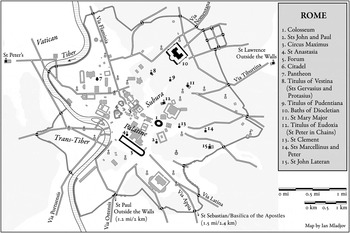
By the time of Leo's papacy (a.d. 440–461), Rome was dotted with a number of churches in which the bishop could lead worship services. There were some twenty-five or twenty-nine tituli — churches in local neighbourhoods which owed their construction and endowments generally to aristocratic lay élites who, over the course of the late fourth and early fifth centuries, had converted to Christianity — in addition to the large basilicas that were founded by emperors and bishops, such as St Peter's, St John Lateran, St Mary Major, and St Lawrence Outside the Walls (Fig 1).Footnote 4 Indeed, we know so much about the building activities of the pontiffs because they were celebrated, most notably in the Liber Pontificalis, a sixth-century compilation of the biographies of the bishops of Rome. Footnote 5 The growing number of churches in Rome meant that the bishop would have to scurry to celebrate stational services across the city, even as the size of Rome's Christian population meant it was all the more important to bridge the distance between bishop and local community; the early fifth-century bishop Innocent sought to address this gap by sending portions of the bishop's consecrated bread, the fermentum, to titular priests in their churches in the city for their use in the Sunday mass.Footnote 6 This liturgy signified the unity of celebration so that, as Innocent said in a letter of a.d. 417, the titular churches would not feel themselves separate from the bishop's communion; to make this point visible, the consecrated host was carried in a sack (sacculus) to the churches, a symbol of the local parish's tie to the bishop of Rome whose authority extended to all the churches within the city walls.Footnote 7
Map showing location of churches mentioned in discussion of liturgical topography.

More potent than the fermentum for visually signalling the unity of Christian communities in Rome was the presence of the bishop himself. Though bishops are known to have gone to different places for stations of worship in Rome since the late second century, a fully developed system of stational services that included the congregating of worshippers and their processing with the bishop to designated places did not emerge in Rome until the late sixth century.Footnote 8 In his still authoritative study comparing urban stational liturgies, Baldovin accepted as the origin of the organization of stational worship in Rome the evidence of the Life of Hilary (a.d. 461–468) from the Liber Pontificalis, which ascribes to this pope the arrangements for ‘services to circulate around the established stationes’.Footnote 9 However, the Liber Pontificalis is an unreliable source, especially for periods earlier than the sixth century; produced in two different recensions, the Liber projects a sixth-century view of the episcopacy onto the past to establish the autonomy of Rome's bishops.Footnote 10 So, rather than assuming the Liber's view of Hilary's seminal rôle, I argue that the system of stational liturgy was the result of a longer process which was shaped, to a large degree, by earlier fifth-century popes, especially Leo. And far more reliable than the Liber Pontificalis, I shall propose, and more influential for the developing stational liturgy are the Sermons of Pope Leo (a.d. 440–461), Hilary's predecessor. Leo's Sermons, collected and published in his lifetime in two different recensions, provide unique but under-appreciated evidence not only for the systematization of stational liturgy in Rome, but more importantly, for the rôle of Leo's liturgy in shaping Rome's identity as a Christian city.Footnote 11 A consideration of Leo's Sermons for their liturgical topography will lead me to put forward three major theses about the fifth-century papal liturgy that are important for gaining a more balanced understanding of Rome's gradual development into a Christian capital.Footnote 12
First, Leo's mid-fifth-century sermons reveal a bishop offering regular services of worship in churches on designated days throughout the year. Though bishops in Italy had preached on the feast or season rather than directly on scripture from the time of Ambrose, Leo's sermons offer, as Bernard Green observed, a ‘coherent, effectively systematic Christology and ecclesiology, pulling the cycle of fasts and feasts together in a way none of his predecessors or contemporaries had done’.Footnote 13 What Green did not address is the topography of Leo's sermons which, I demonstrate, provides the best and earliest evidence for the bishop of Rome preaching and conducting worship services by going to a known annual cycle of set places in the city on set days — the very definition of a system of stational liturgy.Footnote 14 Leo's liturgical topography, as evidenced by his sermons, reflects his efforts to set in place an annual cycle of places for Christian public worship that would set for the city a sequence of places and times as part of his effort in developing what some scholars have called Leo's civic Christianity.Footnote 15
Second, Leo's preaching centred the Christian year in Rome on St Peter's in new ways. The centrality of Peter to Leo's conceptualization of the bishop's rôle and his theology has often been discussed and is succinctly articulated by Green: ‘Everything he [Leo] said and did was animated by his conviction that he was the heir of the apostle Peter, his representative, and as such responsible for the whole city of which Peter was the true second founder.’Footnote 16 But Leo's shaping of the liturgy to focus on St Peter's basilica in the Vatican as the centre of Christian Rome has not been so remarked in the scholarship. Yet in Leo's sermons — edited and circulated in his lifetime — we see Leo congregating the faithful at St Peter's in the Vatican on a regular basis and at new times of the year, in a period when most Christians were not yet expected to attend church every Sunday and when there was not yet a set church or place that the bishop would return to every year for his sermons on the feasts of the martyrs of Rome.Footnote 17 Indeed, through the fourth and into the early fifth century St Peter's was used only infrequently for liturgical purposes, at Christmas or for the Feast of Sts Peter and Paul, but was most often a site for private commemorations of the dead.Footnote 18 Leo's sermons highlight Peter's Vatican church as the papal liturgical centre of Christian Rome. Hence Leo's efforts at controlling and centralizing ritual at St Peter's aimed to make the Vatican sanctuary — not St John Lateran as some have proposed — ‘the religious center … and the symbol of the papacy’ in the middle of the fifth century.Footnote 19
Third, Leo's liturgy should be seen as part of his contestation for space — physically and symbolically — in Rome. Indeed, Leo was a bishop very much embedded in secular as well as religious networks in the city. I shall focus here on how Leo's liturgical topography allowed him to assert papal authority over two important groups in the city of Rome, the resident senatorial aristocracy and the local titular priests who, as a result in part of élite patronage, enjoyed a semi-autonomous existence. As I shall show, Leo's focus on the Collects in November and development of the rôle of the deacons, along with his preaching on fasting and almsgiving, would ideally change the patterns of worship in Rome's Christian communities, and would affect especially the city's resident Christian aristocracy and titular clergy. Moreover, Leo encouraged Christians to forego games on civic holidays and to participate instead in communal public worship, most often at St Peter's in the Vatican. Since the fourth century, this site had been a locus for conspicuous aristocratic munificence — private burial monuments, funerary banquets, and charity; descriptions of drunken feasts ‘far from the bishop's conversation’ suggest that the rites in St Peter's were hard to bring under episcopal control, especially since Rome's aristocrats spent lavishly there into the fifth century, as the inscriptions of the wealthy Rufius Viventius Gallus and Marinianus underscore.Footnote 20 By centralizing papal liturgy, including public vigils and fasts, at St Peter's, Leo was contesting for control over this space with Rome's aristocracy by visibly asserting his control over its ritual uses. Leo's liturgical topography with his focus on the Petrine cult thus offered the bishop another means to demonstrate his authority not only over Christian aristocrats and the titular clergy they patronized, but over other clerical factions and Christian confessional groups in the city as well.
The return of the emperor Valentinian III (a.d. 425–455) to the city for extended periods of time gave Leo access to imperial influence that he used to advance his own authority in the face of Rome's now revived senatorial aristocracy.Footnote 21 Indeed, after a.d. 410, the senatorial aristocracy had returned in force to a position of leadership in the city, and the senate, comprised of the state's highest office holders (illustres), held political influence through its advisory rôle to the emperor.Footnote 22 Valentinian III's return to Rome also brought increased imperial support for the papacy, expressed in financial as well as political terms.Footnote 23 So, for example, in response to representation from the bishop of Rome, Valentinian III issued a strong edict against the Manichees and supported Leo's condemnation of Hilary in Gaul.Footnote 24 Tellingly, when Valentinian III relocated the imperial household to Rome in February 450, he timed his entry to coincide with a vigil and an important feast of St Peter, probably the cathedra Petri, the holiday commemorating at the Vatican the establishment of St Peter's episcopacy in Rome.Footnote 25 Valentinian was restating an imperial presence at St Peter's in co-operation with the bishop. It is against this background, of a supportive but relatively weak emperor and of a revived senatorial aristocracy, that we can better appreciate the contemporary significance of Leo's liturgical topography as a means of contesting for influence with Rome's resident aristocracy and the titular priests whom they patronized. This fifth-century dynamic is important for understanding subsequent sixth-century conflicts such as the Laurentian schism, but it has not been well considered due in part to the nature of our sources for the fifth-century city.Footnote 26
In Section II of this paper I analyse the Sermons of Leo for what they tell us about Leo's innovative liturgy and his focus on St Peter's. I then turn to briefly consider the other major churches attested as part of the mid-fifth-century papal liturgy. In Section III, I discuss how Leo's liturgical topography was also a means to contest for space — physical and symbolic — in Rome. I focus in particular on Leo's efforts at influencing Rome's resident Christian aristocracy and the local titular priests under their patronage. By way of conclusion (IV), I briefly contrast Leo's stational liturgy with its future development, as manifested by the Sunday and Festal Sermons of Leo's successor, Gregory the Great (a.d. 590–604); fittingly, more than a century later, Gregory delivered sermons throughout the city and organized a processional liturgy, two developments at a time when the senatorial aristocracy were living in much reduced circumstances. By the time of Gregory, we see how Leo's centralization of liturgy at St Peter's — what I see as a ‘strategy of visuality’ — had successfully contributed to making the Vatican sanctuary the focus of papal, Christian Rome.
II LITURGICAL TOPOGRAPHY AND LEO'S SERMONS
Leo had inherited a liturgical year that had developed over generations. In Rome, the major liturgical seasons revolved around Lent, the Ember Days, Easter, and Christmas.Footnote 27 As noted earlier, the bishop of Rome went to specific sites to celebrate worship services; by the early fifth century, we hear of the papal eucharist on Sundays as well as presumably for other Christian holidays.Footnote 28 So, it was traditional for the bishop to celebrate Christmas mass and likely the Feast of Sts Peter and Paul at St Peter's in the early fifth century, and a few other basilicas are mentioned as being used for stational liturgy prior to Leo, as will be discussed below.Footnote 29 However, we do not have evidence before Leo that the practice of papal liturgy had developed into a system of regularly recurring places nor was it processional, as it would later become.Footnote 30 We cannot even tell if in the fifth century the anniversaries of the saints' days were regularly considered stational, though I doubt that they were; on the anniversaries of the martyr holidays, there were aliturgical prayer meetings, with or without the benefit of the clergy, in great covered cemeteries outside the city, while mass was celebrated by a priest — not necessarily the bishop — at the grave in the nearby catacomb or in the basilica itself.Footnote 31
Leo's Sermons and Papal Liturgy
Antoine Chavasse, the first modern editor of the manuscripts, demonstrated that a collection of fifty-nine of Leo's Sermons covering the first five years of his papacy (a.d. 441–445) was put together for circulation; a second edition with revisions of some eleven sermons along with several new sermons from a.d. 446–461 was prepared for circulation before Leo's death in a.d. 461.Footnote 32 A ninety-eighth sermon, the Preface to the Creed, has also survived in another manuscript tradition.Footnote 33 Charles Pietri attributed the collection to the notaries of the church, working with the pope's authorization.Footnote 34 If so, as Bernard Green has suggested, the careful balance of feast and fast are signs of a well composed and edited collection that bears the mark of Leo himself. Footnote 35 The sermons may well have been intended to serve as models for other bishops for preaching on the festal days, or they may have been circulated for the education of priests and congregants. Their collection thus represents the approved versions of the delivered sermons. If there were other references to places or people in the original sermons, they are lost to us. Nonetheless, the sermons are invaluable guides to what Leo and the ecclesiastical establishment in Rome wished to present as the proper and appropriate ways to worship in the fifth-century city. In what follows, the sermons are taken as prescriptive and ideal versions of what Leo preached on these holidays.
As I noted above, Leo was the first bishop to offer a theological scheme by preaching consistently throughout the year, some fifteen times, putting the cycle of fasts and feasts together in a way that none of his predecessors had done.Footnote 36 Leo's preaching on set feast and fast days throughout the year and on an annual basis was rigorously Christological, offering an understanding of the year's feasts and fasts that promised salvation to all. How unusual a preaching cycle was for the bishop of Rome can be better appreciated if we consider that, according to the Church historian, Sozomen (HE 7.19), a close contemporary, the bishop of Rome hardly preached at all. Leo's predecessor, Celestine (a.d. 422–427) told his Gallic colleagues that there was no need for priests to preach during the worship, though he does note that it was the duty of the head of a community to teach and we have one fragment of a homily delivered by Celestine.Footnote 37 Yet Leo determined to preach an annual cycle and then to circulate his sermons, in an effort to ensure a wider audience.
The vigils and fasts mentioned in Leo's sermons have been previously seen as precursors to the fully developed system of processional stational liturgy in Rome; but that this was already emerging under Leo is suggested by the fact that in his sermons Leo brings together the two Christian notions that were earlier expressed by the word statio, meaning either a ‘fast’ or a ‘liturgical assembly’, though Leo does not use this term himself.Footnote 38 The vigils Leo discusses in his sermons allowed Christians to come together to pray and read scripture through Saturday night into early Sunday morning when it seems Leo then celebrated a mass, as was the case in the later stational liturgies, though the earliest secure attestation of this practice appears only with Pope Gelasius, some forty years later.Footnote 39 Rather than seeing these as isolated rites, I propose that if we read Leo's sermons together, we can see a clear system of liturgy organized around specific sites, most notably St Peter's.
Centralizing Ritual at St Peter's
Leo's deep ties to Saint Peter emerge vividly in his Sermons. The Sermon collection begins with five sermons that commemorate Leo's elevation to the See of Peter on 29 September 440: the first four were transmitted in the manuscripts as part of the first Sermon compilation (a.d. 441–445); the fifth anniversary sermon was perhaps part of the second edition, prepared before Leo's death in a.d. 461.Footnote 40 Leo's anniversary sermons, preached annually, articulate his strong sense of himself as heir of Saint Peter by ‘virtue of his office as leader of the Church of Rome that had been founded by the apostle Peter’.Footnote 41 As Leo later put it, his ordination is quite literally ‘for Peter’ (Sermon 5.4).
Sermon 1, Leo's so-called election sermon, acknowledges the support of Rome's clergy, deacons and presbyters, as well as the people.Footnote 42 It is not stated where this election took place, though from contested elections it appears that these normally took place in the St John Lateran basilica.Footnote 43 Nonetheless, it is possible that Leo chose to deliver his sermons commemorating his election in St Peter's, though there are no overt topographical markers in this first sermon or in the remaining anniversary sermons. Leo's note that the church was crowded with many supporters (Sermons 3.4; 4.1) and his additional statement (Sermon 5.2) that ‘the whole world throngs to the see of the blessed apostle Peter’Footnote 44 indicate a large basilica of the size of St Peter's or St John Lateran; only if the latter statement is taken literally — Petris sedem — might one see an allusion to the Vatican sanctuary. It is striking that this last anniversary sermon expands on the importance of Peter for Leo; Leo's office and his personal power derive from his special ties to Peter and through Peter to Christ.Footnote 45 The placement of these anniversary sermons at the beginning of the collection, as well as their contents, clearly makes Peter central to Leo's view of the papacy and of his rôle in the Christian world.
If the anniversary sermons lack overt topographical markers, the same is not the case for other of Leo's Sermons that clearly indicate that Leo preached at St Peter's at several times throughout the year. Though Christmas had been celebrated at St Peter's in the mid-fourth century, Leo is the first bishop we know to have delivered a sermon there on that day.Footnote 46 Leo tells us (Sermon 27.4) that misguided Christians think they behave devoutly when, ‘before they reach the basilica of the blessed apostle Peter … after they've climbed the steps and ascended to the platform of the raised area, they turn around to face the rising sun and bow with heads low, in honor of the radiant disk’; they do this ‘partly out of the vice of ignorance, and partly in the spirit of paganism (paganitas)’.Footnote 47
Leo's emphasis on St Peter's emerges from the notations attached to the four fasts, the Ember Days, celebrated in the time of Leo: the September fast, the December fast, the Lenten fast, and the fast after Pentecost. The sixth-century Liber Pontificalis attributes these fasts in Rome to the early third-century pope Callistus (a.d. 217–222) who ‘decreed that on Saturdays, three times a year [in the fourth, seventh and tenth months] there should be a fast from corn, wine and oil according to the prophecy’.Footnote 48 But this statement only means that by the sixth century these fasts were considered traditional. On the contrary, Leo is the first bishop attested as adding a distinct communal dimension by urging Christians to come together to St Peter's to fast in public. So, in Sermon 89.2, Leo states:
Though all are free to discipline their own bodies by voluntary penances, and to control, at times rather easily and at times more strictly, the bodily lusts which are opposed to the spirit. There ought nevertheless, on certain days, to be a general fast celebrated together by everyone. Devotion is then more efficacious and more holy when, in the works of mercy, the soul and the understanding of the whole Church is one.Footnote 49
Communal fasting, in association with almsgiving, was meant to ward off evil and to placate God. This communal element was greatly emphasized, and we find instructions about it at the end of some seventeen out of twenty-two of his published sermons on fasting, including all the fasts for Pentecost:
Let us fast, therefore, on Wednesday and Friday. On Saturday however let us celebrate the vigil together near the blessed Peter (apud beatissimum Petrum) the apostle Peter. By his merits and prayers we trust that the mercy of God will protect us in all things, through Christ our Lord. Amen.Footnote 50
This reference to the physical proximity of Peter (apud beatissimum Petrum) indicates that Leo intended Christians to go to a vigil at St Peter's on Saturday night in order to publicly share fasting and prayers. By adding the Saturday night vigil at St Peter's to the traditional fasts, Leo punctuated the Christian year with rituals that visibly required Christians to move in significant numbers to the Vatican area in Rome at least four more times a year. Such a consistent focus on St Peter's is not known earlier.
Leo contrasts Christian public fasting with the flawed efforts of the Jews in this regard:
Let them have their barefoot processions, and let their pointless fasts show in the sadness of their faces. We, however, show no change in the respectability of our clothes. We do not refrain from any right and necessary work. Instead, we control our freedom in eating by simple frugality, limiting the quantity of our food, but no one condemn what God has created.Footnote 51
The barefoot Jew, fasting in public, is a stereotype.Footnote 52 Nonetheless, Leo uses it here and elsewhere to stigmatize Jewish practice as he advances the superiority of the Christian fast.Footnote 53
Leo's emphasis on Peter is apparent, too, in Sermons 82 and 83 that Leo preached on the Feasts of Sts Peter and Paul, on 29 June 441 and 443 respectively. This holiday was celebrated at the time of the ludi Apollinares, and was the occasion for a collection of alms throughout the city. Sermon 82 was expanded for the first publication of Leo's sermons by a.d. 445, but in either version the central figure of grace, who carries the trophy of the cross of Christ into the Roman citadel (Sermon 82.5) and who was forgiven through the gift of Christ's love, was Peter (Sermon 82.4). Peter is tied to Rome's progress: ‘… so that as a holy nation, a chosen people, a priestly and royal city, you (Christ) — made head of the world through the sacred chair of blessed Peter — would command more widely by virtue of divine religion than by earthly domination.’Footnote 54 In Sermon 82, Paul is off organizing churches, and in Sermon 83, Leo makes no mention of Paul at all. This appears all the more intentional since this sermon shows signs of revision, as Chavasse observed.Footnote 55 In omitting Paul, Leo may be reflecting contemporary practice. Prudentius describes a priest leading prayers at St Peter's on this day and then hurrying back across the Tiber river to repeat this at another site, presumably referring to the bishop whose prayer services only partially fit the sixth-century Martyrologium Hieronymianum that notes on this day ‘Peter at the Vatican, Paul on the Road to Ostia, both “at the catacombs”’; the cult site, ‘at the catacombs’, disappears from records over time and the Basilica of the Apostles was reinvented as the church of St Sebastian by the seventh century.Footnote 56 If Sermon 83 was delivered at the Vatican church of St Peter's, then the omission of Paul would make sense.
The inclusion of sermons to Rome's founding martyrs — who superceded Romulus and Remus — reflects Leo's desire to give them special influence in the Christian city. Nonetheless, he makes no mention of the rites associated with their joint worship, nor of the place in Rome devoted to them, the Basilica of the Apostles near the catacombs, modern St Sebastian. Although on this day there were presumably lengthy processions out to the catacombs as part of the veneration of the Apostolic cult, this movement is not noted in Leo's sermons, another indication that Leo likely preached this sermon at St Peter's in the Vatican.Footnote 57
It seems reasonable, too, to suggest that Leo preached Sermon 84, commemorating Alaric's invasion of Rome in late August or early September, in St Peter's. Leo's sermon is a call for penance and prayers of thanksgiving for the survival of the city after a.d. 410. At the end of this short sermon, the bishop turned to Peter and all the saints:
For our correction let us make use of the gentleness of one who spares us, the Blessed Peter and all the saints who have been with us in many difficulties.Footnote 58
By emphasizing Peter, Leo also underscores the central rôle of the bishop in securing divine favour. His address to Peter — not Peter and Paul — would make more sense if he delivered this sermon in St Peter's. Moreover, we know that St Peter's was one of the churches that served as asylum for Romans during the sack; Alaric, as an Arian Christian, respected churches as holy sites and allowed refugees to stay in them, but not all churches were spared.Footnote 59 St Peter's seems to have escaped damage then, and its rôle as a refuge would only have contributed to making it an appropriate locus for the delivery of Sermon 84.
Sermons likely Delivered at St Peter's
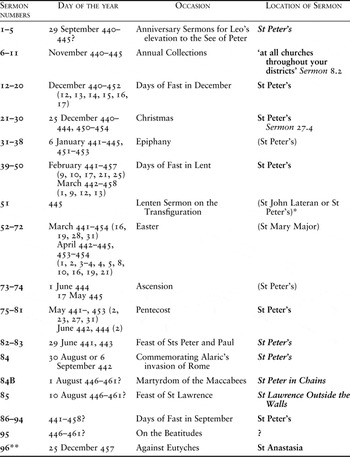
In addition to the times already noted, Leo likely also preached at St Peter's for the Epiphany and Ascension, if we use the later Sunday and Festal Sermons of Gregory (a.d. 590–604) (see Table 1). If Leo followed Pope Anastasius (a.d. 399–401) and if his Lenten Sermon on the Transfiguration (Sermon 51) was his Sunday Lenten sermon, he delivered it at St John Lateran, though Gregory also delivered one Sunday Lenten Sermon (Sermon 18) at St Peter's (see Table 1).Footnote 60 For the other days of the week in Lent, however, Leo stipulated that the vigil be at St Peter's (Sermons 39–50). Though Ennodius mentions the pope baptizing candidates on Easter Sunday in St Peter's during the pontificate of Symmachus (a.d. 498–514), if we again use Gregory as a guide, Leo's Easter Sunday Sermon was likely delivered at St Mary Major (see Table 1); indeed St Mary Major was a church with which Leo had a personal tie since, as deacon under Pope Sixtus, Leo was likely responsible for drawing up the programme for the mosaic cycles in the nave and on the triumphal arch of this church.Footnote 61
Occasions and Locations for Leo's Sermons
(Locations in Bold are attested explicity in Leo's Sermons. Locations in Parentheses are based on Gregory's Sunday and Festal Sermons; on these, see especially Baldovin, op. cit. (n.3), passim. Locations in Bold Italics are proposed by Salzman based on allusions in the text and/or external evidence.)

*Arnobius the Younger, Praedestinatus 82, PL 53, 615 B attests Bishop Anastasius (a.d. 399–401) in St John Lateran for Sunday Lent services. Gregory delivered his Sunday Lent Sermon 16 at St John Lateran, and Sermon 18, another Sunday Lent Sermon, at St Peter's.
**Sermon 98, on the Preface to the Creed, has survived in another manuscript tradition but is not relevant to this paper. For the text of Sermon 98, see R. Dolle (ed.), Sermons de Léon le Grand (4 vols; 1961–2003): (1973), 294–300 [SC 200].
Leo's Building Activity at St Peter's
Leo's sermons, revised for circulation, show a bishop developing a liturgy that centred on Peter and his sanctuary in Rome; the frequency of his mention of Peter in his sermons and the number of times throughout the year that he moved Christians to St Peter's for sermons and public fasting, represent Leo's particular contribution to the Christian year. This fits with what we know of Leo's building activities. He constructed no new major basilicas, but the Liber Pontificalis records Leo's special care for St Peter's. He repaired it in the wake of the later Vandal sack of a.d. 455, and if the porticoes to St Peter, connecting the shrine to a bridge to the city, were standing then, he may well have repaired them as well.Footnote 62 It seems likely that Leo was responsible for the wall-paintings that decorated the central nave inside St Peter's and, as Paolo Liverani has recently argued, that the inscription relating to an image of Christ on the façade of the basilica of St Peter's is tied to Leo's efforts then as well:
Just as Peter ‘guarded’ the faithful and established the Church as a defence (praesidium) in Sermon 83.2–3, so Leo in this monumental inscription proclaims the power of Peter acting to defend (praesidio) the Vatican sanctuary.Footnote 64 He appointed guards (cubicularii) to protect the treasure in St Peter's, and founded a monastery near St Peter's as well.Footnote 65
Given Leo's personal and theological ties to Peter, it is fitting, then, that Leo was the first pope buried in the northern sacristy of the portico at St Peter's.Footnote 66 Indeed, his interment there was in keeping with the burial practices of Rome's aristocrats whose funerary banquets and monuments are attested since the fourth century. Leo's burial was following imperial precedents also, for in St Peter's, in the building later known as St Petronilla, the son of Galla Placidia was reburied in a.d. 450 in what was in essence a dynastic mausoleum for the Western Empire.Footnote 67 Leo's burial, the first of a bishop, made permanent a papal presence in St Peter's and set a precedent for the future.
Evidence in Leo's Sermons for Locations other than St Peter's
I would like to turn briefly to consider the evidence for Leo's preaching in other churches in Rome. His sermons suggest that Leo preached in three other major churches. Two certain sites and one possible site were appropriately large papal/imperial foundations to accommodate as large an audience as possible; two sites were used for martyr celebrations, and hence had specific topographical associations.
Leo delivered Sermon 84B, on the Martyrdom of the Maccabees, on 1 August, their feast day, sometime between a.d. 446 and 461. He notes (Sermon 84B.1) that he is also celebrating the anniversary (natalis) of the church in which he is preaching. This church is identified, on the basis of its anniversary, with the fifth-century church built and dedicated by Leo's predecessor Sixtus III (a.d. 432–440), who, with the empress Eudoxia's funds, made it one of the most significant foundations among the Roman titular churches of the city. The church took on the name ‘Titulus of Eudoxia’.Footnote 68 Location was one key to its prominence; the church is situated on the Oppian Hill overlooking the steep slope down to the Argiletum opposite the Subura, one of the most populous quarters of Rome (Fig. 1). This area, filled with aristocratic homes, was also close to the monumental city centre. This confluence of a date common to the holiday and the foundation of the church, tied so closely as it was to the imperial family, likely contributed to Leo's decision to preach there. By the early sixth century, the church was best known for its most famous relic, the chains of Peter, after which it became popularly known as St Peter in Chains.Footnote 69 It is perhaps due to Leo's preaching there that this church appears as one of the Stations in the seventh-century Gregorian Sacramentaries on 1 August.Footnote 70
On 10 August, the Feast of St Lawrence, Rome's patron saint, Leo preached Sermon 85.Footnote 71 Lawrence had special ties to Rome and its papal clergy. According to legend, Lawrence, an archdeacon of the Roman church in the third century, was arrested for refusing the emperor Valerian's instructions to sacrifice to the pagan gods. Lawrence was executed three days later, and buried in a crypt in the cemetery of Cyriaces on the Via Tiburtina (Fig. 1).Footnote 72 By the time Leo preached his sermon, there were several basilicas to Lawrence, a sign of his local import.Footnote 73 But the basilica on the Via Tiburtina was ‘heavy with episcopal presence’ as a list of episcopal projects there shows.Footnote 74 Originally founded as a Constantinian funerary basilica, the Tiburtine Basilica was likely renovated by Leo's predecessor, Sixtus.Footnote 75 It may have also been the site of another of Sixtus' projects, a newly decorated confessio for the martyr Lawrence, also noted in the Liber Pontificalis.Footnote 76 In a niche over the railing to this confessio was a splendid ‘silver statue of the martyr St Lawrence, weighing 200 pounds’.Footnote 77 The Liber does not state where this confessio and statue were located, but the notice precedes the basilica attributed to this pope, perhaps the Tiburtine basilica noted above.Footnote 78 And it is tempting to see in the conclusion of Leo's sermon, an allusion to this shining statue:
Let us glory in the Lord who is wonderful in his saints, in whom he established a protection and an example for us. He has so illumined his own glory through the whole world that, from east to west, where the brilliance of the lights of his deacons shines, as Jerusalem has become renowned for Stephen, so Rome has become renowned for Lawrence.Footnote 79 (italics by author)
The shining example that will enlighten the world and the brilliance of Lawrence's deacons fits well with the silver statue dedicated by Leo's predecessor, Sixtus. If the memory of Sixtus' confessio and statue was embedded in a sermon delivered at the St Lawrence site on the Via Tiburtina, Leo's words would take on multiple layers of meaning. Leo could be recalling his own career through the ranks of the papal clergy, as archdeacon and then finally bishop of Rome. I can do no more than suggest this topographical location for this sermon since the evidence is only allusive.
Leo's Sermon 96 is somewhat unusual, yet its delivery, on Christmas morning a.d. 457, helps explain its inclusion in the collection. It is a response to contemporary theological debates, as its heading in the manuscript indicates: ‘Item tractatus alius eiusdem contra heresem Eutihces ad populum dictus in basilica sancte Anastasie’ (Another tract by the same writer against the heresy of Eutyches spoken to the people in the basilica of St Anastasia).Footnote 80 The basilica of St Anastasia was near the Tiber port at the Forum Boarium where people from all over the world would quite naturally come (Fig. 1). On the basis of the manuscript heading, Duchesne argued that this was the ideal location for Leo to deliver this sermon since here he could address the Greek-speaking easterners who may well have been convinced by Eutyches' doctrinal position, as Leo himself had been.Footnote 81 In his sermon Leo clearly restates the doctrine of Incarnation and attacks the heresies of Eutyches and of the Manichaeans. If, as Judson Emerick has suggested, the church had a transept that copied that of St Peter's, this location could conjure up appropriate Petrine associations.Footnote 82 The imprint of Leo's liturgy and this sermon may live on in the stational liturgy attested in the sixth century when the pope celebrated a dawn eucharist at St Anastasia before going to St Peter's mass on that day.Footnote 83
These three sermons provide some evidence for the kinds of places in which Leo is presented as preaching; when Leo moved away from St Peter's, he is identified with large papal/imperial basilicas, twice inside and, if the St Lawrence Via Tiburtina site is accepted, once outside the city. If Leo preached sermons on other saints' days, which is certainly likely, these were not consistently collected and circulated as an annual cycle of the city's liturgy. And if he delivered sermons on the saints' days, we cannot be certain where he did so.Footnote 84
Leo's sermons attest where he and his retinue went to celebrate worship services and where he encouraged Christian worshippers to go throughout the year. As noted above, Leo seems to have gone to large papal or imperial basilicas — mostly St Peter's, but also St Anastasia and St Peter in Chains; he may have gone to St Laurence Outside the Walls, and probably to St Mary Major and the Lateran (Fig. 1). The relative infrequency and lack of emphasis on the Lateran as an attested liturgical site is worth remarking. Though the Lateran was the administrative home of the papacy, Leo's sermons provide little evidence for it being ‘the city's religious, political and cultural center’.Footnote 85 Rather, Leo aimed to centre the liturgy on the popular Vatican sanctuary, a place resonant with Roman aristocratic and imperial presences.
III LEO'S LITURGICAL TOPOGRAPHY: CONTESTING FOR SPACE
The Collects, Almsgiving, and Rome's Resident Aristocracy
Leo is our first source to indicate that the Collects, the November collection of alms (collectae or collations), were part of Rome's annual liturgical calendar.Footnote 86 It is unlikely that this ritual goes back to ‘apostolic times’ as Leo claimed, though his statement suggests the practice predates his episcopacy; what is key, however, is that under Leo the Collects were given a prominence and a specific organization that they had lacked in the past.Footnote 87
Each of Leo's sermons on the Collects mentions a different day of the week in November preached in different years; on this day Leo urged the faithful to bring donations — goods, food, monies — to ‘all churches of your regions’.Footnote 88 This reference to churches in regions alludes to the churches in the seven regions of the city said by the Liber Pontificalis to have been first established by Pope Fabian and then later overseen by the regional deacons.Footnote 89 Certainly, giving in church rather than directly to the poor was encouraged from earliest times.Footnote 90 In the late fourth- and fifth-century city, lay donors often gave charity in their local neighbourhood churches, the tituli; these local churches with their priests (presbyters) continued to be the recipients of private gifts.Footnote 91 Some bishops wanted to assert their authority over such gifts and the local clergy who received them. Pietri proposed that it was the late fourth-century pope Damasus who, aiming to control private donations, set deacons in the seven regions in Rome in centres for collecting and distributing charity (the diaconia), but there is no good evidence for this fourth-century origin.Footnote 92
What is clear from Leo's sermons is that in the mid-fifth century, the bishop directed that almsgiving at the Collects and in conjunction with the annual fasts be brought to the churches in the regions of Rome in which clergy designated as ‘praesidentes’ would oversee the collection and redistribution of alms. Although Leo does not specify the deacons by name, that is not unusual for he often uses vague terms for the clergy and his reference to praesidentes overseeing almsgiving in charity centres or diaconia echoes the language of Cassian, whose works and ideas were known to Leo.Footnote 93 Leo is the first bishop of Rome known to have institutionalized giving to the poor through a series of collections in the seven regions of the city at the Collects as part of the annual liturgy; his use of deacons for this task is in keeping with their duties elsewhere.Footnote 94 Moreover, Leo highlights the importance of the Collects through the delivery of his sermons, which were also circulated; this amplified the significance of these charitable acts of giving to clergy closely tied to the bishop, namely the deacons.
Unfortunately, Leo does not indicate in which churches he delivered his seven sermons on the Collects, nor do we find them recorded in Gregory's Sunday or Festal Homilies; only in eighth- and ninth-century documents do we find the Collects noted on 1 November at Sts Cosmas and Damian with a mass at St Caesarius.Footnote 95 But Leo does articulate quite clearly the reason for the date of the Collects during the year; he states that the annual Collects were held on a day when the populace would otherwise be going to the games and enjoying the circus processions; this is the habit that Leo is eager to change by moving the faithful to bring charity to church.Footnote 96
We can imagine the rhythm of life for Christians in Rome who followed Leo's liturgy. The faithful would go to their local churches in their regions where they would find the deacons accepting and then distributing charity. And while the deacons as well as local priests were under the authority of the bishop, the former directly served the bishop's needs. Hence, Leo's Sermons on the Collects are advocating a system of charity that intrudes the bishop and his clergy directly into the semi-autonomous life of the local titular churches; I shall discuss the relationship of local priests, deacons and bishops below, but suffice it to note here that local tituli and their clergy owed their foundations and endowment generally to Rome's élites, mostly the senatorial aristocracy, who, through the sixth century, continued to fund the tituli with their gifts.Footnote 97 Hence Leo's Sermons on the Collects represent part of his ‘strategy of visuality’ insofar as they showed his influence in the local churches where deacons (who were closely tied to the bishop) in church collected and distributed charity on days set by the bishop's calendar.Footnote 98
Leo promoted the benefits of charity not only at the November Collects, but at several holidays throughout the year. Days of fasting required almsgiving.Footnote 99 Taken at face value, this would mean that people should go to their local churches to give alms to the deacons at other times of the year as well, a visible change in the patterns of life, but one much in keeping with Leo's attempts at using liturgy to orchestrate a new Christian civic year.
Like many other fourth- and fifth-century bishops, Leo preached that almsgiving was a means to personal salvation.Footnote 100 So, Leo proclaimed, gifts given in this life are a deposit made, with interest, for eternal life; Leo also ascribed the rôle of creditor to the almsgiver in respect to God, who would repay money given to the poor with interest after death.Footnote 101 Such arguments were aimed to appeal especially, as Bronwen Neil observed, to the wealthy aristocracy.Footnote 102 They were the most important urban patrons of the Church, aside from the emperor. Indeed, they could appreciate Leo's inversion of the traditional Roman model of patronage by promising, in Sermon 10.4, that not only will God know of the almsgiver's good works but the alms themselves and their beneficiaries will intercede for the giver in heaven. Moreover, Leo's efforts to encourage charity were not revolutionary; he did not urge a significant redistribution of wealth, nor did he idealize a community that ignored social difference, as envisioned by some Christians.Footnote 103 Rather, by donating to the Church and by distributing the gifts through the deacons or lay priests, aristocrats could maintain social and physical distance from the poor, even as they gained personal salvation.Footnote 104
Games, Circuses, and Processions
Leo's encouragement to give alms was coupled with criticism for attendance at games and circuses instead of services in church. This message too was aimed at the traditional patrons of these entertainments, Rome's resident aristocracy. In Sermon 84, Leo criticizes those Christians who fail to appear in church for his sermon on the day reserved for the commemoration of the survival of Rome after the a.d. 410 sack.Footnote 105 The reason for this absence — the competing circus games — was particularly egregious to the bishop who claimed that the games and Rome's ingratitude threatened the survival of the city. Here, and elsewhere, Leo asserted the centrality of the city and the empire — the temporal realm — to the Church.
This emphasis on the city as the care of the bishop helps to explain why Leo and the clergy who assembled the collection of sermons included this sermon in the first recension. Leo claimed that he preached on this day in opposition to those who supported other means to secure Rome's survival:
It shames me to say it, but one must not keep silent. More is spent (impenditur) on demons than on the apostles, and the wild entertainments draw greater crowds than the blessed shrines of martyrs.Footnote 106
This devotion to games and circuses is dangerous since, Leo warns, it ignores the true source of salvation:
Who restored this city to safety? Who snatched it from captivity? Who rebuilt this city for health? Who protected it from slaughter? Was it the games of the circus, or the watchful care of the saints? Assuredly it was by their prayers that the sentence of divine judgement was appeased …Footnote 107
Such an error obscures the truth that, as Leo explains, salvation is earned through the ‘veneration of the saints’ (cura sanctorum) not by attending the ‘circus games’ (ludi circensium) (Sermon 84.1). Those Romans who think that Rome's survival was owed to the stars, i.e. fate or astrology, or the gods, are impious holders of pagan notions; they are the focus of Leo's ire as he explains that Rome survived because ‘God deemed it worthy to soften the hearts of the barbarians’ (Sermon 84.1), a reference to Alaric's departure from the city after three days of looting.Footnote 108
Derogatory references to the circuses and games appear in other of Leo's sermons. So, for example, Leo explains that his motivation for establishing a specific day in the calendar of the Roman Church for the Collects was to compete with the games, the ludi Plebeii celebrated in the city 12–16 November; this major set of games, with its traditional procession through the streets of the city, was the object of Leo's anger for he wished the Collects to ‘destroy the snares of the “ancient enemy” – the devil’Footnote 109 and to make the Christian rite ‘most profitable to the growth of the Church’.Footnote 110 Such is the rhetoric of Christian apologists, but in Leo's published sermon it makes no sense unless such language has contemporary relevance. Indeed, in the mid-fifth-century city, these civic holiday traditions were kept very much alive by Rome's Christian senatorial aristocrats who still spent conspicuous sums of money on the games that competed so successfully with the ceremonies in church. In the time of the usurper John (a.d. 423–425), for instance, a senator of the Anician family (Probus, son of Alypius) spent 1,200 pounds of gold on his praetorian games.Footnote 111 The Colosseum was repaired throughout the fifth century and likely continued to hold shows and spectacles — though no longer gladiatorial combats — into the early sixth century.Footnote 112 Similarly, chariot races in the Circus Maximus continued to attract Christians through the middle of the sixth century.Footnote 113
These expensive entertainments brought great prestige to the aristocratic givers of the games who would, traditionally, before the races began, conduct a procession from the Temple of Capitoline Jupiter through the Forum to the Circus; once there, the game-giver presided over the popular races in front of a huge crowd in the Circus Maximus.Footnote 114 Such processions, the pompa circensis/circi, were branded as a ‘pompa diaboli’ by Christian apologists, yet they continued as part of the games and holidays into the fifth century with the support of Rome's aristocrats and the populace at large who enjoyed them, still, on traditional Roman holidays. By Leo's time, pagan trappings, like carrying statues of the gods, decried as part of the early fifth-century city New Year's rites by Peter Chrysologus, were likely gone from these holidays.Footnote 115
We tend to hear about circuses, games and processions, like those for the New Year or the ludi Plebeii in November, only when they are contested. So, for one, we would have no idea that the holiday of the Lupercalia, when bands of men ran through the city centre and professional actors sang out the misdeeds of miscreants for the merriment of all, was popular in Leo's Rome since he does not explicitly name it.Footnote 116 Indeed, we only know about the Lupercalia because some thirty years after Leo's pontificate, after a likely temporary disruption, Pope Gelasius complained about its celebration; Gelasius insisted that one could not be a Christian while participating in the public, openly ‘blasphemous’ and ‘pagan’ diabolical rites that attended this holiday.Footnote 117 Yet the Christian aristocrats who organized and supported the races through the streets of Rome did not see it that way; they countered Gelasius' arguments by describing the Lupercalia as a traditional Roman ritual. As Neil McLynn aptly observed about the Christian senator Andromachus and his peers, ‘the rewards for the organizer arguably outweighed any headaches … the Lupercalia should be counted among the opportunities so essential to them to be seen by whole crowds, active in the pursuit of their religion; for the activity of maintaining tradition a thousand years old should be allowed its religious significance’.Footnote 118 Gelasius, as Leo when explaining his choice of day for the Collects, was trying to stop a popular celebration supported by Christian aristocrats. We do not know if Gelasius was successful in halting the Lupercalia, but he claims that he was not the first pope to try to do so; clearly, the civic authorities had not listened before.Footnote 119 Gelasius' contestation about the Lupercalia, like Leo's complaints about attendance at circus games, demonstrates the limits of papal authority as well as these bishops' attempts to assert their power over traditions supported by Christian aristocrats and the population at large.
The Tituli, Local Clergy, and Rome's Aristocracy
I have already noted Leo's innovative liturgical efforts in conjunction with the Collects and the increased rôle of the bishop's deacons in the collection and redistribution of charity in the regional centres in the city. Leo, as I discussed, was the first Western bishop to organize the collection and distribution of charity at the Collects through Rome's deacons and by making a census of the poor.Footnote 120 But his efforts can be understood as part of his overall campaign to centralize his authority and assert his influence over élite patterns of behaviour associated in Rome especially with aristocratic patronage of the uniquely Roman institution of the tituli. Scattered across the city's neighbourhoods, the tituli began as privately-funded ecclesiastical foundations by wealthy lay and clerical patrons in post-Constantinian Rome.Footnote 121 Their name and existence derives from Roman law. ‘Titulus’ indicates the legality of acquiring property, and thus can be further expanded to mean a gift originating from a person; the church which is typically built with donated funds is technically separate from the donated gift or foundation, the ‘titulus’ proper which was legally part of the bishop's church and so technically under his financial control.Footnote 122 But the recognition of the donor remained, and these gifts retained the name of the donor as, for instance, when the sixth-century Liber Pontificalis records that the aristocratic woman Vestina endowed her titulus, the Titulus of Vestina, in her will and left instructions to build a church on the property which the good pope Innocent carried out in accordance with her wishes.Footnote 123 Hence even the bishop-focused Liber Pontificalis underscores the dual fact of the existence of Rome's titular foundations; they were private donations for which arrangements had to be made for the legitimate transfer to the bishop's control.Footnote 124 A pattern of tension in the founding and funding of the tituli was thus built into their very origins.
If the tituli were under the legal control of the bishop of Rome, in practice the titular priests in these neighbourhood churches were the real administrators of the tituli and their property. So, for instance, the priest Philip of the Titulus of the Apostles and the priest Macius of the Titulus of Pudentiana are mentioned as supervisors and contributors to building projects of the tituli so named.Footnote 125 The Council of a.d. 502 affirmed that local priests were engaged in managing and alienating gifts that they continued to receive, for it, for the first time, prohibited local priests from doing this.Footnote 126 In the mid-fifth century, however, the local titular priests remained in control of their finances and were the recipients of the gifts of local élites. Indeed, the ritual life of most of Rome's inhabitants would centre around their local titular churches which even received as gifts baptismal fonts and were able to handle penitential acts.Footnote 127 This high degree of financial autonomy would seem to be the case outside of the city as well; in a letter to the bishop of Sicily, Leo stipulated that the bishop take into account the wishes of the priests as well as the common good before alienating donated property.Footnote 128
Given the semi-autonomous existence of the local titular priests who received the financial patronage of local élites, it is understandable why fifth-century bishops would want to insert themselves visually into the ritual life of the tituli. The fermentum, as noted earlier, was one way to unite the local communities with the communion of the bishop, which is why in the early fifth century Innocent was concerned to orchestrate this rite. But by bringing Christians to St Peter's and by encouraging almsgiving to deacons, the clerics who served the bishop, Leo was also aiming to change patterns of worship of Romans, and of the aristocracy especially, whose patronage of the tituli continued. Centralizing liturgy at St Peter's thus demonstrated Leo's influence over Christians in Rome, including, one might add, over other Christian factions or confessional groups in the city.
In sum, Leo's sermons urged Christians to worship in Rome in set places on set days throughout the year. His attacks on the games and his advocacy of the Collects as well as his preaching on almsgiving would have, ideally, changed the patterns of patronage and civic life of Rome's Christians, and its resident aristocracy in particular. Though now predominantly Christian, the aristocracy included the wealthiest and most influential members in the Western Empire. These men and women continued to manifest their civic status in Rome by giving games and circuses with their processions that periodically took over the streets of the city, though such activities had aroused the hostility of Christian leaders for centuries. They also tended to support their local titular churches and clergy. Leo's centralization of liturgy at St Peter's, along with his continued opposition to games, and his emphasis on charity were messages of special import for Rome's resident Christian aristocracy.
IV THE IMPLICATIONS OF LEO'S LITURGICAL TOPOGRAPHY FOR CHRISTIAN ROME
It is worth looking past Leo's papacy to consider how the liturgy developed in response to the growth of papal influence and the weakening of the senatorial aristocracy. The early sixth century saw an intense effort on the part of the bishops of Rome to establish their episcopacy as an autonomous institution free of the control of emperor or senate. But it was the later Byzantine reconquest of Italy that, though most damaging to the city's infrastructure and its population, especially its aristocracy, greatly added to the growing influence of the papacy.Footnote 129 It is apt that only due to Byzantine intervention in the city's episcopal politics do we find the first papal procession — a precursor to such processions as part of stational liturgy — in Rome, as Jacob Latham has argued.Footnote 130 Pelagius I (a.d. 556–561) was elevated to the papacy in exchange for his support for Justinian in the Three Chapters controversy, but it left him, according to the compiler of the second edition of the Liber Pontificalis, without the support ‘of the devout, the prudent and the nobility’.Footnote 131 At the Byzantine general Narses's suggestion, a procession was organized to validate Pelagius' position, ending at St Peter's, in a rite symptomatic of the weakening of the aristocracy.Footnote 132
The addition of papal processions to the stational liturgy led Victor Saxer to describe the late sixth-century papal ritual as a ‘liturgy of movement’.Footnote 133 In the second half of the sixth century, we hear of the pope leading penitential processions through the streets of Rome in conjunction with days of fasting; the notice tells us little of the route or the numbers involved, but since it fell on the Collects in December which, since the time of Leo, had included an all-night vigil at St Peter's, I would suggest this papal penitential procession ended there as well.Footnote 134 Subsequently, we find Gregory (a.d. 590–603), first as deacon, and again as pope in a.d. 603 organizing the letania septiformis which included the entire city in seven groupings of urban dwellers in a penitential procession undertaken to save the city after a flood.Footnote 135 The Greater Litany, another penitential procession also noted in the time of Gregory, was held on 25 April, and this procession likely ended at St Peter's.Footnote 136 In documents from the eighth through the twelfth centuries, we see the end result of these processional developments in a fully articulated system in which there were well-publicized places for Christians to meet and then to walk, with the pope on horseback in procession, to the church where the pope would celebrate the Eucharist and preach; one such full set of instructions survives in the twelfth-century Ordo Romanus XVI of Mabillon.Footnote 137
The influence of Leo's liturgical topography and the growth of papal power can be demonstrated spatially as well if we consider the locations for Gregory's sermons on Sundays and holidays (see Table 1 above). Within the city Gregory celebrated the Eucharist at different churches. He went to some churches inside the walls — the titular churches of St Clement, and Sts John and Paul — but spent most of his time, as did Leo, in the great papal/imperial basilicas. St Peter's is the most frequent venue, but so too does he process to St John Lateran, St Paul Outside the Walls, St Mary Major, the Basilica of the Apostles (St Sebastian), and Sts Marcellinus and Peter (Fig. 1). Like Leo, Gregory preached his liturgy in terms of the moments of Christ's life at the same points of the year, but he did so in a much wider range of churches. Yet as was the case for Leo, we cannot say whether Gregory celebrated each martyr's feast each year in the same place. What little evidence we have suggests otherwise, for we find notice of sermons being given for the same date (12 May) at two fairly distant basilicas.Footnote 138 Only for Gregory's Sunday sermons and liturgy tied to Christ's life can we see a developed system of stational liturgy, moving to set churches. In this, too, Gregory was following in the footsteps of Leo.
As the first bishop of Rome to preach a sermon cycle that highlighted a cycle of times and places of worship, Leo developed and systematized liturgical traditions and topography he had inherited. Moreover, he centralized liturgy on St Peter's in the Vatican as a place for feasts and fasts, thereby expanding the earlier usages of St Peter's for papal liturgy. Leo's liturgical topography influenced the subsequent development of the Vatican sanctuary. There were colonnades to St Peter's to facilitate the movement of people there that were maintained for centuries, and by a.d. 800, St Peter's had thirteen stational services per year.Footnote 139
As these later liturgical developments underscore, there were limits on what Leo could accomplish in his lifetime. Processions, for example, were not a part of the Christian stational liturgy for Leo, though they were used elsewhere by contemporaries. In fifth-century Rome, the most frequent occasions for public processions were those traditionally aristocratic civic events, notably in connection with games in the circus or with traditional holidays celebrated in the streets of the city. The aristocracy, whose patronage of civic events, as well as of local titular churches is well documented, would ideally change their patterns of civic life to live in accord with Leo's liturgy. Leo's Sermons show a bishop preaching the virtues of communal fasting and almsgiving, and directing Christians to St Peter's at regular points as the destination for many fasts and feasts throughout the year. Leo's liturgical topography aimed, as Jerome, in the epitaph to this paper, had said of the impact of the fourth-century cult of the saints, to ‘change Rome's address’; but in the fifth century, Leo wanted Christians to move to St Peter's in the Vatican.