Introduction
Inspired by the writings of Michaela Benson and Karen O'Reilly and their respective research on the British in rural France and southern Spain, recent attempts to capture the essence of international retirement migration (IRM) have viewed the phenomenon through a ‘lifestyle’ lens (O'Reilly, Reference O'Reilly2000; Benson and O'Reilly, Reference Benson and O'Reilly2009b, Reference Benson and O'Reilly2016; Benson, Reference Benson2011). In this paper, we extend the lifestyle approach in several ways, reflecting the mission of the special issue. First, our geographical focus is on the little-known Italian region of the Marche, designated as a ‘new frontier’ for IRM (King et al., Reference King, Cela, Morettini and Fokkema2019). Second, we document the experiences of North European later-life and retirement migrants to explore the nuances contained within the umbrella concept of ‘lifestyle’. In the Marche, lifestyle is less about a hot, sunny climate and a leisurely way of life relaxing by the pool (the stereotypical ‘Spanish experience’), and more about active ageing, quality of life, care for the environment and becoming part of a perceived ‘authentic’ rural-based society. Third, unlike the bulk of IRM research which is based on the experience of a single nationality, such as British or Swedes, we introduce a comparative element by recording the motivation and experiences of three national groups – British, Dutch and Germans.Footnote 1 Fourth, we focus on various materialities of the later-life migration experience. Drawing on the narratives of 69 interviewees, we look at three clusters of materialities at different, yet intersecting scales: landscape and environment; ‘home’, property and location; and food, consumption and other constituents of a rural ‘good life’.
The role of lifestyle in later-life and retirement migration
Although lifestyle migration does not feature as a ‘key concept’ in migration according to the otherwise comprehensive manual of Bartram et al. (Reference Bartram, Poros and Monforte2014), there is no doubt that the lifestyle approach has established itself as an important conceptual framework in assisting scholars to understand migrations which are not driven by economic rationales (as in the oft-quoted phrase ‘economic migrants’) or political forces (refugees, exiles, etc.). The last decade has seen a remarkable growth in the literature on lifestyle migration, much of it in association with later-life and retirement migration. This literature comprises edited collections (Benson and O'Reilly, Reference Benson and O'Reilly2009a; Benson and Osbaldiston, Reference Benson and Osbaldiston2014; Duncan et al., Reference Duncan, Cohen and Thulemark2014; Janoschka and Haas, Reference Janoschka and Haas2014; Torkington et al., Reference Torkington, David and Sardinha2015), state-of-the-art papers (Benson and O'Reilly, Reference Benson and O'Reilly2009b; Benson and Osbaldiston, Reference Benson and Osbaldiston2016) and innumerable case-study papers which use the lifestyle lens (as well as several chapters in the above-cited edited books see, inter alia, McIntyre, Reference McIntyre2009; Torkington, Reference Torkington2012; Åkerlund and Sandberg, Reference Åkerlund and Sandberg2015; Benson, Reference Benson2015; Cohen et al., Reference Cohen, Duncan and Thulemark2015; Kordel and Pohle, Reference Kordel and Pohle2018).
In their very useful overview paper on lifestyle migration, Benson and O'Reilly define and characterise the phenomenon as follows:
Lifestyle migrants are relatively affluent individuals of all ages, moving either part-time or full-time to places that … signify … a better quality of life. The fundamental features of the different lifestyles sought … include a re-negotiation of the work–life balance, quality of life, and freedom from prior constraints … Ethnographic accounts reveal a narrative of escape permeating migrants’ decision to migrate, further emphasised by negative presentations of life before migration … Lifestyle migration is thus a search, a project, rather than an act, and it encompasses diverse destinations, desires and dreams. (Benson and O'Reilly, Reference Benson and O'Reilly2009b: 609–610)
Bearing in mind that our study of the Marche limits itself to retirement and pre-retirement migrants, the above quote goes some way towards capturing the essence of our participants’ motivations and life perspectives, including both full-time and part-year residents. Regarding the ‘diverse destinations, desires and dreams’, the specific destination is rural Italy and the desires and dreams have to do with finding a characterful property in an idyllic location and fashioning a pleasant, enjoyable way of life that is ‘in tune’ with the local physical and social environment, and in contrast to the fast pace of life in crowded and sometimes ‘unsafe’ cities in their countries of origin.
Benson and O'Reilly (Reference Benson and O'Reilly2009b: 611–613) nominate three ‘ideal types’ of lifestyle migrant: residential tourists, rural idyllists and bourgeois bohemians. Residential tourists want to live the ‘holiday lifestyle’. A warm sunny climate and a coastal location are usually their main priorities; typically they are the well-researched international retirement migrants living in the Spanish Mediterranean coastal resorts and islands, the Algarve, Malta and Cyprus. Coastal lifestyle migration embodies relaxation, leisure and an escape from the cold North. On the one hand, this is ‘tourism as a way of life’ (Benson and O'Reilly, Reference Benson and O'Reilly2009b: 612); on the other hand, some permanent-resident retirees seek to physically distance and socially differentiate themselves from the mass of short-stay tourists who visit these same locations.Footnote 2
Lifestyle migrants seeking a rural idyll are found in a different set of geographical locations, including a variety of landscape-rich regions of France; in Italy especially Tuscany but extending more recently to Marche and other central-southern regions; in rural, ‘back-from-the-coast’ regions of southern Spain; and in several other scattered rural regions (Gaspar, Reference Gaspar, Torkington, David and Sardinha2015). Outside France (Buller and Hoggart, Reference Buller and Hoggart1994; Smallwood, Reference Smallwood, Geoffroy and Sibley2007; Benson, Reference Benson2011), Tuscany (King and Patterson, Reference King and Patterson1998) and central Portugal (Sardinha, Reference Sardinha, Torkington, David and Sardinha2015), the everyday lives of lifestyle and retirement migrants in these attractive rural spaces have been much less studied than the first group sketched above. From the studies that exist, the common collective narratives are about the ‘simple’ and ‘good’ country way of life, feeling part of a rural community, and the visual and material aspects of the rural idyll – the aesthetic properties of the landscape, the availability of inexpensive historic properties, the excellent local food and wine, and the perceived strength of the local culture.
Benson and O'Reilly's third type of lifestyle migrant, the bourgeois bohemians, comprise many rural idyllists who want to get close to the land and share communal ecological values; a variety of artistic types who seek inspiring places to develop their creative work; and ‘modern nomads’ whose lifestyle is embedded in their mobility to far-flung and mystical places (e.g. Korpela, Reference Korpela2010). Waldren's (Reference Waldren1996) study of the bohemian literary, artistic and musical personalities who settled in the Majorcan village of Deía is a classic if dated text on this genre of lifestyle migration. Kockel's (Reference Kockel and King1991) research on ‘countercultural migrants’ in the west of Ireland also partially fits this template, although his participants, most of whom are from Germany and the Netherlands, are arguably more bohemian than bourgeois. He denotes them as ‘hippy farmers and artisans’, ‘new agers’, ‘eco-freaks’ and ‘wandering poets’.
How do our Marche participants relate to Benson and O'Reilly's typology? To some extent, they are a combination of all three types, with an emphasis on the second and third types. They are certainly drawn to the beautiful landscape and rural way of life in this Italian region, and they have an environmental conscience too, for the most part. But some of them also say that the sunny climate and access to the coast are important, and several of the Dutch participants, and a few of the British, are engaged professionally in the rural tourism sector. We explore these personal characteristics and lifestyle preferences in more detail in the main empirical sections of the paper.
Unpacking the materialities of lifestyle migration
Our main focus in this paper is the material dimension of IRM in the Marche. We prioritise this angle partly because it is an under-researched aspect of later-life migration, and partly because these tangible aspects emerge as particularly relevant in this geographical context, where our participants repeatedly stressed the beauty of the landscape and the fact that it was an authentic ‘working countryside’, with a welcoming rural community, whose hospitality was built around ‘genuine’ food and wine. There is a clear parallel here with Benson's research on the British settlers, many of them retired, in the French department of Lot (Benson, Reference Benson2011: 136–152; Reference Benson2013). Benson's research informants sought, and claimed to have found and become part of, an ‘authentic’ rural lifestyle in a region not tainted by mass tourism, nor by the perceived wealthier, snobbier British who have settled in nearby Dordogne.Footnote 3 This comparison is closely analogous to that evinced by our participants, who constantly contrasted the Marche, cheaper and more authentic, with the neighbouring region of Tuscany, seen now as prohibitively expensive and ‘saturated’ with British, German and other settlers.
According to Dant (Reference Dant1999: 11), the material is ‘that which we can see, touch, smell [and perhaps taste] but which is not human or animal’. As our insertion of the bracketed phrase indicates, food, often important to lifestyle migrants in rural areas, occupies an ambivalent position as a ‘materiality’, since its origins lie in the non-material animal and plant world and, once eaten, it becomes part of its consumer. Nevertheless, it is seen as a ‘thing’ and, therefore, to that extent, as part of the material world – along with the landscape which ‘produces’ it and which has been intensely humanised over centuries by the artefacts of human settlement. In Italy and elsewhere in rural Southern Europe, this organic link between food, soil and landscape plays into a hoped-for rural revival based on principles of ecological and social sustainability (Agnoletti, Reference Agnoletti2014; Mundula and Spagnoli, Reference Mundula and Spagnoli2018).
Most research on material culture focuses on the home and its immediate environs (see the overviews of Miller, Reference Miller1998, Reference Miller2001; Dant, Reference Dant1999; Reimer and Leslie, Reference Reimer and Leslie2004). This generalisation also applies to the rich stream of research on migrants’ home-making practices, with examples drawn from a wide range of geographical contexts, reflecting in turn the huge variety of migratory phenomena around the world (for some examples, see Meijering and Lager, Reference Meijering and Lager2014; Tolia-Kelly, Reference Tolia-Kelly2004; Walsh, Reference Walsh2006, Reference Walsh2018; and the many case-study chapters on older-age migrants and home in Walsh and Näre, Reference Walsh and Näre2014). Whilst we do not ignore the ‘home scale’ in the research reported in this paper, we deliberately broaden our scoping of materialities in two directions. In doing so, we endorse Blunt and Dowling's (Reference Blunt and Dowling2006: 26–29) idea of home as porous and multi-scalar, enlarging beyond home as a purely ‘private’ space, and taking on board the setting of home as simultaneously material, imaginative and social (Walsh, Reference Walsh2018: 476).
The first elaboration is to increase the scale to encompass place and landscape. We follow Andrews and Phillips (Reference Andrews and Phillips2005: 1) when they write that ‘place very much impacts … older people's quality of life and the opportunities for them to achieve goals such as successful and active ageing’, except that we loosen their conceptualisation of place to include location, space and landscape. Also, following Joseph and Cloutier-Fisher (Reference Joseph, Cloutier-Fisher, Andrews and Phillips2005: 135), we espouse a view of place, and its associated spatial referents, not just as a passive container in which human activities such as migration, ageing and day-to-day life occur, but as an operational, living, material and social construct inhabited by dynamic and multi-layered communities. Both coastal and rural regions can be regarded as ‘therapeutic landscapes’, attractive, on the one hand, for their physical, aesthetic and climate characteristics, but also for their imputed social advantages – as ‘healthy’ or ‘relaxing’ or ‘stimulating’ places to be in later life (Kearns and Andrews, Reference Kearns, Andrews, Andrews and Phillips2005: 21–22).
The second dimension that we explore, both within and beyond the spatial confines of the home, is the consumption patterns of later-life migrants in the Marche. Like Benson's (Reference Benson2011) British lifestyle migrants in the Lot, our British, Dutch and German participants in the Marche aspired to live a more ‘genuine’ way of life, marked by the consumption of local produce sourced from their own land and from neighbours and local markets. They saw themselves as part of a movement to reinvigorate the rural economy, including growing their own food and patronising local agriturismo establishments where farmers provide meals and other products based on their own produce. According to Mundula and Spagnoli (Reference Mundula and Spagnoli2018), a process of ‘rewriting’ rural space is currently under way in Italy, based on the ever-present connection between landscape and agriculture. According to these authors, agriculture has begun to express a new, different and more ‘conscious’ meaning, based not only on its capacity to produce food for consumption but also on its potential to fashion new values, new territorial identities, enhanced connections between producers and consumers, and new business and local development models. The Marche, along with certain other Italian regions which have both a strong regional identity based on a distinct landscape and farming pattern, and an evident appeal to rural tourists and foreign settlers, such as Tuscany and Umbria in central Italy, Trentino-Alto Adige in the north and Apulia in the south, is at the forefront of this new relationality between landscape, farming and local consumer appreciation (Mundula and Spagnoli, Reference Mundula and Spagnoli2018: 64).
In focusing on the Marche, we spotlight a ‘new geographical frontier’ for later-life and retirement migration in Europe, following earlier rounds of lifestyle settlement in the adjacent regions of Tuscany and Umbria (see King and Patterson, Reference King and Patterson1998; King et al., Reference King, Warnes and Williams2000). Official data on foreign older residents reveal that the Marche has increased its share of these groups, especially the three largest ‘expat’ groups of British, Germans and Dutch, faster than any other region in recent years (King et al., Reference King, Cela, Morettini and Fokkema2019: 3–4). In tune with the overarching themes of this special issue, we explore at both a theoretical and empirical level new dimensions of the ageing–migration nexus through an examination of the narrated lives of our research participants. We challenge the ‘vulnerability trope’ (King et al., Reference King, Lulle, Sampaio and Vullnetari2017) of older-age migrants by describing their experiences as a group of retired and pre-retirement migrants who attribute a positive value to later life and who develop new and imaginative residential choices and environmentally attuned lifestyles.
Marche: the geographical setting
Situated on the eastern flank of the Italian peninsula, facing the Adriatic Sea, the Marche is both environmentally varied, ranging from coastal plans to the high Apennines, and also diversified historically, evolving out of numerous small feudal territories, each one a ‘marca’. The region's name, ‘Le Marche’ (‘The Marches’) – the only Italian region currently to have a plural denomination – reflects this heterogeneity.
The region comprises three physical zones. A narrow coastal strip concentrates much of the region's population in a series of linear settlements devoted to a mixture of light industry, fishing, services and seaside tourism. Two-thirds of the region's area is occupied by its most characteristic landscape of rolling hills, cut into sections by parallel valleys draining to the coast. Scattered across the hills are numerous medieval fortified towns and villages, many of them perched on prominent ridges. Towards the region's interior, the mountainous Apennine chain contains the high peaks of the Sibillini mountains, exceeding 2,200 metres. Along the coast and adjacent low hills, the climate is typically Mediterranean, with hot dry summers and mild to cool rainy winters. However, the interior hills and mountains are colder, with abundant snowfalls at higher altitudes.
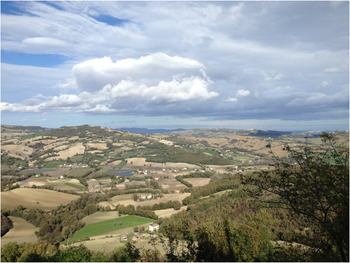
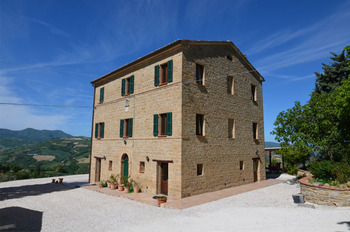
Compared to the rest of Italy, the Marche has a less-dense and more-ageing population, due above all to the depopulation of the hill and mountain regions, driven by a combination of outmigration and sub-replacement fertility (Cela and Moretti, Reference Cela and Moretti2019). These processes are common throughout rural Italy, but in the Marche they have been closely related to the demise of the mezzadria share-tenancy system, an agrarian regime which has left an indelible stamp on the region's human landscape. Whilst the landowners lived in palazzi, large villas, the mezzadri, the share tenants, lived in rural farmhouses scattered throughout the countryside. They worked the land in a semi-subsistence, semi-commercial mixed agriculture of field crops, orchards and livestock, giving half the produce to the landowner. Fundamentally exploitative of rural labour, the share-tenancies were at least stable and heritable, surviving intact until the system's collapse allied to the process of outmigration which started in the 1960s (King and Took, Reference King and Took1983). The demise of the mezzadria system, with its myriad scatter of farmhouses and cottages, led to the abandonment of these rural properties, whilst the farmland was consolidated into larger holdings. But much of the landscape legacy remains in the form of an attractive and varied patchwork of small fields, vineyards, orchards, pastures and woodland, spread across the hilly topography interspersed with ancient hilltop villages. Figures 1 and 2 are an attempt to capture the essence of the Marche setting: a typical landscape shot, and a large farmhouse-villa, in the handsome yet austere style of the region, and now owned and occupied by a Northern European retirement migrant.
Typical Marche landscape: a rolling patchwork of fields under mixed farming dotted with dispersed rural dwellings.

Substantial historic villa, formerly the property of a landowner-farmer, now lived in by an international retirement migrant from a Northern European country.

Methods
Our main research instrument to generate the data analysed in this paper was the in-depth, semi-structured interview: 69 people were interviewed during a series of field visits to the region between November 2014 and November 2016. This total was made up of 27 Dutch, 26 British and 16 German participants. Interviews were clustered in and around villages and towns where municipal records and ‘local knowledge’ indicated the main concentrations of older residents from the three countries to be. These were locations in the intermediate hill region, positioned between the urbanised coastal strip on the one side, and the mountainous and sparsely populated interior on the other. Interviewees had to be in their fifties and older to qualify for the interview survey, and resident in the region for at least one year. In line with the critical literature on ageing, especially in a migratory or transnational context (e.g. Andrews and Phillips, Reference Andrews and Phillips2005; Lulle and King, Reference Lulle and King2016; Walsh and Näre, Reference Walsh and Näre2014; King et al., Reference King, Lulle, Sampaio and Vullnetari2017), we acknowledge the arbitrary nature of this age-related cut-off point, but we imposed it largely for pragmatic reasons. We wanted to cover both those who were effectively retired from the jobs they did before they moved to Italy, and those who relocated at an earlier age, were still economically active (typically running bed-and-breakfast or rooms-for-rent businesses), yet in their pre-retirement life phase. In other words, we view ageing and older-age not as fixed categories, but as fluid concepts which are socially, culturally and even individually embedded. We see ‘ageing’ and ‘retirement’ as processes of ‘becoming’ which span across any fixed-age event such as reaching pensionable age.
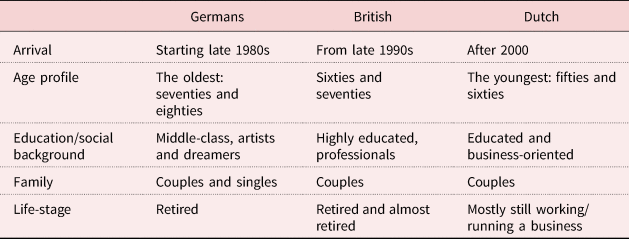
In practice, most of the participants were aged in their sixties or seventies and had been living in the region for several years. There were, however, some broad differences in the ages, length of residence and socio-professional backgrounds of the three participant groups, and these are summarised in Table 1, which is based not just on the interviewees’ biographical data but also on information gleaned from municipal records and local key informants such as mayors. The sample divided into two residential subtypes: those resident all year round (the majority), and those who divided their time between Marche and their home country (most of whom were Dutch). We excluded second-home owners who came only for holidays.
Migrants’ background characteristics

Source: Interview survey and key informants.
Potential interviewees were contacted via a range of channels: the authors’ personal contacts, key informants who acted as intermediaries and, subsequently, the technique of snowballing. Quite a few interviewees were lined up via ‘chance encounters’ whilst travelling around the region and in shops and municipal offices. We found a high level of willingness to participate in the research. Interviews were generally very pleasant, sociable occasions: participants were happy to share information about their lives, experiences and plans. A typical interview would last at least an hour; some were much longer and developed into wide-ranging conversations over refreshments and strolls around the property. All interviews were carried out by the four authors of the paper, often working in pairs; since the typical ‘interviewee unit’ was a couple, many of the interviews took on the character of a small-group discussion.
Fieldwork followed standard ethical principles of informed consent for permission to be interviewed and recorded, which was never refused. Interviewees were informed that they could terminate the interview at any point, and that they could request to see the transcript of the interview when available. We also tried to avoid sensitive topics that might cause distress, moving on to another topic as soon as any evidence of this might become apparent. In practice, the interviewees were very open to our questions and happy to talk at length on the aspects of their lives that interested us. Given the length of many of the interviews – three hours and more – the recordings were selectively transcribed, and translated into English for comparative analysis. We were careful to ensure that this selectivity did not pre-judge or bias our findings; the main purpose was to avoid transcribing lengthy off-topic discussions which developed in the longer interviews. The interview scripts were analysed through a combination of pre-set and inductively derived codes related to the three key themes dealt with in this paper: landscape and environment, property selection and home-making practices, and lifestyle and consumption patterns. Although these three themes are heuristically useful in structuring our analysis, in practice they interface in overlapping and interconnected ways. Participants are given pseudonyms to safeguard their anonymity. For the same reason, precise locations are not named.
Regional landscape and environment
At the macro scale, a first level of materiality consists of the regional environment of the Marche, and in particular the aesthetic quality of its rural landscape. Such visual perceptions on the part of the research participants are inevitably a subjective appreciation, but they were remarkably consistent in the characteristics that were emphasised.
When referring to the scenic and environmental attributes of their chosen region of settlement, participants highlighted three things: the innate beauty of the landscape; the ‘authentic’ nature of the farming society that they perceived as still holding sway in the region; and the fact that, unlike Tuscany, a frequent reference point, the Marche was not overrun by tourists and wealthy foreign settlers. These three themes were often interwoven in the interviewees’ accounts, as the following examples show:
They always say about Marche: ‘It's Italy in one region.’ There is so much diversity in the area. People often think that Italy mainly consists of Tuscany, but this is so much more beautiful … you have this lovely landscape … it is completely different. (Patrick, Dutch)
Several participants elaborated on the non-touristic nature of the region and, as a result, what they regarded as the genuine welcome from the family-oriented local communities, again with Tuscany as a comparison:
Part of the charm of living here is not having too many tourists, because we enjoy living in a rural community … it's not a place that's always trying to please foreigners … it's just a very beautiful, genuine way of life. (Kate, British)
People here are so open, unlike in Tuscany where they are very closed with foreigners, because the region is full of them. Here we are welcomed everywhere … especially in the countryside. (Berta, German)
Other aspects of the geography of the Marche which are important to the participants are its transport links, both within and external to the region. Movement laterally within the region, between the sea and the mountains, is relatively easy because of the roads which follow the alignment of the river valleys. Away from the coast, with its motorway and railway, travel in the other direction, longitudinally north–south, is more challenging because of the lie of the land and the winding, hilly roads. International travel connections with the home countries are reliant on economy flights to Ancona (the regional capital) and to other airports – Bologna for northern Marche, Pescara for southern Marche and Perugia for the western part of the region. For the German and Dutch participants, the continuous motorway links northwards from the coast offer the possibility of a one-day driving trip. This latter point was important for Alex and Guido, from the Netherlands:
Geographically we were like: ‘It needs to be accessible, it should be possible to visit us within one day from the Netherlands.’ And locally, we want there to be connections: a bus, a train not too far from here … Accessibility was an important aspect.
Jack, who was from the United Kingdom (UK), expanded on the same theme, with more details on how his view of ‘active ageing’ – swimming, walking, skiing – could be nicely catered for by his locational choice. For later-life migrants moving to the Marche, visiting family and friends was an important part of this lifestyle-migration decision, and this too was mentioned by Jack and most other participants:
We also wanted to have access to the sea, that was important. Just so that we could go down to the sea, to swim, to take our two dogs, especially in the winter when we go to walk on the beach … And I also wanted to have access to skiing and that was possible because of a small mountain resort not too far from here … I suppose the other thing is that we knew coming here we had good access to airport links which was important if we wanted to go back to visit the UK from Ancona, and we also knew that we have Perugia and Pescara, and that was important from the family point of view.
Although participants acknowledged that the Marche could not claim magnificent (but tourist-overrun) cities like Florence or Siena, with their spectacular monumental architecture and artistic treasures, they were appreciative of the still-impressive architectural patrimony of the smaller, lesser-known historic towns of the Marche, including their ‘hidden’ artistic finds. Lucy and Tom (British) elaborated on this theme in their account of how they ‘discovered’ the Marche:
Well, it's a long story. We have a long-term love affair with Italy: we'd been coming on holiday for 30 or 40 years. We mostly used to go to Tuscany and Umbria. Both of us have a background in art and design, so we tend to spend a lot of time in museums and art galleries. We have a particular love for the Renaissance painter Piero della Francesca. I guess we have seen almost all of his paintings, but there was one in the Palazzo Ducale in Urbino [historic town in northern Marche] that we hadn't seen … We were staying in Tuscany and we decided to drive over the mountains to see this particular painting … And that's how we discovered Le Marche.
Lucy and Tom's account illustrates another common theme in the participants’ decision-making – serendipity. Moving to the Marche was usually not the result of a long-term evaluation of the region's appeal based on repeated visits, but rather a kind of ‘discovery’ followed by instant attraction. The ingredients of this were both the tangible, material aspects and the ‘atmosphere’ of the place – the combination of cheap property prices, accessibility, the aesthetics of landscape, and a welcoming rural society which has not been ‘tainted’ by over-tourism and which ‘respects’ older people.
In sum, the Marche region offers a ‘therapeutic landscape’ (Kearns and Andrews, Reference Kearns, Andrews, Andrews and Phillips2005) in which the participants’ individualised ideas of active ageing can be successfully pursued. The region provides a physical and social space which is free of the constraints of the lives left behind – governed by the stress of excessive work, crowded cities and standardised routines.
House, home and the rural ‘good life’
Our second thematic focus is on participants’ ‘home-making’ and the materialities of establishing a new life in a property which is likely to be quite different from their prior residential experience. Many interviewees expressed the desire for a historic property, with some land – readily available in the Marche. As noted above, there is a division between those who are permanent residents, most of whom have sold their house in the ‘home’ country in order to purchase the house in Marche, and part-time residents, who still have a house in their country of origin. However, this distinction is by no means clear-cut. Some permanent residents have kept a place in the home country (often downsizing to a flat), thinking that they will not end their days in the Marche. The home-country property serves as a pied-à-terre, a safety-net and also as a source of income if rented out. The part-time residents, who for the purposes of this research had to be living in the Marche for at least six months of the year, were more likely to be younger, Dutch and still working, including several who ran small businesses. The temporary residents are not, however, the conventional ‘snowbirds’ who fly south to escape the northern winter, well documented in the cases of North American retirees who over-winter in Florida or Nordic migrants who spend the winter months in southern Spain or the Canary Islands (Myklebost, Reference Myklebost1989; Warnes, Reference Warnes1991; Gustafson, Reference Gustafson2002; Breuer, Reference Breuer2005). If anything they follow an opposite calendar, since they operate their tourism enterprises which are at their peak during the summer and are closed for winter.
Based on our observations of the houses we visited to carry out the interviews, and what our participants and key informants said, we can draw some generalisations, and also contrasts, about the housing choices of the three participant groups. These generalisations can also be read against the background information of the three groups provided in Table 1. The Germans aim above all for a quiet life, ‘off the beaten track’. This usually means that they live in rather hidden locations on valley slopes along or at the end of strade bianche (non-asphalted ‘white roads’ with gravel surfaces). They tend to live in more modest houses, often with a dark and rustic interior design. None of them has a swimming pool, for environmental reasons. As they are the longest established group in the region, they are our oldest participants, and some are widowed and living on their own. The British prioritise a combination of characterful properties and ridge-top locations so that they can enjoy far-reaching views over the landscape. They care about the ‘authentic’ restoration of farmhouses, and interior design features which respect the history of the property. They may have a small swimming pool for themselves and visitors’ use. Like the Germans, they value peace and quiet but do not necessarily seek out isolated locations. Finally, the Dutch, who tend to be younger and more recently settled, with many of them running small tourist-linked concerns, live in valley or hillside locations; they avoid positions which are too remote and inaccessible, for business reasons. For the same purpose, the interior design of their restored properties is usually lighter with more modern furniture, and they have a swimming pool for themselves and their guests.
For those who wanted to be close to the coast, the location of the house had to be carefully selected, to avoid views of larger urban settlements or of the small industries that have sprouted along the valleys close to the coast. Iris and Floris, a Dutch couple living close to one of the main seaside towns, explained how they made their choice:
The location was the most important thing. We wanted to be quite close to the beach, but we didn't want to see any industry, we didn't want big lamp posts … Well, and then we saw the view of those mountains there, the house was beautiful … and here you have the sunset at night … So we immediately decided: ‘This will be it.’
Fresh air, extensive views, and no ‘pollution’ from urbanisation, industry, noise or even light pollution (the reference to ‘lamp posts’), are critical elements guiding the selection of location and property, which itself should be old and ‘characterful’. Grace (British) articulated well some of these essential criteria:
You have a view like that out of my window … Where I live there is no sound apart from the birds; sometimes I hear a tractor somewhere in the distance, or a strimmer … [otherwise] it's very peaceful. No sound, no people, no noise, nothing. And that's exactly what we wanted, and that's what we found, and I love it for that.
Daan and Marie, a Dutch couple, stressed the need to be ‘not overlooked’ in order to be able to practise their meditation outdoors:
Daan: We had a wish list: it had to be quiet.
Marie: Privacy, that was very important.
Daan: Yes, there are only three houses here … This region is so attractive, the peace and quiet, it's authentic.
Marie: We like to meditate. We do it every day, not long, 15 minutes or so, but it's very nice to be able to do that outside without anyone watching … it's nice that we can just do this outside.
For other participants, complete remoteness was not so attractive, since it was important to be able to feel part of a ‘community’ – for instance by being within walking distance of a village with its shops, bars and other services:
And we're very happy when we're out in the garden in the sunshine with a lovely view, and the fact that we can just stroll up to the village if we want to. It's so beautiful here, it really is. (Lucy and Tom, British)
Participants were also enthusiastic to talk about the ‘discovery’ of their property, the state it was in, the convoluted and often mysterious negotiations over prices and agents’ fees, and the painstaking renovations that ensued. On the positive side, the price of older rural properties in the Marche was much lower than Tuscany, where some participants had property-searched beforehand, only to be put off by the extremely high prices, even for a ruin. As a result of decades of rural depopulation in the Marche, there was no shortage of houses available, of varying sizes and states of dilapidation versus modernisation, except that much of the ‘modernisation’ was out of keeping with the original character of the property and had to be ‘undone’ to preserve architectural authenticity. On the downside, participants were surprised at the expense of renovating their properties and at the unclear way the work was costed. Here are three typical accounts, one from each national group. The first illustrates a do-it-yourself strategy, the second describes how the money originally estimated and set aside was quickly swallowed up, and the third is a story about how determination to negotiate and ‘do one's homework’ eventually paid off:
The house was a ruin and we improved it all by ourselves; only the roof was done by a builder, and the sewer drains and the roadway. The other things we did by ourselves. Every evening we asked ‘Doctor Google’ how to build the walls, how to do the electrics, how to make whatever. We started from zero. (Berta, German)
If we had wanted to we could have just moved in [to the house] … but of course once we got started we used to say, mmh, it'd be nice if we changed this, and that, and so we stayed in our friends’ house while we were getting the basic things done. And then we just do a little bit more each time we have the money … but the work is expensive, more than we originally were led to believe … Where we are sitting now was the cantina, where the wine and olive oil were stored, but it was in a very bad state, so all this had to be dug out and the walls plastered. Oh, and we had the fireplace put in … But we moved in before it was all done; we've lived in it with some rooms not done … and gradually over the four years we've done a little bit more each year. (Tom, British)
It took a year before we had a proper water pipeline, just because they asked so much money. The geometra [a kind of planner] and the companies here, they still think like, ‘Oh these Dutch people they have money, we can fool them’, which is absolutely not the case … We had a lot of patience, we were checking everything and talking to people, until we found a cheaper solution. The water company claimed it would cost €44,000, but in the end we spent 8,000, and the neighbour paid half because he needed water for his stable. (Fleur, Dutch)
Part of the search for an authentic house in the Marche is the idea of contributing to the preservation and restoration of the vernacular built environment, and also becoming part of the social landscape of family farming and rural community solidarity. Below are extracts from the accounts of two British participants which illustrate the positive interaction with ‘locals’ – in the first case a neighbouring farmer and in the second case an attempt to revive a local community tradition:
We have some vines … and we asked the geometra, the person who helped us when we bought the house, what we should do with them – they were heavy with grapes when we moved in. He said, ‘I'll get Fulvio, the neighbour, to come and look at them because he makes good wine.’ And Fulvio came, he is an extraordinary man, a force of nature, and he said ‘Your grapes are wonderful’ … Next minute, he was back with his trailer and we were all picking the grapes. Then he said, ‘Get in your car and follow me’; so we went back to his house and we helped unload the grapes … They made the wine and kept it there for us, and we used to go with our bottles and fill them up whenever we wanted. Then, next year, we helped them to pick their grapes … and now every year we get invited to the family lunch after the grape harvest. (Tom)
We [foreigners] are desperately trying to reinstate the cheese festival. When we first came here and attended the event in the village … this tiny place had 10,000 visitors, I loved it. Then, after about three years, it stopped. So what we did, we had a meeting with the mayor, and we all said: ‘What has happened to our cheese festival? How can we help? What can we do as foreigners to help the situation?’ … We also organise every year what we call the ‘stranieri night’ and what the comune [town ball] calls ‘notte culturale’ or ‘la notte dei sapori’, it's the 12th of August … to bring together all the foreigners and the Italians … and we do it through food … We all bring a dish which is traditional to England, Germany, Romania, whatever, put them on the table and we all eat and chat together. (Grace)
The bucolic scenes enacted in the above two quotes must be tempered by the difficulties in communication and interaction with the local population. The language barrier prevents a fuller ‘integration’. Learning a new language, either from scratch or from a rudimentary base perhaps acquired from evening classes, is a challenge for later-life individuals whose initial enthusiasm to learn becomes tempered by the realisation that, at their stage of life, they will probably not achieve fluency in Italian, let alone understand the heavy local dialect. Moreover, there are marked social differences between the mainly middle-class, well-educated and liberal or ‘alternative’ backgrounds of the lifestyle migrants and the more ‘traditional’, socially conservative, less-educated locals:
The local farmers are very nice and friendly but the first problem for us is our inability to speak Italian fluently, and also to understand the local dialect. It's a bit painful for us. (Udo, German)
Some participants bemoaned the lack of young, educated people in the local towns and villages, selective depopulation leaving behind mostly less-educated older people with a farming background who, as noted above, speak local dialect not ‘standard Italian’:
I think the main problem here in [small town] is the lack of younger people … because young people are emigrating to the north of Italy … We see people. We exchange a few words with them, they know who we are and we try to integrate where we can, you know, we go to carnevale … but it would be nicer … to have younger people around. (Liam, British)
The Dutch participants, on the whole younger and more outspoken than their British and German counterparts, were especially vocal about gender relations amongst the local people:
Emancipation in Italy is bad, and still at a low level … For example, I was taking Italian language classes with Alessandra, a nice woman, but every time so negative: ‘Women cannot drive, women cannot do this, women cannot work in high positions…’ And at some point I had enough and I said: ‘Alessandra, these kinds of statements, you cannot say these things in public in the Netherlands, it is simply not done’ … And then I said to Alessandra and the class: ‘Tell me about emancipation here.’ But emancipation is on a low level here, because they still have a family-oriented culture and society … It's also because of the Catholic Church, which is female-unfriendly and still has a lot of power here, so there's a long way to go. (Marion, Dutch)
Our research evidence in this section supports the notion of home as multi-scalar and multi-layered (e.g. Walsh, Reference Walsh2006, Reference Walsh2018). Home is a physical, material ‘container’ for life with certain pre-defined features (historic building, usually with land); it is also a social space to host visitors and a wider community space (the hamlet, the rural neighbourhood) for interacting with ‘the locals’; and it is an imaginative space indicating how the participants envision life in the Marche as a retired or pre-retired older person. The imaginaries of their new home are not without their disappointments however: higher than anticipated renovation costs, language barriers and tensions over gender roles. On the whole, these tensions and disappointments were seen as challenges to be overcome or adapted to, rather than as insurmountable obstacles which threatened their ability to stay on.
Lifestyle and consumption
Whereas the general thrust of the literature on lifestyle and retirement migrations focuses on leisure, relaxation, warm weather and scenic attractiveness (Benson and O'Reilly, Reference Benson and O'Reilly2009a, Reference Benson and O'Reilly2009b; Benson, Reference Benson2011; Janoschka and Haas, Reference Janoschka and Haas2014; Benson and Osbaldiston, Reference Benson and Osbaldiston2016), the evidence from our participants in the Marche indicated a further dimension, related especially to active ageing, environmental sustainability and responsibility, the enhancement of local culture and linkages to the local economy. Many participants had land surrounding their rural houses, on which they grew flowers, vegetables and fruit; some, as noted earlier and also again below, had small vineyards and olive groves. Their consumption practices also reflected these broad principles of environmental concern, and so they preferred to shop for fresh produce in local markets, eat in local restaurants, visit local museums, and attend local cultural events such as festivals and concerts. The fact that this could be construed as a somewhat romanticised vision of active later life was acknowledged by some of the interviewees, such as Heidi (German):
The view is important, then we looked for a house in the countryside, not too far from a village but also not too close. We wanted to have olive trees, a vineyard, the romantic landscape that means Italy. We also wanted to do some farming, the romantic idea to make our own olive oil, which is a very pleasant experience.
Whilst for Heidi it was olives and oil, for Jack (British) it was vineyards and wine:
The house is beautiful, the countryside just wonderful … I enjoy doing some gardening; we have quite a lot of land here. We have olives, we have vines. Another reason why we bought this particular house is that it has a small vineyard. My son studied viticulture at university, so we planted 40 new vines this year, and we pressed and made the wine.
The creative instinct of restoring the landscape, contributing to the local agricultural economy and building something new was expressed in a very literal sense by Ernst (German), whose retirement from a sedentary job coincided with a desire to take up some physical work:
We wanted to live in a different way, to experience the physical efforts of keeping some terreno [land]. As a joke, I always said to people that, at the end of my life, I want to build, at least once in my life, una mura [a stone wall]. I was working with my head all the time; and now I want physical work.
Taken in the round, these environmental and lifestyle factors are part of what the later-life settlers are looking for and find in the Marche: a relaxed pace of life in tune with nature, seen as typical of the Mediterranean region; good value for money in terms of property prices and eating out; and an atmosphere redolent of their idealised memories of how the past ‘used to be’ (but is no more) in their home country (cf. Benson, Reference Benson2011). Whilst part of all this is related to the physical beauty of the landscape, another important part is the social environment and the quality of human relations and interactions – put simply, the friendliness and helpfulness of the local population. Some combination of these ‘way of life’ factors and experiences was present in all of the interviews; here are two typical examples:
Well, look, there are some standard examples of why you want to come here. It has to do with space, the calm, life is less fast here, people are friendly with a lot of warmth, nice food and of course a beautiful countryside … And these are also the reasons why we also came here. (Maarten, Dutch)
People are always very friendly. When you go to the comune [town hall], you find people who actually help you. Maybe sometimes it is a bit strange how they are with you … but eventually it works. You never find a door closed; they are helpful and try to find time for you, to understand what you are asking for. Even if sometimes it's a pain and they know it … Everybody is helpful. (Horst, German)
For most of the participants, the materiality and symbolism of food stood out prominently in their narratives, both in terms of a general admiration for the food and wine of the region, and with reference to specific experiences of generosity and exchange. In the previous section we referred to instances of grape harvesting, wine-making and the cheese festival. Here are some other examples, illustrative of the importance of food, both to the local rural population with its heritage of semi-subsistence farming and to the lifestyle-oriented settlers, as well as its symbolic value as an item of sociality. Pieter (Dutch) was a member of the slow-food movement and in his interview described how, every month, the local branch organises visits to farms, vegetable producers and cantine (wine cellars), and to a slow-food restaurant. The interview conversation extract below, with Erik and Helga (also Dutch), gives a more detailed and rather touching account.
Helga: There are some lovely people here … our neighbour often comes to visit and brings us enormous baskets [of food], they are really such kind people.
Erik: This is organic pasta that we were given by that gentleman over there [gesturing to a neighbour's house]. Out of the blue he gave us all these packs of pasta; incredibly nice, people are really very nice.
[…]
Erik: On New Year's Eve, I always bake deep-fried raisin buns [a traditional Dutch treat], and I take them to the farmer and give them to our neighbours, and then you inevitably get something in return.
Helga: We always help our neighbour to harvest his grapes, which is nice for him because it takes two days to pick them all. In return he constantly brings us wine, his wine, or he prunes our trees or he mows the lawn. They are such kind people.
Erik: If there is something wrong, some emergency, you can go there [to your neighbour] and they will help you instantly. As they say in the Netherlands: ‘Good neighbours are better than distant friends’; and that is true.
Helga: Once, when we were away, the power went off, and our neighbour went and emptied my entire freezer and put the contents in hers, isn't that nice?
This type of anecdote resonated throughout our interview evidence, but the embedding in locally sourced food exchanges and purchases was not absolute. For non-local produce participants admitted shopping in chain supermarkets and discount stores, and some craved non-local food products which they had long been accustomed to and did not want to give up – examples mentioned were peanut butter, muesli and curry powder. Likewise, their relationship with local restaurants was more nuanced. After a while, they regarded the dishes of some local hostelries as ‘narrow’ and ‘monotonous’, and so they sought out establishments with more varied, fusion-oriented menus.
Conclusion
This paper speaks to the general theme of the special issue on new frontiers in IRM in three main ways. First, its geographical focus on the Marche as a frontier region for IRM introduces and clarifies a concept – the diffusion of IRM to new frontiers – which is present in other studies, notably Benson's research on the Lot region in France, but rarely made explicit. A second feature of our research is its comparative nature, between three national-origin groups of later-life migrants: British, Dutch and German. This, too, has rarely been done before (for exceptions, see Rodríguez et al., Reference Rodríguez, Fernández-Mayoralas and Rojo1998; Hüber and O'Reilly, Reference Hüber and O'Reilly2004; Gaspar, Reference Gaspar, Torkington, David and Sardinha2015). On the whole, the similarities in the characteristics, motivations and experiences of the three groups outweigh their contrasts, although there are some differences in the timing of their arrival, age structures, lifestyle preferences and business involvement – these were summarised in Table 1. Thirdly, and most importantly, we have concentrated our attention on the material aspects of the participants’ lives in the Marche, seen as important and under-researched (cf. Walsh and Näre, Reference Walsh and Näre2014: 16). Acknowledging that it is difficult to pin down what qualifies as ‘material culture’, the main empirical sections of the paper dealt with three interlinked scales of materiality: (a) the geographical nexus around place, space and landscape; (b) the house/home and its immediately surrounding land, including ‘the view’; and (c) the quest for a ‘good life’ through a rural-based lifestyle based on environmental principles and a measure of social integration within the region's farming community.
Let us expand a little on this last point. Owing to language, social class and educational differences between the later-life migrants and the local population, this integration is at best partial. Instead, what we are also witnessing is a process of rural gentrification; or to use a term coined by Smith and Phillips (Reference Smith and Phillips2001) in a very different spatial context (internal migrants to the Yorkshire Dales), ‘greentrification’. In both rural Marche and the Yorkshire Dales, beautiful yet former working-class farming societies are ‘colonised’ by relatively affluent, highly educated and alternative-ideology incomers who are concerned with the possession, consumption and (arguably) the preservation of the ‘rural’. Whilst there are power relations here which have to be acknowledged, based above all on the purchasing power of the incomers, what we see in the Marche is also a broader process of a rewriting of rural space through the connection between landscape and a new, or rediscovered, model of agriculture (Mundula and Spagnoli, Reference Mundula and Spagnoli2018). In the Marche, the generally fertile soils, albeit sometimes subject to erosion on steep but picturesque slopes, lend themselves to small fields and mixed production systems of field crops, vineyards and orchards, and pasture for livestock. This mixed-farming regime builds on historical traditions of local culture and cuisine which appeal to later-life settlers from other countries seeking a lifestyle in tune with their environmental principles.
Research on IRM and later-life migration to the Marche offers a counterpoint to the common view of ageing in rural communities, summed up in the phrase ‘vulnerable people in vulnerable places’ (Joseph and Cloutier-Fisher, Reference Joseph, Cloutier-Fisher, Andrews and Phillips2005). It also challenges another common trope regarding living arrangements in older age, which Blaikie (Reference Blaikie, Andrews and Phillips2005: 169) characteristics as the ‘segregationist impulse of “encrustation”, a barricading-in … [through which] retirement becomes a form of retreatism’. It is clear here that Blaikie is thinking of other spatialities of ageing and migration: the American ‘sun-city’ retirement complexes, golf-and-country-club estates with their secured perimeters, the genteel retirement towns of the English south coast or perhaps the archetypal Spanish costa geriatrica.
In the Marche we see a different spatialised version of the ageing–migration nexus, but the inevitable concluding question arises: for how long can older lifestyle migrants sustain their sunny, rural, bohemian idyll? Rural isolation, working the land, whether it be a small vegetable and flower garden or larger vineyard or olive grove, and enjoying mobility by walking and driving, eventually become an unviable way of life when illness strikes and corporeal mobility fails. Amongst some older, mainly German, participants, a return to the country of origin was already being talked about. This trend will undoubtedly continue, and be acted upon, as the years pass.
Financial support
This work was supported by the Italian Ministry of Education, Universities and Research under the PRIN programme – Scientific Research of Relevant National Interest (project: ‘Small-size towns and social cohesion: policies and practices for the social and spatial inclusion of international migrants’).
Ethical approval
At the time the grant from the Italian Ministry of Education, Universities and Research was awarded, there was no formal requirement, nor mechanism, for ethical clearance of this kind of social research. Nor did the Polytechnic University of Marche, the host institution for the research award, require such clearance. Nevertheless, the by-now standard ethical procedures for interviewing research participants were followed, as described in the Methods section of this paper.