Introduction
Health disparities are well documented for Aboriginal and Torres Strait Islander peoples, particularly in relation to the significantly higher occurrences of stroke and traumatic brain injury (TBI), especially at younger ages, compared to other Australian populations (Jamieson, Harrison, & Berry, Reference Jamieson, Harrison and Berry2008; Katzenellenbogen et al., Reference Katzenellenbogen, Atkins, Thompson, Hersh, Coffin, Flicker and Armstrong2016). When compared to non-Indigenous Australian populations, the prevalence of stroke has been reported to be 1.7 times higher and the incidence of TBI estimated to be three times higher in Aboriginal and Torres Strait Islander populations (Balabanski et al., Reference Balabanski, Newbury, Leyden, Arima, Anderson, Castle and Kleinig2018; Jamieson et al., Reference Jamieson, Harrison and Berry2008; Katzenellenbogen et al., Reference Katzenellenbogen, Vos, Somerford, Begg, Semmens and Codde2011).
One of the contributing factors to the greater burden of disease in Aboriginal and Torres Strait Islander populations may be the higher prevalence of medical multi-morbidity, the presence of two or more chronic health concerns in an individual, compared to non-Indigenous Australian populations. In relation to stroke, Aboriginal and Torres Strait Islander patients have been shown to have substantially greater medical multi-morbidity burden, especially the presence of stroke risk factors such as chronic kidney disease, chronic obstructive pulmonary disease, diabetes, heart failure and a history of alcohol and drug-related conditions (Katzenellenbogen, Knuiman, Sanfilippo, Hobbs, & Thomson, Reference Katzenellenbogen, Knuiman, Sanfilippo, Hobbs and Thomson2014). Assault has been reported to be the main mechanism of injury for hospitalisation due to TBI for Aboriginal and Torres Strait Islander peoples and may be linked to a range of social pathologies such as alcohol and drug-related misuse and socio-economic disadvantage (Esterman et al., Reference Esterman, Thompson, Fitts, Gilroy, Fleming, Maruff and Bohanna2018; Jamieson et al., Reference Jamieson, Harrison and Berry2008; Katzenellenbogen et al., Reference Katzenellenbogen, Atkins, Thompson, Hersh, Coffin, Flicker and Armstrong2018). Additionally, people who live in Australian rural and remote locations experience poorer health outcomes, that are often related to geographic isolation and lower socio-economic status, compared to populations who reside in metropolitan areas (Australian Institute of Health and Welfare [AIHW], 2018; Jamieson et al., Reference Jamieson, Harrison and Berry2008). Stroke and TBI rates in Aboriginal and Torres Strait Islander populations who live in non-metropolitan areas are significantly higher than those living in metropolitan areas, and these rates increase with increasing remoteness (Esterman et al., Reference Esterman, Thompson, Fitts, Gilroy, Fleming, Maruff and Bohanna2018; Jamieson et al., Reference Jamieson, Harrison and Berry2008; Katzenellenbogen et al., Reference Katzenellenbogen, Atkins, Thompson, Hersh, Coffin, Flicker and Armstrong2016, Reference Katzenellenbogen, Atkins, Thompson, Hersh, Coffin, Flicker and Armstrong2018).
Aboriginal and Torres Strait Islander peoples represent 3.3% of the Australian population (AIHW, 2018) and are immensely diverse, not only in regard to culture and language but also geographical location. Two-thirds of Aboriginal and Torres Strait Islander peoples living in Queensland reside in regional, remote or very remote geographical locations (Queensland Government, 2017). Over 26% of Aboriginal and Torres Strait Islander peoples in northern Queensland speak at least one Indigenous language at home (Queensland Government, 2017). This language diversity significantly increases in the Cape York and Torres Strait regions of Queensland where up to 77% of peoples speak a language other than English at home (Queensland Government, 2017).
The Queensland Government (Queensland Health, 2010) acknowledges that Aboriginal and Torres Strait Islander peoples unfortunately overall do not receive an equivalent health service as compared to other Australian populations. Factors that may contribute to this suboptimal service include culturally inappropriate health services, poor health professional cross-cultural communication, lack of access to health services, geographical challenges and dislocation from communities (Queensland Health, 2010). Health services that are culturally responsive and have health professionals who have the resources, knowledge and skills to deliver culturally informed services will contribute to improved health outcomes for Aboriginal and Torres Strait Islander peoples (Queensland Health, 2010). Given the extent of likely geographical, cultural and language diversity in Aboriginal and Torres Strait Islander adults with stroke or TBI, there is a need to identify and understand patients clinical profiles in order to better understand potential complexities that may affect health care. These include the interaction of culture, language, geography and complex health issues that may not be well understood by health professionals. Better understanding and consideration of these factors in health service delivery such as assessment, rehabilitation and discharge planning processes may facilitate enhanced culturally responsive and patient-centred healthcare practice (Queensland Health, 2014). The aim of this study therefore was to report on the clinical profile (including relevant demographics and clinical variables) of Aboriginal and Torres Strait Islander adults admitted to a regional Queensland hospital due to stroke or TBI.
Methods
The setting
The data collection site was a regional tertiary Queensland hospital. The hospital and health service provides services to a geographically extensive area of Queensland and has a catchment population of approximately 695 000 people (Queensland Government, 2018). The Australian Bureau of Statistics (ABS) estimates that approximately 4% of the hospital’s catchment population identify as Aboriginal and/or Torres Strait Islander (Queensland Government, 2017). This figure is higher than the 3.3% reported nationally (ABS, 2018).
Ethical approvals
Ethical approvals for this study, that were specific to and aligned with the principles for the ethical conduct of research with Aboriginal and Torres Strait Islander peoples and communities (National Health and Medical Research Council [NHMRC], 2018), were obtained from the relevant health service and university Human Research Ethics Committees. As part of the ethics approval process, the hospital’s Aboriginal and Torres Strait Islander Health Leadership Advisory Council provided guidance and endorsement of the study. A Public Health Act application was also approved for the release of confidential health information (medical records) without the participants’ consent.
Study design and participants
A 2-year (1st July 2015 to 30th June 2017) retrospective descriptive medical record review was conducted in Aboriginal and Torres Strait Islander adults who were admitted to the study site hospital, with a primary diagnosis of stroke or TBI. The review drew on methodologies described by Gearing, Mian, Barber, and Ickowicz (Reference Gearing, Mian, Barber and Ickowicz2006), and Vassar and Holzmann (Reference Vassar and Holzmann2013), particularly in relation to the development of specific participant inclusion and exclusion criteria, the use of a standardised data abstraction instrument and adherence to the institutional guidelines for data abstraction. The medical records were electronic, and the elements reviewed for each patient included demographic information entered during the admission process as well as the notes documented by health professionals during the individual’s admission.
Medical records included in the review were those of adults aged ≥ 18 years who were recorded during the admission process as being of Aboriginal and/or Torres Strait Islander descent, using the principal diagnoses of International Classification of Diseases-10 (ICD-10-CM) codes I63 (cerebral infarction), I60 (sub arachnoid haemorrhage), I61 and I62 (non-traumatic intracerebral haemorrhage [ICH] & other & unspecified non-traumatic ICH), I64 (Stroke, not specified ischaemic or haemorrhagic) and S06 (TBI, intracranial injuries). The principal diagnosis was determined from the documentation and coding standards to be the main reason that the patient was admitted to the inpatient episode of care. Medical records were not reviewed if the patient was not admitted to the hospital.
Data collection and analyses
Each electronic medical record, including notes made by health professionals, was reviewed by the first author, and variables and information relating to the patient’s demographics (age and gender), home location (identified by post code), cultural background, language background, education history and employment status were extracted. Information related to the principal diagnosis, severity (Glascow Coma Scale [GCS]), mechanism of neurological injury, hospital arrival mode, discharge destination and length of stay were also collected. Data were extracted into a Microsoft® Excel spreadsheet containing headings for pre-determined variables of interest. The use of a standardised data abstraction form ensured that data were collected in a consistent manner across all records. To check reliability of the data extraction process, 10% of the medical records were randomly reviewed by an independent reviewer for accuracy using the standardised data abstraction form. Data were analysed using Microsoft® Excel to calculate descriptive statistics relating to the mean, range and percentage for participant demographic variable.
Results
Participant demographics
The review identified that 132 Aboriginal and Torres Strait Islander adults were admitted to the hospital with the principal diagnosis of stroke (n = 64; 48.5%) or TBI (n = 68; 51.5%) over the 2-year period. Demographics of the patients are presented in Table 1. Slightly more females than males were admitted due to stroke. In contrast, the majority of TBI patients were male. The mean age for stroke was approximately 14 years older compared with the mean age for TBI. The age ranges for stroke were slightly older compared with TBI. The majority of patients were identified as being of Aboriginal descent only, irrespective of principal diagnosis. Language background for all patients was recorded as English only. Patients’ language background was selected from a set of language codes provided by the state health department (Queensland Government, 2019) and entered electronically into the patient’s medical record during the admission process. A further review of allied health professionals’ and Indigenous Liaison Officers’ chart notes indicated no references to any other Indigenous Australian languages spoken by the patients. More specific information about cultural background (such as specific Aboriginal or Torres Strait Islander nation, family group, clan or tribe a patient identified with) was not available in any of the charts reviewed. Information about patients’ geographical origin is reported below.
Patient demographics (N = 132)

Principal diagnosis and length of stay
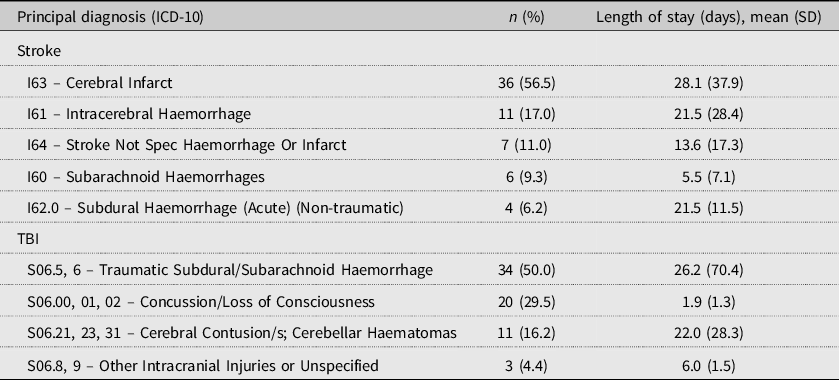
A range of ICD-10-CM principal diagnoses associated with stroke and TBI were documented. A summary of principal diagnoses and subsequent length of stay are presented in Table 2. Cerebral infarct was the most common principal diagnosis for stroke. Traumatic subdural or subarachnoid haemorrhage was the most common principal diagnoses for TBI, followed by concussion or loss of consciousness. The mean length of stay for patients was 25.4 days and 19.4 days for stroke and TBI, respectively. Length of stay for patients admitted with TBI specifically due to concussion or loss of consciousness was 1.9 days.
Summary of stroke and traumatic brain injury (TBI) principal diagnoses and subsequent length of stay (N = 132)

Severity and TBI mechanism of injury
The average GCS for stroke and TBI patients on admission was 13 and 12, respectively. The most common mechanisms of injury associated with TBI were assault (n = 33; 48.5%) and falls (n = 22; 32.3%), whereas high velocity-related injuries accounted for 8.8% of TBIs.
Medical history
The 10 most commonly reported health or medical co-morbidities for the patients are summarised in Fig. 1. Hypertension (HTN) (n = 40; 62.5%), cardiac conditions (n = 32; 50%) and metabolic disorders (including diabetes) (n = 32; 50%) were the most frequently occurring health or medical co-morbidities for stroke patients. A background of ethyl alcohol (ETOH) consumption (n = 35; 51.4%) was the most commonly reported health or medical co-morbidity for TBI patients. Overall, medical multi-morbidity was very common for all patients. More than 90% of stroke patients and 50% of TBI patients presented with two or more medical co-morbidities.
Ten most prevalent health or medical co-morbidities.
Note: CKD, chronic kidney disease; ESRF, end stage renal failure; CVA, cerebrovascular accident; TIA, transient ischaemic attack; COPD, chronic obstructive pulmonary disease; SOB, shortness of breath; OSA, obstructive sleep apnoea; AAA, abdominal aortic aneurysm; CAGB, coronary artery bypass graft; AF, atrial fibrillation; IHD, ischaemic heart disease; CCF, congestive cardiac failure; NSTEMI, non-ST evaluation myocardial infarction; ETOH, ethanol; HTN, hypertension. From NSW Government (2016).

Geographical origin
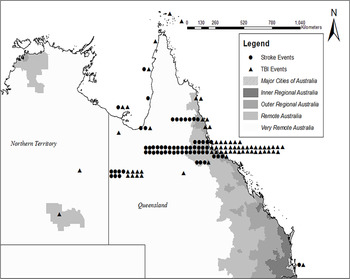
Patients were from 26 diverse home locations across Queensland and the Northern Territory, including 10 communities where the population is predominantly Aboriginal and/or Torres Strait Islander. Geographical regions of Australia are divided into five remoteness classes based on parameters such as the physical distance of a location from the nearest urban centre, population size and relative access to services in those geographical locations (ABS, 2016a). As outlined in Fig. 2, the majority of patients in this study were from Outer Regional Australia (n = 85; 64.4%). A large proportion of patients (n = 43; 32.6%) were from Remote or Very Remote Australian locations. Overall, 44% (n = 58) of patients arrived at the hospital via inter-hospital transfer from a regional, rural or remote hospital within the hospital’s catchment area.

Discussion
To our knowledge, this is the first study that documents the clinical profile of Aboriginal and Torres Strait Islander adults admitted to a regional Queensland hospital with the principal diagnosis of stroke or TBI. The patients had extensive cultural and geographic diversity and the majority presented with medical multi-morbidities. The stroke patients were significantly younger in age compared with the wider Australian population, and assault was the main mechanism of injury for TBI. All patient’s language backgrounds were recorded as English only.
Aboriginal and Torres Strait Islander patients came from diverse cultural and geographic backgrounds. While the majority of patients identified as being Aboriginal, some individuals identified as being both Aboriginal and Torres Strait Islander or solely from a Torres Strait Islander background. Immense diversity exists between and within Australia’s Aboriginal and Torres Strait Islander peoples. There are distinctive cultural, ethnic and language differences between and within these populations, and people may identify with different tribal, clan, regional or language groups (Taylor & Guerin, Reference Taylor and Guerin2014). For example, different groups may have differing beliefs, values, cultural practices and languages (Queensland Health, 2010, 2014). Health care needs may also differ across urban, remote and discrete Aboriginal and Torres Strait Islander communities (Queensland Health, 2010, 2014). Health professionals must recognise and acknowledge these aspects of diversity and tailor their services to ensure culturally secure practice and that the unique values, cultural needs and rights of Aboriginal and Torres Strait Islander peoples are met (Armstrong et al., Reference Armstrong, Coffin, McAllister, Hersh, Katzenellenbogen, Thompson and Hayward2019; Fitts et al., Reference Fitts, Bird, Gilroy, Fleming, Clough, Esterman and Bohanna2019; Hersh et al., Reference Hersh, Armstrong, McAllister, Ciccone, Katzenellenbogen, Coffin and Woods2019; Queensland Health, 2010, 2014; Taylor & Guerin, Reference Taylor and Guerin2014). Failure to do so may lead to patient dis-engagement in the health service, negative emotions and poorer health outcomes for Aboriginal and Torres Strait Islander peoples, particularly those who experience stroke and TBI, and subsequent acquired communication disorders (Armstrong et al., Reference Armstrong, Coffin, McAllister, Hersh, Katzenellenbogen, Thompson and Hayward2019; Fitts et al., Reference Fitts, Bird, Gilroy, Fleming, Clough, Esterman and Bohanna2019; Hersh et al., Reference Hersh, Armstrong, McAllister, Ciccone, Katzenellenbogen, Coffin and Woods2019; Katzenellenbogen et al., Reference Katzenellenbogen, Sanfilippo, Hobbs, Knuiman, Bessarab, Durey and Thompson2013).
As well as considering cultural diversity, the review highlighted the need to consider linguistic diversity. The 26 different home locations potentially represented a great diversity in languages or dialects. To highlight this linguistic diversity, three traditional languages and six different creoles are spoken by Torres Strait Islander peoples alone depending on their cultural heritage (State Library of Queensland, 2005). Despite this diversity, language background was recorded in their medical record as English only for all patients. This is likely inaccurate as potentially many of the patients in this study were bilingual or multilingual. The absence of any data recording languages other than English potentially demonstrates a gap in the hospital admissions process, inadequate information seeking by health professionals or health professionals’ lack of knowledge and awareness regarding Indigenous Australian languages. Non-Indigenous Australian health professionals may also lack knowledge and understanding about these languages and therefore may risk misdiagnosis of the patient’s language difference with a language or cognitive disorder (Armstrong et al., Reference Armstrong, Coffin, McAllister, Hersh, Katzenellenbogen, Thompson and Hayward2019). Another confounding factor may have been that the language was not a code selection option in the hospital data management system. However, a number of the Indigenous Australian languages commonly spoken by patients from the geographical areas in this study are included as code options in the hospital’s data management system, for example Torres Strait Creole and the Wik languages spoken in the Cape York and Gulf of Carpentaria areas of Queensland (Queensland Government, 2019). This would suggest then that a diverse range of Indigenous Australian languages are in fact available as language background code options to be recorded in a patient’s chart; however, these languages were not selected. Health services need to ensure that languages spoken in a region are listed in the health service’s data management system and health professionals must advocate for this need in order to identify possible disparities in health care (López, Green, Tan-McGrory, King, & Betancourt, Reference López, Green, Tan-McGrory, King and Betancourt2011; Morgan, Harris, Gidgup, & Whitely, Reference Morgan, Harris, Gidgup and Whitely2019). Acknowledging language diversity and practicing good intercultural communication are important for the provision of responsive, patient-centred and culturally safe practice, and failure to do so may be seen as a lack of respect (Hersh et al., Reference Hersh, Armstrong, McAllister, Ciccone, Katzenellenbogen, Coffin and Woods2019; Morgan et al., Reference Morgan, Harris, Gidgup and Whitely2019; Queensland Health, 2014). If a patient’s language background is not recognised and documented, they may be disadvantaged in terms of access to culturally responsive services, such as interpreters (López et al., Reference López, Green, Tan-McGrory, King and Betancourt2011).
Prior to 2018, no Indigenous Australian language interpreter services were available in the Queensland public hospital system. In 2018, the Queensland Government partnered with a private interpreter service to provide interpreter services for five Queensland Indigenous Australian languages (2M Language Services, 2019). These five languages are primarily spoken by Torres Strait and northern Cape York Peninsula Aboriginal and Torres Strait Islander peoples where many of the patients included in this review resided. Whilst this is a positive initiative, adequate and accessible interpreter services are not yet available for the diverse range of Aboriginal and Torres Strait Islander languages and dialects spoken in Queensland. Similarly, general practitioners in Western Australia reported difficulties in accessing and using formal interpreting services for their Aboriginal clients and they tended to reply on patients’ family members for this practice (Hersh et al., Reference Hersh, Armstrong, McAllister, Ciccone, Katzenellenbogen, Coffin and Woods2019). More accurate recording of a patient’s language background is needed to continue to develop these important interpreter services. Further investigation into the uptake of these services, and the associated barriers and facilitators would be beneficial. For example, Ralph and colleagues found poor utilisation of Aboriginal interpreter services in the Northern Territory due to a number of barriers related to structure (e.g. limited accessibility to interpreters due to geographical challenges) and process (e.g. health professionals not identifying Indigenous languages spoken; complex interpreter booking processes) (Ralph et al., Reference Ralph, Lowell, Murphy, Butler, Spain, Hughes and Cass2017). The development and utilisation of interpreter services may assist in overcoming some of the communication difficulties experienced by Aboriginal and Torres Strait Islander patients and health professionals.
The challenges related to establishing and using accredited Australian Indigenous language interpreter services have been described by Kelly et al. (Reference Kelly, Dwyer, Pekarsky, Mackean, Willis, Battersby and Glover2012). In narratives with hospital staff, Aboriginal patients were potentially denied access to surgery as the patients were unable to provide informed consent due to the lack of an accredited interpreter service (Kelly et al., Reference Kelly, Dwyer, Pekarsky, Mackean, Willis, Battersby and Glover2012). Additionally, Aboriginal patients preferred to have access to a familiar interpreter, such as a family member or known health worker (Kelly et al., Reference Kelly, Dwyer, Pekarsky, Mackean, Willis, Battersby and Glover2012). Poor intercultural communication may compromise patient’s health and health outcomes due to miscommunication and inappropriate information to make informed decisions, particularly those who have experienced stroke or TBI (Armstrong et al., Reference Armstrong, Coffin, McAllister, Hersh, Katzenellenbogen, Thompson and Hayward2019; Fitts et al., Reference Fitts, Bird, Gilroy, Fleming, Clough, Esterman and Bohanna2019; Katzenellenbogen et al., Reference Katzenellenbogen, Sanfilippo, Hobbs, Knuiman, Bessarab, Durey and Thompson2013; Queensland Health, 2014). Language and cultural difference between the patient and the health professional, along with culturally insensitive practices, have been identified by Australian Aboriginal and Torres Strait Islander patients as having a negative effect on their well-being and health outcomes (Armstrong et al., Reference Armstrong, Coffin, McAllister, Hersh, Katzenellenbogen, Thompson and Hayward2019; Aspin, Brown, Jowsey, Yen, & Leeder, Reference Aspin, Brown, Jowsey, Yen and Leeder2012; Fitts et al., Reference Fitts, Bird, Gilroy, Fleming, Clough, Esterman and Bohanna2019; Hersh et al., Reference Hersh, Armstrong, McAllister, Ciccone, Katzenellenbogen, Coffin and Woods2019).
As well as the complexity stemming from diverse cultural and linguistic profiles, diversity of geographical origin is another factor that may make delivery of health care more complex. Patients were primarily from outer regional, remote or very remote geographical locations which likely contributed to the large proportion of patients arriving at the hospital via road or air inter-hospital transfer. This geographical diversity means that patients may have experienced dislocation from home, family and their community to receive the necessary specialised health care and neurology services that were likely not available near their home (Queensland Government, 2017; Queensland Health, 2014).
This dislocation may have negatively impacted patients’ health and well-being. Disempowerment and a sense of loss due to dislocation from home and country to access renal dialysis services in metropolitan locations have been previously reported by Aboriginal renal patients living in remote areas of Western Australia (Burnette & Kickett, Reference Burnette and Kickett2009). Similar dislocation challenges were reported by Aboriginal TBI patients in Western Australia who needed to travel away from country and family to metropolitan areas to access rehabilitation services (Armstrong et al., Reference Armstrong, Coffin, McAllister, Hersh, Katzenellenbogen, Thompson and Hayward2019). Family members may also become dislocated from country and family when providing care and support for patients (Armstrong et al., Reference Armstrong, Coffin, McAllister, Hersh, Katzenellenbogen, Thompson and Hayward2019). Additionally, tyranny of distance may contribute to poorer neurological outcomes for the patient due to delays in accessing time critical medical interventions. For example, the Stroke Foundation (2019) recommends that thrombolysis treatment should be provided within 4.5 hours following the onset of stroke symptoms. In the current study, more than half of the stroke admissions were due to ischaemic stroke. For many of the Aboriginal and Torres Strait Islander ischaemic stroke patients in this study, and similarly for other patient groups in rural areas, it is likely that this evidence-based treatment was not an option due to the lengthy timeframes associated with the inter-hospital transfer process. Transport and coordination of care issues have also been highlighted by rural Aboriginal patients needing to travel long distances to access urban hospital care in South Australia (Kelly, Dwyer, Willis, & Pekarsky, Reference Kelly, Dwyer, Willis and Pekarsky2014). In this case, the lengthy travel requirements negatively impacted patients’ health and well-being, in particular patients arriving at hospital “exhausted and stressed” (Kelly et al., Reference Kelly, Dwyer, Willis and Pekarsky2014, pp. 111).
In the current study, Aboriginal and Torres Strait Islander adults with stroke were approximately 20 years younger (56.7 years) than the median age of 77 years for all Australian stroke populations previously reported from the Australian Stroke Clinical Registry (Cadilhac et al., Reference Cadilhac, Kilkenny, Levi, Lannin, Thrift, Kim and Anderson2017). Similarly, the mean age of Indigenous Australian stroke patients admitted to a NSW rural hospital was 56.8 years (Tiedeman, Suthers, Julien, Hackett, & Oakley, Reference Tiedeman, Suthers, Julien, Hackett and Oakley2019). However Aboriginal stroke patients from rural South Australian regions were younger with a reported median age of 51 years (Balabanski et al., Reference Balabanski, Newbury, Leyden, Arima, Anderson, Castle and Kleinig2018). The prevalence of stroke risk factors and multi-morbidity, such HTN, cardiac disease, metabolic disorders including diabetes, lipid disorders and previous stroke may have contributed to the incidence of stroke in young Aboriginal and Torres Strait Islander adults (AIHW, 2018; Katzenellenbogen et al., Reference Katzenellenbogen, Knuiman, Sanfilippo, Hobbs and Thomson2014).
The younger age of admission and the presence of multiple medical co-morbidities indicate likely impacts on access to, and participation in education, employment, life roles and social activities. Additionally, the impact of the stroke may be secondary to other health matters such as renal disease. These complex health factors may present challenges for health professionals during the rehabilitation and discharge planning processes. Patients may be less able to actively participate in rehabilitation in the acute hospital setting due to competing medical priorities such as needing to attend dialysis that may result in the patient not receiving adequate rehabilitation for stroke-related outcomes such as mobility or communication impairments. Subsequent challenges may arise during the discharge process where patients may be transferred back to the health service within their home location for ongoing healthcare. However, in many instances, the health service available in those locations, particularly those located in rural and remote areas, is not comparable with the services provided at the tertiary centre and access to some rehabilitation services (e.g. allied health services) is limited. This therefore may negatively impact a person’s recovery and their ongoing health and well-being (AIHW, 2018; Thomas, Wakerman, & Humphreys, Reference Thomas, Wakerman and Humphreys2015).
Patients’ cultural, linguistic and geographical diversity, as well as potential medical multi-morbidities and causal factors, may also be challenging for health professionals when providing services to patients with TBI. In this study, higher hospital admission rates due to TBI for Aboriginal and Torres Strait Islander males than females are consistent with nationally reported data (AIHW, 2019). Assault was the primary mechanism of TBI and is consistent with previously reported Australian data (Katzenellenbogen et al., Reference Katzenellenbogen, Atkins, Thompson, Hersh, Coffin, Flicker and Armstrong2018; Jamieson et al., Reference Jamieson, Harrison and Berry2008). TBI hospital admissions due to assault, including hospitals in metropolitan areas, in Indigenous Australian populations have been reported to be up to 21 times more likely than in non-Indigenous Australian populations (Jamieson et al., Reference Jamieson, Harrison and Berry2008). Whilst Jamieson et al. (Reference Jamieson, Harrison and Berry2008) paper a study of hospital admissions, the population was different to the current study and it included all ICD-10-CM codes related to head injury (S00 – S009), whereas our study only focused on the S06 TBI code. In comparison, falls and transport accident-related injuries are the most commonly reported mechanisms of injury for TBI for all Australian populations (AIHW, 2008). Higher TBI incidence in Aboriginal and Torres Strait Islander male populations, as well as the increased likelihood of a TBI caused by assault, may be related to the high proportion of patients from geographically remote areas, those who may be socio-economically disadvantaged and/or those who have a background of alcohol consumption or mental health conditions (Boufous, Ivers, Senserrick, & Martiniuk, Reference Boufous, Ivers, Senserrick and Martiniuk2010; Esterman et al., Reference Esterman, Thompson, Fitts, Gilroy, Fleming, Maruff and Bohanna2018; Jamieson et al., Reference Jamieson, Harrison and Berry2008; Katzenellenbogen et al., Reference Katzenellenbogen, Atkins, Thompson, Hersh, Coffin, Flicker and Armstrong2016). Social circumstances such as remoteness and socio-economic disadvantage have been reported to correlate with increased risk of TBI in Aboriginal and Torres Strait Islander populations (Boufous et al., Reference Boufous, Ivers, Senserrick and Martiniuk2010; Esterman et al., Reference Esterman, Thompson, Fitts, Gilroy, Fleming, Maruff and Bohanna2018; Jamieson et al., Reference Jamieson, Harrison and Berry2008; Katzenellenbogen et al., Reference Katzenellenbogen, Atkins, Thompson, Hersh, Coffin, Flicker and Armstrong2016). These social complexities may present additional challenges for health professionals, particularly in relation to patient safety and discharge planning.
Of interest in our data is the relatively high percentage of patients admitted due to likely concussion or loss of conscious and their subsequent short length of stay in hospital (mean stay of 1.9 days). Similarly, a national report indicated a length of stay range of 1.4 to 2.5 days for patients who sustained a concussion or a brief loss of consciousness (Helps, Henley, & Harrison, Reference Helps, Henley and Harrison2008). These patients likely presented with a mild TBI, and evidence suggests that a person may experience a range of short- and long-term consequences of mild TBI result including symptoms of depression and anxiety, sleep disorders, mood and behavioural changes, as well as cognitive challenges such as memory (Barker-Collo et al., Reference Barker-Collo, Jones, Theadom, Starkey, Dowell and McPherson2015). Given these ongoing likely significant effects on health and well-being, ensuring patients with mild TBI are adequately assessed and monitored post discharge by a range of health professionals including allied health appears to be a priority. While discharge against medical advice has been reported as a key reason for relatively short length of hospital stays for Aboriginal and Torres Strait Islander populations (Fitts et al., Reference Fitts, Bird, Gilroy, Fleming, Clough, Esterman and Bohanna2019), data related to this challenge were not collected in this study and the length of stay data collected in this study is consistent with previously reported national data for mild TBI (Helps et al., Reference Helps, Henley and Harrison2008).
Limitations
The major limitations to this study were that the data were drawn from one hospital and no direct comparisons were made to non-Aboriginal and Torres Strait Islander adult admissions with the principal diagnoses of stroke or TBI. It is not clear whether these results are consistent with Aboriginal and Torres Strait Islander adult stroke or TBI hospital admissions in other Australian locations. A larger data set over a longer period of time would also have been beneficial to more comprehensively report data and make statistical inferences.
Conclusions
This study provides previously unreported insights into the clinical profiles of Aboriginal and Torres Strait Islander adults admitted to a regional Queensland hospital due to stroke or TBI. The gender, ages and medical co-morbidities of the stroke and TBI patients were largely consistent with previously reported data. Study findings highlighted the immense cultural and geographic diversity of these patients that potentially means these patients may have experienced feelings of dislocation from home and country, as well as potential delays in receiving treatment. Language diversity was not recorded which does not align with responsive and culturally safe healthcare practices. Additionally, the failure to adequately document a patient’s language background potentially denies them access to culturally responsive services, such as interpreters. Due to the immense diversity of Aboriginal and Torres Strait Islander peoples and the differences in health care provision across Australia, further research should explore similar aspects of clinical profiles for these populations across different regions of Australia so health professionals can obtain a sense of local issues that may impact upon their capacity to provide culturally responsive care. Further understanding these challenges may enable health professionals to address these in a more culturally responsive manner.
Financial support
This research received no specific grant from any funding agency, commercial or not-for-profit sectors.
Conflict of interest
None.
Ethical standards
Ethics approval were granted by the Human Research Ethics Committee for QLD Health (HREC/17/QTHS/101) and Griffith University (2018/659). The authors assert that all procedures contributing to this work comply with the ethical standards of the relevant national and institutional committees on human experimentation and with the Helsinki Declaration of 1975, as revised in 2008.