Introduction
The Antarctic benthos hosts a great diversity of amphipods that display a wide range of feeding habits including necrophagy, carnivory, herbivory, suspension feeding, detritivory, and omnivory (Richardson Reference Richardson1977, Coleman Reference Coleman1991, Jażdżewski et al. Reference Jażdżewski, Teodorczyk, Sicinski and Kontek1991, De Broyer & Jażdżewski Reference De Broyer and Jażdżewski1996, Iken et al. Reference Iken, Quartino, Barrera-Ora, Palermo, Wiencke and Brey1998, Dauby et al. Reference Dauby, Scaliteur and De Broyer2001, Lippert et al. Reference Lippert, Iken, Rachor and Wiencke2001, Takeuchi & Watanabe Reference Takeuchi and Watanabe2002, Huang Reference Huang2006, Huang et al. Reference Huang, Amsler, McClintock, Amsler and Baker2007). Many of these amphipod species occur in extremely high densities. For example, Huang et al. (Reference Huang, Amsler, McClintock, Amsler and Baker2007) found collective mean densities of gammarid amphipods ranged up to 20 individuals g-1 algal wet wt in association with the ecologically dominant macroalga Desmarestia menziesii J. Agardh on the western Antarctic Peninsula. If these amphipod densities are integrated with the biomass of this common alga in the same region (Amsler et al. Reference Amsler, Rowley, Laur, Quetin and Ross1995), estimated amphipod densities may attain levels as high as 308 000 individuals m-2 (Amsler et al. Reference Amsler, McClintock and Baker2008). Thus, macroalgal-associated amphipods may play locally significant roles in nutrient and energy flow within Antarctic Peninsula nearshore communities either by direct consumption of select species of macroalgae (Huang et al. 2006) or indirectly as grazers of endo- and epiphytic algae living in association with macroalgae (Amsler et al. Reference Amsler, Amsler, Mcclintock and Baker2009).
In a similar way to macroalgae, sponges may serve as habitat and provide a variety of prospective resources to amphipods (Biernbaum Reference Biernbaum1981). These resources may include providing direct or indirect sources of nutrition (Oshel & Steele Reference Oshel and Steele1985, Crowe & Thomas Reference Crowe and Thomas2002, Ribeiro et al. Reference Ribeiro, Omena and Muricy2003, Lörz & De Broyer Reference Lörz and De Broyer2004), structural or chemical refuge from predation (Huang et al. Reference Huang, McClintock, Amsler and Huang2007, Reference Huang, Amsler, McClintock, Amsler and Baker2008), or as sites for reproduction (Thiel Reference Thiel2000). Sponge-associated amphipods have been described from temperate and tropical latitudes (e.g. Frith Reference Frith1977, Biernbaum Reference Biernbaum1981, Vader Reference Vader1984, Costello & Myers Reference Costello and Myers1987, Poore et al. Reference Poore, Watson, De Nys, Lowry and Steinberg2000, Thiel Reference Thiel2000) and from polar deep water trawl samples (Kunzmann Reference Kunzmann1996, De Broyer et al. Reference De Broyer, Scailteur, Chapelle and Rauschert2001, Lörz Reference Lörz2001). Nonetheless, little is known about the extent to which amphipods may occur in association with or consume Antarctic sponges, particularly in nearshore, relatively shallow communities. This information is of particular ecological importance, because sponges may cover up to 55% of the Antarctic benthos (Koltun Reference Koltun1970, Dayton et al. Reference Dayton, Robilliard, Paine and Dayton1974) and are key players in Antarctic benthic community ecology (Dayton et al. Reference Dayton, Robilliard, Paine and Dayton1974, Dayton Reference Dayton1979, Reference Dayton1989, reviewed in McClintock et al. Reference McClintock, Amsler, Baker and Van Soest2005).
The marine benthos along the western Antarctic Peninsula is regionally rich in both sponges (McClintock et al. Reference McClintock, Amsler, Baker and Van Soest2005, Lockhart & Jones Reference Lockhart and Jones2008) and amphipods (Jażdżewski et al. Reference Jażdżewski, Teodorczyk, Sicinski and Kontek1991, Huang et al. Reference Huang, Amsler, McClintock, Amsler and Baker2007). This makes an understanding of amphipod-sponge interrelationships important in determining factors that influence the ecology of these biologically diverse sea floor communities. The objectives of the present study were to: i) conduct a quantitative analysis of the abundance and diversity of amphipods occurring in association with a broad suite of common Antarctic sponges, ii) indirectly evaluate, through gut content analyses, whether sponge-associated amphipods may be directly consuming sponges, and iii) determine in laboratory feeding assays whether Antarctic sponges possess secondary metabolites that may serve as amphipod feeding deterrents using a common sympatric omnivorous amphipod as a model consumer.
Materials and methods
Collection and quantification of sponge-associated amphipods
Twelve species of common demosponges were investigated for their amphipod associates. These included Clathria flabellata Topsent, Artemisina plumosa Hentschel, Artemisina sp., Calyx arcuaris Topsent, Crella sp., Dendrilla membranosa Pallas, Haliclonissa verrucosa Burton, Hymeniacidon torquata Topsent, Isodictya erinacea Topsent, Isodictya lankesteri (Kirkpatrick), Lissodendoryx ramilobosa Topsent, and Suberites caminatus Ridley & Dendy. Three replicates of each sponge species were collected using SCUBA at depths ranging from 5–40 m in March–May 2007 within 3.5 km of Palmer Station, on the central western Antarctic Peninsula (64°46′S, 64°04′W; cf. Amsler et al. Reference Amsler, Rowley, Laur, Quetin and Ross1995 for map). The 12 sponge species examined in this study were selected randomly from the total of 22 common sponge species known to occur in the vicinity of Palmer Station.
Sponges, or portions thereof, were quickly and gently dislodged from the substrate and immediately placed into a fine mesh (mesh size < 0.5 mm) collecting bag to retain mesofaunal associates. It was not possible to standardize the sizes of sponge samples collected in the field as there was some variation caused by differences in sponge morphology (e.g. crusts versus erect masses). However, preliminary analysis revealed that sponges or pieces of sponges that measured approximately 350 cm3 provided a suitable sample for analysis without being so large as to be impractical to thoroughly sample.
Each sponge sample was first weighed (wet wt), the volume determined by seawater displacement, and then broken into smaller portions and each piece subject to meticulous dissection under a dissecting microscope. All sponge-associated mesofauna were collected and identified to the lowest taxon possible. Amphipod identification was facilitated by our previous studies of the local taxa (Huang et al. Reference Huang, Amsler, McClintock, Amsler and Baker2007), as well as by the use of taxonomic keys (Thurston Reference Thurston1972, Reference Thurston1974, Barnard & Karaman Reference Barnard and Karaman1991). Sponge mesofaunal samples were dominated by amphipods and we chose not to enumerate or identify any sponge-associated fauna other than amphipods.
Amphipod spongivory
As a qualitative proxy for the consumption of sponges the presence of sponge spicules in the guts of amphipods (see Kunzmann Reference Kunzmann1996) collected in association with the sponges was determined. Guts of up to five individuals of each species of amphipod were dissected following the procedure of Dauby et al. (Reference Dauby, Scaliteur and De Broyer2001). Briefly, the digestive tracts of freshly collected individuals were cut at the oesophagus level, extracted from the body, opened, the contents spread on a glass slide, and examined with phase contrast on a compound microscope. Although one of the sponges, Dendrilla membranosa, lacks spicules, the guts of its associated amphipods were inspected nonetheless.
Sponge palatability bioassay - preparation of crude organic sponge extracts
To determine the extent to which secondary metabolites influence the palatability of sponges to amphipods, both lipophilic and hydrophilic organic extracts of each sponge species were prepared using the techniques described in Huang et al. (Reference Huang, McClintock, Amsler and Huang2008). Briefly, sponges were lyophilized and then a small known mass of freeze-dried sponge tissue soaked in three 24 h exchanges of dichloromethane:methanol solution (1:1) to yield a lipophilic extract. This was followed by three subsequent exchanges of methanol:water solution (1:1) to yield a hydrophilic extract. The extracts and their respective solvents were dried using a rotary evaporator and final masses determined. Ecologically relevant concentrations of extracts to be tested in alginate food disks were based on the ratio of the mass of the final crude sponge extract to the wet mass of the sponge sample extracted. The extracts were incorporated into artificial foods such that the concentration of extract per unit wet wt was the same in the artificial foods as in the original sponge extract.
Additionally, the lipophilic extract (8.2 g) of Dendrilla membranosa was subjected to flash chromatography on a silica column to generate nine fractions, A through I. The fractions were eluted with a stepwise gradient of hexane (A), hexane:ethyl acetate (8:2, 6:4, 4:6, 2:8; B–E, resp.), ethyl acetate (F), ethyl acetate:methanol (2:8, 1:1; G & H), and methanol (I). Fractions A and B were combined resulting in eight total fractions which were subjected to amphipod palatability assays as described above at ecologically relevant concentrations.
Amphipod feeding bioassays
Alginate food disks with and without sponge extracts or fractions for amphipod bioassays were prepared according to the techniques described in Amsler et al. (Reference Amsler, Iken, McClintock, Amsler, Peters, Hubbard, Furrow and Baker2005). First, natural concentrations of solvent-dissolved sponge extracts were coated onto freeze-dried krill powder, dried using a rotary evaporator, and then incorporated at 2% dry wt into a 2% alginate matrix. The krill powders were placed into 10 cm diameter plastic Petri dishes. Cold alginate solution was added to the dishes, mixed thoroughly with the food stimulant, and then gelatinized using cold 1 M CaCl2. This yielded artificial food “pies” approximately 2 mm thick that were cut into 1 cm diameter disks with a cork borer. Control alginate food disks were prepared using the same technique but using krill powder treated with solvent.
The amphipod Gondogeneia antarctica Chevreux was selected for sponge extract and sponge fraction feeding bioassays because it is omnivorous, sponge spicules have been found in its gut (C. Aumack, personal communication 2008), it is abundant, and it survives well under laboratory culture conditions. Individuals were collected from macroalgae growing at 3–10 m depth using SCUBA at a variety of sites within 3.5 km of Palmer Station during February–March 2008. The most common algal source was the brown alga Desmarestia menziesii. All algae and associated amphipods were collected following the methods of Huang et al. (Reference Huang, Amsler, McClintock, Amsler and Baker2007). Individuals of G. antarctica were sorted from other algal-associated mesofauna and maintained in 4 L Nalgene bottles with mesh windows that facilitated water transfer while retaining amphipods. The amphipod bottles were floated in flow-through seawater aquaria at approximately 1°C.
In each experiment, ten replicate treatments consisting of one solvent control and one extract- or fraction-containing alginate disk were weighed and placed together into one of ten 250 ml Nalgene bottles. Each such experimental bottle contained 20 adult individuals of G. antarctica. Disks cut from the artificial food immediately next to those used as solvent control and extract-containing disks were placed into ten bottles without amphipods to serve as paired, autogenic controls. Amphipods were allowed to feed on the disks until an appreciable mass of either had been consumed. The disks were then re-weighed. Consumption was calculated as the initial weight multiplied by the ratio of the final:initial wet weights of the paired autogenic control disks minus the final weight of the experimental disk.
Statistical analyses
Mean total abundances of amphipods were compared between sponge species by analysis of variance (ANOVA). Since count data tend to be distributed as Poisson, rather than normal, the total amphipod counts per L sponge were square root transformed prior to analysis  . Post hoc means comparisons were done using Tukey HSD tests. Shannon diversity indices (H’ using natural logarithms) were calculated for all sponge samples that contained at least one amphipod (34 out of the 36 samples). The Kruskal-Wallis test was used to investigate the significance of differences in diversity indices between sponge species. ANOVAs and Kruskal-Wallis tests were done using SYSTAT v.11 (SYSTAT Software, Richmond, CA). Similarities in amphipod communities found in each sponge were investigated with cluster analysis using PRIMER software (v.6, Primer-E Ltd, Plymouth, UK). Two sponge samples (Crella sp. and Suberites caminatus) with no amphipods were excluded. Amphipod abundance data (amphipods per L) were square root transformed and a Bray-Curtis similarity matrix calculated which quantified the degree of similarity in amphipod communities between each pair of sponge samples. The similarity values were used to perform group average linkages in a hierarchical, agglomerative clustering algorithm to create a dendrogram. The compositions of the amphipod communities were compared between sponge species by pooling all amphipods occurring in each species and then comparing the aggregate communities pair-wise between sponge species using the analysis of similarities (ANOSIM) test in PRIMER. The significance of differences between amphipod feeding rates on control and extract- or fraction-containing feeding disks was determined using Wilcoxon signed-rank tests (Peterson & Renaud Reference Peterson and Renaud1989) with SPSS software (SPSS Inc, Chicago, IL).
Results
Quantitative analysis of sponge associated amphipods
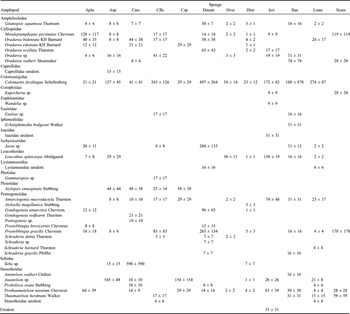
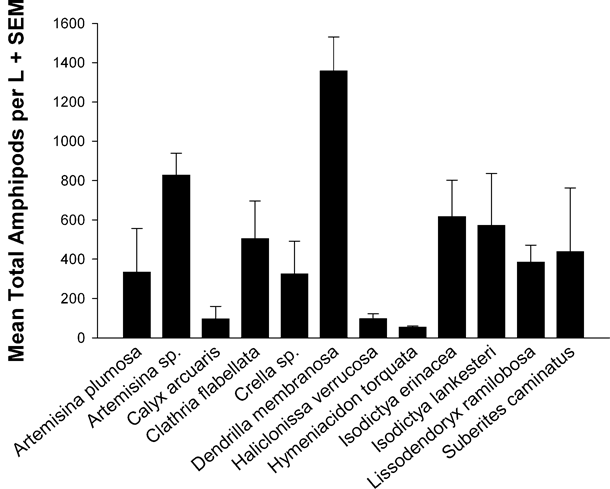
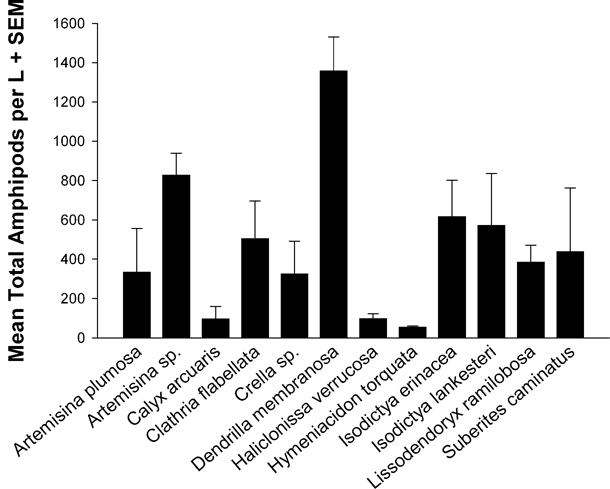
Standardized mean ± 1 s.e. abundances of each amphipod species (number per L sponge) associated with each of the 12 species of sponges are presented in Table I. Mean densities of a given species of amphipod associated with a given sponge species ranged from 0 to 590 L-1. Mean total cumulative abundances of amphipods (abundance of all species combined) per unit sponge biomass for each sponge species ranged from 56 to 1360 amphipods per L (Fig. 1). One of the samples of the sponge species, Calyx arcuaris, contained an inordinately large number of amphipods compared to the other two samples from that species (studentized residual = 3.624). This extreme value produced significant heterogeneity of variances between sponge species (Levene’s test), even after transformation, and so inflated the estimate of within-group variance that the ANOVA comparing means was non-significant. Elimination of this single outlier reduced the heterogeneity of variances to non-significance and resulted in a significant ANOVA (P = 0.018). Tukey HSD post hoc comparisons showed significant differences in mean total amphipod counts per L between Dendrilla membranosa and Hymeniacidon torquata, and between D. membranosa and Haliclonissa verrucosa (Fig. 1).
Standardized mean ± 1 s.e. abundances of each amphipod species (number per liter wet sponge mass) associated with each of the 12 species of sponges. Sponge species abbreviations: Artemisina plumosa (Aplu), Artemisina sp. (Asp), Calyx arcuaris (Carc), Clathria flabellata (Cfla), Crella sp. (Csp), Dendrilla membranosa (Dmem), Haliclonissa verrucosa (Hver), Hymeniacidon torquata (Htor), Isodictya erinacea (Ieri), Isodictya lankesteri (Ilan), Lissodendoryx ramilobosa (Lram), Suberites caminatus (Scam). Amphipod nomenclature according to De Broyer et al. Reference De Broyer, Lowry, Jażdżewski and Robert2007.

Mean number of total amphipods found in each sponge species (n = 3 per species except Calyx arcuaris, n = 2).
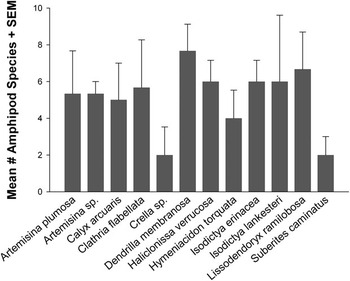
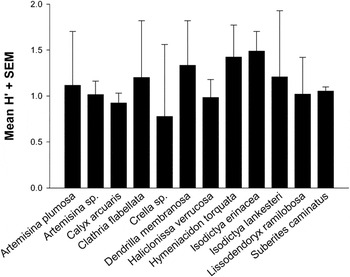
Thirty-eight species of amphipods were found in association with at least one or more of the 12 species of sponges examined (Table I). Mean numbers of amphipod species associating with sponges ranged from approximately two to eight species (Fig. 2), with the largest mean number of amphipod species occurring in association with Dendrilla membranosa. In contrast, a mean of only two species were found in association with Crella sp. and Suberites caminatus as one individual of each sponge species was devoid of amphipods (Fig. 2). Most sponge species (75%) were found to harbour a mean of between four to six amphipod species. The amphipod Colomastix fissilingua Schellenberg was the most ubiquitous species, occurring in association with 11 of the 12 sponge species examined. It was found in particularly high abundance in association with D. membranosa (mean = 497 individuals per L sponge) and Clathria flabellata (mean = 243 per L sponge). However, due to high variation between sponge replicates there were no significant differences (P = 0.446) in mean numbers of amphipod species associated with any of the sponge species (Fig. 2). Mean Shannon diversity indices (H’) ranged from 0.52 to 1.49 and followed the same pattern with high between replicate variability resulting in no significant (P = 0.97) differences in amphipod species diversity between sponges (Fig. 3).
Mean number of amphipod species found in each sponge species.

Mean Shannon diversity index (H’) values for each sponge species. Two sponge samples (Crella sp. and Suberites caminatus) with no amphipods were excluded.

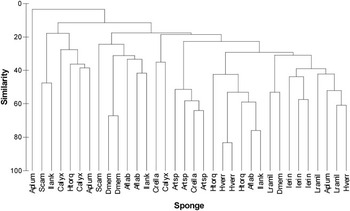
The cluster dendrogram analysis revealed no tendency for replicate samples of a sponge species to cluster together (Fig. 4). Thus, there was no indication of distinct sponge species specific amphipod community associations. This was corroborated by the results of pairwise tests of the significance of difference in amphipod communities between sponge species (ANOSIM). None of these tests were significant (P > 0.05).
Cluster dendrogram showing similarities and differences between the amphipod communities found in individual sponge samples. Two sponge samples (Crella sp. and Suberites caminatus) with no amphipods were excluded. See legend of Table I for definitions of sponge species abbreviations.

Amphipod gut content analysis
Qualitative assessment of spongivory via gut content analysis of amphipods revealed primarily diatoms, algal tissue or fragments of animal prey (copepods, other species of amphipods). Twelve of the 38 species of amphipods were found with spicules in their guts. Eleven of these 12 were found to have guts containing very small amounts of spicules (< 10% of gut contents by estimated volume). These included the amphipods Antarctogenia macrodacytyla Thurston, Eusirus sp., Metaleptamphopus pectinatus Chevreux, Oradarea bidentata K. H. Barnard, O. ocellata Thurston, O. walkeri Shoemaker, Prostebbingia bervicornis Chevreux, P. gracilis Chevreux, Pontogeneia sp., P. redfearni Thurston, and Schraderia dubia Thurston. Only one species, Echiniphimedia hodgsoni Walker, was found with its gut packed (> 75% of gut contents by estimated volume) with sponge spicules.
Amphipod feeding bioassays
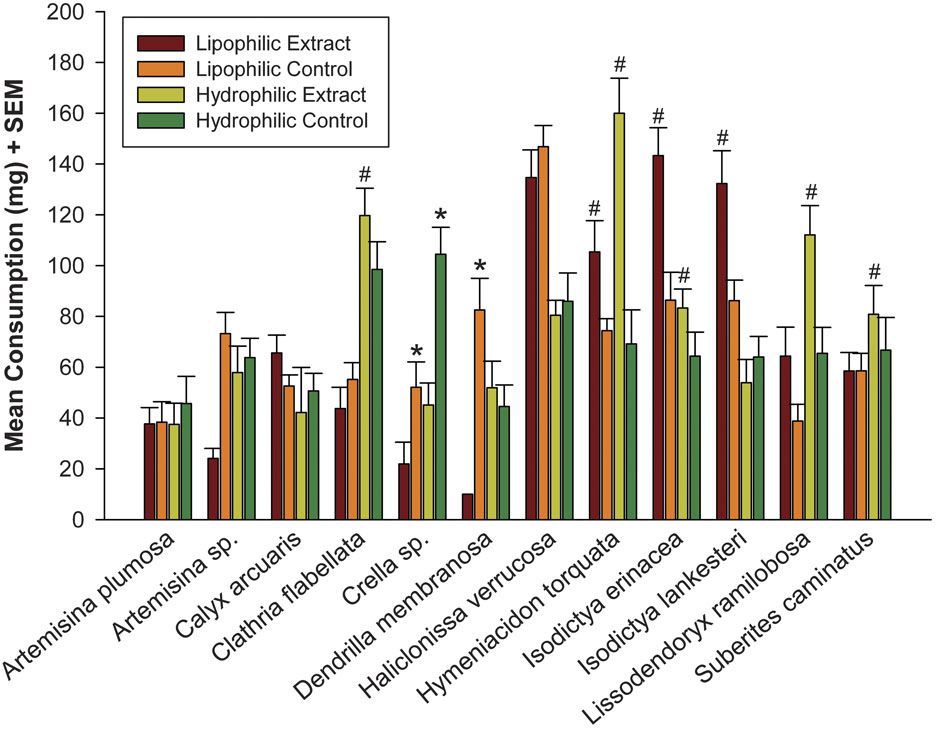
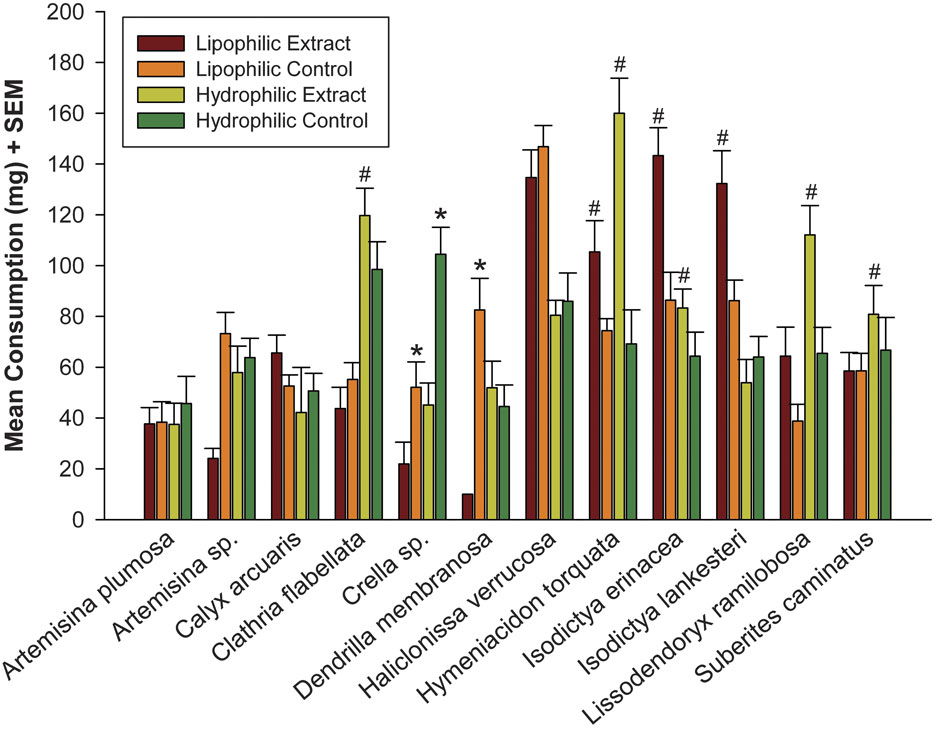
The omnivorous amphipod Gondogeneia antarctica displayed feeding deterrence against alginate food disks containing extracts of two of the 12 sponges examined (Fig. 5). Both the lipophilic and hydrophilic extracts of the encrusting sponge Crella sp. were significantly deterrent as was the hydrophilic extract of the sponge Dendrilla membranosa (P = 0.022). In contrast, G. antarctica showed significant feeding stimulations to food disks containing the lipophilic extract of Isodictya lankesteri, the hydrophilic extracts of Clathria flabellata, Lissodendoryx ramilobosa, Suberites caminatus and both extract types of Hymeniacidon torquata and I. erinacea (Fig. 5). Feeding stimulation by non-deterrent extracts is common in such bioassays with G. antarctica (Amsler et al. Reference Amsler, Iken, McClintock, Amsler, Peters, Hubbard, Furrow and Baker2005). No significant differences between amphipod consumption of control and sponge extract alginate food disks were found for either lipophilic or hydrophilic extracts from the sponges Haliclonissa verrucosa, Calyx arcuaris, Artemisina sp. and A. plumosa (Fig. 5).
Results of bioassays offering artificial foods containing lipophilic or hydrophilic sponge extracts to the sympatric amphipod Gondogeneia antarctica. Means ± standard error of mean. Asterisks indicate significant differences (P ≤ 0.05) between extract and control with controls significantly preferred to extracts. Symbols () indicate significant differences (P ≤ 0.05) between extract and control with extracts significantly preferred to controls. Based on Wilcoxon signed-ranks test.
Of the eight fractions derived from the lipophilic extract of Dendrilla membranosa disks from fractions AB (hexane) and C (hexane:ethyl acetate 8:2) were neither preferentially eaten nor rejected by the amphipods. The extract disk from fraction D (hexane:ethyl acetate 6:4) was preferred (P = 0.005) by the amphipods over the solvent control. Extract disks of the five remaining fractions were all significantly rejected (P = 0.013–0.005).
Discussion
Amphipod abundance, species richness and diversity
All twelve species of common Antarctic Peninsula sponges harboured amphipods. Mean abundances of amphipods per L sponge ranged 22-fold from 56 to 1360 individuals for the sponges Hymeniacidon torquata and Dendrilla membranosa, respectively. The mean overall abundance of amphipods was 542 per L sponge. Because of differences in sampling and sorting techniques, it is difficult to make direct comparisons with previous studies of amphipod abundances associated with marine sponges conducted in Antarctica (Kunzmann Reference Kunzmann1996, De Broyer et al. Reference De Broyer, Scailteur, Chapelle and Rauschert2001, Lörz Reference Lörz2001). However, several quantitative studies from tropical and temperate latitudes lend themselves to broad comparisons. Neves & Omena (Reference Neves and Omena2003) examined mesofauna associated with a suite of 13 tropical sponge species off the island of Rocas, a South Atlantic atoll. While polychaetes were found to be the dominant sponge associate, “crustaceans” were also found associated with 9 of the 13 (69%) of the sponge species examined. Presuming these “crustaceans” represented a significant percentage of amphipods (not uncommon for sponges in general), then amphipod abundances were of the same order of magnitude, yet about one-quarter of the densities found associated with Antarctic Peninsula sponges (mean = 130; range = 20–390 when converted to individuals per L; Neves & Omena Reference Neves and Omena2003). Huang et al. (Reference Huang, McClintock, Amsler and Huang2008) examined mesofauna associated with the sub-tropical/tropical sponge Amphimedon viridis Duchassaing & Michelotti in shallow seagrass habitats of the northern Gulf of Mexico. They found mean total densities of amphipods to be slightly less than we detected on the Antarctic Peninsula, with a mean of 398 individuals per L sponge. In temperate south-west Australia, Abdo (Reference Abdo2007) examined mesofauna associated with two closely related species of the sponge Haliclona and found a diverse associated mesofauna. However, Abdo detected very low mean densities of amphipods associated with each sponge species (18 and 44 individuals per L, respectively). These densities are more than an order of magnitude lower than for sponges along the Antarctic Peninsula. In yet another study conducted in temperate Australia, Poore et al. (Reference Poore, Watson, De Nys, Lowry and Steinberg2000) examined amphipods associated with 12 species of sponges in Botany Bay, New South Wales. They found amphipod densities and associations varied across sponge species. For example, the amphipods Icilius australis Haswell and Ausatelson sp. attained densities of 90 and 955 L-1 (converted from individuals per gram wet mass) for Callyspongia sp. The sponge Phorbus sp. lacked any Ausatelson sp. but it did harbour 500 individuals per L of I. australis.
In the present study, the abundances of individual amphipod species found occurring in association with a given sponge species were generally low (< 100 L-1). The highest densities included Colomastix fissilingua associated with Clathria flabellata, Dendrilla membranosa, and Lissodendoryx ramilobosa (means = 243, 497, and 274 L-1, respectively), Prostebbingia gracilis associated with D. membranosa and Suberites caminatus (means = 265 and 178 L-1, respectively), and Jassa sp. associated with D. membranosa (mean = 261 L-1).
While the sponge-associated mesofaunal studies summarized above all reported a similar order of magnitude of sponge-associated amphipods as that detected in Antarctic Peninsula sponges, a study by Biernbaum (Reference Biernbaum1981) examining seasonal abundances of amphipod fauna associated with three species of sponges in a shallow salt-marsh creek in temperate South Carolina found truly remarkable densities. Here, while abundances varied with season (lowest during cold winter months), total amphipod densities per L sponge (converted from number per 5 g wet mass) ranged from 284–5255 and 7342–28 277 for the sponges Lissodendoryx isodictyalis Carter and Halichondria browerbanki Burton, respectively. The third sponge, Haliclona loosanoffi Hartman had abundances slightly less than the latter. Thus, densities of amphipods occurring in association with sponges in an intertidal salt-marsh habitat were substantially higher than those we found. This suggests that the sponges in our study may be well below their potential carrying capacity in terms of amphipod loads.
A relatively diverse amphipod fauna was found in association with Antarctic Peninsula sponges (38 amphipod taxa across 12 sponge species). A similar study of the amphipod fauna associated with 12 sponge species in New South Wales, Australia, detected 56 sponge-associated amphipod species (Poore et al. Reference Poore, Watson, De Nys, Lowry and Steinberg2000). Costello & Myers (Reference Costello and Myers1987) found 27 and 30 amphipod species associated with the temperate sponges Halichondria panacea Pallas and Hymeniacidon perleve Montagu, respectively. Thus, amphipod species richness (numbers of amphipod taxa) values for Antarctic Peninsula sponges were similar to those in the literature for temperate and tropical sponges. Mean amphipod species richness per sponge species ranged from two to eight taxa, with most Antarctic Peninsula sponges harbouring a mean of 4–6 amphipod taxa. For comparison, four species of amphipods were found in association with the subtropical sponge Amphimedon viridis (Huang et al. Reference Huang, McClintock, Amsler and Huang2008), one species with each of two temperate sponges, Hacliclona spp. (Abdo Reference Abdo2007), and five major taxa of amphipods found in association with each for the temperate sponges Lissodendoryx isodictyalis, Haliclona loosanoffi, and Halichondria bowerbankii (Biernbaum Reference Biernbaum1981).
While some amphipods are obligate sponge symbionts (e.g. Thiel Reference Thiel2000), there was little evidence from the present study of any exclusive association with a given “host” sponge. This can be seen by the absence of clustering among replicate samples of the same sponge species in the dendrogram shown in Fig. 4. The abundances of amphipods within a given species were either too low to adequately evaluate host relationships, or where sufficient numbers were present, these amphipods occurred on more than one species of sponge. A pair of the known amphipod sponge-associate, Echiniphimedia hodgsoni, was found only in association with Isodictya lankesteri. However, this amphipod has also been found in association with several species of Haplosclerid sponges (Coleman Reference Coleman1989), and associated with Haliclona sp. and often adults are surrounded by juveniles presumably exploiting the sponge as a nursery. (MO Amsler, personal observation). Nonetheless, this amphipod does not appear to have an obligate host relationship.
Mean Shannon species diversity indices for amphipods associated with Antarctic Peninsula sponges ranged three fold from 0.52 (Crella sp.) to 1.49 (Isodictya erinacea), with the majority of sponges having amphipod diversity indices falling within the range of 0.9–1.4. While in the present study high between-replicate variability in amphipod species diversity precluded intraspecific comparisons, with the exception of Huang et al. (Reference Huang, Amsler, McClintock, Amsler and Baker2007) who found similar Shannon species diversity indices that ranged from 0.63 to 1.41 for amphipods associated with the sponge Amphimedon viridis, there are no other published studies of amphipod-sponge associations that include amphipod species diversity indices so as to provide for general comparisons.
Potential basis for amphipod-sponge associations
There are a number of prospective reasons for amphipods associating with sponges. Sponges could serve as nurseries, as direct or indirect sources of nutrition, or as structural or chemical refuges from predation. The results from our qualitative analysis of the gut contents of amphipods indicates that one third of the total amphipod species examined (12 of 38 species) feed to some extent on sponges, as evidenced by the presence of sponge spicules in their guts. However, among 11 of these 12 species, only a relatively small volume of total gut amount contained sponge spicules, suggesting that sponges make up only a small portion of overall diet. The one notable exception was the amphipod E. hodgsoni, a comparatively large species that can attain a body length of 40 mm, has been previously observed to consume sponges as evidenced by guts largely filled with spicules (Coleman Reference Coleman1989, Dauby et al. Reference Dauby, Scaliteur and De Broyer2001).
Aside from the presence of spicules in gut material we were unable to discern sponge material in amphipod guts. Graeve et al. (Reference Graeve, Dauby and Scailteur2001) coupled gut content analyses with fatty acid analysis (FAA) for several species of Antarctic amphipods, including E. hodgsoni. Similar to our results, Graeve et al. (Reference Graeve, Dauby and Scailteur2001) observed a gut filled with spicules but using FAA detected evidence of diatoms in the unidentifiable organic gut material. Thurber (Reference Thurber2007) investigated the diet of Antarctic sponges with FAA and stable isotopes and successfully correlated fatty acid biomarkers and isotopic signatures with ingested bacteria. Thus, use of fatty acid analyses (FAA) or stable isotopes in future studies may provide evidence that amphipods consume soft sponge tissues rather than spicules. These techniques could be especially insightful for sponges like D. membranosa that have a spongin fibre-based, rather than a spicule-based skeleton.
In addition to the direct consumption of sponge tissues, it is also possible that some amphipods associate with sponges so as to suspension feed on organic plant and animal detritus concentrated by sponge feeding currents (Koukouras et al. Reference Koukouras, Rosso, Voultsiadou-Koukoura, Arvanitidis and Stefanidou1996), or to graze on sponge-associated microbiota such as diatoms that seasonally foul their outer surfaces and inner channels (Amsler et al. Reference Amsler, Moeller, McClintock, Iken and Baker2000). The latter may be more likely as Antarctic sponges generally feed on pico– or nanoplankton (McClintock et al. Reference McClintock, Amsler, Baker and Van Soest2005) that are probably too small for amphipods to capture, manipulate, or spend energy consuming. Thurber’s (Reference Thurber2007) McMurdo Sound based sponge diet study included Isodictya setifera, a species investigated in our study, and its FAA and isotope signatures confirmed a diet rich in bacteria. Sponge morphology is another variable that could influence patterns of mesofaunal abundance (Kourkouras et al. 1996, Neves & Omena Reference Neves and Omena2003). We did not measure sponge canal volume and diameter, two factors known to influence complex living space and macrofaunal abundance and species diversity in sponges (Kourkouras et al. 1996). However, the highest mean amphipod density we recorded occurred in association with the lobate sponge Dendrilla membranosa, a species with a cactus like body form that in some ways is similar to a branching macroalga. This branching, three dimensionality could enhance the provision of amphipod habitat. Yet, the two sponges (Hymeniacidon torquata and Haliclonissa verrucosa) with the lowest amphipod densities and significantly smaller numbers of amphipods than D. membranosa, were both characterized as massive forms. Neves & Omena (Reference Neves and Omena2003) also found lobate sponge forms to harbour greater densities of mesofauna (polychaetes) than massive sponge forms.
Macroalgae dominate hard bottom communities along the Antarctic Peninsula down to depths often exceeding 30 m (e.g. Delépine et al. Reference Delépine, Lamb and Zimmerman1966, DeLaca & Lipps Reference Delaca and Lipps1976, Klöser et al. Reference Klöser, Quartino and Wiencke1996) and amphipod densities on the dominant brown macroalgae (Richardson Reference Richardson1971, Reference Richardson1977, Huang et al. Reference Huang, Amsler, McClintock, Amsler and Baker2007) are much higher than on the sponges as reported here. The present study was not designed to test the depth distribution of sponge-associated amphipods but it is of note that the vast majority of the sponges we sampled came from relatively deep areas with relatively low macroalgal cover, particularly of highly branched species such as Desmarestia spp. and Plocamium cartilagineum (Linn.) P.S. Dixon that support very dense amphipod assemblages (Huang et al. Reference Huang, Amsler, McClintock, Amsler and Baker2007). The only sponge species we collected that is common in the depth range where such branched macroalgae dominate is Dendrilla membranosa (authors’ personal observation). Dendrilla membranosa had the highest densities of amphipods, and as evidenced by the multiple fractions we tested in the present study, elaborates multiple compounds which deter amphipod herbivory. The other chemically defended sponge, Crella sp. was collected from deeper waters and is most common there, but can occasionally also be found growing in shallower waters (authors’ personal observations). One sponge species we examined, Hymeniacidon torquata, does occur in shallow water. However, this encrusting sponge is usually found in cracks and crevices in ice scoured areas with relatively sparse algal cover dominated by bladed red algal species which support relatively low numbers of amphipods (Huang et al. Reference Huang, Amsler, McClintock, Amsler and Baker2007). It is possible that effective defences against amphipod predation are necessary to grow in waters where branched macroalgae and their associated amphipod fauna are densest.
Amphipods may also associate with marine sponges to provide themselves with a chemical refuge from prospective fish predation (Ribeiro et al. Reference Ribeiro, Omena and Muricy2003, Skilleter et al. Reference Skilleter, Russell, Degnan and Garson2005, Huang et al. Reference Huang, McClintock, Amsler and Huang2008). For instance, Huang et al. (Reference Huang, McClintock, Amsler and Huang2008) demonstrated that pinfish, known to aggressively chase and consume sponge-associated amphipods, were deterred by the tissues and organic extracts of the tropical/subtropical sponge Amphimedon viridis, a sponge known to harbour abundant mesocrustaceans. A large percentage of the ecologically dominant sponges along the Antarctic Peninsula are chemically defended against sea star predators (Peters et al. in press). In the present study, two of the three sponge species that distinguished themselves as harbouring the greatest densities of amphipods, Dendrilla membranosa and Lissodendoryx ramilobosa, are both chemically defended (McClintock et al. Reference McClintock, Baker, Hamman, Slattery, Kopitzke and Heine1994, Baker et al. Reference Baker, Kopitzke, Yoshida and McClintock1995, Ankisetty et al. Reference Ankisetty, Amsler, McClintock and Baker2004). Chemical defence in the third species, Clathria flabellata, has not yet been evaluated. Thus, it is possible that amphipods associate with these sponges in particular, because they provide prospective chemical refuges from fish predation. One of the most common species of sympatric fish that occurs in the benthic communities along the Antarctic Peninsula, Notothenia coriiceps Richardson, is an omnivore known to include amphipods in its diet (Daniels Reference Daniels1982). Moreover, low frequencies of sponge spicules have been detected in its guts (Daniels Reference Daniels1982), suggesting that fish may bite at sponges when pursuing amphipod prey. Further studies are needed to evaluate whether these fish are deterred by sponge tissues and extracts.
The present study indicates that a diverse amphipod fauna commonly associates with sponges and in some cases in relatively high abundance. While additional feeding deterrent studies using other sponge-associated amphipods need to be conducted, our findings using a single model generalist amphipod species suggests that sponge extracts stimulate rather than inhibit feeding. Thus, chemical defences in Antarctic Peninsular sponges may not have evolved as a result of amphipod predation.
Acknowledgements
We thank Craig Aumack, Philip Bucolo, Gil Koplovitz, Alan Maschek, Ryan Wallace and Jill Zamzow for their assistance with field collections and A. Maschek also for fractionating the Dendrilla membranosa extract. We also thank Rob Van Soest for assistance with sponge taxonomy and three anonymous reviewers for their constructive comments. We acknowledge the generous logistical support provided by those individuals employed by Raytheon Polar Services Company. This research was facilitated by National Science Foundation awards to CDA and JBM (OPP-0442769) and to BJB (OPP-0442857). JBM acknowledges the support of an Endowed Research Professorship in Polar and Marine Biology through the University of Alabama at Birmingham.