Dispersal ability and dispersal behaviour are of high relevance when analysing the population structure of a species and potential effects from landscape structures on biota (Jeltsch et al. Reference JELTSCH, BONTE, PE’ER, REINEKING, LEIMGRUBER, BALKENHOL, SCHRÖDER, BUCHMANN, MUELLER, BLAUM, ZURELL, BÖHNING-GAESE, WIEGAND, ECCARD, HOFER, REEG, EGGERS and BAUER2013). Studies on the population structure of forest animal species underline the relevance of the size of the forest habitat, which strongly affect the dispersal behaviour of species, as shown for various bird species (Dolman et al. Reference DOLMAN, HINSLEY, BELLAMY and WATTS2007, Githiru et al. Reference GITHIRU, LENS and BENNUN2007, Spanhove et al. Reference SPANHOVE, LEHOUCK, BOETS and LENS2009). Radio-tracking can give valuable information on movements, home-range sizes, site-fidelity and species-specific habitat demands.
In this study, we conducted a radio-tracking analysis on three cloud-forest bird species, the montane white-eye Zosterops poliogaster (nomenclature after Zimmermann et al. Reference ZIMMERMANN, TURNER and PERSON1996), stripe-cheeked greenbul Andropadus milanjensis and white-starred robin Pogonocichla stellata macarthuri. We measured their daily movements during a 3-wk study. Our study was conducted in the centre of the Chyulu Hills National Park, south-eastern Kenya (2°59′S, 37°85′E). This mountain range consists of patches of pristine cloud forest embedded in a grassland matrix. The cloud-forest patches occur at higher altitudes of about 2000 m asl. The three study species occur in syntopy in East African cloud forests (cf. Bennun et al. Reference BENNUN, DRANZOA and POMEROY1996, Mulwa et al. Reference MULWA, BENNUN, OGOL and LENS2007), like on top of the Chyulu Hills in south Kenya. Zosterops poliogaster forages in flocks consisting of some dozen individuals, while the two other species dwell solitary or in pairs. Based on these radio-tracking data, we analyse home range sizes, dispersal and site fidelity for the three study species. Pogonocichla stellata macarthuri is known to perform seasonal altitudinal movements (Zimmerman et al. Reference ZIMMERMANN, TURNER and PERSON1996), and research in the Taita Hills (Kenya) showed that the species even ventures outside of forest (Aben et al. Reference ABEN, ADRIAENSEN, THIJS, PELLIKKA, SILJANDER, LENS and MATTHYSEN2012, Reference ABEN, STRUBBE, ADRIAENSEN, PALMER, TRAVIS, LENS and MATTHYSEN2014; Mulwa et al. Reference MULWA, BENNUN, OGOL and LENS2007). Zosterops poliogaster in the Chyulu Hills is known as Z. poliogaster mbuluensis due to its specific morphology (Zimmermann et al. Reference ZIMMERMANN, TURNER and PERSON1996).
We conducted mist-netting during 3-wk in September 2010. The three selected study species were equipped with a LB-2X 0.22 g LTM radio transmitter (Holohil Systems Ltd Transmitters, Ontario, Canada). All captured and understorey birds were in adult plumage; sex of the focal individuals were determined exclusively for P. stellata macarthuri. Transmitters were fixed with a wing-loop harness made of natural rubber threads around the birds′ wings following the methods provided by Naef-Daenzer (Reference NAEF-DAENZER2007). The wing-loop harnesses fitted to the birds′ body weight (Naef-Daenzer Reference NAEF-DAENZER2007), with 10.8 ± 1.3 g for Z. poliogaster mbuluensis, 32.8 ± 3.2 g for A. milanjensis and 18.2 ± 2.4 g (mean ± SE) for P. stellata macarthuri and thus was below 4–5% of the body weight for the respective bird species (cf. Kenward Reference KENWARD2001). Individuals were afterwards released at the same place, except for one individual of P. stellata macarthuri which was transferred into the adjoining forest patch prior to release to test for potential site fidelity. In total, we radio-tagged 10 individuals of Z. poliogaster mbuluensis, two individuals of A. milanjensis, and three individuals of P. stellata macarthuri. We used three-element Yagi-antennas (Sirtrack, Havelock North, New Zealand) and AOR AR8200 hand-held receivers (AOR Ltd, Tokyo, Japan). Individuals were located every 10 min via synchronized triangulation by two observers from morning until evening (c. 8h00–18h00). To analyse potential differences in daily activity we created the following temporal cohorts: morning (8h00–11h00), midday (11h00–14h00) and afternoon (14h00–18h00). Bird fixes were plotted on a 1:25000 topographic map using GIS ArcMap 10.0 (1999–2010 ESRI Inc.). Individual home range sizes were calculated by minimum convex polygons with 95% of the locations (MCP95) and fixed kernel estimators with 95% probability level (K95) as well as 50% probability level to determine core areas (K50; Worton Reference WORTON1989, Reference WORTON1995). The ad hoc method was used for estimating the smoothing parameter h for bivariate normal kernels per individual. Home ranges were calculated first for single individuals, with ~30 locations covering the entire time span of observation, to reliably estimate home-range sizes (Seaman et al. Reference SEAMAN, MILLSPAUGH, KERNOHAN, BRUNDIGE, RAEDEKE and GITZEN1999). After analysing the dataset of Z. poliogaster mbuluensis by individual, we merged all individuals to one large dataset to calculate home range and movements for the entire flock. This calculation was conducted with the R package adehabitatHR (Calenge Reference CALENGE2006). Furthermore individual movement distances between consecutive locations were calculated using the R package adehabitatLT (Calenge Reference CALENGE2006). All calculations were done using R version 3.0.2.
We used linear mixed-effects models (Pinheiro & Bates Reference PINHEIRO and BATES2000) with a maximized log-likelihood implemented in the R package nlme to analyse differences between movement distances: (1) among the three species; (2) among the three different time cohorts; and (3) for interactions between explanatory parameters. To account for repeated measurements from individuals, the factor bird identity was included as random effect. To achieve a normal error distribution and/or to avoid heteroscedasticity, the movement distances were square root-transformed. Model simplification was done by removing the least significant term of the full model starting with the interaction term and comparing both models using an ANOVA until obtaining the minimal adequate model. Significance of explanatory variables was assessed by calculating the F- and P values of an ANOVA table. Contrasts between time cohorts were investigated by re-ordering factor levels. To analyse movement distance of P. stellata macarthuri before and after re-colonizing its home patch, during different day times, as well as interaction terms between both parameters, we used a factorial ANOVA. To achieve normal error distribution, the movement distance was square root-transformed. To get the minimal adequate model, an automatic model simplification was obtained using the step command.
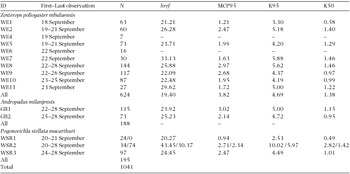
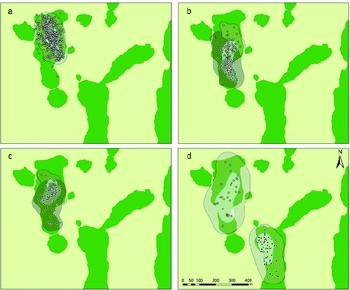
We obtained reliable data for 624 fixes from 10 individuals of Z. poliogaster mbuluensis, 188 fixes from two individuals of A. milanjensis, and 229 fixes from three individuals of P. stellata macarthuri. Time of observation ranged from a minimum of 1 h (WE4) to a maximum 7 d (WE8) (details about the period of observation and the number of fixes per individual are given in Table 1). Home ranges were restricted to one forest patch, with mean sizes (MCP95, K95, K50; ± SE, respectively) as follows: Z. poliogaster mbuluensis 2.1 ± 0.2 ha; 4.7 ± 0.3 ha; 1.2 ± 0.1 ha (based on eight individuals with ~30 locations); A. milanjensis 2.6 ± 0.4 ha; 4.9 ± 0.1 ha; 1.1 ± 0.1 ha (based on two individuals), and P. stellata 1.9 ± 0.5 ha; 4.3 ± 1.0 ha; 1.0 ± 0.3 ha (based on three individuals, including the data of one individual after re-colonizing the home patch; Figure 1). Movement distances per 10 min did not differ significantly among the three species analysed (Z. poliogaster mbuluensis: 57.8 ± 1.9, A. milanjensis: 56.2 ± 3.2, P. stellata macarthuri: 57.3 ± 4.0; variable excluded from the minimal adequate model). Bird individuals for all three species showed highest activities during morning (59.8 ± 1.8 m per 10 min) and midday (60.5 ± 4.8 m per 10 min), but comparatively low activities in the afternoon (43.3 ± 2.8 m per 10 min; F2/892 = 7.02; P < 0.001).
Basis datasets used for home range and movement pattern analyses for montane white-eye Zosterops poliogaster mbuluensis, striped-cheeked mountain greenbul Andropadus milanjensis and the white starred robin Pogonocichla stellata macarthuri. Given are IDs for each individual, date of collection, number of fixes obtained (N) and smoothing parameter (href) for Kernel home range estimations. Home ranges sizes (MCP 95, K95) and core range (K50) in ha are given.

Results obtained from radio-tracking, performed in the forest-grassland mosaic in the Chyulu Hills, south Kenya, shown for the three bird species, montane white-eye Zosterops poliogaster mbuluensis (a), striped-cheeked mountain greenbul Andropadus milanjensis (b) and white starred robin Pogonocichla stellata macarthuri (c). Fixes are shown as white and black dots (for the respective individual), and the 95% Kernels (dark blue line) and the 50% Kernels (light blue line) calculated based on all fixes (for Z. poliogaster mbuluensis) and individual-wise (for A. milanjensis and P. stellata macarthuri). The latter picture (d) indicates the translocation of P. stellata macarthuri from the eastern patch into the western patch, and its colonization back to its home-patch. Forest cover is indicated in dark green, grassland is indicated in light green.

One individual of P. stellata macarthuri was released in a neighbouring forest patch. After 2 d, the individual migrated back to its home patch, crossing about 120 m of grassland matrix (Figure 1d). Kernel home range sizes (K95, K50) were larger in the translocated patch compared with the home patch (Table 1: WSR2). However, movement distances per 10 min tended to decrease in the new environment after translocation (53.7 ± 8.3 m; F1,87 = 3.26; P = 0.07) than in its home patch after moving back (79.7 ± 8.4 m). There was no significant difference in daily activity between the individual observed in the new habitat (translocated) (morning: 52.6 ± 10.5 m, midday: NA, afternoon: 54.4 ± 11.7 m) and the individual being back in its home patch (morning: 80.3 ± 8.4 m, midday: 93.4 ± 23.3 m, afternoon: 42.6 ± 9.2 m; variables excluded from the minimal adequate model).
In addition to our telemetry data from radio-tracking, we observed individuals of Z. poliogaster mbuluensis migrating between forest patches. A flock consisting of about 30–40 individuals first moved to the southern edge of our main study patch. Individuals concentrated on a large tree at the edge of the forest, grouped, and crossed the matrix (crossing distance about 120 m) to an adjoining forest patch in the east in a very rapid, straight-line flight on the shortest flight path possible and in close proximity to the ground.
Our data indicate restricted movement behaviour for all three understorey forest bird species. The movements detected and observed are restricted to one single forest patch, in which individuals collect food (mostly along forest edges during morning), and roost during the night. This restricted movement behaviour is in congruence with other studies on the dispersal behaviour of these forest bird species (Borghesio & Laiolo Reference BORGHESIO and LAIOLO2004), but also for other forest vertebrates (Moore et al. Reference MOORE, ROBINSON, LOVETTE and ROBINSON2008, Smith et al. Reference SMITH, BETTS, FORBES, KEHLER, BOURGEOIS and FLEMMING2011). As long as habitat resources are available, individuals may remain in their home patch, as movement is energy consuming and thus only a positive investment if the new patch provides an improved habitat quality (Robles & Ciudad Reference ROBLES and CIUDAD2012). Various studies have shown that smaller territories usually indicate higher habitat quality, while reduced habitat quality often leads to larger home ranges (Carey et al. Reference CAREY, REID and HORTON1990, Hansbauer et al. Reference HANSBAUER, STORCH, PIMENTEL and METZGER2008). In addition, home-range sizes strongly depend on season most probably as a response on the availability of food resources (Wiktander et al. Reference WIKTANDER, OLSSON and NILSSON2001). Furthermore, the behavioural ecology of species might affect the mobility of individuals (Githiru et al. Reference GITHIRU, LENS, BENNUN and PERRINS2006). The strong restriction to a specific home patch in our study is underlined by the observed homing behaviour of the translocated individual of P. stellata macarthuri. This individual returned to its original patch after 1 d. This behaviour can be explained by either (1) strong site-fidelity, (2) high habitat quality in the original forest patch, or (3) the existence of family structures such as the presence of a nest i.e. fledglings in the original forest patch (however, as the understorey individual showed no brood patch, this third scenario can be excluded).
Our data covers only 3 wk of observation. However, movement behaviour in organisms may differ considerably over the year and in different life-stages. For example, adults are mostly residents, juveniles of the same taxon are assumed to show stronger dispersal behaviour to colonize new, unoccupied habitats (cf. Anders et al. Reference ANDERS, FAABORG and THOMPSON1998). Furthermore, our data represent very small territories, which contradicts other findings on tropical cloud-forest bird species observed in the Usambara Mountains, Tanzania (Newmark et al. Reference NEWMARK, MKONGEWA and SOBEK2010). However, also in this latter study, most individuals avoided crossing non-forested openings (Newmark et al. Reference NEWMARK, MKONGEWA and SOBEK2010).
While our short-term ecological data suggest a high site-fidelity of the three study birds, genetic data imply a moderate exchange of individuals, sufficient to equilibrate the genetic structure over local populations, as indicated for Z. poliogaster mbuluensis over the Chyulu Hills (Habel et al. Reference HABEL, ULRICH, PETERS, HUSEMANN and LENS2014a, b), as well as for A. milanjensis and P. stellata macarthuri for the adjoining Taita Hills (Callens et al. Reference CALLENS, GALBUSERA, MATTHYSEN, DURAND, GITHIRU and LENS2011). Studies showed that only few individuals per generation (as observed for Z. poliogaster mbuluensis) are sufficient to balance genetic differentiation (Slatkin Reference SLATKIN1987). In conclusion, our data have to be interpreted with caution as they were generated (1) during a short period of time, (2) based on adults, i.e. excluding the potentially more mobile juveniles, and (3) without taking various seasonal stages over the year into consideration.
ACKNOWLEDGEMENTS
This project was granted by the German Academic Exchange Service (DAAD). We are grateful to Kioko Mukua and Titus Iboma for help in the field, and Kathrin Böhning-Gaese (BIK-F, Frankfurt, Germany) and Michael Veith (Trier University, Trier, Germany) for providing technical equipment. We finally thank an anonymous referee for critical comments on draft versions of this article.