INTRODUCTION
On an annual scale, the zooplankton community in the eastern tropical Pacific (ETP) is principally modulated by a mesoscale upwelling process in the Gulfs of Tehuantepec, Papagayo, and Panama (Fernández-Álamo & Färber-Lorda, Reference Fernández-Álamo and Färber-Lorda2006). This process is the result of the combined effect of wind jets and the seasonal movement of the Intertropical Convergence Zone (ITCZ) (Amador et al., Reference Amador, Alfaron, Lizano and Magaña2006). Geographically, the Pacific Ocean off Colombia is located within the Panama Bight, eastern portion of the ETP. In this region, the upwelling process generated by the Panama wind jet occurs during the southerly position of the ITCZ in March (about 3°N) (Forsbergh, Reference Forsbergh1969; Amador et al., Reference Amador, Alfaron, Lizano and Magaña2006), bringing colder and saltier waters to the entire zone (Rodríguez-Rubio et al., Reference Rodríguez-Rubio, Schneider and Abarca del Río2003; Fiedler & Talley, Reference Fiedler and Talley2006; Devis-Morales et al., Reference Devis-Morales, Schneider, Montoya-Sánchez and Rodríguez-Rubio2008). The intrusion of this cold subsurface water during the dry season (December to April) enhances a high biological productivity, which is reflected in high phytoplankton (Rodríguez-Rubio & Stuardo, Reference Rodríguez-Rubio and Stuardo2002; Pennington et al., Reference Pennington, Mahoney, Kuwahara, Kolber, Calienes and Chavez2006; D'Croz & O'Dea, Reference D'Croz and O'Dea2007) and zooplankton biomass (Fernández-Álamo & Färber-Lorda, Reference Fernández-Álamo and Färber-Lorda2006). On the other hand, during the northerly position of the ITCZ (in September, about 10°N), the Panama jet completely disappears, and warm, fresh and less productive waters are observed in the region (Rodríguez-Rubio & Stuardo, Reference Rodríguez-Rubio and Stuardo2002; Devis-Morales et al., Reference Devis-Morales, Schneider, Montoya-Sánchez and Rodríguez-Rubio2008). The low values of salinities (<34 psu) recorded in the Panama Bight are accentuated during this period (wet season, May to November), as a result of excess precipitation, a process that is enhanced in coastal waters due to the effect of river discharges (Fiedler & Talley, Reference Fiedler and Talley2006).
In the ETP, most studies about the response of a specific group of the zooplankton community (e.g. copepods, polychaetes and euphausiids) to seasonal changes in hydrographic conditions have been conducted in the Gulf of Tehuantepec (Mexico) (Färber-Lorda et al., Reference Färber-Lorda, Lavín, Zapatero and Robles1994; Fernández-Álamo et al., Reference Fernández-Álamo, Sanvicente-Añorve and Alameda de la Mora2000; Fernández-Álamo & Sanvicente-Añorve, Reference Fernández-Álamo and Sanvicente-Añorve2005). In other localities belonging to the ETP, such as the Panama Bight (Panama, Colombia and Ecuador), few zooplankton studies have been carried out (Fernández-Álamo & Färber-Lorda, Reference Fernández-Álamo and Färber-Lorda2006; Miglietta et al., Reference Miglietta, Rossi and Collin2008). Furthermore, none of these studies has focused on hyperiid amphipods, although members of this group have been recognized as sensitive to slight variations in temperature directly or indirectly through their association with the gelatinous hosts (Laval, Reference Laval1980; Lavaniegos & Ohman, Reference Lavaniegos, Ohman, Schram and von Vaupel Klein1999).
In temperate and polar regions, the ecological role of hyperiids is well documented (e.g. Bocher et al., Reference Bocher, Cherel, Labat, Mayzaud, Razouls and Jouventin2001; Yamada & Ikeda, Reference Yamada and Ikeda2006; Dalpadado et al., Reference Dalpadado, Yamaguchi, Ellertsen and Johannessen2008). However, when tropical environments of the eastern Pacific are considered, the panorama is quite different, because knowledge about the composition of the hyperiid assemblages is scarce, and information of their ecological role is limited (Répelin, Reference Répelin1978; Gasca & Franco-Gordo, Reference Gasca and Franco-Gordo2008; Valencia & Giraldo, Reference Valencia and Giraldo2009; Gasca, Reference Gasca, Wehrtmann and Cortes2009a, Reference Gascab; Gasca et al., Reference Gasca, Suárez-Morales and Franco-Gordo2010). The only ecological study on hyperiids in the Panama Bight was carried out by Valencia & Giraldo (Reference Valencia and Giraldo2009) in the northern portion of the Pacific coast of Colombia. In this study, an unexpectedly high abundance of hyperiids was reported. Nevertheless, the temporal and spatial resolution used did not allow obtaining significant conclusions about the local variation of the assemblage.
There are no previous studies of the temporal variation on an annual scale of a specific group of zooplankton in the Panama Bight, and due to the characteristic changes in water column temperature in this region between the dry and wet seasons, it is expected that the structure of the hyperiid amphipod assemblages responds to these changes. In this context, we expect: (1) that a change in species composition occurs between seasons in neritic waters of the Panama Bight (Isla Gorgona), due to the entrance of subsurface waters during the dry season (upwelling period); (2) that the abundance and diversity of the hyperiid amphipod assemblages will be higher during the upwelling period (cold, salty and productive); and (3) that the abundance of hyperiids may be associated with higher abundances of the possible gelatinous zooplankton hosts.
MATERIALS AND METHODS
Study area
Isla Gorgona is the most extensive insular territory (13.3 km2) in the Colombian Pacific Ocean, located 30 km from the continent. This island was declared a National Natural Park in the 1980s, given its high marine biological diversity, being the most extensive marine protected area in the Colombian Pacific (UAESPNN, 1998). The local weather is characterized by a high precipitation level (4164–8176 mm.years−1), high relative humidity (90%), and mean air temperature of 26°C (Díaz et al., Reference Díaz, Pinzón, Perdomo, Barrios, López-Victoria, Barrios and López-Victoria2001; Blanco, Reference Blanco2009). An oceanographic study in this locality described two contrasting periods: the first one from May to December with a low surface salinity and a thermocline depth of 47 m, and a second one from January to April with a high surface salinity and a thermocline depth of 7.5 m (Giraldo et al., Reference Giraldo, Rodríguez-Rubio and Zapata2008b).
Sampling design and analysis of the samples
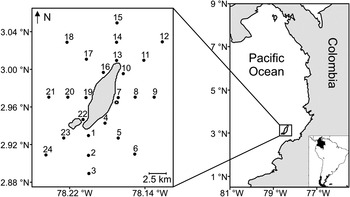
Twelve oceanographic expeditions were carried out on a monthly schedule to Isla Gorgona (Figure 1) between September 2005 and August 2006. During each month, samples were collected following a grid of 24 stations around the island during daylight hours (8:00–18:00). Oblique zooplankton hauls using a bongo net of 30 cm mouth diameter and 250 µm mesh size provided with a General Oceanic flowmeter were carried out. Each haul had a mean duration of seven minutes and was made with a mean velocity of 1.1 m·s−1 to a maximum depth of 50 m, except for Stations 1, 22, 23 and 24, which were 10 m depth. Due to logistical problems, Stations 14, 23 and 24 were not sampled in December. Samples were fixed in 4% formaldehyde diluted in seawater. Additionally, a StowAway Tidbit data logger was deployed at 15 m on the eastern side of the island (Figure 1) to register water temperature at 30 minutes intervals between 1 September 2005 and 30 August 2006.
Location of Isla Gorgona and zooplankton sampling stations on the Pacific coast off Colombia, eastern tropical Pacific. Asterisk indicates location of the temperature data logger.

Hyperiids were sorted from each sample, identified, and counted. All counts were standardized to ind·1000 m−3. Taxonomic identification was made using the keys of Bowman (Reference Bowman1973), Shih (Reference Shih1991), Vinogradov et al. (Reference Vinogradov, Volkov and Semenova1996), Shih & Hendrycks (Reference Shih and Hendrycks2003) and Zeidler (Reference Zeidler2004, Reference Zeidler2009). Once identified, specimens were deposited in the Amphipod Collection at the Universidad del Valle, Cali, Colombia (CAN-UV).
Statistical analysis
The frequency of occurrence of each hyperiid species during a monthly schedule was estimated, establishing five categories: rare (R: 1 to 3 months), frequent (F: 4 to 6 months), common (C: 7 to 9 months) and abundant (A: 10 to 12 months). The structure of the hyperiid assemblages was described using the Shannon–Wiener diversity index (H′) (log e), while the differences in abundance among sampling months were tested by using a Kruskal–Wallis analysis, given that the assumptions of normality and homogeneity of variance were not supported (Statistica 7.0). The multiple comparison test of Nemenyi–Dunn for unequal samples was carried out to identify the source of variation. Because of the high variability in the abundance data, the geometric mean and the 95% confidence interval were used as descriptors. To establish the relation of the hyperiid structure assemblages between hydrographic periods, a hierarchical cluster analysis using group average linking was performed, after the exclusion of stations without amphipods. The similarity measure used was the Bray–Curtis similarity calculated on the transformed data (log x + 1) for all species, while the Simprof technique was used to identify the cluster significance (Primer 6.0) (Clarke & Warwick, Reference Clarke and Warwick2001). To graphically represent the relations of the structure of the hyperiid assemblages, an ordination plot was constructed using the non-metric multidimensional scaling analysis, and the results obtained were compared with that of the cluster to evaluate the consistency of both methods. Based on the groups obtained, a similarity of percentages analysis was performed to examine which species contributed to the similarity within each group (Primer 6.0). Finally, a Spearman rank correlation was calculated to evaluate possible associations between hyperiid abundance (total and most abundant species) and the abundance of gelatinous zooplankton (Statistica 7.0). The Bonferroni criterion for significance level in multiple associations was used (α = α/k).
RESULTS
Temperature
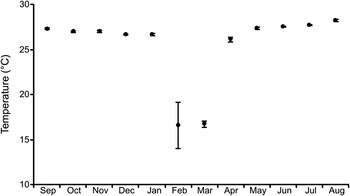
A continuous register of temperature provided by the data logger placed at a 15 m depth on Isla Gorgona (Figure 1) showed that warm water prevailed most of the year (27.2 ± 0.6°C SD), while an abrupt decrease in temperature was observed in February and March (<17°C) (Figure 2). Mean minimum and maximum temperatures were recorded in February (16.6 ± 2.5°C SD) and August (28.3 ± 0.1°C SD), respectively.
Mean temperature (±SD) at 15 m depth on Isla Gorgona during an annual schedule (September 2005–August 2006).

The hyperiid assemblages
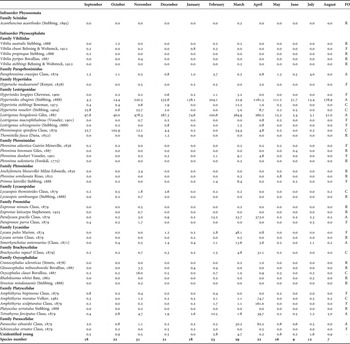
Forty-six species belonging to 14 families were found. November and March were the months with the highest number of species (31 and 29 species, respectively), while June and August presented the lowest (nine and seven species, respectively) (Table 1). Of the 46 species found, 19 were rare, 13 were frequent, seven were common and seven were abundant; of this last category, only Hyperioides sibaginis, Lestrigonus bengalensis and Tetrathyrus forcipatus were found during all 12 sampling months (Table 1).
List of species, geometric mean (ind·1000 m−3) and frequency of occurrence (FO) of hyperiid amphipods on Isla Gorgona between September 2005 and August 2006.

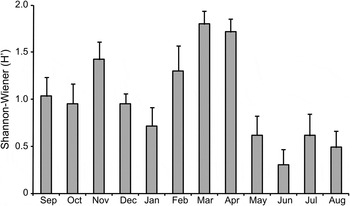
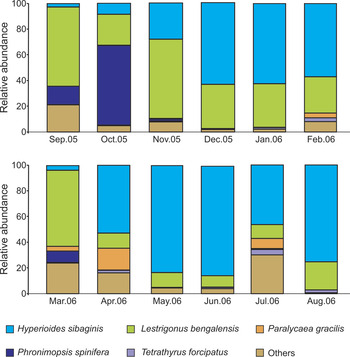
Diversity (H′) presented a bimodal tendency, with peaks in November (1.42 ± 0.19) and March (1.80 ± 0.14). The lowest values were registered in January (0.72 ± 0.20) and June (0.31 ± 0.16) (Figure 3). The hyperiid assemblage was dominated by Hyperioides sibaginis (47.7%), Lestrigonus bengalensis (38.5%), Phronimopsis spinifera (2.1%), Paralycaea gracilis (1.7%) and Tetrathyrus forcipatus (1.5%). The relative abundance of these dominant species was variable. In general, H. sibaginis was highly dominant during June, representing 86% of the assemblage. The relative abundance of L. bengalensis was high during September, November and March. Likewise, P. gracilis was an important component of the assemblage during April and July, P. spinifera during September and October, and T. forcipatus during February, April, and July (Figure 4). Furthermore, in the months in which H. sibaginis presented the lowest relative abundance (September, October, November and March), L. bengalensis and P. spinifera presented the highest contribution to the assemblage.
Shannon–Wiener diversity index of hyperiids between September 2005 and August 2006 on Isla Gorgona.

Relative abundance of the five most abundant species of hyperiids between September 2005 and August 2006 on Isla Gorgona.

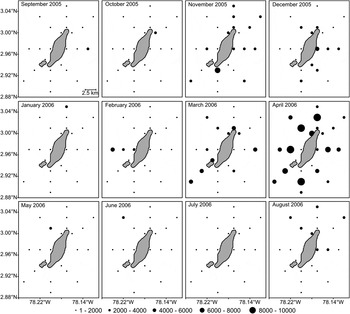
Spatial distribution of abundance was highly variable, and a clear pattern was not found. In general, there were homogeneous distribution and low values (<2000 ind·1000 m−3) during most of the study period (September, October, January, May, June, July and August). However, during November and December, abundance was highest on the eastern side of the island, while during February and March, abundance was highest on the western side. In April, highest abundance values were registered in the entire zone (>4000 ind·1000m−3) (Figure 5).
Distribution of density of hyperiids (ind·1000 m−3) between September 2005 and August 2006 on Isla Gorgona.

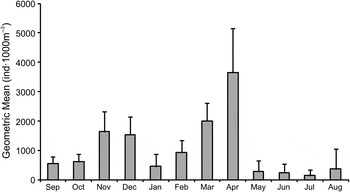
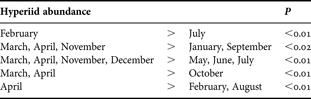
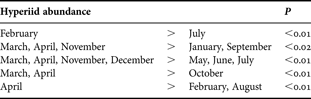
Hyperiid abundance on Isla Gorgona was significantly variable during the study period (H11,285 = 128.39, P < 0.0001), with values ranging between zero and 9833 ind·1000 m−3 (672 ± 146 ind·1000 m−3). Thus, abundance presented a bimodal form with peaks in November and April, with a remarkable decrease between April and May (Figure 6). Hyperiid abundance in November, December, March and April was significantly higher than during May, June and July (P < 0.01); likewise, abundance was significantly higher in April than in August, September and October (P < 0.01), higher in March than in September–October (P < 0.07), and higher in November than in September (P < 0.02). Although January belongs to the same thermal period as March and April, hyperiid abundance was significantly lower (P < 0.02) (Table 2).
Geometric mean (95% confidence interval) of hyperiids between September 2005 and August 2006 on Isla Gorgona.

A posteriori result of Nemenyi–Dunn analysis based on an annual variation of hyperiid abundance on Isla Gorgona. Only significant results are shown (α < 0.05).
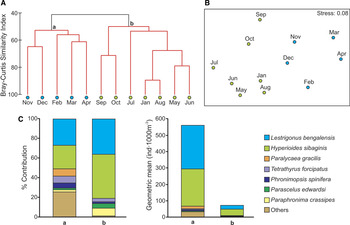
The dendogram based on the Bray–Curtis similarity index indicated that two significant groups were formed. The first group encompassed the hyperiid assemblage of November, December, February, March and April, while the second group encompassed the hyperiid assemblage of September, October, January, May, June, July and August. Although it was expected that the January hyperiid assemblage would be grouped with the months belonging to the dry season, and the November assemblage with that of the wet season, they were grouped in contrary hydrographic periods (Figure 7A). A concordance aggregation pattern was observed in the multidimensional scaling plot, in which the low stress level obtained (0.08) indicates that an analysis considering higher dimensional solutions will not add relevant information to the structure of the hyperiid assemblage on Isla Gorgona (Figure 7B). When the percentage of contribution of the species that identify each group was evaluated, it was found that L. bengalensis and H. sibaginis were the most important species for both assemblages, with their contribution higher in the second (b = 81%) than in the first group (a = 51%). Likewise, the contribution of these species changes between groups, with higher values for L. bengalensis in the first group, and for H. sibaginis in the second group. Additionally, of the five species that presented the highest percentages of contribution in each group, Paralycaea gracilis, T. forcipatus and Phronimopsis spinifera were important components in the first group, while Paraphronima crassipes and Parascelus edwardsi were important components for the second group (Figure 7C). The major diversity observed in the first group was also associated with higher abundances (559 ind·1000 m−3) than that observed in the second group (73 ind·1000 m−3) (Figure 7C).
Dendogram (A) and non-metric multidimensional scaling (B) analysis of hyperiid abundance using Bray–Curtis similarity index. Also based on similarity percentage analysis, the relative contribution and geometric mean (C) of the five most abundant species for each cluster are shown.

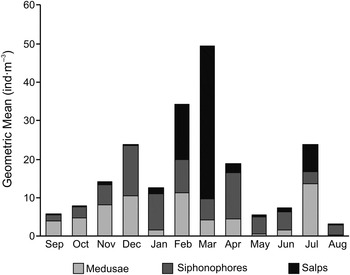
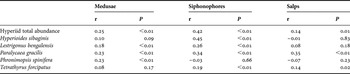
The abundance of the gelatinous zooplankton (potential hosts of hyperiids) presented three peaks during the study period (December, March and July), which did not necessarily coincide with the hyperiid abundance peaks (Figures 6 & 8). Medusae presented higher abundances in December, February and July (>10 ind·m−3), siphonophores in December–January and April (>10 ind·m−3), while salps presented a peak in abundance during March (>35 ind·m−3). Significant associations were found between hyperiid abundance and the three gelatinous groups evaluated (medusae, siphonophores and salps) (P < 0.01) (Table 3). In a detailed analysis, three of the five most abundant hyperiid species were significantly associated with only one gelatinous group: H. sibaginis and T. forcipatus with siphonophores, and P. spinifera with medusae. Lestrigonus bengalensis abundance was significantly associated with medusae and siphonophores, while P. gracilis was significantly associated with the three gelatinous groups evaluated (P < 0.01) (Table 3).
Geometric mean of medusae, siphonophores and salps between September 2005 and August 2006 on Isla Gorgona.

Spearman correlation rank between hyperiid amphipod abundance and the possible gelatinous zooplankton hosts on Isla Gogona (α = 0.02; N = 285).

DISCUSSION
Studies on hyperiid amphipods in the eastern tropical Pacific (ETP) have been temporally or spatially limited. For this reason, the monthly sample carried out on Isla Gorgona between September 2005 and August 2006 had a high species richness (S = 46) compared with that reported in other localities of the ETP, like the northern Pacific coast of Colombia (S = 20; Valencia & Giraldo, Reference Valencia and Giraldo2009), the Pacific coast of Costa Rica (S = 34; Gasca, Reference Gasca, Wehrtmann and Cortes2009a) and Banderas Bay in Mexico (S = 20; Gasca & Franco-Gordo, Reference Gasca and Franco-Gordo2008). The species composition on Isla Gorgona was comprised mainly of tropical–subtropical species (Vinogradov et al., Reference Vinogradov, Volkov and Semenova1996; Vinogradov, Reference Vinogradov and Boltovskoy1999), of which 18 were shared with Punta Cruces and Cabo Marzo (northern Pacific coast of Colombia) (Valencia & Giraldo, Reference Valencia and Giraldo2009), 17 with the Pacific coast of Costa Rica (Gasca, Reference Gasca, Wehrtmann and Cortes2009a) and 16 with Banderas Bay (Gasca & Franco-Gordo, Reference Gasca and Franco-Gordo2008). In relation to other tropical environments, the number of species found during this study was low (e.g. Gasca, Reference Gasca2004); this may be because Isla Gorgona is located near the coast (~30 km), whereas hyperiid amphipods are mostly oceanic (Bowman & Gruner, Reference Bowman and Gruner1973; Vinogradov, Reference Vinogradov and Boltovskoy1999). Further studies that consider greater spatial scales, including oceanic waters and greater depths, will surely increase the species richness reported for this region.
In terms of composition, the only study of major groups of the zooplankton on Isla Gorgona identified only gammaridean amphipods of the families Colomastigidae and Ampeliscidae, and caprellids of the family Caprellidae (Soto et al., Reference Soto, Sánchez, Fernández, Barrios and López-Victoria2001), all recognized as benthic forms. With this panorama, knowledge about hyperiids in particular and the zooplankton community in general on Isla Gorgona is meagre. For this reason, the study made by Valencia & Giraldo (Reference Valencia and Giraldo2009), as well as the taxonomic study of the genus Vibilia in the ETP made by Shih & Hendrycks (Reference Shih and Hendrycks2003), which took samples in waters of the Colombian Pacific (1°30′N to 6°30′N and 77°45′W to 84°00′W) are the only reliable antecedents. Thus, on Isla Gorgona as in Banderas Bay (Gasca & Franco-Gordo, Reference Gasca and Franco-Gordo2008) and the northern Pacific coast of Colombia (Valencia & Giraldo, Reference Valencia and Giraldo2009), Hyperioides sibaginis and Lestrigonus bengalensis were the most abundant species, representing 86%, 94% and 93%, respectively, results that suggest the importance of these species in the neritic environments of the ETP.
On Isla Gorgona, the dominant species during most of the study period was H. sibaginis, while in Banderas Bay (Gasca & Franco-Gordo, Reference Gasca and Franco-Gordo2008), as along the northern Pacific coast of Colombia (Valencia & Giraldo, Reference Valencia and Giraldo2009), L. bengalensis was the dominant species. Only during some months on Isla Gorgona did a switch in species abundance occur, as in September, November and March, where in proportion the contribution of H. sibaginis was at a minimum and that of L. bengalensis was at a maximum. It is possible that the importance of L. bengalensis in the hyperiid assemblage of the Colombian Pacific tends to decrease as we move offshore, and that this species is replaced in neritic and probably oceanic waters by H. sibaginis. Other species that formed important components of the hyperiid assemblages on Isla Gorgona, such as Phronimopsis spinifera, Tetrathyrus forcipatus and Paralycaea gracilis, were also important components on the northern Pacific coast of Colombia for the first two species, with P. gracilis absent (Valencia & Giraldo, Reference Valencia and Giraldo2009), while in Banderas Bay T. forcipatus and P. gracilis were an important and a minor component respectively, with P. spinifera absent.
Species composition found on Isla Gorgona was representative of neritic waters of the ETP, despite the small net size that was used (30 cm in diameter), and that zooplankton samples were collected during daylight hours up to 50 m depth. Even in other regions such as the North Pacific central gyre, where a larger bongo net was used (70 cm in diameter), small species like H. sibaginis represented important components of the hyperiid community (Shulenberger, Reference Shulenberger1977). In relation to the vertical distribution of hyperiids, Shulenberger (Reference Shulenberger1977) reported that they are distributed mainly in the upper 100 m, day and night. A similar result was reported by Cornet & Gili (Reference Cornet and Gili1993) in a study made on the northern edge of the Benguela System. These authors found that the vertical distribution of hyperiids was limited to the upper 40 m, a result that seems a consequence of a strong thermocline (Cornet & Gili, Reference Cornet and Gili1993). Waters on Isla Gorgona and in general in the ETP are also characterized by a strong and shallow thermocline (Fiedler & Talley, Reference Fiedler and Talley2006; Giraldo et al., Reference Giraldo, Rodríguez-Rubio and Zapata2008b). Then, it is possible that most of the hyperiids collected during this study on Isla Gorgona were restricted to the upper layers, day and night. It is important that future studies consider a sampling design that includes stratified tows.
Distribution of hyperiids on Isla Gorgona presented in general low abundances in most of the study area. During the wet season (May to November), this result possibly was due to the presence of homogeneous conditions in the water column around Gorgona, with higher temperatures and lower salinities in surface and subsurface waters (Giraldo, Reference Giraldo2008). These conditions suggest that productivity in the area was also low and homogeneous. On the other hand, hyperiid abundance was higher on the western side of the island during February and March, a period in which significant subsurface lower temperatures and higher salinity values were registered on the eastern side (Giraldo, Reference Giraldo2008). Likewise, higher abundances occurred on the eastern side during November and December; this result suggests that during this period the major contributions to the productivity are associated with local and continental sources, and not with regional processes.
The change in the structure of the hyperiid assemblages on Isla Gorgona seems to be associated with seasonal changes in hydrographic conditions (dry versus wet season). Nevertheless, these results should not be seen as a response to unique hydrological processes, because peaks in hyperiid diversity and abundance were registered both in colder waters and in warmer waters. Hence, the significantly higher values of hyperiid diversity and abundance registered during March and April seem to be a response to the colder-productivity waters registered during February and March (dry season). Likewise, significantly lower values of diversity and abundance observed from September to October and May to August, seem to be a response of the hyperiids to the warm and less productive waters characteristic of the wet season. These results agree with previous reports in the Panama Bight, in which highest zooplankton abundances are reported during the dry season, because of the entrance of oceanic subsurface productive waters during the effect of the Panama wind jet, while lowest zooplankton abundances are reported during the wet season given the presence of warm, less productive waters (Rodríguez-Rubio & Stuardo, Reference Rodríguez-Rubio and Stuardo2002; D'Croz & O'Dea, Reference D'Croz and O'Dea2007; Giraldo et al., Reference Giraldo, Valencia and Martínez-Aguilar2008a).
However, on Isla Gorgona higher values of hyperiid diversity and abundance were also registered during November and December, although during these months the water was warm. These results suggest that although the presence of the Panama wind jet and its colder waters was the most important process influencing hyperiid diversity and abundance in this zone, other local processes that produce a second peak in these variables seem to be involved. According to Blanco (2009), the maximum precipitation and river runoff in Gorgona occurs between May and October, a period coinciding with the lowest hyperiid abundance values. Nevertheless, it is possible that at the end of this period of maximum precipitation, the local and continental contribution of allochthonous nutrients associated with runoff enhance the water productivity around the island during November and December. Although data of nutrient and chlorophyll concentrations in Gorgona are lacking in this period to support or reject this hypothesis, a study of phytoplankton in the island during 1999 also found two abundance peaks: one between February and May dominated by diatoms and dinoflagellates, and a second one between October and December associated with an increase in the abundance of dinoflagellates and Cyanophyta (Soto et al., Reference Soto, Sánchez, Fernández, Barrios and López-Victoria2001). Perhaps the sudden increase in Cyanophyta at the end of the year suggests a change in the source of nutrients in the island, possibly coming from river runoff, which in turn helps to explain the second abundance peak observed for hyperiids.
A consequent result was obtained in the cluster analysis because the two groups that defined the structure of the hyperiid assemblages on Isla Gorgona include November in the dry season while January was included in the wet season. These results suggest that environmental processes occurring in different time scales (e.g. Panama wind jet and local productivity) produce similar effects in the structure of the hyperiid assemblages, as in the ‘dry season group’, in which higher diversity and abundance values were registered. On the contrary, the warm, less productive waters registered on the island during most of the study period produce an assemblage with lower diversity and abundance values. In terms of species composition, L. bengalensis and H. sibaginis presented in proportion similar contributions to the structure of the assemblages during both seasons, with P. gracilis, T. forcipatus and P. spinifera as important components of the dry season assemblage, and Paraphronima crassipes and Parascelus edwardsi of the wet season assemblage. This result suggests that the change in hyperiid structure assemblages on Isla Gorgona were associated with a change in the contribution of the minor species, and with a minor change in the contribution of the dominant species.
Although the hyperiid structure assemblages on Isla Gorgona apparently respond to changes in hydrographic conditions, it is possible that their response is secondary, due to the characteristic life history of hyperiids. For this reason, some authors consider that changes in hyperiid species composition, abundance and distribution on a local scale must be viewed as a function of the dynamics of their gelatinous hosts (e.g. Harbison et al., Reference Harbison, Biggs and Madin1977; Madin & Harbison, Reference Madin and Harbison1977; Laval, Reference Laval1980). During the study period, high abundances of salps occurred during the months with the lowest water temperatures (February and March), and apparently enhanced the presence of some species (e.g. Lycaea pulex and Phronima dunbari). Despite this clear tendency demonstrated by salps, a significant association was found only with P. gracilis. This species also presented significant associations with medusae and siphonophores, although in the literature it has been reported associated only with siphonopohores (Harbison et al., Reference Harbison, Biggs and Madin1977).
Gelatinous hosts used by H. sibaginis are unknown. However, in this study a significant association with siphonophores was found. This result is consistent with the report of Laval (Reference Laval1980), who found an association between a congener (Hyperioides longipes) and this gelatinous group. Tetrathyrus forcipatus presented a significant association with siphonophores only, coinciding with the reports of Harbison et al. (Reference Harbison, Biggs and Madin1977). For P. spinifera significant associations were found with medusae, nevertheless, the gelatinous host for this species is unknown. For L. bengalensis significant associations were found with medusae and siphonophores. Although apparently species of the genus Lestrigonus preferred medusae-like hosts (Harbison et al., Reference Harbison, Biggs and Madin1977), they have been reported also in association with siphonophores and salps (Lima & Valentin, Reference Lima and Valentin2001).
Despite the probable associations found with the correlation analysis, information obtained about associations between hyperiids and the gelatinous hosts from zooplankton samples gave only an overall idea of these relationships (Gasca et al., Reference Gasca, Manzanilla and Suárez-Morales2009). Better results would be obtained if associations could be evaluated considering lower taxonomic levels for the gelatinous zooplankton, information that is lacking for the study area. Moreover, associations between gelatinous zooplankton and hyperiids are usually broken during sample tows (Madin & Harbison, Reference Madin and Harbison1977; Laval, Reference Laval1980; Lima & Valentin, Reference Lima and Valentin2001), and because there is lack of knowledge about species composition of gelatinous zooplankton in the Colombian Pacific, it is more difficult to obtain an appropriate interpretation.
In conclusion, the hyperiid amphipod assemblages on Isla Gorgona presented a high similarity in species composition to other coastal localities of the ETP, assemblages characterized by the high dominance of Hyperioides sibaginis and Lestrigonus bengalensis. Highest values of hyperiid richness, abundance, and diversity were found during March and April, a period in which oceanic upwelling waters (cold, salty and productive) reach the neritic zone in the Colombian Pacific. Likewise, a second peak in hyperiid abundance was present during December, which may be influenced by local factors, like diminished precipitation levels and a possible increase in nutrient availability. Other factors, such as the abundance and composition of the gelatinous zooplankton that hyperiids use as hosts, also seem to be important. Finally, this study is the first effort in the Panama Bight to characterize a specific group of zooplankton on an annual schedule and to contribute significantly to the knowledge of a poorly studied group in the ETP.
ACKNOWLEDGEMENTS
We thank Eugenia Escarria, Gustavo Castellanos, Diego Germán Ramírez and Eliana Velasco for their valuable assistance on field trips. We thank the staff of the National Natural Park (PNN) Gorgona for their logistical help. The UAESPNN allowed the development of this project in the PNN Gorgona. Asturias craft facilitated transportation to Gorgona. We wish to express our gratitude to Dr Yusbelly Díaz and Dr Alberto Martín (Universidad Simón Bolívar, Venezuela) for an introduction to amphipod taxonomy. We specially thank Dr Philip A. Silverstone-Sopkin for correcting the English. This work was supported by the Universidad del Valle and the Instituto Colombiano para el Desarrollo de la Ciencia y la Tecnología ‘Francisco José de Caldas’ (COLCIENCIAS), and is a product of the project ‘Factores físicos, entorno oceanográfico y distribución de arrecifes coralinos en el PNN Gorgona’ (A.G). The identification of hyperiids was supported by Colciencias-Univalle in the program ‘Jóvenes Investigadores-2008 (B.V). Two anonymous referees made outstanding contributions to improve this paper.