Introduction
Mountain pine beetle (MPB), Dendroctonus ponderosae Hopkins (Coleoptera: Curculionidae), is an eruptive herbivore that attacks and kills most Pinus Linnaeus (Pinaceae) species in its range (Furniss and Schenk Reference Furniss and Schenk1969; Wood Reference Wood1982). The range of MPB in northern Canada has historically been limited to British Columbia west of the Rocky Mountains where lodgepole pine Pinus contorta var. latifolia Engelmann (Pinaceae) is the most abundant host. However, during a recent epidemic, significant numbers of beetles breached the Continental Divide and invaded north-central Alberta, Canada a number of times from 2000 to 2009. MPB now threatens pine species in Canada's boreal forest (Safranyik et al. Reference Safranyik, Carroll, Régnière, Langor, Riel and Shore2010).
Throughout much of MPB's historic range, the beetle has a 1-year life cycle (reviewed in Safranyik and Carroll Reference Safranyik and Carroll2006). Adult females typically establish one brood per year, but they may re-emerge during warm or long summers and establish a second brood in a new tree without mating again (Reid Reference Reid1958, Reference Reid1962). In cooler climates, life cycles longer than one year may be prevalent. Pioneering female beetles initiate attack on host trees in July or August and release aggregation pheromones that attract conspecifics and instigate a mass attack. Mating occurs under the bark and eggs are laid along a vertical gallery constructed in the phloem. The male:female sex ratio approaches 1:2; after mating with one female, males may exit and join another lone female and mate again (Reid Reference Reid1958). Larvae mine away from the parent gallery, overwinter, and pupate the following summer in chambers that they excavate in the inner bark. Young adults feed on spores of blue-stain fungi that line the pupal chambers and on phloem prior to emergence (Reid Reference Reid1963; Bleiker and Six Reference Bleiker and Six2007). At high brood densities and during the maturation feeding period, pupal chambers may coalesce. Thus, young adults may share a common feeding area and eventually emerge through the same exit hole (Reid Reference Reid1963; Safranyik and Linton Reference Safranyik and Linton1985), giving them an opportunity to mate with siblings or neighbours prior to emergence.
A handful of studies have investigated preemergence mating in the MPB within the historic range in southern British Columbia, Canada and Colorado, United States of America. The results have varied from 1–2% to 13–18% of emerging females being already mated (Reid Reference Reid1958; McCambridge Reference McCambridge1969, Reference McCambridge1970, Reference McCambridge1974). Unfortunately, the methods used to collect insects in these studies varied and brood densities were not reported, making comparison among studies difficult.
The main objective of this study was to determine the incidence of preemergence mating in the beetle's new habitat in northern Alberta. We also observed that the flight of MPB was delayed in northern Alberta in the summer of 2011 due to a cool, wet period in June and July and that young adults remained under the bark for an extended period prior to emergence. As a result, we also investigated whether delaying emergence affects the incidence of preemergence mating.
Methods
Beetle source
Field-emerged beetles
Trees attacked by the MPB in the summer of 2010 were identified at two sites in northern Alberta, Canada: Grande Prairie, 55.04°N, 118.70°W, 674 m; and Musreau, 54.56°N, 118.66°W, 953 m. Trees in this region are putative lodgepole-jack pine hybrids or backcrosses with the level of introgression varying at both the tree and stand level (Bleiker and Carroll Reference Bleiker and Carroll2011).
Mesh emergence traps ∼15 cm wide and 45 cm high were stapled to the trunks of selected trees at a height of ∼1.0 m on the east and west aspects. There were four trees at Grande Prairie and eight trees at Musreau. Traps were installed in early June 2011 prior to beetles emerging and dispersing from trees attacked in 2010. A plastic funnel fashioned from the top of a 2 L plastic bottle was glued to the bottom of the mesh trap to guide emerging insects into a 100 mL plastic collection cup. The plastic cup was loaded with a propylene glycol-based antifreeze, which served as a killing agent and preservative. Insects in the traps were collected in mid-August just after peak emergence and transported in Whirl-Pak® (Nasco, Salida, California, United States of America) bags to the laboratory where they were stored in a refrigerator until processed. After processing, the beetles were stored in 70% ethanol at room temperature until the females were dissected and their mating status determined for this study (see below). Storage times for field-collected beetles were ∼2–3 months in antifreeze and 2–3 months in 70% ethanol.
Laboratory-reared beetles from naturally infested trees
In late September 2011, six bolts, ∼60 cm long, were cut from each of two pine trees that were 22 and 22.5 cm in diameter at 1.3 m and naturally attacked by MPBs in August 2011 at the Grande Prairie site. The bolts were cut consecutively along the stem of the tree starting at ∼0.5 m with bolt one being the lowest bolt cut from the tree. Bolts were transported to the Pacific Forestry Centre in Victoria, British Columbia, Canada where the ends were sealed with paraffin wax to prevent excessive moisture loss. The height and circumference around the middle of each bolt was measured and used to calculate surface area. Bolts were stored in a walk-in cold room around 0 °C for ∼3 weeks until we were able to hang them at room temperature (∼22 °C) in large mesh bags with 500 mL plastic collection cups at the bottom. Crumpled paper towel was placed in each collection cup to increase surface area for beetles and minimise chances of postemergence mating.
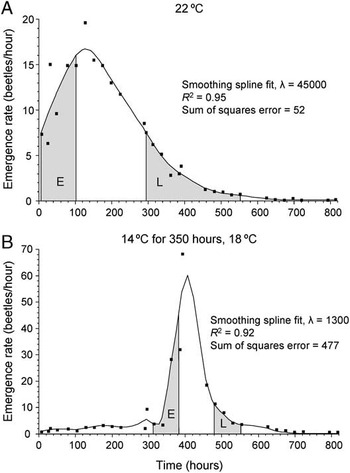
Insect development was monitored periodically in the bolts by removing a small piece of bark from an extra bolt and observing the life stages present. Once most brood adults were medium-to-dark brown in colour and emergence numbers started to increase rapidly (hour 0, Fig. 1), three bolts from each tree were systematically selected and placed in a walk-in growth chamber at 14 °C. We systematically assigned bolts to treatments due to the low numbers of bolts. Bolts one, three, and five from tree one, and bolts two, four, and six from tree two were held at 14 °C for 350 hours to first delay emergence and then the temperature was increased to 18 °C to induce emergence. The 14 °C was a little cooler than the threshold emergence temperature of 15.5 °C identified by Reid (Reference Reid1962), but not too cool as to inhibit mating (McCambridge Reference McCambridge1974). The other bolts remained at 22 °C.
The total number of mountain pine beetles emerging per hour from logs cut from naturally infested pine trees. Logs were held at 20 °C until most developing brood were young adults and then subjected to two temperature treatments (hour 0): (A) a constant 22 °C or (B) 14 °C for 350 hours to delay emergence and then 18 °C. The mating status of female beetles emerging early (shaded area E) and late (shaded area L) in the emergence period was determined. The hourly emergence rate was calculated by dividing the total number of beetles emerged at each collection time by the number of hours since the beetles were last collected. Emergence curves were fitted using the spline smoothing function (JMP 8; SAS Institute, Cary, North Carolina, United States of America).

Beetles used in this study were collected twice daily and their sex determined immediately after collection according to differences in the 7th tergite (Hopkins Reference Hopkins1909). Beetles that we were unable to process immediately after collection to separate the sexes were excluded. We sampled beetles emerging during the first half of the main emergence wave, hereafter called early-emerging beetles, as well as beetles emerging during the second half of the main emergence wave, hereafter called late-emerging beetles (Fig. 1). All females emerging on a sample day were examined. Female beetles were stored alive in vials with shredded phloem in a refrigerator until they were dissected. Each laboratory-emerged female beetle was killed in 70% ethanol just prior to dissection.
Mating status
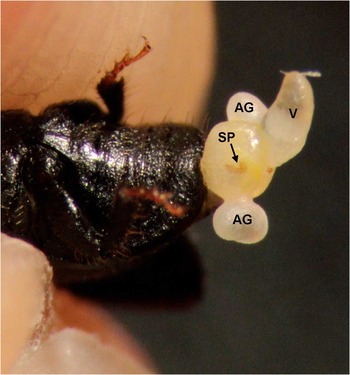
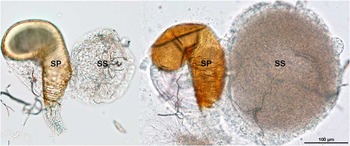
Freshly killed beetles were dissected following the method of McCambridge (Reference McCambridge1969). Beetles were held ventral side up under a dissecting microscope at 40× magnification. The sides of the abdomen were squeezed between the thumb and index finger until the vagina, accessory glands, spermatheca, and spermathecal pump protruded from the insect (Fig. 2). The spermathecal pump and sac were transferred to a drop of 0.9% saline on a slide and examined under bright-field illumination at 200× and 400× magnification. Beetles stored in antifreeze and then ethanol were similarly dissected except the spermatheca was removed by pulling the distal abdominal tergite from the adult beetle with tweezers and removing the hindgut and genitalia (Trostle Reference Trostle1986). Mating status of female beetles was usually determined on the basis of the appearance of the spermathecal pump, presence of spermatozoa, and, with less reliability, the condition of the sac (see the “Results” section; Fig. 3). If mating status could not be determined using the aforementioned reliable characters, we cut open the spermathecal pumps and sacs to look for live or dead spermatozoa. Of the 1529 females examined in this study, we were unable to determine the mating status of 19 females: this included six females reared at 22 °C, three females reared at 14 °C/18 °C, two field-emerged beetles from Grande Prairie, and eight field-emerged beetles from Musreau. These unknowns were excluded from the study.
Reproductive organs protruding from the posterior of a female mountain pine beetle, including the accessory glands (AG), vagina (V), and spermathecal pump (SP).

Spermathecal pump (SP) and spermathecal sac (SS) of an unmated female (left) and a mated female (right). The sac of the mated female appears more opaque and rounded compared with the small, wrinkled sac of the unmated female, although the sacs of many mated females appeared similar to unmated females. The pump of mated females appeared noticeably darker compared with unmated females and a linear pattern running the length of the pump caused by spermatozoa was visible at 200× and 400× magnification.

To ensure that we could reliably distinguish between mated and unmated females, we examined the organs of female beetles extracted from a laboratory colony maintained on bolts. We examined females attacking bolts that were constructing galleries and laying viable eggs and so known to be mated, as well as teneral females assumed to be virgins because they were removed from individual pupal chambers under the bark that had not coalesced with any other chambers or galleries.
Analysis
A G-test, or log-likelihood ratio test (Sokal and Rohlf Reference Sokal and Rohlf2000), was conducted to test if there was an association between preemergence mating and emergence time (early versus late) for beetles reared from bolts. We conducted separate tests for each temperature treatment because of the different lengths of time between early-emerging and late-emerging beetles from the two temperature treatments, which could affect mating opportunities (Fig. 1). Similarly, G-tests were used to test if the incidence of preemergence mating was associated with temperature treatment (delayed versus nondelayed emergence) for laboratory-reared beetles or with site for field-collected beetles. A spline smoothing function was used to fit curves to emergence data from cut bolts so that the relative emergence time of early-emerging and late-emerging beetles could be readily visualised. All analyses were conducted using JMP 8.0 (SAS Institute, Cary, North Carolina, United States of America) and significance was set at P ⩽ 0.05.
Results and discussion
As described by Trostle (Reference Trostle1986), the spermathecal sacs of some mated females were more opaque, smooth, and rounded compared with those of unmated females, which were translucent, grainy, and wrinkled (Fig. 3). However, we also found that the sacs of some mated females appeared very similar to unmated females. This may have been due to the movement of spermatozoa out of the sac and into the pump. The spermathecal pumps of mated females were noticeably darker compared with unmated females and had a granular to parallel linear pattern created by spermatozoa inside the pump that was visible at 200× and 400× magnification; this was the most reliable distinguishing character even in samples that had been stored long term. Movement of spermatozoa could sometimes be seen inside the pumps of freshly killed beetles. We were able to identify mated females that had been stored in antifreeze and 70% ethanol, even after 12 months, based on the appearance of the spermathecal pump. We were able to determine the mated status of virtually all of the freshly killed beetles, but could not determine the status of 2.4% of the stored beetles. We suspect that many of these females may have been mated, but the spermatozoa may have been degraded by ethanol flooding the genitalia; however, this could not be confirmed and these insects were excluded from the study.
For the field-collected beetles, the incidence of preemergence mating did not vary between the Grande Prairie and Musreau sites (G 2 = 1.23, df = 1, P = 0.27). From the Grande Prairie site, 5 of the 94 females examined (5%) were mated. From the Musreau site, 9 of the 317 females examined (3%) were mated. On the basis of the density of beetles in emergence traps (417 beetles/m2 [SD = 366] for Grande Prairie and 763 beetles/m2 [SD = 513] for Musreau, averaged across traps), we expected more preemergence mating opportunities for females emerging from trees at the Musreau site. However, insect development was more advanced at the Grande Prairie site compared with the Musreau site and young adults were observed feeding under the bark at the Grande Prairie site in coalescing pupal chambers for an extended period of time due to the cool spring and summer weather, which delayed emergence. Having putatively mature adults active under the bark for a longer period of time at Grande Prairie, may have offset any effect caused by higher brood densities at Musreau.
For laboratory-reared beetles, late-emerging females were more than twice as likely to be mated than early-emerging females for bolts held at 22 °C: 11.8% of late-emerging females were mated compared with only 5.3% of early-emerging females (G 2 = 8.18, df = 1, P = 0.004; Table 1). Reid (Reference Reid1958) also reported that mated females were the last to emerge. Late-emerging females may be more likely to be mated because they may have the highest probability of encountering a sexually mature male due to shifting sex ratios. The ratio of males to females under the bark may increase over the emergence period because more females emerge than males during the peak emergence period, but similar numbers of both sexes emerge near the end of the emergence period (Rasmussen Reference Rasmussen1980; Amman and Cole Reference Amman and Cole1983). The density of insects under the bark may be higher earlier in the emergence period facilitating mating opportunities, but many of the insects, especially the males that tend to emerge later, may not be sexually mature yet.
Number and percent of unmated and mated mountain pine beetles collected early and late in the emergence period from logs cut from naturally infested trees.

Logs were held at 22 °C until most developing brood were at the teneral adult stage and then logs either remained at a constant 22 °C until emergence was complete or logs were held at 14 °C for 350 hours to delay emergence and then moved to 18 °C to induce emergence.
The incidence of preemergence mating was not associated with the time of emergence (early emergers versus late emergers) for insects emerging from bolts subjected to 14 °C/18 °C (G 2 = 0.50, df = 1, P = 0.48). This may be due to the shorter time lag between early-emerging and late-emerging beetles in this treatment compared with the 22 °C treatment (Fig. 1). Once the temperature was increased from 14 °C to 18 °C, emergence was extremely rapid, resulting in less time between early-emerging and late-emerging beetles in which a difference could manifest.
The emergence surge indicates that holding bolts at 14 °C for 350 hours once most brood were at the teneral adult stage was effective in delaying emergence (Fig. 1). The rapid emergence of beetles and short emergence period that ensued once bolts were moved from 14 °C to 18 °C suggests that the cool temperature inhibited the emergence of mature brood, but may have allowed insects that lagged behind in development to catch up. When emergence was delayed by holding bolts at 14 °C, the incidence of preemergence mating among early-emerging beetles was 3.5% higher than among beetles emerging from bolts held at a constant 22 °C; however, this difference was not significant (G 2 = 1.40, df = 1, P = 0.09; Table 1). Delaying emergence had no effect on the incidence of preemergence mating among late-emerging beetles (G 2 = 0.09, df = 1, P = 0.67). Bolts in the two temperature treatments had similar densities of emerging beetles: 1756 beetles/m2 and 1877 beetles/m2 emerged for bolts held at 22 °C and 14 °C/18 °C, respectively.
The incidence of preemergence mating in MPB ranged from 3–12% in our study conducted in the beetle's recently expanded range. This is similar to what has been reported for MPB in previous studies for its historic range where the incidence of preemergence mating ranged from 1–18.4%. However, these studies favoured a low incidence of preemergence mating of 1–2% and argued that confounding factors contributed to the higher rates (Reid Reference Reid1958; McCambridge Reference McCambridge1969, Reference McCambridge1970, Reference McCambridge1974). Reid (Reference Reid1958) found the lowest rate of preemergence mating with <1% of females being mated upon emergence, although only five females per day for 24 days were examined. The source of the beetles, brood density, and time and method of collection were not reported. McCambridge (Reference McCambridge1969) found that 12.8–18.4% of females emerging from bolts cut from naturally infested trees were mated, but only 2% of females emerging from artificially infested bolts were mated. Similarly, McCambridge (Reference McCambridge1970) found that 18% of 100 females that emerged into collection cups were mated, but <2% of 500 females removed from under the bark of logs cut from naturally infested trees were mated. To reconcile these differences with Reid (Reference Reid1958), McCambridge attributed the higher rate to postemergence mating in collection cups and the presence of re-emerged mothers (females that attacked trees the previous year, mated, established one brood, successfully overwintered, and then emerged at the same time as their offspring). However, brood or attack density was not reported and this may be especially relevant for the artificially infested bolts as it is not known if these bolts were infested at rates as high as what would naturally occur in the field. Furthermore, removing teneral adults from under the bark may affect mating opportunities. While rearing MPB from bolts cut from naturally infested trees in the laboratory at 22 °C, dark-coloured brood adults remained under the bark for more than a week prior to emerging. McCambridge (Reference McCambridge1974) also found a relatively high incidence of preemergence mating (14.5%) among females that emerged from infested trees, but attributed the high rate to postemergence mating: females were confined with males for up to 3 days in cages before assessment.
We attempted to limit postemergence mating opportunities in laboratory-reared beetles by collecting insects frequently and using crumpled paper towels to help separate insects. Although postemergence mating cannot be ruled out in our study, it was likely minimal because the incidence of preemergence mating among early-emerging laboratory-reared beetles held at 22 °C was the same (5%) as for field-emerged beetles from the same site, which were caught in lethal traps preventing postemergence mating. For laboratory-emerged beetles, we also attempted to limit the impact of re-emerged mothers, which usually emerge before their daughters, by not sampling very early-emerging beetles that would most likely be re-emerged mothers. Re-emerged mothers were not a concern in field-collected beetles because extensive sampling in June 2011 at both sites revealed no surviving adults above the snowline. This is likely because the minimum winter temperature above the snowpack dropped below the survival threshold of adult beetles. Surviving mothers may have been a factor in studies by Reid and McCambridge, which were conducted in southern British Columbia and Colorado, areas that do not typically experience the extreme cold of northern Alberta and where adults may survive the winter above the snowpack (Amman Reference Amman1973).
Without more details about the density of emerging brood and the time and method of collection, conclusions and comparisons are difficult to make among studies. Our most conservative estimates of preemergence mating for MPB in the new range are from field-emerged beetles collected in lethal traps where 3–5% of females were mated. This is higher than the generally accepted 1–2% previously reported from the beetle's historic range, but well within the upper range reported (18%), although confounding factors may have attributed to the higher rates (McCambridge Reference McCambridge1969, Reference McCambridge1970, Reference McCambridge1974). Overall, relatively low preemergence mating rates may reduce the chance of inbreeding depression. However, it may be advantageous for a proportion of the population to mate prior to emerging to offset potential Allee effects associated with mate finding at low population levels and after dispersing long distances (Borden Reference Borden1993; Safranyik et al. Reference Safranyik, Carroll, Régnière, Langor, Riel and Shore2010).
Acknowledgements
The authors thank V. Waring and B. Tomm for their help collecting insects in the field. They thank L. Safranyik, D. Langor, V. Nealis, and B. Van Hezewijk for reviewing the manuscript prior to submission. Reviews by two anonymous reviewers further improved the manuscript. This study was conducted as part of a larger study funded by Foothills Research Institute, Spray Efficacy Research Group International, Forest Protection Limited, the provinces of Alberta, Saskatchewan, Manitoba, and Ontario, Canada, and Natural Resources Canada.