Introduction
On March 11th 2020, COVID-19, the infectious disease associated with the coronavirus, SARS-CoV-2 was characterized as a global pandemic by the World Health Organization (WHO). This pandemic has resulted in significant economic and societal disruption worldwide, and as of August 9th 2022, there have approximately 586 million COVID-19 cases and approximately 6.42 million deaths attributable to COVID-19 (World Health Organisation 2022). The declaration of the pandemic was followed by robust public containment measures. These restrictions initially included “cocooning” of individuals who were either over 70 years of age, or immunologically vulnerable (periods of complete restriction to the home environment, without visitors). Limitations on travel from one’s home (i.e. two kilometre radius only allowed at one point from one’s accommodation with some exceptions) and strict ‘social distancing’ measures such as restrictions on public and private gatherings, and the requirement for a two metre radius distance when approaching others were additionally imposed. This resulted in the closure of many facilities deemed ‘non-essential’ or unsuitable for facilitating such measures safely where remote service provision was deemed an option, and included facilities attended by individuals with mental health disorders such as day hospitals and day centres (Hoey Reference Hoey2020). From March 12th, 2020, there have been periods of gradual easing and re-implementation of restrictions, which until recently (February 28th, 2022) was based on the advice of the National Public Health Emergency Team (NPHET). Many therapeutic interventions normally available for individuals with mental health difficulties both within and outside the MHS were unattainable during this time, including group psychotherapeutic activities (Alcoholics Anonymous Ireland 2020). Where therapeutic sessions continued, many were forced to adapt to the public health measures, with face-to-face interactions often replaced by teleconsultations (Kopelovich et al. Reference Kopelovich, Monroe-DeVita, Buck, Brenner, Moser, Jarskog, Harker and Chwastiak2021; Li et al. Reference Li, Glecia, Kent-Wilkinson, Leidl, Kleib and Risling2021; Rojnic-Kuzman et al. Reference Rojnic-Kuzman, Vahip, Fiorillo, Beezhold, Pinto da Costa and Skugarevsky2021).
The impact of these prolonged periods of restrictions and lockdowns for individuals’ mental well-being is somewhat unclear with divergent data available to date. Studies in individuals without pre-existing mental health disorders (including in Ireland) have noted an increase in psychiatric pathology, including higher levels of depressive and anxiety symptoms (Hyland et al. Reference Hyland, Shevlin, McBride, Murphy, Karatzias, Bentall, Martinez and Vallières2020; Wang et al. Reference Wang, Pan, Wan, Tan, Xu, Ho and Ho2020). A relatively modest deleterious psychological impact of COVID-19 for individuals with pre-existing anxiety disorders (Plunkett et al. 2020; Hennigan et al. Reference Hennigan, McGovern, Plunkett, Costello, McDonald and Hallahan2021), bipolar disorder (McLoughlin et al. Reference McLoughlin, O’Grady and Hallahan2021), and schizophrenia (Fahy et al. Reference Fahy, Dineen, McDonald and Hallahan2021; Rainford et al. Reference Rainford, Moran, McMahon, Fahy, McDonald and Hallahan2022) was previously demonstrated; with social functioning most impacted; however, individuals with a diagnosis of Emotionally Unstable Personality Disorder (EUPD) demonstrated both greater symptomatology and impaired social functioning (McLoughlin et al. Reference McLoughlin, O’Grady and Hallahan2021).
Concerns have been expressed regarding a potential increase in suicide rates or episodes of self-harm related to the COVID-19 pandemic (Gunnell et al. Reference Gunnell, Appleby, Arensman, Hawton, John, Kapur, Khan, O’Connor and Pirkis2020; Reger et al. Reference Reger, Stanley and Joiner2020). To date however, there is divergent and relatively sparse data pertaining to the impact of the COVID-19 pandemic on rates of self-harm, with this area potentially important given the known association between increased rates of self-harm and subsequent increased rates of suicide (Carroll et al. Reference Carroll, Metcalfe, Gunnell, Carroll, Metcalfe and Gunnell2014; Bostwick et al. Reference Bostwick, Pabbati, Geske and McKean2016). Previous pandemics have provided inconsistent data regarding suicide rates (Leaune et al. Reference Leaune, Samuel, Oh, Poulet and Brunelin2020); with initial evidence relating to this current pandemic demonstrating no definitive association with suicide (Pirkis et al. Reference Pirkis, John, Shin, DelPozo-Banos, Arya and Analuisa-Aguilar2021; Deisenhammer & Kemmler Reference Deisenhammer and Kemmler2021). In recent months, several reports including case studies, case series and retrospective studies across multiple settings have evaluated a range of constructs including suicidal ideation, self-harm, and suicide. However, ascertaining an association between the COVID-19 pandemic and these constructs including rates of self-harm has not been clear (Farooq et al. Reference Farooq, Tunmore, Wajid Ali and Ayub2021). An 8% reduction in the rates of self-harm in the first two months of the COVID-19 pandemic was previously noted, however a significant increase in lethality of the method of self-harm was noted (McIntyre et al. Reference McIntyre, Tong, McMahon and Doherty2021). Studies conducted in France and India additionally support our initial findings where either a decrease or marginal increase in rates of self-harm were noted, but again a greater lethality of method was employed (Jollant et al. Reference Jollant, Roussot, Corruble, Chauvet-Gelinier, Falissard, Mikaeloff and Quantin2021; Kar et al. Reference Kar, Menon, Yasir Arafat, Rai, Kaliamoorthy, Akter, Shukla, Sharma, Roy and Sridhar2021).
Consequently, in this study, we wanted to ascertain (over a longer time-frame), if the rates of individuals presenting with self-harm or lethality of method of self-harm at University Hospital Galway was different in the 18 months prior to compared to the 18 months following the onset of the COVID-19 pandemic. Additionally, we wanted to ascertain if rates of self-harm since the onset of the COVID-19 pandemic were related to levels of governmental mandated restrictions.
Methods
Procedure
As detailed previously (McIntyre et al. Reference McIntyre, Tong, McMahon and Doherty2021), a database of all individuals referred to the liaison psychiatry team at University Hospital Galway is maintained (including all individuals referred by the Emergency Department, medical and surgical wards for review both within and outside working hours who have engaged in self-harm) and was examined. Basic demographic and clinical data including referral source, type of self-harm diagnosis, current engagement with psychiatric services, and psychiatric diagnosis were reviewed. Data were extracted for all individuals (of any age) referred to the liaison psychiatry team with self-harm for the 18-month period prior to (September 1st 2019–February 29th 2020) and the 18 month period since the onset of the COVID-19 pandemic (March 1st 2020–August 31st 2021). These individuals were deemed ‘participants’ in the study and will be referred to henceforth as such. The term ‘service user’ when used refers to individuals currently engaged with a psychiatric service. Data attained from the database was subsequently manually checked by sourcing participant clinical notes, with data checked to ensure only one referral was included pertaining to any incident of self-harm. All episodes of self-harm were categorized according to common methods of self-harm; poisoning, self-laceration, drowning and hanging. All other methods were categorized as ‘other’. The requirement for medical admission (either to a high dependency or intensive care unit or medical or surgical ward) was utilized as a proxy measure of self-harm lethality. The violence of attempts was additionally measured with hanging or drowning both coded as violent methods and self-laceration and self-poisoning as non-violent methods of self-harm.
Episodes of self-harm were recorded as occurring during governmental mandated restriction (NPHET) levels 1–3 or 4–5. NPHET levels 4 and 5 restrictions included measures such as complete restriction of any household visitors, restrictions on public movements to within the county of residence or within the home respectively, and closure of all public or private indoor gatherings significantly impacting schools and leisure activities. Individuals were required to work from home unless they were deemed ‘essential workers’. NPHET levels 1–3, allowed for various numbers of household visitors, limited work attendance and opening of general retail services. Levels 1 and 2 allowed for travel outside of the county and for indoor social and leisure activities to be held (Government of Ireland 2020).
Statistical analysis
Statistical analysis was performed using the Statistical Package for Social Sciences (SPSS) 27.0 for Windows (SPSS Inc., IBM, New York, USA). Descriptive analyses (frequencies, percentages, means and standard deviation) on key demographic and clinical data were performed for both categorical and continuous variables, as appropriate. Chi-Square (χ2) analysis or Fishers’ Exact tests (where appropriate) were utilized to compare categorical data pre-and post- the onset of the COVID-19 pandemic.
Results
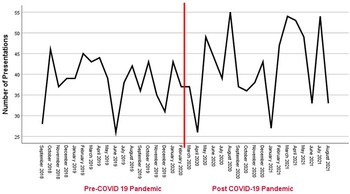
A 9.1% increase (754 v 691 individuals) in the overall rate of individuals referred to the liaison psychiatry team following an episode of self-harm was noted in the time period following the onset of the COVID-19 pandemic (daily rate of 1.37 v 1.26). Figure 1 demonstrates that after an initial reduction, an increase in presentations with self-harm were noted from May 2020, with seven of the 18 months post-onset of the COVID-19 pandemic associated with higher numbers than those seen for any month in the pre-pandemic period. The four months with more than 50 presentations of self-harm all occurred since the onset of the COVID-19 pandemic (August 2020, April, May, and July 2021). Mandated governmental restrictions (NPHET levels 4 and 5) were in situ for 251 of the 549 days in the 18 month study period, with higher rates of self-harm (daily rates of 2.10 v 0.77) evident during these periods compared to those with a lower level of restrictions.
Number of presentations.

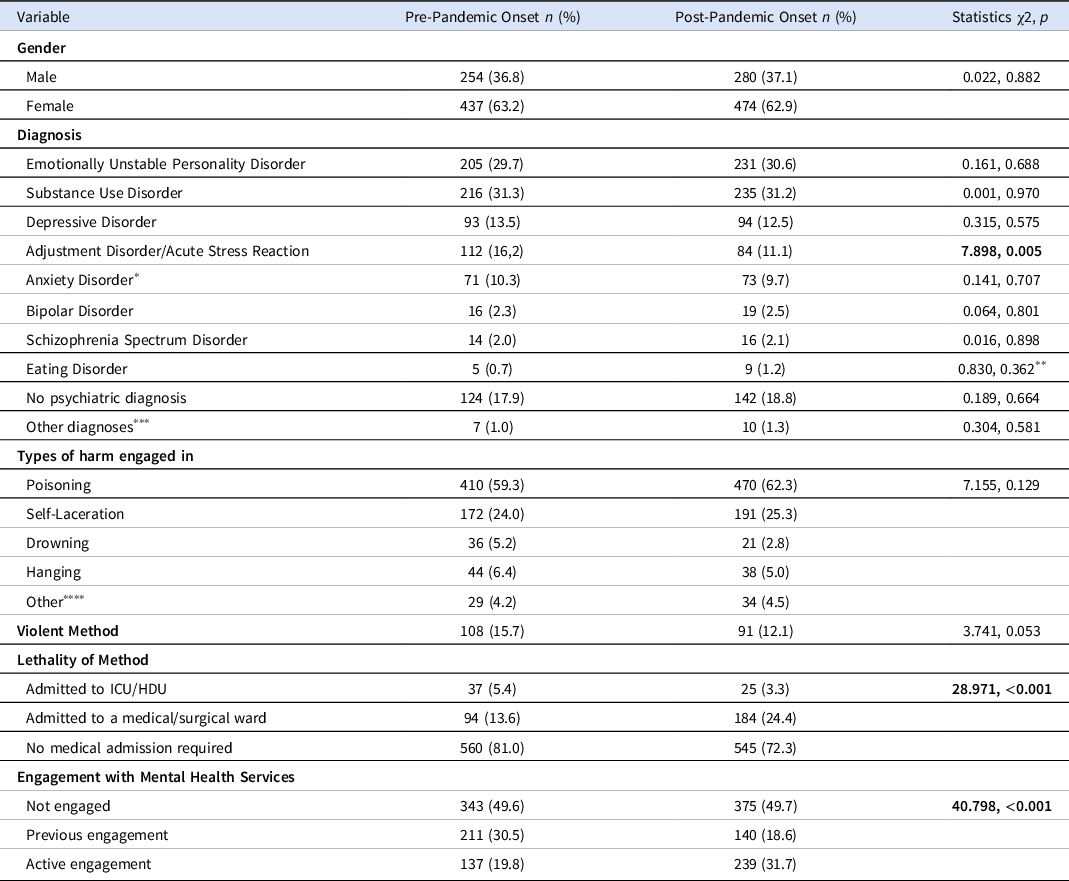
Table 1 describes selected clinical and demographic variables for participants for both time periods. No difference in age, or gender distribution was noted between the two time periods. The most common mental health disorders in both time periods were EUPD and psycho-active substance use disorder, with both disorders present in approximately 30% of individuals at both time points; with the presence of no mental health disorder more common than any diagnosed mental disorder for both time periods. More individuals in the pre-COVID-19 pandemic period had a diagnosis of an adjustment or acute stress disorder (n = 112 (16.2%) v. n = 84 (11.1%), χ2 = 7.90, p = 0.005), however no other anxiety disorder (or other mental health disorder) was more prevalent in the pre-pandemic period.
Demographic and clinical data relating to patients presenting with self-harm before and after the COVID-19 pandemic

HDU, high dependency unit; ICU, intensive care unit.
* Anxiety Disorder included Generalized Anxiety Disorder, Panic Disorder, Social Phobia and Obsessive-Compulsive Disorder.
** Fisher’s Exact test utilized.
*** Other diagnoses included Attention Deficit Hyperactivity Disorder, Autism Spectrum Disorder and Body Dysmorphobia.
**** Other types of self-harm included burning, head banging, hitting, and biting.
Where individuals had comorbid psychiatric disorders recorded both diagnoses were presented above; thus, the total in the variable “Diagnosis” >100%.
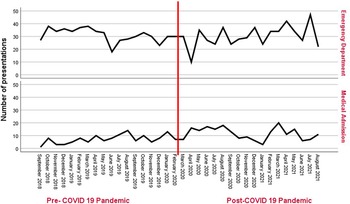
Self-poisoning (59.3% pre-pandemic and 62.3% post-pandemic onset) and self-laceration (24.0% pre-pandemic, 25.3% post-pandemic onset) were the most common methods of self-harm at both time points; with no difference in the prevalence of any method of self-harm, or violence of attempt as a proportion of the overall total number in either time-period, although a non-significant trend towards less violent methods (12.1 v 15.7%, χ2 = 3.74, p = 0.053) since the onset of the COVID-19 pandemic (see Table 1) was noted. A greater lethality of attempt was demonstrated since the onset of the COVID-19 pandemic (209 (27.7%) v. 131 (19.0%), χ2 = 15.38, p < 0.001) (Fig. 2), however this was not clearly more evident during periods of greater governmental mandated restrictions (n = 104 (28.9%) v. n = 105 (26.7%), χ2 = 0.442, p = 0.506).
Lethality of episode.

A statistically significant increase in the percentage of individuals presenting with self-harm who were active attendees of mental health service (MHS) (239 (31.7%) v. n = 137 (19.8%) v χ2 = 40.80, p < 0.001) was noted in the period after the onset of the COVID-19 pandemic with approximately 50% of all individuals at both time-points having no prior contact with any MHS.
Discussion
In the 18 months, since the onset of the COVID-19 pandemic, there has been a 9% increase in the rate of self-harm presentations, despite an initial reduction during the first two months. During periods of increased mandated restrictions (NPHET levels 4 and 5), episodes of self-harm were almost three times as frequent compared to periods of lower levels of restrictions (NPHET levels 1–3). The method of self-harm was not significantly different between the pre- and post-pandemic onset periods, although a trend towards increased lethality of attempt was noted since the onset of the COVID-19 pandemic. Approximately one-third of individuals presenting with self-harm were active attendees of the MHS, which was significantly higher than that noted (approximately one-fifth of presentations), prior to the onset of the COVID-19 pandemic.
International studies to date have indicated a reduction in both primary and secondary care presentations with self-harm (DelPozo-Banos et al. Reference DelPozo-Banos, Lee, Friedmann, Akbari, Torabi, Lloyd, Lyons and John2022); however, this finding is not consistent (Steeg et al. Reference Steeg, John, Gunnell, Kapur, Dekel, Schmidt, Knipe, Arensman, Hawton, Higgins, Eyles, Macleod-Hall, McGuiness and Webb2022). In this study, over a longer time-period compared to previous research, it was noted that any initial reduction, potentially related to individuals not presenting for medical review with less lethal episodes of self-harm was not sustained. It was additionally noted that increased mandated governmental restrictions were associated with greater levels of self-harm, a finding not previously reported. This potentially demonstrates greater distress evident during such periods of restrictions and/or reduced availability of supports for individuals (less group therapeutic interventions and less face-to-face reviews).
No significant differences in psychiatric diagnosis were evident in individuals presenting with self-harm pre- and post- the onset of the COVID-19 pandemic. Whilst increased levels of distress in individuals with EUPD (McLoughlin et al. Reference McLoughlin, O’Grady and Hallahan2021) had previously been described, this has not translated into a significantly higher percentage of individuals with EUPD (despite a small increase in actual numbers of service users with this diagnosis presenting) presenting with self-harm since the onset of the COVID-19 pandemic. This does not preclude increased distress or symptomatology in this patient cohort however. A statistically significant albeit modest reduction in the number of people presenting with an adjustment disorder or acute stress reaction presenting with self-harm was noted; however other anxiety and mood disorders were not associated with any such association. It is probable that this reduction was not related to a clinically significant change and will require further clarification over a longer time-period.
Our previous finding of an increased lethality of self-harm method was replicated (McIntyre et al. Reference McIntyre, Tong, McMahon and Doherty2021). Initially, this may have reflected that individuals with self-harm episodes associated with less severe medical sequelae avoided attending hospital in the early months of the COVID-19 pandemic only. A fear of contracting COVID-19 was particularly evident in the initial period of the pandemic and led to many individuals with significant medical conditions including for example those who experienced cardiac events avoiding hospitals (Kristoffersen et al. Reference Kristoffersen, Jahr, Thommessen and Rønning2020; Mafham et al. Reference Mafham, Spata, Goldacre, Gair, Curnow, Bray, Hollings, Roebuck, Gale, Mamas, Deanfield, de Belder, Luescher, Denwood, Landray, Emberson, Collins, Morris, Casadei and Baigent2020). A previous study also noted an increased lethality of method of self-harm but was of shorter duration compared to this study (Jollant et al. Reference Jollant, Roussot, Corruble, Chauvet-Gelinier, Falissard, Mikaeloff and Quantin2021). Avoidance of hospitals may remain the on-going reason for the increased lethality of attempt and consequently the 9.1% increase in number of individuals engaging in self-harm is an underestimate. However, the continued increased lethality of attempt (albeit not more violent) may simply reflect ongoing greater distress and suicidality.
A significant increase in service users actively engaged with MHS presenting with self-harm was noted since the onset of the COVID-19 pandemic. The COVID-19 pandemic has been associated with significant restrictions in the provision of multiple supports both within and outside the MHS. For example, day centers and training centers have been closed or had very limited, if any, group activities, with many psychotherapeutic interventions, particularly those in group format often taking place in day hospital facilities cancelled, and clinical reviews with members of the multi-disciplinary teams that service users regularly engage with unavailable via a face-to-face format. These restrictions have similarly impacted addiction and mental health supports based outside MHS, with psychotherapeutic services less available, with minimal group sessions and reduced face-to-face therapeutic sessions available (Alcoholics Anonymous Ireland 2020). Other voluntary or service-user led supports often involving group therapeutic sessions and supports linked to non-therapeutic activities (i.e. group sporting activities) have largely been unavailable. It is possible that these reduced supports available for service users have impacted rates of self-harm presentation in this population. In this service, measures were implemented to mitigate the impact of unmet mental health need on the emergency services to reduce the risk of infection among our patient cohort (Tong et al. Reference Tong, Crudden, Tang, McGuinness, O’Grady and Doherty2021). Another potential reason for the increased number of individuals actively engaged with MHS who presented with self-harm since the onset of the COVID-19 pandemic relates to increased referral rates to community MHS (College of Psychiatrists of Ireland 2020), with these increased case-loads potentially including many individuals who had previously engaged with MHS requesting additional supports due to the perceived and potential deleterious impact of the COVID-19 pandemic on their mental health. Whilst studies have previously have noted predominantly minimal deleterious consequences of the COVID-19 pandemic on active service users’ mental well-being, reduced social functioning and quality of life was reported (Fahy et al. Reference Fahy, Dineen, McDonald and Hallahan2021; Hennigan et al. Reference Hennigan, McGovern, Plunkett, Costello, McDonald and Hallahan2021; Plunkett et al. Reference Plunkett, Costello, McGovern, McDonald and Hallahan2021; Rainford et al. Reference Rainford, Moran, McMahon, Fahy, McDonald and Hallahan2022); with MHS users with EUPD (associated with often higher rates of self-harm) experiencing the most significant impact on their mental well-being (McLoughlin et al. Reference McLoughlin, O’Grady and Hallahan2021). These findings suggest an increase in distress in individuals attending MHS and may be reflected in some part in the increased rates of self-harm noted in this study.
Limitations of this study include the retrospective design and basis on a service database, out-ruling the incorporation of patient-reported measures. However, the use of a database allowed for the avoidance of selection bias regarding episodes of self-harm, as all patients referred for self-harm episodes were included. It would be optimal to include qualitative data pertaining to participants’ views regarding the potential relationship of the COVID-19 pandemic to their episode(s) of self-harm and this is planned as a future avenue of research.
Conclusion
A moderate increase in presentations of self-harm since the onset of the COVID-19 pandemic over an 18-month period is noted, despite an initial decline in the rate of self-harm presentations. Periods of more significant governmental mandated restrictions were associated with higher rates of self-harm, suggesting that this potential adverse consequence should be considered if further periods of mandatory restrictions are being considered in the future. Active users of MHS are more likely since the onset of the COVID-19 pandemic to engage in self-harm and thus the provision and recommencement of therapeutic interventions for this cohort in particular is warranted.
Acknowledgements
The authors would like to acknowledge Ms Debra Lynch for her support in data acquisition.
Author contributions
All authors participated in the design of the study, data attainment, and critical review of the manuscript.
Financial support
This research received no specific grant from any funding agency, commercial, or not-for-profit sectors.
Conflicts of interest
The authors have no conflicts of interest to disclose.
Ethical standards
Ethical approval was obtained from the Galway University Hospitals Research Ethics Committee (C.A. 2386; obtained February 2021). As all data were anonymised, written consent was not required. The authors assert that all procedures contributing to this work comply with the ethical standards of the relevant national and institutional committee on human experimentation with the Helsinki Declaration of 1975, as revised in 2008.