Implications
Results from this national study suggest that use of automatic milking systems increase milk production, decrease milking-related labour, and overall do not negatively affect milk quality. These specific findings can act as benchmarks for future dairy producers who decide to switch to an automatic milking system and can aid in more successful transitions by providing information on expected change. Furthermore, the survey itself may act as a tool for dairy industries to evaluate their transitions to this milking technology.
Introduction
Currently, there are ~25 000 dairy farms with automatic milking systems (AMS), or milking robots, in the world (Barkema et al., Reference Barkema, von Keyserlingk, Kastelic, Lam, Luby, Roy, LeBlanc, Keefe and Kelton2015). In 2015, there were 574 AMS farms in Canada (Canadian Dairy Information Centre, 2016). An AMS has the benefit of reducing labour (Bentley et al., Reference Bentley, Tranel, Timms and Schulte2013; Woodford et al., Reference Woodford, Brakenrig and Pangborn2015), while increasing milk production (Bernier-Dodier et al., Reference Bernier-Dodier, Delbecchi, Wagner, Talbot and Lacasse2010; Hansen, Reference Hansen2015). However, milk quality may be compromised (Hovinen and Pyörälä, Reference Hovinen and Pyörälä2011).
Labour requirements are reduced with AMS because teat cleaning, milking and separation of abnormal milk are integrated into the robotic unit. Labour is also modified with AMS, as producers need to be on-call for alarms (fetch cows, robot maintenance, etc.) and must adopt more data-based methods for identifying health and welfare issues (Butler et al., Reference Butler, Holloway and Bear2012). Labour savings with AMS in Europe and the United States have been reported to range from 18% to 46% (Rotz et al., Reference Rotz, Coiner and Soder2003; Mathijs, Reference Mathijs2004; Bijl et al., Reference Bijl, Kooistra and Hogeveen2007); however, these estimates have yet to be made for Canadian AMS farms.
The average reported increase in milk yield with AMS ranges from 2% to 25% (De Koning and Rodenburg, Reference De Koning and Rodenburg2004; Bernier-Dodier et al., Reference Bernier-Dodier, Delbecchi, Wagner, Talbot and Lacasse2010). The positive association between milk yield and AMS may be a result of more frequent milkings/day when using AMS (Melin et al., Reference Melin, Svennersten-Sjaunja and Wiktorsson2005). However, not all researchers agree that milk frequency and milk yield are related (Spolders et al., Reference Spolders, Meyer, Flachowsky and Coenen2004; Migliorati et al., Reference Migliorati, Speroni, Lolli and Calza2005).
Milk quality has been reported to be slightly, albeit significantly, lower in AMS farms, with the poorest quality in the first 6 months after introducing AMS (van der Vorst et al., Reference Van der Vorst, Knappstein and Rasmussen2002). Despite the amount of time since transition to AMS (whether 6 months or between 1 and 3 years after transition), in several studies, freezing point, free fatty acids, and total bacterial count were higher after conversion (Meskens et al., Reference Meskens, Vandermersch and Mathijs2001; van der Vorst et al., Reference Van der Vorst, Knappstein and Rasmussen2002). However, the effect of AMS on bulk tank somatic cell count (SCC) has been variable. Bulk tank SCC either did not change (Salovuo et al., Reference Salovuo, Ronkainen, Heino, Suokannas and Ryhänen2005; Helgren and Reinemann, Reference Helgren and Reinemann2006), increased (Rasmussen et al., Reference Rasmussen, Bjerring, Justesen and Jepsen2002; De Koning et al., Reference De Koning, Slaghuis and Van der Vorst2003; Johansson et al., Reference Johansson, Lundh, de Vries and Sjaunja2017), or decreased (Shoshani and Chaffer, Reference Shoshani and Chaffer2002; Bentley et al., Reference Bentley, Tranel, Timms and Schulte2013; Tousova et al., Reference Tousova, Duchacek, Stadnik, Ptacek and Beran2014).
There has been concern regarding reduced participation in dairy herd improvement (DHI) programmes with AMS becoming more popular, as this technology provides substantial data per cow not previously available to producers (Ontario Ministry of Agriculture, Food and Rural Affairs, 2010). Once producers make the large investment for an AMS, they may be reluctant to pay for DHI services. To date, there has been no published documentation of change in use of DHI programmes after a transition to AMS.
The objective of this study was to determine producers’ reports of change in milking labour management (milking-related activities), milk production, milk quality, and use of DHI programmes after transition to AMS.
Material and methods
This research was part of a larger study to determine the impact of transitioning to AMS on producers’ perceptions of farm management and cow health. As such, detailed descriptions of the methodology are presented in Tse et al. (Reference Tse, Barkema, DeVries, Rushen and Pajor2017) and the two surveys are in the appendix of Tse et al. (Reference Tse, Barkema, DeVries, Rushen and Pajor2017). The following sub-sections provide a short summary of the methodology.
Farm selection and data collection
Alberta Milk (Edmonton, AB, Canada), Dairy Farmers of Manitoba (Winnipeg, MB, Canada), Lely Canada (Woodstock, ON, Canada) and DeLaval Canada (Peterborough, ON, Canada) provided contact information for producers currently using AMS. Contact information was compiled to create a sampling frame. Surveys were conducted from May 2014 to the end of June 2015. A total of 530 AMS farms in Canada were contacted; data were collected by telephone, e-mail or in-person. Respondents were from British Columbia (BC; n=8), Alberta (AB; n=43), Saskatchewan (SK; n=7), Manitoba (MB; n=12), Ontario (ON; n=73), Quebec (QC; n=66), New Brunswick, and Nova Scotia (the latter 2 were grouped together and referred to as the ‘Maritimes’; n=7). One online respondent chose not to indicate their province of residence. Producers were initially contacted by phone by one of six interviewers with the General Survey (described below). After completing the General Survey, producers who were interested were e-mailed a link with follow-up questions. Producers who could not be contacted by phone were e-mailed a link to the Combined Survey (described below), which contained the General Survey and follow-up questions. The response rate was 41%. The majority of respondents completed the survey over the phone (69%; n=149). A total of 15 (7%) respondents completed the survey exclusively online and five (2%) respondents, exclusively in person. A total of 37 (17%) respondents completed the survey over the phone and the follow-up questions online. A total of 11 (5%) respondents completed the survey over the phone and follow-up questions in person. Producers who previously operated an AMS farm but later reverted back to conventional milking systems (n=3) and surveys that were terminated before completion, were excluded.
A pilot study was conducted to identify questions that caused confusion. Subsequent changes were made to reduce the chances of respondents misinterpreting questions. Interviewers were trained to clearly explain to producers that the study was being conducted through the University of Calgary (independent of AMS companies), to ask questions exactly as written in the final version of the survey, and to only provide standardized prompts and clarifications when necessary.
Surveys
Questions were provided as single or multiple choice(s) of multiple options, fill in the blank, and free form open-ended. The General Survey covered the following topics that were addressed in this manuscript: changes in milk production (e.g. average milk yield over the past year (kg/cow per year); how has milk yield changed on a per cow basis after transitioning to AMS (increased, decreased or stayed the same)), changes in milk quality (e.g. average bulk tank SCC over the past year (cells/ml); how has bulk tank SCC changed after transitioning to AMS (increase, decreased, or stayed the same)), changes to milking labour management (e.g. in h/day, how much time did you spend milking before AMS (including moving cows to parlour, preparing parlour, milking time and cleaning milking parlour); in h/day, how much time do you currently spend milking (including fetching cows, preparing and cleaning AMS units)), and current milking statistics (e.g. on average, how often are cows milked in the AMS unit (number of times/day)).
The Combined Survey contained the following: General Survey questions, more detailed questions on topics covered in the General Survey, in addition to questions related to participation in a DHI programme (e.g. are you a participant in a milk recording program, if ‘no’, were you a participant before transitioning).
The follow-up to the initial survey solely consisted of questions unique to the Combined Survey. Sample sizes per question varied depending on which survey was answered and because respondents had the option to skip questions that they could not or did not want to answer. The total number of respondents for General Survey questions was 217, whereas the number of respondents for the follow-up questions, specific to the Combined Survey, was 69.
Statistical analyses
All statistical analyses were performed with R (version 3.2.2; The R Foundation for Statistical Computing Platform, 2015) and P<0.05 was considered significant. Where descriptive statistics are presented (means, SEM, medians, 1st to 3rd quartiles, percentages), normally distributed results are presented as means±SEM, whereas results with non-normal distribution are presented as medians with 1st to 3rd quartile (IQR).
Due to the small number of Insentec (n=2) and BouMatic (n=2) users, only data of farms using Lely (n=165) and DeLaval (n=45) AMS were used where comparisons between brands were made. Three farms chose not to indicate which brand of AMS they operated. A χ 2 test or Fisher’s exact test (for frequency counts <5), were used to compare categorical, frequency data (e.g. when comparing by brand perceptions of change in milk yield (increase, decrease, no change), or when comparing perceptions of change in milk yield, milk fat or protein on farms ⩽24 months since transition with farms >24 months since transition). In addition, ANOVA and Tukey’s post hoc procedure were used to compare ⩾3 group means for normally distributed variables (e.g. comparisons by herd size group, e.g. Table 1), and a two-sample Student’s t-test was used for comparing two group means (e.g. comparing robot occupation rates between Lely and DeLaval brands). Wilcoxon Rank Sum and Signed Rank test was used to compare two medians of variables that were not normally distributed (e.g. comparing average milking frequency/day by brand). Differences between paired groups (e.g. number of employees and time devoted to milking-related activity before and after the transition) were tested by pairwise comparison using a paired Student’s t-test. Linear regression was used to assess strength of associations between: milk yield and bulk tank SCC (BTSCC) with milking frequency, herd size, cows/robot (for farms that stayed within the AMS dealer recommendation of <60 cows/robot), and time since transition to AMS. A subcategory of respondents in their first 2 years of transition was used for linear regressions between variables with time since transition to AMS (underlying assumptions for linear regressions were assessed before developing these models). Bulk tank SCC data were log-transformed to meet assumptions.
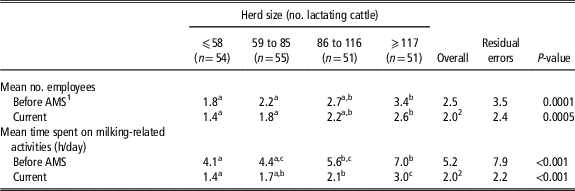
Number of employees and time spent on milking-related activities of dairy cattle farms before and after transition to automatic milking systems, based on herd size (no. lactating cattle)

AMS=automatic milking system.
a,bWithin a row, means without a common superscript differ (P<0.05).
1 Automatic milking system.
2 Different from overall value before AMS (P<0.001).
Results
Milking labour management
Characteristics of participating AMS farms (e.g. median time since transition to AMS, mean number of cows per robot, median herd size on AMS farms, median age of robots by brand, type of housing, etc.) have been described (Tse et al., Reference Tse, Barkema, DeVries, Rushen and Pajor2017). Mean number of employees (full- and part-time non-family employees combined) decreased by 20% with adoption of AMS (Table 1). Reported time devoted to milking-related activities (preparing and cleaning the AMS, fetching cows, and addressing alarms versus preparing and cleaning the parlour, and moving cows to the holding pen in conventional milking systems) also decreased with AMS (Table 1). DeLaval owners reported a mean decrease of 2.5±0.3 h/day in time spent on milking-related activities, whereas Lely owners reported a larger decrease of 3.4±0.2 h/day (P=0.005). However, current time spent on milking-related activities was not different between the 2 brands: Lely owners spent 1.9±0.1 h/day on milk-related activities and DeLaval owners spent 2.4±0.3 h/day.
Milk production and quality
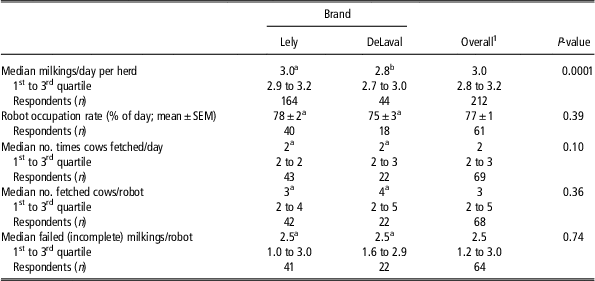
Median milking frequency was 3.0 milkings/cow day, with Lely owners reporting higher milking frequency than DeLaval owners (Table 2). Robots were occupied on average 77% of the day. There was a median of three fetch cows/robot per day, which equated to fetching 4% of a herd/robot per day, and each cow was fetched a median of 2 times/day. Producers waited a median of 12 h (IQR: 10 to 12 h) before fetching early lactation cows, with a maximum waiting period of 15 h. Producers waited a median of 14 h (IQR: 12 to 15 h) for late-lactation cows, with a maximum waiting period of 24 h. Farms reported 2.5 failed or incomplete milkings/robot per day.
Distribution of milking variables by brand of automatic milking system of dairy cattle farms participating in the study

a,bWithin a row, values without a common superscript differ (P<0.05).
1 Overall values include respondents with other brands of automatic milking systems.
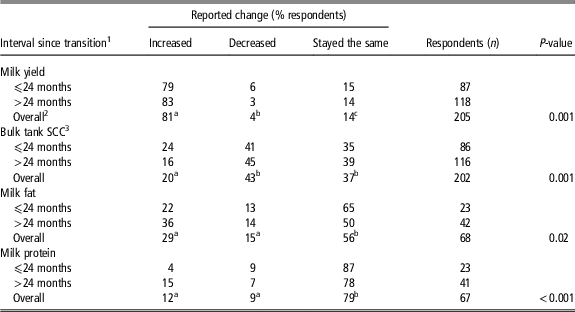
After adopting AMS, most producers (81%) reported that milk yield had increased (Table 3). The majority of producers reported no change in milk fat content (56% of respondents) and milk protein content (79% of respondents). Reported change in BTSCC varied, with 43%, 37% and 20% of respondents reporting a decrease, no change, or increase, respectively. Proportions of producers who reported a decrease or no change in BTSCC did not differ, whereas the proportion of producers who indicated an increase in BTSCC was smaller than the other two categories. The distribution of reported change in milk yield (increased, decreased, or no change) was not different between farms that transitioned to AMS ⩽24 months ago and those that transitioned >24 months ago (Table 3). This was also the case when comparing distributions of reported changes in BTSCC, milk fat, and milk protein by the two categories of time since transition.
Percentage of dairy cattle producers reporting change in milk yield and milk quality after transitioning to an automatic milking system, grouped by two categories of time since transition

a,bWithin a row, values without a common superscript differ (P<0.05).
1 Distributions of perceived change for each item did not differ by time since transition.
2 Overall value includes three respondents that did not provide information on time since transition.
3 Somatic cell count.
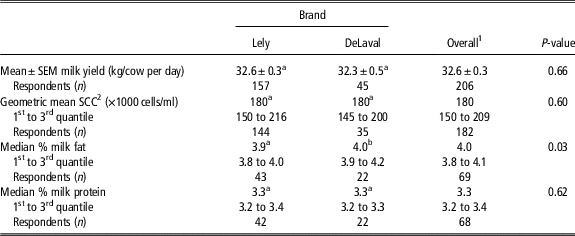
Overall, milk yield on AMS farms was 32.6 kg/cow per day, with no differences between AMS brands (Table 4). Median milk fat content on AMS farms was 4.0%, with DeLaval owners reporting a higher percentage than Lely owners. Median milk protein content on AMS farms was 3.3%, with no differences by brand. Based on reported averages over the past year, geometric mean BTSCC was 180 000 cells/ml, with no differences between the two predominant brands.
Differences between brands of automatic milking system in milk production per cow/day and milk quality of dairy cattle farms participating in the study

a,bWithin a row, values without a common superscript differ (P<0.05).
1 Overall mean includes respondents with other brands of automatic milking systems.
2 Back-transformed log of bulk tank somatic cell count.
A simple linear regression was calculated to predict milk yield based on milking frequency with the robot. Milk yield increased 2.3 kg/cow per day for each additional milking visit (P=0.002). There was no association between milk yield and time since transition to AMS for farms in their first 24 months of transition (n=85; P=0.75) or for all 206 farms with milk yield data (n=206; P=0.27). Milk yield and herd size were not associated (P=0.43), whereas milk yield tended to decrease with increasing number of cows/robot (P=0.06). There was no association between log-transformed BTSCC and cows/robot (P=0.17), whereas log-transformed BTSCC tended to increase with increasing herd size (P=0.09). In addition, log-transformed BTSCC and time since transition to AMS for farms within their first 24 months of transition were not associated (P=0.26). This was also the case when all farms with BTSCC data were included in the model (n=182; P=0.27).
Participation in dairy herd improvement programmes
At the time of the survey, 67% of producers were current DHI participants. Of the 22 respondents who were not current participants, 11 (50%) were DHI participants before transitioning to AMS. Due to the length of the survey, we were unable to ask producers why they decided to end their participation in DHI. Most producers (93%) were satisfied with the information that could be retrieved from the AMS computer programme.
Discussion
This was apparently the first study to provide comprehensive information regarding impacts of adopting AMS on reports of change in milking labour management, milk production and quality, and participation in DHI programmes in Canada. Farms reported increased milk yield with little effect on milk quality and reductions in number of employees and time devoted to milking-related activities after transitioning to AMS. Although two-thirds of producers were participants of a DHI programme at the time of the survey, adoption of an AMS appeared to reduce participation.
The decrease in time devoted to milking-related activities after transition to AMS was similar to the 75% milking-labour savings documented in Iowa, United States, by Bentley et al. (Reference Bentley, Tranel, Timms and Schulte2013). The number of employees also decreased with the transition to AMS in the current study, although the difference was small. A reason why the difference in number of employees before and after the transition was not larger may be that farms were reducing the amount of family labour first before decreasing number of employees. This was also suggested by Bijl et al. (Reference Bijl, Kooistra and Hogeveen2007) who reported a small but significant decrease in number of employees (exclusively non-family workers) when comparing AMS to conventional milking systems (CMS). Furthermore, as labour becomes more data-based with AMS (Butler et al., Reference Butler, Holloway and Bear2012), perhaps some time saved on milking labour is transferred to labour that is more computer oriented.
The average proportion of cows fetched per day (4%) was on the lower end of a previously documented range in Canada (4% to 25% of a herd; Rodenburg and House, Reference Rodenburg and House2007). In a study on a single farm, Munksgaard et al. (Reference Munksgaard, Rushen, de Passillé and Krohn2011) documented an 83% occupation rate/day for both forced and free-traffic AMS combined. Our study had a lower occupation rate (77%) despite more cows/robot (51 cows/robot; Tse et al., Reference Tse, Barkema, DeVries, Rushen and Pajor2017) than the Munksgaard et al. (Reference Munksgaard, Rushen, de Passillé and Krohn2011) study (35 cows/robot). The respondents of the current study reported an average number of failed or incomplete milkings/day that was half the reported average of a recent North American AMS study (Tremblay et al., Reference Tremblay, Hess, Christenson, McIntyre, Smink, van der Kamp, de Jong and Döpfer2016a). This difference may be a result of comparing producers’ reported values in the current study and AMS-generated data in the previous study (Tremblay et al., Reference Tremblay, Hess, Christenson, McIntyre, Smink, van der Kamp, de Jong and Döpfer2016a).
The reported change in milk yield was similar to direct measurements of other studies (e.g. Wagner-Storch and Palmer, Reference Wagner-Storch and Palmer2003; Hansen, Reference Hansen2015; Woodford et al., Reference Woodford, Brakenrig and Pangborn2015): milk production increased with the transition from CMS to AMS. The average milk yield of 32 kg/cow per day is typical for North American AMS dairy farms (Tremblay et al., Reference Tremblay, Hess, Christenson, McIntyre, Smink, van der Kamp, de Jong and Döpfer2016a). Similar to the results of DeVries et al. (Reference DeVries, Deming, Rodenburg, Seguin, Leslie and Barkema2011), milk yield was positively associated with milking frequency in the current study. Melin et al. (Reference Melin, Svennersten-Sjaunja and Wiktorsson2005) detected a 9% increase in milk yield when milking frequency increased from 2.1±0.1 to 3.2±0.1 times/day in an AMS with control gates and an open waiting area. Conversely, a study that increased milking frequency of AMS cows by adding flavoured and appetizing substances to feed delivered at the milking unit determined that milk yield was not affected by increased milking frequency (Migliorati et al., Reference Migliorati, Speroni, Lolli and Calza2005). Another study suggested that improvements in milk yield due to increased milking frequency with AMS were limited to first-lactation cows (Spolders et al., Reference Spolders, Meyer, Flachowsky and Coenen2004).
Milk fat and milk protein were reported to have stayed the same after transition to AMS, whereas BTSCC was reported to have either decreased or stayed the same. Researchers who measured these milk parameters have reported a variety of changes with AMS. Tousova et al. (Reference Tousova, Duchacek, Stadnik, Ptacek and Beran2014) documented an increase in milk fat and protein content, but decreased BTSCC with the use of AMS with their Czech Fleckvieh cows. Milk fat and protein percentage levels were similar to our study, whereas BTSCC was lower (164 000 cells/ml; Tousova et al., Reference Tousova, Duchacek, Stadnik, Ptacek and Beran2014). In an experiment in Israel, cows milked in AMS had lower fat content and BTSCC than those milked conventionally, with no difference in milk protein (Shoshani and Chaffer, Reference Shoshani and Chaffer2002). Similar to the current study, SCC, milk fat and protein content did not change after transitioning to AMS (Svennersten-Sjaunja et al., Reference Svennersten-Sjaunja, Berglund and Pettersson2000). In a Finnish study, milk fat content increased after the introduction of AMS from 3.9% to 4.2%, whereas BTSCC increased (albeit not significantly) from 142 000 to 208 000 cells/ml (Salovuo et al., Reference Salovuo, Ronkainen, Heino, Suokannas and Ryhänen2005). However, in a recent study (Hiitiö et al., Reference Hiitiö, Vakkamäki, Simojoki, Autio, Junnila, Pelkonen and Pyörälä2017), average composite cow SCC was higher on AMS farms than CMS farms. Rasmussen et al. (Reference Rasmussen, Bjerring, Justesen and Jepsen2002) and De Koning et al. (Reference De Koning, Slaghuis and Van der Vorst2003) documented an increase in BTSCC, reporting average BTSCC between 193 000 and 302 000 cells/ml on AMS farms. Van der Vorst et al. (Reference Van der Vorst, Knappstein and Rasmussen2002) reported that BTSCC on AMS farms in Denmark, Germany and the Netherlands initially increased during the first 1 to 2 years after introducing AMS (BTSCC of 202 000 to 312 000 cells/ml) but improved after some time (191 000 to 277 000 cells/ml). Median time since farms transitioned to AMS in our study was >2 years (Tse et al., Reference Tse, Barkema, DeVries, Rushen and Pajor2017), which may explain the low geometric mean BTSCC. In addition, studies reporting an increase in BTSCC were all conducted more than a decade ago, and AMS have been improved (Tremblay et al., Reference Tremblay, Hess, Christenson, McIntyre, Smink, van der Kamp, de Jong and Döpfer2016b). Perhaps problems reported in the earlier days of AMS implementation have been largely resolved.
Milking frequency and the difference in time spent on milking-related activities were larger for the Lely brand v. DeLaval, whereas milk fat content was greater for DeLaval v. Lely. There were no brand differences in average herd size or number of cows/robot, and there were more free flow robots of both brands than there were directed traffic robots (Tse et al., Reference Tse, Barkema, DeVries, Rushen and Pajor2017), so differences in milking frequency and time devoted to milking-related activities cannot be the result of these two variables. To our knowledge, there is no literature that addresses specific brand differences in any of these variables or provides explanations for differences between brands of AMS. The small brand differences identified in this study could be due to factors not included in this study.
With the large amount of data generated by an AMS, producers using this technology may decide to cease participation in a DHI programme (Barkema et al., Reference Barkema, von Keyserlingk, Kastelic, Lam, Luby, Roy, LeBlanc, Keefe and Kelton2015). The proportion of herds in Canada enrolled in an official (recognized) DHI programme decreased from 43.1% to 42.7% from 2014 to 2015 (Canadian Dairy Information Centre, 2016). In the same year, the proportion of dairy farms in Canada that used AMS increased from 5.6% to 6.8% (Canadian Dairy Information Centre, 2016). It is not possible to determine if this decrease in participation in DHI programmes was an immediate result of farms transitioning to AMS, as herd-types (AMS or otherwise) were not specified. In our study, 11 (50%) of 22 AMS respondents, who were not DHI participants, had left DHI as a result of adopting AMS. Moving forward, it will be important for DHI organizations to find ways to make their programmes attractive to AMS users; losing AMS farms in DHI programmes may compromise their effectiveness in making national evaluations of dairy cattle and milk quality.
Survey limitations included the potential for misinterpretation of questions, recall bias, interviewer bias, social desirability bias (the tendency to respond differently in the presence of an interviewer as to appear in favourable light; Green and Thorogood, Reference Green and Thorogood2013), and post-product rationalization (a bias that causes a purchaser of an expensive product to ignore product faults as a way to justify their purchase; Cohen and Goldberg, Reference Cohen and Goldberg1970). Conducting a pilot study allowed us to identify questions that caused confusion and to make necessary changes, thus reducing the likelihood of producers misinterpreting questions. Recall bias, namely failing to remember accurately, was minimized by allowing producers to skip questions if they could not remember particular details. For surveys conducted by phone and in-person, interviewer bias was minimized in two ways. First, interviewers were trained to ask questions strictly as they were scripted in the final version of the survey, and second, interviewers only provided standardized prompts and clarifications when necessary. When addressing social desirability bias, at the beginning of each phone and in-person interview, interviewers explained that the study was being conducted through the University of Calgary, not in partnership with AMS companies. This would have allowed producers to understand that they had nothing to lose or benefit by giving an honest account of the transition, which also helped reduce post-product rationalization. Lastly, changes in housing and management that occurred at the same time as the transition to AMS (Tse et al., Reference Tse, Barkema, DeVries, Rushen and Pajor2017) may have influenced differences after installation of AMS.
In conclusion, farms using an AMS reported increased milk yield with little effect on milk quality. The number of employees and time devoted to milking-related activities decreased after the transition to AMS. Half of the producers who were not DHI participants had stopped participation after transitioning to AMS. Findings from this study can act as a benchmark for future dairy producers who decide to switch to AMS and improve transitions by providing information on what to expect.
Acknowledgements
This work was conducted as part of the first author’s Master of Science thesis at the University of Calgary. The authors acknowledge the following organizations and institutions for their financial support: Dairy Farmers of Canada (Ottawa, ON, Canada), Agriculture and Agri-Food Canada (Ottawa, ON, Canada) and the BC Ministry of Agriculture (Duncan, BC, Canada) through Growing Forward 2, a federal-provincial-territorial initiative (part of which was managed by the Investment Agriculture Foundation of BC), and the University of Calgary Veterinary Medicine (UCVM; Calgary, AB, Canada). The authors thank Alberta Milk (Edmonton, AB, Canada), Dairy Farmers of Manitoba (Winnipeg, MB, Canada), Lely Canada (Woodstock, ON, Canada) and DeLaval Canada (Peterborough, ON, Canada) for providing access to AMS producers. The authors also thank Grace Kwong at UCVM for her statistical advice and the collaborators used for regional data collection: Kelsey Chapman at UCVM; Ellen Watkiss and Dr Joe Stookey at the University of Saskatchewan (Saskatoon, SK, Canada); Lisa Gordon at the University of Guelph, Kemptville Campus (Kemptville, ON, Canada); Meagan King at the University of Guelph, Main Campus (Guelph, ON, Canada); Stephanie Dion, Jean-Michel Beaudoin, and Dr Doris Pellerin at Laval University (Quebec City, QC, Canada); and Dr Elsa Vasseur at McGill University (Montreal, QC, Canada).
Declaration of interest
The authors declare no conflicts of interest.
Ethics statement
This study received institutional human ethics certification prior to contacting participants (University of Calgary, certification no. REB14-0149_MOD1). Participants provided consent before surveys were conducted.
Software and data repository resources
None. Access to data can be requested via the last author.