1. Introduction: Electoral Rules and Industrial Order
An iron-bound class society solidly entrenched in majority rule
— William Walling (1912)Footnote 1Comparative studies of capitalist political economies and electoral systems have settled on a new understanding of how historical choices about electoral rules were constitutive of the current varieties of capitalism that are distinguished by their strategies of growth and adjustment to competitive conditions.Footnote 2 Countries that established multiparty (typically, proportional representation) rules early in the twentieth century are countries in which negotiations among major stakeholders (especially employers and unions) regulate core labor market practices, while countries with majoritarian (typically, plurality) rules are characterized by arms-length market-based relationships that are more conflictual and lead to inegalitarian outcomes, as predicted by William Walling in 1912. In recent decades, when faced with structural challenges in the competitiveness of national industries in international markets, multiparty countries like the Scandinavian countries, Germany, the Netherlands, and others typically address them through interparty negotiations in parliament and negotiations among organized social groups. These countries have been called “coordinated market economies” and typically have well-organized unions and employers with distinct partisan representation.Footnote 3 The state redistributes a greater percentage of gross domestic product and there is less inequality and overt class conflict. The plurality countries have been called “liberal market economies” and have weak working-class opinion representation, while business associations have interest-group agendas. These countries devote fewer resources to mitigating the costs of adjustment, and they experience greater electoral and policy rigidity.
Scholars have applied this analysis to the United States, which always is taken as a case of plurality rule and liberal market political economy. In contrast, this article argues that the United States historically encompassed multiple forms of industrial order within a heterodox political environment based on diverse local electoral rules and practices, including extensive industry collaboration in New York City that was fostered by a center-left coalition. New York's practice was one of the building blocks for the New Deal, in part because key New Deal leaders were the people who had operated New York's model. Industry collaboration and regulation persisted until the later crisis of the New Deal regime in the 1970s, which was marked by a contemporaneous crisis of New York's political economy. The solutions to that crisis led to the establishment of the U.S. liberal market economy.
Thomas Cusack, Torben Iversen, and David Soskice suggest that the United States is “a special case” of the theory of electoral choice and industrial order. Clarifying how the U.S. “special case” is special will contribute to our understanding of how electoral rules are constitutive of the interests of groups in forms of industrial order. Cusack et al. point out that before rapid industrialization, the United States established manhood suffrage and a two-party system, which tended to favor voter-mobilization strategies aimed at the “median voter” rather than appeals targeting classes of voters. Following Cathie Jo Martin's analysis of the National Association of Manufacturers (NAM) at the turn of the twentieth century, Cusack et al. note that “the structure of the political system forced NAM to become just another special interest.”Footnote 4 A second factor extends Kathleen Thelen's analysis of skill-development systems. Large U.S. producers and craft unions could not agree on training for blue-collar employees, and as a result, NAM and other employer organizations launched an anti-union campaign while individual companies introduced mass-production technologies to avoid the problem of skills. Finally, American federalism enabled labor and capital mobility and subnational competition, which undermined the local stability that was a prerequisite for investments in collaborative institutions.Footnote 5 For Cusack et al., these considerations in the American case obviate the choices about the relations among employers and employees and electoral rules that galvanized European leaders at turn of the twentieth century.
However, these claims are significantly mistaken. Getting the timing of developments right matters, as does the imputation of interests to the key players. Moreover, the U.S. electoral system sustained significant electoral diversity, rather than uniform plurality, at the turn of the last century. Although the logic outlined by Cusack et al. is convincing, the exceptions are significant for the longer-run emergence of the New Deal regime in the 1930s. The New Deal, of course, did not establish social democracy, but the New Deal does not easily fit the contemporary profile of a “liberal market economy” either. In the postwar 1940s, close observers of what had emerged from the New Deal reforms labeled the United States a “laboristic state” that supported labor–management collaboration and a welfare state.Footnote 6
I focus on New York because for most of its modern history its voters have engaged in multiparty politics. My analysis confirms the argument made by Martin and Swank that multiparty rules are enabling for social collaboration in contexts where social partners are trying to formulate cooperative relationships, but they do so in a case where we least expect it, namely, the United States. This article shows how political activists used New York's fusion nomination rule to create a center-left coalition that supported industry coordination. Yet, New York is not simply the exception that proves the rule that plurality complements the U.S. liberal market economy, because still other places in the United States could have other different outcomes. The Southern Jim Crow economy is notably ignored in comparative studies. I argue that a crucial feature of the New Deal laboristic state is that it shielded industrial collaboration from plurality partisan electoral interference. I agree with Cusack et al. that when capitalists are unified against labor, catchall parties are dangerously disruptive of collaboration. In New York the capitalist Right was historically divided and could not achieve domination consistently and, during the New Deal regime, capitalist elites were nationally divided between a North-based Republican Party and South-dependent Democratic Party. The solutions to the later crisis of the New Deal in the 1970s emerged when Northern employers began to coalesce with Southern employers in new business associations and a highly unified national Republican Party that governed industry without organized labor.Footnote 7 The key to clarifying the U.S. case is to conceive electoral rules as constitutive of projects of industrial order rather than as reflections of interests. This type of argument requires a historical analysis of the sequence of events and the evolving economic and political relationships.
The rest of this article is organized as follows. Section 2 argues that the comparative analysis of the link between electoral rules and social collaboration must be modified in the U.S. case. These analyses are based on assumptions about the timing of electoral choices and the nature of group interests. I show that multiparty politics at the subnational level was common in the late nineteenth century and that interest in industry coordination was widely manifest. Where multiparty politics was engaged, the possibility for social collaboration was viable. Rather than a uniform line of march to neoliberalism, the U.S. economy comprised multiple forms of market regulation.
Section 3 presents an alternative theory of how electoral institutions are constituents of an integrated action field in which the social roles that agents assume depend on how situations are perceived and opportunities to use rules are pursued. I discuss the predominant rule in subnational American politics in the late nineteenth century, namely, the cross-endorsement or fusion rule. Fusion reduces the control that party leaders exercise over voter choices and enables a more flexible and responsive electoral system when voters act appropriately. New York is the leading case of fusion politics in the United States. Section 4 examines New York's historical electoral and industrial politics. It shows that the two big parties competed in a highly unstable electoral environment in which they jockeyed for advantage by offering governance reforms. The Democratic Party eventually committed itself to labor–management collaboration and labor market regulation. With critical help from government and community leaders, three of the biggest industries in the city were unionized and practiced industry-wide bargaining.
Section 5 shows that New York reformers brought their experiences to the New Deal and combined them with practices from other industrial centers to establish a laboristic state. New York's political difference also helps explain important postwar developments. Working-class politics survived Cold War repression in New York to a greater degree than elsewhere because of multiparty politics; labor independence prompted New York City leaders to pioneer public-sector collective bargaining. Finally, however, in the 1970s the combination of new postsegregation national electoral rules and a crisis for U.S. manufacturing that hit New York's unionized industries especially hard at least temporarily undermined multiparty politics and the laboristic political economy.
The concluding section summarizes the argument that industrial order in the U.S. case can be explained by a theory of the constitutive role of electoral rules and the coalitional strategies they enable. The concept of political development means the creation of some new ordering principle or authority, an innovation from a particular historical practice in social, economic, and political organization. Instead of reproducing past practice, real agents use organizational and institutional resources to change what they were doing. When this theory is applied to the U.S. case, much is revealed about the regionalism of the New Deal industrial order and the development of its late twentieth-century liberal market economy.
2. The Theory of Electoral Rules and Social Collaboration
The theory of the historical political antecedents of varieties of capitalism argues that the plurality election rule is complementary to liberal market economy and proportional representation is complementary to coordinated market economy. The United States is widely conceived as a liberal polity that has a liberal market economy. The association between liberalism and the plurality rule is familiar from much of the analysis of U.S. politics, but historical investigations reveal considerably more diversity of economic organization and flexibility of political rule than expected. The question about the creation of forms of American political economy then may be reopened by absorbing the implications of diversity and flexibility for the analysis of key sequences and the relationship between rule and role. The political development of the United States will be better understood as an open-ended process engaged by agents to further their projects than as a system of liberal reproduction. The new analysis will suggest that the United States has been composed of multiple forms of industrial order and it only became a liberal market economy in the late twentieth century.
The key issue in the theory of the historical creation of the varieties of capitalism is the electoral representation of interests in social collaboration.Footnote 8 Thus, when Cusack et al. rework Stein Rokkan's classic analysis of the historic social bases of electoral systems and its reinterpretation by Carles Boix, their argument is about the representation of interests rather than the formation of interests. Cusack et al. argue that the Right did not choose proportional representation rules during the democratization of the franchise for the reason given by Rokkan and supported by Boix, namely, to protect itself from the threat from a newly enfranchised industrial working-class Left. To avoid defeat under a majority rule, Rokkan argued that the Right favored proportional representation to preserve its place in government. Cusack et al. argue that under certain conditions of economic structure, right-wing industrialists will favor proportional representation because they gain regulatory benefits.Footnote 9 They argue that the choice is determined by social group preferences. The key variable is whether or not employers and unions in fact are social partners. If collaboration exists, then the agents choose proportional representation, which is a useful tool for representing interests in social collaboration to govern the key economic relationships. If labor–employer collaboration does not preexist, then the rule choice is plurality, under which a center-Right party can dominate without labor. Plurality rule reinforces (complements) interest group labor representation, poor skill development, and other features of the liberal market economy. In this way, Cusack et al. link the theory of electoral choice to the debate about the origin of varieties of capitalist economy.
The stylized history of how industrial structure motivates economic interests is that employers in the late nineteenth century faced problems securing the conditions for large-scale production that depended on specialized assets whose profitability was jointly produced. They needed ample supplies of mechanically skilled workers, organizational discipline at the workplace, and standard setting for fair competition among competitors, so that dedicated investments would have a chance to pay off. Because employers want to gain public authority to enable them to manage the labor market (with unions), employers have an incentive to make sure that (cooperative) unions are politically represented as well.Footnote 10 Proportional representation rules enable them to form parties that will represent their specific interests (in an industrial order) rather than the general interest (in, say, economic growth or low taxes) propounded by catchall parties in a plurality system, which appeal to the median voter and excoriate special interests. In addition to multiparty interest representation, proportional representation systems have strong parliamentary committees with inclusive participation in law making, in contrast to plurality systems with weak committees with dominant-party control. The proportional representation committee type is conducive to a process of consultation among the social partners and experts in government about solving regulatory problems. In contrast, parties in plurality systems that appeal to the median voter cannot readily broker social collaboration. Cusack et al. thus distinguish a politics of regulation from a politics of distribution associated with zero-sum class and interest group conflicts.Footnote 11
Cusack et al. identify the United States as a case of noncollaboration. They rely heavily on Thelen's comparative historical analysis of skill-development systems and on Martin and Swank's study of how American electoral conditions shaped the interest group strategy of the NAM.Footnote 12 Thelen's argument is that in the United States in the late nineteenth century, craft unions controlled the skills and training for high-level blue-collar work, but they fell into conflict with employers at the turn of the twentieth century because they wanted to limit the supply of skilled workers.Footnote 13 Employers then responded with strategies to (1) spurn unions and mechanize production in ways that built skills into the technology and/or shifted skills to white-collar technicians and (2) support catchall politicians to prevent undue union influence over government policy. In both respects, American employers were successful.
There is considerable evidence for this interpretation, which parallels a major theme in American labor history, namely, that American Federation of Labor (AFL) craft unions and employers waged a zero-sum war on each other over job control and that the unions lost,Footnote 14 but it does not describe what happened in New York. According to Martin and Swank, employers’ associations that initially showed interest in cooperation, such as the NAM or the National Machine Tool Builders Association, adopted an aggressive anti-union strategy just after the turn of the century known as the Open Shop movement.Footnote 15 The paradigmatic form of industrial organization in the United States became the autarchic integrated business corporation devoted to mass production, which freed employers from the need for skill-development institutions.Footnote 16 Without a need for a union partner that could represent the interests of employees and coproduce industrial order with a public imprimatur, industrialists unified behind the catchall Republican Party. Unions were relegated to the margins of the economy, and workers were represented as ethnic factions of local patronage parties. The United States was established as a liberal market economy.
Cusack et al. are too quick to come to this conclusion, however. There was manifest interest in a variety of forms of collaboration. New York City's major industries established citywide collective bargaining, and New York officials used legislative and executive powers to foment collaboration and regulation before the New Deal (as discussed below). If Cusack et al. are correct, this coordination should not have occurred. Beyond New York, we observe a variety of industry forms, including the integrated business corporation and “regulated monopoly,” sometimes with “welfare capitalism” in their internal labor markets; “developmental associations,” in which firms in an industry jointly produced best practices; social collaboration in batch and project-based industries; and racial exploitation. Even the mass-production firms that manufactured with specialized workers and tools needed the general-purpose tools and skills of the craft sector that built production equipment and plants.Footnote 17
The question for actors is how they can secure the conditions (the rules, institutions, budgets) that enable them to work together (their roles, relationships) successfully. When Cusack et al. discuss rules and roles that are features of contemporary systems characterized by institutional complementarity, they extend the functionalism of political economy types to a historical binary choice of the electoral rule that will enable one or another industrial order. A problem for the proposed correspondence between an electoral rule and an industrial role (collaboration or arms-length) is that all of the (other) stipulated political economy institutional features—skill-development arrangements, agreements about interfirm contracting, rules of legitimate competition, social protection, and so on—are resources, too, that may be mobilized by agents to bring about a variety of desired relationships. Karen Orren and Stephen Skowronek argue, in contrast, that U.S. institutions were historically heterogeneous and that developments occurred as institutional agents clashed with rather than complemented one another.Footnote 18 Given the diversity and flexibility we observe historically, the way in which a rule may be instrumental for agents’ purposes is probably less tightly based on industry structure.Footnote 19
I argue that Martin and Swank's analysis of how national variation in electoral rules matters for the kinds of market strategies that are organized can be applied to subnational variations in electoral rules in the United States. In this regard, Cusack et al. observe that in all of the countries they studied there was considerable de facto proportional representation in subnational politics before the key decision for a national rule for elections. But in the United States, the election laws were not nationalized.Footnote 20 There was widespread ballot and voter registration reform, which has been interpreted in ways consistent with the Cusack et al. analysis as elite attempts to create median voter elections characterized by a split between electoral representation and market organizational interests, such that workers did not bring their specific industrial interests into the electoral arena.Footnote 21 This interpretation usefully conceives rules as instruments to achieve a purpose, but the diversity of purposes of the groups is glossed, as are the uniform effects: In some areas, voters and groups did not readily normalize their preferences to elite designs. A widely used election rule that aided citizen control of the ballot was fusion, a.k.a. the cross-endorsement rule of nominations (as discussed in the next section). It was abolished in most states, but survived in New York.Footnote 22 If Martin and Swank's analysis can be applied to subnational politics, we should expect that New York's specific electoral conditions contributed to the forms of collaboration established there. The combination of diverse and evolving industrial interests (modifying Cusack et al.) and responsive electoral rules (applying Martin and Swank) means that significant variation in political economy may occur. My argument is that this is not only theoretically possible, but it actually happened.
New York's fusion rule enabled political factions (including nonparty movements) to gain access to policymaking and administrative authority. Their experiments with social collaboration in New York before the New Deal contributed directly to the policy and administrative reforms adopted by the New Deal. Therefore, examining this case will help us explain how rules and roles interact in the development of industrial order, as well as give us leverage over the explanations for the emergence and decline of America's peculiar laboristic state and the creation of its liberal market economy.
3. An Alternative Theory of Rules and Roles: Fusion and Social Collaboration
We should conceive that agents use rules (and changes in the rules) to achieve purposes that they could not otherwise fulfill and, therefore, that the rules help shape the actual interests of the agents. Rules are enabling for prospective interests, not just strategic for already established ones. Rules are factors in feasible projects that groups become interested in. One's role is constituted by the rule: The rights and authority assigned to employees, unions, managers, and trade associations to make decisions about the organization of work may depend on electoral representation of the group constituted to secure certain rights and authority in that desired organization of work. Without that authority, collaboration in a new project is voluntary or coerced, which leaves it more exposed to defections. Electoral rules are used to form coalitions to generate power that their users want. Forms of social collaboration evolve because institutions are accessible to agents rather than appear only as external constraints on them. Institutions are the resources (rules, authority, budgets) of an action field that may be recombined to forward the programs of the agents.Footnote 23
Much like proportional representation, the fusion rule favors the expression of diverse interests, whatever they are. Fusion can be used by any group, including by the Right against the Left. The effect of the fusion rule is that elections have a flexibility of purpose and often an explicit class character in contrast to median voter coalitions under plurality rule. The key is the independence of a significant fraction of the electorate, which expresses its preferences by voting for fusion candidates and by independent party support and, thereby, navigates electoral politics to support its favored social project. Just as proportional representation might enable class-based parties (if groups want them), fusion might send the message that voters want something other than distributive interest group representation and “median voter” politicking in a two-party system.
Under the cross-endorsement or fusion rule, one political party can nominate a candidate who has also been nominated by another party for the same office. The two parties nominate the same person; they are fusing their endorsements. Fusion allows groups of citizens to form a party to express their interests without weakening the political party whose positions are the closest to theirs. In a two-party political system, in contrast, either the voters are captives of their party, or they risk making things worse for themselves if they bolt or make no choice on election day.Footnote 24
Fusion empowers groups of citizens to send a specific message to the leaders of the party with which they ostensibly identify without aiding parties with which they sharply disagree. The mechanics of fusion start with citizens who form a party organization and gather signatures to be listed on the ballot; call this party, Party A. Then Party A nominates candidates, some of whom will be popular candidates from a second party which is close to the commitments of Party A's own members. Call the second party, Party B. The candidates from Party B must agree to be nominated by Party A. If a candidate agrees to be cross-endorsed, then the candidate's name will appear on both parties’ lists and have two places on the ballot. The voters can choose to vote for this candidate either from the list of Party A or from Party B; the votes for the candidate from both lists are added together to determine which candidate won the election. No votes are lost. In contrast to two-party election dynamics, fusion enables voters to express greater information about their preferences for government policy than simply that they are dissatisfied with a governing party by voting for the other party or by abstaining. Party B candidates that are cross-endorsed can fortify their issue positions with party leaders by accepting Party A's endorsement and by getting elected with its support. Also, small parties that cross-endorse at the top of the ticket can bootstrap their down-ballot candidates to victory.
From the voters’ perspective, fusion allows these voters to send a message to Party B that it cannot take their votes for granted. When they go to vote on election day, they can vote for the new Party A and still elect the popular leaders from Party B. In New York, in the 2008 U.S. presidential election, New Yorkers cast over 150,000 votes for Barack Obama on the ballot line of the Working Families Party, which is a party to the left of the Democrats. The voters did not inadvertently help the Republican candidate, as happened when thousands of Florida voters supported the Green Party candidate for president in 2000. In the late nineteenth century, fusion was widely practiced by groups when faced with a locally dominant party that typically acted to monopolize office and public policy through patronage and by redrawing election districts to “distort” voter preferences.Footnote 25 In the Midwestern states with fusion, urban Democrats, the Greenback Party, the Union Labor Party, and the Peoples’ Party, among others, sometimes including the Republican Party, cross-endorsed candidates to unify voters to promote specific issues. Peter Argersinger observes that fusion “was a mechanism … for achieving proportional representation.”Footnote 26 In response to the Peoples Party and as one of their tactics for control in the 1890s, Republican legislatures banned fusion ballots in Michigan, Ohio, Illinois, Indiana, Iowa, and Wisconsin, but fusion survived in New York.
Recall that Martin and Swank argue that unions and employers need help from political leaders to strengthen and broaden their relationship through appropriate legislative and administrative actions, which is crucial to their respective credibility with prospective members to make deals.Footnote 27 But, as they and Cusack et al. argue, in a two-party system like that in the United States, the logic of electoral competition favors median voter strategies and winner-take-all outcomes. In New York, where fusion existed and electoral institutions were accessible to motivated groups and voters interested in the possibility of social collaboration, the logic of electoralism and industrial order plays out significantly differently.
When there is a significant voter bloc on the labor-left that can express itself effectively, then one or more parties on the Right have an incentive to respond to the specific interests so expressed. Given that there is more than one right-wing party, it is logical for one to position itself to appeal to the mobilized interest on its Left. This strategy of the moderate-Right party works when both the Left and the far-Right party remain organized. If the Left fails to sustain an independent electoral presence, then it risks capture by the moderate-Right party. If the Left organizes complete independence, however, it risks marginalization unless it is large enough to elect candidates on its own. The far Right also has to sustain a distinct organized electoral presence for the moderate Right's center-left scenario to play out. If the far-Right party is small, it is irrelevant in a plurality system, according to Cusack et al., but if it is large, then what it does matters. Yet, if their party does not remain organized to mobilize voters on its behalf, then the moderate-Right party can consolidate its dominance with right-wing rather than left-wing voters. These spatial mechanisms are familiar from the economic theory of democracy, but there is a difference with fusion. In a plurality system, the ballot functions to elect the candidates supported by the investors in the party rather than to enable voters to express themselves.Footnote 28 With fusion, the moderate-Right party might put up a candidate committed to the Left's program (at least in part) or a faction of the moderate-Right party could accept the Left's fused nomination. Either way, fusion gives the initiative to motivated organizations and voters. Fusion is a tool that organizational leaders (including labor and business) can use to link their projects with voters to gain the electoral resources to leverage legislative and administration authority. The argument, in short, is about rules as tactics as well as substance: Rules are resources to constitute roles to play. It matters how historical actors instrumentalize such institutional resources to advance specific projects of work, and it matters how party leaders respond.
The fusion rule added potential flexibility to New York's electoral politics. I argue it was one of the key factors in the divergent development of industrial collaboration in that state compared to other places in the United States before the New Deal. Industrial coordination linked electoral mobilization to the specific use of public authority rather than an outcome of industry structure and the demographic profile of New York. Later, in the New Deal, organized workers became a constituency of the national Democratic Party, but that outcome was not inevitable, as the diverse practices in the pre–New Deal era demonstrate.
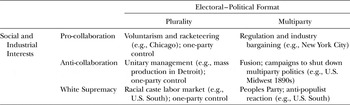
The alternative theory is summarized in Table 1. The table presents a static view of several possible relationships between electoral formats and social interests as they may be combined into projects of organized political economy. The examples span the time period when multiparty politics was common in the United States in the late nineteenth century to the era that Republican President Warren Harding called normalcy in the 1920s.
Electoral Rules and Social Collaboration before the New Deal

The electoral–political formats are formats of rule and role—practice—that encompass political party insurgencies and factionalism, including fusion candidacies as well as independent (nonfusion) party politics, and plurality rule. The social and industrial interests are arrayed according to how authority at work is allocated, whether shared through bargaining among the parties to the relationship (principally labor and management, but also competing firms in an industry, schools and training institutions, public regulatory authorities, civil society groups, etc.) or unilaterally (principally by owner-managers, including Jim Crow arrangements between white managers and white workers). As the examples in Table 1 illustrate, there is not a fixed correspondence, but movement among these elements where agents act to create relationships by various combinations of perceived interests and rule resources. Where pro-collaboration interests and multiparty rules combine, the forms of work may be negotiated and publicly regulated.
In the terms of the comparative debate about how electoral rules shape types of political economy, there is greater diversity in the United States. The Right was well organized after about 1900 in two big parties, and the plurality rule suited its power in most places. Reformers of various kinds emerged to challenge the Right, and they could use fusion where it existed, which made it easier to mobilize voters who might not vote Left or entirely abandon their traditional Right party identification, but who would support heterodox programs of social progress. In this scenario, the right-wing parties should compete with each other to sponsor industrial melioration, by helping social partners make agreements as part of their electoral appeal as problem solvers for the public good. My contention is that in New York they did in fact do that. In contrast, in other locales where roles and rules were combined differently, different forms of industrial order were established. In the South, for example, employers established a state-supported racial caste economy and smothered electoral democracy.
4. How Electoral Possibilities and Industrial Developments Evolved in New York
How was a laboristic state pioneered in New York? What we expect to observe are organizers of workers and businesses who created relationships of a type that did not exist before, which took shape in collective bargaining agreements that govern labor management in the workplace and in regulations that set standards for the external labor market and interfirm competition. This means that we have to recast the standard historiographies of U.S. ethnic and labor politics, which keep rules and roles separate, to underline the deep influence of institutions as resources for interest formation in the political economy. To establish the authority to make agreements and write regulations, organizers used a variety of tactics, but fusion was especially potent because it offered a virtually unique tool to link prospective workers’ specific interests in collaboration to electoral contests.
In the standard histories, city politics is about binaries like ethnic group patronage or professional regulation and corruption or efficiency, and labor history is the story of apolitical craft unions and the failure of socialism. But individual roles in the economy and politics were in fact more flexible, and there were more than two ways to organize and manage a capitalist economy. Thus, the standard history is that the Democratic Party had complete control of New York City government because it was an ethnic-based election machine that made distributive promises based on monopoly of government office and budgets. Kenneth Finegold's study of machine politics is unusually perceptive for analyzing choices within the regulatory coalition, but it nonetheless is typical in its focus on the public sector.Footnote 29 Yet we can readily add collaboration interests in the standard analysis when we note that fusion and independent electoral action prompted New York's party leaders to adopt agendas to regulate labor market conditions and to support private agreements about the terms of labor exchange.
There is no dispute that machine politicians created ethnic-based political parties and preoccupied themselves with controlling office and distributing patronage, which made the local state an unreliable partner in regulation. Rather, my argument is that no immigrant was born a machine party voter. This is the truth of the electoral histories of ballot and voter registration reform. On the contrary, immigrants were typically working class in an era of brutal capitalist market cycles, and they repeatedly identified with radical political messages that promised justice. Machine politicians scrambled to compete for support. Martin Shefter synthesized the argument about the interactive quality of local party politics and reformism in American regions.Footnote 30 In his study of “ethnic succession” through party politics, he shows the great lengths to which machine leaders went to create appropriate ethnic community representatives and shape immigrants into machine voters. New York City's Tammany Hall Democratic club politicians preferred to groom gangsters in the late 1920s and 1930s as ethnic leaders than accept labor radicals, but workers continued to evade their control a significant amount of the time. Fusion helped them do so.
Thus, to say that New York's laborist politics resulted from demographic factors, such as the large immigration of Jews to New York, who brought socialistic politics with them, is to elide the very struggles of actual Jewish workers and business owners to make a place for themselves in a desirable future economy and society.Footnote 31 They created this place in part by rejecting the practice of Democratic Party politics by Tammany Hall, but also by staying engaged in the electoral process by choosing to vote for candidates who would (more likely) help them work and live as they wanted. In the economy, many Jewish workers were non-union or joined craft-based unions or they believed in workers’ direct action, but most eventually decided to pursue an industry-wide bargaining strategy. Once some Democratic Party leaders began to offer appropriate leadership to Jewish labor leaders, as discussed below, they became potential partners for Jewish workers’ organizations.Footnote 32 In short, “Jewish preferences” responded to opportunities and shaped the evolution of New York politics. Similar observations can be made about how other important groups in the social structure made their way, among them self-identified reformist women during the Progressive Era, post–Irish Civil War Irish immigrants who were prominent organizers of the Transport Workers Union in the 1930s, and black and Puerto Rican migrants in the 1940s and 1950s. Rules that govern the economic and political opportunities to express identities shaped those identities. Both fusion tactics and independent voting were tactics to express evolving preferences that avoided political consolidation on the ethnic representation model. Organized independent voting was significant in New York City in the Progressive Era (1900–1922) and New Deal Era (1935–1975).
Similarly, it is agreed that the AFL became craft-based and pursued an interest group agenda for job control (including skills). Yet Gary Marks's comparative study asks the key question: If electoral action for American union leaders was a pragmatic question of how it could be useful, then why did they not try to overcome obstacles to their power in the wake of the 1890s Populist insurgency?Footnote 33 The answer is that sometimes they did, and in New York, they had significant success. A study by Christopher Ansell and Arthur Burris pushes at the margin of the standard history when it brings together the analysis of union organization and electoral forms.Footnote 34 If their analysis is extended further than they take it—they are preoccupied with explaining how the AFL's union form contributed to the emergence of the machine form of local politics by 1910—to labor–management relations in the next decade, we can clarify the significance of flexible electoral rules for the manifestation of interests in industrial collaboration in New York.
Ansell and Burris argue that craft union organization contributed to New York City's machine politics because the national office of the trade union was able to enforce its claim over a piece of the division of labor by centralized control over the workers’ decision to strike. Likewise, the machine party mobilized ethnic (not class) identities and centralized control over the ballot to ensure that candidates represented the ethnic voter blocs that the party leaders wanted to establish. Ansell and Burris argue that the two strategies overlapped because craft groups had an ethnic basis. Thus, the AFL encouraged skilled workers to identify by craft and ethnicity, and the machines mobilized cross-class coalitions of ethnic groups. When both occurred together, they were complementary, and alternatives were shut out. This is consistent with the predictions of the comparative capitalism literature on which Cusack et al. rely. Craft organizations are anathema to employers. When craftism is combined with the failure to organize a class-based political party, employers prefer unitary (not collaborative) management and plurality rule.
There are several problems with the received wisdom in the New York case. First, fusion helped prevent complete control of the ballot by Tammany. Second, there is more than one working-class insurgency. There is the one in the late nineteenth century and another one in the second decade of the twentieth century, which is after the alleged consolidation of the New York City Tammany machine. Workers became better organized at work and in electoral politics.Footnote 35 Even when craft unionists opposed an independent labor party, they combined trade and class consciousness.Footnote 36 Third, the AFL was not uniformly nonpartisan even where it was dominant in the union field, and the New York AFL supported fusion coalitions. Fourth, the craft-ethnic nexus was unstable because of massive immigration and migration. Because of these factors, the Democratic Party did not consolidate its power in New York City until the 1920s.
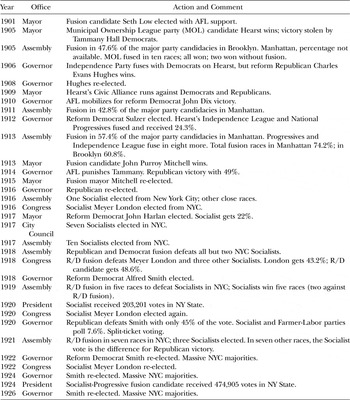
In contrast to expectations about fixed interests and political monopoly, New York's politics were wide open, characterized by fleeting control by the big parties, electoral insurgencies, emergent political identities, and transforming party agendas and electoral appeals. Table 2 chronicles New York City voter independence that blocked the consolidation by right-wing party leaders until the 1920s. The leaders of the Republican and Democratic parties discovered that the electoral arena was still unstable after the defeat of Populism. New York Republicans and Democrats alternated in state office from 1900 to 1922. In New York City, where Republican support had collapsed in the 1890s, fusion and independent party voting repeatedly denied Democrats complete victory. Voters elected fusion mayoral candidates who defeated Tammany Democrats in 1901, 1905 (but stolen), 1913, and 1915.Footnote 37 Organizers created fusion ballots for other local elected offices and voters elected these candidates. Voters also supported local parties: the Progressive Party, which was started by reform Republicans in the second decade of the century; the Farmer-Labor Party; and the Socialist Party. In short, rather than machine consolidation, and stimulated by the rapidly gelling economic organizational environment in the city and independent electoral power, the big parties factionalized and developed new policy profiles. Moreover, Democratic leaders were ambitious—controlling the city was not enough; they wanted to control the state government. The city's electorate was large enough that, if the Democrats could fashion an appropriate appeal, the party could win statewide office by a massive majority in the city and thereby control both the state government and the city administration. Yet the Democrats regularly alienated voters. When attractive alternatives were offered, working-class voters deserted the party. In retrospect, the lasting reconfiguration of the electorate emerged from Democratic leaders’ new strategy for statewide electoral victory, which emerged first in a trial run in 1910 but which did not get firmly established until 1918. They committed the party to an agenda of industrial relations mediation and public regulation to attract independent middle-class voters and left-wing unionists. Al Smith's 1922 election as governor finally established Democratic dominance, but now as a laborist rather than as a machine party.
Voter Independence in New York State and City before the New Deal

Sources: Red Book and Legislative Manual, various years.
Now, how were interests formed in the industrial and political order, and how did the fusion option contribute? First, as I have just suggested, the big parties could not establish their dominion over the ballot and government authority. To do so, the big party leaders had to take the measure of the specific interests of labor and business that had led them to spurn the regular party tickets. These leaders had choices, which included measures to depress voter turnout, but fusion offered the opportunity for alliances between civil society organizations and insiders who were sympathetic to reform. Second, the labor-left needed to sustain independent organization because the evidence of betrayal was palpable. They had to demonstrate that they could punish party leaders who were unresponsive to their specific reform proposals. This could include independent party voting, which was pursued but which had the shortcoming of leaving the field to the dominant parties, and fusion tactics, which enabled organizers to demonstrate their electoral power and to form alliances with party factional leaders (whether Republican or Democrat).
In this context, Democrats began to support social collaboration and regulation, but the sequence was not linear, as if the actors knew exactly what they wanted and how to get it. The field of play was very heterogeneous. In addition to the AFL and unions not affiliated with the AFL and to the middle-class social reform organizations, such as the New York Women's Trade Union League, the pro-labor National Consumers League, and the Child Welfare League, there was William Randolph Hearst, who used his newspapers to promote his own party and his own candidacies, and the Progressive Republicans and other parties.Footnote 38 From 1905 to 1913, Hearst mobilized a wide following, but eventually his personalist politics alienated voters and other organizers. The Progressive Republicans rallied to Theodore Roosevelt, but the Republican Party purged the Progressive wing after 1912. And the Democrats adopted a reform agenda in 1910 and then backtracked. In the second decade, labor militancy exploded, and Socialists began to win elections, which made it seem “not only to them, that they were on the way to becoming the second party in New York City.”Footnote 39 Democrats and Republicans then fused many nominations from 1918 to 1920 to stop the Socialists’ ascent. This episode supports the categorization of the Democrats and the Republicans as right-wing parties. In real time, then, the power of the Left was palpable for the two big Right parties, but what the outcome would be depended on what the actors did.
The AFL Central Federated Union of New York City (CFU) organized its own Working Men's Independent Political League.Footnote 40 The leading historian of New York unions observes that the “Tammany administration in New York City weakened the existing [labor] laws by poor enforcement and created such animosity that important anti-Tammany political action developed within organized labor.”Footnote 41 The CFU formed the Joint Labor Conference of the Central Labor Bodies of the City of New York, which included the Socialist unions, in 1909.Footnote 42 The unions allied with non-labor-reform groups like the settlement house movement and the Consumers’ League, and together they cooperated in the remarkably flexible electoral environment. For example, the CFU strongly mobilized for (but did not endorse) Hearst in 1905.Footnote 43 After Hearst's appeal evaporated, the state AFL began to aggressively court state Democratic leaders. An astute Tammany leader, Charles Murphy, launched a new party strategy when he placed a labor reformer, John Dix, at the top of the party's ticket in 1910, which helped Democrats sweep all statewide offices.Footnote 44 But, when Tammany later reneged on a key electoral pledge, the AFL joined a fusion movement to punish it.
Dix's election seemed a harbinger of a new order for labor–management relations if the electoral commitments could be carried through. The incipient party–labor link had features similar to those observed in comparative studies of multiparty systems. The Democrat produced appointments for AFL officials as chair of the state's Workmen's Compensation Committee and as commissioner of the Department of Labor. In addition, as in multiparty system parliamentary committees, legislative leader Al Smith co-chaired the legislature's Factory Investigating Commission and chose its members from the key social partners: Mary E. Dreier of the Women's Trade Union League; Samuel Gompers, president of the national AFL; Robert Emmett Dowling, a major real estate developer involved with the construction industry; and Simon Brentano, the book publisher.Footnote 45 The commission proposed workers’ compensation, mothers’ pensions, stronger regulation of factory conditions, public employment agencies, and minimum wages and maximum hours for female workers.Footnote 46 Reformers helped re-elect a Democratic majority in 1912 and a new Democratic governor, William Sulzer.
The keystone was Democratic Party support for workers compensation, a fundamental feature of the development of western welfare states because of its centrality to mitigating the costs that workers bore for industrial modernization. But the newly elected legislature failed to pass the AFL's compensation proposal because Tammany made a deal with insurance companies to remove a public insurance option. Sulzer vetoed the weakened law, declaring that it violated the party's pledge to workers:
A workmen's compensation law, which fails to inspire the confidence of the industrial toilers for whom it is enacted and which meets with their vigorous and emphatic protest, cannot be said to be an adequate performance of such pledge.Footnote 47
The governor's ethical stand illustrates the “credible commitments” argument in comparative studies about how class-based parties enable substantive representation and accountability, if everyone acts in the expected ways. In this instance, Tammany Democrats broke their commitment. After his veto, Tammany Democrats impeached Sulzer.Footnote 48 In retaliation, the AFL joined a campaign to punish Tammany Hall. The CFU endorsed the successful fusion mayoralty campaign of John Purroy Mitchell in New York City in 1913, despite some division among the building trades, and Tammany was swept out of New York City government and “practically every county and judicial office as well.”Footnote 49 In 1914 in the state election, only twelve of the forty-eight legislators from New York City who voted for impeachment were returned to office, and the Republicans won the governorship with 49% of the vote; Sulzer was elected to the legislature on the Progressive line.Footnote 50 Thanks to the flexibility of access to the ballot, organized labor could make the point that the key to power in the state was working-class votes in New York City. So, even with Republican control of state government, the legislature established an Industrial Commission, whose design was based on the tripartite model of the Wisconsin Industrial Commission.Footnote 51
Democratic Party leaders were chastened by this experience, but even then the new link between party leaders and reform voters was a work of construction. Tammany found its reform spokesperson in the surprisingly able Al Smith, who was elected governor in 1918, 1922, 1924, and 1926. Smith's outspokenness and regulatory agenda appealed to reform activists. For example, nationally, during the First World War, the antiwar Socialist Party became the object of intense government harassment; Republicans in the Congress and New York Assembly refused to seat them; but Smith defended the rights of Socialist voters.Footnote 52 He also refused to deploy the state police to break the postwar strike wave.Footnote 53 On the other hand, in 1920 Smith was defeated for re-election by the Social Darwinist Republican Nathan Miller, who received less than half of the total vote, in a broad Republican sweep.Footnote 54 Three left-wing parties polled 7.9%, which was more than enough to have elected Smith, but many labor-left voters were alienated by Democrats and Republicans who fused against Socialists and by President Wilson's withdrawal of support for unions at the end of the war. In a rematch between Smith and Miller in 1922, the Democrats finally consolidated their control. Smith soundly defeated Miller with 55.2% of the statewide vote, comprising 68.7% of the New York City vote compared to his upstate second-place finish.Footnote 55 In 1924 Smith was re-elected with 66.9% of the NYC vote, and in 1926 Smith again was elected with 67.5% of the NYC vote.Footnote 56 In 1928, Smith was nominated by the national Democrats for the presidency, and Franklin Roosevelt was elected New York's governor.
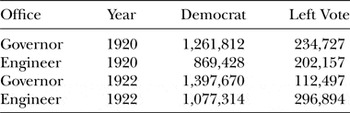
A notable quality of Smith's electoral performance in the 1920s was split-ticket voting by left-wing voters. As if many New York leftist voters were moving on from the 1920 contest to size up the next opportunity, many voted for the Democrat Smith at the top of the ticket and for left-wing candidates down ballot (see Table 3).Footnote 57 Smith outpolled down-ballot candidates on the Democratic Party line, while the pattern for the left-wing parties was the reverse.Footnote 58 The continued potency of the independent voters is shown by the presidential election in 1924, when more than 470,000 New Yorkers voted for the Socialist-Progressive fusion candidate, Wisconsin Senator Robert LaFollette.
Split-Ticket Voting by Left Voters

Sources: Legislative Manual, 1924, 763–35; Red Book 1922, 534, 540; and Red Book 1923, 520.
Note: The Left vote includes the votes for the Socialist, Socialist Labor, and Farmer-Labor parties.
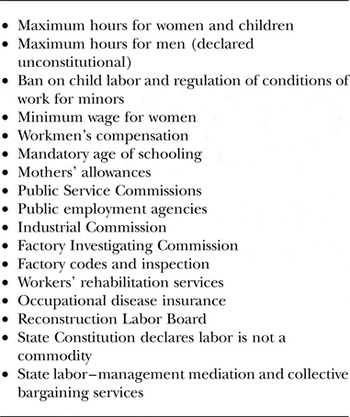
New York's electoral politics were more flexible than typically conceived, and electoral rules were instrumentalized by reformers to express new industrial interests. Now, what did unions and employers use the rules to achieve in New York? Cusack et al. argue that social coordination did not emerge in the United States because there was little effective demand for it, echoing Thelen's analysis of skill systems. I have already indicated that there was widespread interest in various forms of coordination. Skill development is just one subject of coordination; there are many other elements of industrial order that would benefit from regulation. New York City's biggest industries were project and batch producers, such as building construction, garment manufacturing (largest by value and employment), and publishing (second largest by value; employed 86,000 in 1919). Employers in these sectors collaborated with unions to govern industrial conditions at work and in the marketplace, eventually with the help of public authorities.Footnote 59 In the 1930s, three-quarters of New York City's unionized industrial workers enjoyed multiemployer contracts compared to one-quarter of workers in other places who typically negotiated with a single company.Footnote 60 Yet the big investment of time and effort by labor and management to stabilize industry conditions would be for naught if the state did not provide political support and public services to reinforce private agreements. New York's collaborative industrial order was reinforced by mediation and fact-finding in strikes and lockouts, the union shop on public works projects, a child labor ban, enforcement of factory building codes and workplace safety, workmen's compensation, hours laws, limits on the judicial labor injunction, and support for union discipline of union members (see Table 4).
Examples of Progressive Era Policies Adopted in New York State

Industry coordination benefitted from the ongoing enforcement as market conditions evolved. Instability of the product markets required continual adjustments of who would do what in the production chain, and these involved disagreements, conflicts, and even impasses in the normal course of collaboration. The authority of unions and firms to set terms for industry relationships rested on the actual organization of workers and employers and on the government support to prevent exploitative forms of industrial practice.
New York employers perceived value in collaboration with organized labor. After the building trades unions fell into a bitter dispute with the Building Trades Employers’ Association (henceforth, the Employers’ Association) of New York City in 1903, which led to a lockout, it was the Employers’ Association that sought a new agreement in 1904 rather than emerge from the battle without a union.Footnote 61 The union shop was accepted. From 1904 to 1910, the General Arbitration Board governed all but one trade in the industry, published rules, and settled disputes. The board's Executive Committee was composed of equal membership from unions and employers. While non-union companies could participate, nonparticipating companies were warned away from the city. In 1910 the framework collapsed again amid political turmoil, but many unions and employers continued to follow it, and a new agreement was established in 1920.Footnote 62
Similarly, garment manufacturers became partners with the garment worker unions.Footnote 63 The industry was the largest in the city and nation; in 1921, 70% of national employment in the women's and children's sector was in New York City.Footnote 64 Union membership that year reached 100,000, and the industry was governed by citywide agreements. To achieve this, workers and employers had to be organized, and government leaders provided support. A leading segment of the garment workers’ movement at the turn of the century was the Cloak Makers craft union. The union had been founded by Irish immigrants, but it became a bastion of Jewish immigrant power. Other unions of the various garment trades became increasingly populated by Italians (about 15% of all workers in 1900) and later by Puerto Ricans and African Americans. In 1900 many of the needle trades coalesced into an industrial union, the International Ladies’ Garment Workers’ Union (ILGWU), affiliated with the craft union federation AFL. Unlike the ethnic craftism thought to be characteristic of the AFL, the ILGWU organized everyone and produced its newspaper in Yiddish, English, and Italian (and in the 1930s, in Spanish). The union also became the primary organizational base for the Socialist Party in New York. In the men's clothing segment of the industry, initially there also were independent garment unions and a preexisting AFL union, the United Garment Workers (UGW). Many of the locals of the UGW and some independents re-grouped in 1914 to create an industrial union, the Amalgamated Clothing Workers of America (ACWA), which became the primary union in the industry from then on and later gained AFL membership.Footnote 65
In 1910 the ILGWU and the suit manufacturers signed an agreement called the Protocols of Peace, which was inspired by the ideas of Louis Brandeis about regulated competition and negotiated by prominent attorneys, including the future Socialist congressman, Meyer London, and the legal counsel for the New York State Chamber of Commerce and the New York Merchants Association.Footnote 66 At the same time, Progressive Republicans and reform Democrats promised industrial regulations to prevent exploitative working conditions. Like the construction industry's Arbitration Board, the garment industry agreement established procedures for rule making and dispute resolution.Footnote 67 The Protocols pattern spread to the rest of the industry once the union launched a general strike in 1913, at the behest of the employers’ association, to demonstrate that the union controlled at least 80% of the market. At the conclusion of the strike, the settlement affirmed that “a strong organization of the employers and a strong union are necessary, each working to strengthen the other” to standardize conditions and prevent destructive competition.Footnote 68 Similar to the construction accord, the Protocols required vigilant policing, and the union drew on a broad network of community and political leaders, including fusion mayor John Purroy Mitchell, to keep the peace. Likewise, the ACWA negotiated an industry-wide agreement in the men's segment of the industry. This agreement was negotiated with the help of the AFL and political leaders, including London and future fusion Mayor Fiorello La Guardia.Footnote 69
Governor Smith then played a key role in holding unions and employers together. In the national strike wave of 1919, Smith rejected requests from local officials and employers to deploy state police against strikers in the metalworking, machinery, traction, textile, glove-making, and hat industries. Instead, he convened a conference with the AFL and employers that led to creation of the Reconstruction Labor Board to mediate disputes.Footnote 70 When the New York Cloak and Suit Manufacturers’ Protective Association broke its agreement with the ILGWU, the union won an injunction against the employers for locking out its members, turning the tables on the employers’ use of the injunction. The union won the appeal hearing before State Supreme Court Justice Robert Wagner. Smith led a conference with the ILGWU and employers in January 1920 that concluded with the creation of a tripartite committee to settle the dispute.Footnote 71 In the garment industry bargaining rounds in 1924 and 1926, when the union factionalized between Communist and Socialist leadership, Smith appointed state fact-finding commissions to recommend terms of settlement favorable to the ILGWU. In 1929 Governor Franklin Roosevelt and in 1932 Lt. Governor Herbert Lehman each acted similarly to support the union's position through a negotiated settlement.Footnote 72
The printing and publishing industry further illustrates industrial collaboration, including the ongoing need for monitoring and problem solving. Printing was the second most valuable industry in the city after apparel; in 1921 it accounted for 18% of the nation's total commercial printing output and employed 49,000 blue-collar workers. The book and job printing industry workers were 70% unionized in 1919. The New York printers’ union (International Typographical Union [ITU] Local 6) established a shorter work week in New York book and job shops, but in 1921 it lost a national strike to establish the 44-hour week in other cities.Footnote 73 Both the employers and the union factionalized, with some employers and union members seeking collaboration and others opposed.Footnote 74 However, the book and job shop firms had a continuing need to coordinate their actions to stabilize competition, including wages and labor supply. They organized themselves into a “developmental association” that drew on Brandeis's notions of scientific management.Footnote 75 Some firms remained unionized, and New York City Local 6 was willing to collaborate. In the 1930s and 1940s, in the wake of the New Deal, the ITU regained its prominent position in the industry. The book industry became about 70% unionized nationwide, and New York City's printing employment was 50% higher in 1947 than in 1919.
The Democratic Party leaders in New York became committed to support the laboristic agenda for industrial governance, but the electoral independence of voters waned in the later 1920s and politics in New York City changed. As already indicated, unions experienced internal divisions. Probably more damaging, Smith retired from politics after his 1928 national defeat and Charles Murphy died; the old Tammany politics re-emerged, now supercharged by the distractions and risk taking associated with violating Prohibition. The next section discusses how union leaders revived fusion in the 1930s to discipline the Democrats once more, but then with the possibilities of the national New Deal counted in the stakes.
In sum, the fusion rule in New York offered a useful tool to organizers to express a specific demand for social collaboration and to establish a governing center-left coalition that supported union–management negotiation and labor market regulation. In Michigan and Illinois, where fusion had been banned before the Progressive Era, governing outcomes were different. Large employers made Detroit the bastion of the Open Shop and mass production; the Democratic Party became anti-union no less than the Republicans. Ansell and Burris argue that labor in Chicago was less craft-oriented and more open to industrial unionism, which obviated the nexus of the craft union and machine party they say existed in New York. But my argument is that New York politics took a decisive turn to laborism after 1910 when their study ends, and that Chicago labor got less for its independent electoral strategy than in New York City because it could not express itself effectively at the ballot box. After the defeat of the national steel strike in 1919, the Chicago AFL launched an independent Labor Party, but it attracted only 8.1% of the vote for mayor and then collapsed.Footnote 76 In short, timing matters as well as electoral options, as suggested by the different experience in Milwaukee, where, two decades before the Chicago AFL created a Labor Party, the AFL allied with the Socialist Party and elected the city government and a congressman. The effective representation of labor was a condition for the Wisconsin Industrial Commission and reforms in that state, including the creation of the only tax-supported system of technical colleges in the United States to produce skilled labor. In short, where unions had established more effective political expression—New York and Wisconsin—labor got more from government, and collaboration was more likely. In cases where government support for labor was not forthcoming and electoral options were narrower, as in Detroit and Chicago, craft unionists and small employers in the 1920s hammered out their relationships outside the law.Footnote 77 In the South, employers used white supremacy and plurality rule to establish a racist oligarchy and a racial caste labor market.Footnote 78 These relationships are summarized in Table 1 (above). Later, in the 1930s when mass-production workers engaged direct action for union recognition and collective bargaining, the New Deal Congress looked to Wisconsin and New York for models.
5. New York's Contribution to the New Deal Laboristic State
New Dealers combined lessons from New York with those from other places into something new, a laboristic state.Footnote 79 In the 1930s and the following decades, New York's leaders and experiences continued to figure prominently in national political developments. New York's unions used fusion tactics to pressure Democrats to support their agenda. The Left survived the political repression of the Cold War better because labor leaders could use fusion tactics to sustain an independent voice. They used their electoral independence to pioneer public-sector unionism. Yet, in the 1970s, the industrial economy of New York fell into a crisis, the solution for which undermined local union organizations. This later development was a significant piece of a broader national realignment of party politics that led to the creation of the U.S. liberal market economy.
The lessons that the New Dealers learned about industrial politics came directly from the politicians and unionists whose careers Charles Murphy's formula for success had nurtured. Beyond Smith and President Roosevelt (governor 1928–32), there was U.S. Senator Robert Wagner (1927–1949), who authored the National Labor Relations Act (NLRA) in 1935 but who was previously a pro-union ally of Smith's in the New York legislature and on the State Supreme Court. Another is Roosevelt's Labor Secretary Frances Perkins, who helped establish the National Recovery Administration (NRA) and the federal welfare state during the Second New Deal, but who previously promoted social regulation in New York as the president of the National Consumers League and as one of Smith's labor commissioners and chief mediators. Major labor movement leaders were based in New York, such as Samuel Gompers, Baruch Vladek,Footnote 80 David Dubinsky, Max Zaritsky, Alex Rose, and A. Philip Randolph, plus later prominent unionists such as George Meany, Jerry Wurf, John Sweeny, and Dennis Rivera, among many others. Frances Perkins appointed the ACWA's president and chief economist to the Labor Advisory Board of the NRA. The ILGWU president, David Dubinsky, was the co-chair of the enforcement administration.Footnote 81 The ILGWU and the ACWA were the first unions to request approval under the NRA in 1933 for codes of conduct for their industries, which were based on the industry-wide agreements they had pioneered. When the NRA was declared unconstitutional the next year and the Congress passed the 1935 National Labor Relations Act (NLRA), both segments of the garment industry continued to operate nationwide according to the codes.Footnote 82 More broadly, the potential of the NLRA for unionizing industrial workers was seized by the Committee for Industrial Organization of the AFL, which was started by the leaders of the United Mine Workers of America (UMWA), three garment unions—the ILGWU, the ACWA, and the New York–based Cloth Hat, Cap and Millinery Union—and the Typographers.Footnote 83
The New Deal's labor policy was based on the labor–management experiences before the 1930s, but it emerged also from the immediate pressure of the labor insurgency under the failed NRA. The NLRA labor policy was pluralist because it recognized two lines of authority that combine in a unionized workplace, in contrast to unitary management, but it was no longer the voluntarist labor management of the Progressive Era. Robert Wagner's Act stipulated that where workers formed a union, the employer could not interfere with the labor organization, and once the union was certified by the federal government, the employer was obligated by law to bargain collectively. At the same time, the New Deal policy accommodated diverse practices across the economy. The key was that the federal law supported workers where workers themselves organized unions; what they did was supported; if they did not organize, there was no labor–management collaboration. The mobilization of workers in the mass-production industries was the novelty of the era and prompted theories of the Keynesian welfare state in which unions provided countervailing power to corporations, but my point is that the New Deal model accommodated various forms of collaboration, non-union workplaces, and Southern apartheid. Some indicators of the New Deal's accommodation of labor–management relations outside of the mass-production sector are the Fitzgerald Apprenticeship Act (1937), under which the U.S. Department of Labor provides the administrative structure of union–employer cooperation on skill development, which was mostly used in construction, tool and die making, and printing, and the Walsh-Healey Act (1936), which established local union wage scales as the basis for government contracting, including construction. Another critical piece of federal labor policy was its administration by an independent agency, the National Labor Relations Board (NLRB), through regional offices that largely supplanted court supervision and shielded labor management from partisan plurality interference. The Taft-Hartley Act of 1947 was the most explicit expression of diversity because it enabled employers in Southern states to write state laws to ban the union shop. As New Deal labor policy drew from regional experiences, Democratic Party leaders’ management of their political alliances in turn reconfirmed the federal structure of U.S. labor policy and administration.
In New York, the New Deal labor policy multiplied the use of joint boards and arbitration to “over fifty branches of industry, covering 22,000 employers and 397,000 employees.”Footnote 84 In printing, Local 6 had contracts that covered 80% of the market with 600 job shops with whom it negotiated through the Printers League Section of the Printing Industries of Metropolitan New York.Footnote 85 The Book Manufacturers Institute analyzed contracts in the industry that covered about 95% of the books produced by union labor in the United States. Also, the Brooklyn Chamber of Commerce's Bureau of Employee Relations provided consultants and research staff and had an advisory committee of major employers that provided services to hundreds of firms.Footnote 86 Joshua Freeman concludes that a “hybrid form of municipal social democracy grew up in New York.”Footnote 87
The basis of New York labor's influence over industrial governance during the New Deal era was fusionist electoral action, which re-created the center-left coalition. In 1936, Left union leaders deployed the fusion tactic when they perceived that the New Deal was threatened by Tammany opposition and by the Socialist Party, which would not cross-endorse Roosevelt.Footnote 88 To corral the Left vote for Roosevelt, the union leaders quit the Socialist Party and formed the American Labor Party (ALP) to cross-endorse him for president; the ALP attracted 270,000 votes. The next year the ALP cross-endorsed Fiorello La Guardia for mayor and gave him 482,790 votes.Footnote 89 Also in 1937, the ALP elected seven state legislators. In 1938, the ALP elected a congressman, and Governor Lehman appointed an ALP leader as state comptroller.Footnote 90 The ALP became the official political arm of the New York State Congress of Industrial Organizations (CIO) Council. For decades thereafter, the ALP and a successor labor party, the Liberal Party, often held the balance of power in the city and state between Republicans and Democrats by regularly (but not always) fusing its nominations with theirs. The Left also established a new city council election system based on the single-transferable vote (STV), which operates like proportional representation.Footnote 91 From 1937 to 1947, when it was abolished, this electoral rule helped deny machine Democrats domination of the council and put union leaders on it. In 1937 the ALP sent six to the council; the Communist Party eventually sent two.Footnote 92
Once again, Left electoral power disciplined Tammany. La Guardia's successor in 1945 was Democrat William O'Dwyer, who followed “policy positions” that “were mostly written by ALP members.”Footnote 93 O'Dwyer's response to the postwar strike wave was similar to Al Smith's positive response in 1919; he established a Division of Labor Relations and appointed tripartite committees to settle over 150 disputes. Labor's electoral independence also helped organized workers preserve their voice during the Cold War. When the ALP was divided by the exit of anti-Communist union leaders to form the Liberal Party, Tammany leaders allied with the Republicans to smother the ALP, much as the Democrats and Republicans had moved to blunt the Socialists in the late 1910s.Footnote 94 The union-led Liberal Party, however, sustained the independent expression of labor's preferences despite these bipartisan pressures.Footnote 95 Elsewhere the Communist Left was purged and the labor movement was a captive of the Democratic Party.Footnote 96
An example of how fusion was effectively used to establish new labor–management relations occurred in the 1950s. In 1953, the Liberal Party's independent candidate for mayor received 560,000 votes, although he lost to Robert Wagner, Jr., the Democrat. Wagner was the son of the Progressive Era State Supreme Court justice and New Deal senator, but the Liberals did not trust him because he was sponsored by Tammany. He mostly gave lip service to unionism, although he did sponsor a broad expansion of social services. In his re-election bid in 1957, the Liberal Party unionists cross-endorsed him because he promised to issue an executive order for collective bargaining by public-sector employees, which he did in 1958. New York City was the national breakthrough for public-sector workers’ rights, followed the next year by a Wisconsin state law. President Kennedy followed Wagner's example in 1962 when he issued an executive order, drafted by a Wagner aide, for unionization of federal government employees—much as President Roosevelt had followed the senior Wagner's lead on the NLRA. Unionizing public-sector employees greatly increased the political influence of the labor movement and reinforced collaborative industrial relations and the welfare state.Footnote 97
In retrospect, the New Deal regime went from strength to weakness suddenly. My claim is that the New Deal regime was fragile because of the complex combination of plurality rules and diverse industrial arrangements. The national Republican Party played the expected role in a plurality election system of appealing to the median voter against the special interests represented in the Democratic coalition. But this charge only could work when the Democrats lost the ability to sustain credible commitments to all of the social partners (of various kinds). During the 1970s several of the Democrats’ special arrangements came undone. One was the crisis of New York's “hybrid social democracy.”
Union membership in New York City had declined before 1970, in part because garment firms migrated to Southern states and because technological changes reduced the labor intensity of printing, but this did not affect the New York model. During the first half of the 1970s, however, in just a few years the city lost several hundred thousand jobs.Footnote 98 The sharp national recession of 1974 led to a financial crisis in New York City in 1975. In this context, the balance of political power shifted against laboristic politics and the social service budgets and public employee unions that were its achievements.Footnote 99 The unions fragmented politically when it came to endorsements. The Liberal Party leader was prosecuted for corruption, and the party went into terminal decline.Footnote 100 The collapse of the labor-left in New York was one factor in the broader realignment of American politics that was being organized by conservative and employer activists. After national electoral rules were changed in the mid-1960s in the wake of the civil rights movement and the racial basis for the Southern differences in labor market governance began to fade, and when the U.S. manufacturing economy's competitiveness lagged in the 1970s, American employers turned decisively against the New Deal laboristic state and its preference for negotiated solutions and regulation. Nationally, Northern employers coalesced with Southern employers in a newly united Right organized by the Republican Party that now appealed to Southern white Democrats.Footnote 101
As Cusack et al. have argued, when the Right is unified in a plurality system, it can win without organized labor. Since the 1980s some advanced capitalist democracies have made adjustments to global market flux that preserved prominent elements of labor market collaboration, but in the United States the Reagan electoral coalition turned decisively against labor and social regulation. Reagan's electoral success led many Democratic Party leaders to adopt median voter politics to protect the status quo, which inadvertently further weakened the capacity of the federal state to provide services and support joint solutions to problems.Footnote 102 The new Right used plurality rule to reform industrial relations—no compromise in politics and policymaking and unitary management in the workplace. Although groups committed to social collaboration persisted in neoliberal era, they were weakened in the newly organized election system. Eventually, in New York City, in the 2000s, labor and community organizers used the fusion rule to regroup left-wing voters behind a new party called the Working Families Party, which revived the center-left coalition in the city and which, in 2016, gave a significant endorsement to the presidential candidacy of Bernie Sanders.Footnote 103
6. Conclusion
This article contributes to the debates about varieties of capitalist development that analyze how electoral rules shape industry governance by showing how the U.S. case both exemplifies and furthers the leading arguments about the significance of electoral rules for interest formation and representation. The characterization of political economies as liberal or coordinated mislead if a country is taken as definitive of a type rather than as a bundle of institutional practices that have their own history and relationships that evolve over time, as argued by many American political development scholars.Footnote 104 There may be a dominant format, but diverse practices are part of the political economy's operations. Like Cusack et al., Thelen, and Martin and Swank, this article points to distinctive qualities of the American case. But it departs from causal accounts that run from industrial structure to group interests and from national electoral rules to forms of industrial order. That narrative explains the failure of the United States to develop industry collaboration: It highlights intransigent craft-based unions and plurality election rule, which obviated employers’ interests in coordination and explains the emergence of an economy of mass-production manufacturing. Instead, I argued that electoral rules and social roles are mutually constitutive and that what interests emerge and whether collaboration is established depends on how situations are perceived and opportunities to use rules are pursued. Interests are more flexible and may be re-imagined where rules may be used (or changed) to secure those interests. This article demonstrates this alternative theory by studying an exception to the two-party system in the American case, New York, where forms of industry collaboration were established. The anomaly matters when we can link it to an alternative explanation of developments.Footnote 105
The historiography of the American politics emphasizes its liberal features, including its interest group format, but the greater diversity of industrial organization and flexibility of electoral rules historically recasts our understanding of the significance of rules for projects of industrial order that need access to the state's authority. The wants of unions and employers at the turn of the last century were not the direct outcomes of a singular industrial structure because industrial order was the joint outcome of how they perceived their interests and how to pursue their wants politically in the specific conditions they found themselves in. In all places and industries, labor–management relations were the joint product of group identity formation (who does what at work) and the specific electoral rules and policies that enabled their effective representation. Several combinations were possible. New York supports the argument that electoral rules are interactive with social purposes in determining industrial order because it had different rules than most of the United States and different outcomes.
In New York, the fusion rule enabled organizers to mobilize independent-minded voters to prevent the right-wing parties from consolidating their hold on government. As employees and employers rapidly organized themselves into associations and unions and began to negotiate with each other, organizers could offer voters ballot choices to press political leaders to support their industrial projects. Independent voters’ electoral power was sufficient for union leaders to leverage a relationship with the Democratic Party (and sometimes the Republican Party) in which the right-wing parties deviated from expectations of the median voter model to back the specific interests of organized labor and firms in regulation. In fact, the Republican Party split over Theodore Roosevelt's 1912 campaign, and New York Republicans shifted toward a Social Darwinist platform opposed to collaboration and regulation. Among the prominent supporters of this shift were leaders of the integrated corporations, epitomized by U.S. Steel, headquartered in New York City, which is the outcome expected by Cusack et al. Even though voter eligibility rules made it harder to vote, and the new far-Right Republican Party won the governor's office in 1914, 1916, and 1920, ultimately the logic of the center-left strategy made sense for Democrats because the Republicans moved Right while the Left remained mobilized.
The effects of the electoral rules are not static because the interests and projects of the social partners evolve. In New York in the 1920s, voter turnout declined, collective bargaining repeatedly broke down, and the post-Smith Democrats descended into gangsterism, but the Left revived fusion tactics in the 1930s to achieve a more robust laboristic effect. The New Deal Democratic Party supported labor–management collaboration, but did not require it everywhere, accommodating a regionally segmented coalition.
The research that might now be conducted would first deepen the evidentiary basis for the claims about the historical links between electoral rules and strategies for industrial order. In contrast to New York, in other locales where roles and rules were combined differently, different forms of industrial order would be established. Gerald Berk and Andrew Cohen have shown how in some industrial districts where political representation was unavailable, private forms of industry collaboration emerged, such as racketeering and developmental associations, which were policed by the state. In still other places, the defeat and demoralization of craft production was accompanied by the organization of corporate bureaucracies for mass production.Footnote 106 In the South, the construction of an authoritarian political economy was accomplished through vanquishing the People's Party in the 1890s and by the reorganization of politics on the basis of one-party dominance and suppression of the vote. Employers established a racial caste economy and smothered electoral democracy.Footnote 107 Second, in comparative studies of capitalism the United States is often taken as the epitome of a liberal market economy, but not only is the past less clearly typed, current U.S. politics should be included in contemporary analyses. Beramendi and others argue that the variety of combinations of electoral rules and industrial order is significant and ongoing. The multiparty politics of New York City has continued to evolve into the Bloomberg and De Blasio mayoralties, and the ongoing demonstration of alternative arrangements may confirm or refute the claims made here.
Finally, electoral rules are enablers of interest formation and strategies to achieve substantive goals in the economy. Recent partisan rigidity is in part at least an outcome of electoral rules that favor neoliberal projects and disfavor other possible ones (given the comparative evidence of viable alternative ways to govern the economy). The debates over electoral rules (for nominations and ballot access, campaign finance, federal enforcement of the Voting Rights Act, state-level redistricting, and voter eligibility) are thus not only about the representation of interests with a distributive dimension. The uses of these rules are constitutive of empowered projects of political economy.