Introduction
Delirium is common in the acute care setting. Among older people delirium is associated with higher mortality and morbidity, and increased length of hospital stay (Cole and Primeau, Reference Cole and Primeau1993; Inouye et al., Reference Inouye, Rushing, Foreman, Palmer and Pompei1998; Stevens et al., Reference Stevens, de Moore and Simpson1998).
The prevalence and incidence of delirium among older patients vary according to setting. An Australian study reported 18% of older general medical inpatients had delirium within 72 hours of admission (Iseli et al., Reference Iseli, Brand, Telford and LoGiudice2007). High postoperative incidence rates of delirium are reported among hip fracture (53%) and elective orthopaedic surgery inpatients (28%) (Bruce et al., Reference Bruce, Ritchie, Blizard, Lai and Raven2007).
Management of older patients with delirium requires a multifaceted approach, including investigation for the cause as well as non-pharmacological interventions to reduce behavioral and emotional disturbance associated with delirium (Clinical Epidemiology and Health Service Evaluation Unit, Melbourne Health, 2007). Pharmacological agents may be required in some cases of delirium with severe behavioral and or severe emotional disturbance (severe symptoms).
There is limited evidence to guide the pharmacological management of older patients with delirium, especially in relation to the newer atypical antipsychotic agents. In response to this, clinical practice guidelines for the management of delirium in older people were recently developed in Australia (Clinical Epidemiology and Health Service Evaluation Unit, Melbourne Health, 2007). Box 1 provides a summary of the guideline recommendations for the management of severe symptoms associated with delirium.
Box 1. The guideline contains the following recommendations for the management of severe behavioral and/or emotional symptoms of delirium
• The use of antipsychotic medications for the management of delirium in older people should be reserved for those cases where the person experiences severe behavioral and/or emotional disturbance symptoms (expert opinion).
• Caution should be exercised in prescribing antipsychotic medications to older people with delirium (expert opinion).
• When antipsychotic medications are indicated the following processes should be incorporated into the patient care plan:
 The indication(s) for its use must be documented and reviewed regularly.
- Commencement of the antipsychotic should be accompanied by documented recommendations about: (i) the dosage of medication; (ii) the mode of medication delivery; and (iii) the frequency with which patient status is to be reviewed by a medical physician.
- The frequency of medical review will vary according to patient status. For example, a patient with significant agitation may require 4-hourly medical review, and a patient with less significant agitation may require 8-hourly medical review.
- Titrated antipsychotics need to be closely monitored by nursing and medical staff. The dosage and frequency should be titrated carefully against the level of agitation at each review.
- Titration must commence from a low dose typically commencing with the equivalence of 0.25–0.50 mg of haloperidol; (or if existing extrapyramidal signs) olanzapine 2.5 mg orally; or risperidone 0.25 mg orally.
- It is important that nursing staff caring for patients on antipsychotic medication are able to consult regularly with medical staff (expert opinion).

This paper describes an audit of medical records prior to the publication of the guideline document. The primary aim of this study was to document the pharmacological management of severe symptoms of delirium, prior to implementation of the Australian guidelines. The information from this study will assist in determining the areas of pharmacological management that will need to be targeted for the practical implementation of the guideline recommendations, and will provide a baseline measure of management for comparison post-guideline implementation. Secondary aims were to assess the impact of severe symptoms of delirium on use of hospital services and on patient health outcomes.
Methods
The study setting was the Royal Melbourne Hospital, a tertiary teaching hospital with approximately 350 acute beds in Melbourne, Australia.
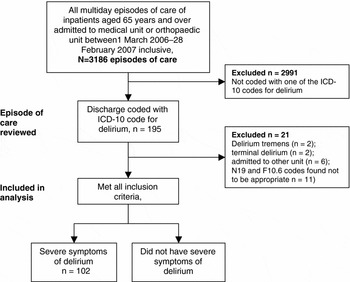
Episode of care information was extracted from the hospital administrative database. Inclusion criteria were: patients aged 65 years or more on admission,; admission to a general medical or orthopaedic unit between 1 March 2006 and 28 February 2007, with a discharge episode coded (‘primary or other’) for delirium, and multi-day stay (Figure 1). Patients with delirium tremens, delirium due to alcohol or drug intoxication (e.g. amphetamines, cannabis) and terminal delirium were excluded.
Flowchart for episode of care ascertainment and inclusion in study.
Note: ICD-10 = International Statistical Classification of Diseases and Related Health Problems, 10th revision.

A structured audit data collection form was developed and used. Coded diagnosis of delirium was compared to documentation of the following terms: delirium, acute brain syndrome, confusion or increased confusion (where pre-existing confusion existed). Timing of delirium diagnosis (on admission, after admission) was also noted.
Severe symptoms of delirium were defined as “where a patient's behavior threatens their own safety or the safety of others; or where their behavior interferes or is likely to interfere with essential medical or nursing care; or where the disturbance is causing significant distress” (Rossi and Edwards, Reference Rossi and Edwards2003). Reviewers assessed for documented symptoms such as hallucinations or aggressive behavior.
Baseline characteristic data collected included gender, age, living status on admission, admitting unit, comorbidities, and medication history of antipsychotic and/or benzodiazepine therapies. Extracted episode of care data included use of antipsychotic medication – including timing, dose, type of dose, and documentation of management plans (maximum daily dose, frequency of titration, frequency of medical review, components of review such as level of agitation, side effects, total dose past 48 hours); use of newly prescribed sedative or hypnotic medications; and whether prescription of antipsychotic or benzodiazepine medication was stopped or modified.
Use of behavior management approaches such as “specialling” (one-on-one) nursing, security services and mechanical restraint were documented, as were patient outcomes including adverse events such as falls, pressure areas and skin tears. Hospital utilization and discharge destination data were collected.
Medical records were audited by one of two reviewers. To assess the reviewers' inter-rater reliability (kappa statistic, κ) for diagnosis of severe symptoms, both reviewers independently audited the same 30 episodes of care. The inter-rater reliability was high (κ = 0.85) (Kirkwood and Sterne, Reference Kirkwood and Sterne2003). Where there was disagreement between the two reviewers, consensus was reached by discussion.
Data analyses were performed using Stata 8.2 (StataCorp., College Station, TX). To assess differences between those with and without severe symptoms of delirium, χ2 test or Fisher's exact test was used for categorical variables and t test or Wilcoxon ranksum test for continuous variables.
Results
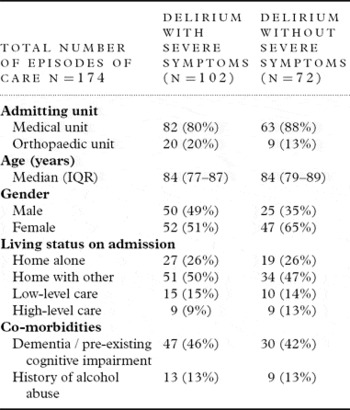
Of 3186 episodes of care, 195 (6%) were coded with delirium, of which 174 (5%) met the inclusion criteria (Figure 1). These included 145/2632 (6%) medical unit and 29/554 (5%) orthopaedic unit episodes (Table 1). The 174 episodes of care represented 165 patients, that is, nine patients had two episodes of care within the 12-month period. One hundred and two (59%) episodes of care were classified as having documented severe symptoms of delirium.
Characteristics of the two delirium groups based on hospital episodes

Note: IQR: interquartile range.
Timing of delirium
Over half the episodes (n = 102, 59%) involved patients with delirium at the time of admission, of which 39 (38%) were documented with the term “delirium”, 61 (60%) “confusion” or “increased confusion”, and two (2%) had the term “acute brain syndrome” (ABS) documented in their initial assessment admission notes. In total, 156 (90%) had the term “delirium” documented at some stage during the episode of care, four (2%) the term “ABS” and 14 (8%) had the term “confusion” or documented.
Admission diagnosis
A wide variety of primary admission diagnoses were documented. Delirium, confusion, or increased confusion was the primary admission diagnosis for 52 episodes of care (30%). Twenty-eight patient episodes (16%) had a primary admission diagnosis of infection; and 27 (16%) a primary diagnosis of fracture (8% of total episodes were hip fractures).
Characteristics of 174 patient episodes (Table 1)
The mean age on admission of all episodes was 83 years (SD = 7 years). There was a significant association between increasing age in all episodes with delirium compared to all other episodes of care of general medical or orthopaedic units (p<0.001). These findings are consistent with a number of studies that found increasing age to be a strong risk factor for delirium (Elie et al., Reference Elie, Cole, Primeau and Bellavance1998; Galanakis et al., Reference Galanakis, Bickel, Gradinger, Von Gumppenberg and Förstl2001).
Most episodes of care involved female patients (n = 99, 57%); and the most common living status on admission was from home (n = 131, 75%). Seventy-seven (44%) patient episodes were documented with dementia or pre-existing cognitive impairment, and 22 (13%) had a documented history of alcohol abuse. There were no significant differences in characteristics between the two delirium groups.
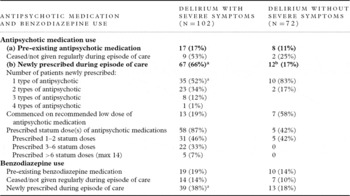
Antipsychotic medication use (Table 2)
Twenty-five (14%) episodes of care involved patients admitted on antipsychotic medications, including 14 (56%) cases in which this was documented as being a regular medication. In two (8%) episodes the medication had been newly prescribed to treat delirium just prior to hospitalization, and for nine episodes (36%) the reason for medication prescription was unclear. Antipsychotic medications were ceased, or were given intermittently during the episode of care for 11 (44%) patients admitted on these agents; and for two (8%) episodes the variance in antipsychotic medication orders was part of their care plan.
Of the 102 patient episodes with severe symptoms, 67 (66%) were newly prescribed antipsychotic medications, compared with 12 (17%) from the non-severe symptoms group. Among those newly prescribed antipsychotic medications, over half were prescribed only one type of antipsychotic agent (n = 45/79, 57%); and the remaining 34 (43%) were prescribed two or more types. The most commonly prescribed antipsychotic therapies were haloperidol (n = 50) and olanzapine (n = 49). Risperidone was prescribed during 17 patient episodes, droperidol during five patient episodes and quetiapine during two patient episodes.
For the majority of cases, the commencement dose of the antipsychotic agent was higher than the recommended low dose (n = 59/79, 75%); and many were prescribed at lease one statum dose of antipsychotic medication (n = 63/79, 80%). Eighteen percent (12/67) from the severe symptoms group were already taking antipsychotic agents on admission, and were prescribed another type in addition to this. This did not occur in the non-severe symptoms group.
Antipsychotic medication management plans were not documented for most episodes of care. Among the severe symptoms group, antipsychotic medication management plans were documented at the time the antipsychotic was first prescribed for 6/67 (9%) episodes; 33/67 (49%) had documentation of a medication management plan at any other time during the episode of care; and 8/67 (12%) had documentation regarding regular review of the antipsychotic medication. This compares to 3/12 episodes (25%) from the non-severe symptoms group where medication management plans were documented at some time during the episode of care – but none at the time of first prescribing or with regular review.
Thirty-four (33%) patients with severe symptoms were not newly prescribed antipsychotic medications. One patient's drug chart was missing.
Use of benzodiazepines and other sedatives and hypnotic agents
A total of 68/174 (39%) episodes involved newly prescribed sedative or hypnotic medication, 53 (78%) of which were from the severe symptoms group. In nine cases these medications were not administered, and in seven cases the documented reason for prescription was due to the patient undergoing a procedure that required sedation such as lumbar puncture. On further assessment, benzodiazepines (Table 2) were newly prescribed during 52 (30%) episodes, and 39 of these involved patient episodes with severe symptoms of delirium.
Antipsychotic medication and benzodiazepine use among delirium patients

a Statistically significant difference p < 0.05 between the severe symptoms and non-severe symptoms groups.
b 3 cases were prescribed these medications but were not administered.
Twenty-nine (17%) episodes were of patients admitted on benzodiazepines. These medications were ceased or were given intermittently for 21/29 (72%) episodes; for 6/21 (29%) episodes these changes were documented as part of the care plan.
Overall, 30/174 (17%) episodes were newly prescribed both antipsychotic medication and benzodiazepines – 27 from the severe symptoms group. Benzodiazepines were newly prescribed before antipsychotic prescription for 11 (37%) episodes; eight (27%) cases had both medications prescribed on the same day; and 11 (37%) cases had the benzodiazepine prescribed after the antipsychotic was prescribed.
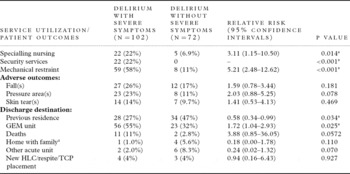
Impact of delirium on service utilisation and outcomes (Table 3)
There were differences in outcomes between the two delirium groups; however, the risk of adverse events such as falls, pressure areas and skin tears was not significantly different. There was a significantly greater probability of the use of specialling nursing (p = 0.014), mechanical restraint (p<0.001) and security services (p<0.001) in the severe symptoms group compared to the non-severe symptoms group.
Impact of delirium (severe symptoms compared to non severe symptoms) on service utilisation and patient outcomes.

*Statistically significant difference between the two groups p < 0.05.
aAmong those whose previous residence was not “home with family”.
GEM – geriatric evaluation management unit.
HLC – high level care.
TCP – transitional care package resident.
A significantly higher proportion of severe symptoms patient episodes were discharged to a geriatric evaluation management unit (n = 56, 55%, p = 0.025), while a significantly higher number of non-severe episodes saw the patients discharged back to their preadmission residence (n = 34, 47%; p = 0.034). A small number from each delirium group were: discharged home with family where this was not their preadmission residence; transferred to another acute hospital unit; newly admitted to a high level care facility; or discharged to a respite care or transitional care facility.
Median length of stay (LOS) on the acute hospital units for all episodes with delirium was 13 days, with an interquartile (IQR) range of 7–20 days. This was significantly higher than the median LOS of all other episodes of patients aged 65 years and over admitted to the general medical or orthopaedic unit over the same 12 month period (p<0.0001). The median LOS among the severe symptoms group (median LOS = 15, IQR 8–23) was significantly higher than that of the non-severe symptoms group (median LOS = 9, IQR 4–14; p<0.001). This does not include data on the LOS of those discharged to other inpatient services.
A total of 13 (7%) patients died during an episode of care, 11 of whom were from the severe symptoms group and two from the non-severe symptoms group. The risk of death was higher, but not significantly, among those with severe symptoms (RR = 1.75, 95% CI 0.86–3.20; p = 0.09) and among all delirium patients (RR = 1.19, 95% CI 0.62–2.08; p = 0.53) compared to the total number of deaths among all other patients aged 65 years plus admitted to the general medical or orthopaedic unit over the same 12-month period.
Discussion
To our knowledge, this study is the first to document current pharmacological prescribing practice for the management of older patients with delirium in an acute hospital setting. Our data demonstrate a wide variation in the prescribing patterns of antipsychotic medications. Very few patients had adequate documentation of a medication management plan or regular medication review once antipsychotic medications had been prescribed; the commencement dosage tended to be higher than those recommended in the delirium guideline; and there were high numbers of statum doses ordered. Antipsychotic medications are being used to treat a large proportion of older patients with severe symptoms of delirium, with haloperidol and olanzapine being the medications of choice.
The prescribing of multiple antipsychotic medications was common practice. One explanation may relate to different medications being used for alternative modes of delivery. For example, haloperidol can be administered intravenously (IV), whereas the atypical antipsychotics are currently not available for IV administration. Our method did not allow us to test this hypothesis. We did not differentiate between the use of antipsychotics administered by IV, intramuscularly or orally as there was inadequate documentation for any conclusions to be made. There is no published research regarding the safety and efficacy of co-prescribing antipsychotic agents among older patients with delirium, indicating an area for future research. Qualitative research on clinician decision-making may help to further understand why this practice occurs and help determine how adherence to guidelines may be achieved.
A small number of patients were admitted on antipsychotic medications, of whom almost half had these medications stopped for reasons that were not documented. Unintended cessation of antipsychotic medications could be considered a medication error and may contribute to the development or worsening of delirium. The National Prescribing Service suggests that “reducing, stopping or missing doses of antipsychotic medications in long-term users can lead to relapse of symptoms” and “stopping an antipsychotic suddenly can lead to withdrawal symptoms” (National Prescribing Service Limited, 2007).
A large number of patients were newly prescribed benzodiazepines. The guideline recommends that these medications be avoided in older patients, except in certain circumstances such as alcohol withdrawal, as older people are at greater risk of developing complications. In particular, long-acting benzodiazepines have been shown to increase risk of delirium in older people (Marcantonio et al., Reference Marcantonio1998; American Psychiatric Association, 1999; Conn and Madan, Reference Conn and Madan2006). In addition their sudden withdrawal may also lead to adverse effects including delirium (Cook, Reference Cook2004). The audit findings not only highlighted the number of older people presenting to hospital on benzodiazepines, but also the lack of medication review and planning for patients taking these medications.
Health care utilization was higher among the delirium group, which is consistent with the literature (Inouye et al., Reference Inouye, Rushing, Foreman, Palmer and Pompei1998; Marcantonio et al., Reference Marcantonio, Flacker, Michaels and Resnick2000). The difference in length of stay between the two delirium groups may be overestimated as our sample probably under-represents patients with the hypoactive (non-severe symptoms) type of delirium. More patients with severe symptoms were discharged from acute care to a subacute inpatient unit, and were not discharged directly to their previous residence. This not only indicates higher health care utilization (additional subacute care) but that there was a greater degree of decline in function among the severe symptoms group.
We were unable to show that in-hospital mortality was associated with delirium; however, this may be a reflection of the small sample size. We were unable to compare the incidence of falls, skin tears and pressure areas of the delirium patients with all other admissions due to lack of accurate available data.
Our findings show that mechanical restraint is being used to manage challenging behaviors associated with delirium. Although it is not surprising that there was higher use among the patients with severe symptoms, there is no evidence to support the safety or efficacy of mechanical restraint (Australian Society for Geriatric Medicine, 2005); and its use has been associated with adverse outcomes, including increased mortality rates (Joanna Briggs Institute, 2002). Prudent use of antipsychotic medications among this patient group has the potential to reduce the use of mechanical restraint. Restraint-reducing approaches such as restraint minimization programs should also be considered in the acute care setting (Australian Society for Geriatric Medicine, 2005).
This study had a number of additional limitations. As with all medical record audits the findings reflect what was available from the written documentation. We acknowledge that the audit findings may not fully represent what occurred for each episode of care. However the importance of effective communication, including use of medical record documentation, is a critical component of patient care and is associated with improved patient outcomes and reduced medical errors (Bethell et al., Reference Bethell, Myers and Smith2000; Lingard et al., Reference Lingard2005).
The audit also relied on the discharge coding of medical records to identify the sample. Compared to delirium prevalence studies, the proportion of patients coded as having delirium in this study was much smaller. This is consistent with the literature which suggests that delirium is under recognized and under-coded. Research suggests that the hypoalert type of delirium is often under-recognized as these patients tend to be sleepy and quiet compared to the hyperalert type (Inouye et al., Reference Inouye, Foreman, Mion, Katz and Cooney2001; Ski and O'Connell, Reference Ski and O'Connell2006). The focus of this study was on those with severe symptoms of delirium (hyperalert) due to the potential for being diagnosed and therefore coded with delirium, and because it is this patient group which may require pharmacological agents as part of its management.
To assess whether the patient experienced severe behavioral and or emotional disturbance associated with delirium, the Australian Medicines Handbook Drug Choice Companion: Aged Care definition was used (Rossi and Edwards, Reference Rossi and Edwards2003). Reviewers looked for terms such as “hallucinations”, “aggressive behavior” and “severe agitation”. While the inter-rater reliability of this method was excellent, the validity is uncertain. Misclassification of patients according to their symptoms was possible, and symptoms may not have been accurately reflected in the documented notes. Methods to validate classification such as by observation were not feasible for the purposes of this study. However, when we reviewed use of security services, which we would expect only where patients had severe behavioral disturbance, we found that all 22 were for patient episodes classified as having severe symptoms.
This study provides valuable baseline information about what areas of practice are consistent with the guideline recommendations for the management of older people with severe symptoms of delirium, and highlights which areas should be the focus for future quality improvement. In particular, commencing the antipsychotic agent at a low dose; and documentation of a clear management plan appear to be vital. The latter should include documenting the type of antipsychotic agent and the indication for its use, the dose and maximum daily dose, frequency of titration, and frequency of medical review.
There is a paucity of evidence guiding antipsychotic use in this population. There is a clear need for research into the efficacy and adverse effects of multiple antipsychotic medication use, and into the outcomes associated with the cessation or modification of antipsychotic medications in older patients with delirium.
Conflict of interest
None.
Description of authors' roles
Joanne Tropea, Jo-Anne Slee, Caroline Brand and Alex Holmes contributed to the study design and writing up of the paper. Joanne Tropea and Jo-Anne Slee conducted the medical record audit. Caroline Brand and Alex Holmes provided supervision and advice to reviewers. Alexandra Gorelik was responsible for the statistical design of the study, and performed the statistical analysis and interpretation.
Acknowledgments
The authors thank the following Royal Melbourne Hospital staff members for their assistance with the project: David Ford, Dina Lo Giudice, Juri Ots, Kevin Ratnayake, Carol Roberts, David Russell, Tony Snell, Cathy Thornely, Brooke Treacher and the Royal Melbourne Hospital Health Information Services.