In the popular music canon there are many songs whose lyrics mark a clear beginning and reach a satisfying conclusion. Opening statements of reverie (‘sitting in the morning sun’), nostalgia (‘I met my old lover in the street last night’) and hope (‘maybe the sun will shine today’) are common currency, as surely as endings are defiant (‘tramps like us, baby we were born to run’), optimistic (‘I shall be released’) and life-affirming (‘every little thing is gonna be all right’). Three-minute pop music vignettes, even when lacking a narrative arc, are capable of defining boundaries and attaining lyrical closure. In literature it is claimed that ‘the best beginnings are the best faked. … Ends are ends only when they are not negative but frankly transfigure the events in which they were immanent’ (Kermode Reference Kermode2000, pp. 174–5). In pop music, the listener's pleasure has as much to do with the song's composition and performance as the sense that an opening reverie can lead effortlessly to isolation (‘… this loneliness won't leave me alone’), nostalgia to world-weariness (‘… still crazy after all these years’), and hope to resignation (‘… everything has its plan either way’).Footnote 1 The ‘happily ever after’ of a three-minute pop song is clearest when lyrical explorations of doubt or isolation elicit emotional resolution. Literary narratives and three-minute pop songs would seem to have little in common, but in this paper I consider beginnings and endings, musical and lyrical, in ‘Supper's Ready’, a canonical song of the progressive rock literature. While there are many ways of analysing such works, by applying narrative and formalist theory to this song I demonstrate that it adheres to a common archetypal structure found in universal stories, from its faked beginning to its inconclusive ending. In this way, ‘Supper's Ready’ serves as a good micro model for the macro analysis of other works in the progressive rock repertory.
Given the depths possible in a formal literary narrative, it can be difficult to imagine what use narrative theory could hold for the study of popular music.Footnote 2 As Roland Barthes suggested:
narrative is a hierarchy of levels or strata. To understand a narrative is not only to follow the unfolding of the story but also to recognise in it a number of ‘strata’, to project the horizontal concatenations of the narrative onto an implicitly vertical axis; to read a narrative (or listen to it) is not only to pass from one word to the next, but also from one level to the next. (Barthes Reference Barthes and Duisit1975, p. 243)
The ‘traditional’ pop song – verse/chorus/middle eight, three minutes' duration – would not seem capable of sustaining this multiplicity of levels. Exceptions exist, of course, but the scope of a pop song is often limited to overall effect rather than ‘real’ storytelling.Footnote 3 Progressive rock sought to change all that, to expand the three-minute pop song in as many directions as possible, and it did this by adopting some of the following strategies:
• Songs predominantly on the longish side, but structured, rarely improvised
• A mixture of loud passages, soft passages, and musical crescendos to add to the dynamics of the arrangements […]
• Extended instrumental solos, perhaps involving some improvisation
• The inclusion of musical styles from other than a rock format
• A blending of acoustic, electric and electronic instruments where each plays a vital role in translating the emotion of compositions which typically contain more than one mood
• Multi-movement compositions that may or may not return to a musical theme. In some cases the end section may bear little resemblance to the first part of the song
• Compositions created from unrelated parts. (…)
(Lucky Reference Lucky1998; quoted in Holm-Hudson Reference Holm-Hudson2002, p. 3)
Add to this list the notion of ‘the concept’. Generally speaking, concept albums in the progressive rock literature attempted to link together a collection of songs through the use of extended musical structures, with some kind of narrative device or notional scheme providing a sense of coherence or unity. Much English progressive rock involved explorations of Englishness, Anglicanism and mythology, and drew inspiration from literary figures such as Tolkien and Blake.Footnote 4 The music underscoring the concept might explore symphonic structures, asymmetrical rhythms and passages of great complexity and technical skill; the entire product might then be packaged (by its cover art or other illustrative material) in such a way as to suggest visual imagery underlying the story or representing the music, in one coherent whole. Yes's Tales from Topographic Oceans (Atlantic, 1973) is one obvious example of such strategies, and Genesis' The Lamb Lies Down on Broadway (Charisma, 1974) is one of the defining gestures toward a progressive rock Gesamtkunstwerk.
This sense of unification across a concept album via possible musical or thematic interrelationships is complicated by the temporal restrictions of the long-playing record. The two halves of a vinyl record are necessarily finite. The physical act of flipping a record over suggests to a listener that he or she is enjoying a kind of intermission, and that the second half of the recorded performance would either follow on logically from the first, as in an opera, or that the two sides were to be enjoyed as independent entities, as in a symphonic concert: thus the four movements of Tales from Topographic Oceans, one per side, and the subtle musical distinctions separating the exposition (sides one to two) and dénouement (sides three to four) of The Lamb Lies Down on Broadway.
Not all progressive rock albums were conceptual, though many betrayed a group's interest in some aspect of literary or spiritual life. Because the original members of Genesis shared a background in the British public school tradition, there is in their early recordings an unsurprising reflection of the Englishness and Anglicanism of their early education.Footnote 5 Genesis' fourth studio album, Foxtrot (1972), is one such example. Although not a concept album as such, Foxtrot nonetheless exhibits a certain cohesion from beginning to end, and within each side:
Side one: ‘Watcher of the Skies’
‘Time Table’
‘Get’ Em out By Friday'
‘Can-Utility and the Coastliners’
Side two: ‘Horizons’
‘Supper's Ready’
The bookends of Foxtrot's first side, ‘Watcher of the Skies’ and ‘Can-Utility and the Coastliners’, foreshadow the metaphorical language of the second side's ‘Supper's Ready’.Footnote 6 The two intermediary songs on the first side, ‘Time Table’ and ‘Get’ ‘Em Out By Friday' paint pictures of decay, of the loss of heroic national past, and the dehumanisation of society, also prefiguring ‘Supper's Ready’.Footnote 7 Within the first side, the musical grandeur of ‘Watcher of the Skies’ is tempered by the lyrical ‘Time Table’; similarly, the dialogic character-piece, ‘Get’ ‘Em Out by Friday' is balanced by the more sporadically dialogic ‘Can-Utility and the Coastliners’. There is also a temporal balance to the first side, the more bombastic first and third tracks lasting 7.5 and 8.5 minutes respectively, the gentler second and fourth tracks lasting nearly-5 and nearly-6 minutes, respectively. On the macro level there is thus a loud/soft balance, a mixture of textures and moods, and brief forays into extended structures.Footnote 8 Even within those shorter tracks, Genesis could incorporate any number of metrical shifts, orchestral textures and organ solos; the standard three-minute pop song, in other words, was not yet their modus operandi.Footnote 9
The second side of Foxtrot opens with the brief, acoustic guitar palate-cleanser, ‘Horizons’, and leads directly into ‘Supper's Ready’, which occupies the rest of the side. There are many examples in the progressive rock literature of long tracks with allegorical or symbolic lyrics;Footnote 10 what I wish to show here is that ‘Supper's Ready’ acts as a ‘concept song’ – an epic with internal lyrical and harmonic coherence, clearly and systematically intertextual. It embodies in its 23 minutes the progressive rock ethos – length, complexity, electric/acoustic and loud/soft contrasts, metaphorical lyrics – and maintains a certain position in the progressive rock canon as a ‘stand-alone’ work worthy of analysis.Footnote 11 To date little has been written about the song's lyrical content and less about its literary inspiration. Most recently, Hegarty and Halliwell have suggested that ‘Supper's Ready’ uses T.S. Eliot's ‘The Waste Land’ as a structuring device (Hegarty and Halliwell Reference Hegarty and Halliwell2011, pp. 85–6). While this is an interesting interpretation, I would argue that the clearer model is the biblical Book of Revelation. Indeed, scattered throughout ‘Supper's Ready’ are references to the Book of Revelation, and passages lifted almost verbatim from it.Footnote 12 More importantly, ‘Supper's Ready’ interprets Revelation on a number of levels – literary, metaphorical, structural – all of which I aim to illustrate here, for it is this type of intertextual concept song which presents a number of challenges to our assumptions about the narrative limitations of popular music. By applying literary and formalist theories to the song's narrative structure I suggest that there is potential for those limitations to be transcended.
Origins and form
Edward Said (Reference Said1997, p. 5) has suggested that ‘the beginning … is the first step in the intentional production of meaning’. The Bible, opening as it does with an unimpeachable sense of time and motion (‘In the beginning God created the Heaven and the Earth’), also closes with an undeniable finality (‘Amen.’). Dropping a needle at the beginning of an LP, like opening a book, is the clearest indication that a musical journey is about to begin; in much the same way that a reader's right hand signals the impending resolution of a mystery novel, the stylus of a record player indicates an impending musical conclusion of some sort. ‘Supper's Ready’ is restricted in scope to the last 23 minutes of the second side of a long-playing record. When the listener realises during the song that he or she is becoming involved in some kind of extended story, there is an expectation that the lyrical and musical tension will resolve within those 23 minutes. The way in which Genesis dealt with this temporal restriction, from beginning to ending, is the point I wish to consider here.
‘Supper's Ready’ is comprised of seven episodes, or tableaux, each of which recounts a particular series of events either witnessed or experienced by the narrator, of whom more later. The titles given to each episode do not follow any inherent logic. One could not discern the shape of the narrative by a glance at the titles alone; rather, they seem to delineate discrete movements of a larger musical suite:
(i) Lover's Leap
(ii) The Guaranteed Eternal Sanctuary Man
(iii) Ikhnaton and Itsacon and Their Band of Merry Men
(iv) How Dare I Be So Beautiful?
(v) Willow Farm
(vi) Apocalypse in 9/8 (Co-starring the Delicious Talents of Gabble Ratchet)
(vii) As Sure as Eggs Is Eggs (Aching Men's Feet)
The title of tableau vi betrays the song's only obvious literary reference, suggesting a complicated relationship between ‘Supper's Ready’ and its Biblical source. The titular reference in tableau vi to the compound triple metre is similarly revealing.Footnote 13 The Book of Revelation has a reputation for being a bit of a tough read. It is an epistolary book, a letter to be read aloud. Genesis are apparently suggesting that as such, it is not suited to common time.
As a framing device, Revelation begins with a statement that the author, John, bore witness to certain visions, and was told: ‘write the things which thou hast seen, and the things which are, and the things which shall be hereafter’ (Revelation 1:19).Footnote 14 The visions that John recounts are both profound and horrible, couched in nearly impenetrable language, intended for the benefit of ‘insiders’ – the seven churches to whom John's letter is written, those with knowledge of the mysteries of faith.Footnote 15 John's visions are therefore held not to be hallucinations brought on by religious fervour, but some sort of universal truth understandable by the initiate.
The lyrics to ‘Supper's Ready’ recount in part a paranormal experience that Genesis' lyricist Peter Gabriel had in the early 1970s in the company of his first wife, Jill, and Genesis producer John Anthony. In the midst of a philosophical conversation late one night, Jill went into a trance, and as Peter Gabriel said:
we saw other faces in each other. It was almost as if something else had come into us and was using us as a meeting point. The curtain flew wide open, though there was no wind, and the room became ice cold. And I did feel that I saw figures outside, figures in white cloaks, and the lawn I saw them on wasn't the lawn that was outside. […] I made a cross with a candlestick and held it up to Jill when she was talking in this voice. She reacted like a wild animal and John and I had to hold her down. (Bright Reference Bright1988, pp. 50–51)
In that one moment, these three ‘insiders’ had a battle with some dark spiritual force, and emerged unscathed, but profoundly changed. This experience is the basis of ‘Supper's Ready,’ and the lyrics can be read as a recollection of that night by its witnesses, or as a veiled use of that night's experience as a metaphor for the larger, universal battle between good and evil.
There are certain episodes in Revelation that in isolation have entered the popular consciousness,Footnote 16 and certainly the notion of the apocalypse was the basis for a great deal of pre-millennial tension.Footnote 17 But the imagery of the book's 22 chapters is uniquely successive: each chapter generally begins with ‘and’, following on from whatever preceded it, as in the following:
And immediately I was in the spirit: and, behold, a throne was set in heaven, and one sat on the throne. And he that sat was to look upon like a jasper and a sardine stone: and there was a rainbow round about the throne, in sight like unto an emerald. And round about the throne were four and twenty seats: and upon the seats I saw four and twenty elders sitting, clothed in white raiment; and they had on their heads crowns of gold. And out of the throne proceeded lightnings and thunderings and voices: and there were seven lamps of fire burning before the throne, which are the seven Spirits of God. And before the throne there was a sea of glass like unto crystal: and in the midst of the throne, and round about the throne, were four beasts full of eyes before and behind. And the first beast was like a lion, and the second beast like a calf, and the third beast had a face as a man, and the fourth beast was like a flying eagle. And the four beasts had each of them six wings about him; and they were full of eyes within: and they rest not day and night, saying, Holy, holy, holy, LORD God Almighty, which was, and is, and is to come. (Revelation 4:2–8)
The visions of Revelation work under the same logic as any dreamscape: time and space are suspended, and symbolism is understood on some unspoken level.
As a work of oral literature Revelation utilises certain mnemonic devices which determine its structure: the symbolic use of the number seven, for example, is one marker of time and of time remaining. Similarly, Gabriel's lyrics make use of rhetorical devices which are themselves reminiscent of oral folklore:
The controlling power of folklore, the carrying out of its rhetorical intent, resides in the ability of the item and the performer to establish a sense of identity between a ‘real’ situation and its artificial embodiment. This sense of identity is engineered through the exercise of control, allowing the audience to relax at the same time it identifies with the projected situation. This is done by creating a ‘psychic distance’, by removing the audience far enough from the situation that it can see that it is not going to actively involve them immediately. Presented with an anxiety situation but relieved from the actual anxiety, the listener gains control, and with this limited control, relief. This relief becomes pleasure when the performance exercises control by the use of wit, by the imposition of rules and boundaries, by the creation of an imaginary world, or by some other limiting device which proclaims artifice. Such controls make the problem seem more impersonal and universal and less immediate. (Abrahams Reference Abrahams1968, pp. 148–9)
However real Gabriel's vision was, and however tenuous the link between the unreality of the situation and his normal waking life, the lyrics of ‘Supper's Ready’ speak to the listener's anxiety of mortality, and the structural play with that anxiety – Gabriel's use of surrealism and wit, the prolongation of narrative conflict, the forays into unfamiliar harmonic terrain and asymmetrical metres – enhances the listener's pleasure at the final resolution.
There is an important point to note here, about rhetorical device, hyperbole and the notion of apocalypse as a literary form. According to Craig R. Koester:
broadly speaking, there are two types of apocalypses. Some are mainly accounts of heavenly journeys that tell how a seer ascends through celestial regions in the company of an angelic guide to see things that are inaccessible to other human beings. […] Other apocalypses focus on the movement of history, often dividing time into periods that lead up to catastrophic upheavals, which are followed by a time of salvation, that may include the restoration of the land of Israel and the transformation of the world. (Koester Reference Koester2001, p. 28)
Given the earlier reference to oral folklore, it is easy to understand apocalypse as a mode of literature recognisable by an audience through its use of certain narrative formulae and by the promise of ultimate redemption. What transpires within that literary form is interesting to note, especially as regards potential interaction with large-scale musical structure. In The New Cambridge Bible Commentary, Ben Witherington III states that ‘apocalyptic … is primarily a matter of the use of a distinctive form – visions with often bizarre and hyperbolic metaphors and images’ (Witherington Reference Witherington2003, pp. 33–4). It is the term ‘hyperbole’ which interests me here. If there were such a thing as ‘hyperbolic music’, it would surely be progressive rock, with its wilfully protracted harmonies and metaphorical lyrics, an expansion of compositional scale offering potentially endless adventures in narrativity. The literary tools available to Gabriel in excess of ‘simple pop music’ allowed him to explore the (un)reality of his experience, using traditional forms and structures, and to enable his audience's understanding of his experience via those forms and structures.
As the Book of Revelation was intended to be read aloud, so is ‘Supper's Ready’ intended to be heard, but I would like here to consider ‘Supper's Ready’ as written text.Footnote 18 There are two ways of reading the lyrics of ‘Supper's Ready’, both of which obscure the story's origins. In the spirit of communal experience, one could enter the narrative with the assistance of the programme notes provided by Peter Gabriel for contemporary Genesis concert-goers (extracted from Spicer Reference Spicer and Everett2008):
I. Lover's Leap
In which two lovers are lost in each other's eyes, and found again transformed in the bodies of another male and female.
II. The Guaranteed Eternal Sanctuary Man
The lovers come across a town dominated by two characters: one a benevolent farmer and the other a head of a highly disciplined scientific religion. The latter likes to be known as ‘The Guaranteed Eternal Sanctuary Man’ and claims to contain a secret new ingredient capable of fighting fire. This is a falsehood, an untruth, a whopper and a taradiddle; or to put it in clearer terms, a lie.
III. Ikhnaton and Itsacon and Their Band of Merry Men
Who the lovers see clad in greys and purples, awaiting to be summoned out of the ground. At the G.E.S.M.'s command they put forth from the bowels of the earth, to attack all those without an up-to-date ‘Eternal Life License’, which were obtainable at the head office of the G.E.S.M.'s religion.
IV. How Dare I Be So Beautiful?
In which our intrepid heroes investigate the aftermath of the battle and discover a solitary figure, obsessed by his own image. They witness an unusual transmutation, and are pulled into their own reflections in the water.
V. Willow Farm
Climbing out of the pool, they are once again in a different existence. They're right in the middle of a myriad of bright colours, filled with all manner of objects, plants, animals and humans. Life flows freely and everything is mindlessly busy. At random, a whistle blows and every single thing is instantly changed into another.
VI. Apocalypse in 9/8 (Co-starring the Delicious Talents of Gabble Ratchet)
At one whistle the lovers become seeds in the soil, where they recognise other seeds to be people from the world in which they had originated. While they wait for Spring, they are returned to their old world to see the Apocalypse of St John in full progress. The seven trumpeters cause a sensation, the fox keeps throwing sixes, and Pythagoras (a Greek extra) is deliriously happy as he manages to put exactly the right amount of milk and honey on his corn flakes.
VII. As Sure as Eggs Is Eggs (Aching Men's Feet)
Above all else an egg is an egg. ‘And did those feet …’ making ends meet.
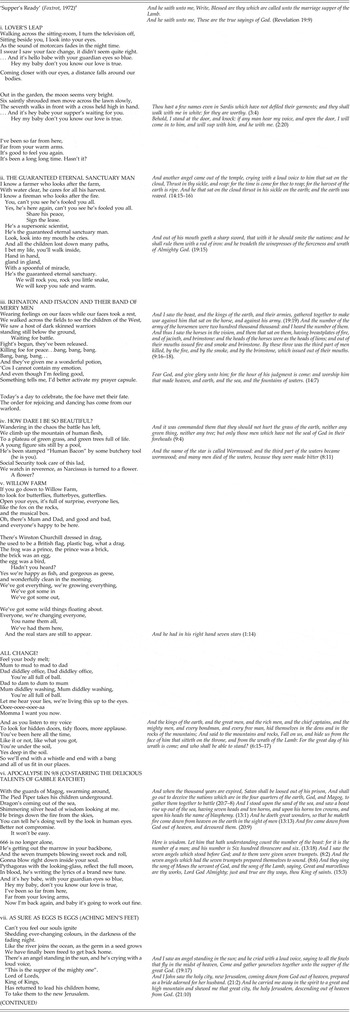
What the audience infers from these programme notes is a kind of Alice in Wonderland tale, where curious things happen to the two lovers, where they encounter all manner of peculiar characters and are led, apparently by the power of Parry's great hymn ‘Jerusalem’, back to where they started – Albion, one supposes. These actions are to some extent implicit in the lyrics themselves, but as Genesis were nothing if not a static band on stage, the programme notes were really an attempt by Gabriel to guide the audience through the various performative tricks he had developed in the early 1970s in compensation for this fact. Although Gabriel's programme notes illuminate the narrative to some small degree, I would like here to concentrate on the more widely disseminated version of the lyrics, reprinted on the Foxtrot album sleeve and CD re-issue, which provides only the movement titles and text. In this way we may regard the text as part of a recorded performance, quite separate from the visual dimension which, granted, was such a central facet of Peter Gabriel's live enactment of the work.Footnote 19Table 1 reproduces the lyrics from ‘Supper's Ready’ alongside the passages from Revelation which they echo, to show that the song, from its title to its closing lines, utilises the metaphorical language of Revelation in both subtle and overt ways. Yet although ‘Supper's Ready’ borrows liberally from the image bank of the Book of Revelation, it does not seem at first to follow the biblical source's chronology. I will then propose an alignment of ‘Supper's Ready’ with larger, traditional narrative structures in an attempt to show a further underlying logic to the lyrical form of the song which reinforces this intertextual relationship.
‘Supper's Ready’ lyrics: a Biblical concordance.

aSUPPER'S READY Words and Music by Mike Rutherford, Peter Gabriel, Phil Collins, Steve Hackett and Tony Banks – © 1972 Stratsong Ltd – All Rights Reserved – Used by Permission.
In addition to the close, micro-level interplay between the lyrics of ‘Supper's Ready’ and the Book of Revelation, there is also a larger, macro-level relationship. That there are seven tableaux is perhaps not coincidental, for the number seven holds a particular significance in the Book of Revelation – seven churches, seven bowls, seven trumpets, seven seals. Furthermore, the lyrics read as apocalyptic literature:
a genre of revelatory literature with a narrative framework, in which a revelation is mediated by an otherworldly being to a human recipient, disclosing a transcendent reality which is both temporal, insofar as it envisages eschatological salvation, and spatial, insofar as it involves another, supernatural world. (Collins Reference Collins1979, p. 9; quoted in Bauckham Reference Bauckham1993, p. 6)
The tender lyrics in the opening scene establish a clearly sexual relationship between the human recipients – the two lovers – and suggest the onset of a dream state shared between them, which is then outlined in the six successive tableaux. The ‘otherworldly being’ actually takes many forms, from the six saintly shrouded men of tableau i, to the Guaranteed Eternal Sanctuary Man of tableau ii, to the angel standing in the sun of tableau vii: the first prefigures the otherworldly action; the second – a false prophet – challenges it; and the third offers a glimpse at eschatological salvation. There would seem therefore to be an innate internal coherence in ‘Supper's Ready’. The narrator moves from situation to situation, receiving visions and insight from various otherworldly beings, all under the aegis of some sort of dream state. The song's narrative arc returns to familiar territory, and the listener enjoys an ostensibly happy ending. But there are other ways of interpreting this narrative, which remove it from the realm of dreams or Biblical allegory, and place it more firmly in a literary tradition. For this reason it is instructive to turn to a formalist theory of narrative structure, and to plot the action of ‘Supper's Ready’ against more universal tropes.
Interpretive tools
Vladimir Propp's Morphology of the Folktale is a useful tool for the interpretation of ‘Supper's Ready’, in part because it helps to whittle down what seems an unruly cast of characters into a very concise roll call.
Just as the characteristics and functions of deities are transferred from one to another, and, finally, are even carried over to Christian saints, the functions of certain tale personages are likewise transferred to other personages. Running ahead, one may say that the number of functions is extremely small, whereas the number of personages is extremely large. This explains the two-fold quality of a tale: its amazing multiformity, picturesqueness, and color, and on the other hand, its no less striking uniformity, its repetition. (Propp Reference Propp and Scott2005, pp. 20–21)
Propp proposed that all folktales conform to a set pattern: a preliminary situation (in this case the separation of the lovers' bodies from their spirits); followed by a ‘mischief or lack’ (the introduction of the Guaranteed Eternal Sanctuary Man and the ensuing battle); and finally the closing of what had been opened by mischief (here the reunion of the lovers and the ascent to the New Jerusalem). The lovers end where they began; the narrative seems to have a happy ending, and the horrors that they witnessed in tableaux two through six have been resolved by angelic proclamation. Indeed, despite the many minor peculiarities of the ‘Supper's Ready’ narrative, there is a decidedly traditional sense to much of the action.
The lovers in ‘Supper's Ready’ encounter more than one other character, however, and Propp's catalogue of dramatis personae and their functions is similarly exhaustive:
We have seen … that one character in a tale is easily replaced by another. These substitutions have their own, sometimes very complicated, causes. Real life itself creates new, vivid images which supplant tale personages. The epos of neighboring peoples exerts its influence, as does written literature, religion (Christianity for example), and local beliefs. The tale at its core preserves traces of very ancient paganism, of ancient customs and rituals. The tale gradually undergoes a metamorphosis, and these transformations and metamorphoses of tales are also subject to certain laws. It is all these processes that create a multiformity which is exceptionally difficult to analyze. (Propp Reference Propp and Scott2005, p. 87)
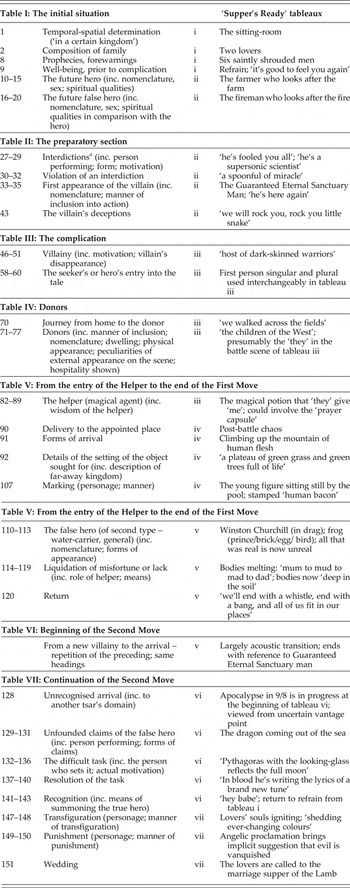
It should not be surprising, therefore, to see Gabriel mixing mythology with history, Biblical imagery with paganism. In fact, the unusually malleable sense of time and logic in ‘Supper's Ready’ nonetheless betrays a clearly systematic process, oddly in tune with Propp's morphology (Table 2).Footnote 20 The keywords in Propp's tabulation – prophecies, hero, villain, journey, delivery, recognition, transformation – are sufficient in themselves to mark the various tableaux of ‘Supper's Ready’. That there is some sort of micro-level logic to what initially appears, both in Genesis' programme notes and the Foxtrot liner notes, to be nothing more than another of Gabriel's fanciful stories, suggests that the song's resonance with the structure of the folk tale should not be overlooked. But it is the song's open and extended reference to that other literary source which demands further attention.
A tabulation of the tale.

Source: Propp (Reference Propp and Scott2005, Appendix I, pp. 118–27).
aAn interdiction can be defined as ‘exclusion from church sacraments’. In this sense, the Guaranteed Eternal Sanctuary Man, as false prophet, ‘supersonic scientist’, is clearly in breach of the laws of the Church.
According to Richard Bauckham (Reference Bauckham1993, p. 57), in the Book of Revelation:
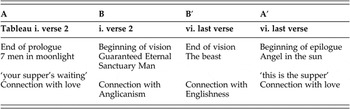
John's vision (1:9–22:9) is framed by a prologue (1:1–8) and an epilogue (22:6–21…). There are a number of literary ways in which the prologue and the epilogue correspond. One of these is that the divine self-designation at the end of the prologue (1:8) corresponds to the self-designation by Christ near the beginning of the epilogue (22:13). These two verses correspond further in that each is preceded by an announcement of the parousia (1:7: ‘Behold, he is coming …’; 22:12: ‘Behold, I am coming …’). If 1:8 and 22:13 correspond in this way, 1:17 and 21:6, placed respectively towards the beginning and toward the end of the vision, also correspond, so that the four tests form a chiastic arrangement (A-B-B'-A'). […] The chiastic pattern can be set out as follows:

That there is a recapitulation in ‘Supper's Ready’ at the end of tableau vi – the lovers returned, their souls spinning into eternity – could similarly reveal an overarching structure to the song akin to a chiastic pattern. Such a pattern would then reveal four overall stages to the song: the prologue, the introduction of a false prophet in a pagan world, the battle between good and evil, and the epilogue (Table 3).
Chiastic pattern in ‘Supper's Ready’.

As in Bauckham's model, there is a musical overlapping of the prologue and vision, and the vision and the epilogue: the return to narrative reality in the epilogue is accompanied by a recapitulation of the musical material from the first and second tableaux. It is as though the dream sequence of tableaux two through six was necessary for the unification of the two souls, as though only through trials and tribulations could the narrator realise the depth of his worldly love. Regardless of movement title or programme note, this unification is also clear musically. In the prologue, Peter Gabriel doubles his own voice at the octave, straining at the limits of his range, suggesting perhaps the enactment of both the male and female characters. With the return to familiar musical material in the epilogue, the lead vocal is no longer doubled; Peter Gabriel's solo voice represents the two lovers, no longer separated by an uncomfortable octave, but joined in the colourful upper reaches of Gabriel's chest voice.Footnote 21 The listener is thus granted thematic and lyrical closure.
Imminence, delay, finality
‘Supper's Ready’ adheres to one or more common narrative patterns which resolve according to certain structural formulae, understood by the listener on the cultural as well as subconscious levels. But it can't be as easy as all that. In fact, the more one picks apart ‘Supper's Ready’, the more problematic it becomes structurally, musically and lyrically, and the less likely one is to gain a sense of closure when the New Jerusalem finally comes around. There is first the basic confusion regarding the narrative voice. In his recordings with Genesis, Peter Gabriel often suggested dialogue by alterations in his accent, vocality and range;Footnote 22 but it is not always clear here – and perhaps it should be – which character is speaking in the first person and which is being addressed in the second. Some members of Genesis have claimed that the lyrics are the weakest part of ‘Supper's Ready’;Footnote 23 the problems certainly arise right at the outset. The prologue appears to start midstream: ‘walking across the sitting-room’ – walking from where? Why? The motion is then followed by an action: ‘I turn the television off’. This grammatical structure is common to most of the tableaux of ‘Supper's Ready’: ‘wearing feelings on our faces … we walked across the fields’; ‘wandering in the chaos … we climb up the mountain’. On the one hand, this seems to serve lyrically the same function as Revelation's continual ‘and … this happened; and … then that happened’, suggesting a lyrical form which Frank Kermode likens to
a duration (rather than a space) organising the moment in terms of the end, giving meaning to the interval between tick and tock because we humanly do not want it to be an indeterminate interval between the tick of birth and the tock of death. (Kermode Reference Kermode2000, pp. 57–8)
In these terms, the arpeggiated guitar pattern underscoring the prologue of ‘Supper's Ready’ suspends those first lines in an uncomfortable, unresolved moment:
tick Walking across the sitting room
tock I turn the television off
tick Sitting beside you
tock I look into your eyes
On the other hand, and more problematically, the prologue, beginning as it does mid-action, also begins mid-harmonic progression.Footnote 24 Rather than providing a period of tonal establishment, Genesis are dropping their listeners into the middle of an extended tritone relation, from E to B♭. The beginning of ‘Supper's Ready’, to paraphrase Frank Kermode, is somewhat faked.
Surely with such harmonic uncertainty, the overall structure of ‘Supper's Ready’ will lead the listener through the battle of good and evil – and what could be more evil than the tritone? – to the safety of a properly ecumenical key, say, E♭ major? Mark Spicer and Nors Josephson have published harmonic and structural analyses of ‘Supper's Ready’ which help to shed some light here on the overall musical structure of the song, outlining the relationship between the first two and last two tableaux, and the static nature of the fourth and fifth (see Table 4).Footnote 25
Summary of harmonic and structural analyses.

As the middle section, the fourth tableau should represent the height of tension built thus far, and signal the dénouement toward the recapitulation. The listener has by this point heard about ten minutes of progressive apocalypse, and perhaps subconsciously sensed the midpoint of the work, or physically seen the record needle halfway through the track. The listener has been introduced to the Guaranteed Eternal Sanctuary Man (the Antichrist, by another name), witnessed a battle between the believers and the non-believers, and in the third tableau ‘the foe have met their fate’. But it is unclear whether good has yet triumphed over evil. In Propp's terminology, the listener has reached the end of the First Move. It is at this point that the energy dwindles and the musical action that accompanied the battle scene dies away. There is in effect a fade-out in the middle of the song, and the listener is left wanting some kind of harmonic – not to say narrative – resolution.Footnote 26 When the curtain rises again, the lovers find themselves in the midst of a scene of desolation, and the listener joins them in a vaguely familiar harmonic terrain, oddly devoid of any melodic comfort.
There is a startling parallel to note here. At the midpoint of the Book of Revelation, there is a sudden shift to the story of two unnamed martyrs:
And I will give power unto my two witnesses, and they shall prophesy a thousand two hundred and threescore days, clothed in sackcloth. […] And when they shall have finished their testimony, the beast that ascendeth out of the bottomless pit shall make war against them, and shall overcome them, and kill them. (Revelation 11:3, 5–7)
There is a common supposition that these martyrs appear in chapter 11 as representations of Peter and Paul, who bore Christian witness in Rome, the heart of the evil empire. According to one interpretation the martyrs' witness is actually an allegory for the crucifixion itself, and when in Revelation this interlude of the two witnesses ends, there is an earthquake, followed by the sounding of the seventh trumpet.Footnote 27 It is at the midpoint of ‘Supper's Ready’ that the narrative voice shifts from the first person singular to the first person plural – from the various first-hand accounts of experience and vision, the third tableau recounts the two lovers witnessing a battle. The lovers, separated from their earthly bodies, have found themselves in an earlier time, where ‘the farmer who looks after the farm’ – Jesus – is challenged by ‘the fireman who looks after the fire’ – the Antichrist. As in Revelation, this interlude ends in Babylon:Footnote 28 the fifth tableau, ‘Willow Farm’, ‘ends with a whistle, ends with a bang, and all of us fit in our places’, and thus begins the Apocalypse in 9/8, the most direct paraphrasing of the Book of Revelation, with the seventh trumpet about to sound.
It may be too much to suppose that Peter Gabriel built ‘Supper's Ready’ around narrative markers in the Book of Revelation, but it is useful to consider the extent to which the listener is fooled by this series of actions. The break in the musical and figurative action in the fourth tableau, the closed form of the fifth and the onset of the Apocalypse in 9/8 in the sixth suggest structurally a hitherto unexpected cyclical pattern to ‘Supper's Ready’: from spiritual epiphany, through war, to peace, and back again. It also calls to mind Bauckham's discussion of the greater meaning encoded in Revelation's inherent sense of tension:
[E]schatological delay is as much a feature of Revelation as eschatological imminence. It is written into the structure of the book. From the moment the martyrs cry, ‘How long?’ and are told to wait a little while longer (6:10–11), the reader – and more especially, the hearer of an oral performance of Revelation – becomes conscious of the tension of imminence and delay, as the End is constantly approached but not definitively reached. Disappointingly moderate series of warning judgments progress rather slowly towards the expected climax in the final judgment. The interludes between the sixth and seventh seal-openings and between the sixth and seventh trumpet-blasts both symbolize and explain the delay. In the crucial chapters 10–11, we learn that there is to be no more delay for the sake of further warning judgments (10:3–6) and that there is to be a delay lasting the symbolic period of three-and-a-half years (11:3), for the sake of the church's prophetic witness to the world. John here creates his own version of the tension between eschatological imminence and eschatological delay that runs through the whole apocalyptic tradition. The logic of imminence is that God's kingdom must come. Evil is triumphant and the righteous suffer: surely this contradiction to God's purpose cannot continue indefinitely? (Bauckham Reference Bauckham1993, pp. 157–8)
Imminence and delay work on obvious harmonic levels as well: a piece cannot be felt to end until a resolution is reached, or until the listener senses a logical end to the musical propulsion. The ‘suffering of the listeners’ is relieved by an acknowledgment of the rightness of the tonic or, in ‘Supper's Ready’, by the arrival at tableau vii.Footnote 29
This leads me to the final point I wish to make, about the end of the world, and the end of ‘Supper's Ready’. Apocalyptic literature ‘envisages eschatological salvation’. The arc of ‘Supper's Ready’, which leads the listener through various battles and stages of spiritual uncertainty, is designed to offer the listener hope at the end of the final battle of good and evil. At the moment of final judgment, the lovers are returned to each other's arms, and everything is ‘going to work out fine’. That cycle seems to have reached closure: we are back in familiar musical terrain; where there were two voices there now is one, and the angel of Revelation is signalling an end to worldly troubles. Surely this is the end of the epic? Well, yes and no. Yes, because we've been brought to what we hear as a lyrical and harmonic resolution of the 22 preceding minutes; no, because we have also been conditioned to expect a brief lull in the action before the commencement of another phase in the cycle. Furthermore, the album's liner notes leave us dangling in a rather unusual way. Between the final line of text, ‘to take them to the new Jerusalem’, and the album credits, we have ‘(CONTINUED)’. Compounding this lyrical inconclusion, rather than allowing their listeners a properly religious, final plagal cadence, Genesis opt again for a fade-out.Footnote 30
This is in one sense satisfying – the implied endlessness of this musical ending is akin to the et in saecula saeculorum, amen of so many liturgical works, and the listener therefore envisions the New Jerusalem as the ‘world without end’. But maybe ‘(CONTINUED)’ implies something altogether different. The end of ‘Supper's Ready’ does something towards changing our understanding of the beginning of the song: as Kermode might say, it ‘frankly transfigures the events in which they were immanent’ (Kermode Reference Kermode2000, pp. 174–5). The listener was not aware, as Gabriel ‘walked across the sitting-room’, that he would ultimately be led to the New Jerusalem. But the lack of closure – the characters are still in motion as the music fades away – is essentially a more realistic way to end an allegorical story, albeit one based on an actual experience. Loose ends may seem tied up, but the listener's interest is piqued by the further implications of ‘(CONTINUED)’, of ‘what happened next’. As Kermode suggests:
The books which seal off the long perspectives, which sever us from our losses, which represent the world of potency as a world of act, these are the books which, when the drug wears off, go on to the dump with the other empty bottles. Those that continue to interest us move through time to an end, an end we must sense even if we cannot know it; they live in change, until, which is never, as and is are one. (Kermode Reference Kermode2000, pp. 179)
Given earlier patterns in the piece, the listener cannot assume that the themes of ‘Supper's Ready’ are finite. Indeed, the listener need only take one step forward, to the first moments of Genesis' subsequent studio recording, Selling England by the Pound (1973), to discover what happens next (see Example 1).Footnote 31
‘Dancing With the Moonlit Knight’.

Go one step further, and The Lamb, whose marriage supper we witnessed at the end of ‘Supper's Ready’, … Lies Down on Broadway, at the heart of modern-day Babylon. With each step a new beginning, each ending a mere pause, Genesis not only extend the narrative arc of ‘Supper's Ready’, they extend the narrative thread of their entire output. The promise of the New Jerusalem – be it England's green and pleasant land or a more heavenly place – is yet to be fulfilled.