Introduction
‘Democracy means only that the people have the opportunity of accepting or refusing the men who are to rule them’ (Schumpeter, Reference Schumpeter1942: 269). That is, citizens have the opportunity to throw the rascals out in a democracy, which makes it possible to hold the government accountable for their policy and service outcomes. Thus, performance-based retrospective voting is a fundamental mechanism of democracy. The central idea of this mechanism is that citizens vote for the governing party if they are satisified with its performance; otherwise, they will vote against it. A good deal of scholarship has examined this electoral mechanism and finds a positive association between voter evaluations of government performance and vote choice or electoral outcomes in terms of the economy (Kiewiet, Reference Kiewiet1983; Lewis-Beck, Reference Lewis-Beck1988; Lewis-Beck and Stegmaier, Reference Lewis-Beck and Stegmaier2000; Duch and Stevenson, Reference Duch and Stevenson2008), corruption (Welch and Hibbing, Reference Welch and Hibbing1997; Krause and Mendez, Reference Krause and Mendez2009; Winters and Weitz-Shapiro, Reference Winters and Weitz-Shapiro2013), and foreign policy (Anand and Krosnick, Reference Anand and Krosnick2003; Aldrich et al., Reference Aldrich, Gelpi, Feaver, Reifer and Sharp2006; Gelpi et al., Reference Gelpi, Reifler and Feaver2007; Gadarian, Reference Gadarian2010). In addition, Inoguchi (Reference Inoguchi, Inoguchi and Tokuda2017) found that voters’ retrospective and sociotropic evaluations have greater effects on their confidence in government institutions as well. Nevertheless, the extant studies of this literature have two omissions.
First, there is no research on retrospective performance voting that considers several retrospective evaluations together in an incumbent voting model, but rather the extant studies include one or two retrospective evaluations (mainly the economy and/or corruption). However, there is no reason to believe that electoral accountability should be restricted to the economy, corruption, and/or foreign policy (Singer, Reference Singer2011). There may be many other retrospective evaluations other that affect incumbent voting such as human rights (Fiorina, Reference Fiorina1981; Cingranelli and Filippov, Reference Cingranelli and Filippov2010) or welfare protection (Cox and McCubbins, Reference Cox and McCubbins1986; Brooks and Manza, Reference Brooks and Manza2006; Shin, Reference Shin2016). Also, the voting decisions of voters may be influenced by several dimensions of retrospective evaluations rather than solely by one or two retrospective assessments. Thus, including merely one or two retrospective evaluations in models of voting behavior may produce biased results because of omitted-variable bias. At the very least, the omission of various dimensions of retrospective evaluations from models of incumbent voting limits their explanatory power. If voters’ other retrospective evaluations, such as evaluations of human rights or welfare protection, affect their vote choice, then a model of incumbent voting that incorporates only an evaluation of the economy, corruption, or foreign policy fails to capture the full electoral effects of voters’ retrospective evaluations. Hence, including several dimensions of voters’ retrospective evaluations in a model of voting behavior helps to expand our understanding of retrospective voting.
Second, when exploring the effects of voters’ retrospective evaluations on vote choice in mixed electoral systems in which voters have two ballots (one for party list vote and one for district level vote), previous studies have examined only one of two ballots (Debus et al., Reference Debus, Stegmaier and Tosun2014). Since the voting mechanism for the party list ballot differs from that for the district ballot (Shugart and Wattenberg, Reference Shugart and Wattenberg2003), it is expected that the effects of voters’ retrospective evaluations on vote choice differ between the constituency level and party list ballots in a mixed electoral system. However, surprisingly no research explicitly examines whether there is a difference in the performance-based voting behavior between the district level and party list votes in a mixed electoral system.
In this sense, this article adds to our knowledge of retrospective performance voting by testing a comprehensive retrospective performance voting model in a mixed electoral system. Specifically, this analysis examines the effects of voters’ retrospective evaluations of six performance categories – economic performance at the national and personal levels, human rights, corruption, welfare protection, and foreign policy – on vote choice for the incumbent party in the 2016 Korean legislative election in which voters had two ballots: one for the party list vote and one for the district vote. For this analysis, this article analyzes the 20th Korean legislative election survey conducted by the Korean Association of Electoral Studies, Sogang Institute of Political Studies, and Korean Social Science Data Center in 2016. Unlike the other election surveys, the 20th Korean legislative election survey includes questions on voters’ evaluations for the above six performance categories. In addition, the 2016 Korean legislative election were held under the two-vote system (Mixed Member Majoritarian System).
Using multinomial logistic regression models, this article finds that Korean voters consider not only the retrospective evaluations of the national economy, but also those of human rights and foreign policy when making their vote choice. However, their judgments on corruption and welfare protection do not affect the likelihood of voting for the incumbent party. In turn, retrospective performance voting is stronger for the party list vote choice than for the district level decision. Among the six retrospective evaluation categories, the judgments of the national economy, human rights, and foreign policy have statistically significant impacts on the likelihood of voting for the incumbent party in the party list vote, whereas only the voters’ evaluation of foreign policy matters at the district level.
The findings of this article contribute to the extant literature. First, given the relative lack of research on retrospective voting, examining the electoral effects of retrospective evaluations, other than the economy and corruption, this research fills an important gap. Second, the results suggest that, in mixed electoral systems, the retrospective voting behavior of voters differs between party list and district level ballots.
Various retrospective evaluations and vote choice
The theory of retrospective performance voting is that if a voter evaluates the past performance of the governing party as good, he or she votes for the governing party; otherwise he or she will vote for the opposition party. One of the earliest theories on retrospective voting was that by Key (Reference Key1966). Key posits that ‘voters judge retrospectively . . . [and] may reject what they have known; or they may approve what they have known’ (Key, Reference Key1966: 61). Fiorina (Reference Fiorina1981) refined the theories of Key (Reference Key1966) and Downs (Reference Downs1957) in his Retrospective Voting in American National Elections. Later Campbell et al. (Reference Campbell, Dettrey and Yi2010) in an article on retrospective voting stated that, unlike other types of voting behavior, such as prospective voting or issue voting that demand voters to evaluate and compare the sophisticated or ambiguous policies or ideologies of political parties, retrospective voting demands relatively little of voters. In this context, electoral accountability is said to exist when citizens can retrospectively hold politicians accountable, and reward or punish them with their vote.
There is a large body of empirical research examining the link between citizens’ evaluations of government performance and their vote choice. However, most research focuses on the role of economic evaluations in vote choice, although some attention is given to the impact on vote choice on corruption or foreign policy. Some reasons are given in the literature for the dominance of economic performance in retrospective voting. First, the economy is a common valence issue (Fiorina, Reference Fiorina1981). That is, most voters have a common preference when considering economic performance, such as high levels of economic growth and low levels of inflation and unemployment. Second, the economy is an important issue in most elections (Wlezien, Reference Wlezien2005). Third, economic outcomes are relatively easier for rank and file voters to understand and observe. For these reasons, existing studies on retrospective voting focus heavily on the electoral effects of voters’ perceptions of the economy. For the electoral effects of retrospective economic evaluations, a respondent's evaluation of the economy is captured by two different points of view: perception of the national economy (sociotropic evaluation) and the respondent's own economic circumstances (egocentric evaluation) (Lewis-Beck and Stegmaier, Reference Lewis-Beck and Stegmaier2000). Although the degree of economic voting varies according to context, such as clarity of responsibility (Powell and Whitten, Reference Powell and Whitten1993), it is well known that the electoral fortunes of democratic leaders are highly influenced by their economic performance (Lewis-Beck, Reference Lewis-Beck1988; Duch and Stevenson, Reference Duch and Stevenson2008; Nadeau et al., Reference Nadeau, Lewis-Beck and Bélanger2013). In addition, the consensus is that the sociotropic evaluation has a stronger effect on vote choice than egocentric evaluation in the general voting population across countries (Lewis-Beck and Stegmaier, Reference Lewis-Beck, Stegmaier, Dalton and Klingemann2010).
The second most examined retrospective evaluation is corruption. Like the economic performance, corruption is a valence issue because no one likes tarnished politicians and corrupt behavior (Stokes, Reference Stokes and Kavanagh1992). It is also an important issue in many democracies, particularly in the new ones (Ecker et al., Reference Ecker, Glinitzer and Meyer2016), and the corrupt behavior of government officials signals to voters that the government is of a bad type (Fearon, Reference Fearon, Przeworski, Stokes and Manin1999). Thus, as retrospective voting theory argues, throwing the rascals out is a fundamental mechanism of democracy, and voters should vote against the tarnished incumbents and for an honest and accountable government. Several studies have tested whether voters’ evaluation of government corruption influences vote choice or electoral outcomes (Peters and Welch, Reference Peters and Welch1980; Welch and Hibbing, Reference Welch and Hibbing1997; Krause and Mendez, Reference Krause and Mendez2009; Winters and Weitz-Shapiro, Reference Winters and Weitz-Shapiro2013; Ecker et al., Reference Ecker, Glinitzer and Meyer2016). In general, empirical findings show that an increase in perceived corruption by voters has a negative effect on the electoral success of the incumbent party. However, the effects of corruption on voting can be nullified in some circumstances, such as good economic conditions (Manzetti and Wilson, Reference Manzetti and Wilson2007; Choi and Woo, Reference Choi and Woo2010), lack of information (Winters and Weitz-Shapiro, Reference Winters and Weitz-Shapiro2013; Chong et al., Reference Chong, Ana De La, Karlan and Wantchekon2015), or partisanship (Ecker et al., Reference Ecker, Glinitzer and Meyer2016).
As well as economic performance and corruption, foreign policy is another area that has drawn attention from students of retrospective voting. Unlike economic performance and corruption, the traditional belief is that foreign policy is not a salient issue, and citizens are often misinformed or do not have consistent attitudes towards foreign policy (Almond, Reference Almond1950; Delli Carpini and Keeter, Reference Delli Carpini and Keeter1996; Kull et al., Reference Kull, Ramsay and Lewis2003). Consequently, those studies suggest that evaluation of foreign policy has a limited effect on vote choice. Nevertheless, several studies find that voters hold reasonably sensible views on foreign policy (Aldrich et al., Reference Aldrich, Gelpi, Feaver, Reifer and Sharp2006) and that these views help shape their evaluations of foreign policy, which affect vote choice (Fiorina, Reference Fiorina1981; Hurwitz and Peffley, Reference Hurwitz and Peffley1987; Wilcox and Allsop, Reference Wilcox and Allsop1991; Gadarian, Reference Gadarian2010). Foreign policy is not a typical valence issue but rather an ownership issue (Petrocik, Reference Petrocik1996). For example, American voters consider that the Republican Party ‘owns’ the issue of national security and foreign relationships (Petrocik, Reference Petrocik1996), so when evaluating foreign policy, voters will rely more on the Republicans than the Democrats (Gadarian, Reference Gadarian2010). This is an example of issue ownership theory, when voters identify the political party that they feel is the most competent proponent of a particular issue and cast their votes accordinglyForeign policy evaluation plays a greater role in vote choice when there are severe foreign policy threats (Stokes, Reference Stokes1966; Li et al., Reference Li, James and Cooper Drury2009). For example, Taiwanese voters pay much more attention to foreign affairs than to the economy because the relationship with mainland China is a major issue in Taiwan (Li et al., Reference Li, James and Cooper Drury2009).
Except for these three examples of retrospective evaluations, other retrospective evaluations of voters have received scant attention. There may be several performance categories outside the economic, corruption, and foreign policy domains that voters could use to evaluate the government. It could be welfare protection since there are existing studies that find that levels of welfare protection affect electoral outcomes (Feldman and Jondrow, Reference Feldman and Jondrow1984; Giger and Nelson, Reference Giger and Nelson2010; Shin, Reference Shin2016). It also could be human rights. Human rights are one of the essential components of democracy, and democratic regimes should respect the individual rights of their citizens. Therefore, citizens in democratic countries may take into account when voting the government's efforts to ensure human rights. In this sense, Richards and Gelleny (Reference Richards and Gelleny2007) find that government respect for human rights is associated with success in national elections. However, there are no studies that examine the effect of human rights evaluation on vote choice.
In the case of South Korea, the six policy evaluation categories are also significant issues for voters. According to a newspaper survey, conducted by Hankook Ilbo and Hankook Research a few weeks before the election, the four important issues in the 2016 Korean legislative election were social welfare, economic growth, foreign policy, and political reform. Although human rights was an important issue in this survey, it was not included as one of the most important issues. This is because the issue of human rights (in particular, freedom of expression and belief) has gradually decreased since the Saenuri party has been in power. According to the Freedom House report, political rights and freedom of expression and belief in South Korea have deteriorated since 2014, and South Korea was finally categorized as a partly free country in terms of freedom of expression and belief in 2016.
Using a comprehensive retrospective voting model, this article examines the effects of voters’ retrospective evaluations of the six performance categories – economic performance at the national and personal levels, human rights, corruption, welfare protection, and foreign policy – on vote choice.
Voting behavior in mixed electoral systems: 2016 Korean legislative election
A series of efforts have been made to examine the impact of retrospective perceptions on vote choices and electoral outcomes in South Korea. Most of them focused on economic voting with the exception of a few studies such as that by Choi and Woo (Reference Choi and Woo2012) which examined the effect on presidential approval of voters’ perception of corruption. According to the existing scholarship on economic voting in South Korea, the impact of voters’ economic evaluations on vote choice showed no significance in the elections shortly after democratization in 1987, but the economy came to play an important role in vote choice after the 2002 presidential elections. For example, Kim (Reference Kim1993) and Park (Reference Park1993) find no evidence for the effect of economic issues on vote choice in the 1992 presidential election. Kim (Reference Kim1993) argues that political cleavage based on regionalism was so dominant that other issues such as the economy were not able to affect vote choice in 1992. Hwang (Reference Hwang2000) also fail to find substantive effects of the economy on vote choice in the 1997 presidential election. Lee and Glasure (Reference Lee and Glasure2012), however, show significant effects of sociotropic economic evaluations on vote choice in the 2002 Korean presidential election, but they find no evidence for egocentric economic voting. In addition, Kwon (Reference Kwon, Hyeon-Woo and Yong Kwon2008) and Kang (Reference Kang2012) find that voters’ retrospective sociotropic economic evaluation affected vote choice in the 2007 presidential election. Choi (Reference Choi2007) argues that economic voting was not observed in the 1992 and 1997 Korean presidential elections because one-party dominance made it difficult for Koreans to judge the government's economic performance – the opposition parties were unable to demonstrate their ability to govern and therefore Korean voters were not confident that the opposition parties would be able to handle the economy better than the ruling party. In the 2002 presidential election, however, Koreans were more able to make comparisons between the ruling party's ability to handle the economy and that of the opposition parties, which gave voters the opportunity to be involved in economic voting. Retrospective evaluations of Korean voters will show meaningful impacts on vote choice in the 2016 Korean legislative election.
The 20th Korean legislative election was held on 13 April 2016. In the election, the ruling party was the Saenuri Party, which won 152 seats out of 300 in the 2012 legislative election.Footnote 1 The incumbent president was Park Geun-hye of the Saenuri Party. Therefore, clarity of responsibility is quite high, which means that responsibility for government performance outcomes is relatively clear. This situation makes one to expect high levels of retrospective performance voting.
However, the 2016 Korean legislative election was conducted under a mixed electoral system (Mixed Member Majoritarian System: MMM) in which voters cast two ballots: one for a constituency representative and one for a political party. In the MMM system, vote counting and the application of electoral formula are undertaken independently of each other.Footnote 2 The extant literature on voting behavior and mixed electoral systems claims that there is a difference in voting behavior between the constituency level vote and party list vote in mixed electoral systems (Matthew and Wattenberg, Reference Matthew and Wattenberg2003). For example, in Germany, there are two reasons why voters may vote for a different candidate in the constituency level vote than they doin the party list vote: supporting a preferred coalition or evaluating the performance of district candidates (Matthew and Wattenberg, Reference Matthew and Wattenberg2003: 296).
In particular, research indicates that whether voters reward or punish the governing party as a result of their retrospective evaluations depends on who is attributed responsibility for policy outcomes and the state of the nation (Petrocik and Steeper, Reference Petrocik and Steeper1986; Powell and Whitten, Reference Powell and Whitten1993; Nadeau and Lewis-Beck, Reference Nadeau and Lewis-Beck2001; Campbell et al., Reference Campbell, Dettrey and Yi2010). Attribution of responsibility determines whether voters base their votes on their assessments of the past performance of the governing party. It is expected that less responsibility is attributed to a candidate of the governing party in the district level vote. In attributing responsibility for national policy outcomes, voters usually give credit or blame to the President (the presidential party) in presidential systems and the majority party in parliamentary systems, rather than focusing on the performance of individual congressman. Unlike the presidents or governors, each individual member of the national assembly does not have decision-making power to enact national policies. Thus, the target of performance voting is not the individual candidate in legislative elections but the president or the governing party. In this regard, it is well-known from the literature on economic voting, that voters generally attribute economic prosperity or failure to the president, not to House members (Nadeau and Lewis-Beck, Reference Nadeau, Lewis-Beck and Lewis-Beck2004). It is hardly expected that punishments or rewards for the policy outcomes are distributed equally across all members who belong to the presidential party or the majority party in the national assembly. Moreover, legislative elections in SMDP systems are national-level competitions run within local contexts (Jacobson, Reference Jacobson1997). Although some voters are always sociotropic, most of them also consider local issues when making a vote choice. In district level elections, candidates are able to build personal trust, to make a connection with their constituencies, and to relate to the variety of activities dealing with the local issues. Incumbent members of the national assembly who are elected from district-level elections have taken advantage of their office to strengthen their own security by weakening the competition and generating disadvantages for challengers (Mayhew, Reference Mayhew1974). It means that the incumbent district representatives not only have incumbency advantages, but also are mainly evaluated on their own performance (Shugart and Wattenberg, Reference Shugart and Wattenberg2003, 294) or personality (Tucker, Reference Tucker2006).
In contrast, in proportional representation (PR) electoral systems, voters generally vote for a political party, not for an individual candidate. Thus, the criteria voters consider to make a vote choice in district-level elections are different from those in proportional representation elections. Consequently, retrospective evaluations should matter less for the district level vote. For these reasons, it is reasonable to assume that voters are more likely to cast a ballot on the basis of government performance for the party list vote than for the constituency level vote.
Nevertheless, the extant scholarship focus only on sincere, strategic, coalitional, and voter confusion when examining voting behavior in mixed electoral systems (Gschwend and van der Kolk, Reference Gschwend and van derKolk2006). This article examines whether Korean voters base their votes on retrospective evaluations more for party list vote choice than for district level vote choice.
Research design
For this research, the 20th Korean legislative election survey is analyzed. This survey was conducted by the Korean Association of Electoral Studies, Sogang Institute of Political Studies, and Korean Social Science Data Center after the election in April 2016. Unlike other election surveys, the 20th Korean legislative election survey includes questions regarding voters’ evaluations of government performance. The questions relate to the six performance categories: the national economy, the personal economy, human rights, corruption, welfare protection, and foreign policy. Voter evaluation for each category consists of three categories: worse, the same, better.Footnote 3 The reference category for each retrospective evaluation is ‘the same’.
The dependent variable for the analysis is the respondent's actual vote choice. It has three discrete categories: the Saenuri Party, the Democratic Party, and the People's party. There were other political parties that ran for both party list and district level votes in the 2016 Korean legislative election. In the election, the incumbent party was the Saenuri Party (right party), and the opposition parties were the Democratic Party (center left party), the People's Party (center right party), and the Justice Party (left party).
The statistical model used for this analysis is the multinomial logistic regression (MNL). MNL models show the effect of each explanatory variable on the likelihood of the respondent selecting one alternative over the baseline category. The baseline category is ‘The Saenuri Party’ which is the incumbent party.
Several control variables were included in the analysis to control for other effects on vote choice and to minimize the risk of omitted variable bias. These include party identification, hometown, ideology, age, wealth, income, gender, and education. Party identification is measured as whether a respondent has partisan attachment with the Saenuri Party (coded as 1) or not (0). Hometown is measured as whether a respondent's hometown is Youngnam province (1) or not (0). Ideology is an interval variable that has a range from 0 (far left) to 10 (far right). Age is an interval variable from 19 to 85. Wealth is a measure of the value of all of the assets of worth owned by a respondent's family. It has seven ordinal categories from 1 (lowest) to 7 (highest). Income is a measure of a respondent's family income from 1 (lowest) to 7 (highest). Gender is coded as 1 if a respondent is male; otherwise 0. Education is measured as dichotomous. It is coded as 1 if a respondent earned a college degree or higher; otherwise 0.
Results
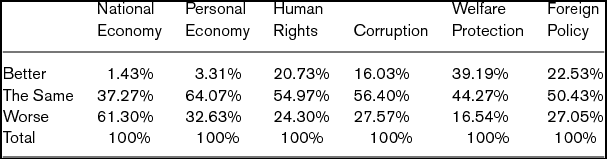
This article estimates the effects of voters’ evaluations of the six performance categories – the national economy, the personal economy, human rights, corruption, welfare protection, and foreign policy – on the likelihood of voting for the incumbent party in the party list vote and for the incumbent party's candidate in the district level vote. Before presenting the results of multinomial logistic regression models, it is worth looking at the distribution of the voter evaluations for each category: better, the same, and worse for each government performance.
Table 1 shows that Korean voters evaluate the national economy as the worst area of government performance among the six categories. For the national economic evaluations, only 1.4% of respondents said that the national economy had been better, whereas 61.3% said that the national economy had been worse. The personal economic judgments are the second worst category of government performances. Only 3.3% of respondents have a positive evaluation for the personal economy whereas 32.6% have a negative evaluation. In contrast, the best category of government performances is the welfare protection. For this category, 39.2% of respondents have positive evaluations whereas only 16.5% have the negative evaluations. From Table 1, one can recognize that Korean voters differently judge the government performance according to different criteria.
Government performance evaluations of six categories

Table 2 demonstrates the Kendall's tau-b correlation between individuals’ party identification and their retrospective evaluations for the six performance categories. The results of Table 2 show that there is a correlation between partisan attachment and retrospective evaluations, but it is not strong enough to cancel out the electoral effects of retrospective evaluations.
Correlations between performance evaluations and party identification (identifiers with governing party, independent, and identifiers with other parties)

Note: Performance evaluation variables have the three categories: better, worse, the same. Kendall's tau-b is used because both of the two variables are ordinal. Tau-b has a range between –1 and 1, and, in general, less than 0.10 is weak association, 0.10 to 0.30 moderate association, more than 0.30 strong association.
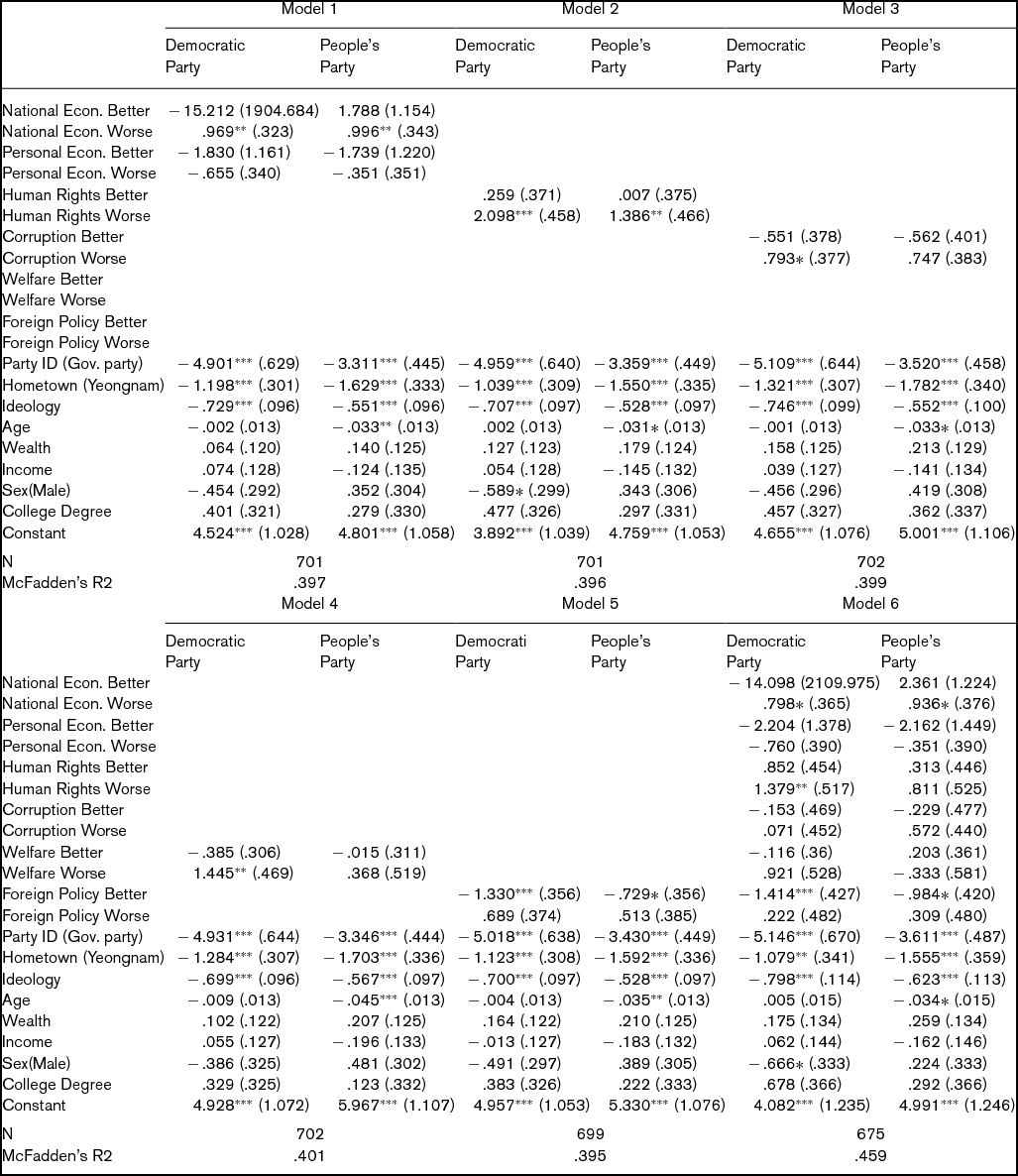
In turn, the results of the MNL analysis are presented in Tables 3 and 4. The baseline category for the multinomial logit models is ‘The Saenuri Party’, which is the incumbent party. This means that the coefficients for the democratic party (the People's Party) demonstrate the effect of each variable on the likelihood of voting for the democratic party (voting for the People's Party) versus voting for the Saenuri party which is the governing party. The reference category for the retrospective evaluations is ‘the same’. Thus, if the voters’ retrospective evaluations matter, the sign of the ‘better’ category should be negative for the democratic party (the People's Party). The sign of the ‘worse’ category should be positive for the Democratic party and the People's Party. In addition, if the better category is statistically significant, it means that voters reward the governing party for good performance, whereas if the worse category is significant, it means that voters punish the governing party for bad performance.
Performance voting for party list vote in the 2016 Korean legislative election: multinominal logit (reference category = the Saenuri party)

Note: Reference category for each performance evaluation variable is ‘The same’.
*P<0.05, **P<0.01, ***P<0.01.
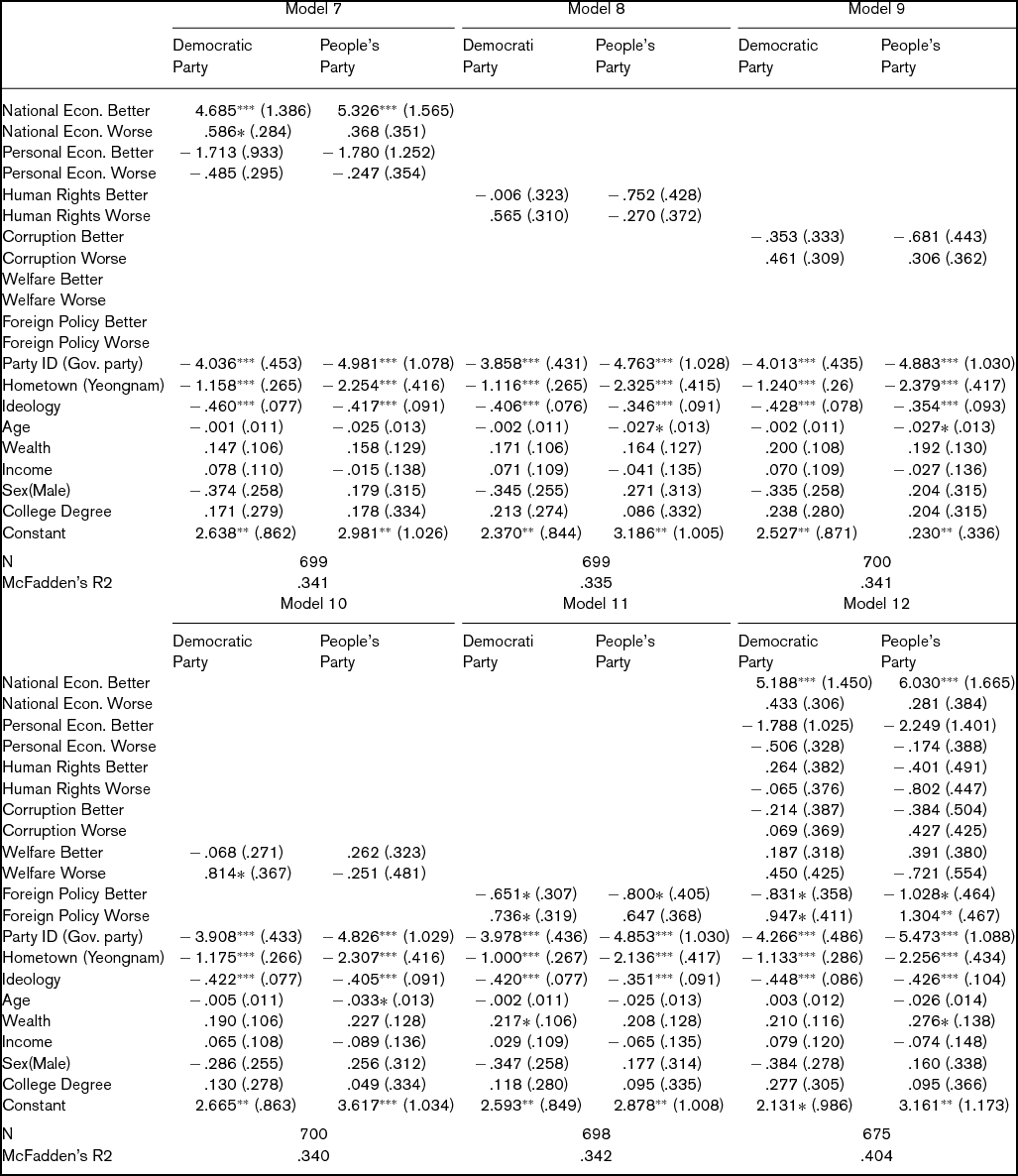
Performance voting for district level vote in the 2016 Korean legislative election: multinominal logit (reference category = the Saenuri party)

Note: Reference category for each performance evaluation variable is ‘The same’.
*P < 0.05, **P < 0.01, ***P < 0.01.
The results in Table 3 shed light on the effects of voters’ evaluations of of the six performance categories on their party list vote. Table 3, model 1, includes the national and personal economic retrospective evaluations. Models 2, 3, 4, and 5, include, respectively, the evaluations for human rights (model 2), corruption (model 3), welfare protection (model 4), and foreign policy (model 5). Model 6 incorporates all six evaluations. For each independent retrospective evaluation model, all retrospective evaluations of voters except for the personal financial conditions affect the choice between voting for the Saenuri Party (incumbent) and the People's Party (the largest opposition party), whereas only the retrospective assessments of the national economy, human rights, and foreign policy influence the choice between voting for the Saenuri Party and the People's Party. When incorporating all the six evaluations into a model, the retrospective perceptions of welfare protection and corruption lose their statistical significance for the choice between the Saenuri Party and the Peoples Party, whereas the human rights evaluation loses its statistical significance for the choice between the Saenuri Party and the People's Party. Interestingly enough, except for foreign policy evaluations, voters who have positive evaluations for the national economy and human rights do not reward the Saenuri Party, but those who have negative evaluations for them punish the incumbent party. In contrast, in terms of foreign policy, voters who have positive evaluations are more likely than those who have neutral evaluations to vote for the Saenuri party, but those who have negative judgments are not less likely than those who have neutral evaluations to vote for the Saenuri Party. In short, the retrospective evaluations of the national economy, human rights, and foreign policy affect the likelihood of voting for the incumbent party in the party list vote of the 2016 Korean legislative election.
For control variables, as expected, party identification, hometown, and ideology of the voter influence the probability of voting for the incumbent party across all six models. However, the other controls such as gender, age, wealth, income, and education do not. Like other countries, party identification and ideology of voters have significant and consistent effects on vote choice in South Korea.
In turn, hometown effect is a unique feature of Korean politics. In South Korea, regional bloc voting has consistently been observed since the 1987 presidential election. Before the 1987 election, the most significant electoral cleavage was the democratic–authoritarian cleavage. However, the 1987 Korean presidential election was conducted right after the end of the military dictatorship, which made the democratic–authoritarian cleavage meaningless. In such a circumstance, each presidential candidate used campaign strategies to attract voters based on regional backgrounds. In general, voters feel closer to the candidate from their region because people often have psychological attachment to those with similar backgrounds. Major parties such as the Saenuri Party and the Democratic Party have constructed strong regional bases. Voters support a party that allegedly represents their region (generally their birthplaces) and have hostility to people and parties from other regions. In this case, many Korean voters select the candidate of the party, or the party itself, which is closely associated to their native or residential region with respect to its top leadership or past history. Regional voting tends to be more often observed among the residents or natives of the Honam and Yeongnam regions than among people from other regions (Lee and Im, Reference Lee, Kyunghoon and Wook Park2005; Park, Reference Park2009a; Park, Reference Park, Nae-Young and Mingeon2009b). Specifically, voters from Youngnam have voted for the Saenury Party, whereas those from Honam have voted for the Democratic Party. Therefore, it is expected that the coefficient for the Youngnam variable is negative. The result shows that the coefficient of Youngnam is statistically significant and negative in the models.
The results of the MNL analysis for the district level vote are presented in Table 4. The results in Table 4 show the effects of the voters’ assessments of the six performance categories –the national economy, the personal economy, human rights, corruption, welfare protection, and foreign policy – on their district vote. As in Table 3, model 7 includes the two economic evaluations for the main independent variables; models 8, 9, 10, and 11 include one retrospective evaluation each, and model 12 incorporates all the six retrospective evaluations in the model. First, the effects of the national economic evaluation are statistically significant for model 7 and model 12, but the sign of the coefficients is opposite of the predicted direction. It means that voters who have positive national economic evaluations are more likely than those who have neutral evaluations to vote for the opposition party compared to the incumbent party. Thus, this result fails to confirm the retrospective theory. For the retrospective evaluations of the personal economy, human rights, corruption, and welfare protection do not have significant impacts on the choice between the incumbent and the opposition parties. For the district level vote, only the evaluations of foreign policy have statistically significant coefficients with the sign of the predicted direction. In model 12, voters become less likely to vote for the incumbent party as their foreign policy evaluations deteriorate from the same to worse and they are thus more likely to vote for the governing party as their foreign policy assessment improves from the same to better.
Conclusion
The results of this article show that retrospective evaluations are applied more strictly to party list vote choice than to district level vote choice. Voters may assign only partial credit or blame for national conditions to district candidates of the governing party because each individual candidate has little influence on the policies that might affect the national conditions leading up to the election. As expected, the electorate's retrospective evaluations do have more significance for the party list vote than for the vote at the district level. Specifically, voters attribute responsibility for national conditions of the economy, human rights, and foreign policy to governing party for party list vote, whereas they attribute responsibility only for foreign policy to candidates of governing party for district level vote.
For the party list vote, Korean voters blame the incumbent party for the bad conditions of the national economy and human rights violations, but do notbut do not give credit when conditions are good. In terms of foreign policy, voters who evaluate foreign policy has having improved give credit to the incumbent party, whereas those who evaluate foreign policy has having worsened do not blame the incumbent party. Voters’ evaluations of corruption and welfare protection do not have any impact on the likelihood of voting for incumbent party.
For the district level vote, only voters’ evaluations of foreign policy matter. Voters assign both credit and blame for the performance of foreign policy to incumbent party's candidates. However, the other retrospective evaluations had no impact on the choice between the incumbent party's candidates and opposition party candidates.
The results of this analysis have several implications. First, Korean voters consider various aspects of government performance, such as human rights and foreign relationships with other countries rather than just the economy. Second, Korean voters use different retrospective evaluation categories for the party list vote than for the district level vote. Furthermore, as expected, voters use retrospective evaluations more for their party list vote, than for the district level vote. Third, the effects of voters’ evaluations for some categories lose their significance when other retrospective evaluations are taken into account. Moreover, the comprehensive retrospective models (models 6 and 12) that include all the six retrospective evaluations for their explanatory variables have higher McFadden's R2 than individual retrospective models that include only one or two retrospective evaluations. That is, if only one type of retrospective evaluation is included in voting behavior models, the effects of the retrospective evaluation on vote choice may be overestimated. Hence, this research suggests that future studies on retrospective voting should attempt to incorporate various aspects of retrospective evaluations rather than only one or two, such as economic performance and corruption.
About the author
Jungsub Shin is an assistant professor in the department of Political Science and International Relations at Soongsil University, Seoul. His research focuses on voting behavior, political campaigns, and elections. He has published in premier journals such as Political Research Quarterly, International Political Science Review, and Asian Journal of Communication.