But what I should like also to have contributed here is a better understanding of the way cultural domination has operated.
—Edward SaidFootnote 1Six months after its world premiere at the Théâtre de la Monnaie in Brussels, on 5 September 1991, John Adams's opera The Death of Klinghoffer received its U.S. premiere at the Brooklyn Academy of Music (BAM). Working in collaboration (as they had done several years earlier with Nixon in China), John Adams, Alice Goodman, and Peter Sellars staged the hijacking of the Italian cruise ship Achille Lauro. The incident was one that audiences would have remembered. The Achille Lauro was hijacked off the coast of Egypt in 1985, just six years before the premiere, by four members of the Palestinian Liberation Front, who, during a fifty-one-hour siege, shot to death a wheelchair-bound Jewish American, Leon Klinghoffer, and threw his body overboard. Although over the next fifteen years The Death of Klinghoffer would be reproduced numerous times (most prominently by the British documentarian Penny Woolcock in 2003), it was also the focus of immediate criticism, not least because the public process of remembering the hijacking, of embedding it within the nation's historical consciousness, was still, in 1991, in medias res. It is one thing to stage historical events to which audiences are not directly connected, yet another to represent living memories.
Building an opera around an event that had occurred so recently (and that continued to make headlines at the time of the premiere) raises questions about the role of American opera as an historical genre—about the nature of its increasing participation in the historical consciousness of the millennial United States. Yes, opera has functioned as an historical genre across its four-hundred-year history, but when an opera stages events that audiences have witnessed, whose emotional and physical wounds are still gaping, the nature and effect of those representations change, become more overtly political and more actively engaged in public policy and ideology. Indeed, with The Death of Klinghoffer, it is not the facts of the event that are at stake as much as their interpretation—how these events are remembered as our own. The Death of Klinghoffer, that is, participates not so much in reconstructing the hijacking, but rather in reevaluating the hijacking as terrorism at the turn of the twenty-first century, at a crucial time, before and after 11 September 2001, when the Arab body hovers ambiguously and precariously in the contemporary U.S. Imaginary.
The presence of Leon Klinghoffer's two daughters at BAM that first night, in 1991, highlights the friction this opera readily engenders around the representation of the hijacking as it relates to U.S.–Arab relations: “We are outraged at the exploitation of our parents and the cold-blooded murder of our father as the centerpiece of a production that appears to us to be anti-Semitic,” Ilsa and Lisa Klinghoffer said in a statement following the first performance. “While we understand artistic license, when it so clearly favors one point of view it is biased. Moreover, the juxtaposition of the plight of the Palestinian people with the cold-blooded murder of an innocent disabled American Jew is both historically naïve and appalling.”Footnote 2 The Klinghoffers' statement situates the crux of what would be an onslaught of criticism at stark distinctions between representations of Palestinians and Jews. Such differences (real or perceived) proved to be a primary source of anxiety that would continue to resonate long after the premiere.
In fact, in 1991 criticism in the press converged on the work's failure to depict the Palestinian hijackers as terrorists and on its readiness, instead, to elevate their psychological traumas at the apparent expense of the Jewish victim, Klinghoffer. Edward Rothstein, writing for the New York Times, complained that the Jewish characters in the opera are portrayed as “narrow in their focus and vision” while the Palestinians are “suffused with historical consciousness, with ‘complex’ feelings and claims.”Footnote 3 In the Wall Street Journal, Manuela Hoelterhoff attacked the opera for “turning the sport killing of a frail old Jew in a wheelchair into a cool meditation on meaning and myth, life and death.”Footnote 4 In Perspectives of New Music, Leo Kraft added: “From the powerful opening chorus to the end, the Arabs were portrayed as selflessly devoted to their cause, the most reluctant of terrorists, poetic and God-loving. . . . The killing of a hostage in a wheelchair was passed over as some kind of abstract event.”Footnote 5
Several critics did commend the opera for its alternative perspectives. Most notably, Edward Said, writing for The Nation, proposed that although The Death of Klinghoffer provides a “vision of the struggle over Palestine [that] resonates more with the Arab than with the American-Jewish side of things,” such representations “heighten our awareness of the appalling background from which Palestinians and Israelis draw so much of their anger and continued suffering.”Footnote 6 Nevertheless, the emphasis in most reviews was on the presence of consciousness and complexity in the representation of Palestinians that apparently belied their status as terrorists.
These characteristics are ones that John Adams has readily acknowledged and continues to defend. The opera, he argued in an interview several years after the premiere, purposely did not condemn “either side”:
We weren't making an overly conscious attempt to be neutral, but on the other hand, after reading about the background it was impossible not to have strong feelings. All of us did a lot of research. I read the Old Testament for the first time since I was in Sunday school, and read many books on the history of the Middle East, the foundations of Zionism, the Balfour Declaration, Theodore Herzl, etc. And I read a great deal of Edward Said's writing. I know Alice Goodman read most of the Koran. And I think we all felt independently of one another that the situation[,] like any complicated political situation in the world[,] is much too complex to fall into one easy answer or another.
Adams maintains that although The Death of Klinghoffer does not pardon the Palestinians on moral grounds, it does examine their backgrounds—“what the forces were that brought them to this moment.”Footnote 7
Certainly, too, the disputes the opera has provoked (unusual, to say the least, for opera) can be tied not only to the proximity of the hijacking at the time of the premiere, but also to a broader and expanding U.S. involvement with terrorist activities and the Middle East beginning in the 1970s that occupied increasing media attention in the eighties, nineties, and into the new millennium. Such events include the massacre of Israeli athletes at the Olympic Games in Munich in 1972, the Iran hostage crisis in 1979, the hijacking of TWA flight 847 in 1985, and the explosion of Pan Am flight 103 in 1988. It is relevant, too, that the first Gulf War ended just months before the BAM premiere, and largely without resolution. Melani McAlister aptly suggests that most representations of terrorism and the Arab body in late-century U.S. culture had been shaped by “a decades-long ‘war against terrorism,‘ which had been waged on television, made meaningful through culture, and brought home through violence.”Footnote 8
Certainly, the Achille Lauro hijacking was one of these events that figured prominently in U.S. culture, represented as it is in numerous works in addition to the opera: two television movies (1989 and 1990), a tell-all memoir by the ship's captain Gerardi de Rosa (1987), analytical texts such as Antonio Cassese's Terrorism, Politics and Law: The Achille Lauro Affair (1989) and Annamarie Oliverio's The State of Terror (Reference Oliverio1998), and a variety of broadcast and print news media. Moreover, if, as Oliverio argues, the hijacking's many representations serve as “strategies” designed to produce values and icons—heroes, victims, and villains—in relation to the concept of terrorism, I would suggest, too, that the opera's several productions are part of that ongoing work.Footnote 9 Because the production history of The Death of Klinghoffer surrounds the events of 9/11, the opera becomes inextricably enmeshed in a dramatic reimagining of values and icons in millennial U.S. culture. The opera's role in this process was highlighted when the Boston Symphony Orchestra canceled a performance of the opera's choruses immediately after 9/11, prompting a debate in many publications about the role of art and representation in the midst of terrorism's devastation. More vital to the process of reimagining icons, I believe, are the opera's several productions, which show The Death of Klinghoffer reinventing itself in the twenty-first century in response to events and conversations about terrorism and national identity. Indeed, the characteristics of consciousness and complexity in the representation of Palestinians—which provoked the initial outcry—are adeptly, over the course of thirteen years, erased, replaced with other meaningful qualities.
The aim of the present essay is, first, to investigate the opera's representations of Palestinians as complex collaborations made up of image, sound, and text, and then to situate transformations in those collaborations across productions in relation to broader cultural, ideological, and political contexts.Footnote 10 I rely in part for this critique on the film theorist Bill Nichols; his careful analyses of cinematic representations of historical subjects raise relevant questions about how contemporary film, through its use of several media, represents the human body “in a manner commensurate with its status in the ensemble of social relations.”Footnote 11 Nichols delimits three “axes of representation” in particular that impact our reading of the historical figure. The “axis of narrative plot development” positions historical subjects within a storyline that provides closure and resolution; regardless of the open-endedness of historical events, narrative counters the errant trajectory of life with the smooth curve of beginning, middle, and end. The second axis, that of “historical reference,” utilizes traces of the historical subject that testify to its presence in the pro-filmic world; documents—sound recordings, photographs, films, etc.—imbue the represented body with authenticity and the work with authority. The final axis, that of “myth and spectacle,” transforms the historical subject into icon; myth replaces local detail, and documents, with universals. These axes, writes Nichols, are used singly, combined, or juxtaposed in the representation of historical figures in ways that say more about contemporary values than they do about the historical past.
It is worth emphasizing here that Nichols's focus is documentary film; and although I do not intend to draw connections in this essay between opera and documentary, I do believe that Nichols's analytical framework can be applied to both. As Nichols suggests, even documentary is a multimediated re-presentation of historical subjects: “Documentary film may not provide as direct or scenic a route to the unconscious as most fiction does. Documentary films, though, are part and parcel of the discursive formations, the language games, and rhetorical stratagems by and through which pleasure and power, ideologies and utopias, subjects and subjectivities receive tangible representation.”Footnote 12 Regardless of genre, then, Nichols's axes are useful for approaching a recent generation of American opera (Nixon in China, Harvey Milk, Tania, Dead Man Walking, Dr. Atomic, among others) whose dramatic personae, although part of our living memory, are likewise “discursive formations” and “rhetorical stratagems.” Nichols's axes are constructive in this context not because these operas replace fiction with reality (they obviously do not), and not just because they flirt with some of the signs and signals of documentary, but also because their representations of historical subjects and their requisite combination of different practices of representation within works are, like Nichols's documentaries, laden with contemporary social relations and discursive formations. Also noteworthy is that these historical operas, to varying degrees, often bend genre boundaries, so that distinctions between fiction and nonfiction, opera and documentary, may be obscured.Footnote 13
That said, my analyses of The Death of Klinghoffer productions are not modeled directly on Nichols's methodology. Yet I do highlight, throughout this essay, the varying role of representational axes in different productions in order to frame the stark distinctions among these productions' Palestinian subjects; such distinctions derive from different methods of representation and result in divergent meanings and values.
In addition to these three “axes,” I focus on two additional elements of representation that underscore changing portrayals of Arab identity in The Death of Klinghoffer. First, I examine the representation of the Palestinian hijackers as a collaboration among media—visual, textual, and sonic—whose dynamics are unique to a particular production. In certain productions, interactions among media produce conflict; in others, collaborations are less interactive, and rather produce correspondence and unanimity. Second, I examine the ways in which changes in these interactions across productions are enmeshed in a contemporary culture in which Arab identity is a site of intense discursive struggle. Such changes illumine a cultural Imaginary still in the process of defining terrorism and still forging the heroes and antiheroes central to its narratives.
Specifically, over a period of just thirteen years, this opera underwent enormous upheaval in terms of Palestinian representation and most emphatically in relation to the representational roles of the opera's media in documenting the Palestinian body. In the 1991 BAM production there was as yet no fixed version of the hijacking or of the Palestinians as terrorists. Oppositional messages, and countering narratives, thrive within its confines; text is destabilized by sound; choreography and set design are unimpeded by narrative. Here collaboration means a fiercely interactive site that produces an abundance of meaning. Such interactions among media, however, rapidly subside over the course of The Death of Klinghoffer's production history—changes that reflect, I suggest, shifts in broader cultural and political spheres around the topic of terrorism after 9/11. Where the first production reveled in conflict, heterogeneity, and reflection, two later productions in 2003 projected sharp distinctions between Arab and Western subjects that rely in large part on the visual domain. The sonic, textual, and visual dynamics of these productions no longer produce collaborative dissonance but rather depend on cooperation from music and text in the service of the image. Music and libretto are no longer independent signifying forces, but now merely accompany dominant images that do most of the representational work.
Given the sensitivity of U.S. audiences to images of terrorism in the days, months, and years following 9/11—we might remember that films were delayed and television scrutinized for anything connected to explosions—the timing of the re-production of this opera as a film that was bound to reach much wider audiences than the BAM stage bears some consideration. In fact, the opera was revived in not one, but two, productions in 2003 that were visible facets of New York City's cultural landscape: Woolcock's film, which aired on England's Channel 4 in May but opened that same month at Lincoln Center's Walter Reade Theater (and was subsequently released on DVD), and Bob McGrath's “semistaged” production at BAM in December of the same year.
To date, little has been written about these productions. John Rockwell, in a brief article for the New York Times, commended the film for showing “unequivocally that murder is nothing more than that, vicious and unconscionable.”Footnote 14 Anthony Tommasini wrote of BAM's Reference Tommasini2003 production that it “may offer this opera its best chance to reach audiences in the way its creators intended” (a comment with which I disagree for reasons I discuss below).Footnote 15 I ask in this essay, however, if the critical reserve surrounding these productions—so distinct from the avid criticism directed at BAM in 1991—stems in part from radical changes in the representation of the Palestinian hijackers in ways that resonate more easily with images of Arabs circulating in a broader cultural context.
The representation of Palestinians is the central focus of my essay. Although I readily acknowledge the validity of criticism aimed at the opera's representation of Jewish subjects (which I believe is a valid point of concern even in later productions), I am concerned almost exclusively here with the ways in which different interactions of textual, visual, and sonic signs in 1991 and 2003 produce different versions of Palestinian identity, are invested with distinct political and cultural values, and make divergent claims about terrorism and the Middle East. I am also aware that much has already been written about the anti-Semitic elements of the opera, while little attention has been given to other facets of the opera's politics of representation.
The title of this essay, I hope, will ultimately call attention to the opera as a highly variable work that is connected to those events, conversations, and representations taking place around terrorism and the Middle East in the millennial United States. The Death of Klinghoffer in this analysis, then, is not treated as a single work, but as a number of independent works that signify separately and uniquely: from a 1991 production, in which the opera's media passionately interact, to more recent productions in which word and music are subdued by a visual domain that imposes clear distinctions between Arab and Western characters. As the visual takes control, and as sonic elements devolve to soundtrack, The Death of Klinghoffer emerges as emblematic of a new era. The events of September 11th are shadows moving imperceptibly behind the 2003 productions—silent partners to the reinterpretation of the Achille Lauro hijacking and the re-presentation of Arab identity. These productions bear witness to changing definitions of terrorism, but they also play a role in the strategies and rhetoric involved in producing those definitions. Like the endless replay of the two planes rocketing toward the towers, so too do a set of representational practices take shape. These several productions, then, function as sites of negotiation and revision whose changes not only reflect, but also impact, the formation of narratives and icons about terrorism in the contemporary United States.
A Collective Experience of Tragedy
Criticism aimed at The Death of Klinghoffer's BAM premiere, as noted above, focuses in part on representations of Jewish Americans that exploit anti-Semitic stereotypes.Footnote 16 The controversy surrounding the premiere had also to do with the opera's representation of Palestinians, who seem by comparison to exhibit a complexity, an “historical consciousness,” that the Jewish characters do not. I would suggest, too, that the opera's first critics were also responding, although often not explicitly, to facets of this production that undermine distinctions among these characters, that erase differences between Palestinian hijackers and Jewish victims. Yes, the libretto that many critics cited renders the Palestinian hijacker with empathy; but the rich and often thorny interactions among all the opera's media also produce an ambiguity among historical subjects that is an inherent aspect of the values infused into the work in 1991. This production, in fact, is less a documenting of particular crimes and historical people than a reflection on exile and violence in which national and ethnic boundaries are erased or traced back to remote and mythical origins that involve Jews and Palestinians alike.Footnote 17
If, as Nichols suggests, mythologizing strategies of representation (his “axis of myth and spectacle”) replace the local details of historical subjects with the broad brushstrokes of icons—“Something of the historically contingent must be evacuated to render the body as icon”Footnote 18 —then the BAM production is an exemplar of this strategy, in which myth's icons rise readily to the surface, leaving behind their local circumstances. This production adamantly erases identifiable traces of the 1985 hijacking. Historical events are often only implied, while most passages occur outside of specific temporal and geographical spaces. Peter Sellars suggests that the erasure of local details in this production was strategic: “The opera is an experiment with the question of how one puts forward a collective experience of tragedy. That is why people are not dressed as Palestinians or as Jews or as Americans or Italians. We all know what is different—the obvious points of separation—but the next question is, what are the points of connection?”Footnote 19 John Adams similarly describes the 1991 production as akin to passion or oratorio, more abstract than local, more reflective than dramatic: “Suddenly we are allowed to see this event as part of a vast historical perspective.”Footnote 20
References to the hijacking in the BAM production are, in fact, almost entirely absent. Two brief passages recount the hijacking in the past tense, and only three passages reenact historical events. In place of a coherent narrative, the production instead shifts continuously among recollection, reflection, and action, with order and causal connections among passages ambiguous throughout. Moreover, only two dates are specified in the libretto: the Palestinian Chorus cites 1948, “when the Israelis passed over our street,” and the terrorist Mamoud recalls the Sabra and Shatila massacres of 1982, in which Palestinian refugees were killed by the Lebanese. Both are but fleeting references, and neither is directly connected to the hijacking event.
In the place of dramatic reenactment, and evoking that “vast historical perspective,” are lengthy choruses that deliberate on an often abstract history of conflict, and during which no action is staged. These choruses, taking up much of the opera and deliberating on events whose dates are unknown, unspecified, or mythic in origin, form a reflective scaffolding for the work overall and carry it far beyond the local events of 1985. The Ocean Chorus, for example, describes a primordial man who is prior to race and nation; the Hagar Chorus refers to a time before Palestine and Israel; and the Night Chorus evokes an indeterminate future: “Elijah will return; the dead, the wicked, and the good will be distinguished.”
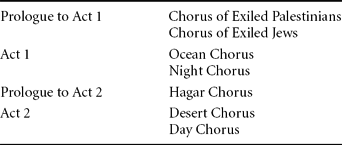
Although reflective, the choruses also occur in pairs, suggesting a broad and originary dichotomy—a mythological rift that serves as a structural framework for the opera as a whole (see Table 1). The sole exception is the Hagar Chorus, which narrates the birth of Ishmael from Hagar and Abraham (a story that appears in the Hebrew Bible and in the Qur'an); the Hagar Chorus, occurring at the midpoint of the opera, is the only chorus that appears alone, without a partner. Nevertheless, the chorus still suggests a deep dichotomy: Its prominent placement, at the opera's center, indeed highlights the rift between Arab and Judaic peoples, but simultaneously reflects on their ancestral connection. Altogether, then, the meaning of that duality represented by the opera's choruses is complex, suggesting at the same time union and division, brothers and enemies.
Organization of The Death of Klinghoffer Choruses, BAM, 1991.
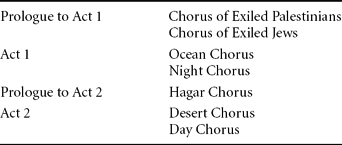
Certainly, in particular passages, the libretto's distinction between Jews and Palestinians is problematic. Especially worrying is the libretto's seeming tendency to heroicize Palestinians without also elevating Jewish characters and without endorsing a “collective experience of tragedy.” At crucial points, for example, where Palestinians reference a long history of trauma and victimization (that by implication excuses a turn to violence), Jewish characters speak of more narrow concerns (knee surgery, lunch buffets, tourism) in language that verges on the prosaic. The texts of the Chorus of Exiled Palestinians and the Chorus of Exiled Jews, which begin the opera, already foreground these distinctions. The Palestinian Chorus is set as poetry, its lines thick with references to natural materials like stone, glass, and water. The sounds of the words are musical and alliterative, the -oo- of cool and moon, the soft -ss of glass and coolness:
The Jewish Chorus, by contrast, is set as prose. In the place of vowels and soft esses are thick consonants that bespeak an exhausted people weighed down by luggage, limited by money:Footnote 21
A more disturbing passage juxtaposes the aria of the hijacker Omar (a trouser-role), in act 2, scene 1, with that of Leon Klinghoffer's wife Marilyn, in act 2, scene 2, just as Leon Klinghoffer is killed and at the apex of the opera's drama. Omar, in his aria, voices a resounding lament for the Arab people, opining the poverty and violence that has long beset them. Beneath him, the Ah's of a female chorus bear witness to the depth of his suffering:
Marilyn's aria is subsequent, separated only by the Desert Chorus. Yet even as she sings simultaneously with the murder of her husband (which seems to take place off stage), her thoughts meander over squash and tennis and lunch buffets. With no chorus to bolster her, and with a tessitura that is lower than Omar's, her vocal lines seem to dip and expire and to carry less emotional weight:Footnote 22
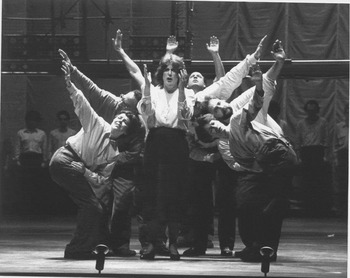
The libretto's distinctions between Palestinian and Jewish characters, however, are continuously offset by other media that insistently blur boundaries among dramatic personae, that fuse bodies and voices, and that equalize historical figures: mythologizing strategies that function sometimes at cross-purposes to the representational work of the libretto. George Tsypin's set design, for example, is a cage of steel bars that vaguely connotes a ship's interior but just as ably evokes an abstract space, mythical and timeless, that encloses all the opera's peoples. Dunya Ramicova's costumes, nondescript beige tops and bottoms, are worn by everyone on stage—choir, dancers, and soloists alike; these costumes do not belong to a particular time or place but rather erase perceptible differences among characters. (In Figure 1, for example, both Palestinians and Jews are depicted on stage, but it is impossible to tell them apart.) In addition, Mark Morris's choreography situates bodies beyond a narrative domain: “I have very little to do with the subject matter,” Morris explains. “Of course I know about it and I've read about it and I know what's supposed to be going on, but I think because of the way it's composed and the way it's written that it's not linear. It's a whole bunch of little flashes and they relate or don't.”Footnote 23
Marilyn Klinghoffer's Lament, act 2, scene 2, BAM, 1991. Copyright Martha Swope. All rights reserved. Reproduced by permission.

Just as significantly, the BAM production relies on doubling, a practice that obscures distinctions among the opera's characters. Certain singers in this production portray both Arab and Western characters, while characters are often also doubled by dancers. Stephanie Friedman, for example, sings the role of the youngest hijacker, Omar, and the Jewish friend of the Klinghoffers, Alma Rumor. Leon Klinghoffer, although wheelchair bound, is doubled by a dancer. Thomas Hammons sings the role of the hijacker Rambo and of the ship's Italian First Officer. Thomas Young sings both the hijacker Molqi and the Rumors' Jewish son. Character doubling, moreover, is enhanced by screens on which appear the enlarged faces of the opera's characters. In all these ways, characters are multiplied, visually, sonically, and physically. The effect of screens and doubles is to obfuscate any sense of narrative or historical specificity, to dematerialize physical presence, and to interrogate dichotomy. Characters are removed from a self-contained body. Instead, they resonate as mythic figures who stand not for a particular event, or historical subject, but rather for a whole history of conflict to which few are immune and none is completely innocent.
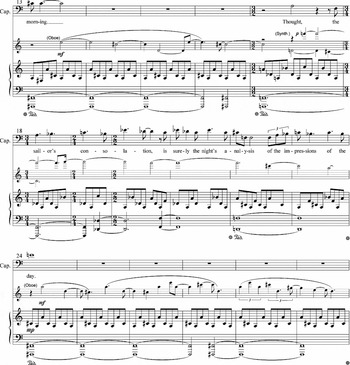
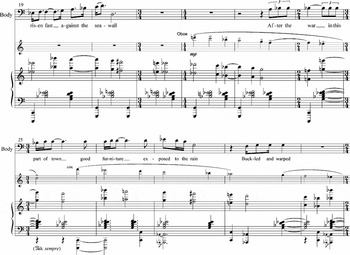
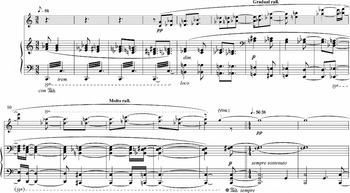
The music, too, by means of shared harmonic, melodic, instrumental, and textural gestures, undercuts boundaries between characters—something a listener might recognize as another form of doubling. In act 1, scene 1, for example, as the captain, in a rare narrative passage, recollects the morning of the hijacking, a wistful oboe obbligato makes a first appearance (see Example 1a). The oboe meanders above an F-sharp pedal, falls a seventh from C-sharp to D, and then rises again. Its melody is closely bound to the captain's mental wanderings, his memory of mediating between passengers and hijackers, and his obligation to respond to both.
Oboe solo, The Death of Klinghoffer. Copyright 1991 Hendon Music, Inc. A Boosey & Hawkes company. Copyright for all countries. All rights reserved. Reprinted by permission.
1a Captain's Aria, act 1, scene 1, mm. 13–29.

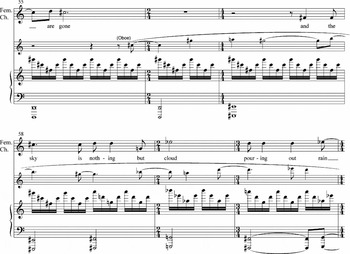
That oboe voice, however, does not exclusively represent the subjectivity of the captain, but returns again in two other contexts. Its second appearance occurs during the Desert Chorus that follows Omar's act 2 lament (the passage, cited above, that separates the arias of Omar and Marilyn Klinghoffer; see Example 1b). The Desert Chorus is connected, although ambiguously, to a collective Palestinian perspective; its soprano-alto scoring and rising arpeggios are reminiscent of the Palestinian Chorus from the prologue to act 1, while references to Iran and Persia evoke Arab identity more broadly. Moreover, the Desert Chorus appears immediately after Omar's lament, so that it seems to reflect on his suffering: “Is not their desert the garden of the Lord?” This passage, however, is also musically connected to the captain's monologue through the solo oboe, which, because it so rarely appears in the opera, is marked as significant. Once again, the oboe stretches a seventh, this time upward from C-sharp to B, and then, later, meanders about again. The chorus is grounded in A major, with occasional F-sharp minor harmonic areas in the lower regions of the orchestra through arpeggiated accompaniment.
The Desert Chorus, act 2, mm. 55–60.

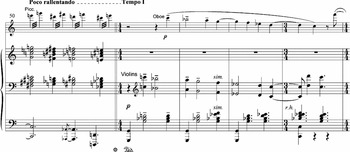
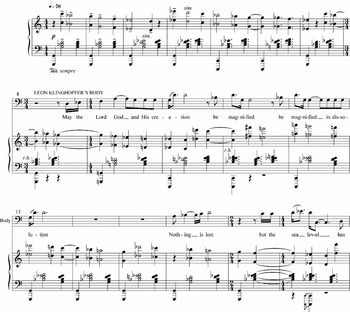
Tellingly, the oboe appears a third time, in Leon Klinghoffer's posthumous “Aria of the Falling Body.” This aria is set in stark musical contrast to both the captain's aria and the Desert Chorus. Grounded in G minor, the orchestra's voicing thick and close, with recitative-like declamation in the vocal line, Klinghoffer's aria is distant in sound from these earlier passages. Additionally, this oboe solo eschews the arpeggiated texture of its first appearances. It rather begins in imitation of the descending violin melody that signifies Klinghoffer's fall from the ship (see Example 1c). Fleeting references to A major and F-sharp minor, however, might suggest connections to the harmonic centers of the two earlier passages. For example, in m. 50, as the oboe solo resumes, the G minor of Klinghoffer's aria follows first an F-sharp dominant seventh and finally an A-major triad (which sits just above an E-flat dominant seventh), a musical metaphor perhaps for the mythic connection of Jewish and Palestinian peoples (see Example 1d).Footnote 24 The oboe, then, despite the libretto's potentially polarizing effect, works as connective tissue across the diverse contexts in which it appears: it is a sonic realization of the ties that bind all people on board the Achille Lauro.
Klinghoffer's Aria of the Falling Body, act 2, scene 2C, mm. 19–29.

Klinghoffer's Aria of the Falling Body, act 2, scene 2C, mm. 50–54.

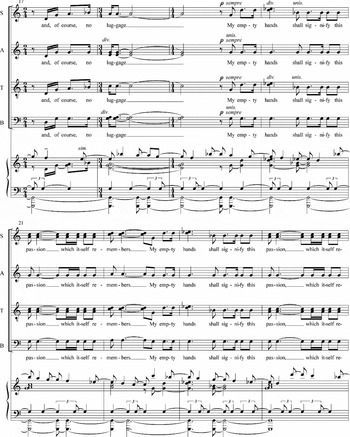
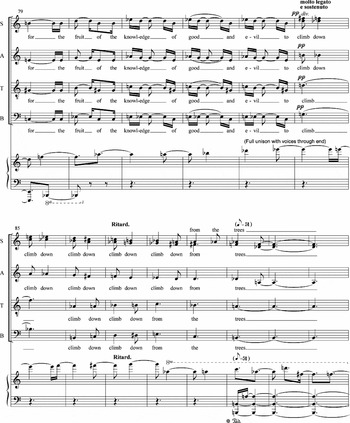
Another recurring motive is a stepwise descending melody that likewise interconnects disparate peoples. The motive first appears during the Chorus of Exiled Jews, deeply engrained in the string accompaniment (see Example 2a). From a perfect fourth, the motive expands steadily downward to a minor sixth, then a major seventh, and ultimately a major ninth (mm. 24–26). If the motive here is connected to Jewish exhaustion, expanding scalar descents appear again in the voices of the Ocean Chorus, which describes a primordial man, neither Western nor Eastern, Jewish nor Palestinian: “The perfect shapes, cross obliquely. Here is the semblance of the first man.” These descending scales appear tepidly at the beginning of the chorus, but again grow longer and culminate with its last phrase, “and waiting for the fruit of the knowledge of good and evil to climb down from the trees,” with which the descent encompasses the interval of a ninth, as it had done in the Chorus of Exiled Jews (see Example 2b). The motive is also prominent throughout Mamoud's aria in act 1, scene 2 (see Example 2c) and in Klinghoffer's Aria of the Falling Body, in which it finally mimes the descent of Klinghoffer's body into the ocean after his death (see Example 2d). In fact, occurring as it does throughout the opera, the motive effectively blends passages of Jewish and Palestinian perspectives; and if the motive seems in retrospect to foreshadow the falling body of Klinghoffer—indeed, it appears for the last time in this aria—it also suggests that all characters conspire in and suffer for Klinghoffer's death.
The descending motive, The Death of Klinghoffer. Copyright 1991 Hendon Music, Inc. A Boosey & Hawkes company. Copyright for all countries. All rights reserved. Reprinted by permission.
2a. The Chorus of Exiled Jews, prologue, scene 2, mm. 17–24.

The Ocean Chorus, act 1, mm. 79–92.

Mamoud's Aria, act 1, scene 2, mm. 1–16.

Klinghoffer's Aria of the Falling Body, act 2, scene 2C, mm. 1–18.

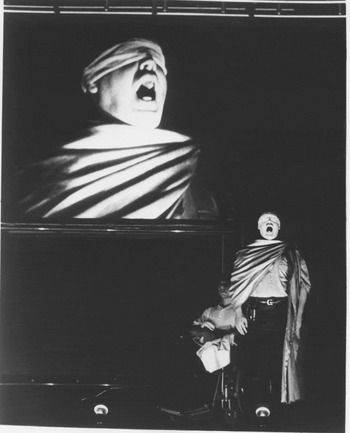
In 1991, then, The Death of Klinghoffer weaves a mythic terrain far broader in scope than the Achille Lauro hijacking. This production's mythologizing strategies, its eclipsing of the local, are especially palpable in act 2, scene 1, when Klinghoffer and the hijacker Rambo face each other in matching robes, effectively as brothers, just before Klinghoffer is killed (see Figure 2). The use of screens here to double the faces of the two men, and the presence of dancers to double their bodies (only Klinghoffer's is shown in Figure 2, with his dancing double in the wheelchair beside him), not only fractures individual identity, and therefore individual guilt and trauma, but also raises local events and characters to realms of universal significance.
Klinghoffer, as he confronts Rambo, act 2, scene 1, BAM, 1991. Copyright Martha Swope. All rights reserved. Reproduced by permission.

That slippage between local and mythic is most volatile just subsequent to this exchange, at the very point of Klinghoffer's murder, or rather at the point of its absence. On the one hand, because the act of murder is not staged and is never referenced in the libretto, the opera lacks grounding in historical detail—in the very event claimed by the opera's title. The absence of murder possibly provides for a collective experience of tragedy, but it also allows the opera to avoid “naming names.” On the other hand, the visceral horror of that act is painfully evidenced by the music that interrupts Marilyn's subsequent aria. Here, in a twenty-eight-measure interlude replete with a building chromaticism, thick orchestral voicing, rhythmic quickening, and a steady crescendo, the ugliness of Klinghoffer's murder is signified by sound alone. At the peak of that musical crescendo, at the very rear of the stage, behind Marilyn's back (figuratively and literally), the body of Klinghoffer's double slowly descends by rope, confirming the finality of his death.
The combined effect of screens and dancers, metal bars, indistinct clothing, and indiscriminate musical motives, of passages that do not always flow forward in obvious teleological design, of the absence of local detail, is to substitute historical events and subjects for a mythic universe peopled by icons that evoke a broad abundance of meaning. Just as vital are the collaborative dissonances of this production: Morris's “little flashes” that relate (or don't), Adams's musical gestures that act contrary to the libretto, and casting that contradicts dramatic roles. Indeed, the librettist Alice Goodman has specifically referred to conflicts among the opera's collaborators—Goodman, Sellars, Adams, and Morris—as central to the opera's outcome. “There was a lot of violent disagreement,” she says. “Some of it was resolved, some wasn't, but I think that the remaining tensions become a strength of the piece.” Goodman describes disagreements over the general tone of the work and its particular content. Sellars, according to Goodman, wanted the opera to be “more pro-Palestinian”; Adams made cuts in the opera “without consulting.” What was to be included, and what was not, proved to be a source of constant discord: Goodman wanted more depth than envisioned in the original concept; but Sellars advocated including an entire act on the media cashing in on the event after the hijacking. In the end, only act 1 of the original sketch made it into the libretto. By the time of the Brussels premiere, Goodman recalls, the collaborators were scarcely speaking to one another; yet to Goodman that energy produced artistic merit: “We strongly hold disagreeing views. Why does opera have to be people in unison speaking to the audience?”Footnote 25
Sellars, like Goodman, understands the conflict among collaborators as productive, making its way into the opera and providing for “what Bahktin would call dialogic imagination, where the truth is never here or here but it's in the dialogue of these things happening at the same time, hovering in between.”Footnote 26 Although Sellars refers, in this quotation, to the team's work on an earlier opera, Nixon in China, he emphasizes that this dialogic approach applies to his other operas as well: “The way I direct is always about simultaneity. . . . The only reason we put any of this stuff out there is to get people to discuss these issues. Therefore you create something where you don't have a universal reaction, you exactly have the potential for a wide range of reaction.”Footnote 27
These dialogic elements might seem to undermine an axis of myth in which, according to Nichols, the historical subject is made over as “complete, as an eternal symbol.”Footnote 28 Disparate and simultaneous perspectives frustrate expectations of a mythic domain that is fixed and of its dramatic personae as indelible symbols and archetypes. The BAM production rather enfolds a space teaming with the knotty and ambiguous associations that I believe are common if not innate to opera as a genre. Opera, in which sonic signs appear simultaneously with visual and textual ones, in which music is, at least theoretically, elevated above that of soundtrack, and composer at least equal to librettist and director, ably binds a multitude of voices, perhaps most emphatically when it stages histories that are current, that have not yet been forgotten, and thus not yet consistently remembered.Footnote 28
The Death of Klinghoffer in 1991, therefore, even as it evokes a world of myth and icons, also bears traces of the dialogues and debates, the contradictions, disagreements, and complexities, surrounding terrorism and Arab identity in the late-century U.S. Imaginary. The disjunctive representational strategies and lack of expressive cohesion in the BAM production, evidence of collaboration at its thorniest, indeed highlight its social and cultural relevance. Here heterogeneity among media, narratives and counter-narratives, suggests local time: a time just subsequent to the first Gulf War and just prior to 9/11, a time already saturated with images of Arab bodies positioned within a mass-mediated “war against terrorism,” but also a time when a National Symbolic surrounding terrorism and its icons had not yet solidified.
The Excluded Middle
Stark changes to The Death of Klinghoffer over the next twelve years, however, radically reduced its dialogic properties and testify to the shifting nature of conversations taking place around terrorism and the Middle East, both within the opera and in broader cultural spheres. Certainly 9/11 is not the originating point of a hegemonic narrative about terrorism, but it is a point at which, even if momentarily, the possibilities of what can be represented are limited. The Death of Klinghoffer was not immune to shifts in the cultural climate. In 1991 the opera was a dynamic, if pugnacious collaboration—a near cubist depiction of the hijacking in which media represent discrete perspectives at the same time. Signs of interaction among media and artists, however, were decidedly diminished in The Death of Klinghoffer film, directed by Penny Woolcock in 2003.Footnote 30 In the place of the complexities produced by interaction is a galvanizing melodramatic narrative that carefully delineates the hijacking as a specific series of events that unfolds within a narrowly defined temporal and geographical space.Footnote 31 Moreover, this production persuades largely through visual evidence that replaces multiple and multimediated points of view. Indeed, the film's narrative is constructed largely out of images, which the opera's words and music bolster and accompany. These images are a representational force that overshadows other signifying elements.
Narrative (or rather what Nichols refers to as the “axis of narrative plot development”) is a common device that is utilized across historical genres, serving, among other things, to organize events within a coherent framework. “Narrative trajectory,” writes Nichols, “in its classic form, suppresses difference and effects closure. It gives resolution. Contradictions appear and ramify only to be vanquished. Identifications and references get tilted onto the moving chain of events, of actions and enigmas, that sweep (or drift) toward a conclusion.”Footnote 32 Within that narrative framework, historical personae function as causal agents; they tend to be motivated dramatically and freed of the vicissitudes and ambiguities of history that may be irrelevant to the narrative design. The dramatic finitude of narrative, therefore, is also finally a moral finitude. As Peter Brooks explains, the characters that people melodramatic narrative specifically generate an ideological effect because they function as primal ethical forces, “pure and polar concepts of darkness and light, salvation and damnation,” ushering events from beginning to end. For Brooks, the melodramatic mode of narrative, therefore, is the “logic of the excluded middle,” in which characters justify a simplification of moral terms and social relations.Footnote 33
Yet how much more convincing are narrative's moral binaries when buoyed by the musical gestures and stirring accompaniment enabled, if not mandated, by film? In Woolcock's The Death of Klinghoffer, in which the camera functions as the focused lens of the narrator, music's role is indeed subsumed into the sweep of ordered events, its once individuated meanings repurposed as soundtrack. The axis of narrative that governs the film's representational forces, therefore, also rearranges the opera's media hierarchically. The visual domain is primary, providing for a singular position from which a viewer follows events and characters, while libretto and music sustain its representations. Narrative renders the viewer less active as well. One need no longer mediate among media, but only gaze along with the camera's point of view.
That Woolcock's narrative leans most heavily on images for its representational heft, momentum, and moral authority is demonstrated most strikingly by the vivid staging of Klinghoffer's murder. The act of murder, once absent, is now depicted in gory detail: Klinghoffer is shot three times in the head, his brain scattered across the ship's deck, and his body dumped from its wheelchair by two hijackers, headfirst into the ocean. Audio referents—gun shots, screams—sound at the expense of the opera's score, which for a time is literally silenced. The depiction of murder here relies on the narrative axis of representation over and above that of myth (this incident is historically specific and localized) and does not only ensure the primacy of Woolcock's narrative, but also depletes the complexity of the media's interactions that once substituted for this event.
Central to this change in representational practice, here and throughout the film, is the role of the Arab body. Where the 1991 production complicates the politics of race and representation by obscuring distinctions among bodies, Woolcock begins with the Arab body, emphasizing its visual difference as a locus of significance and as an anchor for the opera's historical trajectory. She acknowledges the importance of that visual difference to her production in comments included on the DVD: “It took quite a long time,” she says, “to find four people who could believably be Palestinian.” Race in this case—the visual markers that make Palestinian identity “believable,” the color of the skin, the eyes, the hair—becomes a definitive factor within the opera's representational work. (The irony is that none of the four singers cast as hijackers is actually Palestinian.) It is worth noting that Sellars cast two African American singers, Thomas Young and Eugene Perry, as hijackers in the BAM production, thereby foregrounding the issue of race to some extent—although not in straightforward terms. The doubling of roles, through which Young also plays the son of the Jewish Rumors, for example, at the very least complicates any straightforward messaging around this issue. The 2003 production, on the other hand, uses the body, and its differences, as the bedrock of narrative, proof of history, and substantiation of realism.
Woolcock's film positions race as a key element of narrative even before the opera's score begins, in a prefacing scene (unique to this production) that depicts the end of the hijacking and the arrest of the Palestinians in Egypt. Thus in the film the hijackers' guilt becomes the starting point for the narrative. In this prologue to the opera's prologue, Klinghoffer's widow enters a squalid room where the four men are held, to identify them as the perpetrators of Klinghoffer's murder. The men stand against a wall, hands bound in front. The stark contrast between bodies here—the fair-skinned, fair-haired Marilyn opposite four dark-skinned, dark-haired Arabs—is reinforced by the camera as it consistently alternates between them. The absence of music in this scene might also be a clue to the precedence the visual will continue to take hereafter, just as the attendant sounds of traffic coming from an open window, sounds that take the place of music, testify to the authenticity of the scene and authorize, therefore, the ones that follow. In this scene the essence of Woolcock's production is laid bare: with music and text absent, the visual field sets the narrative terms and solidifies the divide among historical subjects. Marilyn spits at a smirking hijacker, Rambo, and then the opera proper begins.
In Opera and Modern Culture, Lawrence Kramer proposes that video heightens opera's already intense concern with visual pleasure. In filmed productions of opera, music, by nature compliant, he suggests, reinforces the visual domain: “Music's visual tolerance stems from the semantic malleability or plasticity accorded to it as part of its very definition qua music. The music thus easily accommodates itself to a wide variety of visual representations.”Footnote 34 For an opera like Salome (the one Kramer discusses), the camera's gaze, and the music's malleability, together compel a consideration of gender. For The Death of Klinghoffer, however, different issues are clearly at stake: most obviously, the politics of race. The camera, in this case, positions race as a defining element of the opera; and race, as a text that depends on the visual, has the potential to quiet other, more unwieldy characteristics of identity, and of the musical score.
This is not to say that Palestinians are represented in Woolcock's film without sympathy, but only to underscore the degree to which the narrative axis elevates the visual significance of the body at the expense of an approach that had once complicated that dimension. On the contrary, Woolcock's film provides ample justification for the Palestinian cause by positioning the narrative between the years 1948, a date connected to the birth of Israel, and 2003, the aftermath of 9/11. This temporal framework is established throughout the film by visual flashbacks and flashforwards that are superimposed on top of the opera score and that recur in varied forms numerous times. These extra-operatic visuals show Jewish Holocaust survivors arriving in Israel and forcefully, violently, evicting innocent Palestinians from their homes; they depict Palestinians turning to religious fundamentalism as a result of their exile; and they finally explain the hijacking and other violent acts as a form of Islamic fundamentalism that is directly related to the loss of Palestinian land. So although the visual attaches race to its explanation of the hijacking, the narrative also attributes the hijacking to the oppression of Palestinians by Israeli Jews. Not incidental (and not unproblematic) in this context is the connection established by these visuals between Leon Klinghoffer and Israeli Jews. Indeed, the film, by beginning in Israel and including Israeli passengers on the Achille Lauro, insists on these relations as central to Klinghoffer's murder—despite the fact that Klinghoffer was not Israeli.
As noted earlier, Woolcock's historical trajectory is one that is almost entirely absent in the BAM production, which effectively evades emphasis on cause, effect, and resolution. In the 1991 production, at least seven of the opera's sixteen scenes, almost half, reflect on events whose dates are unknown or unspecified, while only two dates are ever referenced in the score. By contrast, most passages in the 2003 production are attached to specific dates and places that appear prominently at the bottom of the screen and that fit the opera within a limited historical scope, 1948 to 2003. In fact, all passages are positioned within these fifty-five years, with characters, many of them new to the opera, reappearing, even if they don't sing, so that dramatic continuity is reinforced throughout.
More telling is what has been cut from the score in 2003: the prologue's scene 2, the Ocean Chorus, the Hagar Chorus, and the Desert Chorus. Adams remarks on these cuts in commentary included on the film's DVD. “I like the stripped-down version,” he says. “There are some choruses which I'm very sorry that are not in this version, but I think that the original operatic opera is very slow. . . . If you have a long evening and you feel in an operatic mood it works, but I think that this cinematic form . . . is very effective. . . . The timeframe of cinema is a completely different experience than the timeframe of opera.”Footnote 35 Adams rightly suggests that the change from opera to film is not incidental; it is, he remarks, a change in genre, in tone, and in viewing experience. He also emphasizes a necessary reduction, in cinema, in the degree of “abstraction” that may be tolerable to the viewer.
Indeed, with the exception of scene 2, those passages cut from the original are all reflective ones, providing what Adams describes as a “vast historical perspective” and what Sellars calls a “collective experience of tragedy.” The Desert Chorus (discussed earlier) immediately follows and reflects on Omar's lament. The Hagar Chorus originally functioned as a centerpiece of the opera's score (see Table 1 above). It dwells on the divide between Jewish and Arab peoples, and on the nature of their union as well. Just as vital to the vast historical perspective is the Ocean Chorus, which describes a primordial, pre-divided people: “Is not the ocean itself their past? . . . The perfect shapes, delicately blazing monstrous creatures, cross obliquely. . . . Here is a semblance of the first man; sinewy, translucent, thick with life, superficially violent.” Even the libretto's reference to the story of Adam and Eve and the tree of knowledge in this chorus, referencing as it does both the Hebrew Bible and the Qur'an, bespeaks the interchange of texts and bodies: “This is the night of his wedding. His extremities reek of his wife, flesh of his flesh, a rib of sand, who is listening, not to his voice but to the voice of spirits, and waiting for the fruit of the knowledge of good and evil.”
The remaining four choruses, staged in 1991 with only Morris's dancers, are refigured in 2003 as accompaniment to Woolcock's narrative. The Chorus of Exiled Palestinians, for example, accompanies the first narrative sequence: 15 May, 1948: The day after the creation of the state of Israel. Music and libretto contend here with “real” audio—gun shots and screams—and Morris's choreography, flashes that “relate or don't,” is replaced by actors playing Palestinians driven from their homes by actors playing Jewish Holocaust survivors. Halfway through the chorus, the scene shifts abruptly to depict the training of young Palestinian terrorists: 1985: 3.7 Million Palestinians in Exile. Images of angry Palestinian youths turning to religion and violence are forebodingly intercut with tourists boarding the Achille Lauro, that contrast foregrounding the havoc wreaked by exile. With the chorus's last phrase, “We'll break his teeth,” Rambo, preparing to board the ship, turns directly to the camera and deliberately lip-synchs these terrifying words, our first indication that this dramatic rendering of the hijacking is opera.
That same visual sequence returns six more times in varied form, wed to the music and libretto of the opera score. The sequence normally begins with the aftermath of the Holocaust and leads to the hijacking of the Achille Lauro. In act 2, scene 1, however, against the backdrop of Omar's aria (in 1991 a significant moment of Palestinian lament), the sequence plunges forward in time, suggestively incorporating the timeframe of 9/11: 2001: the conflict continues. Islamic fundamentalism flourishes in a climate of despair. Women must wear the Hejab. A Palestinian woman is depicted on screen, stoned by her own people for not wearing the Hejab, and the sounds of her screams and an angry mob literally silences Omar's lament—the music and text of the opera score.
If, as Hayden White argues, historical narrative introduces a structure and resolution, and therefore a moral content, that history does not otherwise possess, Woolcock's narrative suggests ideological impulses and moral trajectories that radically diverge from the 1991 production. So common a strategy is narrative for representing historical events, White says, that it may appear natural, unimpeded by ideology, but for this very reason needs to be scrutinized for its social and political positions: “Every narrative, however seemingly ‘full,’ is constructed on the basis of a set of events that might have been included but were left out. . . . And this consideration permits us to ask what kind of notion of reality authorizes construction of a narrative account of reality in which continuity rather than discontinuity governs the articulation of the discourse.”Footnote 36 Certainly Woolcock, through the addition of narrative to the choruses and across the opera as a whole, does not only impose a history of causal connections and polarized characters not present in the original, but also wields the authority necessary to funnel all of the opera's media into that cultural work.
In this way The Death of Klinghoffer, once a polyvocal opera about interethnic conflict, becomes a monovocal film about terrorism and race before and after 9/11. The elements of dialogue and conflict that appear so prominently in the opera's first production are replaced, twelve years later, by order and resolution; the operatic heterogeneity that provoked such avid responses in the media is exchanged for the hegemonic voice of the camera. If, as I proposed earlier, Sellars, Goodman, Morris, and Adams originally used the opera as a stage on which to voice disagreement, and if, as Sellars suggests, their production of history therefore specifically required mediation and interpretation on the part of the viewer—“What drives me wild is that with so many irritating pieces of our period . . . the questionnaire is filled out in advance for you. . . . It is assumed that I am an idiot . . . content to have my world depicted in these flat comic book terms”—the prominent role of the camera, and the striking images of the narrative, reduce the complexity of the dialogue and the necessity of audience reflection along with it.Footnote 37 The 1991 production realizes history as unknowable, characters as ineffable, narrative as only implicit. The 2003 production, on the other hand, provides answers, shows us the way it is and the way it was: radical changes that require an authoritarian hand that wields knowledge, in the form of images, in a definitive way.
Woolcock's camera is especially paralyzing for the opera's music. The camera's images force music into what Carolyn Abbate refers to as the half-music of recitative. Although Abbate refers to the relationship between music and text in opera, that between music and image in opera on film has the potential to engage a similar dynamic. “The inviolability of narrative text,” Abbate writes, “places heavy restraints on any accompanying music. . . . In monaural narrating, the solution is the half-music of recitative.”Footnote 38 Likewise, in 2003 The Death of Klinghoffer's music simply scrolls by beneath the narrative frame without a voice of its own, pulling the libretto along with it. The images tell the story, while the music, disguised as soundtrack, propels the story forward, eases transitions between scenes (Adams in fact composed bridge passages for this production to further enable this musical work), and distinguishes among characters. Like a film score, the music is also silenced as needed, at crucial junctures when “real” audio takes precedence, or when music threatens to interfere with narrative. Music, in this way, is reencoded within the narrative, in a sense itself a hostage, victim of a violent act. Of the music that had once fused identities, and interconnected bodies, only a shell remains.
Interlude 2001: You Are Either with Us or . . .
The stereotypes of Jewish Americans that ignited criticism in 1991 are not eradicated in Woolcock's production and are still, I believe, a cause for serious concern. However, the representations of Palestinians in this film are, to me, more worrying, in part because they engage practices that have become increasingly widespread following 9/11. To be sure, employing melodramatic narratives as a way of defining violent events as terrorism has a long history.Footnote 39 Yet scholars across disciplines still pinpoint that framework as the primary means by which the events of 9/11 have circulated across media—as an inviolable opposition between Arab criminals and a morally sacrosanct and unified U.S. identity. According to Elizabeth Anker, for example, melodrama is “a pervasive cultural mode that structures the presentation of political discourse and national identity in contemporary America.” Anker argues that media coverage of 9/11 in particular uses melodrama to suggest a unified national citizenry, “positioning the U.S. as a victim engaged in a battle against evil.”Footnote 40 Sandra Silberstein underscores a similar construct in the news media. “The rhetorical terrain of September 11,” she writes, “can be thought of as a national symbolic site . . . a fantasy of national integration” in which the conventional news frame is one of bifurcation, of the idea that within a complex situation there exist only two options, us and them.Footnote 41 Pippa Norris, Montague Kern, and Marion Just likewise suggest that, following 9/11, the “war on terrorism” frame was used by politicians and journalists alike to situate “friends and enemies” internationally, providing a single narrative with which to make sense of diverse situations: “The use of the terrorism frame serves several functions, both cognitive, by linking together disparate facts, events, and leaders, and also evaluative, by naming perpetrators, identifying victims, and attributing blame.”Footnote 42
Musicologists, too, have begun to evaluate the sonic terrain of the post-9/11 United States as not only highly politicized but also as contributing to a polarizing cultural narrative. J. Martin Daughtry, in his introduction to Music in the Post-9/11 World, argues, for example, that music performance has been used “to create narrative cohesion in the face of the entropic sting of violent acts.”Footnote 43 A spontaneous chorus of “God Bless America” by an ensemble of congressmen; a televised commemorative concert shortly after the event; performances of pop songs whose lyrics call for retribution: all participate, Daughtry writes, in a pervasive rhetoric in the United States that situates global relations in the stark terms of Self and Other. Along similar lines, Martin Scherzinger takes aim at an enveloping censorial, and self-censorial, musical environment following 9/11 that would seem to enforce the ubiquitous narrative that Daughtry describes. For Scherzinger, the Boston Symphony Orchestra's cancellation of The Death of Klinghoffer choruses in November 2001 is typical of this cultural terrain. It is a form of self-censorship that “registers the limits of American toleration at a particular historical moment and thus functions as an ideological gauge.”Footnote 44
Daughtry and Scherzinger focus on the act of music performance, and on its absence, as a cog within a pervasive national narrative about terrorism burgeoning in the millennial United States; but what about musical sound in and of itself? Can music, as a medium, contribute to the production of that narrative? Can sound partake of the rhetoric of Us and Them; can it amplify the concept of nation as a heroic force battling evil? Does sound in this context offer up a signifying practice that supports the visual narrative circulating in the mass media? Or, similarly, does music possess the power to oppose that representational regime, producing other forms of knowledge and historical consciousness? Does sound in this case employ signifiers too slippery to censor but meaningful enough to be understood by the most astute listeners? Does it ever, beneath the safe haven of words and images, counter the metaphors and tropes and icons of terrorism circulating in the late-century United States? Or is music, finally, the flimsiest of all media, the least communicative, and thus the easiest to repurpose and ventriloquize, the first to be besieged by its collaborators? Is it, then, regardless of intent, ultimately of little consequence?
The risk, I believe, in thinking about these questions, especially in relation to opera, is that it is so easy to valorize the musical, to think of music as able to rise above the mundane and the totalitarian should the artist be willing, to believe in music's metaphysical and communicative powers—and in its liberalism too, its ability to rescue diligent listeners from pervasive cultural narratives. Yet the particular nature of musical signifiers, no matter what their intended meaning (if they can even be said to possess one), also makes music susceptible to repurposing, both by musicologists and by other artists and media. One of the challenges of interpreting opera on film, therefore, is that music, once it is conscripted by the camera and no matter what its “original” content, is easily dominated and reencoded by a more concrete and thus potentially more powerful signifying force: the moving image. A related phenomenon has been the use of music in broadcast and cable news in recent years, and specifically in news coverage of 9/11, to bolster and naturalize media messaging. James Deaville describes a multimillion-dollar industry that provides “disappearing yet convincing music” for the news and that strives for “subliminal and thus ‘natural’ effects upon audio-viewers in order that they buy into the particular message of the medium being consumed.”Footnote 45 Deaville argues that in news coverage of 9/11, music frequently functions as a reinforcement of prevailing ideology and enables the transformation of events into a convincing narrative that proactively encourages a “War on Terror.”
What is notable, then, about the 1991 production of The Death of Klinghoffer is its deviation from what was already a common mode of representing terrorism in late-century culture, as well as its seeming use of music as counterpoint to the opera's other media. Although the result is a remarkably complex portrait of Palestinian characters, one has to ask if that approach is viable ten years later, after 9/11. To be sure, Adams has expressed discomfort with the framing of 9/11 in melodramatic terms: “In the weeks following the September 11th attack, I noticed an unspoken imperative here in the United States which was summed up in the President's use of language. We were told that we are fighting ‘evil,’ plain and simple. We have been discouraged from examining the causes.” Certainly the 2003 production continues to probe the historical conditions of Palestinians as essential to understanding the hijacking. Nevertheless, the representational complexities of 1991, “the more complex themes” cited by the first collaborators of The Death of Klinghoffer, are radically reduced by a visual rhetoric that is easily accessible to a viewing audience long habituated to melodramatic narratives about terrorism.Footnote 46 In fact, if Scherzinger proposes that acts of self-censorship post-9/11 are even more devastating to the cultural climate than acts of legislated censorship, then the 2003 production is especially complicit in this cultural terrain. The visual in this production eliminates the odd angles of perception, silences the choruses, disguises the abstractions that riled audiences in 1991; interactions among media and connections among characters in this production give way to a single melodramatic plotline; and the opera's knotty collaborative antagonisms and varying tones of dissonance are replaced by silence.
The Truth about Terrorism
In what ways can an historical figure be re-presented as a body on screen? asks Nichols. By means of what “weave of materials” can the subject be reconstructed, the body imbued with significance? Of Nichols's three axes of representation—myth, narrative, and historical reference—the last, according to Nichols, may be the most ethically compromising, if only because historical reference can disguise the act of re-creation with elements—historical documents, photographs, indexical sound, etc.—that suggest objectivity and authenticity. Such conventions of realism, in documentary specifically, appear to ground the work firmly in the historical world: “The realist code of location photography and sound, of physical presence ‘on the scene’ and the various forms of documentary gaze that follow from it, of style and rhetoric that constitute an argument about the historical world within the bounds of permissible conventions—these all supply evidence that works to authenticate the subject matter, legitimate the filmmaker or reporter, and validate the canon of objectivity . . . generating a sense of trust based on the naturalness with which what could be questioned is instead taken for granted.”Footnote 47 Because historical reference seems to provide unobstructed traces of a pro-filmic world, in other words, it encourages an attitude of belief in the viewer and risks authorizing one perspective only as natural.
Indeed, the use of historical documents in a genre like opera, despite its fictive profile, can also allow opera, at least in part, to lay claim to authenticity and objectivity, to suggest “having been there,” and to generate a “sense of trust” on the part of the viewer. In Woolcock's The Death of Klinghoffer, elements of historical reference are prominent. Although narrative elements introduced into Woolcock's film already encourage the viewer to adopt an uncritical stance towards the film's re-creation of the hijacking—one in which racial and ethnic distinctions function as concrete and polarizing elements—equally compelling is Woolcock's use of historical reference, which tends to document (thus to embody and make real) Jewish subjects while leaving Palestinians largely undocumented.Footnote 48
Historical reference is most prominent during the Chorus of Exiled Jews. Unstaged in 1991, the chorus in 2003 is coupled with newsreel footage of Holocaust victims splayed before the camera, evidence of historical atrocities. These images require the viewer, early on, to invest in the film's narrative of historical events not only as authentic but also as originating with the very real devastation of the Holocaust. Moreover, because these images are iconic in the United States—a foundational element of late-century historical consciousness—they easily establish an authoritative connection between the hijacking and a longer history of violence directed against the Jewish people. The murder of Klinghoffer that appears at the center of the drama and at the apex of the narrative, therefore, with these innumerable victims still in the mind, can function metonymically for a longer history of genocide.
It is possible that the Holocaust footage was a response to charges of anti-Semitism that were directed at the 1991 BAM production. The overall effect of the newsreel footage, however, has to be understood in relation to the representation of historical subjects in the Chorus of Exiled Palestinians that immediately precedes it. Here there are no documents of the Palestinian people, but rather actors shown fleeing their homes as Jewish survivors arrive in Israel. Owing to the quality of the film and because the characters who are introduced here continue to return in other scenes, it is obvious to the viewer that this passage is staged; and although the reenactment does evoke sympathy for the Palestinian cause, juxtaposed as it is with images of the Holocaust, it also produces a gaping hole, a lack of magnitude and authenticity on the same scale as that of the newsreel footage from the Chorus of Exiled Jews.
It is, however, crucial to note in this context that later in the opera, during Mamoud's aria, Woolcock does include brief footage of the 1982 massacre of Palestinian refugees by Lebanese militia in the Shatila and Sabra camps. Certainly these horrific images may be interpreted (though not unproblematically) as establishing some equivalence between Jewish and Palestinian suffering. Nevertheless, because U.S. viewers may not recognize this footage as readily as the Holocaust footage, because this history is more recent and less documented, because Israeli involvement in the event is still unclear, and because the atrocities in these camps occurred on a smaller scale than those of the Holocaust, these historical traces may also resonate less emphatically, and more ambiguously, than those of the Jewish Chorus. Furthermore, the footage does not diminish the stark narrative terms established by the Jewish and Palestinian Choruses and by the film's framework overall; it continues, that is, to frame events in melodramatic and polarized terms that are backed by the authenticity that the historical documents imply.
In addition to historical reference, authenticity in this film is also signaled by documentary-like conventions: handheld cameras, real audio, dates and places at the bottom of the screen all suggest objectivity and accuracy, what Nichols calls the “professional gaze,” even when historical documents are absent. Moreover, an actual documentary about the film is included with the DVD, in which the opera's score is nearly inaudible, allowing the visual images to scroll by unencumbered. The privileging of the visual in this case is taken to its farthest extent, further evidence of the music's accompanimental status. Heard over and above the score, in fact, is Woolcock's running commentary on the making of the film, along with remarks by some of the production's cast. Woolcock here often testifies to the authenticity of the film's images: their historical significance, their facticity, etc. However, whereas Woolcock's comments suggest that her approach simply lets reality speak, lets the events narrate themselves, the imposition of historical reference and documentary strategies on top of The Death of Klinghoffer score is both cultural and political work that does not just mirror history but that also produces ideas about history. Certainly it is as much work as BAM's more reflective rendering, although it may seem to be more natural.
The most profound effect of Woolcock's use of historical reference and documentary conventions in 2003 is that it substitutes the ambiguity that thrived in 1991, the “dialogue of things happening at the same time,” the search for “common origins,” the “collective experience of tragedy,” with rigid distinctions between Arab and Western bodies. Said, in Orientalism, famously encourages the development of representational approaches that would depict non-Western peoples from a libertarian or nonrepressive perspective. Representational logics that escape the easy dichotomy of difference, he argues, are still necessary in our contemporary culture, and to develop such logics is an urgent social and political need, if only because it affects concrete issues such as immigration laws, international policy, and education. “My objection to what I have called Orientalism is not that it is just the antiquarian study of Oriental languages, societies, and peoples, but that as a system of thought Orientalism approaches a heterogeneous, dynamic, and complex human reality from an uncritically essentialist standpoint.”Footnote 49 It is possible that in 1991 The Death of Klinghoffer provided that nonrepressive logic that Said describes; but even if so, in 2003, the opera's relinquishing of dialogue, its hierarchical arrangement of media, and its heightening of visual authority through narrative and historical reference together result in the rigid racing of historical subjects and in the dramatic streamlining of historical events.
Because the film's use of historical reference suggests an authoritative version of the hijacking, it also forecloses the possibility of music functioning as an equal partner in the opera's representational universe. Here music can offer no traces, can contribute little to the rhetoric of the real or to the axis of historical reference more broadly. Once the opera redefines this history through historical reference, music is automatically demoted.
Moreover, the prominence of the camera in this production plunges The Death of Klinghoffer much farther along the spectrum of mass mediation than previously afforded by the opera stage, so that the opera's work as a repository of collective historical memory is intensified. Indeed, the film's focus on the visual—the power of the image—allows it to circulate with greater ease than do the collaborative entanglements that once occupied the BAM production. In 2003, comfortably situated within the post-9/11 media terrain out of which it materializes, the opera trades its once rough associations for the smooth technologies and backlit narratives of historical opera on film.
Keeping Our Focus on the Reality, or the Limits of Collaboration
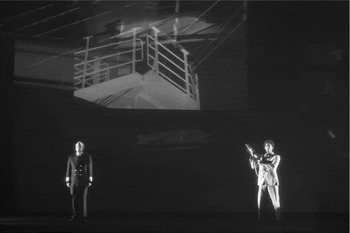
By way of conclusion, it is worth considering, if briefly, a third production of The Death of Klinghoffer directed by Bob McGrath and staged at BAM shortly after the premiere of Woolcock's film. Unlike the 1991 production, the second BAM production is semistaged. The chorus appears in concert attire, there are no dancers or sets, and little movement takes place on stage. Moreover, McGrath reinterprets the work (much like Woolcock) as historical realism, using photographic images projected on large back screens to suggest a narrative: “I try to focus on what happened on the ship over those couple of days. Our projectionist and filmmaker went out on a cruise ship and got a bunch of images and footage, and we're really trying to place [the staging] within the ship it happened on. We're not trying to make it too abstract—we're keeping our focus on the reality.”Footnote 50 The “reality” that McGrath cites here is reinforced by singers dressed in historically realistic costumes that clearly differentiate among hijackers and passengers; by photographic images that replace Tsypin's steel bars and that cue appropriate locales; and by the absence of character doubling (see Figure 3).
Captain and Hijacker on board the Achille Lauro, BAM, 2003. Copyright Stephanie Berger 2008. All rights reserved. Reproduced by permission.

That BAM's 2003 production and the radical changes it undertakes are tied inextricably to a contemporary context is readily apparent. McGrath, both in his comments and in his staging, draws a clear distinction between abstraction and reality, emphasizing that his focus is on the latter, on historical events and “what happened.” His comments imply that his representational approach, his decision to depict history as narrative, as a series of events, is a direct response to current social and political sensitivities. “It's so inflammatory and incendiary,” explains McGrath, “that people have a lot of really strong feelings about this. That's just inherent in doing the thing. But this is an historical thing that happened, that's how I'm approaching it. . . . I don't want to fan any flames. . . . I just want to show the horribly sad events that happened over these two days in this gorgeous spot in the Mediterranean.”Footnote 51 McGrath's decided emphasis on “what happened” here might obviously be read as a response to the criticism aimed at BAM in 1991. Recall Ilsa and Lisa Klinghoffer's worry over artistic license that had gone too far, and Hoelterhoff's complaint that murder had been staged not as an event but as meditation on “meaning and myth.” McGrath, however, might also be reacting to the more recent events of 9/11 (and to the subsequent BSO affair), especially given BAM's proximity to “ground zero.”
Worth emphasizing, in this case, is that McGrath's comments, like Woolcock's, suggest that narrative is a more natural, less effortful, and therefore less questionable approach to history: “I don't want to fan any flames . . . I just want to show the horribly sad events that happened.” McGrath indeed implies that his simple “semi” approach substitutes ideological decision making for a mimetic re-presentation of real life. Like Woolcock's film, however, McGrath's production takes work, revision, and reconstruction, not the least of which involves, once again, a privileging of the visual—“a bunch of images and footage” that keep “our focus on the reality”—at the expense of a more dialogic approach. The prominent roles given to choreographer, set designer, and costume designer in 1991 have nearly vanished in 2003, while the camera in BAM's semistaged production works overtime.
One final issue, then, bears consideration: that of the collaborative process. If American opera is increasingly a crucial site for the negotiation of contemporary historical memory and its attendant values, then the practice of collaboration too—the ways in which opera's media and artists engage one another—has something to tell us about our own social and political environs. We can approach opera's collaborations, in this case, as a microcosm of broader social and political interactions taking place beyond the opera proper. In this context McGrath's statements might suggest a loss of dialogue about, and possibilities surrounding, the topic of terrorism after 9/11, not just within the confines of his production, but in wider, more influential spheres. “I don't want to fan any flames,” he says. “We're keeping our focus on the reality.”
Perhaps the presence of a camera in 2003 allowed the opera's collaborators to lay claim to objectivity; perhaps it is the only inroad they had to this provocative material after 9/11. Whether intentional or not, however, the camera also limits the possibilities of collaboration, enabling as it does the domination of the image over text and music. Images lend shape to histories, provide evidence and authority, while music is easily harnessed to that representational track. In Said's words, representational authority, especially if seemingly natural, is the bearer of ideology: “There is nothing mysterious or natural about authority. It is virtually indistinguishable from certain ideas it dignifies as true, and from traditions, perceptions, and judgments it forms, transmits, reproduces. Above all, authority can, indeed must, be analyzed.”Footnote 52 Representational authority, in other words, is a social and political force.
The prominent role of the camera in these late productions, then, has to be understood as proactive, rather than objective, invisible, or neutral. It has to be understood as radically impacting the opera's meanings and the collaborative processes that produce them—because opera is not necessarily (and I would argue is rarely) produced by a like-minded community, but more often by a fiercely interactive and dialogic, sometimes even antagonistic (perhaps anarchic) body of citizens. Opera is an engagement among artists who necessarily think differently (owing at the very least to their work with different media) but simultaneously about sometimes little else but the same topic or title. Recall Goodman's statements about the 1991 production, in which she describes music and text as existing on equal planes—“I've never felt that my words have been subsumed into John's music; they coexist”—and also highlights the collaborative process as rocky and vicious, and not just over practical matters but over values, ideas, and ethics. (It's a collaboration, too, that would later collapse before the premiere of Dr. Atomic when Sellars replaced Goodman as librettist for the San Francisco premiere in October 2005; according to Goodman, she withdrew from the project because she believed it was anti-Semitic.)Footnote 53 The re-presentations of the Achille Lauro hijacking in 2003, however, erase evidence of those collaborative dissonances on which the work was originally based. They are buried beneath melodramatic narratives and realistic images that effectively resist “fanning any flames” in the post-9/11 climate.
That kind of self-censorship, however, also risks the silences of hegemony. In 2003 the reenactment of terrorism as narrative may have been inevitable for a nation so recently rocked by the devastation of September 11th, but it is a form of closure that the 1991 production resisted. In 1991 The Death of Klinghoffer offered alternatives that were enabled by dialogue and collaboration that is as much a political and social process as an artistic one. The freedom of word, music, and image to signify distinctly, separately, and simultaneously not only reflects but also enables the capability to engage in dialogue about thorny topics such as terrorism far beyond the sphere of opera.
Yet even if The Death of Klinghoffer productions in 2003 do signal a disquieting increase in forms of self-censorship and a decrease in the kinds of conversations surrounding terrorism in the millennial United States, my last thought about this opera is an optimistic one. The Death of Klinghoffer's different productions, I would argue, bear witness to a still-forming historical consciousness. These productions are infused with our own negotiations around collective memory and its values, a kind of ongoing therapy in which we continue to ask about who we were and who we want to be. So for me, the best thing about The Death of Klinghoffer is that it has been produced numerous times, and the best we can hope for is that it will be produced again in the future and that we will continue to have the opportunity to engage with this opera—that we will once again have the chance to respond, to mediate, and to debate the merits of its representations.