





Introduction
Production costs in prime-lamb meat-production systems can be reduced by increasing the number of lambs reared during a ewe’s lifetime since costs in these systems are primarily attributable to the ewe, rather than her lambs. The two major factors affecting ewe-replacement costs are age at first lambing and the number of lamb crops produced per ewe lifetime (Keady and Hanrahan, Reference Keady and Hanrahan2018b). Keady (Reference Keady2014) estimated that the mean cost, nationally, of rearing a replacement ewe that is joined for the first time at 19 months is equivalent to approximately 0.25 of the value of her lifetime lamb-carcass output. Many previous authors (Annett et al., Reference Annett, Carson, Dawson, Irwin and Kilpatrick2011; Hanrahan, Reference Hanrahan1994; Hanrahan and Keady, Reference Hanrahan and Keady2014; Keady and Hanrahan, Reference Keady and Hanrahan2018b; Keady et al., Reference Keady, Hanrahan and Flanagan2007) have reported differences of up to 1 lamb reared per ewe joined due to ewe genotype. In previous papers on the current study (Keady and Hanrahan, Reference Keady and Hanrahan2021, Reference Keady and Hanrahan2022) it was reported that the number of lambs reared per ewe joined, for lambing at 1 and 2 years of age, depended on genotype: Belclare ewes reared 1.17 and 1.50 lambs per ewe joined, respectively, compared with 0.82 and 1.21, respectively, for Suffolk-cross ewes of the type prevalent in lowland flocks in Ireland (viz., ≥0.75 Suffolk).
Source of replacements can impact flock biosecurity. Keady et al. (Reference Keady, Hanrahan, Hession, Moran, Kendall and Hanrahan2019) reported that 0.52 of Irish sheep producers produce all their ewe replacements, while all replacements were purchased in 0.32 of cases. Whilst Keady and Hanrahan (Reference Keady and Hanrahan2022) reported that joining replacement ewes to lamb at 1 year of age had no effect on the number of lambs reared per ewe when joined at 19 months, ewes are joined for the first time as 2-tooths on most farms. In New Zealand, Kenyon et al. (Reference Kenyon, Morris, Perkins and West2004) concluded that the main reason farmers do not join replacements to lamb at 1 year of age is the perceived negative effects on 2-tooth performance. In the first paper from this study, Keady and Hanrahan (Reference Keady and Hanrahan2021) reported that body weight (BW) at 19 months was reduced by only 2 kg for replacements that lambed at 1 year of age, having received a preferential plane of nutrition during mid and late pregnancy (to meet nutrient requirements for pregnancy and growth) and had reared at least 1 lamb per ewe joined (difference among ewe genotypes was 0.35 lambs per ewe joined). Previously, Keane (Reference Keane1974), Kenyon et al. (Reference Kenyon, Proctor, Morel, Morris and West2008) and Keady and Hanrahan (Reference Keady and Hanrahan2022) reported that ewes that lambed at 1 year were 10%, 14% and 3% lighter, respectively, at their next joining (around 19 months old). However, Keady and Hanrahan (Reference Keady and Hanrahan2018a, Reference Keady and Hanrahan2018b) concluded that altering the weight of 2-tooth ewes by up to 8.4 kg (16%) at joining did not significantly alter ovulation rate, number of lambs born, or number reared per ewe joined.
Ewe age impacts BW and productivity (Annett et al., Reference Annett, Carson, Dawson, Irwin and Kilpatrick2011; Hanrahan, Reference Hanrahan1994). However, there is relatively little information on the effects of age on the performance of lowland ewe genotypes that differ widely in prolificacy, thus productivity, when managed in grass-based prime-lamb systems. The hypotheses that informed the design of this study, for ewes joined from 19 months of age until exiting the flock, were: (i) that age at first joining (7 or 19 months) does not affect ewe productivity (ii) that productivity of ewes is influenced by genotype but there is no interaction between inherent prolificacy and age at first joining; (iii) that the productivity of ewes, and the performance of their lambs, improves as parturition number increases.
Materials and methods
Animals and management
A total of 424 March-born ewes (around 19 months old and representing 2 consecutive cohorts) were used in the current study, which represents the adult-ewe performance phase of an investigation into the effects of joining at 7 months (Keady and Hanrahan, Reference Keady and Hanrahan2021, Reference Keady and Hanrahan2022) on ewe performance. The study was terminated when ewes in the second cohort reached the weaning stage following lambing at 8 years of age (the number of ewes in the flock was 371, 294, 218, 151, 101 and 60 for ages 3 to 8, respectively). All ewes remained on the study until termination unless culled for health/welfare reasons (mastitis, vaginal prolapse, foot defects or a rapid/unexpected decline in body condition), or they died. Three genotypes that differ in expected prolificacy were involved (Belclare (Bel), F1 Suffolk × Belclare (Suf × Bel; sired by Suffolk) and ewes with ≥0.75 Suffolk ancestry (Suf75; Suffolk-cross ewes by Suffolk rams)), and the animals recruited (at 7 months of age) to the study were chosen to have an average BW that equalled 0.55 of estimated mature BW for their genotype. Upon recruitment, ewe lambs were ranked on BW within genotype and assigned at random to 1 of 2 groups which were then assigned randomly to treatment (joined at 7 months or not joined until 19 months). Ewes that were joined at 7 months of age were managed separately from the ‘not-joined’ group between that joining and subsequent weaning as follows: From mid-October to housing in early December the 2 ‘age-at-first joining’ groups were managed separately, on similar pastures, in a rotational grazing system. At housing all animals were shorn. Ewes that were joined at 7 months were offered grass silage ad libitum and received 200 g concentrate from mid-January to 6 weeks prior to expected lambing date. During the last 6 weeks of pregnancy, ewes scanned as carrying singles, twins and triplets received a total of 19, 26 and 33 kg concentrate supplement per ewe, respectively. Ewes were put to pasture within days of lambing and managed in a rotational grazing system. Ewe rearing twins received 0.5 kg concentrate daily for the first 5-week post lambing. Ewes that were not joined at 7-months were offered grass silage, ad libitum, as the sole diet from housing until turn out to pasture which occurred when 0.5 of the 7-month joining group had lambed. Both the joined and not-joined groups were managed in a rotational grazing system with similar pre-and post-grazing sward heights. When the ewes that were joined at 7 months were weaned the two treatment groups were combined and subsequently managed as one flock in a rotational-grazing system on predominantly perennial-ryegrass swards. Full details of the grazing management and plane of nutrition offered from recruitment to the study up to joining at 19 months of age are in Keady and Hanrahan (Reference Keady and Hanrahan2021).
The number of ewes per genotype (cohort 1 and 2, respectively), for the present phase of the study was: 157 (67, 90) for Belclare (Bel); 114 (64, 50) for Suf × Bel and 153 (65, 88) for Suf75. The proportion that had been joined at 7 months ranged from 0.48 to 0.52 across genotype-x-cohort groups. In the case of ewes joined at 7 months and available for the present phase of the study 14% had failed to lamb at 1 year of age. Oestrus was synchronized using progesterone-impregnated sponges, which were removed after 12 days; ewes were joined with Charollais rams (ewe:ram ratio 8:1) at 36 h post sponge removal. Rams were removed after 4 days and returned approximately 7 days later to cover repeats.
All ewes were housed annually, at the beginning of December, in a slatted-floor shed (10 to 20 per pen; about 1.2 m2/ewe) and shorn within 7 days. Water was available ad libitum. Grass silage, sufficient to allow a refusal of 50 to 100 g/kg, was offered once daily. The silage used was made in mid-May each year, following wilting (24 h), from the primary growth of permanent swards (mainly perennial ryegrass), as described by Keady and Hanrahan (Reference Keady and Hanrahan2015). Expected litter size was ascertained by ultrasonography in mid-January. Following ultrasonography, ewes were re-penned according to expected litter size to facilitate differential concentrate supplementation during late pregnancy. A booster vaccine for pasteurella pneumonia and clostridial disease (Heptavac-P, MSD Animal Health, Buckinghamshire, England) was administered about 4 weeks prior to lambing.
Ewes were supplemented with concentrate during late pregnancy; the quantity offered depended on silage feed value and expected litter size. The total quantity of concentrate offered to ewes identified as carrying singles, twins, triplets or quads was about 14.5, 21.5, 26.5 and 29.0 kg, respectively. The concentrate was offered to single-, twin-, triplet-and quadruplet-bearing ewes during the final 5, 6, 7 and 7 weeks of pregnancy, respectively. The initial amount per ewe was 0.3 kg/d in all cases and was increased stepwise (by 0.1 or 0.2 kg, at 1 or 2 weeks intervals) to maxima that ranged from 0.6 kg (single-bearing ewes) to 1 kg (ewes with quadruplets). Concentrate was offered once daily at around 10.00 h. In year 1 to 4 of the present study the concentrate was formulated to have crude protein (CP) and metabolizable energy (ME) concentrations of 220 g/kg dry matter (DM) and 12.7 MJ/kg DM, respectively. The concentrate (pelleted) consisted of (g/kg fresh weight): soybean meal (200), maize (190), barley (170), soybean hulls (145), sugar beet pulp (100), rapeseed meal (80), maize distillers (40), molasses (50) and minerals plus vitamins (25). The concentrate (pelleted) for years 5 to 8 was formulated to have CP and ME concentrations of 215 g/kg DM and 12.9 MJ/kg DM, respectively, and consisted of (g/kg fresh weight): soybean meal (180), maize (265), barley (100), soybean hulls (150), rapeseed meal (80), maize gluten (50), sugar beet pulp (50), maize distillers (50), molasses (50) and minerals plus vitamins (25).
Ewes lambed indoors and were transferred to permanent pasture (predominantly perennial ryegrass), with their lambs, within 3 days of parturition; ewes that had 4 live lambs had at least 1 removed to an artificial rearing unit. Those rearing singles or twins at turnout were managed as a single flock and received no concentrate supplement. Triplet-rearing ewes were managed in a separate flock and offered concentrate (0.5 kg/head; the same concentrate as offered during late pregnancy) daily until week 5 post lambing. Lambs reared as triplets had access to concentrate (maximum 300 g/day per lamb) until weaning. At pasture, all paddocks were grazed, in a rotational-grazing system, to the pre-and post-grazing sward height targets described by Keady (Reference Keady2010). Male lambs were not castrated. Lambs were treated for internal parasites at 5 and 10 weeks of age (levamisole hydrochloride; Chanelle, Loughrea, Co. Galway, Ireland), and at 14 weeks and subsequently at 6-week intervals (oral ivermectin (Oramec); Merial Animal Health, Harlow, Essex, England). Ewe and ram lambs were drafted at weaning if BW exceeded 42 and 43 kg, respectively; subsequent drafting was at approximately monthly intervals with BW criteria (females and males) of 44 and 46 kg up to end of August and 46 and 48 kg thereafter.
Measurements
The silages to be used each year had 4 core samples removed per silo, within 1 week of the ewes being housed, for the determination of pH and the concentrations of DM, CP, ammonia-nitrogen (N), DM digestibility (DMD) and ME as described in Park et al. (Reference Park, Agnew, Gordon and Steen1998). Sward height was monitored, during the grazing season, throughout the study to provide objective information to guide the grazing-management system. It was recorded pre-and post-grazing, at 50 positions located randomly across the paddocks being grazed, using a rising plate meter (Ashgrove Pastoral Products, Hamilton, New Zealand).
Ewe BW and body condition score (BCS; Russel et al., Reference Russel, Doney and Gunn1969) were recorded pre joining (early October), post joining (late November), mid pregnancy (mid-January), at lambing, 5 weeks post lambing and at weaning (June/July – lambs aged about 14 weeks). Withers height, body length, chest (heart) girth and the circumference of a fore-cannon bone were recorded for all ewes post mating (early November; at ages ∼1.5 to ∼7.5 years), as described previously (Keady and Hanrahan, Reference Keady and Hanrahan2018a). This collection of linear measurements will be referred to as body size. Where a ewe needed assistance with lambing, the level of assistance (some or severe) was recorded (Keady and Hanrahan, Reference Keady and Hanrahan2018b). Lambs were tagged and weighed within 24 h of birth; those dead at this time were recorded as born dead. Total lamb mortality refers to those born dead plus lambs that died between birth and weaning. Lamb BW was recorded at approximately 5, 10 and 14 weeks of age and at sale; average daily body-weight gain (ADG) was calculated for the intervals birth to 5 weeks, 5 to 14 weeks, birth to 14 weeks and birth to sale. Lambs were slaughtered, within 24 h of drafting; at an abattoir approved by the European Union and information on carcass weight (cold) and classification were recorded as described by Keady and Hanrahan (Reference Keady and Hanrahan2021). Barrenness was recorded and ewes that failed to produce a lamb, either due to barrenness or death pre-lambing, were categorized as ‘failed to lamb’.
Statistical analyses
All data analyses involved the use of SAS/STAT software (Version 9.4 for Windows; 2002–2012); ewe traits were analysed by fitting linear models using either Proc GLM (number of seasons joined between 19 months of age and the termination of the study), Proc MIXED (BW, BCS, body size, litter size, number of lambs reared) with ewe within genotype-x-treatment as random term, or Proc GLIMMIX with a logit link function (failed to lamb (died pre lambing or barren)), barrenness, lambing assistance, lamb mortality and whether (≥1 lamb was reared) with ewe within genotype-x-treatment as a random effect. Proc MIXED was used for the analysis of lamb growth and carcass traits by fitting a linear mixed model with dam (genotype-x-treatment) and dam (genotype-x-treatment-x-dam age) as random effects. All models used had fixed effects for treatment, ewe genotype and ewe age (years). Two-way interactions among these fixed effects were evaluated in initial models followed by backward elimination of interactions with P ≥ 0.2. Fixed effects for sex, and birth type (for birth weight, lamb mortality) or birth-rearing category (growth traits other than birth weight) were added to models for analysis of lamb performance traits. Five birth-rearing categories were defined: ‘11’ = born and reared as a single; ‘21’ = birth litter ≥2 but reared as single; ‘22’ = lambs born and reared as a twin; ‘32’ = birth litter ≥3 but reared as a twin; and ’33’ = birth litter ≥3 and reared as a triplet. Artificially reared lambs were excluded from all analyses of lamb traits except for BW at birth and lamb mortality. Differences among genotypes were evaluated after adjustment for multiple comparisons (Tukey–Kramer test). Analysis was also undertaken to evaluate the effects of ewe BW at 7 months of age on whether zero or ≥1 lamb was reared. For this analyses, the model included deviations of BW at 7 months from the mean of the appropriate genotype-x-treatment-x-season subclass. Linear, quadratic, cubic and quartic components of ewe age effects were evaluated using orthogonal polynomials.
The contribution of heterosis to the differences among genotypes was estimated by assuming that the Suf75 genotype was equivalent to ‘purebred’ Suffolk; thus these estimates should be treated with some caution.
Results
The silages offered during the indoor feeding period had mean pH and concentrations of DM, CP, ammonia-N, DMD and ME of 3.9, 213 g/kg, 124 g/kg DM, 60 g/kg N, 0.753 and 11.2 MJ/kg DM, respectively. Weekly pre-and post-grazing sward heights from early March, when the ewes and their lambs were put to pasture, until mid-October are summarised in Figure 1. The pre-grazing sward heights averaged 5.7, 7.2, 9.2, 8.3, 9.2, 9.4, 9.4 and 7.5 cm for the months of March to October, respectively, while the corresponding average values for post-grazing sward height were 3.7, 4.5, 5.7, 5.7, 5.8, 5.8, 5.9 and 5.6 cm, respectively.
Least squares means (±SE), by week - from the beginning of March until the end of October – for sward height pre-and post-grazing.

The effects of joining treatment, ewe genotype and ewe age on BW, BCS and body size are presented in Table 1. The only trait for which the effect of treatment was significant (P < 0.05) was BCS at weaning when the mean for ewes joined at 7 months was highest. Ewe genotype had a significant effect (P < 0.05 or smaller) on: BW pre joining, post joining, mid-January, lambing and 5 weeks post lambing; BCS in mid-January; and withers height, body length, body girth and cannon bone circumference. Relative to Bel, the Suf × Bel and Suf75 ewes were: heavier (P < 0.05) pre joining, post joining and at lambing; had a higher (P < 0.05) BCS in mid-January; and had a greater (P < 0.05) body girth and cannon bone circumference. Compared to Bel, the Suf × Bel ewes were heavier (P < 0.05) in mid-January and at 5 weeks post lambing. Height at withers was greater for Bel than for Suf × Bel and Suf75 (P < 0.05) while body length was greater for Bel than Suf75 (P < 0.01). There was a significant heterosis effect (P < 0.05 or smaller) for ewe BW post joining and in mid-January, and for body girth, withers height and cannon bone circumference. The effects of ewe age were significantly (P < 0.01) curvilinear for all BW and BCS traits and all components of body size. The age profile for ewe BW and BCS traits are shown in Figure 2a and 2b, respectively. All BW traits increased up to either 5 or 6 years of age and then plateaued until age 7 followed by a small decline to age 8 years except for BW at weaning. In the case of BCS, a maximum was reached at 4 or 5 years for all measurements except those at weeks 5 post lambing and weaning, which peaked at 3 years, and exhibited a steady decline with age after the peak. The age profile for body girth, length, height and cannon bone circumference are shown in Figure 3. The pattern of change with age differed between traits: withers height and body length increased up to age 3.5 years and then plateaued; both body girth and cannon bone circumference increased up to age 4.5 and 3.5, respectively, after which girth essentially plateaued whereas cannon bone circumference declined steadily.
Least squares mean (±SE), by ewe age, for body weight (a) and body condition score (b) at: pre-mating, post-mating, mid-pregnancy, lambing, 5 weeks post-lambing and weaning.

Least squares means (±SE), by ewe age, for height at withers, body girth, body length and circumference of the fore cannon bone.

Effects of age at first joining, ewe genotype and age on body weight (BW), body condition score (BCS) and body measurements for ewes aged 2 to 8 years

Table 1. Long description
A table comparing body weight, body condition score, and body measurements of ewes based on age at first joining and genotype. The table has 21 rows and 12 columns. The columns are labeled as Age at first joining (J) with sub-columns 7 months, 19 months, and S.E.; Ewe genotype (G) with sub-columns Bel, Suf x Bel, Suf75, and S.E.; and Significance with sub-columns J, G, Heterosis, and Ewe age. The rows are labeled with different traits and time points: BW (kg) with sub-rows Pre joining (end Sep), Post joining (end Nov), Mid January, At lambing (Mar/Apr), 5 week post lambing, and At weaning (Jul); BCS with sub-rows Pre joining, Post joining, Mid January, At lambing, 5 week post lambing, and At weaning; and Body measurements (cm) with sub-rows Withers height, Body length, Body girth, and Cannon bone (circumference). Each cell contains numerical values representing the measurements or scores. Notable trends include significant effects of ewe genotype on various traits and significant heterosis effects on certain body measurements. Ewe age also shows significant curvilinear effects on all traits.
* P < 0.05, **P < 0.01, ***P < 0.001, ns = not significant (P ≥ 0.05).
a Bel = Belclare, Suf × Bel = Suffolk × Belclare, Suf75 = ≥0.75 Suffolk.
b Contrast: Suf × Bel − (Bel + Suf)/2.
c Orthogonal linear (L) and quadratic (Q) components of the trend with age.
There was a significant interaction (P < 0.001) between treatment and ewe age for BW pre-and post-mating, which was due essentially to an interaction between the linear effect of ewe age and treatment. This reflected the fact that the BW of ewes that had been joined at 7 months was lower than for the ‘not-joined’ ewes at 2 years of age but the reverse was the case at 7 and 8 years of age, with relatively minor differences at intermediate ages. A similar pattern of interaction effects (P < 0.01) was evident for body girth and circumference of the cannon bone but not for the other body size measurements. There was also evidence that the effect of heterosis on BW depended on ewe age with the estimate of heterosis being greater at ages 7 and 8 years compared with estimates at ages 2 and 3 years.
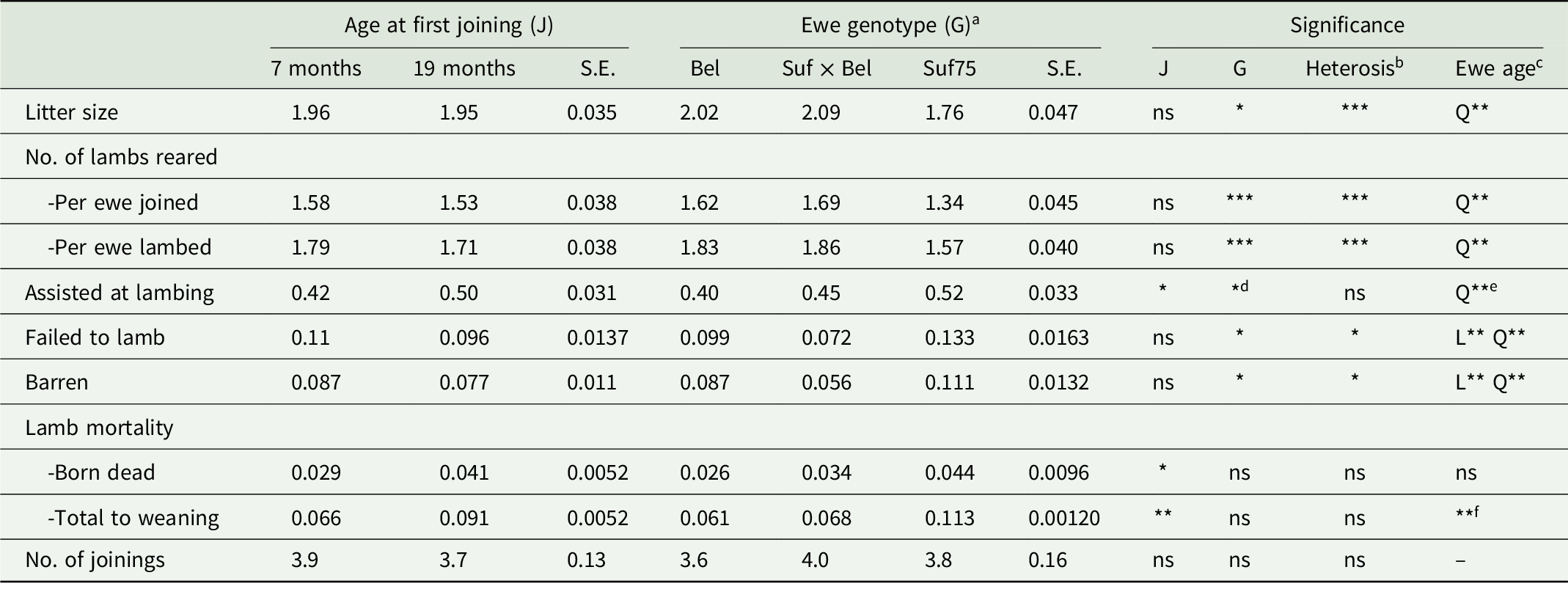
The effects of joining treatment, ewe genotype and ewe age on reproductive performance traits, lamb mortality and on the number of years a ewe was joined with rams (no. of joinings) are presented in Table 2. Ewes that were joined at 7 months of age required less assistance at lambing (P < 0.05), had a lower number of lambs born dead (P < 0.05) and lower total lamb mortality to weaning (P < 0.01). The incidence of assistance exhibited a quadratic association with litter size (P < 0.001) being 0.42, 0.34 and 0.62 for ewes with singles, twins and triplets, respectively, and this quadratic effect exhibited a significant interaction with ewe genotype (P < 0.05) which was essentially due to the difference between the Bel and Suf75 genotypes. Thus, 0.47 of Suf75 with singles required assistance compared with 0.34 for single-bearing Bel ewes while the corresponding values for ewes with triplets were 0.74 and 0.56, respectively, whereas there was no difference between these genotypes for ewes with twins (0.34 in both cases). The Bel and Suf × Bel ewes had larger litters (P < 0.001), and reared more lambs per ewe lambing (P < 0.001) and per ewe joined (P < 0.001) than the Suf75 ewes. Relative to Suf × Bel ewes, more Suf75 ewes failed to produce lambs or were barren (P < 0.05). Relative to Bel ewes, Suf75 ewes required more assistance at lambing and had higher total lamb mortality. Heterosis was significant (P < 0.05 or greater) for litter size, number of lambs reared per ewe lambed and per ewe joined and the proportion of ewes that failed to lamb and the proportion that were barren. While the estimate of heterosis was not significant for lamb mortality there was an interaction between the heterosis effect and litter size (P < 0.01) for both the incidence of dead born lambs and total mortality to weaning. This reflected the fact that the difference in mortality between triplets and singles was much lower for Suf × Bel dams than for the other two genotypes. The incidence of total lamb mortality to weaning varied significantly with age of dam (P < 0.001), which reflected a much higher mortality of lambs born to dams aged 2 years (0.185) compared with the average over all older age classes (0.106; range 0.093 to 0.119). There were significant linear and curvilinear effects of ewe age on the incidence of barrenness and failure to lamb (P < 0.01) reflecting the major increase in barrenness (Figure 4) and failure to lamb at 8 years of age. There was a significant curvilinear effect of ewe age on litter size, on the number of lambs reared per ewe joined and per ewe lambed and on the proportion of ewes requiring assistance at lambing. Litter size increased until 6 years of age followed by a small decline at age 7 years and a major drop between 7 and 8 years. Number of lambs reared per ewe joined increased up to 4 years, plateaued to 6 years followed by small decline to age 7 years and a major drop between 7 and 8 years (Figure 4). The decline in the number of lambs reared after age 6 was due to increased barrenness plus other reasons for failure to lamb and reduced litter size; these changes were especially large between ages 7 and 8 years. The number of joinings between 19 months of age and the termination of the study was not significantly affected (P > 0.05) by joining treatment or ewe genotype.
Least squares means (±SE), by ewe age, for litter size, number of lambs reared per ewe joined and incidence of barrenness.

Effects of age at first joining and ewe genotype on reproductive performance traits of ewes aged 2 to 8 years

Table 2. Long description
A table comparing reproductive performance traits of ewes based on age at first joining and genotype. The table has 11 rows and 12 columns. The columns are labeled as Age at first joining (J), Ewe genotype (G), Significance, and S.E. The rows are labeled as Litter size, No. of lambs reared, Per ewe joined, Per ewe lambed, Assisted at lambing, Failed to lamb, Barren, Lamb mortality, Born dead, Total to weaning, and No. of joinings. The Age at first joining column has two sub-columns: 7 months and 19 months. The Ewe genotype column has three sub-columns: S.E., Bel Suf x Bel, and Suf75. The Significance column has four sub-columns: J, G, Heterosis, and Ewe age. The table presents data on various reproductive performance traits, including litter size, number of lambs reared, assistance at lambing, failed to lamb, barren, lamb mortality, and number of joinings. Notable trends include differences in litter size, number of lambs reared, and assistance at lambing based on age at first joining and ewe genotype. The significance of these differences is also indicated.
* P < 0.05, **P < 0.01, ***P < 0.001, ns = not significant (P ≥ 0.05).
a Bel = Belclare, Suf × Bel = Suffolk × Belclare, Suf75 = ≥0.75 Suffolk.
b Contrast: Suf × Bel − (Bel + Suf)/2.
c Orthogonal linear (L) and quadratic (Q) components of the trend with age.
d Interaction between Bel v Suf75 and the quadratic effect of litter size (P < 0.02).
e Interaction with G for both linear (P < 0.01) and quadratic (P < 0.02) components of ewe age.
f Due to the difference between age = 2 (0.185) and the mean of later ages (0.106 [range 0.093 to 0.119]).
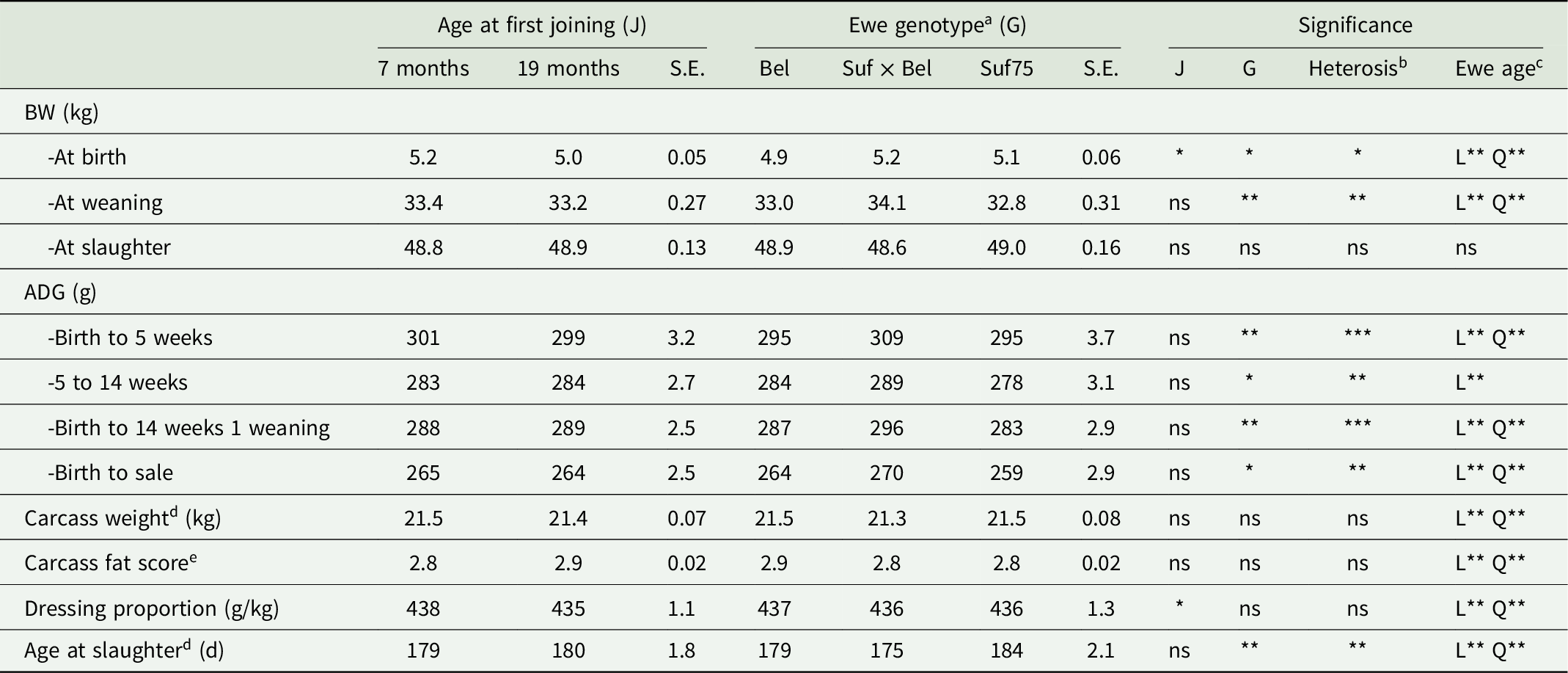
The effects of joining treatment and ewe genotype on lamb growth and carcass traits are presented in Table 3. Lambs born to ewes joined for the first time at 7 months were heavier at birth (P < 0.05) and had a higher dressing proportion (P < 0.05) than lambs from ewes not joined at this age; otherwise treatment had no significant effect. Lambs from the Suf × Bel ewes were heavier at weaning and had a higher growth rate from birth to 5 weeks of age and from birth to weaning (P < 0.01) than those from Bel or Suf75 ewes. They were also heavier at birth compared to lambs from Bel ewes and had a higher ADG from 5 to 14 weeks of age (P < 0.01) and from birth to sale (P > 0.05); age at slaughter was lower (P < 0.01) than for lambs from Suf75 ewes. The estimate of heterosis was significant (P < 0.05 or smaller) for lamb BW at birth and weaning, ADG from birth to 5 weeks, 5 to 14 weeks, birth to weaning, birth to sale and for age at slaughter. There were also significant linear (P < 0.01) and curvilinear (P < 0.01) effects of age of dam on BW at birth and weaning, ADG from birth to 5 weeks, birth to weaning and birth to sale and on age at slaughter (Figure 5a,b) and on carcass weight, fat score and dressing proportion. Age of dam had a linear effect on ADG between 5 and 14 weeks.
Least squares means (±SE), by ewe age, for body weight at birth and growth rate from: birth to 5 weeks (G_05), birth to weaning (G_014) and birth to sale (a) and body weight at weaning and age to slaughter (b).

Effects of age at first joining, ewe genotype and ewe age on growth and carcass traits of lambs from 2-to 8-year old ewes

Table 3. Long description
A table with 11 rows and 10 columns comparing the effects of age at first joining, ewe genotype, and ewe age on lamb growth and carcass traits. The columns are labeled as Age at first joining (J), Ewe genotype (G), Significance, and S.E. The rows are labeled as BW (kg), ADG (g), Carcass weight (kg), Carcass fat score, Dressing proportion (g/kg), and Age at slaughter (d). The Age at first joining column has sub-columns for 7 months, 19 months, and S.E. The Ewe genotype column has sub-columns for Bel, Suf x Bel, Suf75, and S.E. The Significance column has sub-columns for J, G, Heterosis, and Ewe age. The table presents data on various growth and carcass traits of lambs, including birth weight, weaning weight, slaughter weight, average daily gain, carcass weight, carcass fat score, dressing proportion, and age at slaughter. Notable trends include significant differences in birth weight, weaning weight, and growth rates based on the age at first joining and ewe genotype. The table also highlights significant effects of heterosis and ewe age on various traits.
* P < 0.05, **P < 0.01, ***P < 0.001, ns = not significant (P ≥ 0.05).
a Bel = Belclare, Suf × Bel = Suffolk × Belclare, Suf75 = ≥0.75 Suffolk.
b Contrast: Suf × Bel − (Bel + Suf)/2.
c Orthogonal linear (L) and quadratic (Q) components of the trend with age.
d At fat score = 3.
e At carcass weight = 21.5.
Discussion
The objective of the present study was to evaluate the effect of age at first joining and ewe age, using 3 genotypes differing in productivity, on the performance of ewes from 2 years to end of lifetime in the flock and on the performance of their progeny from birth to slaughter. As outlined in previous papers (Keady and Hanrahan, Reference Keady and Hanrahan2021, Reference Keady and Hanrahan2022) the genotypes were chosen because they are known to differ in productivity (Hanrahan, Reference Hanrahan2001; Keady and Hanrahan, Reference Keady and Hanrahan2021, Reference Keady and Hanrahan2022) and they represent approximately 0.65 of the Irish national lowland flock (Keady et al., Reference Keady, Hanrahan, Hession, Moran, Kendall and Hanrahan2019). Currently, Suffolk-X and Belclare-X ewes account for 0.55 and 0.095 of the national lowland flock, respectively (Keady et al., Reference Keady, Hanrahan, Hession, Moran, Kendall and Hanrahan2019). Ewes only exited the current study when culled for physical reasons (e.g., udder or mouth issues), reached 8.5 years of age, or died. Thus, the current study differs from most previous studies where ewes were not able to express their lifetime potential because they were either culled for reasons associated with reproductive performance (Baker et al., Reference Baker, Steine, Vabeno, Bekkan and Gjedrem1978), were removed from the study after 4 (Baker et al., Reference Baker, Steine, Vabeno, Bekkan and Gjedrem1978) or 5 years (Kenyon et al., Reference Kenyon, van der Linden, West and Morris2011) of age, or were not offered additional nutrients during pregnancy to meet foetal requirements and maintain growth trajectory to achieve mature BW (Kenyon et al., Reference Kenyon, van der Linden, West and Morris2011). The current study also enabled the effects of ewe age on ewe productivity and progeny performance to be determined in a grass-based prime-lamb production system.
Age at first joining
The two ‘age at first joining’ groups were managed as one flock from approximately 16 months of age. Between 7 and 16 months of age, whilst they were in separate groups, they were managed in similar grazing regimes, or were housed in the same house, shorn on the same day and offered the same grass silage. During the foregoing housing period, the ewes that had been joined to lamb at 1 year of age and were pregnant, were offered concentrate supplement to meet pregnancy requirements. Previous authors have reported that ewes that had lambed at 1 year were lighter at the subsequent joining (about 19 months of age) than those that had not been joined (Keane, Reference Keane1974; Kenyon et al., Reference Kenyon, Proctor, Morel, Morris and West2008; Thomson et al., Reference Thomson, Smith and Muir2021). As previously reported by Keady and Hanrahan (Reference Keady and Hanrahan2021), relative to ewes joined for the first time to lamb as 2-tooths, ewes that had been joined to lamb at 1 year were 2 kg lighter at joining but were 2 kg heavier at lambing. The lack of a negative effect of age at first joining on BW and BCS from 2 years of age onwards is probably associated with the fact that those that lambed at one year of age received concentrate supplementation to meet energy and protein requirements during pregnancy (Keady and Hanrahan, Reference Keady and Hanrahan2021) and illustrates the absence of residual effects of lambing at 1 year on BW or BCS up to 8 years of age. Previous studies have also shown that age at first joining had no effect on ewe BW after 3 years of age (Baker et al., Reference Baker, Steine, Vabeno, Bekkan and Gjedrem1978; Drymundson, Reference Drymundson1973; Kenyon et al., Reference Kenyon, van der Linden, West and Morris2011). Whilst the 0.1 unit increase in BCS at weaning for ewes first joined to lamb at 1 year was statistically significant it is of little biological relevance as the ewes were the same BCS at pre-and post-joining, at mid-pregnancy and at lambing. Based on the data from the current study a change in BCS of 0.1 equates to 1.3 kg which is similar to previous data by Hanrahan (Reference Hanrahan1990) who, using lowland ewes, reported that a one unit difference in BCS was equivalent to 12 kg difference in BW. The similarity of BW and BCS between the ‘age at first joining’ treatments is consistent with both groups having the same body size as measured by BW, girth and length, withers height and cannon bone circumference.
Replacements are a major cost in lowland systems of prime lamb production (Keady, Reference Keady2014). A key finding from the current study is the absence of evidence for any negative impact of joining at 7 months on the total number of lifetime joins per ewe from 2 years of age (ewe longevity) onwards, thus increasing ewe lifetime productivity and reducing ewe replacement rate. The absence of an effect of joining treatment on the number of joins between 19 months of age and the end of the study is consistent with the data reported by Thomson et al. (Reference Thomson, Smith and Muir2021) for an outdoor-lambing system where the maximum ewe age was 7 years. Similarly, Kenyon et al. (Reference Kenyon, van der Linden, West and Morris2011) found no effect of lambing at 1 year of age on longevity up to joining to lamb at 5 years.
The lack of an effect of age at first joining on ewe litter size is similar to the results reported for this group of ewes when lambing as 2-tooths (Keady and Hanrahan, Reference Keady and Hanrahan2022) but contrary to results reported by Kenyon et al. (Reference Kenyon, Proctor, Morel, Morris and West2008). The similarity in litter size between the two ‘age at first joining’ treatments, similar to that reported by Kenyon et al. (Reference Kenyon, van der Linden, West and Morris2011), demonstrates that there is no negative residual effect of lambing at 1 year on subsequent ewe prolificacy. Since age at first joining had no impact on ewe BW or BCS at pre-mating, post-mating or lambing, an effect on litter size was not expected since a previous study on rearing regimes for replacement ewes showed that a difference of 8.4 kg in ewe BW when joined at 19 months had no significant effect on ovulation rate or litter size (Keady and Hanrahan, Reference Keady and Hanrahan2018a, Reference Keady and Hanrahan2018b).
Previously, Keady and Hanrahan (Reference Keady and Hanrahan2021, Reference Keady and Hanrahan2022) reported a positive relationship between ewe BW at 7 months and the probability of rearing at least one lamb when lambing at 1 and 2 years of age, respectively. A further analysis of the effects of ewe BW at 7 months identified a positive relationship (P < 0.02) with the probability of rearing at least 1 lamb when lambing between 2 to 8 years of age, and this response did not differ significantly between the genotypes (Figure 6). An increase of 5 kg (about 10%) in average BW at 7 months would increase the percentage of ewes rearing at least 1 lamb by about 2 percentage points, which is equivalent to an additional 3 lambs reared annually for a flock of 100 ewes.
The effect of ewe genotype and body weight at 7 months on the probability of rearing ≥1 lamb when lambing at 2 to 8 years of age (vertical bars represent the SE at the average BW).

Two of the key issues influencing the efficiency of prime-lamb production systems are the number of lambs reared per ewe joined (Keady and Hanrahan, Reference Keady and Hanrahan2006) and labour input. The main factors influencing the number of lambs reared per ewe joined are ewe barrenness, litter size and lamb mortality, while the level of assistance required at lambing impacts labour requirement. While age at first joining had no effect on litter size or ewe barrenness over the lifetime of ewes in the current study, the lower mortality of lambs from ewes that were first joined at 7 months, both at lambing and at weaning, had a positive impact on the number of lambs reared per ewe joined and the reduced the incidence of assistance at lambing has a positive impact on labour requirements. Previously, Keady and Hanrahan (Reference Keady and Hanrahan2022) reported that when lambing as 2-tooths, lamb mortality was numerically lower for the ewes that had been joined to lamb at 1 year. Most of the lamb mortality (0.44) had occurred at birth, similar to reports from previous studies (Keady and Hanrahan, Reference Keady and Hanrahan2018b; Shiels et al., Reference Shiels, Mee, Hanrahan, Dwyer, Fagan and Keady2025). The lower mortality of lambs born to ewes first joined at 7 months is consistent with the results from a New Zealand study (McMillan and McDonald, Reference McMillian and McDonald1983) and could be associated with these ewes having had prior lambing experience and/or producing lambs with a BW at birth closer to the optimum. The optimum BW at birth depends on birth type. Hanrahan and Keady (Reference Hanrahan and Keady2013) reported that the optimum BW at birth for lambs born as singles, twins and triplets was 6.0, 5.6 and 4.7 kg, respectively. On meat-sheep farms the highest labour requirement is around lambing and is influenced by the amount of assistance required at parturition, which is due primarily to dystocia – one of the main causes of lamb mortality (Shiels et al., Reference Shiels, Mee, Hanrahan, Dwyer, Fagan and Keady2025).
The higher BW of lambs that were born to ewes first joined at 7 months was reported previously for these ewes when lambing as 2-tooths (Keady and Hanrahan, Reference Keady and Hanrahan2022). Lamb BW at birth influences BW at weaning. Previously, Keady et al. (Reference Keady, Hanrahan and Flanagan2007) and Keady and Hanrahan (Reference Keady and Hanrahan2009a, Reference Keady and Hanrahan2009b, Reference Keady and Hanrahan2018b, Reference Keady and Hanrahan2021) reported that each 1 kg increase in lamb BW at birth increased BW at weaning by just over 3 kg. Keady and Hanrahan (Reference Keady and Hanrahan2009b) concluded that 0.47 of the response in BW at weaning to increased BW at birth was due to higher BW gain, most likely due to higher milk energy output by ewes between birth and weaning, and that the remaining 0.53 was attributable to BW at birth per se. The lack of an effect of the difference in BW at birth on BW at weaning in the present study is probably a reflection of the fact that there was no difference in BCS at lambing due to age at first joining. In our previous studies (Keady et al., Reference Keady, Hanrahan and Flanagan2007; Keady and Hanrahan, Reference Keady and Hanrahan2009a, Reference Keady and Hanrahan2009b, Reference Keady and Hanrahan2018b, Reference Keady and Hanrahan2021), differences in BW at birth were associated with significant differences in BCS of the dams.
Ewe genotype
In the current study, BW differences among ewe genotypes were of the order of 3 kg (∼4%), depending on time of measurement, and this essentially reflects the difference between Bel and the other genotypes. Previously Annett et al. (Reference Annett, Carson, Dawson, Irwin and Kilpatrick2011); Hanrahan (Reference Hanrahan1994); Hanrahan and Keady (Reference Hanrahan and Keady2014); and Keady and Hanrahan (Reference Keady and Hanrahan2018a) reported differences in ewe BW, due to genotype, of 19%, 14%, 15% and 35%, respectively. It is unlikely that, in the current study, the BW differences due to ewe genotype were due to BCS as this only differed in mid-January. The higher BW of the Suf × Bel and Suf75 ewes, relative to the Bel, is probably associated with body size as these genotypes had a greater body girth and cannon bone circumference even though the Bel had the greatest withers height.
The number of lambs reared per ewe joined, which reflects litter size, lamb mortality and ewe fertility, is one of the main factors influencing flock profitability in prime-lamb production systems (Keady and Hanrahan, Reference Keady and Hanrahan2006). Many authors have previously reported large effects of ewe genotype on litter size (Annett et al., Reference Annett, Carson, Dawson, Irwin and Kilpatrick2011; Hanrahan, Reference Hanrahan2001; Hanrahan and Keady, Reference Hanrahan and Keady2014; Keady and Hanrahan, Reference Keady and Hanrahan2018b; Keady et al., Reference Keady, Hanrahan and Flanagan2009). The Belclare breed was developed from a range of genetic resources (Hanrahan, Reference Hanrahan1997) and has a litter size of about 2.2 when managed in lowland grass-based systems. Previously, Hanrahan (Reference Hanrahan2001) and Hanrahan and Keady (Reference Hanrahan and Keady2014) reported that, relative to a wide selection of other crossbred types, Belclare-cross ewes have a higher prolificacy. Hanrahan (Reference Hanrahan2001), using data from 6 years, reported that litter size and the number of lambs reared per ewe joined were 0.24 and 0.19 higher for Belclare × Cheviot ewes compared with Suffolk × Cheviot ewes. When the animals used in the current study lambed at 1 year, and as 2-tooths, the Bel and Suf × Bel genotypes reared 0.35 and 0.19, and 0.25 and 0.23 extra lambs relative to the Suf75, respectively. In the current study, the differences between Bel and Suf75 ewes for litter size and number of lambs reared per ewe joined were 0.26 and 0.29, respectively. The similarity, in the present study, between Bel and the Suf × Bel genotypes for the number of lambs reared per ewe joined reflects the significant heterosis for litter size and failure to lamb (barrenness plus ewe mortality). Previously, Keady and Hanrahan (Reference Keady and Hanrahan2018b) reported a difference in lamb mortality to weaning of up to 8.6% due to ewe genotype. Shiels et al. (Reference Shiels, Mee, Hanrahan, Dwyer, Fagan and Keady2025) reported that dystocia was the second main cause of lamb mortality and there was a higher incidence of lamb mortality due to dystocia among ewes sired by terminal sire breeds (Texel, Suffolk) than for Belclare ewes. The higher incidence of lamb mortality associated with the Suf75 ewes in the current study was probably due to dystocia as the incidence of assistance at lambing was higher than for the other two genotypes.
Ewe age
The increase in BW with ewe age has been documented previously (e.g., Annett et al., Reference Annett, Carson, Dawson, Irwin and Kilpatrick2011; Hanrahan, Reference Hanrahan1994). In the current study the mature BW of the Bel, Suf × Bel and Suf75 ewes was estimated to be 81, 85 and 84 kg, respectively, based on the mean BW at pre-joining, post-joining and weaning and occurred at about 6 years of age. Mature BW influences maintenance energy requirements (AFRC, 1993). The higher maintenance requirements of heavier ewes (AFRC, 1993) are partially offset by their heavier carcass weight when culled from the flock. Whilst BW increased as ewes aged, BCS declined after 5 years of age, indicative of changes in body composition. The decline in BCS whilst BW did not decline is probably associated, firstly, with increased body size, particularly girth and withers height, which increased until 6.5 and 7.5 years, respectively. Secondly, the grazing system employed in the current study may not have provided sufficient opportunity for the ewes to replenish body reserves following lactation. Thirdly, feed intake may have been impacted by ‘teeth’ issues, since the incidence of ‘teeth’ as the reason for culling increased as ewes aged. Finally, as ewes matured, litter size and number of lambs reared per ewe joined increased thus imposing greater nutrient demands during pregnancy and lactation
Ewe age influenced the number of lambs reared per ewe joined, which is the main factor influencing profitability in grass-based systems of prime-lamb production. The number of lambs reared per ewe joined increased until 4 years of age and declined after lambing at 6 years. Similarly, Hanrahan (Reference Hanrahan1994), using crossbred ewes aged 2 to 4 years, reported that number of lambs reared per ewe joined increased as ewes aged. Using 2-to 6-year-old ewes in a hill environment, Annett et al. (Reference Annett, Carson, Dawson, Irwin and Kilpatrick2011) reported that the number of lambs reared per ewe joined increased up to 5 years of age. The decline in the number of lambs reared per ewe joined, in the current study, after age 6 was not associated with lamb mortality but with a smaller litter size and a higher incidence of ewe barrenness, which coincide with the decline in BCS after age 6. Previously, Hanrahan (Reference Hanrahan1990) reported that fertility and litter size are depressed in ewes that have a relatively low BCS (BCS < 3 and 2.5, respectively).
The low value for ADG from birth to weaning at ages 4 and 5 years was due to a large decline (about 65 g/day compared with means for dams aged 3 and 6 years) in ADG between 10 and 14 weeks of age which was associated with a period of below target grass feed value (supply). Whilst the largest increase in lamb performance occurred as dams aged from 2 to 3 years, lamb performance, as measured by BW gain from birth to sale and age at slaughter, increased as dams aged to 8 years. This positive effect of ewe age on overall lamb performance was probably due to a combination of the increase in birth BW and an improvement in ewe mothering ability. The increase in lamb BW at birth with increasing ewe age is similar to the results of Thomson et al. (Reference Thomson, Smith and Muir2021). The decline, after 4 years of age, in lamb BW gain from birth to 5 weeks mirrors the impact of ewe age on lamb BW at weaning as reported by Thomson et al. (Reference Thomson, Smith and Muir2021), and probably reflects a reduced milk energy output due to the decline in BCS at lambing for ewes aged over 5 years (Figure 2).
Lamb performance from pasture
Achieving high levels of lamb performance from grazed pasture is a key factor for an effective grass-based prime-lamb production system (Keady and Hanrahan, Reference Keady and Hanrahan2006). The growth rate of lambs up to weaning in the current study was similar to that (286 g/day) reported by Keady and Hanrahan (Reference Keady and Hanrahan2021) but higher, by 10% to 15%, than the 258 and 238 g/day reported by Earle et al. (Reference Earle, McHugh, Boland and Creighton2017) and McGrane et al. (Reference McGrane, McHugh, Boland and Creighton2023), respectively, in long-term studies at the Athenry research centre. These differences between studies may be due to many factors, including grazing management. In the studies of Earle et al. (Reference Earle, McHugh, Boland and Creighton2017) and McGrane et al. (Reference McGrane, McHugh, Boland and Creighton2023) mean sward height post grazing was 3.5 and 4.0 cm for the first rotation, and 4.1 and 4.5 cm for subsequent rotations pre weaning, respectively. In the current study mean pre-grazing height increased from 3.7 cm in March to 5.7 cm in June and thus lambs were not forced to graze into the lower horizons of the sward canopy, which have lower digestibility and intake characteristics (Grennan and O’Riordan, Reference Grennan and O.’Riordan1996). All lambs were slaughtered prior to the end of the grazing season, which illustrates that, with appropriate grassland-management practices, all lambs can be finished to the market-desired carcass weight (21 to 23 kg) in grass-based systems prior to the end of the grazing season without any concentrate supplementation. The lambs in the current study were slaughtered 25 and 57 days earlier, without concentrate supplementation post-weaning, and at a mean carcass weight that was 1.7 and 1.5 kg heavier than in the studies of Earle et al. (Reference Earle, McHugh, Boland and Creighton2017) and McGrane et al. (Reference McGrane, McHugh, Boland and Creighton2023), respectively.
Conclusion
The positive performance effects (reduced lambing assistance, lower lamb mortality) for adult ewes associated with first joining at 7 months of age, for all genotypes in this study, together with the absence of any evidence of negative impacts, shows that systems based on first joining at 7 months and prolific ewe genotypes can yield significant improvements in efficiency of resource use, increased lifetime output per ewe and enhanced sustainability of sheep production. Retaining ewes after age 7 years led to large drop in lamb output due to increased barrenness and lower litter size. All lambs can be finished from pasture prior to the end of the grazing season without any concentrate supplementation – except during the pre-weaning period for lambs being reared as triplets.
Supplementary material
The supplementary material for this article can be found at https://doi.org/10.1017/S0021859626100781.
Acknowledgements
The authors acknowledge Noel McNamara for his technical assistance and the farm staff at Athenry for care of the animals.
Author contributions
Conceptualization, methodology, funding acquisition, project administration, resources, supervision, writing – original draft, T.K.; Conceptualization, methodology, statistical analysis, data curation, visualization, writing – review & editing, J.P.H.
Funding statement
This work was supported by Teagasc (RMIS 6256).
Competing interests
The authors declare there are no conflicts of interest.
Ethical standards
All animal procedures used in this study were conducted under experimental licence from the Irish Department of Health and Children (Dublin) in accordance with the Cruelty to Animals Act 1876 and the European Communities (Amendment of Cruelty to Animals Act 1876) Regulations 2002 and 2005.





 Open access

