1. Introduction
Systematic trends or changes in the general price level of goods and services are the subject of extensive measurement and significant interest among researchers, policy makers, and the general public. The general price level is measured, typically, using index numbers: the consumer price index (CPI) and the producer price index (PPI) are prime examples. Dynamic price measurement is also important beyond the boundaries established by the national income and product accounts (NIPAs). Just as real measures of market production facilitate inferences on conventional measures of growth, real measures of comprehensive output are required to draw inferences on sustainability. This topic was the subject of a recent symposium in this journal (Arrow et al., Reference Arrow, Dasgupta, Goulder, Mumford and Oleson2012; Smulders, Reference Smulders2012). In particular, Arrow et al. (Reference Arrow, Dasgupta, Goulder, Mumford and Oleson2012) argue that determinations of whether growth is sustainable hinge on measuring wealth using constant shadow prices. This point was also made by Dasgupta and Maler (Reference Dasgupta and Maler2000) who contend that intertemporal augmented wealth comparisons be made at constant prices. Sustainability is, in effect, a real measure. Smulders (Reference Smulders2012) points out that in an economy with externality, wealth may be computed using real market prices adjusted for externalities. Because market prices (or summaries provided by indices) are observable, the primary obstacle that prevents an empirical measure of sustainable development is the measurement of marginal external costs (MECs) of production and consumption.
This motivates the present paper which grapples with the task of dynamic shadow price measurement in the context of air pollution in the United States. The analysis estimates air pollution marginal damages in the US over a period spanning nine years.Footnote 1 In a manner that is akin to their use in more conventional applications, the paper uses index numbers to accomplish two goals; the indices summarize the changes in the marginal pollution damages over time and the indices are also used to create ‘pollution price deflators’ that are used to estimate real pollution damage. The paper concludes with two applications. First, the pollution index numbers are used to decompose changes in air pollution damage between 1999 and 2008 in the US into quantity changes and ‘price’ changes. Second, the marginal damages are used to calculate the MEC of extraction and delivery of oil, natural gas and coal in the US.
1.1. Environmental accounting structure
It is generally accepted that there are two approaches to environmental accounting: physical accounts and value (or economic) accounts (NAS NRC, Reference Nordhaus and Kokkelenberg1999; UN, 2000). In the context of pollution, physical accounts, as the name suggests, tabulate tonnage of emissions or ambient concentrations. Value accounts convert the mass of pollutants to monetary equivalents. The primary strength of conducting value accounts is that monetization facilitates inclusion of the environmental accounts into existing market-based accounting systems. The weakness of value accounts is the introduction of considerable uncertainty (or even subjective value judgments) through the exercise of valuation (Abraham and Mackie, Reference Abraham, Mackie, Jorgensen, Landefeld and Nordhaus2006). The benefit of employing physical accounts is the avoidance of introducing such uncertainty. However, there are two important drawbacks to this approach. First, reporting emissions (or concentrations) overlooks heterogeneity in the welfare impact or damage of exposure to different pollutants or of releases of the same pollutant from different sources (see Fann et al., Reference Fann, Fulcher and Hubbell2009; Muller and Mendelsohn, Reference Muller and Mendelsohn2009, for a description of this variation). Second, physical accounts cannot be included directly into an augmented accounting system because they are not reported in monetary terms. This paper argues that the ability to include monetary pollution damage directly into an augmented accounting system merits the use of value-based accounting.
Conditional on the pursuit of value accounts, the question of how to value pollution emissions remains. Broadly speaking, there are two approaches: maintenance costing and damage measurement (UN, 2000). This paper adopts the latter approach by measuring damages from reported emissions in the US using an integrated assessment model. (Note that the accounting framework adopted in this paper is also different from tabulating the avoided damages from emissions abated due to environmental policy.Footnote 2 ) Maintenance costing estimates the abatement or mitigation costs of avoiding adverse impacts during a specified accounting period (UN, 2000). The NAS NRC (Reference Nordhaus and Kokkelenberg1999: 49) argues that maintenance costing may introduce significant inconsistencies. Finally, in accord both with the literature and with how the total value of production is computed in the NIPAs (market price times quantity produced), in the present analysis total pollution damage is formulated as the marginal damage ($/unit mass of emission) times the total mass of emissions, by source, by pollutant (Cairns, Reference Cairns2002; Abraham and Mackie, Reference Abraham, Mackie, Jorgensen, Landefeld and Nordhaus2006; Nordhaus, Reference Nordhaus, Jorgensen, Landefeld and Nordhaus2006; Muller et al., Reference Muller, Mendelsohn and Nordhaus2011).
1.2. Conceptual issues in the deflation of marginal damages
Having laid out the accounting approach underlying the analysis in this paper (as well as some alternative systems), the next step is to discuss the approach to deflation in pursuit of reporting real pollution damage across time. An important question to tackle is: what is the appropriate physical (quantity) base of environmental damage in the context of air pollution? That is, an exercise in deflation might use (1) emissions, (2) resulting concentrations, or (3) final physical effects (numbers of mortalities, for example) as the quantity base. First, emissions are the primary unit produced by, and are directly attributable to, a polluting agent. These subsequently yield concentrations and impacts. Further, emissions are the accepted quantity base in static environmental accounts whether in the value or the physical accounting framework (Abraham and Mackie, Reference Abraham, Mackie, Jorgensen, Landefeld and Nordhaus2006; Nordhaus, Reference Nordhaus, Jorgensen, Landefeld and Nordhaus2006; Muller et al., Reference Muller, Mendelsohn and Nordhaus2011). Given prior use and acceptance in the static context, there is no clear argument why emissions are not appropriate as the quantity base in a dynamic context. Second, concentrations are an intermediate step between production and impact; they are merely transformed emissions. In principle the deflation exercise could use either. Empirically one may expect differences in price indices based on emissions or concentrations if the process by which emissions form concentrations is non-linear or non-monotonic.
The third candidate for a quantity base, the final physical impacts of the emissions, are the disservices that emissions ultimately provide to society. The approach embodied in the NIPAs does not value the services that market goods provide, but rather the goods themselvesFootnote 3 (NAS NRC, Reference Nordhaus and Kokkelenberg1999). Further complicating the use of final impacts as a quantity base is that the effects of exposure encompass human health, crop and timber damage, and depreciation of man-made materials. How one would aggregate these disparate endpoints into a singular measure to be used as the quantity base is not clear. In sum, using final impacts as the quantity base would introduce potentially major inconsistencies with the NIPAs which would make inclusion of pollution damage into an augmented accounting system problematic in a dynamic context. Therefore, in an effort to construct measures of pollution damage as congruent with the NIPAs as possible, this analysis uses emissions as the quantity base in the price indices. These physical units of production are most akin to units of market output. The paper also uses ambient concentrations in a sensitivity analysis.
Any exercise in deflation, whether in market or non-market contexts, is intended to correct for changes to the general price level. Thus, the modeling apparatus used to estimate nominal damage must incorporate the major factors inducing change. What causes air pollution marginal damages to change? First, air pollution damages are primarily composed of premature mortality and chronic illness (USEPA, 1999; Muller and Mendelsohn, Reference Muller and Mendelsohn2007; Muller et al., Reference Muller, Mendelsohn and Nordhaus2011). As such, movements and growth in population have a direct effect on marginal damages. Shifting demographics also matter as incidence rates of illness and death vary with age and socioeconomic status. Aggregate changes in emissions also impact the value of incremental emissions through changes in the level of ambient concentrations. Each of these effects is captured by the integrated assessment model used in this study.Footnote 4 These factors are embedded in the nominal marginal damage estimates ultimately subject to deflation. Insofar as these factors affect the overall level of marginal damage, the estimated deflators will remove such shifts. However, because of the spatially heterogeneous nature of population, demographic and air quality changes over time, both the mean level and the relative pollution shadow prices change. The removal of level shifts and retention of changes in relative prices is akin to the effect of deflation in market prices.
1.3. Scope and applications of the pollution price index
This analysis estimates the levels and changes in the marginal damages associated with emissions of five economically important air pollutants in the US. These include: sulfur dioxide (SO2), nitrogen oxides (NO x ), fine particulate matter (PM2.5), ammonia (NH3) and volatile organic compounds (VOC). The analysis includes the years 1999, 2002, 2005 and 2008. The pollution price indexes encompass all reported emissions of these five pollutants in the contiguous US. The marginal damages are computed on a source-by-source basis (effectively treating emissions of each pollution species from each pollution source as different goods) because of the significant cross-sectional variation in the marginal damages (Fann et al., Reference Fann, Fulcher and Hubbell2009; Muller and Mendelsohn, Reference Muller and Mendelsohn2009). This national, source-by-source approach is employed in order to construct indices that are as representative as possible. Just as the GDP deflator or the CPI are intended to synthesize the vast collection of price measurements in the US economy in order to provide a simple, accessible measure of whether prices are constant, rising or falling, the indices estimated herein are designed to be representative of the change in marginal damages overall (Diewert, Reference Diewert1998).
Pollution price indices have both analytical and practical significance. The indexes comprise the first systematic measurement of nationally comprehensive marginal damages for air pollution emissions across multiple time periods. The primary use of the indices computed herein is in the field of environmental accounting. While prior papers have estimated pollution damage either in static (Muller et al., Reference Muller, Mendelsohn and Nordhaus2011) or nominal (Bartelmus, Reference Bartelmus2009) terms, the indices provided by this paper facilitate converting nominal pollution damage to real terms. This, as pointed out by Arrow et al. (Reference Arrow, Dasgupta, Goulder, Mumford and Oleson2012) and Smulders (Reference Smulders2012), is essential to dynamic augmented accounting particularly as it relates to notions of sustainability. Index numbers are also of interest in this context because they enable a decomposition of changes in an aggregate measure of pollution damage into price and quantity effects. That is, one can explore whether changes in nominal damage are primarily due to emissions intensity or the marginal value of emissions. This matters because most pollution policies manage quantities, not prices. As such, one would expect changes in nominal damage to closely approximate real damage.
The indices are also important for policy makers. As mentioned above, marginal damages in the years 1999, 2002, 2005 and 2008 are computed for PM2.5, SO2, NOx, VOCs and NH3. Each of these air pollutants is either directly regulated under the Clean Air Act or is a precursor emission to a regulated pollutant. As such, the US Environmental Protection Agency (USEPA) conducts Regulatory Impact Analyses (RIAs) to evaluate administrative rules that affect emissions of these pollutants. In certain situations it is now USEPA policy to use marginal values to evaluate the welfare impact of non-marginal emission changes (USEPA, 2010). The connection between this point and the present study is the following: evidence of temporal trends or variability in the marginal damages suggests that policy analysts conducting RIAs may need to use time period specific shadow prices to evaluate policy.
The empirical results detect evidence of time series heterogeneity in the marginal damages. The magnitude and direction of change in the price level depends on the pollutant. The marginal damage level for NH3 declines by one-half from 1999 to 2008. Marginal damages for PM2.5 and VOC increase by about 4 per cent. Marginal damages for SO2 and NOx increase by approximately 15 and 90 per cent, respectively.
The price and quantity indexes are used to compute the change in nominal and real air pollution damage. Nominal damages decrease by just under 40 per cent. Real damages decrease by just over 40 per cent. Nominal damage and real damage are so close because, for most pollutants, the change in nominal damage is driven by a reduction in emissions between 1999 and 2008. In contrast, for NOx and NH3, the change in damage is driven by the large changes in prices reported in the preceding paragraph. For NOx, nominal damage increased by 25 per cent while real damage fell by 35 per cent. For NH3, nominal damage dropped by 55 per cent but real damage decreased by just 15 per cent.
For PM2.5, VOC and SO2, damage reductions are due to emission reductions, which makes sense given that these three pollutants are regulated through quantity restrictions. The aggregate damages from these pollutants are gradually being ratcheted back by quantity limits stipulated in regulations governing these substances. The relative impact of prices and quantities for NH3 is also intuitive; this pollutant is not directly regulated so there is no reason to expect a discernible trend in emissions. The result for NOx is surprising. Emissions of this pollutant are limited by government regulation. As such, one would expect quantities to dominate prices in terms of the effect on total damages. In fact, this paper does find a significant downward trend in emissions of NOx (nearly 5 per cent per year). However, this effect or pattern is overwhelmed by the 7 per cent annual increase in marginal damage which is neither a stated goal nor an anticipated effect of air pollution policy. In an empirical application, the marginal damages are used to compute the MEC of extraction and delivery for oil, natural gas and coal. The analysis finds that the MECs comprise a small percentage of market prices for both natural gas and oil. In contrast, the external costs comprise between 10 and 20 per cent of the reported price for coal delivered to power plants.
The remainder of the paper is organized as follows. Section 2 develops a conceptual model that frames the empirical analysis. Section 3 describes the empirical methods while section 4 presents results. Section 5 concludes with a brief summary, a discussion of connections of the paper to policy, and suggestions for future research.
2. Conceptual model
Just as the prices and quantities of market goods relate to an aggregate measure of economic performance and growth, namely GDP, the marginal damages and pollution quantities at issue in this study relate to an aggregate metric: gross external damage (GED) (Muller et al., Reference Muller, Mendelsohn and Nordhaus2011). Like GDP, nominal GED is tabulated by aggregating the product of marginal damage (price) and quantity in a given time period (t) across emissions produced at location (i) of pollution species (s):
 $$GED_t = \sum_{s = 1}^S \sum_{i = 1}^N P_{s\comma i\comma t} Q_{s\comma i\comma t}$$
where P s,i,t = the marginal damage of pollutant (s) emission from location (i), period (t) and Q s,i,t = the quantity of pollutant (s) emission from location (i) in period (t).
The relative change in nominal GED, denoted ΔGN t,0, from period (0) to period (t) is shown in (2).
 $$\Delta GN_{t\comma 0} = {\sum_{s = 1}^S \sum_{i = 1}^N P_{s\comma i\comma t} Q_{s\comma i\comma t} \over \sum_{s = 1}^S \sum_{i = 1}^N P_{s\comma i\comma 0}Q_{s\comma i\comma 0}}$$
where P s,i,0 = shadow price of pollutant (s) from location (i) at time (0) and Q s,i,0 = quantity of emissions of pollutant (s) from location (i) at time (0).
The nominal change in GED is comprised of two elements: the rate of change in prices (Δ P) and the rate of change in quantities (Δ Q). Expression (2) may be rewritten as shown in (3).
 $$\Delta GN_{t\comma 0} = \lpar 1 + \Delta P\rpar \lpar 1 + \Delta Q\rpar$$
Diewert and Allen (Reference Diewert and Allen1981) note that by Fisher's (Reference Fisher1922) weak factor reversal test, nominal growth may be decomposed according to price and quantity changes using price and quantity index numbers denoted ( P ) and ( Q ), respectively. Expression (4) is computed empirically in this paper using chain-type indices over the period 1999–2008.
 $$\Delta GN_{t\comma 0} = \lpar {\bi P}\rpar \lpar {\bi Q}\rpar$$
The relative change in real GED, denoted ΔGR, from period (0) to period (t) is nominal GED deflated using a price index ( P ). This reduces to ΔGR = Q , a quantity index, which is also computed empirically in the paper. While Fisher forms for ( P ) and ( Q ) satisfy the factor reversal test (expression (4) holds with equality), the Tornquist, Paasche and Laspeyres forms do not.Footnote 5 In light of this, prior authors (Diewert and Allen, Reference Diewert and Allen1981; Kohli, Reference Kohli2004) propose implicit indices.Footnote 6 These forms are derived by assuming that the factoral reversal test holds, computing either ( P ) or ( Q ), and solving for the implicit index as shown in (5):
 $$\tilde{Q}_{t\comma 0} =\Delta GN_{t\comma 0} P^{-1}$$
where
 $\tilde{Q}_{t, 0}$
denotes an implicit quantity index.
3. Empirical methods
This analysis uses the AP2 model to compute the marginal damages due to emissions of five air pollutants in the US. AP2 is an integrated assessment model that has been used in many applications (Muller and Mendelsohn, Reference Muller and Mendelsohn2007, Reference Muller and Mendelsohn2009; Muller, Reference Muller2011; Muller et al., Reference Muller, Mendelsohn and Nordhaus2011) and which is similar in its overall structure to integrated assessment models that have been used in prior work (Burtraw et al., Reference Burtraw, Krupnick, Mansur, Austin and Farrell1998; USEPA, 1999). The distinguishing feature of this model is its ability to estimate source and pollutant specific marginal damage over a wide geographic domain. Specifically, nearly 10,000 individual and grouped sources are attributed a unique marginal damage for each of the pollutants for each year (1999, 2002, 2005 and 2008). Note that this is not a continuous time series but rather four distinct years. The analysis is limited to these four years due to the release of emissions data by the USEPA. The algorithm used to compute marginal damages was developed in Muller and Mendelsohn (Reference Muller and Mendelsohn2007, Reference Muller and Mendelsohn2009) and used subsequently in Muller et al. (Reference Muller, Mendelsohn and Nordhaus2011). For a given year, the AP2 model begins by allocating the USEPA's National Emissions Inventory to the appropriate source location and type in the AP2 model. These include ground-level, county-aggregated area sources which include total emissions from small individual sources such as homes, vehicles, and small commercial facilities without an individually monitored smokestack. The AP2 model also attributes emissions reported by the USEPA to point sources; these are facilities with a smokestack that has its emissions monitored either by state regulators or the USEPA. The emission inventories are provided for 1999, 2002, 2005 and 2008 (USEPA, 2002, 2006, 2008, 2011). These inventories reflect all state and federal air pollution policies in place at the time of measurement.
With emissions documented in the model, AP2 uses an air quality model to translate emissions into ambient concentrations in every county in the contiguous US. The accuracy of the air quality model's predictions has been statistically tested against the USEPA's monitoring network (which measures and records actual pollution levels) (see Muller, Reference Muller2011). With the connection between emissions and ambient concentrations established, the next step is to compute exposures to the predicted pollution levels. County-level inventories of people, agricultural crops and commercial timber are used in conjunction with the predicted pollution levels in order to estimate county-level exposures. Note that the population changes, in terms of levels, its spatial distribution and demographics, are encompassed by the model through the use of the US Census Bureau's county-level population data.
The exposures of county-level inventories of crops, people and timber are then translated into physical effects using concentration–response relationships. For example, crop yield effects due to exposures to tropospheric ozone (O3) are estimated using the functional relationships reported by Lesser et al. (Reference Lesser, Rawlings, Spruill and Somerville1990). The impacts on mortality rates and incidence rates of illness are determined by using the findings reported in peer-reviewed studies in the epidemiological literature. Specifically, for mortality impacts AP2 uses results from Pope et al. (Reference Pope, Burnett, Thun, Calle, Krewski, Ito and Thurston2002) for exposures to PM2.5 and the findings in Bell et al. (Reference Bell, McDermott, Zeger, Samet and Domenici2004) for exposures to O3. (The list of specific dose–response functions is found in the appendix to Muller and Mendelsohn, Reference Muller and Mendelsohn2007.)
In the final stage of the AP2 model, a monetary value is attributed to the physical effects. Crop yield impacts are valued at the corresponding current market price, as are timber yields. The valuation of health impacts is considerably more challenging and, potentially, contentious. Small changes in mortality risks are valued using the value of statistical life (VSL) method (Viscusi and Aldy, Reference Viscusi and Aldy2003). The VSL employed in this study attributes a value of approximately $600 per 0.0001 chance of death in the current year. This particular value is used by the USEPA in their analysis of the benefits and costs of the Clean Air Act (USEPA, 1999).
The marginal damage algorithm begins by computing the baseline damages for a particular year, denoted (t). Baseline damage is the total damage that results from all sources emitting at their reported levels. Then one ton of one pollutant, denoted (s), is added to baseline emissions for source (i). The AP2 model is re-run with the additional ton, and concentrations, exposures, physical effects and damages are recomputed. The difference from the baseline case is the marginal damage due to pollutant (s) being emitted from source (i) at time (t). This is shown in (6):
 $$MD_{sit} = p_{sit} = \sum\limits_{r = 1}^R \left(D_{str}^{\prime} - D_{str} \right)$$
where r = pollution receptor location; Dstr = baseline damage in receptor location (r), due to pollutant (s), time (t); and D′str = add one ton damage in receptor location (r), due to pollutant (s), time (t).
The marginal damage (p sit ) is the spatial sum of the change in damage in all receptor counties. Emissions are then reset to baseline levels, and one ton of (s) is added to source (i + 1). The corresponding marginal damage (p si+1t ) is then computed. This routine is then repeated over all 50,000 source/pollutant combinations for all four years. Possible differences in MD sit across source locations (i) stem from population demographics and density in receptor locations, ambient concentrations in receptor locations and physical specifications of the source (i.e., whether emissions come from a tailpipe or a smokestack). These are captured by the approach to marginal damage measurement shown in (6).
The literature focusing on index numbers suggests that there is no clear choice of functional form (Diewert, Reference Diewert, Diewert and Nakamura1993). The paper computes two superlative forms, Fisher and Tornquist indices, which, in turn, require the estimation of Paasche and Laspeyres indices. Each form is shown in the online appendix, available at http://journals.cambridge.org/EDE. In order to demonstrate how the marginal damages estimated in this paper might be applied in a context that is relevant to environmental accounting, the analysis tabulates the MEC for oil, natural gas and coal in the US for 1999, 2002, 2005 and 2008. The methodology used in this portion of the analysis is discussed in the online appendix.
4. Results
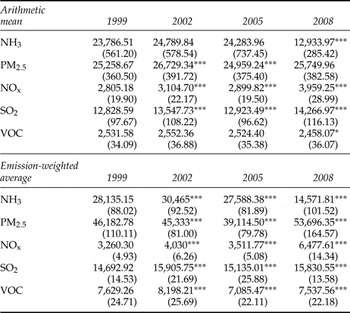
Table 1 displays the arithmetic mean marginal damage for each pollutant for 1999, 2002, 2005 and 2008. In addition, the table reports the results of a mean comparison test between the marginal damage for a particular pollutant in period (t) and period (t − 1).Footnote 7 For NH3, the average damage per ton is $23,790 in 1999, $24,790 in 2002 and $24,280 in 2005. The difference in means is statistically indistinguishable from zero. In contrast, the average marginal damage drops to $12,930 in 2008, which is different from the 2005 mean at α = 0.01. For PM2.5 the marginal damages are significantly different from the previous period, except for the 2008–2005 comparison. The PM2.5 marginal damages range between $25,000 and $27,000 per ton. For VOC the only comparison that rejects the null of equivalent means is the 2008–2005 comparison; however, this rejection is at the α = 0.10 level of significance. VOC marginal damages show a narrow range of between $2,500 and $2,600 per ton. For NOx and SO2, the intertemporal mean comparison tests reject the null hypothesis of equivalent means at α = 0.01.
Marginal damages: 1999, 2002, 2005 and 2008

Notes: n=9, 983.
All values in (US$ short ton).
Standard errors in parentheses.
Asterisks denote significance level of mean comparison tests of marginal damage with preceding period marginal damage: * = 0.10, ** = 0.05, *** = 0.01.
Table 1 also provides evidence of a pattern in the magnitude of the average marginal damages; for all pollutants except for NH3 and VOC, the averages are smaller in 1999 and 2005 than in 2002 or 2008. NH3 increases slightly from 1999 to 2002 and then declines from 2002 to 2008. None of the other four pollutants changes monotonically. The relative magnitudes of the marginal damages among pollutants are relatively stable. In 1999, PM2.5 causes the greatest damage per ton, followed by NH3, SO2, NOx and VOC. This rank ordering is preserved in 2002 and 2005. In 2008, the order changes slightly to: PM2.5 followed by SO2, NH3, NOx and VOC.
The bottom panel of table 1 reports the emission-weighted average marginal damages. Several patterns evident in the arithmetic means are also present in the weighted averages. First, the quasi oscillation of marginal damages is evident for NOx, SO2 and VOC. PM2.5 prices decline from 1999 to 2005 and then show a significant increase from 2005 to 2008. NH3 marginal damages have a significant increase from 1999 to 2002 and then decline precipitously to 2008. The rank ordering in magnitudes of marginal damages is also very similar to the arithmetic averages. The only difference is that VOC damages are consistently larger than the marginal damages for NOx. Finally, the intertemporal, intrapollutant mean comparison tests tend to show significant differences (at α = 0.01).
The emission-weighted averages are consistently larger than the arithmetic means. The emission weights give greater emphasis to the marginal damages for sources that produce relatively large quantities of emissions. For VOC, PM2.5 and NH3, sources that generate large amounts of tonnage are situated in or near urban areas. Since the damages are mostly comprised of human health impacts, the marginal damages tend to be higher for sources near urban centers (because human exposures per ton are greater). Hence, weighting by emission tonnage increases the average marginal damage relative to the arithmetic mean computations which place equal weight on all sources.
It is interesting to note that emission weighting does not appreciably increase the marginal damage for SO2. For example, the arithmetic mean for 2002 is $13,550 while the emission-weighted mean (also for 2002) is $15,910. The roughly 17 per cent increase is significantly smaller than the 220 per cent difference between the arithmetic mean and the emission-weighted means for VOC in 2002. The subtle difference for SO2 results from the fact that the largest emitters of this pollutant tend to be coal-fired power plants which often are located in rural areas. The marginal damage for rural emissions of SO2 tends to be relatively low and, as a result, the emission-weighted average does not dramatically differ from the un-weighted arithmetic mean.
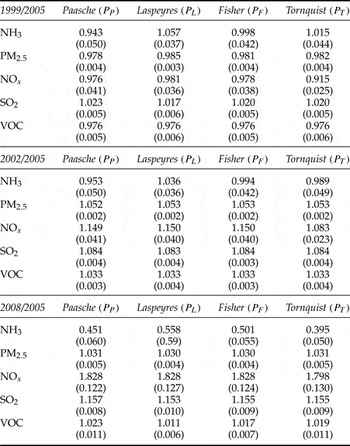
Table 2 reports the bilateral price indices relative to base year 2005. For all four index forms, marginal damages were generally lower in 1999 than in 2005 for NOx, PM2.5 and VOC. The marginal damages for each of these three pollutants suggest modestly increasing prices from 1999 to 2005. For PM2.5 and VOC, all four index numbers are similar in magnitude: for PM2.5 the indices range between 0.978 and 0.982. For VOC the price indices are all equal to 0.976. For NOx there is greater variation. The price indices range from 0.915 (Tornquist) to 0.981 (Laspeyres). For all forms aside from Tornquist, the NOx standard errors suggest that the price indices are not significantly different from unity at conventional levels.
Bilateral pollution index numbers

Notes: All index numbers computed with 2005 as base year.Values in parentheses are bootstrap standard errors.
For SO2, the price indices range between 1.017 (Laspeyres) and 1.023 (Paasche). These values suggest a modest rate of decreasing marginal damage between 1999 and 2005. The indices computed for NH3 span unity, suggesting no significant change in marginal damages between 1999 and 2005. Specifically, the Paasche and Laspeyres indices are 0.943 and 1.057, respectively. The Fisher index is 0.998 with a standard error of 0.042 and the Tornquist index is 1.015 (standard error of 0.044).
The middle panel of table 2 reports price indices for 2002 relative to 2005. For PM2.5, the price indices reveal that the level of marginal damage for this pollutant was about 5 per cent higher in 2002 than in 2005. The bootstrap standard errors indicate that the indices for this pollutant are significantly different from unity. This translates to roughly a 2 per cent annualized rate of change in prices. For NOx, VOC and SO2 the price indices reported in table 2 support the findings in table 1; all indices point toward higher marginal damages in 2002 than in 2005. For VOC and SO2, the indices are in close agreement. As with the 1999/2005 indices, the Tornquist index for NOx differs from the other three forms; the Paasche, Laspeyres and Fisher forms equal about 1.15, while the Tornquist price index is estimated to be 1.083.
For NH3 the indices provide mixed evidence of price changes. The Paasche index suggests marginal damages were lower in 2002 than in 2005, although the standard error on this index is large. In contrast, the Laspeyres index indicates higher marginal damage in 2002. The Fisher and Tornquist indices point toward slightly lower marginal damages in 2002; however, again the standard error associated with these indices is large.
The bottom panel of table 2 displays the fixed base price indices for 2008 relative to 2005. The indices show clear evidence of falling marginal damages for NH3. The marginal damage level for NH3 in 2008 is about one-half the magnitude of that in 2005. This supports the findings reported in table 1. For all of the other pollutants, the price indices suggest that the marginal damages are increasing from 2005 to 2008. The marginal damages for PM2.5 are about 3 per cent higher in 2008. The VOC marginal damage level increases by about 2 per cent. The SO2 marginal damage increase is larger, with the price indices ranging between 1.157 (Paasche) and 1.153 (Laspeyres). The NOx marginal damage level increases substantially. The price indices displayed in table 2 suggest that the 2008 marginal damage level is of the order of 80 per cent higher than that in 2005.
Table A1 in the online appendix shows the bilateral price indices that are computed using ambient concentrations of PM2.5 as the quantity base. Only NH3, SO2 and PM2.5 are included in this auxiliary set of results because NOx and VOC emissions affect ambient concentrations of both PM2.5 and O3 so the quantity base in such a situation is not straightforward to calculate. In summary, appendix table A1 shows that the price indices for NH3 are sensitive to the specification of the quantity base. In particular, the Fisher NH3 indices range between 0.02 and 0.08 smaller when computed using the concentration base rather than the emission base. The differences in the NH3 Tornquist indices are even more dramatic. Employing the 1999/2005 Fisher index, the emission base suggests constant marginal damages, while the concentration base suggests that marginal damages decreased by 1.4 per cent per annum.
While the SO2 and PM2.5 price indices are statistically different when using concentration bases and emission bases, the differences in numerical terms tend to be quite small. For SO2, the concentration base price indices are about 0.01 smaller than the emission base forms. The difference in the implied rates of change in SO2 marginal damage for the 1999–2005 period is about 0.15 per cent. For PM2.5, the difference between the concentration base price indices and the emission base indices is between −0.002 and −0.008. The difference in the implied rates of change in PM2.5 marginal damage for the 1999–2005 period is about 0.03 per cent. These small differences also hold for 2002–2005 and for 2008–2005.
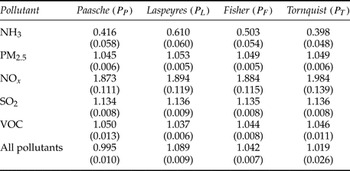
While table 2 presents fixed base bilateral price indices, table 3 displays the chain-type price indices. For NH3, the chain-type price indices show that marginal damages declined by about a factor of one-half between 1999 and 2008. The SO2 and NOx price indices indicate that the marginal damages for these pollutants increased over the 1999–2008 time periods. For NOx, the Paasche, Laspeyres and Fisher indices show an increase of about 90 per cent. The Tornquist index suggests a marginal damage increase of the order of 100 per cent. The indices reveal an increase of about 14 per cent for SO2 marginal damages. For VOC and PM2.5, the rate of price change appears to have been more modest; the four indices show that VOC and PM2.5 marginal damages increased by approximately 4–5 per cent from 1999 and 2008. Table 3 also computes a multi-pollutant chain-type index. The multi-pollutant Fisher index value of 1.04 indicates that between 1999 and 2008 marginal damages adjusted upward by about 4 per cent, or less than 1 per cent per annum. The multi-pollutant Tornquist index suggests that marginal damages increased by about 2 per cent over the 1999–2008 time period.
Chain-type pollution index numbers: 1999–2008

Notes: Values in parentheses are bootstrap standard errors.
Dumagan (Reference Dumagan2002) notes that Fisher and Tornquist indices should approximate one another numerically. However, table 3 shows that the chain-type Tornquist and Fisher price indices differ significantly for NOx and NH3. Figure 1 in the online appendix plots Tornquist indices against Fisher indices for the multi-pollutant case and for SO2, NOx and NH3. The best fit or agreement between the two price indices is for SO2. NOx and especially NH3 show considerably less agreement between the Tornquist and Fisher indices, although the indices are clearly positively correlated.
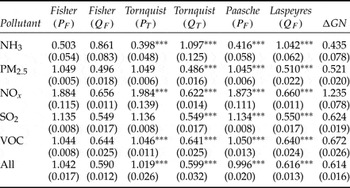
Table 4 shows the results from the empirical calculation of nominal GED as in expression (4); nominal GED is the product of the Fisher price and quantity indices. Real GED is given by the quantity indices (which are reported in table 4 as well). Table 4 decomposes the change in nominal GED (Δ GN) into price changes and quantity changes, by pollutant and for the multi-pollutant indices shown in table 3.
Nominal GED price and quantity decomposition: 1999–2008

Notes: All indices are chain type.
Values in parentheses are bootstrap standard errors.
ΔGN=P F x Q F .
Asterisks denote significance level of mean comparison tests between corresponding Fisher, Laspeyres, Paasche and Tornquist index numbers: * = 0.10, ** = 0.05, *** = 0.01.
For NH3 nominal GED declined by about 55 per cent from 1999 to 2008. The Fisher price index suggests that marginal damages declined by about 50 per cent while the Tornquist and Paasche price indices suggest that marginal damages decreased by about 60 per cent. All three price index numbers indicate that most of the reduction in nominal GED for NH3 was due to the reduction in marginal damages over this time period. However, the quantity indices for NH3 vary considerably according to whether Tornquist, Fisher or Laspeyres forms are employed. The Fisher quantity index is 0.86 while the Tornquist (implicit) quantity index is 1.097 and the Laspeyres quantity index is estimated to be 1.042. The quantity indices do not provide clear results as to whether real GED for NH3 increased or decreased between 1999 and 2008. However, the dramatic drop in NH3 marginal damages suggests that deflation of the NH3 GED over this time period is critical.
The nominal GED due to PM2.5 dropped by just under 50 per cent between 1999 and 2008. In contrast to NH3, most of the reduction in PM2.5 damages was due to quantity decreases of about 50 per cent. As reported in tables 1 and 2, PM2.5 marginal damages remain quite stable. The quantity indices for PM2.5 are also quite similar in magnitude, ranging in value from 0.49 (Tornquist) to 0.51 (Laspeyres). Hence, real and nominal GED for PM2.5 both declined by about 50 per cent.
Nominal NOx GED increased by nearly 25 per cent between 1999 and 2008. It is the only pollutant that shows an increase in nominal GED over this time period. The marginal damages for NOx increased by over 85 per cent while the emission levels declined by almost 35 per cent. The quantity indices clearly indicate that real NOx GED decreased. These changes are relatively robust across index forms.
For SO2, between 1999 and 2008, nominal GED declined by over 35 per cent while real SO2 GED dropped by 45 per cent. The relatively small increase in marginal damages of about 13 per cent between 1999 and 2008 was clearly dominated by the 45 per cent reduction in emissions. And finally, for VOC, the nominal GED decreased by about 35 per cent; the marginal damages increased by less than 5 per cent, and emissions (real GED) dropped by over 35 per cent.
The multi-pollutant Fisher index numbers indicate that total nominal GED decreased by about 40 per cent between 1999 and 2008. The three quantity index forms show strong agreement that aggregate emissions (that is, cumulative emissions across pollutants) decreased by approximately 40 per cent. Hence, real GED decreased by 40 per cent. A comparison of the Fisher price and quantity indices shows that correcting for inflation in the marginal damages yields a 2.5 per cent difference between nominal and real GED.
Summarizing table 4, for NH3 and NOx the change in nominal GED over the course of this study was driven by changes in the marginal damages. For the other three pollutants, reductions in emissions drive the change in nominal GED. Hence, for PM2.5, VOC and SO2, nominal GED is quite close to real GED. The fact that all of the pollutants except for NH3 show decreased emissions makes sense. Every pollutant except for NH3 is regulated under the Clean Air Act. SO2, VOC, NOx and PM2.5 are subject to quantity-based policies that mandate reduced emissions over time. The finding that for SO2, VOC and PM2.5 marginal damages remained relatively stable is also intuitive, given how these pollutants are managed. That is, under quantity-based policies, regulators do not specifically manage the pollutants using information on marginal damages. The finding that NOx marginal damages increased significantly should be cause for concern among regulators, since this occurred despite increasingly stringent controls on NO x emissions. This marginal damage appreciation appears to be an artifact or an unintended consequence of pollution policy.
Appendix table A2 reports the GED decomposition using the alternative ambient concentration quantity base rather than the emissions base. The first two columns in table A2 report the Fisher price and quantity index numbers used in the GED decomposition. The NH3 price index is 0.56 using the concentration base and 0.50 using the emissions base. While this is a significant difference, the Fisher NH3 quantity indices computed using the two quantity bases are dramatically different. The NH3 quantity base is 0.86 with the emissions base and 0.46 using the concentration base. As such the nominal GED change for NH3 is 0.44 using the emissions base and 0.26 when the concentration base is employed. What causes the dramatic difference in the quantity indices for NH3? Although NH3 emissions are relatively stable between 1999 and 2008, the effect of these discharges on ambient PM2.5 declines precipitously. This is what the two different quantity indices reveal. Also, NH3 emissions have a more limited effect on air quality (concentrations) because NH3 requires either SO2 or NOx discharges to produce ambient PM2.5. Since emissions of both SO2 and NOx dropped over this time period, subsequent releases of NH3 do not yield as much PM2.5. In sum, for NH3, real GED is estimated to have dropped by 54 per cent between 1999 and 2008 using the concentration base rather than 14 per cent using the emissions base. Further, the price change comprises a much smaller share of the nominal GED change when using the concentration index than the emissions based index.
For SO2 and PM2.5 the effect of using the concentration base indices is much more subtle. Using the concentration base, real SO2 GED is estimated to have dropped by 44 per cent. The emissions base specification suggests that SO2 GED dropped by 45 per cent. And for PM2.5 the concentration base quantity index indicates that real GED fell by 53 per cent while the emissions base index suggests that real GED fell by just over 50 per cent.
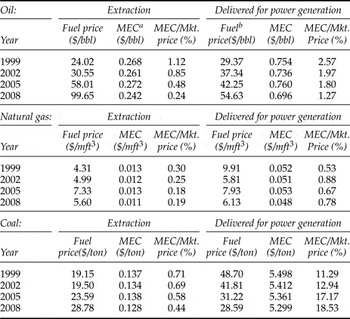
Table 5 displays the results from the empirical application of the marginal damages to prices for three fossil fuels. The left panel of the table focuses on external costs associated with extraction. The right panel examines external costs for delivery to power generation facilities. Beginning with oil, in 1999 the reported market price for crude was $24 and the MEC was just $0.27 or about 1 per cent of the market price. Table 5 indicates that the MEC for extraction comprised less than 1 per cent of the market price for oil in 2002, 2005 and 2008. In contrast, the MEC for oil delivered to power plants was of the order of $0.70 per barrel which amounted to between 1 and 3 per cent of the unit cost of oil to power generators. In general, the greater external costs for delivered fuels are associated with emissions produced during delivery by pipeline, trucks, vessels or trains.
Externality pricing for fossil fuels

Notes: All values expressed in real terms. CPI used to deflate market prices; Fisher deflator used to deflate pollution marginal damages.
a MEC stands for marginal external cost.
b Fuel prices under the ‘delivered for power generation’ heading reflect prices paid by power generators for fuel as an input.
Much like the case for oil, the MEC for extraction of natural gas was equivalent to less than 1 per cent of the wellhead price for gas. The MEC associated with delivery of natural gas for use in power production was about five times larger than for extraction. However, due to the relatively higher prices paid for delivered natural gas, the MEC at this stage of production still amounted to less than 1 per cent of the delivered price.
At the extraction stage, the MEC for coal is estimated to have been about $0.13 for each year. Due to steadily increasing coal prices, the MEC began in 1999 at 0.7 per cent of the market price for coal and then dropped to 0.4 per cent in 2008. However, the MEC for delivered coal increases dramatically (relative to the MEC at the extraction stage) to over $5 per ton. Accordingly, even though power plants pay substantially higher prices for delivered coal, the MEC at this stage ranged between 11 and 20 per cent of the market price for delivered coal. Unlike both oil and natural gas, correcting the price of delivered coal for the air pollution externality would have a significant impact on the price level. Taken a step further, measuring the aggregate value of stocks of these fuels is an important aspect to tabulating national wealth. For the case of coal, correcting prices for external cost would have a noticeable effect on the gross value of reserves.
5. Conclusions
The general price level is measured using index numbers such as the CPI and the PPI. Dynamic price measurement is also important beyond the boundaries established by the NIPAs. Real measures of market production facilitate inferences on growth. Likewise, real measures of augmented output are required to draw inferences on sustainability. The paper uses index numbers to summarize the changes in the marginal pollution damages over time and to create price deflators to estimate real pollution damage. The paper concludes with two empirical applications. First, the paper uses the pollution index numbers to decompose changes in air pollution damage between 1999 and 2008 into quantity and price effects. Second, the marginal damages are used to characterize the MEC of extraction and delivery of oil, natural gas and coal.
The paper detects evidence of time series heterogeneity in the marginal damages. The magnitude and direction of change in the marginal damage level depends on the pollutant. The marginal damages for NH3 declined by one-half from 1999 to 2008. Marginal damages for fine particulate emissions and VOC increased by about 4 per cent. Marginal damages for SO2 and NOx increased by approximately 15 per cent and 90 per cent, respectively.
Price and quantity indexes are used to compute the change in nominal and real air pollution damage. Nominal damages decreased by just under 40 per cent. Real GED decreased by just over 40 per cent. Nominal and real GED are so similar because, for most pollutants, the change in GED is driven by a reduction in emissions between 1999 and 2008. Hence, ‘price’ effects are relatively small. The exceptions are NOx and NH3; the change in damage was driven by the large changes in marginal damages reported in the preceding paragraph.
This paper suggests future research in a number of areas. First, one of the primary purposes of estimating the price indices is to compute deflators for use in dynamic environmental accounting. The price indices reported in the paper could be used to report real GED by industry or sector over the time period covered by this analysis in the US. Second, the price indices developed herein could be integrated with production and emissions data to construct augmented price indices of the form suggested by Nordhaus, Reference Nordhaus1999 and developed by Banzhaf, Reference Banzhaf2005. A worthwhile application would be to energy prices where the link between energy production, consumption and air pollution emissions is clear. Building the pollution prices into an energy price index would be an important step toward correcting one dimension of the bias inherent in conventional price indices. Finally, the evidence that marginal damages change through time raises a question that could be tackled in future research: how large a change in marginal damages justifies a recalibration of efficient emission taxes or the marginal damages used by USEPA in their RIAs? Policy adjustments may be costly. Regulators should weigh the efficiency gains of policy change against the administrative costs. The findings reported herein suggest that the large changes in NH3 and NOx prices probably would justify policy adjustments; the much smaller changes detected for SO2, VOC and PM2.5 probably do not.
Supplementary materials and methods
The supplementary material referred to in this paper can be found online at journals.cambridge.org/EDE.