INTRODUCTION
Intensive ruminant production systems demand a supply of high protein- and energy-yielding crops. However, during the last decade, dietary protein sources for livestock have become tremendously expensive and difficult to access, challenging researchers and farmers globally to seek alternative protein sources, and increase the quality and availability of alternative livestock feeds (Moyo et al. Reference Moyo, Masika and Muchenje2012). As a consequence, various forage trees and shrubs have been explored as potential protein sources, and special attention has been paid to the tree Moringa oleifera (Mendieta-Araica et al. Reference Mendieta-Araica, Spörndly, Reyes-Sánchez and Spörndly2011a ), originating from the Indian sub-continent. Moringa oleifera is reputed for its adaptability to grow in all types of soils and to tolerate hot and dry conditions (Duke Reference Duke1983). It contains negligible amounts of anti-nutritional factors, has a high crude protein (CP) content, significant amounts of vitamins A, B and C in the foliage and high amounts of polyphenols, resulting in significant anti-oxidative activity (Makkar & Becker Reference Makkar and Becker1996; Verma et al. Reference Verma, Vijayakumar, Mathela and Rao2009). However, the antioxidant activity of Moringa is not exclusively attributed to polyphenols. In addition to direct antioxidants, Moringa leaves also contain indirect antioxidants, a combination which can explain its ability to prevent and treat various health disorders such as inflammation, hypertension and bacterial and viral infections. These include isothiocyanates that owe their oxidative stress modulation to induction of phase II detoxifying enzymes (Tumer et al. Reference Tumer, Rojas-Silva, Poulev, Raskin and Waterman2015). Moringa leaves can be stored for long periods without deterioration in nutritive value (Foidl et al. Reference Foidl, Makkar, Becker and Fuglie2001). All in all, the above described traits make M. oleifera a potential feed for livestock.
Indeed, the CP-rich M. oleifera, which is highly resistant to rumen degradation, has become one of the most widely used species for fodder (Makkar & Becker Reference Makkar and Becker1996). A growing number of studies have been carried out to test its effects on production performance of ruminants; most of them, however, used dried leaves harvested manually. For example, Moyo et al. (Reference Moyo, Masika and Muchenje2012) reported improved growth performance and carcass characteristics in goats supplemented with dried Moringa leaves compared with grass hay. In a different study, dietary supplementation of dried M. oleifera leaves, as substitute for local forage, resulted in a dose-dependent increase in milk yield (MY) of dairy cows (Reyes-Sanchez et al. Reference Reyes-Sanchez, Spörndly and Ledin2006). Qwele et al. (Reference Qwele, Hugo, Oyedemi, Moyo, Masika and Muchenje2013) reported significantly higher anti-oxidative capacity in meat of goats supplemented with dried M. oleifera leaves, compared to goats fed with sunflower cake or grass hay. The anti-oxidative capacity was expressed through higher enzymatic activities of glutathione, catalase and superoxide dismutase, and higher values of lipid oxidation inhibition.
Although drying of M. oleifera leaves preserves its nutritive value (Foidl et al. Reference Foidl, Makkar, Becker and Fuglie2001), past experience has shown that ensiling was a more efficient preservation protocol, in terms of retaining anti-oxidative activity (Shabtay et al. Reference Shabtay, Eitam, Tadmor, Orlov, Meir, Weinberg, Weinberg, Chen, Brosh, Izhaki and Kerem2008). Ensiling is a preservation technology suitable for moist crops. In this sense, M. oleifera, whose leaves have a dry matter (DM) content not exceeding 200 g/kg (Foidl et al. Reference Foidl, Makkar, Becker and Fuglie2001), is an appropriate candidate for ensiling. Moreover, in modern farming, forage crops are harvested at the optimal time when yields and quality are at their peak. The large mass of forage must thus be preserved for continuous feeding throughout the year, especially if, like Moringa, it can be harvested several times a year. However, in order to evaluate this agricultural process economically, data should be provided for the nutrition and health-promoting traits of ensiled M. oleifera. It is noteworthy that only a few studies have made use of ensiled Moringa as a dietary supplement for ruminants. In one such case, Mendieta-Araica et al. (Reference Mendieta-Araica, Spörndly, Reyes-Sánchez and Spörndly2011b ) reported higher intake and digestibility in low-yielding dairy cows fed Moringa silage, compared with either fresh Moringa foliage plus molasses or elephant grass plus concentrate, but with no differences among the three groups in MY and composition. In a more recent study, Moringa silage prepared from fresh forage, pre-mixed with chopped wheat hay and sugar cane molasses, was fed as additive (0·065 of total mixed ration; total mixed rations (TMR)) to dairy cows in mid-lactation (Cohen-Zinder et al. Reference Cohen-Zinder, Leibovich, Vaknin, Sagi, Shabtay, Ben-Meir, Nikbachat, Portnik, Yishay and Miron2016). The authors reported higher milk and fat-corrected MYs and higher milk fat content, but lower milk protein content in the Moringa-fed cows, compared with their control counterparts. Moreover, cows served the M. oleifera silage additive showed a significant increase in production efficiency (Cohen-Zinder et al. Reference Cohen-Zinder, Leibovich, Vaknin, Sagi, Shabtay, Ben-Meir, Nikbachat, Portnik, Yishay and Miron2016).
To the best of the current authors’ knowledge, among the few reports on Moringa silage, no study has referred to the effect of ensiling on its antioxidant capacity. The antioxidant capacity has been mainly attributed to the water-soluble polyphenols, anthocyanins, and hydrolysable tannins (Tzulker et al. Reference Tzulker, Glazer, Bar-Ilan, Holland, Aviram and Amir2007). It has often been associated with a decreased risk of various diseases and mortality (Miller et al. Reference Miller, Brzezinska-Slebodzinska and Madsen1993; Chirase et al. Reference Chirase, Greene, Purdy, Loan, Auvermann, Parker, Walborg, Stevenson, Xu and Klaunig2004). Leaves of M. oleifera are rich in polyphenols (Lako et al. Reference Lako, Trenerry, Wahlqvist, Wattanapenpaiboon, Sotheeswaran and Premier2007) and it has been previously shown that ensiling leads to a dramatic reduction in polyphenol content (Weinberg et al. Reference Weinberg, Chen and Weinberg2008).
Thus, the particular interests of the current study were to test whether ensiling is an appropriate technology for preserving the anti-oxidant potential of M. oleifera in a small-scale ensiling process and, if Moringa silage processed commercially on a large-scale basis and fed as a substitute for maize silage to dairy cows prior to calving, would confer health-promoting traits and affect milk production and quality in dairy cows.
MATERIALS AND METHODS
Small-scale ensiling procedure
Whole M. oleifera plants (leaves + small stems) were hand-harvested at 40 cm above ground level and immediately wilted for 8 h outdoors on a cement bed until they reached 300 g/kg DM. The pre-wilted plants were chopped into 2–3 cm pieces and ensiled in 1·5-l anaerobic jars (Weck®, Wehr-Oftlingen, Germany). Each jar was filled with about 750 g pre-wilted plants, without a headspace, and stored at room temperature (25 °C) for 37 days. There were four jars per treatment. Treatments included: control Moringa silage (pre-wilted Moringa with no additives; CMS); pre-wilted Moringa +1% molasses (w/w) (MSM); and a combined treatment of pre-wilted Moringa +1% molasses + a lactic acid silage inoculant comprising Lactobacillus plantarum MTD1 (Ecosyl, UK) (MSML), applied at 106 colony-forming units (cfu)/g. The inoculant was applied by suspending 100 mg of its powder in 20 ml water and spraying over 1·5 kg forage. At the end of the storage period the silages were sampled for analysis. At this time, silages were also subjected to an aerobic stability test in bottle systems for 5 days (Ashbell et al. Reference Ashbell, Weinberg, Azrieli, Hen and Horev1991). Change in pH, production of carbon dioxide (CO2), numbers of yeasts and moulds, and visual appraisal served as spoilage indicators. Sorghum (SoS) and wheat (WS) silages served for comparison of the polyphenols content and antioxidant potential to that of Moringa. Forages were harvested at the milk stage of maturity, chopped to 2–3 cm and ensiled similarly to Moringa in 1·5-l anaerobic jars. At the end of the storage period the silages were processed in the same way as Moringa silages. Wheat and sorghum silages are well defined and routinely used as roughage in Israel. Their ensiling fermentation is adequate and the pH values obtained are around 4·0. Lactic acid is the major fermentation product. The aerobic stability of wheat silages is moderate good, while that of sorghum silages is usually good (Weinberg et al. Reference Weinberg, Khanal, Yildiz, Chen and Arieli2010, Reference Weinberg, Khanal, Yildiz, Chen and Arieli2011a ).
Feeding trial with Moringa oleifera silage
Based on the small-scale ensiling procedure in the anaerobic jars, a large-scale ensiling protocol was designed for a feeding trial in dairy cows, aiming to follow the effect of M. oleifera silage supplemented at a concentration of 270 g/kg DM as maize silage replacer in the TMR on milk production and composition and milk antioxidant capacity. The Moringa used for the feeding trial was sown on June 15, 2014 at density of 160 000 seeds/ha, in a 2-ha commercial field in Eden Farm, Israel (35°E, 32°N). The plants were drip-irrigated every week, up to a total of 800 mm during the growth season (June–November). Four mechanical harvests were conducted at 45-day intervals, at 20-cm stubble height in the first cut, and additional 7-cm above in each of the three following cuts. In each harvest, the Moringa forage (including leaves, soft twigs and thin branches) was harvested and chopped to at least 2–3 cm long using a John Deere combine harvester (9660 STS; John Deere, Moline, IL, USA), loaded directly into trucks, delivered to Nahalal Feeding Center (29 miles away) and wilted on a cement floor for 1 week until reaching DM content of 300 g/kg. Then, the chopped, wilted Moringa was mixed with sugar cane molasses (at DM ratio of 910 : 90 on DM basis) and then ensiled by loading into a compression chamber that produced compressed bales, and wrapped thereafter with stretch polyethylene ultra-violet-resistant film, as previously described (Weinberg et al. Reference Weinberg, Chen, Miron, Raviv, Nahim, Bloch, Yosef, Nikbahat and Miron2011b ). The bales with M. oleifera silage were delivered to Afikim dairy farm (Kibbutz Afikim, Jordan valley, Israel) and kept outdoors for 2 months prior to the feeding trial.
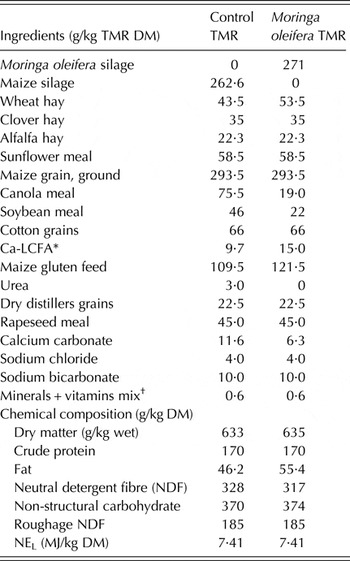
A commercial cultivar of forage maize (Pioneer 32W86), used as the main forage source in the control diet, was sown in a near-by field on 18 April. The plants were drip-irrigated every week, up to sum of 500 mm during the growth season (April–July), and harvested at the end of the soft-dough stage of grain maturation when plants reached 330 g/kg DM content. Plants were harvested and chopped, delivered to the feeding centre and directly ensiled in bales as described above. The Moringa silage and the maize silage contained similar DM content (300 and 330 g DM/kg wet silage, respectively), but differed in CP content (180 and 90 g/kg DM, respectively). This gap in CP content was compensated by addition of protein sources to the control TMR (Table 1) to get similar levels of CP (170 g/kg DM) in both TMRs.
Ingredients of the total mixed rations (TMR) fed to lactating cows

* Calcium salts of long-chain fatty acids.
† Containing (g/kg of Minerals + Vit mix): Zn, 24; Fe, 24; Cu, 12·8; Mn, 24; I, 1·44; Co, 0·32; Se, 0·32; 16 000 000 IU of vitamin A; 3 200 000 IU of vitamin D3; and 48 000 IU of vitamin E.
Fresh TMRs were prepared on a daily basis in a mixing wagon by mixing either wilted Moringa silage (experimental group) or maize silage (control TMR) plus the additional premixed ingredients as described in Table 1. Twenty-four multiparous Holstein dairy cows were randomly assigned in pairs into two similar groups of 12 cows each, according to previous production records. Cows were fed with either control or Moringa TMRs starting 3 weeks prior to calving and up to 6 weeks post-calving. On week 7 of the lactation, both groups were fed the Control TMR. Milk yield (kg) and content of milk fat, protein, and lactose, were recorded daily for each cow by an automatic meter equipped with on-line near-infra-red-spectroscopy measurement (Afilab, Afimilk Ltd., Kibbutz Afikim, Israel). Based on these data, differences among groups in MY were measured at days 11, 18, 30d, 60, 90, 180 and 270 in lactation, on the basis of the average yield during the week prior to calculation. In parallel, milk samples from the four initial sampling points were analysed for milk antioxidant capacity. These samples reflected values in weeks 1–4 in lactation. Milk somatic cell counts (SCCs) were determined by Fossomatic 5000 FC (Foss Food Technology Corp., Denmark). The animal performance study was carried out according to the guidelines and under the supervision of the Agricultural Research Organization Animal Care Committee.
Antioxidant activity evaluation
Antioxidant activity in silages TMRs and milk was measured using the luminol-enhanced chemiluminescence (CL) assay (Ginsburg et al. Reference Ginsburg, Sadovnic, Oron and Kohen2004), with slight modifications. Briefly, 20 µl of 20 mg/ml DDW lyophilized and ground silage samples (equivalent of 400 µg) or 30 µl of milk were added to a reaction mixture containing 10 µl of luminol (10 µm), 10 µl H2O2, 20 µl of sodium selenite (2 mm), 10 µl of bovine serum albumin (100 µg/ml), and 10 µl of 1 mm Co+2. This radical-generating cocktail simultaneously generates a flux of peroxide. Luminol enhanced CL was measured in a LUMAC/3 m Biocounter M2010 connected to a linear recorder, and the resulting light output was recorded as counts per minute during 6 min (Ginsburg et al. Reference Ginsburg, Sadovnic, Oron and Kohen2004). All tests were replicated four times.
Colorimetric determination of total phenolics
The amounts of total polyphenols in M. oleifera leaves were determined using Folin–Ciocalteu reagent and calibrated against gallic acid (Singleton et al. Reference Singleton, Orthofer and Lamuela-Raventós1999). All tests were conducted four times.
Protein extraction and sodium dodecyl sulphate polyacrylamide gel electrophoresis.
To follow protein concentration and content in fresh and dried Moringa and the various silages, the Bradford protein assay was performed followed by sodium dodecyl sulphate-polyacrylamide (SDS–PAGE) gel. Fifty mg of lyophilized M. oleifera samples were homogenized in ice-cold buffer containing 0·1 m sodium chloride (NaCl), 20 mm tris(hydroxymethyl)aminomethane (Tris) pH 7·4, 0·2 mm ethylenediaminetetraacetic acid (EDTA), 20% glycerol (v/v), 0·5 mm dithiothreitol (DTT), 15 µg/ml leupeptin and 1 mm phenylmethylsulfonylfluoride (PMSF). Samples were centrifuged for 30 min (4 °C, 12 000 rpm), and supernatants were collected, frozen in liquid nitrogen and stored at −80 °C until further analysis. Twenty microlitres of protein extracts were thawed and boiled for 5 min in sample application buffer containing 2-mercaptoethanol, and separated by 10% SDS–PAGE gel. Proteins were visualized staining the gels by Commassie.
Determination of free amino acids
For determination of total soluble amino acids, 50 mg of lyophilized silage samples were taken. Acid hydrolysis was carried out using a Carousel 12 plus reaction station (Radleys, UK). The amino acids were detected using the single-ion method (SIM) of GC–MS, as previously described (Amira et al. Reference Amira, Ifat, Tal, Hana, Shmuel and Rachel2005).
Analysis of tocopherols and carotenoids
All preparations and analyses of tocopherols and carotenoids were carried out in the dark or under gold fluorescent light to avoid possible photo-degradation of analysed metabolites. All chemicals and solvents were purchased from Sigma (St. Louis, MO, USA).
Lyophilized M. oleifera samples were ground to a fine powder in the presence of liquid nitrogen, using a D3V-10 cutting mill (Hsiangtai Macinery Industry Co., Ltd., Taiwan) at 28 000 rpm. Carotenoids and tocopherols were extracted in a mixture of hexane : acetone : ethanol (2 : 1 : 1, v/v/v) as described previously (Tadmor et al. Reference Tadmor, King, Levi, Davis, Meir, Wasserman, Hirschberg and Lewinsohn2005) and separated using a Waters 2695 HPLC apparatus equipped with a Waters 996 PDA detector and Waters 2475 Fluorescence detector (Milford, MA, USA). Carotenoids and tocopherols were identified by their characteristic absorption spectra, distinctive retention time and comparison with authentic standards. Quantification was performed by integrating the peak areas with standard curves of authentic standards and the Waters millennium chromatography software. To increase sensitivity and accuracy of tocopherol quantification, they were also quantified using the fluorescence detector (excitation 290 nm, emission 330 nm).
Statistical analysis
Fermentation profiles and aerobic stability variables were subjected to analysis of variance (ANOVA) and Duncan's multiple range tests, which were performed with the General Linear Model of SAS. A pooled estimate of the standard error for characteristics in the small-scale ensiling procedure (Table 2) was based on the Satterthwaite approximation. A log 10 transformation was used for Lactic acid, CO2 and yeast and mould counts (Table 2). Differences in the values of antioxidant capacity, polyphenols, tocopherols and carotenoids among silage groups were tested by one-way analysis of variance (ANOVA) followed by Bonferroni's post hoc test (P < 0·05). Repeated measures ANOVA and t-tests for two independent groups were performed to test for differences in MY and antioxidant capacity. The above variables were tested for their normality prior to analyses and analysed by SPSS 15·0.
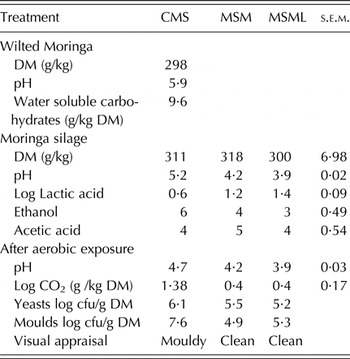
Characteristics of Moringa oleifera silages prepared for the small-scale ensiling procedure, from wilted leaves (control silage; CMS), wilted leaves +10 g Molasses/kg (MSM) and Lactobacillus plantarum MTD1 inoculum (MSML)

Log cfu = log10 of colony-forming units/g DM. Yeast and mould counts are representative data, based on random counts of one replica from each treatment.
s.e.m. – Standard error of the means. Degrees of freedom (d.f.) for all variables = 9.
RESULTS
Ensiling variables of pre-wilted Moringa oleifera
The ensiling variables of pre-wilted M. oleifera are presented in Table 2. The wilted crop had suitable DM content, but was characterized by relatively low water soluble carbohydrates (WSC) for the ensiling process. Indeed, ensiling Moringa leaves without any additive (control) failed to become a stable silage, as judged by the relatively high pH values (5·2), low concentration of lactic acid and a low lactic acid to acetic acid ratio (about 1 : 1), and aerobic exposure that revealed higher amounts of CO2, yeasts and moulds. Addition of molasses to the pre-wilted leaves promoted the decrease of pH to 4·2 and an increased lactic to acetic acid ratio. Furthermore, the molasses added to the wilted M. oleifera leaves, at the beginning of the ensiling process, resulted in stable silage, characterized by reduced CO2 production and yeasts and moulds. Lactic acid bacteria inoculums added on top of the molasses, further improved the silage variables and aerobic stability (Table 2).
Ensiling improves antioxidant capacity of Moringa oleifera
To follow the effect of ensiling protocols on the antioxidant capacity of M. oleifera, the CL assay was used. As seen in Fig. 1(a), whereas drying Moringa leaves to 300 g/kg DM (a prerequisite step in the ensiling process) resulted in an expected decrease in antioxidant capacity, a surprising increase was revealed for each of the M. oleifera silages regardless of type of starter added. Interestingly, while M. oleifera silage containing molasses as a starter (MSM) exhibited the highest antioxidant capacity, sorghum (SoS) and wheat (WS) silages had very low counts (F 6,21 = 292·333, P < 0·001).
Effects of various ensiling conditions on the antioxidant capacity (a) and total polyphenols (b) of Moringa oleifera. C – fresh M. oleifera leaves, DM – dried (300 g/kg DM) M. oleifera leaves, CMS – control M. oleifera silage, MSM – M. oleifera leaves ensiled with molasses, MSML – M. oleifera leaves ensiled with molasses and Lactobacillus, SoS – Sorghum silage, WS – wheat silage. Counts represent 400 and 200 µg per sample, for the antioxidant and polyphenols assays, respectively. Bonferroni's multiple comparison test (P < 0·05) revealed differences between treatments except for CMS and MSM, CMS and MSML in panel A and SoS and WS, in panels A and B (n = 4). LDCL – luminol-dependent chemiluminescence. One-way ANOVA followed by Bonferroni Multiple Comparison Tests were used to compare chemiluminescence among the seven sample extracts.

Ensiling decreases polyphenol content of Moringa silages
In order to estimate total concentration of polyphenols in Moringa silages, the Folin–Ciocalteu colorimetric assay was used; values are presented in Fig. 1(b). Generally, the tendency of polyphenols to change according to the ensiling process and silage types followed that of the antioxidant capacity. However, unexpectedly, no correlation between antioxidant capacity and polyphenol concentration was found in the current study (R = 0·24; n = 20; and P = 0·28). Interestingly, while no polyphenols were detected in SoS and WS silages, CMS, MSM and MSML had apparently higher polyphenol concentration compared to DM leaves (F 6,21 = 351·171, P < 0·001). Moreover, M. oleifera leaves pre-wilted to 300 g/kg DM had significantly lower polyphenol content as compared with fresh leaves.
Ensiling Moringa oleifera leads to accumulation of free amino acids
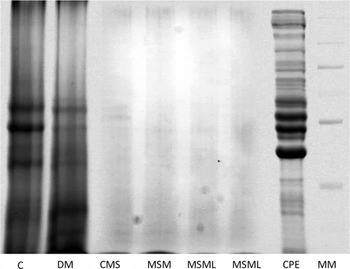
The protein content of different M. oleifera silages is seen in Fig. 2. Unlike the clear appearance of proteins of various sizes in C and DM samples, massive protein degradation is observed in Moringa silages, non-related to starters added to the ensiling process. Indeed, metabolomic analysis exclusively revealed high occurrence of free amino acids in all kinds of Moringa silages. Among the prominent amino acids L-proline (400 ± 2 ppm) followed by glycine (77 ± 23 ppm), were most abundant.
Representative SDS–PAGE gel showing protein content in various Moringa oleifera silages. Please note a dramatic effect of the ensiling process on degradation of proteins (lanes CMS, MSM, MSML). C – fresh M. oleifera leaves, DM – dried (30% DM) M. oleifera leaves, CMS – control M. oleifera silage, MSM – M. oleifera leaves ensiled with molasses, MSML – M. oleifera leaves ensiled with molasses and Lactobacillus, CPE – positive control: protein extraction of animal source, MM – molecular size marker (KDa).

Ensiling has a moderate effect on content of tocopherols and carotenoids
To follow the fate of bioactive compounds during the ensiling process, the content of carotenoids and vitamin E in wilted and ensiled M. oleifera leaves was determined, with emphasis on lutein, β-carotene and α- and γ-tocopherols stereoisomers (Fig. 3). As seen, concentrations of all tested compounds are the lowest in the MSML silage. The MSML silage was generated by addition of molasses and Lactobacilli inoculum. Unlike γ-tocopherol and lutein concentrations that only tended to decrease in the MSML silage (F 3,12 = 3·03, P = 0·071 and F 3,12 = 2·67, P = 0·095, respectively) but remained stable in the other silages, concentrations of α-tocopherol (F 3,12 = 4·47, P = 0·025) and β-carotene (F 3,12 = 7·53, P = 0·004) decreased significantly in the MSML silage. It is noteworthy that β-carotene content was lower also in the MSM silage (P = 0·041).
Effects of various ensiling conditions on concentrations of tocopherols and carotenoids. DM – dried (300 g/kg DM) Moringa oleifera leaves, CMS – control M. oleifera silage, MSM – M. oleifera leaves ensiled with molasses, MSML – M. oleifera leaves ensiled with molasses and Lactobacillus. Levels of α-tocopherol and β-carotene were significantly lower in MSML and in MSM and MSML, respectively, comparing with the other treatments (Bonferroni's multiple comparison test; P ⩽ 0·05; N = 4).

Dietary Moringa oleifera silage positively affects production and health-promoting traits
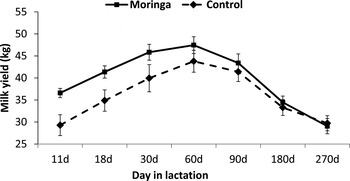
To gain knowledge into the potential of ensiled M. oleifera as a substitute for maize silage in TMR of dairy cows, a feeding trial was designed in which commercially produced M. oleifera silage replaced 263 g/kg of maize silage in the diet. The effect of this silage was tested as a dietary substitution, given 3 weeks pre-calving up to 6 weeks post-calving, on MY, composition, antioxidant capacity and SCCs, measures that account for production and health. As seen in Fig. 4, during most stages of lactation, MY of cows fed M. oleifera silage were higher than that of control cows, with no effect on concentrations of milk protein, fat and lactose (data not shown). However, differences were significant only on days 11, 18 and 30 in lactation (P < 0·05), and became smaller and non-significant in parallel with the return to control TMR.
The effect of Moringa oleifera silage, fed up to 42 days post-calving as maize silage replacer (Moringa v. control treatments), on average milk yield (MY) of Holstein cows during the entire lactation. Moringa-fed cows had significantly higher MY on days 11, 18 and 30 of lactation (P < 0·05). Data are shown as means ± s.e. (n = 12 in each group).

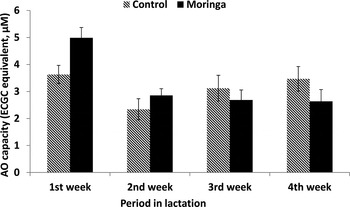
The antioxidant capacity of milk collected during the first week of lactation from M. oleifera fed cows was significantly higher (P < 0·05), accounting for over 30% improvement, compared with the control counterparts (Fig. 5).
The effect of Moringa oleifera silage, fed up to 42 days post-calving as maize silage replacer (Moringa v. control treatments), on milk antioxidant (AO) capacity of Holstein cows during lactation. Milk AO capacity of moringa-fed cows was significantly higher in the first week of lactation (P ⩽ 0·05). Data are shown as means ± s.e. (n = 12). Counts represent 30 µl milk per sample.

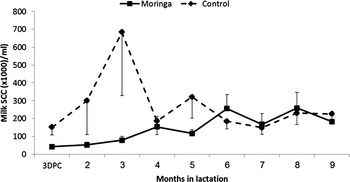
The effect of supplementing TMR of lactating cows with M. oleifera silage on SCC was investigated and the results are shown in Fig. 6. As can be seen, cows fed M. oleifera silage had lower milk SCC than the controls. These differences were manifest in milk samples taken 3 days and 3 months post-calving (P < 0·05), and also tended towards significance (P ⩽ 0·1) in milk samples taken 2 and 5 months into lactation.
The effect of Moringa oleifera silage, fed up to 42 days post-calving as maize silage replacer (Moringa v. control treatments), on milk somatic cell count (SCC). Significant differences between Moringa and control fed groups (P ⩽ 0·05) were measured 3 days (3DPC) and 3 months post-calving. Tendency towards lower SCC in Moringa fed cows (P ⩽ 0·1) was measured 2 and 5 months in lactation; –Data are shown as means ± s.d.

DISCUSSION
The ensiling experiments of Moringa in mini-silos indicated that it would be necessary to augment the ensiled biomass with molasses and lactic acid bacteria inoculants. That is because the content of water-soluble carbohydrates in the Moringa was too low to support adequate ensiling fermentation. The low content of WSC in Moringa has been also reported in a previous study (Mendieta-Araica et al. Reference Mendieta-Araica, Spörndly, Reyes-Sánchez, Norell and Spörndly2009). Addition of molasses and Lactobacillus inoculants resulted in good silages with low pH values, in spite of the relatively low concentrations of lactic acid. This might be due to a low buffering capacity of Moringa leaves, which enabled a low pH to be achieved with few fermentation acids (lactic and some acetic acid).
Leaves of the tropical tree M. oleifera are a promising feed for livestock, due to significant amounts of protein, vitamins, carotenoids and polyphenols, and negligible amounts of anti-nutritional factors. It is well established that fresh and dried leaves of M. oleifera possess considerable antioxidant activity, attributed to the phenolic flavonoid compounds quercetin and kaempferol (Siddhuraju & Becker Reference Siddhuraju and Becker2003; Lako et al. Reference Lako, Trenerry, Wahlqvist, Wattanapenpaiboon, Sotheeswaran and Premier2007), as has also been described for these and other polyphenols in other fruits and vegetables (Tzulker et al. Reference Tzulker, Glazer, Bar-Ilan, Holland, Aviram and Amir2007; Shabtay et al. Reference Shabtay, Eitam, Tadmor, Orlov, Meir, Weinberg, Weinberg, Chen, Brosh, Izhaki and Kerem2008). Ensiling is a common practice implemented in ruminant enterprises to preserve seasonal moist crops for longer periods. However, studies have shown that the ensiling process may cause considerable reduction in polyphenol concentrations (Weinberg et al. Reference Weinberg, Chen and Weinberg2008), thereby affecting crops’ antioxidant capacity. Therefore, one of the main goals of the present study was to explore how the ensiling process of M. oleifera would affect the antioxidant activity of its leaves.
The results shown herein reveal an apparent discrepancy in the polyphenol-antioxidant capacity concept – the improved antioxidant capacity of Moringa silages was not associated with its polyphenol content. Based on the above, and since drying is a prerequisite stage in the preparation of plant based silages, the higher records of polyphenols in CMS, MSM and MSML compared with DM leaves may not really reflect true increase in polyphenol concentrations in these silages. Consequently, the non-correlative relationship between polyphenols concentration and antioxidant capacity may stem from either, technical and/or biological background. Technically, the Folin–Ciocalteu reagent not only measures polyphenols in a given biological source, but is also a known procedure for the estimation of protein concentration. Indeed, various amino acids, including tryptophan and tyrosine react with the Folin–Ciocalteu reagent to produce colour (Layne Reference Layne1957). It is thus possible that the higher records of polyphenols in M. oleifera silages observed in Fig. 1(b) are actually attributed to the presence of amino acids that were detected by the Folin–Ciocalteu reagent. If so, protein content in M. oleifera silages, as compared with fresh and dried leaves, is expected to decrease, while free amino acids and small peptides are likely to become more abundant. Indeed, determination of soluble protein levels, based on the Bradford assay and protein gel electrophoresis, may indicate intensive protein degradation in Moringa silages, unrelated to the ensiling process, concomitant with L-proline and glycine being the most prominent free amino acids in the silages. It cannot be excluded, however, that proteins have precipitated in silage due to low pH. In response to different abiotic stresses, plants accumulate high concentrations of free proline in their tissues. Among the various adaptive functions against stresses in plants that have been ascribed to proline, its antioxidative activities have been well documented (Kishor et al. Reference Kishor, Hong, Miao, Hu and Verma1995; Hare & Cress Reference Hare and Cress1997; Kaul et al. Reference Kaul, Sharma and Mehta2008). Few examples include hydroxyl radicals (Smirnoff & Cumbes Reference Smirnoff and Cumbes1989) and singlet oxygen scavenging (Alia et al. Reference Alia, Mohanty and Matysik2001), decreased heavy-metal-dependent lipid peroxidation (Mehta & Gaur Reference Mehta and Gaur1999) and antioxidative protection against Cd toxicity (Siripornadulsi et al. Reference Siripornadulsi, Traina, Verma and Sayre2002). Similarly, reactive oxygen species (ROS) and reactive nitrogen species (RNS) scavenging activity has been attributed to glycine, one of three amino acids that glutathione, the most abundant thiol-containing substance of low molecular weight in cells, is synthesized from (Fang et al. Reference Fang, Yang and Wu2002). But it is not only free amino acids released during the ensiling process that should be considered contributors to the improved antioxidant activity found in Moringa silages. It is evident that low molecular weight peptides, resulting from hydrolysis of animal and plant protein sources, possess antioxidant activities, which depend on their amino acid composition and sequences (Chen et al. Reference Chen, Muramoto and Yamauchi1995; Wu et al. Reference Wu, Chen and Shiau2003). Based on the above, it can be postulated that the improved antioxidant capacity of M. oleifera silages compared to fresh and dried M. oleifera leaves is a result of protein degradation that releases amino acids and low molecular weight peptides with free radical scavenging and antioxidant activities. However, in order to obtain more information about structural characteristics of antioxidant peptides derived from Moringa silages, protein hydrolysate fractionation (using size exclusion chromatography), followed by amino acid sequencing of the active peptides is required.
The association between ‘healthy diets’ and lowered risk of human diseases has been attributed to the presence of various forms of phytochemicals and antioxidants present in foods, e.g. vitamins, carotenoids and polyphenol compounds (van Poppel Reference Van Poppel1996; Lako et al. Reference Lako, Trenerry, Wahlqvist, Wattanapenpaiboon, Sotheeswaran and Premier2007). This property is of even greater significance when considering the findings of polyphenols possessing synergistic activity with lipophilic antioxidants, to prevent lipid peroxidation in the digestive tract (Gorelik et al. Reference Gorelik, Lapidot, Shaham, Granit, Ligumsky, Kohen and Kanner2005; Kerem et al. Reference Kerem, Chetrit, Shoseyov and Regev-Shoshani2006). Interestingly, voluntary intake of fresh, polyphenols-rich pomegranate peels by beef calves promoted significant increases in α-tocopherol concentration in their plasma (Shabtay et al. Reference Shabtay, Eitam, Tadmor, Orlov, Meir, Weinberg, Weinberg, Chen, Brosh, Izhaki and Kerem2008), suggestive of a protective role of polyphenols on vitamins in the diet. Increased concentrations of vitamin E in ruminant diets have often been associated with improving their health status (Hays et al. Reference Hays, Gill, Smith and Ball1978; Weiss Reference Weiss1998; Weyl-Feinstein et al. Reference Weyl-Feinstein, Markovics, Eitam, Orlov, Yishay, Agmon, Miron, Izhaki and Shabtay2014) and the quality of their products (Lavelle et al. Reference Lavelle, Hunt and Kropf1995; Granit et al. Reference Granit, Angel, Akiri, Holzer, Aharoni, Orlov and Kanner2001).
In addition to its polyphenol content (Siddhuraju & Becker Reference Siddhuraju and Becker2003) M. oleifera is known to be a considerable source of lipophilic antioxidants, including tocopherols and carotenoids (Sánchez-Machado et al. Reference Sánchez-Machado, López-Cervantes and Ríos Vázquez2006; Lako et al. Reference Lako, Trenerry, Wahlqvist, Wattanapenpaiboon, Sotheeswaran and Premier2007), turning it into a potential health-promoting feed for livestock. Like tocopherols, carotenoids including β-carotene and lutein, and exert antioxidant activity in lipid phases by quenching oxygen or free radicals (Stahl & Sies Reference Stahl and Sies2005).
In the present study, the lowest concentrations of carotenoids and vitamin E were observed in the MSML silage, generated by addition of molasses and Lactobacilli inoculum. It is thus believed that the reduction in amounts of tocopherols and carotenoids in the MSML silage is a result of their metabolism by Lactobacilli. However, the reduction was significant only for α-tocopherol and β-carotene, while γ-tocopherol and lutein concentrations only tended to decrease in the MSML silage but remained stable in the other silages. Similar trends for tocopherol stability under various storage conditions were reported for pomegranate peels (Shabtay et al. Reference Shabtay, Eitam, Tadmor, Orlov, Meir, Weinberg, Weinberg, Chen, Brosh, Izhaki and Kerem2008). The amount of γ-tocopherol detected in the present study was in line with those reported by Sánchez-Machado et al. (Reference Sánchez-Machado, López-Cervantes and Ríos Vázquez2006). However, α-tocopherol concentrations were c. 10-fold lower, and this may be attributed mainly to cultivar variances, the extraction method, or to both.
The findings reported herein for the small-scale M. oleifera ensiling experiment reflected a feed resource with improved capacity to promote production and health in dairy cows. To further explore this potential, a large-scale ensiling protocol was designed, followed by a feeding trial in which M. oleifera silage replaced 263 g/kg maize silage in TMR of dairy cows, 3 weeks pre-calving up to 6 weeks post-calving. The effect of this silage was tested on MY and composition, antioxidant capacity and SCCs, measures that account for production and health. The results shown in Fig. 4 indicate that supplementation of M. oleifera silage significantly improved MY on days 11, 18 and 30 in lactation and became smaller and non-significant in parallel with the return to control TMR. In the setup of the present study, these results may suggest that dietary supplementation of M. oleifera silage to dairy cows potentially promotes milk production as long as it is included in the TMR, but does not have a long-term effect.
The effect of dietary supplementation of M. oleifera on ruminants’ milk production, with non-unequivocal findings, has been reported by others. Reyes-Sanchez et al. (Reference Reyes-Sanchez, Spörndly and Ledin2006) found that supplementation of increasing amounts of M. oleifera foliage to Bos indicus cows of the Creole Reyna breed increased MY by 58–65%. In a different study, M. oleifera leaf meal failed to increase daily MY when fed to dairy cows with a basal Elephant grass diet as a protein source in concentrate when compared with soybean meal (Mendieta-Araica et al. Reference Mendieta-Araica, Spörndly, Reyes-Sánchez and Spörndly2011a ). In another experiment, Mendieta-Araica et al. (Reference Mendieta-Araica, Spörndly, Reyes-Sánchez and Spörndly2011b ) compared the effect of feeding low-yielding dairy cows with diets based mainly on either fresh M. oleifera foliage with molasses, ensiled M. oleifera foliage with molasses, or elephant grass plus concentrate. Although for the M. oleifera silage, intake and digestibility were higher, no differences in MY were found among the three groups. Interestingly, a positive effect of dietary M. oleifera silage, served as additive, on milk and fat corrected MYs was reported in high-yielding dairy cows in mid lactation (Cohen-Zinder et al. Reference Cohen-Zinder, Leibovich, Vaknin, Sagi, Shabtay, Ben-Meir, Nikbachat, Portnik, Yishay and Miron2016). A positive effect on MY was also reported in lactating goats, for which M. oleifera leaf meal replaced 0·5–1·00 sesame meal in the diet (Kholif et al. Reference Kholif, Gouda, Morsy, Salem, Lopez and Kholif2015).
During the first week of lactation M. oleifera-fed cows were characterized by higher milk antioxidant capacity, accounting for over 30% improvement compared to the control group. This finding is in agreement with Cohen-Zinder et al. (Reference Cohen-Zinder, Leibovich, Vaknin, Sagi, Shabtay, Ben-Meir, Nikbachat, Portnik, Yishay and Miron2016) who reported a 20% increase in milk antioxidant capacity in high-yielding dairy cows, although the stage in lactation and the amount of M. oleifera silage served differed between the two studies. Considering this a desirable milk trait, dietary protocols to stabilize Moringa-driven milk antioxidant capacity for longer milking periods should be developed. It is well-established that polyphenols contribute a great extent of the antioxidative potential of feeds (Tzulker et al. Reference Tzulker, Glazer, Bar-Ilan, Holland, Aviram and Amir2007; Shabtay et al. Reference Shabtay, Eitam, Tadmor, Orlov, Meir, Weinberg, Weinberg, Chen, Brosh, Izhaki and Kerem2008). Indeed, the polyphenolic fraction of M. oleifera leaves was found to protect against oxidative DNA damage induced by hydroxyl radicals in a dose-dependent manner (Verma et al. Reference Verma, Vijayakumar, Mathela and Rao2009). To the best of our knowledge, this is the first study to show that antioxidant potential is improved upon ensiling of feeds. Moreover, relating to these findings, it is postulated that on top of the basic antioxidant potential conferred by M. oleifera polyphenols, and tocopherols, this improvement is a result of free reducing amino acids and low molecular weight peptides. The combined contribution of these compounds along with carotenoids may provide a possible explanation for the higher MY presented in the current study. It is logical to assume that a greater capacity to quench ROS would increase the energy portion devoted for production, at the cost of non-productive activities. Grubbs et al. (Reference Grubbs, Fritchen, Huff-Lonergan, Dekkers, Gabler and Lonergan2013) addressed this issue by showing that mitochondria of pigs genetically selected for high feeding efficiency produced less ROS than mitochondria of non-efficient pigs; the authors concluded that decreasing ROS production could lead to a decrease in oxidative damage to macromolecules leading to a decreased mitophagy and protein turnover that in turn would contribute to a shift in energy utilization from cellular repair to improved production. In line with the above, improved production efficiency could be also achieved through reduction of energy losses as methane by phenolics in the rumen (Shaani et al. Reference Shaani, Eliyahu, Mizrahi, Yosef, Ben-Meir, Nikbachat, Solomon, Mabjeesh and Miron2015).
The bio-active compounds bearing the antioxidant activity not only affect production, but may also have a direct effect on animal health. Indeed, a positive correlation between oxidative stress and illnesses has been widely documented in cattle (Miller et al. Reference Miller, Brzezinska-Slebodzinska and Madsen1993; Chirase et al. Reference Chirase, Greene, Purdy, Loan, Auvermann, Parker, Walborg, Stevenson, Xu and Klaunig2004). Milk SCC has become the gold standard indicator of milk and dairy product quality and udder health status (Schukken et al. Reference Schukken, Wilson, Welcome, Garrison-Tikofsky and Gonzalez2003) and thus, may be considered a reliable estimate for potential health-promoting and quality-affecting feeds. Ma et al. (Reference Ma, Ryan, Barbano, Galton, Rudan and Boor2000) showed that during refrigerated storage, low SCC milk was subjected less to lipolysis and casein hydrolysis than high SCC milk and maintained higher organoleptic quality for the entire shelf-life period. Similarly, Barbano et al. (Reference Barbano, Rasmussen and Lynch1991) reported decreased cheese yield efficiency, increased losses of fat and protein in whey and moister cheese with increased milk SCC. Based on the above and other studies, it was recommended that incentives should be allocated to low SCC milk (Ma et al. Reference Ma, Ryan, Barbano, Galton, Rudan and Boor2000). Following this rationale, the current authors questioned how supplementation of M. oleifera silage to the TMR of lactating cows would affect SCC. The results reported herein suggest a beneficial effect of M. oleifera silage on lowering milk SCC.
Taken together, the findings described in the current study imply that ensiling protocols can be used to improve antioxidant capacity of M. oleifera leaves, in a non-polyphenol related manner. It is anticipated that accumulation of amino acids and low molecular weight peptides during the course of ensiling account for this improved antioxidant capacity. Moringa silage used as dietary substitution for maize silage may contribute to health and production in lactating dairy cows. Future studies should focus on profiling and purifying ensiling-derived M. oleifera antioxidant peptides.
We express our gratitude to Nahalal Feeding Center for the preparation of the commercial Moringa silage and Afikim dairy farm staff for their help with the feeding experiment and milk sampling. The technical assistance of Mr. Ali Zouabi is deeply acknowledged. This research was supported by funds of the Israeli Dairy Board Foundation, Project # 362-0459-15.