Introduction
By any standard, child protection is a demanding field of social services work. All post-industrial countries have child protection legislation requiring the state to intervene in families’ lives for the protection of children. Yet child protection caseworkers face continual challenges to the legitimacy of their work from service users, the media and even from within the political institutions responsible for the development of child protection legislation. In the context of these challenges and the complexities of child protection practice, it is little wonder that some child protection agencies face a crisis in the retention of practitioners.
Despite common challenges facing child protection practitioners, marked inter-country differences exist in workforce turnover rates. In this article, we analyse the role of institutional conditions in shaping child protection workforce turnover in two contexts: Queensland (Australia) and Norway. We have focused on one state of Australia, Queensland, to offer a greater depth of analysis than would be possible should we compare the entire country, with its eight states and territories, each of which has its own legislative and policy frameworks. The comparison is also appropriate because of the similarities in the size and geographical dispersion of populations in Queensland and Norway.
Our analysis focuses on institutional conditions of child protection work by which we refer to the legal and policy frameworks and organisational structures shaping the scope and nature of casework practice and the characteristics of the workforce (Beland, Reference Béland2005: 3; see also Immergut, Reference Immergut1998). Our focus complements the vast body of literature that has focused on the individual worker characteristics, such as appropriate educational preparation (Healy and Meagher, Reference Healy and Meagher2007; Vinokur-Kaplan, Reference Vinokur-Kaplan1991), job design (Bennett et al., Reference Bennett, Plint and Clifford2005) and local organisational features, such as professional support structures, on shaping workforce outcomes (Glisson and Hemmelgarn, Reference Glisson and Hemmelgarn1998; Glisson et al., Reference Glisson, Dukes and Green2006; Steib and Blome, Reference Steib and Blome2004; Tham, Reference Tham2007). While prior research has adopted a systemic approach to the analysis of child protection service outcomes, such as child homicides (see Pritchard, Reference Pritchard1996; see also UNICEF, 2003), and rates of substantiated child maltreatment and numbers of children in out-of-home care (see Paxson and Waldfogel, Reference Paxson and Waldfogel2001), our paper is among the first to examine how institutional context influences workforce outcomes, particularly caseworker turnover. By illuminating the role of institutional context, we aim to create options for policy-makers to improve workforce retention in this complex and demanding field.
The ‘problem’ of workforce turnover in child protection
We use the term workforce turnover to refer to the proportion of child protection casework staff leaving their jobs, either for employment in non-direct service roles or to positions in other fields or organisational contexts. We refer to caseworkers as officers responsible for the direct delivery of child protection services – particularly investigation, assessment and family support work – to children and families. Typically, caseworkers have responsibility for, and frequent contact with, a caseload of clients of their agency. The casework workforce should be an important focus of policy analysis given that these workers play a key role in the implementation of child protection policy. Reasonable levels of workforce turnover can be positive as new caseworkers may bring innovative ideas and opportunities to policy implementation and service delivery. However, high levels of workforce turnover can be destabilising and are problematic in the child protection field where the relationship between caseworkers and service users is critical to achieving children's safety and promoting family well-being (Glisson and Himmelgarn, Reference Glisson and Hemmelgarn1998).
Evidence points to substantial inter-country variation in caseworker turnover rates in child protection agencies, despite shared challenges in the nature of this work. Some liberal welfare states, particularly Australia and the USA, record high turnover rates. Information about mobility within the caseworker workforce is difficult to access in both Australia and Norway, though perhaps for different reasons. Even though governments across Australia have identified substantial staff retention challenges in the child protection workforce (Institute of Child Protection Studies, 2005), they rarely release information on the scope of the problem. For example, annual reports of child protection authorities seldom include information about staff turnover, let alone disaggregated information about rates of separation of caseworkers compared to other employees. Information of this nature is only made available occasionally, such as in the course of public reviews. Such documents, however, show alarming levels of workforce turnover among front-line staff. For example, in 2007, the Queensland Department of Child Safety reported that:
42% of all turnover [among child safety officers] occurs within the first year and 73% occurring within the first three years. This is significantly different to the Queensland public sector average where 27.5% have separated under three years. (Department of Child Safety, 2007: 6)
This excerpt indicates that child protection caseworkers are leaving at a much greater rate than other occupational groups within the public sector. Indeed, the Queensland Child Safety authority describes the turnover as unsustainable (Department of Child Safety, 2007: 2). The rate of turnover appears also to have escalated since the introduction of child protection reforms in 2004 that led to increased concentration of child protection casework on investigation and assessment. Indeed, prior to the reforms, the Minister for the Child Protection authority reported that, in 2003, 28 per cent of caseworkers left the organisation in their first year of practice (Spence, Reference Spence2003). The elevated rates of workforce turnover are comparable to those reported in the USA. For example, data from the USA show that, in some states, caseworker turnover exceeds 30 per cent per annum (Barak et al., Reference Barak, Levin, Nissly and Lane2006). In contrast, a recent survey of local authority social services across the United Kingdom reported that while there is an 11.8 per cent vacancy rate in child protection casework positions, the turnover rate among staff had declined from 13.7 per cent in 2001 to 11 per cent in 2005 (Local Authority Workforce Intelligence Group, 2006).
In Norway, the organisational structure of child welfare services contributes to difficulties in accessing workforce mobility information. Services are delivered by 431 municipalities and there is no centralised database on workforce mobility. Even so, studies on this topic indicate variation between municipalities and suggest overall lower rates of mobility than those found in Queensland. Data from a one-year period (October 2005–October 2006) regarding the proportion of caseworkers who left their job within the municipalities reveal that the turnover rate among child pedagogs and social workers, who together constitute the bulk of child protection workers, was 12 per cent, which is equal to average workforce turnover across all occupations within the municipalities (Stensig, Reference Stensig2007).
Different rates of workforce turnover contribute to contrasting profiles of the caseworker workforce in Australia and Norway, which in turn create vastly different capacities among the workers. In Queensland and, indeed, all other states of Australia, direct practice is largely the domain of newly qualified practitioners; this is due to the high turnover of staff and the occupational classification of this role as an ‘entry-level’ position. In 2004, a Public Inquiry in Queensland found that one quarter of casework staff were under 26 years old and more than half were under 35 years old, with the majority having less than three years experience in the field (Crime and Misconduct Commission, 2004: 30). It is observed that inexperienced staff members are rapidly elevated to supervisory and management roles, where they are expected to offer support to a frontline workforce comprised largely of newly qualified practitioners (Healy, Reference Healy2009; Healy and Meagher, Reference Healy and Meagher2007; Crime and Misconduct Commission, 2004: 30).
By contrast, an evaluation of child protection services undertaken in 2004 between Norway's two largest cities, Oslo and Bergen, showed that a typical child protection worker is 35 years old and has at least five years experience in child protection work (Bogen et al., Reference Bogen, Grønningsæter and Jensen2007: 108). The report also found that few of the workers start their career in child protection; only 7 per cent of the workers are 26 years or younger. While this profile points to the substantial professional experience among Norwegian child protection workers, we are also aware that, in some regions, newly qualified caseworkers are employed in child protection roles. Moreover, in some Nordic states, such as Sweden, there is evidence also of an increased concentration of novice workers in direct child protection practice (see Tham, Reference Tham2007).
The contrasting policy contexts of child protection services
International comparison of child protection systems must recognise that child protection services are implicated in the construction of the entities in which these systems intervene. Regional and national differences exist in the construction of key entities such as childhood, parenthood, and child abuse and neglect; child protection systems reflect, and reproduce, these constructions. For example, in Nordic nations and some European countries, the physical punishment of children is illegal; however, such practices remain legally acceptable in many other wealthy nations and, as such, may not be recorded as instances of abuse. Recognition of national and regional differences in the construction of entities such as prevention, intervention, child abuse and neglect has generated considerable debate about the assessment of success and failure in child protection systems (see Finkelhor, Reference Finkelhor1994; Pritchard, Reference Pritchard1996; Trocmé and Lindsey, Reference Trocmé and Lindsey1996; UNICEF, 2003). The construction of the term ‘child protection’ itself is a point of considerable contest internationally, and is a site of difference in the comparative analysis of Australian and Norwegian services directed at vulnerable children and their families. In Australia, the term ‘child protection’ is commonly used to refer to all levels of assessment and intervention aimed at reducing the risk of child abuse and neglect, such as community education and family support, through to statutory interventions, including the permanent removal of children. The preference for the term ‘child protection’ rather than ‘child welfare’ is partly explained by the stigmatised association of ‘welfare’ services with the forced removable of generations of Indigenous children, commonly known as the ‘Stolen Generations’ (see Human Rights and Equal Opportunity Commission, 1997). By contrast, the term ‘child welfare’ is typically used in Norway to refer to a wide range of services aimed at assessing and intervening in families where there is a risk of child abuse and neglect.
Australia and Norway exist within distinct social policy regimes that influence the nature and contexts of child protection service delivery within each of these nations. Esping-Andersen's (Reference Esping-Andersen2000) typology of social policy regimes illuminates contrasting assumptions about the relationship between the state and family, which, in turn, create different approaches to child protection service delivery.
Within Esping-Andersen's typology, Australia is, like other Anglo-Saxon countries, characterised as a liberal welfare regime. As Esping-Andersen (Reference Esping-Andersen2000: 74–5) defines it:
Liberal welfare regimes in their contemporary form reflect a political commitment to minimize the state, to individualize risks, and to promote market solutions. As such, they disfavour citizen entitlements.
In liberal welfare states, social policy interventions are largely focused on minimising risk, rather than maximising human welfare and equality. In many Anglo-Saxon countries, commentators have observed the increasing forensic focus of child protection services, with service delivery concentrated on the identification and treatment of risk, rather than promoting child and family well-being (see McLaughlin, Reference McLaughlin2007).
The residual focus of the liberal welfare regime in Australia is brought into stark relief by reforms to the Queensland child protection system in 2004 (Crime and Misconduct Commission, 2004). These reforms saw the dismantling of the former child protection authority − which carried multiple responsibilities related to child protection investigation, intervention and family support services − and the creation of the Department of Child Safety, an authority focused on child protection investigation and assessment. As a result of these institutional reforms, the Queensland government is no longer directly responsible for the delivery of most early intervention and family support, with these services now outsourced to non-government agencies. The state government remains the primary funding source for these services. In Queensland, as in other Australian states, the delivery of alternative care services is the shared responsibility of government and non-government agencies.
By contrast, Nordic countries, such as Norway, belong to the social democratic welfare state model (Esping-Andersen, Reference Esping-Andersen2000). This social policy regime is characterised by universal social provision, holistic service provision and strong social protection (Eydal and Satka, Reference Eydal and Satka2006: 306; Harrikari, Reference Harrikari, Brembeck, Johansson and Kampmann2004: 89). In the Nordic welfare states, the ‘child is seen as the joint responsibility of parents and the state, and it is regarded to be the duty of the state to contribute to both the costs and care for the children’ (Eydal and Satka, Reference Eydal and Satka2006: 313). This assumption is embedded in the requirement within the Norwegian Child Welfare Services Act (section 4–4) that the state ensures that the families of children in need will be provided with financial and other support needed to prevent the child being taken into state care. In contrast to the social policy regimes of either the liberal or corporatist states, the aim of the social democratic state is to promote social equality among all citizens (Brown, Reference Brown and Lund2002). The notion of equality is also integral to The Child Welfare Services Act (section 4–4) via provisions for state support of vulnerable children's participation in leisure and social activities while resident in the family home.
This comparison between one state of Australia and Norway cannot be generalised to child protection authorities in the broader liberal welfare or social democratic regimes. Indeed, we are aware of considerable influence of neo-liberal ideologies upon governments even within the Nordic states. For example, Harrikari (Reference Harrikari, Brembeck, Johansson and Kampmann2004: 92) suggests that during the 1990s the Finnish state abandoned the social contract, recognising the joint responsibility of the state and family to raise children, which resulted in a decline in service provision to families. Similarly, Tham (Reference Tham2007) has pointed to deteriorating employment conditions in Swedish child welfare services, and a sharp escalation in turnover rates in this field.
Institutional contexts of the child protection workforce
We turn now to examine the institutional contexts of child protection service delivery in Queensland and Norway. Drawing on the work on institutional scholars (see Béland, Reference Béland2005; Immergut, Reference Immergut1998), we refer to institutions as service delivery structures, enforcing formal rules and norms that structure conduct, particularly with regard to decisions about the nature and scope of child protection services, who will deliver these services and the conditions under which they will be employed to deliver them. An institutional approach reveals different insights into service structures and norms of service provision than can be achieved by an analysis of policy regimes alone (Béland, Reference Béland2005: 3). This approach also lifts our gaze beyond individual worker characteristics or local organisational practice to the analysis of the contribution of institutional structures to the emergence of worker capacities and conditions favourable to workforce retention.
As our concern is with understanding differences in workforce turnover among caseworkers in two contexts, in this article we focus on the institutional conditions that constitute the caseworkers’ role and their working circumstances. Immergut (Reference Immergut1998: 25) asserts that the focus of institutional research should be determined by the problem under investigation:
Since the common research problem is the black box between potential political demands and ultimate outcomes, it does not make sense to predefine the contents of this box. A standard definition of ‘institution’ is thus not desirable; the common research agenda is the study of institutional effects wherever, or however, they occur.
In this analysis, we focus on: the scope and nature of child protection services, the legislative context shaping the child protection workers’ practice roles and responsibilities and workforce profile and characteristics.
International comparative research on child protection systems is difficult. Prior research has outlined problems in establishing concordance across data sets due to definitional issues around notions of child maltreatment, and differences in the administrative data collection (Finkelhor, Reference Finkelhor1994; Pritchard, Reference Pritchard1996). We encountered these difficulties also. For example, the age range for children included in Norwegian child protection statistics is 0–17 years, whereas in Queensland such information is collected for children 0–16 years. Further challenges in workforce data collection arose due to gaps in data sets and difficulties in data access. A key data gap was the limited data about workforce turnover either because those data are not centrally collected, as is the case in Norway, or because governments do not regularly publish these data, as is the case in Australia. Confusing use of terminology further compromised data access. Most notably, in Queensland access to caseworker figures was difficult because the Department of Child Safety (2008a: 40) annual reports include managerial and administrative officers, who do not have direct service responsibility, in the definitions of the ‘front-line workforce’. It was necessary to refer to external audits of the agency to determine the casework workforce in the Queensland child protection service (see Crime and Misconduct Commission, 2007). Moreover, even though the Queensland government is the primary funding source for family support services, there are no publicly available figures about the size of the family support workforce. Despite issues in data access and comparability, the available data sets reveal substantial differences in the institutional structures of child protection systems in Queensland and Norway, with worrying implications for workforce retention. We turn now to a discussion of these data.
Scope and nature of child protection services
In Table 1 we present data on the scope and nature of child protection inventions and fatal child protection outcomes in Queensland and Norway. Because of differences in child protection reporting practices, the figures for Queensland pertain to children 0–16 years and for Norway for children 0–17 years.

The figures in Table 1 show that while the populations of Queensland and Norway are relatively similar, in 2006–07 Queensland child protection workers undertook 20 per cent more investigations than Norwegian child protection workers. The term ‘investigations’ refers to actions undertaken by authorised child protection officers to assess risk of child abuse and neglect and to identify intervention options. Notably, the numbers of investigations undertaken in Queensland are much lower than some other states of Australia, such as New South Wales, where mandatory reporting laws have led to dramatic increases in the number of child abuse and neglect reports (Australian Institute of Health and Welfare, 2008). The table also shows the numbers of children in out-of-home care, referring in particular to the number of children under guardianship orders who are living in the care of people other than one of their parents. The majority of these children are in foster care arrangements. The figures indicate a similar proportion of children in out-of-home care in Queensland and Norway.
Despite similarities in the proportion of children in out-of-home care, the level of state-sanctioned involvement varies markedly between the two contexts. In Queensland, in 2006–07 there were 6,156 children under ‘care and protection’, with 659 of these children living with at least one parent, and a further 1,746 were placed in kinship networks (Australian Institute of Health and Welfare, 2008: 47; see also Department of Child Safety, 2008a: 72). A further 3,338 children, or 54.3 per cent of children under care and protection orders, were placed in foster care or residential care arrangements. In Queensland, child protection officers can also initiate an ‘Intervention with Parental Agreement’ (IPA), which is a voluntary agreement between the agency and the service users to work for a time-limited period on specific matters related to improving child safety. In most situations, children remain in the family home for the course of the intervention and neither the child nor the family has access to financial support from the child safety authority. In 2006–07, the Department of Child Safety recorded 1,389 IPAs.
While in Norway the number of children under protective orders is much greater than in Queensland, approximately 80 per cent of these children remain in their family home. In 2006, 30,804 Norwegian children were under ‘protective orders’, with 24,864 of these children receiving ‘assistance in the home’ – and this includes financial assistance from the local government authority (Statistics Norway, 2007a). When the total numbers of children under protective orders, including children living with a parent, are compared, the proportion of children subject to child protection orders rises slightly in Queensland (from 0.535 per cent to 0.6 per cent of all children under 16 years) and dramatically in Norway (from 0.515 per cent to 2.57 per cent of all children under 17 years). The much larger proportion of children under protective orders in Norway, compared to Queensland (and in Australia more broadly), reflects the broader responsibilities carried by the Norwegian state to provide interventions to vulnerable families whose children are resident with them.
Legal context of child protection services
The legislative context of child protection shapes the roles and responsibilities of child protection workers. In Australia, legislation is generated at the state and territory levels, meaning that there is some variation between states and territories. However, there is little variation within states, as the child protection law provides the legal framework for the entire state. In Norway, the Child Welfare Services Act is developed at the national level; however, there is scope within the Act for the local municipalities to interpret their responsibilities and ways of executing those responsibilities before the law. This contributes to some regional variation in local statutory child protection practices.
Both Queensland and Norwegian child protection legislation oblige child protection authorities to investigate concerns of child abuse and neglect, and to do so in ways that are both thorough and minimally intrusive. In both contexts, child protection legislation incorporates the principle that the actions of child protection agencies must support the ‘best interests of the child’. However, the relative responsibilities of the families and the state in achieving this principle vary dramatically between the contexts. In Queensland, the ‘best interests of the child’ are interpreted to mean that the child's needs should, wherever possible, be met within the privacy of their family environment. In a review of Australian child protection laws, the Crime and Misconduct Commission (2004: 9) noted that: ‘an emphasis on family preservation and reunification, and minimal intervention, is found in most child protection legislation throughout Australia’. The emphasis on family responsibility is apparent, for example in the Queensland Child Protection Act 1999 (Part 2, 5(2)b), which states that ‘families have the primary responsibility for the upbringing, protection and development of the child’.
Australian child protection laws also reflect the state's residual role in relation to helping families address the problems they face, with the focus being on providing support as far as ‘practical’ for the service provider. For example, the Queensland Child Protection Act 1999 (Part 6, Division 1, 73 (2)) requires that: ‘The Chief Executive must take steps that are reasonable and practicable to help the child's family meet the child's protection and care needs.’ By confining the statutory authority's responsibility to that which is deemed ‘reasonable and practicable’, the Law limits the responsibility of the statutory authority with regard to supportive interventions with families. Children deemed to be at elevated risk, but not sufficient to warrant statutory intervention, are referred to voluntary services in the non-government sector. However, there is no compulsion on the state to assist families to access these services, or to ensure that these services have sufficient resources to respond adequately to vulnerable families (Ainsworth and Hansen, Reference Ainsworth and Hansen2006).
The Norwegian Child Welfare Services Act (1992), by contrast, requires the municipality to intervene early to take action to ensure the child and family have access to resources needed to ‘avoid lasting problems’ for the child (section 3–1). Norwegian child welfare law also compels municipalities to assume responsibility for supportive interventions with families and children. Section 4–4 of the Norwegian Child Welfare Services Act (1992) states:
The child welfare service shall, when the child is in particular need of such measures to do with conditions at home or for other reasons, ensure that the measures are implemented to assist the child and the family, e.g. in the form of a personal support contact, a place for the child at a day care institution, or respite care at home. The child welfare service shall similarly seek to implement measures which may encourage the child to take part in leisure activities, or contribute to ensuring that the child is offered training and employment, or an opportunity to live away from home.
The Norwegian child welfare law compels municipalities to provide services in the home, if appropriate to reducing risk, as well as to adopt more comprehensive support, including support of ‘leisure’ activities for vulnerable children, than is provided under Queensland child protection laws.
Child Protection Laws also determine the relative responsibilities borne by individual child welfare workers and their agencies. In Australia, like other liberal welfare states, child protection casework practice is subject to extensive administrative regulation. Over the past decade, Queensland child protection workers have been subject to a growing network of review bodies. In addition to the courts and public sector review agencies, such as the Ombudsman, child protection caseworkers are also accountable to three further legal entities: the Child Death Review Committee, the Children's Guardian and the Children's Services Tribunal. These entities can, in response to negative case outcomes or complaints from service users or carers, review the practice of individual caseworkers. The responsibility borne by child protection workers is evident in child death reviews, where the review panel is obliged to consider whether ‘disciplinary action’ should be taken against individual officers; this action is in addition to the possibility of criminal liability in matters of negligent practice (Commission for Children and Young People and Children Guardian Act, 2000, Part 4A). The growth of the administrative infrastructure is consistent with Ferguson's (Reference Ferguson2004: 10) observation that:
The overwhelming response by welfare states to child deaths and other system failures has been to seek bureaucratic solutions by introducing more and more laws, procedures and guidelines. The more risk and uncertainty have been exposed, the greater the attempts to close up the gaps through administrative means.
The administrative infrastructure represents the significant investment by the state government in monitoring negative outcomes, attributing responsibility and, where necessary, revising policy and procedures. As there is no similar investment in the systematic review of positive service outcomes, it would seem that administrative review procedures are heavily influenced by information about negative outcomes.
The Norwegian child protection caseworker is subject to much lower levels of administrative governance than practitioners in Queensland. Aside from the municipal welfare review boards, which carry responsibility for case decision making and review, the Norwegian government has not established separate review bodies to examine casework practice or negative case outcomes such as child death. Child deaths where maltreatment is the suspected cause are subject to the same legal procedures as all suspicious deaths, which include post-mortem and referral of the matter to the police service if there is sufficient evidence for criminal investigation. The actions of individual child welfare workers and service directors may be assessed as part of a criminal investigation. The municipality may also investigate matters of service omission or failure where the child protection services actions are considered to have possibly contributed to a fatal outcome. However, in these instances the leader of the child welfare service rather than the individual practitioner will be required to appear before the review to account for the actions of the service.
Structures for the delivery of child protection services
Significant differences exist in the structures of child protection service delivery between Queensland and Norway. In Queensland, like all states and territories of Australia, tertiary child protection services are delivered via large state-based bureaucracies. The bureaucratic overhead – that is, the ratio of administrative to casework staff – in Australian child protection authorities is high. At June 2006, the total number of staff in the Queensland child protection authority was 2,051, of which 725 (35 per cent) were in child safety caseworker roles (Crime and Misconduct Commission, 2007: 7). Approximately 50 per cent of the staff members employed by the Department of Child Safety are located in administrative and managerial streams to carry out a wide variety of functions, including data management, administrative case review, and policy and programme development (see Department of Child Safety, 2008b; see also Crime and Misconduct Commission, 2004). The remaining staff members are located in support and supervisory roles in relation to child safety officers.These roles, such as senior practitioners, can involve client contact; however, primary casework responsibility remains with the child safety officer.
In Queensland, like the rest of Australia, the bulk of early intervention and family support services are delivered by non-profit community services. These services are primarily funded by government and rely on a combination of paid workers and volunteers; however, no reliable figures exist about the number of practitioners deployed in these services. In 2007–08 the Queensland government, as the primary funding source for family support services in the state, provided $60,000,000 in recurrent funding to non-government agencies for the provision of early intervention and family support services; this funding level is sufficient to employ approximately 860 full-time equivalent practitioners (see Department of Child Safety, 2008a: 108–11; Department of Communities, 2008: 161).Footnote 1
By contrast, in Norway, like other Nordic countries, child welfare services are delivered at the municipal level (see also Bergmark and Lundström, Reference Bergmark and Lundström2007). The three major functions of the Norwegian child welfare services, under child welfare law – to investigate and assess child abuse and neglect, to provide family support and therapeutic services and to provide alternative care services – are typically undertaken by distinct teams within the child welfare service, though in the case of smaller municipalities practitioners may be involved in all three aspects of practice. This trend toward team-based specialisations in child welfare has been observed also in other Nordic countries, such as Sweden (Bergmark and Lundström, Reference Bergmark and Lundström2007). In 2004, reforms to the Norwegian Department of Children and Equality saw the introduction of the BUFDIR. This is a state-administered specialist child and family support service intended to complement the child welfare teams within the municipalities. The BUFDIR has five regional offices across Norway with a further 26 regional ‘response and consultation teams’, known as BUFETAT, which are responsible for local delivery of services (Stavseng et al., Reference Stavseng, Aspelund, Skutlagerg and Larsen2008: 42). Considerable debate exists about the function of the BUFETAT, with substantial problems in co-ordination of responsibilities between these state agencies and the local municipalities. However, in contrast to the reforms in Queensland, Australia, which have seen a narrowing of state involvement in the direct delivery of service, the BUFDIR reform indicates an intensification and further professionalisation of the services offered to vulnerable families.
In Norway in 2006 there were 3,040 workers employed in child welfare services in the municipalities (Statistics Norway, 2007b). A further 3,333 workers are employed throughout Norway in the BUFETAT. This combined figure of 6,373 workers is substantially greater than the 1,585 workers we have estimated are employed in Queensland child protection and family support services, based on conclusions drawn from government funding data. The municipalities, the primary site of statutory child protection practice, have a much flatter governance structure than the large child protection bureaucracies of Australia. This means that these workers have more limited bureaucratic oversight of their work and it also means that there are fewer options for child protection workers to pursue a career in administration. However, the BUFETAT offers a career pathway in specialist child protection work and is emerging as an important employment destination for experienced practitioners (Stavseng et al., Reference Stavseng, Aspelund, Skutlagerg and Larsen2008).
Workforce profile and conditions
The qualification profile of child protection workers in Australia is varied, with no single professional group regarded as the core professionals in this area. Even so, child protection bureaucracies have preferred to employ graduates in human services, social work or a wide variety of behavioural sciences disciplines. Despite the range of qualifications held by statutory child protection caseworkers, the Queensland Department of Child Safety (2007) plans to further broaden the qualification requirements for caseworkers, to recruit workers with trade-level qualifications in fields as diverse as public record keeping, policing, and occupational health and safety.
In Norway, the qualifications profile of the child protection workforce is more standardised than that found in Queensland or in Australia more broadly. In their review of child protection workers in Oslo and Bergen, Bogen et al. (Reference Bogen, Grønningsæter and Jensen2007) reported that more than 90 per cent of the workforce members are educated as social workers or as child pedagogs. Social workers and child pedagogs both complete a minimum three-year degree-level education and share a common ethical code and professional association. Whereas social workers undertake a generic degree enabling them to work in a wide range of social services, child pedagogs undertake a specialist social work degree focused on working with disadvantaged children and young people. In Norway there are a number of current activities aimed at strengthening the professional preparation of social workers and child pedagogs for child protection work. In 2008, The Ministry of Child Protection funded an evaluation and review of social work education in child protection with the aim of further developing social workers’ professional foundations in this field. Furthermore, there is currently a policy debate about whether the child protection worker role should be further restricted to licensed social workers and child pedagogs. The National Director of Health inspection has recently called for the authorisation of child protection social workers (Hanger, Reference Hanger2008) on the grounds that these workers are working with the most vulnerable groups in society, and users need the protection that authorisation of officers implies. The proposal is supported by FO, the labour union for social workers.
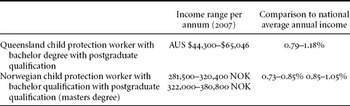
Salary scales provide important insights into the value placed on occupations, and can be an important factor in workforce turnover. Table 2 presents information on the salary levels of child protection workers in Queensland and Norway.

In both Queensland and Norway, entry-level salaries for child protection practitioners are low compared to national average salaries for the respective countries. In both contexts, new child protection workers start at salaries of less than 80 per cent of the average annual income for all workers in Australia. Queensland child protection officers have a more hierarchical salary scale, with the opportunity for child protection workers to earn up to AUS $65,045, which is almost 20 per cent above average national earnings, which in 2007 was $55,600 (Australian Bureau of Statistics, 2007). However, given the high turnover rates, the majority of caseworkers are concentrated in the lower end of the salary scale. Norwegian child protection workers with substantial work experience and specialist child protection qualifications earn less than 2 per cent above average national earnings. However, the salary range for child protection workers is commensurate with average annual incomes in the municipalities, which, in 2006, was 327,000 kroner, and provides scope for practitioners to achieve incomes substantially above this average (Statistics Norway, 2008). Unlike Queensland, where casework practitioners are paid within the same salary scale regardless of qualification level, in Norway salary scales for caseworkers are differentiated by qualification level, with masters’ degree qualified caseworkers being paid at substantially higher rates than those with bachelor degrees. This provides a significant incentive for practitioners to undertake advanced study in professional practice. This educational investment is likely not only to improve practitioners’ professional capacities, but also to reinforce their commitment to direct practice.
In Queensland and Norway, salaries for administrators and managers in child protection services are substantially higher than those available to practitioners. For example, in Queensland, the salary range for team leaders, policy officers and service managers is between $54,000 and $91,000 (Department of Employment and Industrial Relations, 2008), meaning that these officers can earn more than twice the salary of direct service practitioners. Incomes for managerial staff employed in the senior executive service of the agency are substantially higher still than for those in the administrative stream. Similarly, the salary range for team leaders in the municipalities and the BUFETAT is between 345,000 and 745,000 kroner, which is more than twice the annual salary of the entry-level child protection worker (Mellomoppgjøret, 2007). The substantially higher salaries offered to administrators and managers in child protection services provide powerful incentives for practitioners to seek administrative careers (Healy and Meagher, Reference Healy and Meagher2007). However, this is much more likely to be a factor in workforce turnover in Queensland where, like the rest of Australia, the large and growing child protection bureaucracies provide significant employment opportunities, compared to Norway, where the flatter organisational structures provide fewer options of this nature.
Discussion
Our examination reveals that in Queensland and Norway child protection workers experience financial disincentives to remain in direct practice. In both contexts, salaries for practitioners are significantly lower than for managers and administrators in child protection agencies. These salary disparities reflect the economic penalties associated with care work (England et al., Reference England, Budig and Folbre2002) as well as the ‘painfully low status of children’ and their families with whom child protection caseworkers practise (Ferguson, Reference Ferguson2007: 138). However, differences in the turnover rates between the two contexts suggest that factors other than salary are influential in caseworkers’ career decisions.
Our analysis suggests that differences in the institutional structures of the child protection field between Norway and Queensland contribute to the variations in workforce stability. First, the institutional structures of Norwegian child protection services provide greater opportunity for professional recognition and support of child protection caseworkers. This is most evident in the varying levels of individual responsibility borne by Queensland and Norwegian child protection workers. Ironically, while the entry pathways into child protection caseworker roles in Queensland are relatively unregulated, the practice of caseworkers is heavily governed by administrative protocol, both within the child protection authority and by external review agencies. Child protection caseworkers, the vast bulk of whom are newly qualified practitioners, face the persistent risk that, in the event of a negative case outcome, their practice will be subject to external scrutiny and criticism.
By contrast, Norwegian child protection caseworkers experience relatively low levels of administrative regulation of their casework practice because of the limited development of external boards of review beyond the review structures within the local municipalities. Furthermore, responsibility for negative casework outcomes is borne by the service director who represents the decisions of the casework team. This shared professional accountability reduces the personal responsibility and stress borne by the individual caseworker and communicates a level of organisational value and support to the caseworker. Compared to Norwegian child protection workers, Queensland caseworkers experience a high level of exposure to administrative scrutiny, which is likely to increase workplace stress and communicates to the worker a lack of organisational support for them individually; this factor is significant because feeling devalued and uncared for is associated with high turnover rates among child protection workers (see Tham, Reference Tham2007).
Second, the more holistic scope of Norwegian child protection practice, as defined in child welfare legislation, also allows caseworkers opportunities for more varied and satisfying casework practice than is possible within the Queensland child protection context. Moreover, in Queensland child protection caseworkers are subject to the institutional devaluation of a human service orientation in their work as casework practice is being re-conceptualised to focus on ‘evidentiary requirements, records management, [and] forensic investigation’, with little focus on early and supportive interventions with vulnerable families (see Department of Child Safety, 2007: 7). The 67 per cent increase in the number of front-line staff leaving their jobs in their first year of practice since the child protection authority adopted an exclusive focus on child safety suggests that the narrowing of caseworker roles is implicated in heightened turnover. It appears that, while workers in care industries tolerate poor wages and conditions (see England et al., Reference England, Budig and Folbre2002), they are less likely to accept the removal of the care dimensions of the work itself.
In Norway, the size of the direct service child protection workforce is much greater than that found in Queensland. Our analysis suggests that in Norway more than 6,000 workers are employed in direct service roles, whereas in Queensland the workforce of child protection and family support practitioners supported by state government funding is fewer than 2,000 equivalent full-time practitioners. The comparatively small casework workforce in Queensland is likely to contribute to the increased incidence of factors associated with work stress, such as high caseloads.
Differences in the educational preparation of caseworkers in the two contexts offer further explanation for the variation in workforce turnover. The majority of Norway child protection caseworkers hold degree-level qualifications in child pedagogy or social work. Furthermore, Norwegian salary structures provide substantial incentives for practitioners to gain postgraduate qualifications in professional practice. By contrast, Queensland caseworkers are drawn from a wide variety of fields, with many having no educational foundation in professional practice with vulnerable children and families (Healy and Meagher, Reference Healy and Meagher2007; see also Healy, Reference Healy2009). This contributes to turnover because foundational educational preparation in child and family welfare policy and practice is associated with increased resilience and commitment to child protection work (Healy and Meagher, Reference Healy and Meagher2007; Vinokur-Kaplan, Reference Vinokur-Kaplan1991). In addition, the enormous variety of disciplinary foundations found among Queensland child protection workers precludes the development of a shared professional identity among caseworkers that can be a vital resource in establishing and maintaining a satisfying and committed career in human service fields (Ibarra, Reference Ibarra1999).
The wider range of employment options for human service professionals in Queensland (and Australia more generally) compared to Norway, also explains some of the variation in turnover. The rapidly expanding child protection bureaucracies in Queensland, and in other states of Australia, offer employment opportunities for caseworkers to move into administrative roles which are better remunerated and carry lower levels of exposure to external scrutiny than casework roles (Healy, in press). The mixed economy of service provision in Australia offers employment opportunities for caseworkers in government and non-government services. By contrast, the bulk of Norwegian child and family welfare services are delivered through local government, with a small proportion delivered via the state government. The relatively flat organisational structures within the municipalities provide little opportunity for a managerial career pathway for child protection caseworkers. The limited development of the non-government sector also means that this sector does not offer a viable employment alternative. Beyond these options, Norwegian child protection workers’ alternative employment opportunities appear limited to: seeking employment in other municipalities; employment in a different field of social service provision, such as mental health services; or to exit their profession altogether. The low turnover rates suggest that few feel compelled to explore these alternatives.
Conclusion
In this article, we have illuminated the powerful role of institutional conditions within two child protection systems in contributing to workforce turnover. Our research highlights key institutional factors shaping the characteristics and capacities of child protection workers, and the nature and scope of child protection practice. Our analysis suggests that variations in the workforce turnover between Norway and Queensland can be explained by institutional differences in opportunities for professional recognition and support of caseworkers, and in the scope of practice with vulnerable children and families. We envisage that these insights into the role of institutional context in shaping workforce outcomes will assist policy-makers in the challenging task of creating sustainable and high-quality child protection services.