On 12 May 2008, a massive earthquake struck Sichuan province (Wenchuan dadizhen 汶川大地震). According to the State Council Information Office, the death toll from the earthquake was approximately 70,000, and with a total of 7,000 collapsed classrooms, approximately 10,000 of the confirmed deaths were of schoolchildren.Footnote 1 Accompanying this tragedy was a significant outpouring of donations and volunteers, leading many analysts to speculate that, similar to the SARS crisis in 2003, relief and reconstruction efforts will strengthen civil society in China.Footnote 2 According to these arguments, participation in relief efforts increases civil society groups' capacity through an expanded volunteer and donor base, improves experience in project management, and demonstrates to the government the potentially positive role played by civil society. Additionally, group relief efforts create habits of trust and participation on behalf of the government, potential volunteers and donors.
In this article, I analyse these arguments through interviews with civil society groups, academics, journalists and local government actors in Sichuan province conducted in June and July 2008, supplemented by a review of published articles. The interviewees were selected according to their role in relief efforts, that is, they came from groups and government agencies who participated in relief efforts. These included both domestic and international groups, with issue areas ranging from poverty alleviation to environmental concerns. Such an analysis is vital given the explosion of civil society activity in China in the last few years, even though many groups have low capacity and effectiveness.Footnote 3 Based on my interviews, I argue that participation in relief efforts advanced civil society but also revealed some remaining weaknesses that must be resolved for civil society to consolidate its gains. In three areas of civil society – capacity, mobilization ability and relationship with local government – the initial outcomes of participation in relief efforts are ambiguous. Earthquake relief efforts illustrated the increasing project abilities and sources of funding available to civil society organizations, both important indicators of capacity. Additionally, groups demonstrated the ability to mobilize a large volunteer base quickly. While it is too early to tell if habits of volunteering and donating have been inculcated in society, relief efforts have allowed groups to begin to build trust with local government and citizens, many of whom are distrustful or ignorant of civil society. Furthermore, despite initial government mistrust and uncertainty, these groups demonstrated to local government that they do not wish to serve as a substitute for government, but as a complement. Partnering with local government created a potential model for local state–civil society co-operation that can be used in other provinces.
However, many Chinese citizens chose to bypass organized civil society groups and participate in relief efforts directly or via the local government, illustrating the continuing trust and capacity deficit of these groups. In addition to this trust deficit, a number of problems emerged during initial relief efforts relating to group capacity, such as a lack of project management experience, adequate auditing processes, and professional or trained volunteers.
By clearly revealing civil society's strengths and weaknesses, relief efforts served as a learning process for both groups and government. Civil society groups learned how to work in a complementary fashion within government processes, co-ordinate activities among different groups, and transmit information about their activities and needs to a wider audience through extensive use of the internet and media. Local government officials learned how quickly civil society groups could mobilize resources and play a complementary role to government efforts that increased effectiveness and the reach of government resources. Through this learning process, remaining obstacles to the further strengthening of civil society were highlighted, namely trust and capacity weaknesses in civil society and their governing institutions which inhibit further development.
As discussed in the concluding section, reforms institutionalizing groups' roles, increasing capacity and improving trust between society, groups and the local state must be undertaken to consolidate gains and strengthen civil society further. The pressure for civil society to perform well is high, as poor performance could reverse these gains. First, civil society groups – both international and domestic – and other capacity-building organizations must focus on building human resources and professional skill levels. Second, local groups must also improve their ability to use internet technology and traditional media to increase information about their activities, funding and needs to a broader public, which also improves trust and awareness. And finally, the Ministry of Civil Affairs (MOCA) must create new laws to govern civil society. Civil society groups need a formal, legal status in the political system, channels to access the policy process and ability to fundraise domestically. This process of institutionalization, while empowering civil society groups, also allows MOCA to regulate them more effectively and normalize their existing place in the Chinese social and political arenas.Footnote 4
While these are only initial outcomes, it is clear that the co-operation between civil society groups, society and local government initiated a learning process allowing all actors to learn the strengths and weaknesses of the others, and to create a model of local state–civil society co-operation that can be followed again in the future. Civil society is now more widely viewed as legitimate in Chinese society which is an important step forward, but these gains must be consolidated through group and institutional reform.
The Development of Civil Society in China
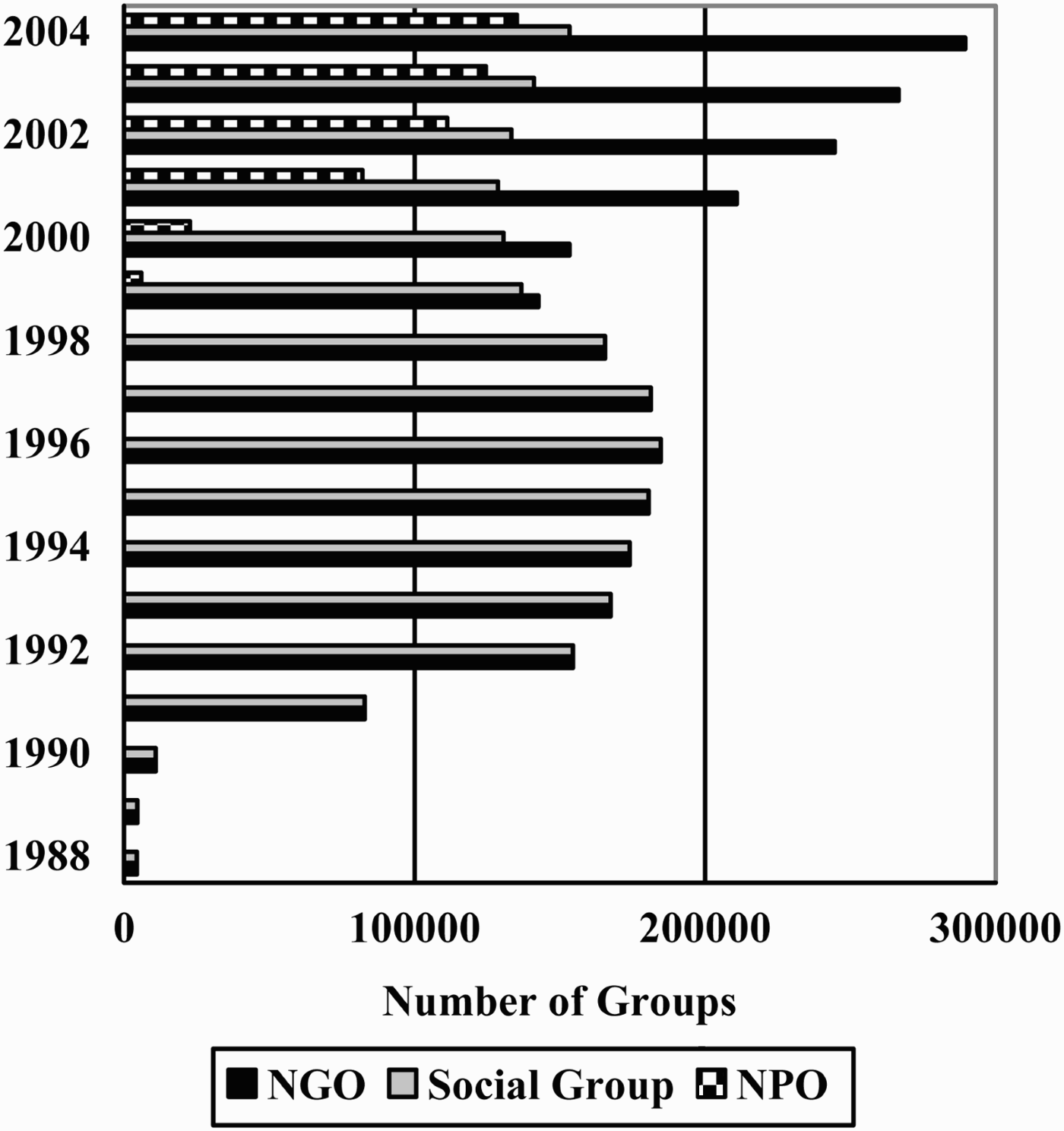
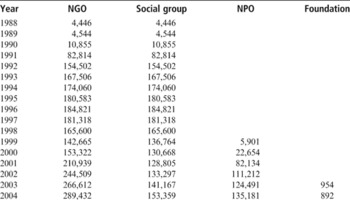
Since the 1980s, many organizations broadly called non-governmental or non-profit organizations (minjian zuzhi 民间组织, shehui tuanti 社会团体, feizheng fuzuzhi 非政府组织, feiyingli zuzhi 非营利组织) have formed to deliver services and advocate for certain groups in society. These organizations seek to address the concerns of the rural poor, migrants, rural women and other vulnerable groups through service delivery, local capacity-building, legal advocacy and policy advocacy. Chinese civil society (gongmin shehui 公民社会) has dramatically increased since the mid-1990s in both the number of registered groups and in participation. As illustrated below, this associational revolution in China peaked first in 1996. Most of the literature examined below on Chinese civil society was written during this peak period from 1993 until 1996; however, since 1998, civil society has grown even more dramatically. While these statistics do not capture death rates and only measure registered groups, most scholars believe the number of active groups far exceed the numbers reported by MOCA.Footnote 5
Registered Civil Society Organizations in China
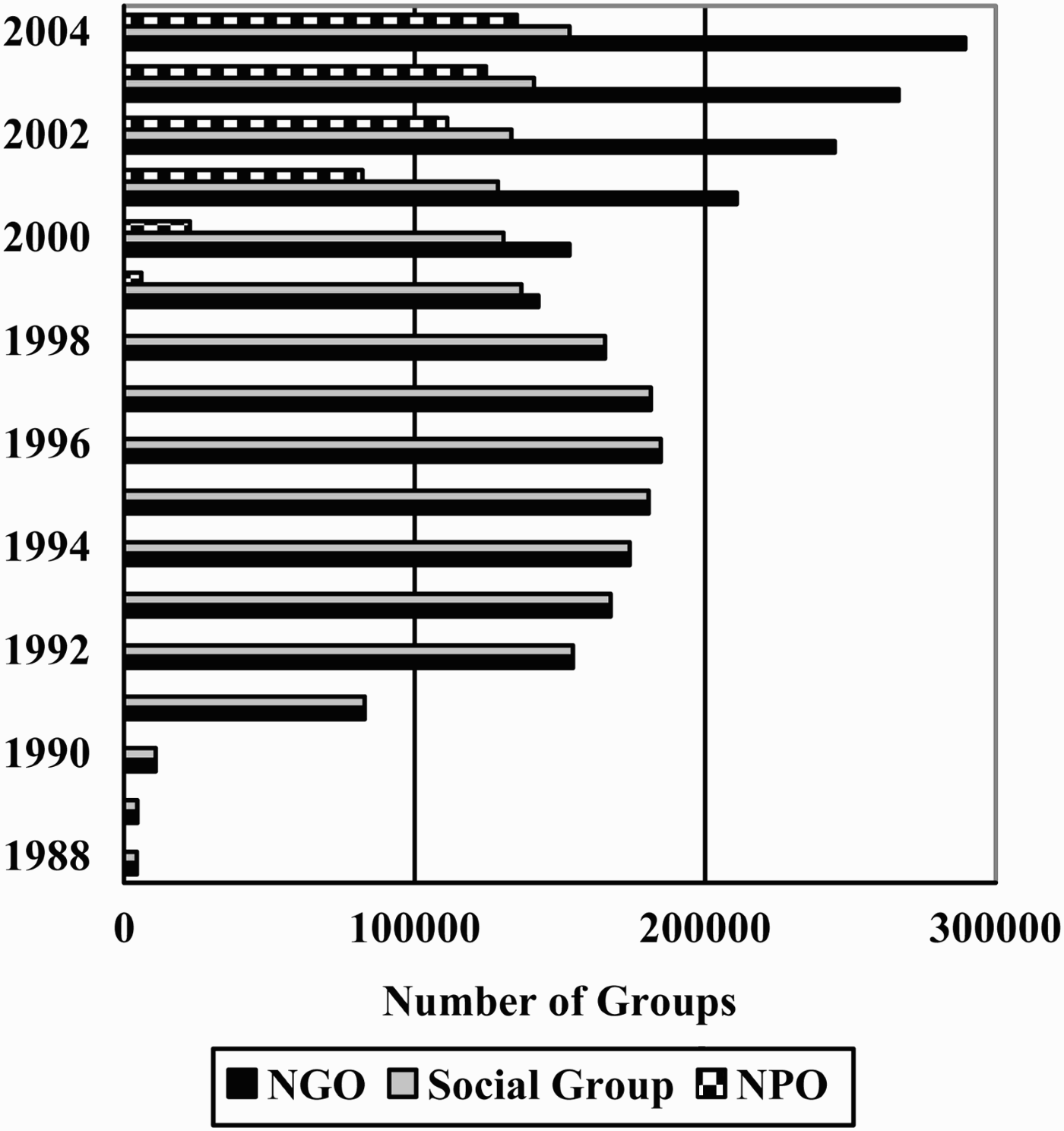
Registered Civil Society Organizations in China

Note: Statistics are drawn from the Ministry of Civil Affairs. Please note that NGO is the category under which all groups are registered, although there are subcategories of social group, non-profit organization and foundation. Also foundations and social groups were only separate categories after 2002.
The following is a brief outline of the past debates on civil society in China. Increasing participation in social groups in China and the success attributed to civil society movements in the collapse of communism in Eastern and Central Europe led many China scholars to investigate civil society's emergence in the early 1990s.Footnote 6 These examinations were based on a model of civil society developed by Jürgen Habermas, positing a public sphere autonomous from the state and composed of groups of voluntary associations. Habermas contends that establishing this ideal type of civil society based on the historical experiences of Western Europe is important as a heuristic for understanding state–society relations.Footnote 7 The key criterion for this idealized civil society, one that plays an oppositional role to the state and fosters democracy, is that the associations composing civil society must be autonomous from the state. If civil society is not autonomous, it cannot allow the democratic will-formation for legitimizing or opposing state action. A public sphere of un-coerced action is necessary for the development of social trust upon which collective action rests. The majority of scholars studying civil society concluded that associations that sometimes served to oppose the state did exist in China, but they did not fit Habermas's model in that they were not fully autonomous.Footnote 8 In fact, in 1996, a high official in MOCA estimated that fewer than 50 per cent of groups were self-organized, self-supported and self-governed.Footnote 9 Similarly, Chinese and Western analysis of the late 1990s based on autonomy from the state suggested that the majority of groups are semi-governmental.Footnote 10 Many scholars critiqued the search for civil society in China as impossible by either imposing a Western state–society model or as attempting to find an autonomous civil society that does not exist.Footnote 11
Whereas past research largely found little autonomy from the state, recent research emphasizes the variation in autonomy in both mass and grass-roots organizations. Several scholars find that as the market changes from centrally planned to market-based, workers in mass organizations like the Labour Federation have begun not only to “articulate its interests vis-à-vis the state, but their individual rights vis-à-vis the group.”Footnote 12 The mass organizations have gradually begun to shift from state corporatism to a role of social representation, leading many to the conclusion that this is an area of emerging civil society in China.Footnote 13 Although mass organizations are legally dependent on the state, funding and issue or project decisions are increasingly more independent, leading to a more dynamic role for these organizations than imagined under the state corporatism model. In addition to the mass organizations structured by the government, many self-organized or grass-roots associations exist to promote members' interests in business, professional and social realms. There is great variation in the legal status of these associations: many are registered as social organizations (minjian zuzhi 民间组织), but many are unofficially associated with a university or operate informally. Howell contends that since the early 1990s, the creation of new forms of associations such as networks, centres, user groups and projects can bypass the need for registration; however, the group's intentions still matter – if it appears to have political goals it will be repressed by the state, but if it appears beneficial local officials especially will turn a blind eye towards registration.Footnote 14
Besides variation in legal autonomy, many groups rely on a diversity of funding, such as grants from INGOs (international non-governmental organizations), foundations, international organizations, foreign governments and businesses, and the Chinese government. This suggests that civil society organizations have some autonomy from the state. For example, recent research highlights private business associations (shanghui 商会) which are funded through membership dues and independently select issues to advance. Despite past analyses which questioned the ability of these groups to sustain collective action because of the lack of common identity among entrepreneurs, recently Scott Kennedy has found that membership in these groups is increasingly creating such an identity.Footnote 15 Kennedy argues that economic reforms created incentives for businesspeople to defend their interests, often by joining associations but also by direct lobbying. He finds that these associations are primarily voluntary, increasingly financially independent, not ordered hierarchically and not unchallenged representatives of certain interests.Footnote 16 While Kennedy shows that these groups secure their own funding and develop their own issue agendas, he argues that a focus on civil society as autonomous from the state privileges separation as being more important than access to challenge the state, as well as privileging organized political action.
Similarly cultural organizations in China, one of the largest growing group categories, are composed of voluntary membership depending in large part on dues or donations. This category consists of groups organized to protect and promote cultural practices such as ethnic music, ethnic history or tradition, religion, traditional music or literature, and martial arts. These groups are increasingly popular, and are autonomous from the government although in some instances they might receive funding for a particular project from the local government. Lily Tsai recently explored how these groups actively seek to provide public goods and services to community members, using embedded relationships such as kinship ties.Footnote 17 As recent research illustrates, civil society in China – NGOs, private business associations and cultural groups – exercise varying degrees of autonomy through registration status, funding sources and in project decisions.Footnote 18
In the past, analyses of civil society in China often relied on this dichotomous understanding of societal autonomy: civil society must either be completely autonomous similar to the Habermasian model, or completely co-opted similar to the state corporatism model. While many scholars contend that state corporatism no longer best describes the Chinese state–society relationship, it is also claimed that this relationship does not fit into a Habermasian model.Footnote 19 This leaves the obvious dilemma that using group autonomy to define a model of state–society relationships is inconclusive when group autonomy varies greatly. As described in the preceding section, both mass and grass-roots organizations vary in their level of autonomy from the state, whether measured legally, by funding or by project decisions. This variance is seen not just in China but also around the world. In fact, Lester Saloman finds most Western governments fund NGOs at high levels: Western European NGOs receive 56 per cent of their funding from the state.Footnote 20
Other scholars also have reservations about the use of autonomy to delineate state–society relationships. For example, many question the notion that there exists a “bright line” dividing state and society; in fact, Neera Chandhoke argues, this line is blurred and dynamic.Footnote 21 Thus the dichotomy between state and society is over-idealized and in reality the two overlap. Timothy Brook argues that civil society in China should be thought of as a spatial interaction between state and society, not as something between or autonomous from either.Footnote 22 Alison Jaggar agrees with this conception, and argues that civil society is “enmeshed with the state … in a complex, changing and co-dependent web of relationships that are both oppositional and symbiotic.”Footnote 23 Michael Walzer goes as far as to reject the idea that civil society can exist without the state, saying “the state frames civil society and occupies space within it. It fixes the boundary conditions and the basic rules of all associational activity. It compels association members to think about a common good beyond their own conceptions of the good life.”Footnote 24 Given the necessity of an interacting and overlapping state–society relationship, Gordon White argues “in brief, the extent to which a specific social organization embodies the defining qualities of ‘civil society’ – autonomy, separation and voluntariness – is a question of degree rather than either/or.”Footnote 25 This overlap implies the need for a more interactive approach to understanding state–civil society relationships. Additionally, the use of an oppositional model overlooks the positive interaction potentially found in a more dynamic model. Using this conception, the relationship is one that is shifting, contested and periodically accommodating or oppositional depending on the issue. For example, Philip Huang envisages a “third realm” between state and society where a civil society exists born of the interaction of the two.Footnote 26 In fact, full autonomy might not be necessary for associations to play an oppositional role, simply “relative autonomy.”Footnote 27 A focus on state–civil society autonomy disregards that this is a dynamic space where boundaries might shift, and both society and the state have influence.
Habermas' model concentrates on two aspects of civil society – the state–society relationship and the role of civil society. As explained above, this model as it has been elaborated by other Western theorists posits an oppositional relationship between state and society, and the role of civil society in acting in the public sphere to generate a democratic will and, if necessary, to oppose the state to attain this will. Chinese civil society does not fit this model well, but rather than debating the usefulness of imposing a model from one historical context on another or categorizing all civil society in China as not in fact being a civil society, I use the empirical richness of past research and my field research in China to re-envisage civil society as an action-based category.Footnote 28 The primary differences between an action-based definition of civil society and a Habermasian conception are, first, that the state–society relationship is theorized to be dynamic and contested, and thus not dependent on autonomy as the primary determinant of the relationship but rather allowing for a relational view that includes varying degrees of partnership and collaboration. Second, an action-based definition focuses on the ability of civil society organizations to create social trust, collective action and civic participation. This definition allows us to move away from a model of autonomous and contentious state–society relationships that does not fit either the developed or developing world well, and towards a model of state–society collaboration that enables civil society to generate better governance and welfare outcomes.
Analysing the role played by civil society in post-earthquake relief efforts allows us to trace this gradual development of civil society in China. I first examine how relief efforts serve as a learning process for both civil society and local government, and then outline how civil society uses a strategy of co-operation with the local state to meet its service delivery and advocacy goals.
Participation without Formal Institutions
Immediately after the extent of the earthquake devastation became clear, the Chinese Red Cross was able quickly to organize an action plan and receive government approval, but many local NGOs and INGOs were not sure how best to deliver assistance or how to co-ordinate their activities with each other and the local government. Thus groups were unable to assist the relief efforts coherently, had difficulty in gaining access to disaster areas and duplicated others' efforts. While many groups, such as the Western Volunteers Association (Xibu zhiyuanzhe 西部志愿者), have extensive networks of volunteers, they did not have the organizational capacity to mobilize and conduct relief efforts.Footnote 29
To resolve these problems, the founders of the Chengdu Urban Rivers Research Group (Chengdu chengshi heliu yanjiuhui 成都城市河流研究会) used personal connections in the government to meet officials in charge of relief efforts to assess how they might effectively partner the government. Through this meeting they persuaded the government that they could co-ordinate the civil society community's activities through organizing a command structure called the Non-Governmental Relief Services Centre with approximately 30 groups ranging from environmental to poverty alleviation to rural education groups (5.12 Minjian jiuzhu fuwu zhongxin “5.12”民间救助服务中心).Footnote 30 In addition to co-ordinating relief efforts and communication among civil society groups, this umbrella organization served as the bridge between civil society and the local government by providing information, mediation, co-ordination and securing access.Footnote 31
The organization used two methods to mobilize groups, resources and volunteers. First, the Chengdu Urban Rivers Research Group used its online platform (pingtai 平台) to provide real-time information about relief needs and co-ordinate information and efforts between government, local NGOs, INGOs, volunteers and donors. Additionally, it convened a meeting on 15 May 2008, to plan co-ordinated relief efforts with other members of the umbrella group, and resolved issues such as creating a volunteer database, training programme and insurance plan. At the end of this meeting, members of the umbrella group met members of the government to establish relief plans and tour the disaster area together. Through this process, civil society groups organized themselves to participate in relief efforts. The Centre trained and provided volunteers to government agencies or other groups' relief projects, collected financial and material resources from society and delivered these to the disaster sites, and supported the troops with food, medicine and water. This assistance greatly supported the government's relief efforts, and organized the large amounts of donations and volunteers that were quickly overwhelming the local government.Footnote 32 The following section examines how relief efforts revealed increasing group capacity in terms of human and financial resources, as well as continuing problems with professional project management and auditing skills.
The Capacity Deficit of Chinese Civil Society: Human and Financial Resources
Initial reports of civil society's role in the relief efforts emphasized how it was strengthened by the flows of financial donations and materials. By 16 May, MOCA stated that a total of 3.2 billion yuan of donations in cash and relief materials had been received, 81.7 per cent from domestic sources and 18.3 per cent from international sources, including foreign governments and international organizations.
Many of these domestic donations were not completely voluntary. Lists of how much each company, agency and famous individual donated were publicly available on television and in most major newspapers. For example, basketball star Yao Ming was criticized in the media and online forums for offering half a million yuan which was not viewed as sufficient; in response, he quadrupled his donation.Footnote 33 At some companies, bosses also publicized names of employees with the amount they donated.Footnote 34 The public pressure to donate large amounts was high, and many companies feared boycotts if not seen as generous in their giving. Additionally, most donations go directly to the local government or the Chinese Red Cross, and not to local civil society organizations. Although civil society groups have captured additional financial resources with which to assist in relief efforts, most donations are not voluntary and are not flowing through these groups, meaning that these lines of financing will not remain open in the future. Both these factors raise serious questions as to the creation of a philanthropic corporate or social base that will increase future civil society capacity.
Analysts argue that relief efforts dramatically increased the human and financial resources of these groups, allowing them to play a larger role than many expected.Footnote 35 The volunteer base has significantly increased since the earthquake; however, most of these volunteers are students with little training and no professional experience. Another common criticism is that these groups have little experience with relief efforts and do not have professionally trained project managers, which led to poorly co-ordinated initial relief efforts.Footnote 36 For example, many groups were not accustomed to co-operating with other groups or local government, and had conflicts with service-delivery methods and the government decision-making process.Footnote 37 Many civil society professionals and academics recounted stories of groups which turned away volunteers and donations simply because they did not have the trained staff or work processes to handle them: “A local doctor called a civil society group he had heard was participating in relief efforts and offered to volunteer, but the group did not know how to deploy his skills so asked him to buy some water instead. Even though a doctor would have been useful, they couldn't make use of him.”Footnote 38 The inability of civil society groups to manage the financial and human resources available illustrates the lack of skilled project managers and institutionalized processes of auditing, project management and volunteer training. Additionally, as discussed below, prospective volunteers and donors often bypassed civil society groups, reflecting a lack of belief in the groups on the part of citizens and corporations.
In summary, participation in relief efforts highlighted both the improved capacity of groups and remaining capacity problems faced by these groups. For example, groups demonstrated their ability to respond quickly to crisis situations in moving funding and staff to the disaster site, even though their domestic fundraising activities were technically illegal at the time. They also dramatically expanded their ability to transmit real-time information by linking with online communities of volunteers and donors to spread information about their view of relief efforts and to commission donations. This increased ability to manage complex projects and to use the media to transmit information expands the capacity of groups. However, it is unclear that habits of donations were inculcated that would continue to fund these groups after reconstruction efforts. Additionally, there remain many questions as to the capacity of these groups to manage projects effectively, especially regarding auditing and staffing practices. Therefore, while participation in relief efforts advanced group capacity in identifying funding sources and providing on-the-job training for staff in project management and accounting, significant capacity weaknesses remain in these areas that must be addressed in order for civil society to progress.
The Trust Deficit of Chinese Civil Society: Mobilizing Society
The presence of what many analysts are calling “informal civil society,” meaning spontaneous unorganized social action, illustrates the difficulty for many groups in mobilizing society outside existing networks.Footnote 39 A common explanation for why so many donors and volunteers bypassed existing civil society organizations is that these groups are seen as ineffective: “This kind of civil society, based not around formal organisations but around issues, can mobilise more people.”Footnote 40 Another explanation is that corporations and citizens do not trust these groups, as evidenced by low trust levels in the World Values Surveys in China.Footnote 41 As one interviewee noted, “If an ordinary (laobaixing 老百姓) Chinese gives 100 kuai to a group, he wants to see that group spend 100 kuai on the activity. If the group uses any of that money for administrative costs, the ordinary Chinese thinks that is corruption.”Footnote 42 Because trust for civil society is low and many doubt groups' capacity to undertake this work, a great deal of the donations and volunteers were not an organized response, but rather a spontaneous one to the tragedy.Footnote 43 While many older Chinese embrace what they see as the younger generation's return to traditions of community assistance from the materialism of the last two decades, this type of social action does not strengthen but rather undermines civil society.Footnote 44 If social action takes place outside organized civil society, these groups will find it difficult to increase their capacity or social trust levels.
Despite the presence of unorganized participation, many analysts argue that relief efforts created a strong volunteer base for civil society through feelings of social responsibility and habits of volunteering. As Jia Xijin, a scholar at the school of public policy and management at Tsinghua University explains: “It's good news for civil society. People are aware of their social responsibility.”Footnote 45 Reporters described the outpouring of volunteer efforts as “the whole country seemed to mobilize for relief work, showing the generosity and sense of duty expected in a civil society. Thousands of volunteers went to the quake zone, and tens of billions in cash has poured into Sichuan province. People queued at blood donation vehicles, and many are seeking to adopt quake orphans.”Footnote 46
Civil society groups actively worked to mobilize volunteers and donors, and while many participated through informal channels, these unorganized volunteers and donations, once in Sichuan, were managed and co-ordinated by groups. As one government official observed:
All of these volunteers, money and materials flooded into the disaster zones. Anyone who had a van was trying to deliver materials to these places. It got very chaotic as the troops who were supposed to be doing relief efforts ended up taking care of the unorganized volunteers. Finally we asked the Red Cross and the NGO Relief Centre to supervise these spontaneous volunteers and donations.Footnote 47
Groups trained and co-ordinated these volunteers, and developed a strong volunteer base for the future.Footnote 48 Many were college students, but there were also a number of young professionals who had never before volunteered or interacted with civil society. While it is too early to tell if habits of volunteering and donating were internalized, participation in relief efforts (and perhaps also with the Olympics) created a more trained, diverse and socially responsible potential volunteer base.Footnote 49
In addition to expanding their volunteer base, many groups learned for the first time how to mobilize their networks of members across great distances. For example, the Mothers Network (Mama luntan 妈妈论坛), an online group of mothers who routinely discuss issues concerning children, mobilized in response to the earthquake and quickly gathered money and supplies from members.Footnote 50 One example of their relief efforts was to collect donated books and deliver them to the temporary schools established in the disaster areas. This case is particularly interesting given the explosion of online communities in China. Most analyses of civil society in political science ignore these online clubs because they are formed for purely social reasons, not political ones, and do not occupy space in the physical world. However, in China these social networks can become politically relevant when a particular issue catches the membership's attention. The earthquake caused the members of the Mothers Network to provide relief efforts and discuss the issues facing the orphans and school children, as well as motivating members to meet in person for the first time. The use of information technology dramatically increases the capacity of these groups, and shows their strong potential mobilization power, especially over different regions.Footnote 51 This example illustrates the growth and potential strength of civil society; however, this type of mobilization plays on government fears of spontaneous social mobilization not directed by the Party. Although civil society, including online clubs, demonstrated the ability to mobilize new volunteers, the presence of unorganized participation illustrates the remaining trust and capacity deficit of these groups.
The Trust Deficit of Chinese Civil Society: Local Government Interaction
In addition to low levels of trust for civil society among the general population, local government in Sichuan also revealed a lack of trust in these groups' intentions. The key doubt felt by many local officials was succinctly summarized by one cadre: “If their funding is from overseas, what are the true motives of this group?” While one fear is that the groups intend to oppose the government, the more immediate fear is that they want to substitute for government, and through this substitution reduce local government power and authority. Local officials feel threatened that the strengthening of civil society might create social disorder and erode their own power and authority, but also that many in the international community and in central government view these groups as a substitute for local government. They feel threatened that people outside their province view their work as of poor quality and believe that civil society groups could do this work better. As one cadre explained:
Why would people say that local government has low capacity or doesn't understand the needs of our people? We are very professional and are able to accomplish most of our goals. I have worked and lived in this area all of my life, and no one [civil society groups] can do my job better than me or know better than me what the people need.Footnote 52
However, there was tremendous pressure from the public, central government and foreign governments to allow civil society groups to participate in relief efforts. This led to conflicting attempts to support groups which were deemed politically safe and to control groups which were not well known. Compounding this distrust was the lack of understanding by local government of the role, capacity and work processes of civil society groups.Footnote 53 Additionally, the legal status and official role of civil society in China is unclear.Footnote 54 Uncertainty over which groups were appropriate to co-operate with delayed the participation of many groups until “bridge” organizations such as the Non-Governmental Relief Services Centre were established, with local government unwilling to grant permission to enter disaster sites, share information or partner on relief efforts.
Despite initial mutual mistrust, relief efforts allowed both sides to understand more about how to work together in a complementary fashion to secure mutual goals (peihe zhengfu 配合政府). For example, civil society organizations supported the troops with water, medicine and food, while the troops engaged in the more physical efforts of relief work.Footnote 55 Through co-operation the government recognized the need for group capacity building, and groups acknowledged the need for co-operation with the government and to increase their capacity, especially in managing funding and training staff.Footnote 56 Both sides realized that co-operation leads to amplification of efforts, money, resources, reach and legitimacy.Footnote 57 Working as partners to deliver relief efforts helped build a more trusting relationship that can be used in the future between government and groups, and constructed a potential model of co-operation. For example, a Hong Kong-based relief organization first partnered the government to deliver aid and then partnered a local NGO, bringing three actors together in one project.Footnote 58
In addition to creating a potential model for local state–civil society co-operation, relief efforts constructed a model to enable the central government to supervise groups better.Footnote 59 In response to the large amounts of donations and public fears of corruption, the central government created new channels for supervising both the projects and funding of groups. The government increased information transparency about relief spending and death counts, and piloted a new supervision model that includes local government, MOCA and group representatives in a form of “mutual supervision.”Footnote 60 For example, the National Audit Office, MOCA and the State Council are supervising both local government and charities' use of relief funds and materials.Footnote 61
Therefore, the local state–civil society partnership during relief efforts served as a learning process for both sides creating models to deliver services and create accountability. To develop and deliver services, the local state–civil society co-operation model is characterized by the responsible government agency partnering a high capacity group – usually an INGO or large domestic group often founded by a cadre – which then supervises smaller local groups. Additionally, this co-operation model contains a mutual supervision system where civil society plays an active role in helping the central and provincial government supervise lower levels of government and civil society groups.
However, it is uncertain if these models will be extended to the rest of China because of fears of social disorder in the current political context. After the Tibetan protests in March 2008, MOCA worried about groups using international funding to oppose certain government policies and create social unrest. This worry was further heightened by angry parents protesting over school collapses after the earthquake.Footnote 62 As social unrest increased, local government pressured civil society organizations not to interact with parents.Footnote 63 MOCA is uncertain if groups would continue to play a social mediation role similar to the one during relief efforts, or a social mobilization role in opposition of government goals.
Implications for Strengthening Chinese Civil Society
Although earthquake relief efforts strengthened civil society in many ways, it also revealed problematic institutional and group weaknesses that must be remedied before civil society is truly strengthened.Footnote 64 Necessary reforms to improve the trust and capacity deficit of civil society organizations are increasing the trust of both government and society, strengthening auditing procedures, improving human resource capacity, and reforming laws about social group status, role in the policy process, donations and registration.
First, civil society groups and international capacity-building organizations must focus on building human resources and professional skill levels. Groups need to build capacity specifically in transparent auditing processes and in professional management skills, especially project management. While many capacity-building projects are currently under way in China, this area must receive more funding and attention. Second, in order to increase trust levels of civil society, groups must publicize their activities and work processes. Many people in society and government do not understand how these groups conduct projects or what their goals are in society. In addition to this ignorance, many also distrust groups that are viewed as foreign proxies. Groups need to learn how to use online platforms and media to broadcast their existence and activities in order to increase the knowledge of and trust in them, similar to the platforms maintained by environmental groups.Footnote 65 They often do not advertise their activities for fear of the government increasing monitoring; however, this publicity is necessary to increase exposure, legitimacy and trust.
Third, MOCA must reform laws about social group status, role in the policy process, donations and registration. Current regulations maintain costly and difficult registration procedures that most civil society groups do not understand, do not allow domestic fundraising except for certain registered charities, and do not legitimize a role for groups in either the social or political life of China.Footnote 66 The government needs to alter rules on registration and fundraising to match the reality on the ground witnessed during the earthquake relief efforts.Footnote 67 One way to reform current laws about domestic fundraising is to develop an independent “social auditing agency” to ensure that groups handle donations properly. However, many experts argue that MOCA is wary of institutionalizing the role of non-governmental organizations, giving them a role that could grow and provide a counterweight to the one-party state: “The government is a little worried. The traditional way people participated in the past is through their work unit or through the Party system. Now, other groups are arising to fulfil a social need.”Footnote 68 However, in response to the development of civil society MOCA has created a new NGO management office, headed by an academic who studied civil society at Tsinghua University, which is considering how best to reform the current laws.Footnote 69 Additionally, an even more difficult reform is how to institutionalize a role for these groups that allows them to play a beneficial role in society while establishing effective government supervision. One reform that is being piloted is a participatory budgeting process at the local level, which allows civil society groups to play an advocacy role in the policy process.Footnote 70
By clearly revealing civil society's strengths and weaknesses, the relief efforts served as a learning process which highlighted obstacles – trust and capacity weaknesses in civil society and its governing institutions – which inhibit further development. Thus reforms institutionalizing groups' roles, increasing capacity, and improving trust between society, groups and the local state must be undertaken to consolidate gains and further strengthen civil society. However, participation in relief efforts strengthened civil society by increasing co-operation between civil society groups, society and local government, creating a model of local state–civil society co-operation that can be used in the future.
Civil society in China is clearly playing an increasingly independent and important role in both service delivery and policy advocacy. The case of the post-earthquake relief efforts illustrates that civil society in China acts like civil society in many democracies, by identifying social needs, developing projects to address these unmet needs, and mobilizing resources from state, society and market. Despite using a local state–civil society co-operation model, civil society is acting independently and is not simply being co-opted by the state. In fact, much of the co-operation was designed by civil society groups and imposed on the local government through international and domestic pressure. I find that this co-operation model is similar to the strategies used by many other civil society groups in China.Footnote 71 While this case illustrates the significant independent role of civil society in China, it also reveals the remaining obstacles to further development.
Interview Appendix