Impulsivity has been identified as a risk factor for a wide array of maladaptive outcomes in adolescence and early adulthood, including heightened aggression, substance use, and risky sexual behavior (Colder & Chassin, Reference Colder and Chassin1997; Fergusson, Boden, & Horwood, Reference Fergusson, Boden and Horwood2013; Kahn, Kaplowitz, Goodman, & Emans, Reference Kahn, Kaplowitz, Goodman and Emans2002; Nagin & Tremblay, Reference Nagin and Tremblay2001). In particular, previous research with the New Zealand birth cohort has found that low self-control in the toddler years is associated with greater externalizing problems much later in life, including heightened criminal behavior (e.g., Caspi, Moffitt, Newman, & Silva, Reference Caspi, Moffitt, Newman and Silva1996; Moffitt et al., Reference Moffitt, Arseneault, Belsky, Dickson, Hancox, Harrington and Sears2011; Moffitt, Poulton, & Caspi, Reference Moffitt, Poulton and Caspi2013). While impulsivity has also been associated with greater substance use and risky sexual behavior (Colder & Chassin, Reference Colder and Chassin1997; Cooper, Agocha, & Sheldon, Reference Cooper, Agocha and Sheldon2000; Oldehinkel, Hartman, De Winter, Veenstra, & Ormel, Reference Oldehinkel, Hartman, De Winter, Veenstra and Ormel2004), much of this research is limited to studying impulsivity in adolescence or adulthood (for notable exceptions, see Caspi et al., Reference Caspi, Moffitt, Newman and Silva1996; Dodge et al., Reference Dodge, Malone, Lansford, Miller, Pettit and Bates2009; Sitnick, Shaw, & Hyde, Reference Sitnick, Shaw and Hyde2014). Identifying early risk factors is an important first step in designing effective prevention and intervention programs, as early preventative programs can disrupt the developmental processes related to the emergence of later problem behaviors (Connell et al., Reference Connell, Bullock, Dishion, Shaw, Wilson and Gardner2008). Thus, the first aim of this study is to build on previous work and examine how impulsivity at age 2 predicts aggression, substance use, and risk sexual behavior during adolescence and early adulthood.
In addition, developmental psychopathology frameworks emphasize the importance of the interplay between social contexts and individual child attributes in predicting adjustment (Cicchetti & Rogosch, Reference Cicchetti and Rogosch1996). Because of children's greater physical and psychological dependence during the toddler years, parenting behaviors are particularly salient aspects of the environmental context (Maccoby, Reference Maccoby1992). However, longitudinal research examining the mutual interplay of parenting and impulsivity during toddlerhood has generally been constrained to examining developmental consequences in early childhood, stopping short of prospectively examining their interacting role in predicting long-term adjustment (e.g., Davies, Cicchetti, & Hentges, Reference Davies, Cicchetti and Hentges2015; Karreman, de Haas, van Tuijl, van Aken, & Deković, Reference Karreman, de Haas, van Tuijl, van Aken and Deković2010). Furthermore, developmental psychopathology models emphasize the heterotypic continuity in how early experiences of risk may emerge into distinct embodiments of maladjustment depending on the stage-salient challenges of specific developmental periods. Thus, the goal of the current study is to examine how impulsivity and parenting assessed at age 2 are related to three critical outcomes in early adolescence, middle adolescence, and early adulthood: aggression, substance use, and high-risk sexual behavior.
Associations Between Impulsivity and Problem Behavior
Broadly defined, impulsivity refers to traitlike individual differences in behavioral control and reactivity (Buss & Plomin, Reference Buss, Plomin, Buss and Plomin1984; Eisenberg et al., Reference Eisenberg, Ma, Chang, Zhou, West and Aiken2007). While the individual features of impulsivity continue to be debated (Evenden, Reference Evenden1999; Kochanska, Reference Kochanska1993), impulsivity is often considered to have behavioral, motivational, and cognitive components, including deficits in the ability to inhibit a dominant response, lack of forethought and planning, sensitivity to rewards and immediate gratification, and indifference to punishment or nonrewarding consequences (Vitaro, Arseneault, & Tremblay, Reference Vitaro, Arseneault and Tremblay1999). Thus, impulsive individuals are often guided by desires and immediate urges, with little thought paid to potential consequences of their actions (Slagt, Semon Dubas, & van Aken, Reference Slagt, Semon Dubas and Aken2016). Therefore, it is not surprising that impulsivity is often a core feature in theories of antisocial behavior and aggression, substance use, and risky sexual behavior (Cloninger, Reference Cloninger1987; Loeber & Dishion, Reference Loeber and Dishion1983; Pulkkinen, Reference Pulkkinen, Olweus, Block and Radke-Yarrow1986).
Impulsivity and the development of aggression
Impulsivity and correlates of impulsivity in school-age children have emerged as consistent predictors of aggressive tendencies in adolescence and adulthood (Nagin & Tremblay, Reference Nagin and Tremblay2001; Olson, Shilling, & Bates, Reference Olson, Schilling and Bates1999). Impulsivity during the toddler years has also been implicated as a risk factor for externalizing problems in early and middle childhood (Buss, Kiel, Morales, & Robinson, Reference Buss, Kiel, Morales and Robinson2014; Garstein, Putnam, & Rothbart, Reference Gartstein, Putnam and Rothbart2012). However, there is a paucity of research examining the influence of impulsivity in early toddlerhood on aggression in adolescence and adulthood.
The early toddler years may be particularly important in understanding the developmental processes that put individual children at risk for sustained aggression throughout adolescence. Stability in impulsivity first begins to emerge in the second year of life, a developmental period that also co-occurs with the beginning of parental expectations and demands (Kochanska, Reference Kochanska1993; Maccoby, Reference Maccoby1992). During this time, aggression and defiance emerge as normative reactions to frustration and anger, resulting in a period commonly referred to as the “terrible twos” (Loeber & Hay, Reference Loeber and Hay1997). While most children show subsequent declines in aggression as they develop self-regulatory capabilities (Miner & Clarke-Stewart, Reference Miner and Clarke-Stewart2008; Shaw, Lacourse, & Nagin, Reference Shaw, Lacourse and Nagin2005), children high in impulsivity are considered to be at risk for sustained aggressive tendencies because of deficits in regulating their behavioral responses to experiences of anger and frustration (Vigil-Colet & Codorniu-Raga, Reference Vigil-Colet and Codorniu-Raga2004). In support of the hypothesized link between toddlers’ impulsivity and later aggression during adolescence and early adulthood, in a birth cohort of New Zealand children the broader construct of low self-control at age 3 predicts later antisocial behavior and criminality into adolescence and adulthood (e.g., Caspi et al., Reference Caspi, Moffitt, Newman and Silva1996; Moffitt et al., Reference Moffitt, Arseneault, Belsky, Dickson, Hancox, Harrington and Sears2011, Reference Moffitt, Poulton and Caspi2013).
Impulsivity and substance use
Impulsivity has also been implicated as a core behavioral characteristic of adolescent and adult substance abusers (Bari & Robbins, Reference Bari and Robbins2013; Cloninger, Reference Cloninger1987; Perry & Carroll, Reference Perry and Carroll2008). Substance use can be conceptualized as choosing a smaller and more immediate reward (e.g., heightened arousal and feelings of euphoria) over a long-term reward (e.g., better health and academic success; de Wit & Richards, Reference de Wit and Richards2004; Perry & Carroll, Reference Perry and Carroll2008). Abstaining from substance use, particularly after prior experience with the substance, also requires the ability to inhibit a prepotent response (Jentsch & Taylor, Reference Jentsch and Taylor1999). Because children high in impulsivity are (a) more likely to discount future rewards or consequences in favor of immediate gratification and (b) show deficits in inhibitory control, individuals high in impulsivity are hypothesized to be particularly susceptible to substance use and addiction.
Several longitudinal studies have established that behavioral undercontrol during the preschool years predicts later substance use problems in adolescence and early adulthood, particularly among boys (Caspi et al., Reference Caspi, Moffitt, Newman and Silva1996; Dodge et al., Reference Dodge, Malone, Lansford, Miller, Pettit and Bates2009; Sitnick, Shaw, et al., Reference Sitnick, Shaw and Hyde2014). Despite the fact that links between impulsivity and risk for substance abuse problems are likely to be age specific (Molina, Pelham, Gnagy, Thompson, & Marshal, Reference Molina, Pelham, Gnagy, Thompson and Marshal2007), many studies either assess substance use during one developmental period (e.g., middle adolescence) or aggregate substance use across a wide range of developmental periods (e.g., from early adolescence to early adulthood). Highlighting the potential developmental specificity of the link between impulsivity and later substance use, Molina et al. (Reference Molina, Pelham, Gnagy, Thompson and Marshal2007) found that children diagnosed with attention-deficit/hyperactivity disorder during childhood showed elevated binge drinking and alcohol abuse symptoms during middle adolescence when compared to a control group. However, the attention-deficit/hyperactivity disorder and control groups did not differ in alcohol use during either early adolescence or young adulthood.
Impulsivity and high-risk sexual behavior
Fewer empirical studies have assessed the association between impulsivity and risky sexual behavior, particularly during adolescence. However, individuals high in impulsivity are thought to show greater propensities to tolerate and seek out high-risk sexual behaviors because of their inability to inhibit preponent responses and their sensitivity to rewarding aspects of behavior (Raffaelli & Crockett, Reference Raffaelli and Crockett2003; Zuckerman, Reference Zuckerman1991). In support of this hypothesis, cross-sectional research has linked impulsivity to risky sexual behavior in adult samples (Cooper et al., Reference Cooper, Agocha and Sheldon2000; Lejuez, Simmons, Aklin, Daughters, & Dvir, Reference Lejuez, Simmons, Aklin, Daughters and Dvir2004). In one of the few studies to examine the link between impulsivity and risky sexual behavior in adolescents, Kahn et al. (Reference Kahn, Kaplowitz, Goodman and Emans2002) found that higher impulsivity in an all-female sample was associated with a range of risky sexual behaviors, including age of first sexual intercourse, number of sexual partners, and nonuse of contraception and condoms. However, in addition to the lack of longitudinal research, research on impulsivity and risky sexual behavior has also been confounded by using samples with concurrent issues of substance use or delinquency, making it difficult to disentangle the unique link between impulsivity and risky sexual behavior (e.g., Cooper, Wood, Orcutt, & Albino, Reference Cooper, Wood, Orcutt and Albino2003; Lejuez et al., Reference Lejuez, Simmons, Aklin, Daughters and Dvir2004).
The Role of Early Parenting and Interactions Between Parenting and Child Impulsivity
According to the developmental psychopathology concept of multifinality, any individual component or trait has the potential for multiple end points (Cicchetti & Rogosch, Reference Cicchetti and Rogosch1996). The environmental context has been identified as a primary source of these diverging pathways, as individual traits are thought to function differently depending on the system in which they operate (Cicchetti & Rogosch, Reference Cicchetti and Rogosch1996). As such, the developmental sequelae of early impulsivity would be expected to vary based on differences in the early environmental context. During the toddler years, parents represent the most proximal and salient source of individual differences in environmental exposure (Maccoby, Reference Maccoby1992). However, empirical research examining the interaction between early impulsivity and parenting predicting long-term outcomes in adolescence and early adulthood is limited. Thus, a key remaining objective of this paper is to examine whether the interaction between impulsivity and parenting in the toddler years predicts later problems of aggression, substance use, and risky sexual behavior in adolescence and early adulthood.
Parenting and aggression
Parenting behaviors characterized by low warmth and high levels of anger, disapproval, and rejection have been consistently linked to an increased risk of externalizing problems in childhood and delinquency and aggression in adolescence and adulthood (Miner & Clarke-Stewart, Reference Miner and Clarke-Stewart2008; Patterson, Reference Patterson1982; Shaw, Hyde, & Brennan, Reference Shaw, Hyde and Brennan2012). Because impulsive children tend to have difficulties in self-regulation and coping (Rothbart, Ellis, & Posner, Reference Rothbart, Ellis, Posner, Baumeister and Vohs2004), the link between rejecting parenting and aggression may be exacerbated for impulsive children because of repeated and prolonged difficulties in regulating affect and behavior in the face of parental rejection. In addition, because of their own ill-equipped emotion regulation skills, rejecting parents may also be more likely to elicit early negative parent–child interactions (Shaw & Bell, Reference Shaw and Bell1993), particularly with highly impulsive toddlers as they begin to assert their own autonomy and independence (Trentacosta & Shaw, Reference Trentacosta and Shaw2008). These processes are likely to eventuate in increasingly aversive and coercive processes that put the child at risk for later aggression and behavior problems (Patterson, Reference Patterson1982).
However, prior research has generally been limited to either (a) exploring early childhood impulsivity and parenting in predicting aggression in later childhood (e.g., Campbell, Pierce, Moore, Marakovitz, & Newby, Reference Campbell, Pierce, Moore, Marakovitz and Newby1996; Davies et al., Reference Davies, Cicchetti and Hentges2015) or (b) examining temperament in middle childhood or adolescence in relation to concurrent or subsequent adjustment (e.g., Lengua, Wolchik, Sandler, & West, Reference Lengua, Wolchik, Sandler and West2000; Slagt, Dubas, Denissen, Deković, & van Aken, Reference Slagt, Dubas, Denissen, Deković and van Aken2015). In one of the few long-term longitudinal studies, Ahmad and Hinshaw (Reference Ahmad and Hinshaw2017) found that hyperactive/impulsive symptoms in girls aged 6–12 predicted increased externalizing behaviors (e.g., aggression and criminality) in adolescence and early adulthood, but only for those with highly authoritarian mothers.
Parenting and substance use
While longitudinal research on parenting during the toddler years and later substance use is limited, several key longitudinal studies have suggested that harsh or rejecting parenting increases the child's risk for subsequent substance abuse problems. For example, maternal hostility and unresponsive parenting in the early school years have both been associated with increased substance use in adolescence (Dodge et al., Reference Dodge, Malone, Lansford, Miller, Pettit and Bates2009; Siebenbruner, Englund, Egeland, & Hudson, Reference Siebenbruner, Englund, Egeland and Hudson2006). In addition, a study using the same data set as the current study found that low levels of parental nurturance at age 2 had an indirect effect on adolescent substance use through lower levels of parental knowledge during early adolescence (e.g., monitoring and adolescent disclosure; Sitnick, Shaw, et al., Reference Sitnick, Brennan, Forbes and Shaw2014). However, to our knowledge, studies on the influence of early parenting behaviors on substance use have not extended into early adulthood.
In addition, few studies have examined the interaction between early impulsivity and parenting on subsequent substance use, and these studies show mixed results. For example, findings from Rioux et al. (Reference Rioux, Castellanos-Ryan, Parent, Vitaro, Tremblay and Séguin2016) revealed that highly impulsive children at age 6 used alcohol more frequently at age 15 than children who were low in impulsivity, but only if they experienced highly coercive parenting at age 6. However, another study examining the related trait of “disinhibition” (e.g., high activity and approach behaviors) found that authoritarian parenting was most influential for children low on disinhibition, such that higher authoritarian parenting at age 4.5 predicted more rapidly increasing slopes of alcohol use during high school for children low on disinhibition (Armstrong et al., Reference Armstrong, Ruttle, Burk, Costanzo, Strauman and Essex2013). As these two studies had contradictory findings regarding the children most impacted by harsh parenting in relation to later substance use, the current study is intended to help clarify the nature of the potential interactive effects of early impulsivity and negative parenting on later substance use.
Parenting and risky sexual behavior
Theoretical conceptualizations of sexual behavior have also emphasized the importance of socialization agents on the subsequent development of risky sexual behaviors. For example, Belsky, Steinberg, and Draper (Reference Belsky, Steinberg and Draper1991) argued that harsh or rejecting childrearing practices in the first 5–7 years of life set the stage for later risky sexual behaviors, including early sexual initiation, multiple sexual partners, and increased risk of early pregnancy. In an empirical test of this theory, maternal harshness at 4.5 years of age was indirectly related to sexual risk taking in females at age 15 through the development of early pubertal onset (Belsky, Steinberg, Houts, & Halpern-Felsher, Reference Belsky, Steinberg, Houts and Halpern-Felsher2010). In the only longitudinal study to examine early caregiving as an antecedent to high-risk sexual behavior in boys, parenting low in nurturance (i.e., low responsivity and acceptance) at age 2 predicted higher sexual risk taking between the ages of 15 and 20 through the mediating influence of heightened peer deviancy at age 12 (Sitnick, Brennan, Forbes, & Shaw, Reference Sitnick, Brennan, Forbes and Shaw2014).
The extent to which the early caregiving environment predicts later risky sexual behavior has been proposed to vary based on individual genotypic and phenotypic (e.g., impulsivity) differences (Belsky et al., Reference Belsky, Steinberg and Draper1991; Del Giudice & Belsky, Reference Del Giudice, Belsky, Buss and Hawley2011). However, to our knowledge, no study has examined the potential moderating role of impulsivity in the link between early parenting and risky sexual behavior. Based on the independent associations of rejecting parenting and impulsivity on later risky sexual behavior (e.g., Feldman & Brown, Reference Feldman and Brown1993; Kahn et al., Reference Kahn, Kaplowitz, Goodman and Emans2002), the current study will examine if toddlers high in impulsivity are particularly susceptible to developing risky sexual behaviors in the context of early rejecting parenting.
The Current Study
The current study was designed to address several key limitations and gaps in the existing literature on impulsivity and problematic behavior in adolescence. First, we extend prior work on the associations between early impulsivity and parenting on subsequent problem behaviors in adolescence by examining the interactions between impulsivity and rejecting parenting during the toddler years on several domains of risky and problematic behaviors in adolescence and early adulthood. Second, existing research on the moderating effect of impulsivity and parenting on later child outcomes has generally relied on measuring indicators of either negative (e.g., harsh) or positive (e.g., warmth and sensitivity) parenting. In accord with more recent approaches examining interactions between child and contextual risk factors (Belsky & Pluess, Reference Belsky and Pluess2009), the current study focused on child impulsivity and parental rejection, the latter of which is thought to operate on a continuum from acceptance and warmth on one end to dislike and disregard on the other end (Simons, Robertson, & Downs, 1989). Third, prior studies on risky behavior in adolescence have often utilized a composite approach to studying outcomes across a range of ages. Because there are marked shifts in risky behavior during adolescence and the composite approach might obscure developmental findings (Schulenberg & Maggs, Reference Schulenberg and Maggs2002), we chose to examine outcomes at three distinct developmental time points reflecting early adolescence (age 12), middle adolescence (age 15), and early adulthood (age 22). Fourth, in addressing another significant gap in the field, we simultaneously examined aggression, substance use, and risky sexual behaviors as distinct outcomes to determine whether predictive pathways were unique to a specific form of risky behavior while accounting for its shared variance with other risky and problematic behaviors. We also accounted for concurrent impulsivity when possible to provide a more rigorous test of the links between impulsivity during the toddler years and later problem behaviors in adolescence and early adulthood.
Method
Participants
Data for this study were drawn from the Pitt Mother & Child Project, a prospective longitudinal study designed to examine the developmental precursors of antisocial behavior from infancy through childhood and adolescence. Participants included 310 infant boys and parents who utilized Allegheny County's Women, Infants, and Children Nutritional Supplement Program in the Pittsburgh, Pennsylvania, metropolitan area. To increase the probability of antisocial behavior in the future, sample recruitment was restricted to boys. Recruitment occurred when infants were between 6 and 17 months, with most children seen for the first time at age 18 months (see Shaw et al., Reference Shaw, Hyde and Brennan2012, for more information on recruitment procedures). For the purposes of the current study, impulsivity and rejecting parenting were measured when toddlers were 2 years old. Of the 310 families who originally participated at 18 months, 305 (98%) families had data available for at least one of the subsequent time points used in the current study (N = 305 at age 2, N = 235 at age 12, N = 257 at age 15, and N = 254 at age 22). The sample was racially diverse, with roughly half of the participants coming from a European American background (51%), followed by 40% who identified as African American, and 9% identifying as biracial, Hispanic, or other. At the 2-year assessments that were conducted in 1992 and 1993, mother-reported mean family income was $1,091 per month ($13,092 per year), and median maternal education was a high school diploma.
The current study also utilized data from assessments when the child participants were 12, 15, and 22 years old. The retention rate across the 20-year period from 18 months to age 22 was 82%. To test for selective attrition, we compared participants who remained in the study at age 22 with those who did not. There were no significant differences between those who did and did not remain in the study at age 22 on any of the variables included in the study.
Procedure
At age 18 months, researchers had families make an initial visit to the laboratory for a 1.5-hr assessment, during which time mothers completed questionnaires about their own and their family's well-being, as well as the target son's behavior. Mothers and sons also participated in a number of videotaped structured tasks varied in stress level to elicit individual differences in child and parenting behavior (e.g., free play, cleanup and teaching tasks, and the Strange Situation).
At age 2, researchers visited the homes of mothers and their target children for a 1.5-hr visit that allowed examiners to observe the quality of the home environment as well as parenting behaviors during semistructured tasks and a parent interview. As part of the same assessment, following the home portion of the assessment examiners drove the mother–child dyad to a laboratory for approximately 2 hr where more structured parent–child tasks were conducted. One of the parent–child structured activities conducted in the lab was a cleanup task that is widely used to assess child oppositional and aggressive behavior and multiple dimensions of parenting with young children (Martin, Reference Martin1981; Shaw, Keenan, & Vondra, Reference Shaw, Keenan and Vondra1994; Shaw et al., Reference Shaw, Winslow, Owens, Vondra, Cohn and Bell1998). Prior to the task, children were allowed to play with a variety of toys for a 15-min warm-up period while their mothers completed questionnaires with an examiner. Mothers were then instructed to get their child to put the toys away in the basket. The mother–child dyad had 5 min to complete this task, and the interaction was video recorded for subsequent coding.
Measures
Rejecting parenting
Maternal rejecting parenting was measured with two separate rating systems: (a) observations from the lab-based cleanup task at 2 years old, and (b) examiner impressions of the entire 4-hr age 2 assessment and interviews conducted with mothers during the home portion of the age 2 assessment. First, trained researchers used the Early Parenting Coding System (Winslow & Shaw, Reference Winslow and Shaw1995) to rate parenting behaviors during the cleanup task on nine molecular and six global codes. Rejecting parenting was assessed from the cleanup task by two molecular ratings (reverse scored verbal/physical approval and critical statements) and three global ratings (hostility, punitiveness, and reverse-scored warmth). Hostility was defined as expressions of anger (e.g., tone and mannerisms) directed toward the child, while punitiveness assessed the extent to which the mother was overly strict or harsh in response to the child's behavior. Warmth was defined as positive affect (e.g., smiles and affection) directed toward the child. To assess interrater reliability, Cohen κ coefficients for the molecular codes were 0.87 for verbal/physical approval and 0.79 for critical statements. The κ coefficients for the global ratings ranged from 0.83 to 0.94 for hostility, punitiveness, and warmth.
Second, trained graduate student researchers completed the 36-item Home Observation for Measurement of the Environment (HOME) scale based on their observations and an interview with the parent during the home visit. The HOME scale is a widely used assessment of parenting behaviors seen during home visits and has demonstrated good reliability and validity (Caldwell & Bradley, Reference Caldwell and Bradley1984). The 8-item acceptance of child's behavior subscale assesses the quality of maternal responses to child misbehavior or distress (e.g., “parent does not express annoyance or hostility to the child” and “parent does not shout at the child”). The HOME acceptance scale was chosen as an additional measure of parenting due to its reflection of parenting behaviors in a broader context occurring outside of the laboratory. The HOME acceptance subscale was reverse scored so that high ratings indicated less accepting and more rejecting parenting behaviors.
The five codes from Early Parenting Coding System and one subscale from HOME were standardized and averaged together to create a composite scale of rejecting parenting (α = 0.70). The resulting scale included three indicators of warmth/acceptance and three indicators of hostility/rejection, so that high scores reflect high levels of rejecting parenting and low scores reflect higher levels of accepting parenting. This construct has been used in previous research using the same data set to examine the links between parenting and early child noncompliance on externalizing and conduct problems in preschool and school-age children (Shaw, Gilliom, Ingoldsby, & Nagin, Reference Shaw, Gilliom, Ingoldsby and Nagin2003; Shaw et al., Reference Shaw, Winslow, Owens, Vondra, Cohn and Bell1998). However, it has not been used to examine its role in conjunction with impulsivity on later problem behaviors in adolescence and early adulthood.
Impulsivity
At age 2, mothers completed the Child Behavior Checklist (CBCL/2–3; Achenbach, Reference Achenbach1991), which was supplemented with 21 items from the Toddler Behavior Checklist (TBCL; Larzelere, Martin, & Amberson, Reference Larzelere, Martin and Amberson1989). An impulsivity factor was generated based on examining the CBCL and TBCL for items consistent with the inhibitory control subscale of the impulsivity scale on the Emotionality, Activity, Sociability, and Impulsivity Temperament Survey (Buss & Plomin, Reference Buss, Plomin, Buss and Plomin1984). We identified 4 items from the CBCL and 1 item from the TBCL. Items assessed the degree to which the child could not wait (e.g., “wants things now” and “demands must be met immediately”), was impulsive and approach oriented (e.g., “gets into everything” and “touches objects after being told no”), or was frustrated by constraints or limits (e.g., “easily frustrated.”). The resulting 5-item scale showed adequate internal consistency (α = 0.67). At ages 12 and 15, impulsivity was assessed by 3 items (e.g., “Is impulsive”) from the CBCL/4–18 (Achenbach, Reference Achenbach1991), which was completed by the primary caregiver (αs = 0.84 and 0.78, respectively). However, the age 22 assessment did not include a measure of impulsivity.
Adolescent problem behavior
At ages 12, 15, and 22, the target youth completed the Self-Report of Delinquency (SRD; Elliott, Huizinga, & Ageton, Reference Elliott, Huizinga and Ageton1985) measure. The SRD is a widely used and well-validated assessment of antisocial behavior that measures a range of delinquent behaviors, including theft, property damage, fraud, physical aggression, and substance use. The number and type of individual items differed on the age 12, 15, and 22 assessments to reflect the progression to more serious forms of delinquent behaviors (e.g., “hit other students” at ages 12 and 15 and “been physically cruel to someone else” at ages 15 and 22). However, we attempted to match individual items whenever possible to create scales of aggression and substance use while also being cognizant of the developmental progression of problem behaviors. All items on the SRD were administered using a 3-point Likert scale (0 = never, 1 = once or twice, and 2 = more often); however, because of low base rates and positive skewness on the resulting aggression and substance use scales, the items were dichotomized to indicate presence (i.e., 1 or 2) or absence (i.e., 0) of the behavior in the past year.
Aggression
Because of low internal consistency among physical aggression items at the age 12 assessment, aggression at age 12 was measured more broadly to also include destructive behavior (e.g., “damaged something not belonging to you” and “set fires”) and acting out (e.g., “sent home for bad behavior”). The resulting 13-item scale showed adequate internal consistency (α = 0.69). At age 15, an aggression factor was generated using 10 items that captured acts of physical assault (e.g., “hit other students or got into physical fight”) or threats of violence (e.g., “threatened anyone with a weapon”; α = 0.72). Many of the same items used at age 15 were also used for the aggression factor at age 22. However, several items pertaining to aggression were removed from the age 22 SRD because of developmental considerations (e.g., “hit teacher”). The resulting 8-item scale of aggression at age 22 showed adequate internal consistency (α = 0.62).
Substance use
Adolescent self-reports on the SRD were used to assess substance use at ages 12 and 15. Because of low base rates and weak interitem correlations between tobacco, alcohol, and marijuana use at age 12, substance use was measured by 2 items pertaining to the consumption of beer and wine (r = .46). At age 15, substance use was measured by 9 items that assessed the consumption of alcohol (e.g., beer and liquor) and tobacco as well as the use of marijuana and other illicit substances (e.g., methamphetamine and “speed”; α = 0.74). At age 22, participants completed the 12-item Alcohol and Drug Consumption Questionnaire (Cahalan, Cisin, & Crossley, Reference Cahalan, Cisin and Crossley1969), which measures the frequency of drug and alcohol use on a 9-point Likert scale (0 = have never tried, 8 = everyday use). This measure replaced the SRD as an indicator of drug use because of the increased use and availability of certain drugs in early adulthood (e.g., binge drinking and abuse of prescription or over-the-counter drugs). Alcohol, tobacco, and marijuana use items were normally distributed and used the full range of the scale. However, the other 9 items (e.g., cocaine, sedatives, and heroin) in the questionnaire were heavily skewed and had few endorsements in the upper range of the scale. Therefore, these 9 items were dichotomized into a score of 0 (never used) or 1 (used at least once), while we retained the original scale for alcohol, tobacco, and marijuana use. All 12 items were then standardized and averaged together to create a measure of substance use at age 22 (α = 0.84).
Risky sexual behavior
At age 15, risky sexual behavior was assessed by two items on the SRD relating to whether the participants had had sex and had engaged in unprotected sex (r = .56). At age 22, participants completed a modified version of the Youth Risk Behavior Survey (Eaton et al., Reference Eaton, Brener, Kann, Denniston, McManus, Kyle and Ross2010). Three items assessing age of first sexual intercourse and number of sexual partners within the last month and within their lifetime were standardized and used to assess risky sexual behavior at age 22 (α = 0.71).
Covariates
Observed child aggression and family socioeconomic status (SES) at child age 18 months were included as covariates in all models to rule out “third variable” explanations in relation to adolescent and young adult problem behavior. Early aggression was assessed based on coding of several observational tasks during the laboratory visit (e.g., free play, cleanup, teaching, and Strange Situation). The total coding time of the tasks was 23 min. Coders examined the video-taped records of the task for instances of physical aggression, including throwing toys or objects, hitting or biting the parent or experimenter, or directing aggression at objects in the room (e.g., kicking the door and pounding a toy on the floor). Coders then provided a global rating of aggression on a 4-point scale: 1 = unaggressive, 2 = mildly aggressive, 3 = moderately aggressive, and 4 = severely aggressive. Interrater reliability between observers was satisfactory, as evidenced by a κ coefficient of 0.90 (Shaw, Keenan, & Vondra, Reference Shaw, Keenan and Vondra1994).
At the 18-month assessment, mothers also responded to questions about their own and their partner's occupational status and educational level on the Hollingshead Four Factor Index of Social Status (Hollingshead, Reference Hollingshead1975). Scores ranged from 1 (farm laborers/menial service workers) to 9 (higher executives, proprietors of large businesses, and major professionals) for occupational status (M = 2.17) and 1 (no formal education to 7th grade) to 7 (master's or doctoral degree) for educational level (Mdn = 4). These responses were used to create a measure of family SES, according to standard procedures as outlined by Hollingshead (Reference Hollingshead1975).
Results
Descriptive statistics and preliminary analyses
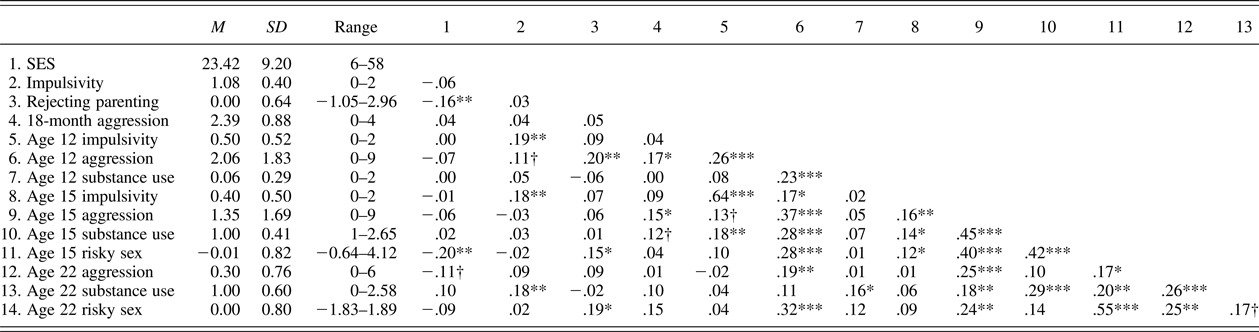
Table 1 provides the means, standard deviations, and correlations among the variables included in the study. Age 15 substance use was positively skewed and log-transformed for all primary analyses. SES at 18 months was negatively associated with rejecting parenting at age 2, risky sexual behavior at age 15, and substance use at age 22 (rs between –.13 and –.22, p < .05. Impulsivity at age 2 was only directly related to later impulsivity (rs = .18 and .19, p < .01) and substance use at age 22 (r = .17, p < .05). Rejecting parenting at 2 years was positively related to aggression at age 12 (r = .20, p < .01) and risky sexual behavior at ages 15 and 22 (rs = .15 and .19, p < .05). There were modest to strong correlations between concurrent aggression, substance use, and risky sexual behavior at ages 12 (r = .23, p < .001), 15 (rs between .40 and .45, p < .001), and 22 (rs between .17 and .26, p < .10). Aggression showed moderate stability across the three time points (rs between .19 and .37, p < .05) and was generally associated with later substance use and risky sexual behavior (rs between .11 and .32). However, substance use at ages 12 and 15 were only associated with substance use at age 22 and was not correlated with later aggression or risky sexual behavior.
Means, standard deviations, and correlations

Note: SES, socioeconomic status.
†p < .10. *p < .05. **p < .01. ***p < .001.
Primary analyses
We conducted three separate path analysis models to examine our research questions, one for each developmental period, in the AMOS 23.0 statistical software program (Arbuckle, Reference Arbuckle2009). To provide a conservative test of our hypotheses, we conducted analyses in a fully identified model in which: (a) SES, early aggression, rejecting parenting, impulsivity, and their interaction term were specified as predictors of aggression, substance use, risky sexual behavior (at ages 15 and 22), and concurrent impulsivity (at ages 12 and 15); (b) correlations were estimated between all early childhood predictors and covariates; and (c) aggression, substance use, risky sexual behavior, and concurrent impulsivity were allowed to covary within each model. Because the models were fully identified, the models at all three ages evidenced perfect fit to the data, χ2 (0, N = 305) = 0.00, root mean square error of approximation = 0.00, comparative fit index = 1.00. To retain the full sample size, missing data (Mdn = 15.9%, range = 0.03%–56.7%) were estimated using full information maximum likelihood for all primary analyses. Significant interactions effects were subjected to follow-up simple slopes analyses using an online utility program (Preacher, Curran, & Bauer, Reference Preacher, Curran and Bauer2006; www.quantypsy.org) to determine the form and nature of the interaction.
Age 12 model
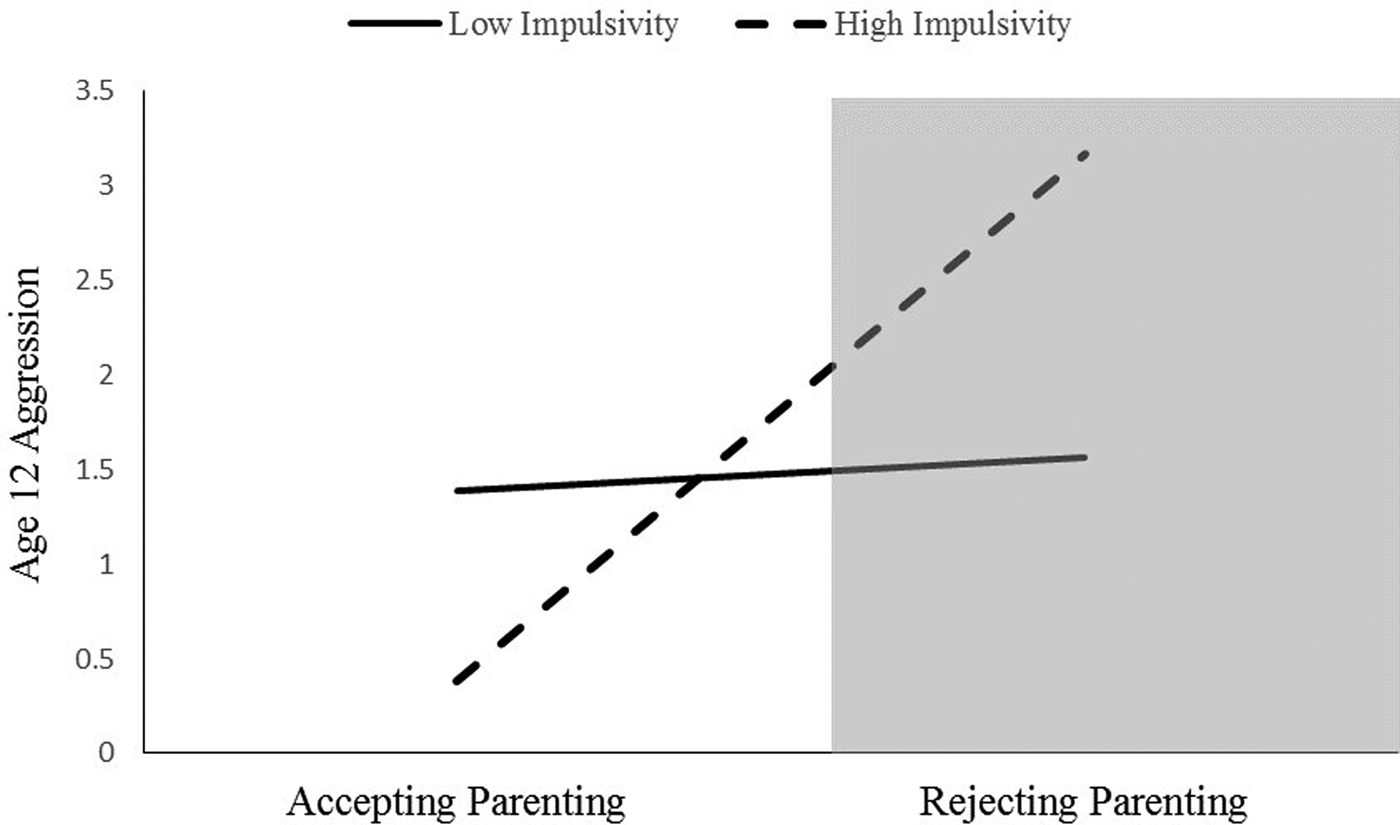
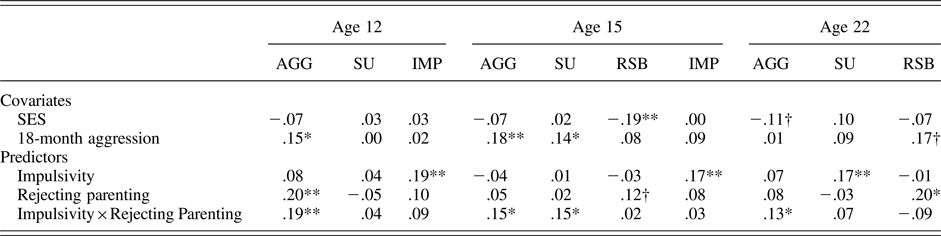
Results for the path analysis model predicting age 12 aggression and substance use are displayed in Table 2. Toddler aggression and impulsivity showed moderate stability over time (β = 0.15, p < .05 and β = 0.19, p < .01, respectively). There was also a main effect of rejecting parenting positively predicting aggression at age 12 (β = 0.20, p < .01). As hypothesized, there was a significant interaction between impulsivity and rejecting parenting in predicting age 12 aggression (β = 0.19, p < .01). However, there were no main or interaction effects between impulsivity or rejecting parenting and age 12 substance use. The findings, displayed in Figure 1, indicated that rejecting parenting was associated with increased aggression for children high in impulsivity at age 2 (b = 4.67, p < .0001), but not for children low in impulsivity (b = 0.24, p > .05).
Simple slope plot of the interaction between impulsivity (at ±1 SD) and parenting (at ±2 SD) predicting aggression at age 12. The grey shaded region represents the region of significance.

Estimated standardized path coefficients in path analysis models

Note: AGG, aggression; SU, substance use; IMP, impulsivity; RSB, risky sexual behavior; SES, socioeconomic status.
†p < .10. *p < .05. **p < .01.
To further examine the nature of the interaction, we performed a regions of significance on X test, which determines the values of X (i.e., rejecting parenting) at which those high and low on the moderator (i.e., impulsivity) are significantly different on the outcome (i.e., aggression; Dearing & Hamilton, Reference Dearing and Hamilton2006; Roisman et al., Reference Roisman, Susman, Barnett-Walker, Booth-LaForce, Owen and Belsky2011). As shown by the gray shaded region in Figure 1, children high in impulsivity showed significantly greater aggression than those low in impulsivity at high levels (i.e., +2 SD) of early rejecting parenting, but did not show significantly less aggression than those low in impulsivity in contexts of accepting parenting (i.e., –2 SD).
Age 15 model
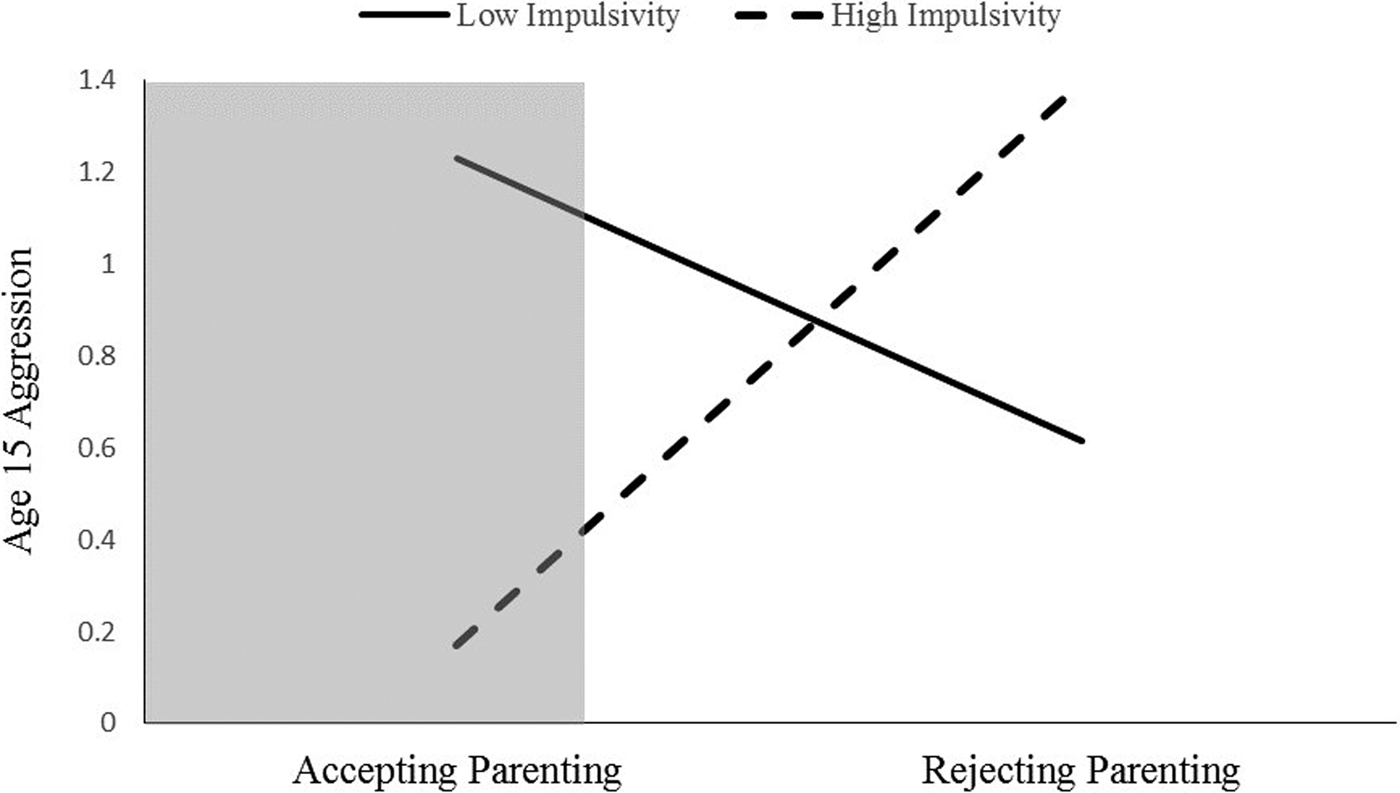
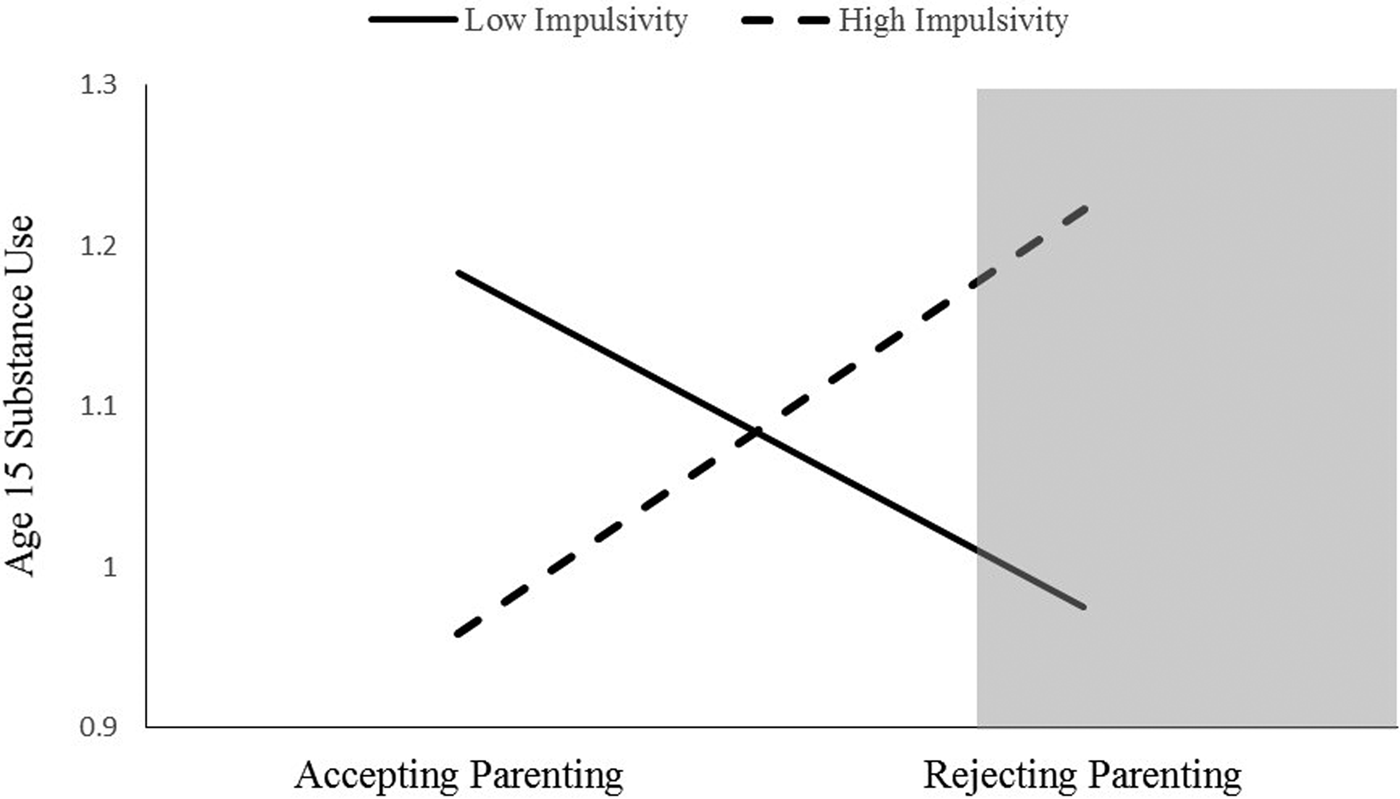
As shown in Table 2, observed aggression at 18 months continued to predict higher aggression at 15 years old (β = 0.18, p < .01) and higher levels of substance use (β = 0.14, p < .05). Again, early impulsivity at age 2 predicted greater impulsivity at age 15 (β = 0.17, p < .01). There were no main effects of impulsivity or rejecting parenting on aggression or substance use at age 15, but rejecting parenting at age 2 marginally predicted greater risky sexual behavior (β = 0.14, p = .07). In addition, the interaction between impulsivity and rejecting parenting significantly predicted aggression and substance use. As shown in Figures 2 and 3, simple slope analyses revealed that rejecting parenting was only associated with increased aggression and substance use for children high in impulsivity (b = 2.30, p < .05 and b = 2.07, p < .05, respectively). For children low in impulsivity, rejecting parenting was not associated with aggression or substance use at age 15 (b = –0.97, p > .10 and b = –1.27, p > .10, respectively). Follow-up tests of the regions of significance revealed that children high in impulsivity showed greater substance use than children low in impulsivity in the context of high rejecting parenting (see Figure 3). However, as shown in Figure 2, children high in impulsivity did not demonstrate significantly greater aggression than those low in impulsivity in the context of high rejecting parenting; instead, children high in impulsivity displayed significantly lower aggression than children low in impulsivity in the context of high accepting parenting.
Simple slope plot of the interaction between impulsivity (at ±1 SD) and parenting (at ±2 SD) predicting aggression at age 15. The grey shaded region represents the region of significance.

Simple slope plot of the interaction between impulsivity (at ±1 SD) and parenting (at ±2 SD) predicting substance use at age 15. The grey shaded region represents the region of significance.

Age 22 model
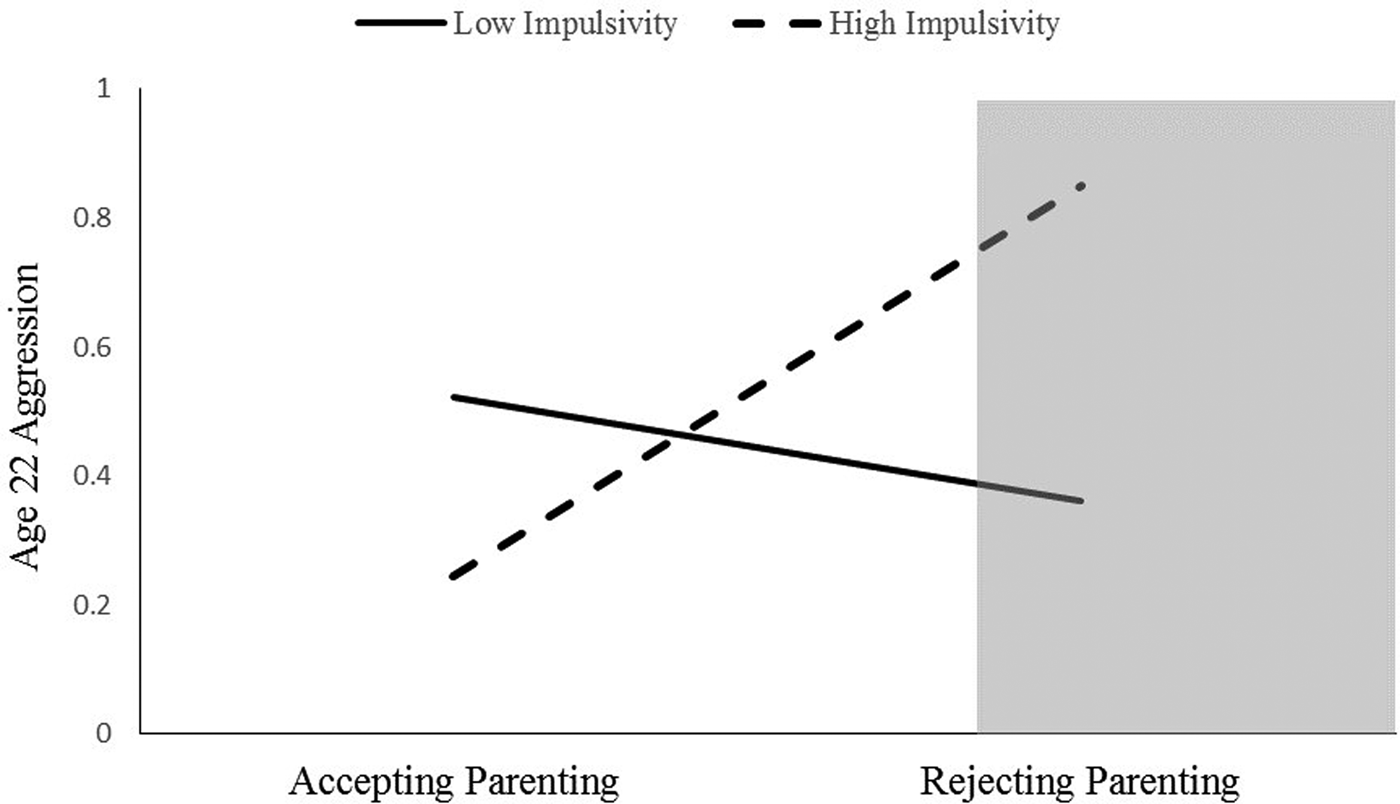
As depicted in Table 2, aggression at 18 months did not predict early adult reports of aggression, although there was a marginally significant association between early childhood aggression and young adult risky sexual behavior (β = 0.17, p = .06). Rejecting parenting at 2 years also predicted higher levels of risky sexual behavior at age 22 (β = 0.20, p < .05). However, impulsivity did not moderate this association. While there was a direct effect of early child impulsivity on substance use at age 22 (β = 0.17, p < .01), the interaction between impulsivity and rejecting parenting on substance use was no longer significant at age 22. However, impulsivity continued to moderate the link between rejecting parenting and age 22 aggression (β = 0.13, p < .05). As portrayed in the simple slope plot in Figure 4, rejecting parenting was associated with heightened aggression at age 22 only for children who showed high impulsivity at age 2 (b = 2.43, p < .05). In line with findings at age 12, the regions of significance on X test showed that children high in impulsivity displayed significantly higher physical aggression at age 22 than children low in impulsivity when exposed to early rejecting parenting.
Simple slope plot of the interaction between impulsivity (at ±1 SD) and parenting (at ±2 SD) predicting aggression at age 22. The grey shaded region represents the region of significance.

Discussion
The current study builds on previous work on child impulsivity and maladjustment by exploring direct and interactive effects of early impulsivity and rejecting parenting at age 2 on three types of problem behavior (i.e., aggression, substance, and risky sexual behavior) during three different developmental periods (i.e., early adolescence, middle adolescence, and early adulthood). There were few direct effects of toddler impulsivity on later aggression, substance use, and risky sexual behavior, with the exception that early impulsivity predicted greater substance use at age 22. However, early impulsivity did confer greater risk for later aggression and substance use in the context of early rejecting parenting. Results did not support the proposed moderating role of impulsivity on the link between rejecting parenting and risky sexual behavior in early adulthood.
Pathways toward aggression
The lack of main effects for early impulsivity on later aggression is consistent with developmental models that emphasize the interaction between child predispositions and the environmental context in predicting long-term maladjustment (e.g., Thomas & Chess, Reference Thomas and Chess1977). In addition, impulsivity during toddlerhood is characterized by dysregulated behaviors (e.g., rapid approach), expectations of immediate gratification, and tendencies toward frustration when desires are not met (Buss & Plomin, Reference Buss and Plomin1975), but the preschool years are marked by rapid developments in executive functioning and emotion regulation (Kopp, Reference Kopp1982, Reference Kopp1989). These important developmental tasks may mitigate the risks of early impulsivity by allowing some individuals to learn skills that promote greater self-regulation and reduce some impulsive behaviors in later childhood. Therefore, early impulsivity might not be a strong prognosticator for later problems, particularly aggression, in and of itself by age 2.
In contrast, observations of early rejecting parenting at age 2 did predict greater youth-reported aggression at age 12. This is consistent with previous research using the same sample that found rejecting parenting predicted parent reports of child conduct problems from ages 2 to 10 (Shaw et al., Reference Shaw, Lacourse and Nagin2005). One proposed mechanism for the link between early rejecting parenting and child aggression at age 12 could be the tendency for early dysfunctional parenting to alter the normative increases in self-regulation during early childhood. For example, while positive parenting practices, such as sensitivity and autonomy–support, have been found to promote the development of executive functioning in early childhood (Bernier, Carlson, & Whipple, Reference Bernier, Carlson and Whipple2010), hostile, rejecting, and overcontrolling parenting behaviors have been associated with problematic or delayed brain development, deficits in theory of mind development, and lower self-regulation skills (Olson, Lopez-Duran, Lunkenheimer, Chang, & Sameroff, Reference Olson, Lopez-Duran, Lunkenheimer, Chang and Sameroff2011; Rutter, O'Connor, & English and Romanian Adoptee Study Team, Reference Rutter and O'Connor2004). These deficits in brain functioning and self-regulation may be further related to later psychological and social maladaptation, including an increased likelihood of responding to frustrating events with aggression (Olson et al., Reference Olson, Lopez-Duran, Lunkenheimer, Chang and Sameroff2011; Rutter et al., Reference Rutter and O'Connor2004). Hostile, rejecting, and overcontrolling parenting may also contribute to later child aggression through modeling and the development of a coercive pattern of responding between the parent and child (Patterson, Reference Patterson, Reid, Patterson and Snyder2002). It is also possible that rejecting parenting remains fairly stable across childhood, particularly in the context of high child impulsivity. The combination of high rejecting parenting and child impulsivity during the toddler years may aid in the development of sustained and increasingly hostile dynamics, which then evolve into stable and high levels of aggression in adolescence.
While increasing levels of rejecting parenting were positively associated with increased aggression for children high in early impulsivity at all three ages, regions of significance testing revealed that high impulsivity may proffer both developmental disadvantages and advantages depending on the developmental period being assessed. The results at ages 12 and 22 support a diathesis–stress perspective, as children high in early impulsivity were more likely to demonstrate aggression in the context of rejecting parenting. However, the form of the interaction at age 15 was more consistent with a vantage sensitivity model. In contrast to the diathesis–stress emphasis on vulnerability, vantage sensitivity proposes that some individuals may disproportionately benefit by supportive environments (Pluess & Belsky, Reference Pluess and Belsky2013). At age 15, children high in early impulsivity showed significantly less aggression than those low in impulsivity in the context of early accepting parenting.
To our knowledge, this is the first study to find evidence of impulsivity being a potential vantage-sensitive marker. However, these results were specific to the midadolescent period, as early impulsivity acted as a vulnerability factor for aggression in early adolescence and early adulthood. Pluess and Beslky (Reference Pluess and Belsky2013) have suggested that one possible mechanism for vantage sensitivity is individual differences in reward sensitivity. While impulsive individuals tend to be reward sensitive (Vitaro et al., Reference Vitaro, Arseneault and Tremblay1999), neural activation in the ventral striatum in response to rewards also peaks during middle adolescence (Van Leijenhorst et al., Reference Van Leijenhorst, Zanolie, Van Meel, Westenberg, Rombouts and Crone2010). Thus, it is possible that these developmental differences might be the result of highly impulsive individuals being more sensitive to rewarding or positive features in the environment during middle adolescence compared to early adolescence and early adulthood. Another possible interpretation is that, taken together, these findings are consistent with differential susceptibility (Belsky & Pluess, Reference Belsky and Pluess2009). In other words, children high in impulsivity show both disadvantages in the context of rejecting parenting and advantages in the context of accepting parenting. However, to our knowledge this is the first study to implicate that sensitivity to adverse and supportive environments might differ by developmental period. Thus, further research should attempt to replicate this provocative developmental finding.
Pathways toward substance use
The results of the current study suggest that early childhood risk factors may operate differently in predicting adolescent versus adult substance use. Specifically, early toddler impulsivity at age 2 did not predict substance use during adolescence but was associated with greater substance use in early adulthood. Conversely, the interaction between high impulsivity and early rejecting parenting predicted greater substance use at age 15, but not at age 22. Thus, early childhood impulsivity and rejecting parenting appear to be differentially predictive of later substance use depending on developmental period. While these developmental differences could be the result of measurement changes between adolescence and early adulthood, risk of substance use might also depend on the perceived environmental availability of substances, which may differ qualitatively from adolescence to early adulthood. For example, highly impulsive adolescents may only engage in early substance use in the context of lax or inconsistent parenting and deviant peers (Dodge et al., Reference Dodge, Malone, Lansford, Miller, Pettit and Bates2009; Sitnick, Shaw, et al., Reference Sitnick, Brennan, Forbes and Shaw2014). Developmental cascade models have posited that the interaction between early harsh or rejecting parenting and vulnerable child characteristics (e.g., high impulsivity) confer a greater risk of substance use due to their joint influence on the later development of affiliation with deviant peers and lower parental monitoring (Dodge et al., Reference Dodge, Malone, Lansford, Miller, Pettit and Bates2009; Wills & Dishion, Reference Wills and Dishion2004). By contrast, in early adulthood, when alcohol and tobacco use become legal and other substances become easier to obtain or use in the absence of supervision, early impulsivity might operate as an independent risk factor for more frequent use of both legal and illicit substances. However, this study is the first to test the effect of impulsivity in the toddler years on substance use in early adulthood, so more research is needed to explicate these developmental findings.
Pathways toward risky sexual behavior
Consistent with evolutionary theories of reproduction, early rejecting parenting predicted later risky sexual behavior at both ages 15 and 22 (Belsky et al., Reference Belsky, Steinberg and Draper1991, Reference Belsky, Steinberg, Houts and Halpern-Felsher2010). To our knowledge, this is the first study to establish that parenting assessed as young as age 2 has direct effects on sexual risk taking in adolescence and early adulthood. Previous longitudinal studies have found support for a link between harsh or neglecting parenting in the toddler or preschool years and later risky sexual behavior in adolescence through mediating processes, such as early pubertal timing in an all-girl sample and peer deviancy in a boys-only sample (Belsky et al., Reference Belsky, Steinberg, Houts and Halpern-Felsher2010; Sitnick, Brennan, et al., Reference Sitnick, Brennan, Forbes and Shaw2014). While we found evidence for direct effects of parenting, other more proximal processes are likely to show stronger associations with risky sexual behavior in adolescence and emerging adulthood, and future research should attempt to examine the specific mediating processes accounting for the association between early rejecting parenting and later risky sexual behavior.
Theoretical formulations on the socialization influences of sexual behavior have postulated that the influence of parenting behaviors on high-risk sexual behavior is likely dependent on individual child characteristics (Belsky et al., Reference Belsky, Steinberg and Draper1991; Del Giudice & Belsky, Reference Del Giudice, Belsky, Buss and Hawley2011), but we did not find evidence for an interaction between early impulsivity and rejecting parenting on later risky sexual behavior. One possible explanation for the lack of moderation effects is the heterotypic continuity of impulsivity during early childhood (Putnam, Rothbart, & Gartstein, Reference Putnam, Rothbart and Gartstein2008). While impulsivity showed modest stability in the current study, there are rapid increases in executive function and self-regulatory capabilities across the preschool and early school years. As a result, the cognitive facets of impulsivity (e.g., impulsive decision making) that may be related to later sexual risk-taking behaviors have not yet developed at age 2 (Kopp, Reference Kopp1982). Thus, future research should examine if impulsivity during the preschool or early school years acts as a vulnerability factor for later risky sexual behavior in the context of harsh or rejecting parenting.
Early aggression and later problem behaviors
Although not hypothesized, the current study also found remarkable links between observed aggression at 18 months and later self-reported aggression at ages 12 and 15. While the majority of research on the stability of aggression is short term (see Piquero, Carriaga, Diamond, Kazemian, & Farrington, Reference Piquero, Carriaga, Diamond, Kazemian and Farrington2012, for a review), at least one study has demonstrated that aggression shows moderate to high stability between early childhood and adolescence, with genetics playing a large role in the continuation of aggressive tendencies (van Beijsterveldt, Bartels, Hudziak, & Boomsma, Reference van Beijsterveldt, Bartels, Hudziak and Boomsma2003). However, studies have generally relied on common informants (i.e., maternal report), while the current study showed stability in a multiple-method, multiple-informant longitudinal design. In addition, we found a direct link between observed aggression at 18 months and youth-reported substance use at age 15. This association may reflect an underlying genetic vulnerability to both aggression and substance use problems (Krueger et al., Reference Krueger, Hicks, Patrick, Carlson, Iacono and McGue2002; Young, Stallings, Corley, Krauter, & Hewitt, Reference Young, Stallings, Corley, Krauter and Hewitt2000). An alternative, but not necessarily antithetical, interpretation might suggest that early aggression is an initial step in a developmental cascade toward substance use (Dodge et al., Reference Dodge, Malone, Lansford, Miller, Pettit and Bates2009).
Limitations and directions for future research
Although there were notable strengths of this study, several limitations merit discussion. First, the sample was limited to boys, and participants were from a low-income urban area. Boys display greater risk of developing externalizing disorders and risky behavior than girls (Byrnes, Miller, & Schafer, Reference Byrnes, Miller and Schafer1999), and boys also may be more sensitive to features of the parenting environment (Shaw et al., Reference Shaw, Keenan and Vondra1994). Thus, this limits the generalizability of the findings, particularly in light of research indicating higher rates of impulsivity and behavior problems among males than females and in low SES contexts (Card, Stucky, Sawalani, & Little, Reference Card, Stucky, Sawalani and Little2008; Farrington, Reference Farrington1995). Future research should explore whether early impulsivity in girls from socioeconomically diverse backgrounds is a similar risk factor for later maladjustment in the context of harsh or rejecting parenting. Second, measurements of key constructs (e.g., substance use and risky sexual behavior) changed across the 10 years from ages 12 to 22. While we believe these measurement changes reflect appropriate developmental changes in the constructs, we cannot rule out the possibility that changes in instrumentation might account for some of the differential findings regarding predictors of later problem behavior. However, the moderate correlations between the different methods used to assess substance use and risky sexual behavior across the 7 years from age 15 to 22 strengthen our confidence in the findings. Third, some of the scales (e.g., risky sexual behavior) were limited and constructed from a small number of items. Future research should attempt to replicate our findings with broader, widely used measures of problem behavior. Fourth, our measurements of problematic and risky behaviors were limited to adolescent self-reports of behavior. Previous research has highlighted that impulsive individuals might be particularly prone to underestimate their own problem behaviors (Owens, Goldfine, Evangelista, Hoza, & Kaiser, Reference Owens, Goldfine, Evangelista, Hoza and Kaiser2007). Thus, while they are in keeping with prior research, the relatively small effect sizes in the current manuscript may be partially due to the use of adolescent self-reports for all our assessments of aggression, substance use, and risky sexual behavior. Future research should attempt to replicate the current findings utilizing a multimethod approach (e.g., sibling and peer reports and official records).
Fifth and finally, although the current study makes some important contributions to our understanding of how early impulsivity and parenting affect problem behaviors in adolescence and early adulthood, future research should identify more proximal mediating mechanisms that account for these links (e.g., Belsky et al., Reference Belsky, Steinberg, Houts and Halpern-Felsher2010; Dodge et al., Reference Dodge, Malone, Lansford, Miller, Pettit and Bates2009; Sitnick, Shaw, et al., Reference Sitnick, Brennan, Forbes and Shaw2014; Sitnick, Brennan, et al., Reference Sitnick, Brennan, Forbes and Shaw2014). In addition, the current study only used assessments of early impulsivity and rejecting parenting at age 2, but developmental psychopathology frameworks have emphasized the transactional nature of parent and child characteristics (Cicchetti & Valentino, Reference Cicchetti, Valentino, Cicchetti and Cohen2006). For example, bidirectional cross-lagged models have suggested that negative parenting and temperamental dimensions related to impulsivity (e.g., low effortful control and delay ability) mutually influence one another over time (Klein et al., Reference Klein, Lengua, Thompson, Moran, Ruberry, Kiff and Zalewski2016). While dysfunctional parenting is thought to increase child impulsivity due to dampened development of self-regulatory capabilities (Klein et al., Reference Klein, Lengua, Thompson, Moran, Ruberry, Kiff and Zalewski2016), child impulsivity may also play an evocative role in eliciting more negative parental behaviors (Brody & Ge, Reference Brody and Ge2001; Harold et al., Reference Harold, Leve, Barrett, Elam, Neiderhiser, Natsuaki and Thapar2013). Thus, a potential area for further exploration is if the interaction effects we observed at age 2 may be the result of continued reinforcement and the canalization of impulsivity and negative parenting practices throughout childhood.
Conclusions
Despite these limitations, the current study advances our understanding of how early impulsivity and rejecting parenting interact to predict problems of aggression and substance use in adolescence and early adulthood. In addition, this study is the first to find an effect for parenting at age 2 on risky sexual behavior 20 years later. These results highlight the potential for coercive processes between impulsive children and rejecting parents to start early in the child's life, setting the stage for consistent and long-lasting aggressive tendencies that have the potential to escalate to serious criminal offenses. Although there were a few main effects of impulsivity and parenting on later problem behaviors, our findings suggest that the combination of both high impulsivity and rejecting parenting were particularly deleterious for adolescent and adult adjustment. Thus, early intervention and prevention programs targeting parenting behaviors and child behavioral impulsivity in the toddler years could be particularly beneficial in altering the parent–child dynamic before it becomes ingrained in an escalating and coercive pattern of responses that put the child at risk for long-lasting problem behaviors.