Introduction
With any illness, the most important questions from the perspective of the family and patient are those involving prognosis. Clinicians are frequently asked to advise on matters such as how long a patient is likely be in hospital or when a patient may start to recover. Identifying reliable prognostic indicators is essential in order to make these judgements.
Longitudinal studies have provided most of our knowledge to date on the course and outcome of schizophrenia. However, most of these studies relied on non-first-episode cohorts and were biased towards patients who experienced multiple hospital admissions and included patients at varying stages of illness with an over-representation of chronic cases (Browne et al. Reference Browne, Larkin and O'Callaghan1999). In recent times a number of studies have re-examined the area of outcome in more representative samples by including only cases of first-episode psychosis (Singh et al. Reference Singh, Croudace, Amin, Kwiecinski, Medley and Jones2000; Malla et al. Reference Malla, Norman, Manchanda and Townsend2002; Addington et al. Reference Addington, Addington and Patten2003; Lieberman et al. Reference Lieberman, Phillips, Gu, Stroup, Zhang, Kong, Ji, Koch and Hammer2003; Stirling et al. Reference Stirling, White, Lewis, Hopkins, Tantam, Huddy and Montague2003; Addington & Addington, Reference Addington and Addington2005; Malla & Payne, Reference Malla and Payne2005; Simonsen et al. Reference Simonsen, Friis, Haahr, Johannessen, Larsen, Melle, Opjordsmoen, Rund, Valgum and McGlashan2007). These studies have generally concluded that the outcome of schizophrenia is more favourable than first thought with one systematic review suggesting that about 40% of patients experience a favourable outcome (Menezes et al. Reference Menezes, Arenovich and Zipursky2006). However, identifying reliable prognostic indicators has proved more challenging due to the reliance on diagnosis at first presentation when assessing outcome and varying durations of follow-up in studies to date. About 25% of patients with a first-episode of psychosis evidence a change in diagnosis at follow-up with the most common change being into a diagnosis of schizophrenia (Whitty et al. Reference Whitty, Clarke, McTigue, Browne, Kamali, Larkin and O'Callaghan2005). Consequently, first-episode studies that do not re-diagnose cohorts during the follow-up period are likely to exclude a number of cases of schizophrenia, which may explain the inconsistencies in findings. A further limitation of previous studies relates to the length of follow-up and it is now accepted that the minimum duration of follow-up for first-episode studies should be 2 years (Menezes et al. Reference Menezes, Arenovich and Zipursky2006). This is because the short-term functional outcome of patients tends to improve after treatment of the first episode, but longer-term outcome remains relatively poor for a substantial proportion of patients (Malla & Payne, Reference Malla and Payne2005).
Consequently, we conducted a 4-year outcome study of patients who experienced a first episode of schizophrenia in Cluain Mhuire Family Centre and St John of God Hospital (SJOGH) in Dublin. We re-diagnosed all patients at follow-up and compared level of functioning at first presentation with that at follow-up. We also measured levels of remission and Global Assessment of Functioning (GAF) and established prognostic indicators using the Strauss–Carpenter Scale.
Method
All patients presenting with a first episode of psychosis to SJOGH and Cluain Mhuire Family Centre were assessed at first presentation and 4-year follow-up. These centres provide private and community-based psychiatric care for an urban catchment area in County Dublin. First-episode psychosis was defined as a first ever presentation to any psychiatric service with a psychotic episode. Patients who commenced antipsychotic medication prior to referral were included in the study only if they were being treated for a first psychotic episode and treatment had not commenced more than 30 days before assessment. The patients were part of an incidence sample from a geographically defined catchment area and included patients never admitted to an in-patient facility. We also assessed patients from the catchment area who were treated in a private psychiatric hospital (SJOGH) to increase the representativeness of the sample. Furthermore, the rater who carried out follow-up assessments was blind to the duration of untreated psychosis (DUP), which helped reduce the potential bias this might have on outcome assessments (Marshall et al. Reference Marshall, Lewis, Lockwood, Drake, Jones and Croudace2005). The study received approval from the Ethics Committee (Research) of SJOGH.
Clinical assessments
Each patient was assessed at first presentation and re-diagnosed at 4 years using the Structured Clinical Interview (SCID-I) in accordance with DSM-IV criteria (APA, 1994). We also examined patients across a number of variables.
Psychopathology was assessed using the Positive and Negative Syndrome Scale (PANSS; Kay et al. Reference Kay, Fiszbein and Opler1987). We evaluated general outcome using the Strauss–Carpenter Scale (Strauss & Carpenter, Reference Strauss and Carpenter1972). This observer-rated scale combines aspects such as social and occupational functioning as well as psychopathology and hospitalizations to give a global score of outcome. We also measured the GAF (Spitzer et al. Reference Spitzer, Williams, Gibbon and First1995) of all patients at first presentation and follow-up. During the SCID interview, patients were asked to detail their educational history and to date to the nearest month the onset of their first psychotic symptom for determination of DUP. Co-morbid substance abuse/dependence was also assessed during the SCID interview. Initial and follow-up assessments included collateral histories from family members, carers, general practitioners and treating teams as well as case-note reviews. We established inter-rater reliability for the PANSS (PANSS total score r=0.89) and all follow-up assessments were conducted blind to assessments at first presentation.
Statistical analysis
We compared psychopathology and GAF at first presentation and follow-up using paired t tests. Remission rates were calculated using the criteria established by Larsen et al. (Reference Larsen, Moe, Vibe-Hansen and Johannessen2000). Remission was defined as no PANSS item >3 in the month prior to the follow-up interview. We used a forced-entry linear regression analysis to determine the predictors of outcome on the Strauss–Carpenter Scale. The following ten prognostic variables were used to predict outcome: age of onset of psychosis, gender, positive and negative subscale scores of the PANSS at first presentation, duration of untreated initial psychosis, family history of psychiatric illness in a first-degree relative, place of upbringing (urban or rural), marital status, years spent in education and a history of alcohol or substance abuse/dependence.
Results
In total, 171 patients with a first episode of psychosis were assessed at first presentation. At follow-up, five were deceased (four suicide, one natural causes) while a further four were excluded from analysis as they had a diagnosis of an organic psychosis. During follow-up assessments we re-diagnosed 129 of the remaining 162 patients resulting in a follow-up rate of 80%. Of these 129 patients, 97 (75%) had a diagnosis of schizophrenia/schizophreniform disorder. Patients who were assessed at follow-up (n=129) were indistinguishable from those who were not (n=37) in terms of age at first presentation to the psychiatric services (t=−0.81, p=0.41), DUP (t=1.63, p=0.11), total PANSS score (t=1.3, p=0.21) or GAF (t=−0.09, p=0.93) at first presentation. All further results refer to the 97 patients with DSM-IV first-episode schizophrenia.
Patient characteristics
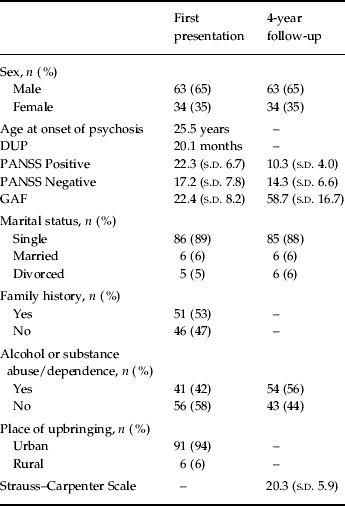
Table 1 details the characteristics of the sample at first presentation. Of the 97 patients, 63 (65%) were male while 34 (35%) were female. Their mean age at onset of psychosis was 25.5 years and their mean DUP was 20.1 months (s.d.=34.9 months; median=4 months). Males (n=63) had an earlier age at onset (24.6 years) compared to females (n=34, 27.2 years) but this difference was not statistically significant (t=−1.1, p=0.3). Fifty-one patients (53%) had a known family history of psychiatric illness in a first-degree relative. At first presentation most patients (n=86, 89%) were single while a smaller proportion (n=11, 11%) were either married once or were divorced. One patient married and one patient divorced between first presentation and follow-up.
Sample characteristics at first presentation and follow-up of the 97 patients with DSM-IV first-episode schizophrenia

DUP, Duration of untreated psychosis; PANSS, Positive and Negative Syndrome Scale; GAF, Global Assessment of Functioning.
Comparison of first presentation and follow-up assessments
The mean length of follow-up was 42.0 months (s.d.=8.9 months). The average number of admissions per patient was 2.6 (s.d.=2.9) and each patient spent and average of 92.8 days (s.d.=95.6) in hospital. Forty-one patients (42%) had a lifetime history of alcohol or illicit drug abuse at first presentation and this increased to 54 patients (56%) at follow-up. There were statistically significant improvements in positive (t=14.7, p<0.001) and negative symptoms (t=3.8, p<0.001) between first presentation and follow-up and 42 patients (43%) were in remission as defined by Larsen et al. (Reference Larsen, Moe, Vibe-Hansen and Johannessen2000). Similarly, there were statistically significant improvements in mean GAF scores (t=−19.8, p<0.001) at follow-up (Table 1).
GAF and occupational functioning
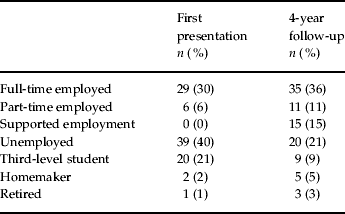
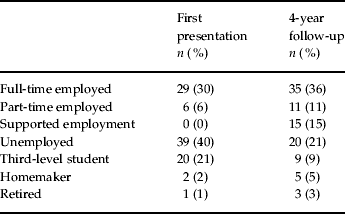
At follow-up 30 patients (31%) had mild or no impairment in functioning as determined by their GAF score (GAF score >70), a further 29 patients (30%) had moderate impairment (GAF score 51–70) while the remaining 38 patients (39%) had severe impairment (GAF score <50). Table 2 describes the occupational functioning of patients at first presentation and follow-up. At follow-up 35 patients (36%) were in full-time employment. The major change in employment status at follow-up was progression from of unemployment into a supported work environment (Table 2).
Occupational status at first presentation and follow-up among the 97 patients with schizophrenia
Predictors of outcome
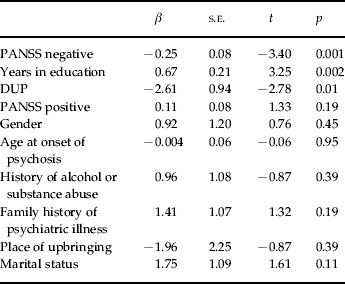
The predictors of outcome, as determined by the Strauss–Carpenter Scale, are detailed in Table 3. The data on DUP were skewed with a small number of patients experiencing a very long DUP, so we log-transformed DUP before conducting the regression analysis. Fewer negative symptoms, a shorter DUP and more years spent in education significantly predicted an improved outcome at 4 years (Table 3).
Forced-entry regression analysis predicting outcome on the Strauss–Carpenter Scale
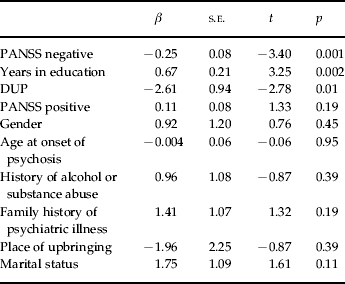
PANSS, Positive and Negative Syndrome Scale; DUP, log-transformed duration of untreated psychosis.
F=4.43, p<0.001, r 2=0.34.
Discussion
Main findings
The main finding of the present study was that patients with schizophrenia showed significant improvements in psychopathology and overall functioning 4 years after first presentation to the psychiatric services. The improvement in positive symptoms is understandable as all patients were treated with antipsychotic medication at the time of their first episode and most were treated with medication in the follow-up period. A more encouraging finding was the improvement in negative symptoms and overall functioning. The previously described course of progressive deterioration was not observed in the present study and supports more recent findings in this area (Lieberman, Reference Lieberman1999; Siegel et al. Reference Siegel, Irani, Brensinger, Kohler, Bilker, Ragland, Kanes, Gur and Gur2006). This might be due to the study design, which addressed some of the methodological limitations of previous first-episode and non-first-episode studies. The follow-up period was 4 years and all patients were re-diagnosed at follow-up thus removing the potential bias of diagnostic change in the sample (Whitty et al. Reference Whitty, Clarke, McTigue, Browne, Kamali, Larkin and O'Callaghan2005). Follow-up assessments were conducted without prior knowledge of DUP. Including in-patients and out-patients from a geographically defined catchment area increased the representativeness of the sample. The use of baseline comparative measures further adds to the validity of the findings.
In terms of occupational functioning, there were increases in full-time, part-time and rates of supported employment at follow-up. This finding was most marked in terms of supported employment and may have been due to the psychiatric treatment available within the service. All patients had access to a specific psychosocial and occupational rehabilitation programme for patients with psychosis (Whitty et al. Reference Whitty, Lydon, Turner and O'Callaghan2006). Such programmes have positive outcomes in terms of quality of life and occupational functioning among patients with schizophrenia (Bachrach, Reference Bachrach2000).
Prognostic indicators
Of the ten variables selected we identified three favourable prognostic indicators on regression analysis.
Negative symptoms
There remains a degree of uncertainty about the validity of psychopathology as a determinant of outcome. Positive symptoms have been associated with poor outcome (Brier et al. Reference Brier, Schreiber, Dyer and Pickar1991; Robinson et al. Reference Robinson, Woerner, Alvir, Bilder, Goldman, Geisler, Koreen, Sheitman, Chakos, Mayerhoff and Lieberman1999a) while other researchers found no such associations (Jonsson & Nyman, Reference Jonsson and Nyman1984; Lastra et al. Reference Lastra, Vazquez-Barquero, Herrera Castanedo, Cuesta, Vazquez-Bourgon and Dunn2000). Similarly, the relationship between negative symptoms at first presentation and outcome is mixed with some studies reporting an association (Jonsson & Nyman, Reference Jonsson and Nyman1984; Siegel et al. Reference Siegel, Irani, Brensinger, Kohler, Bilker, Ragland, Kanes, Gur and Gur2006) while other studies found no such associations (Robinson et al. Reference Robinson, Woerner, Alvir, Bilder, Goldman, Geisler, Koreen, Sheitman, Chakos, Mayerhoff and Lieberman1999b). In the present study increased levels of negative symptoms at first presentation significantly predicted a poorer outcome at follow-up while positive symptoms had no relationship with outcome. Our study supports the view that the presence of negative symptoms early in the course of illness predicts a group of patients with more severe functional impairment at mid-term outcome. The extent to which this finding holds true over time will require further longer-term follow-up studies of first-episode cohorts.
Years in education
The relationship between years spent in education and outcome in schizophrenia is well established with most of the evidence reporting an association between level of education and outcome (DeQuardo et al. Reference DeQuardo, Goldman, Tandon, McGrath-Giroux and Kim1995; Wieselgren & Lindstrom, Reference Wieselgren and Lindstrom1996; Siegel et al. Reference Siegel, Irani, Brensinger, Kohler, Bilker, Ragland, Kanes, Gur and Gur2006). Studies exploring the relationship between specific cognitive deficits and outcome concluded that verbal memory was associated with functional outcome (Green, Reference Green1996; Harvey et al. Reference Harvey, Bertisch, Friedman, Marcus, Parrella, White and Davis2003). The effects of a decline in educational performance predicting future development of schizophrenia in vulnerable individuals is supported by the study of Olin and colleagues in which school teachers were able to anticipate 35% of patients who later developed schizophrenia (Olin et al. Reference Olin, Mednick, Cannon, Jacobsen, Parnas, Schulsinger and Schulsinger1998). This finding suggests that early warning signs of psychosis are present from a young age and our study supports the need for the early detection of young people who are at increased risk of psychotic illness as their outcome may be less favourable if their educational performance is poor.
DUP
DUP is increasingly being recognized as an important prognostic indicator and has led to the establishment of early intervention services in many countries (Marshall et al. Reference Marshall, Lewis, Lockwood, Drake, Jones and Croudace2005). However, most studies to date have focused on the relationship between DUP and outcome in the short term and relatively few first-episode studies addressed this issue beyond the first 2 years of illness (Huber et al. Reference Huber, Gross and Schlutter1975; Wiersma et al. Reference Wiersma, Nienhuis, Sloof and Giel1998; Bottlender et al. Reference Bottlender, Strauss and Moller2000; Clarke et al. Reference Clarke, Whitty, Browne, McTigue, Kamali, Gervin, Kinsella, Waddington, Larkin and O'Callaghan2006; Siegel et al. Reference Siegel, Irani, Brensinger, Kohler, Bilker, Ragland, Kanes, Gur and Gur2006).
In the study by Bottlender and colleagues, prolonged duration of symptoms, and not DUP, was related to poor outcome. Wiersma et al. (Reference Wiersma, Nienhuis, Sloof and Giel1998) reported an association between DUP and length of psychotic episodes but not between DUP and outcome, while Huber et al. (Reference Huber, Gross and Schlutter1975) found a relationship between the length of the prodromal phase and outcome. However, these studies have limitations in terms of clinical measurements (Marshall et al. Reference Marshall, Lewis, Lockwood, Drake, Jones and Croudace2005), which may in turn limit their findings. The present study augments the first-episode studies of Clarke et al. (Reference Clarke, Whitty, Browne, McTigue, Kamali, Gervin, Kinsella, Waddington, Larkin and O'Callaghan2006) and Siegel et al. (Reference Siegel, Irani, Brensinger, Kohler, Bilker, Ragland, Kanes, Gur and Gur2006), and supports the growing body of evidence of an association between duration of untreated initial psychosis and outcome (Bottlender et al. Reference Bottlender, Strauss and Moller2000; Norman & Malla, Reference Norman and Malla2001; Addington et al. Reference Addington, Van Mastrigt and Addington2004; Melle et al. Reference Melle, Larsen, Haahr, Friis, Johannessen, Opjordsmoen, Simonsen, Rund, Valgum and McGlashan2004; Marshall et al. Reference Marshall, Lewis, Lockwood, Drake, Jones and Croudace2005). These results support the need for clinical trials to establish more conclusively whether shortening DUP can improve the outcome of patients with schizophrenia.
Limitations
There are some limitations to the present study. One limitation is that we only had information at two time-points (first presentation and 4-year follow-up). Consequently, we could not examine for fluctuations in symptom levels and relapse rates during the course of the study. This could be addressed by measuring outcome at fixed intervals to determine whether these findings are sustained throughout the course of illness. A further potential limitation is the measurement of DUP. This was assessed as part of the SCID-I interview and the use of a more valid measurement such as the scale devised by Beiser and colleagues (Reference Beiser, Erickson, Fleming and Iacono1993) may augment the strength of our findings. In terms of cognitive function, the patients did not undergo formal neuropsychological assessment and it is possible that the relationship between years in education and outcome could be a proxy for cognition.
Conclusion
This study supports the view that the outcome of schizophrenia is not as poor as was once thought. Patients with schizophrenia show significant morbidity at first presentation in terms of psychopathology and GAF. However, unlike earlier descriptions of a downward deteriorating course and poor outcome, the subjects in this study evidenced significant improvements at follow-up in terms of psychopathology and GAF. The most important predictors of a favourable outcome were low levels of negative symptoms at first presentation, increased years spent in education and a shorter DUP at first presentation.
Declaration of Interest
None.