Childhood obesity is an increasing health concern in developing countries. It causes serious health problems such as hypertension, dyslipidemia, diabetes mellitus, and atherosclerosis.Reference Vos and Welsh 1 It is also a serious risk factor for the development of cardiovascular disease.Reference Llewellyn, Simmonds, Owen and Woolacott 2 Atherosclerosis is a multi-factorial, chronic process that results from inflammation and endothelial damage in the vascular wall.Reference Manduteanu and Simionescu 3 Obesity is a sub-clinical systemic inflammatory disease; the inflammatory markers interleukin-6, tumour necrosis factor-α, and C-reactive protein are all elevated in obese children.Reference Zimmermann and Aeberli 4 , Reference de Ferranti and Mozaffarian 5 Thus, obesity is a risk factor for the development of cardiovascular disease.Reference Bahadır, Baltacı and Türker 6 , Reference Inzaugarat, Billordo, Vodánovich, Cervini, Casavalle and Vedire 7 There is also a direct relationship between increased total body fat mass, epicardial adipose tissue thickness (EATT), and carotid intima media thickness (CIMT).Reference Abaci, Tascilar, Saritas, Yozgat, Yesilkaya and Kilic 8 In obese patients, EATT and CIMT are risk factors for the development of cardiovascular disease because of the relationship between EATT, CIMT, and coronary atherosclerosis.Reference Rabkin 9 , Reference Lamotte, Iliescu, Libersa and Gottrand 10
Salusins, which are newly defined biomarkers, are divided into two groups: Salusin-α (Sal-α) and Salusin-β (Sal-β), consisting of 26 and 28 amino acids, respectively.Reference Shichiri, Ishimaru, Ota, Nishikawa, Isogai and Hirata 11 These proteins, which are endogenously secreted from the hypothalamopituitary axis, vascular endothelium, and kidneys, play roles in atherogenesis and the regulation of haemostasis.Reference Suzuki, Shichiri, Akashi, Sato, Sakurada and Hirono 12 However, they have opposing effects on atherosclerosis. Sal-β is a precursor of atherosclerosis, while Sal-α has a protective effect against atherosclerosis.Reference Sato, Watanabe and Itoh 13 They confer these effects through acyl-coenzyme A: cholesterol acyltransferase 1 (ACAT-1).Reference Watanabe, Nishio and Kanome 14 ACAT-1 promotes atherosclerosis by causing cholesterol ester accumulation in macrophages and foam cell formation.Reference Miyazaki, Sakashita and Lee 15 , Reference Suguro, Watanabe and Kanome 16 These events cause a decrease in cardiac contraction via a cholinergic mechanism and decrease heart rate (HR) and blood pressure.Reference Shichiri, Ishimaru, Ota, Nishikawa, Isogai and Hirata 11 , Reference Yu, Zhao and Yang 17 Thus, salusins are effective peptides in the cardiovascular system.
This study investigated the predictive value and usefulness of serum salusin levels in the early diagnosis of atherosclerosis in obese children.
Materials and method
Study design, patients, and blood sample
This was a prospective cohort study of children and adolescents with obesity. The study cohort comprised 176 children aged 6–18 years who had been referred to the Department of Pediatric Cardiology and Pediatric Endocrinology of Sakarya University, Research and Training Hospital between July 2017 and August 2018. The study protocol was approved by Sakarya University Local Ethical Committee. Informed consent was obtained from all patients. Patients were selected from the paediatric cardiology and endocrinology outpatient clinic. The body mass index (BMI) levels were calculated as weight (kg) divided by height (m) squared. The BMI reference curves established by Bundak et al for Turkish children were used for the determination of corpulence.Reference Bundak, Furman, Gunoz, Darendeliler, Bas and Neyzi 18 Patients who were above 95th percentile according to age and sex were accepted as obese, as defined by Obesity Task Force (IOTF). BMI standard deviation score (BMI SDS) was used in statistical calculations, because there was a wide age distribution in both obese and control groups. Patients with BMI SDS of 2 and above were accepted as obese.Reference Cole, Bellizzi, Flegal and Dietz 19 Children aged <6 and 18> years, children with syndrome of obesity, and obesity due to hormonal disorder were excluded from the study. In addition, patients with impaired glucose tolerance, diabetes, dyslipidemia, and hypertension were not included in the study. Patients with a history of early cardiovascular disease, chronic illness, and long-term drug use for any reason were excluded. The patients who were diagnosed with innocent murmur admitted to the paediatric cardiology outpatient clinic formed the control group. The blood pressure measurements were performed on the right arm after resting for 10 minutes. The measurements were repeated three times. All measurements were performed with the same automated oscillometric device (53000, Welch Allyn, New York, United States of America) sphygmomanometer. Venous blood samples were centrifuged and stored at –80°C in EDTA-containing tubes.
Echocardiographic measurements
All ultrasound studies were performed using a Philips iE33 ultrasound machine with 3 MHz phase transducer (Philips, Ultrasound, Bothell, United States of America). All measurements were made by the same physician. Apical four-chamber and parasternal long-axis imaging were performed in the left lateral position. Left ventricular mass (LVM) was automatically calculated by the device using the current standardised formula, and height was used for indexing, and indexation of LVM to height raised to an allometric exponent of 2.7 (LVMI = LVM/height 2.7).Reference Daniels, Kimball, Morrison, Khoury and Meyer 20 , Reference Lang, Bierig and Devereux 21 EATT was determined as an echo-free space on the pericardium and its thickness was measured on the free wall of the right ventricle.Reference Iacobellis, Ribaudo, Zappaterreno, Iannucci and Leonetti 22 The CIMT was measured from the posterior wall of the left common carotid artery and ≈10 mm proximal from the bifurcation.Reference Lamotte, Iliescu, Libersa and Gottrand 10
Detection of salusin-α and β
Salusin-α and β Commercial ELISA kit was used for the measurement of salusins (Uscn Life Science, Houston, TX, United States of America). This ELISA kit uses the Competitive-ELISA principle. The micro-ELISA plate provided in this kit has been pre-coated with Human Salusins. During the reaction, Human Salusins in the sample or standard competes with a fixed amount of Human Salusins on the solid phase supporter for sites on the Biotinylated Detection Ab specific to Human Salusins. Excess conjugate and unbound sample or standard are washed from the plate, and Avidin conjugated to Horseradish Peroxidase (HRP) are added to each microplate well and incubated. Then a substrate solution is added to each well. The enzyme–substrate reaction is terminated by the addition of stop solution and the colour change is measured spectrophotometrically at a wave length of 450±2 nm. The concentration of Human Salusins in the samples is then determined by comparing the optical density value of the samples to the standard curve.
Statistical analysis
All statistical analyses were conducted out using the Statistical Package for Social Sciences (SPSS) package program (version 21.0, SPSS® Inc., Chicago, Illinois, United States of America). Descriptive statistics were conducted out to inform the general features of patients. The Kolmogorov–Smirnov test was used to determine the distribution of numerical variables. Numerical variables with normal distribution were calculated as mean ± standard deviation, those with abnormal distribution median (range). Categorical variables were denoted as number (n) and percentage (%). Student’s t test was used to compare two groups containing numerical variables with normal distribution. Mann–Whitney U test was used to compare two groups containing numerical variables with abnormal distribution. Groups consisted of categorical variables were compared using x2 test. For establishing a relationship between numerical variables with normal distribution Pearson correlation coefficient was calculated, those with abnormal distribution Spearman correlation coefficient. A p value <0.05 was considered as statistically significant for all analyses.
Results
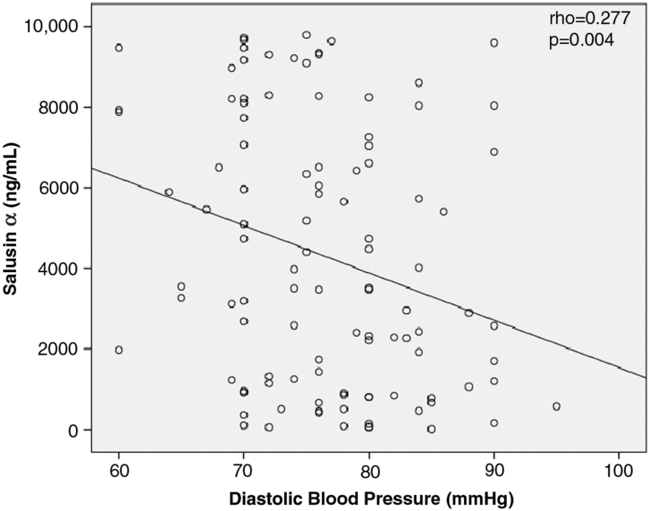
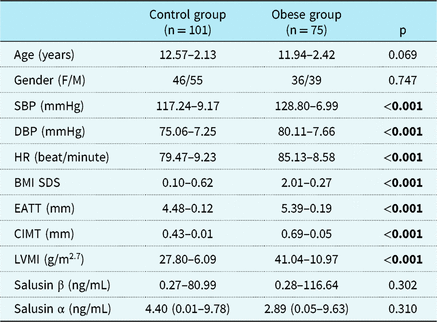
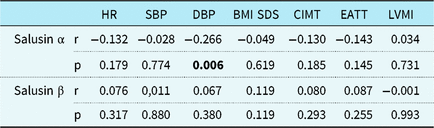
Of the total 176 patients included in the study, 75 were in obese group and 101 were in control group. The mean age was 11.94 ± 2.42 years old for obese group, and 12.57 ± 2.13 years old for control group. There was no difference in age and gender between the two groups (p > 0.05). The mean BMI SDS was statistically significantly higher in obese group (2.01 ± 0.27) than in control group (0.10 ± 0.62) (p < 0.001). Obese children had statistically significantly higher HR, systolic blood pressure (SBP) and diastolic blood pressure (DBP), EATT, CIMT, and LVMI than control group (Table 1). The median Salusin-α level was 2.89 (0.05–9.63) ng/ml in obese group and 4.40 (0.01–9.78) ng/ml in control group (p = 0.310). Salusin-β level in obese group was 0.28 ± 116.64 ng/ml and 0.27 ± 80.99 ng/ml for control group. There was no significant difference between the groups (p = 0.302). There was no significant correlation between Sal-α, β, and BMI (respectively, r = –0.045, p = 0.645 and r = 0.098, p = 0.197) (Table 2). There was a negative correlation between Sal-α and DBP (r = 0.277, p = 0.004) (Fig 1).
Scatter plot figure for correlations analyses of Salusin-α with diastolic blood pressure in obese group.

Demographic data, vital signs, BMI SDS, echocardiographic data, Salusin β and α values of study groups.

BMI SDS = body mass index standard deviation score; CIMT = carotid intima media thickness; DBP = diastolic blood pressure; EATT = epicardial adipose tissue thickness; HR = heart rate; LVMI = left ventricular mass index; SBP = systolic blood pressure.
Parameters were expressed as n, mean ± SD and median (range).
Student’s t test, Mann–Whitney U test and x2 were performed and p value <0.05 was considered significant.
Correlation analysis of Salusin-α and β with vital signs, BMI SDS, echocardiographic data in the obese group.

BMI SDS = body mass index standard deviation score; CIMT = carotid intima media thickness; DBP = diastolic blood pressure; EATT = epicardial adipose tissue thickness; HR = heart rate; LVMI = left ventricular mass index; SBP = systolic blood pressure.
Pearson correlation test was performed and p value <0.05 was considered significant.
Discussion
Obesity is associated with chronic inflammation, and increasing inflammatory mediators can produce atherosclerotic cardiovascular diseases in obese patients of advanced age.Reference Ogden, Carroll and Lawman 23 – Reference Wildman, McGinn, Lin, Wang, Muntner and Cohen 25
However, the pathophysiology of sub-clinical inflammation in obese children is unclear. There are a few studies of childhood obesity, but these studies have not been able to explain fully the features and clinical significance of sub-clinical inflammation. Excess accumulation of visceral adipose tissue plays an important role in inflammation.Reference Tam, Clément, Baur and Tordjman 26 , Reference Ferroni, Basili, Fako and Davi 27 Salusins, which are newly defined biomarkers, play roles in atherogenesis and the regulation of haemostasis and thus may help in the early detection of atherosclerosis and inflammation. These mediators are released from vascular tissue, the central nervous system, the kidneys, and endothelial cells.Reference Shichiri, Ishimaru, Ota, Nishikawa, Isogai and Hirata 11
Sal-β is an endogenous atherogenic factor, while Sal-α is an anti-atherogenic peptide.Reference Watanabe, Nishio and Kanome 14 , Reference Nagashima, Watanabe and Shiraishi 28 Nagashima et al showed the opposing effects of Sal-α and Sal-β on atherosclerosis in mice. They demonstrated that Sal-β accelerated the development of atherosclerosis by increasing cholesterol ester accumulation in macrophages. In contrast, Sal-α exerted an anti-atherosclerotic effect by suppressing cholesterol ester accumulation in macrophage.Reference Nagashima, Watanabe and Shiraishi 28 , Reference Kołakowska, Kuroczycka-Saniutycz, Wasilewska and Olański 29 The relationship between childhood obesity and salusins is unclear in the literature. Our study is the first to investigate the relationship between salusins and childhood obesity. We did not find a difference in Sal-β levels between obese and healthy children. We did find that the Sal-α level was lower in obese children compared with the control group, but the difference was not statistically significant. Fujimato et al showed higher Sal-β levels in patients with definite evidence of coronary artery disease (CAD). Their study suggests that an increased Sal-β level is an indicator of the development of systemic atherosclerosi.Reference Fujimoto, Hayashi and Kamata 30 Similarly, Liu et al showed that patients with CAD had serum Sal-β levels that were significantly higher than in patients without CAD, and that serum Sal-β was independently associated with CAD.Reference Liu, Ren, Zhang, Tong and Kang 31 Another study demonstrated low Sal-α levels in patients with CAD, and a negative correlation was reported between Sal-α and CAD severity.Reference Du, Wang, Wan, Wang, Wang and Zhang 32 Several studies have reported a positive correlation between CIMT and visceral fat accumulation.Reference Lakka, Lakka, Salonen, Kaplan and Salonen 33 , Reference De Michele, Panico, Iannuzzi, Celentana and Ciardullo 34 Our study revealed a higher CIMT in obese children than in the control group. However, there was no correlation between the levels of Sal-α and Sal-β and CIMT. Watanabe et al showed that the serum Sal-α levels were decreased and correlated negatively with CIMT in patients with acute coronary syndrome.Reference Watanabe, Nishio and Kanome 14 EATT is strongly correlated with visceral obesity.Reference Wheeler, Shi and Beck 35 , Reference Iacobellis, Assael and Ribaudo 36 Visceral adiposity is an independent risk factor for CAD that primarily influences the correlation between EATT and CAD.Reference Chistiakov, Grechko, Myasoedova, Melnichenko and Orekhov 37 In our study, the EATT was higher in obese children than in the control group, but there was no correlation between the levels of Sal-α and Sal-β and EATT.
Obesity and hypertension are not necessarily associated, but there is a clear correlation between the two.Reference Robinson, Batisky, Hayes, Nahata and Mahan 38 , Reference Flynn and Alderman 39 Some studies have shown that DBP is superior to SBP in predicting coronary heart disease risk in young adults.Reference Kannel, Gordon and Schwartz 40 , Reference Lichtenstein, Shipley and Rose 41 For example, the Framingham study reported that DBP was the best predictor of cardiovascular disease risk in patients under 50 years of age.Reference Franklin, Larson and Khan 42 However, some prospective studies have shown that isolated diastolic hypertension has a benign prognosis.Reference Pickering 43 Differences in these studies can be attributed to the diversity of the population. In children, there are no enough data to investigate the relationship between Sal-α, hypertension, and cardiovascular disease risk. In our study, we found a negative correlation between Sal-α and DBP in obese children. In a study of 60 hypertensive adults, Ti et al found that Sal-α was decreased in essential hypertension.Reference Ti, Wang and Wang 44 Similarly, Kolakowska et al reported that Sal-α was decreased in hypertensive patients and that this peptide was associated with pre-clinical atherosclerotic markers in essential hypertension.Reference Kołakowska, Kuroczycka-Saniutycz, Wasilewska and Olański 29 In contrast, Watanabe et al showed that the serum Sal-α level was low in essential hypertensives, but there was no direct correlation between serum Sal-α and blood pressure.Reference Watanabe, Nishio and Kanome 14
In conclusion, no statistically significant differences in Sal-α and Sal-β levels were detected between obese and healthy children, though there was a negative correlation between Sal-α and DBP. This result suggests that Sal-α is an indicator of cardiovascular involvement in obesity. Long-term prospective studies are needed to demonstrate the predictive value of salusins in obese children.
Acknowledgements
P.D. designed the study, planned the concept, and prepared and edited manuscript. B.E. and M.K. had a role in data acquisition and performed statistical analysis. Ş.P.İ and M.B. designed the study and had a role in manuscript design and review. M.K. had a role in manuscript design and data analysis.
Financial Support
This research received no specific grant from any funding agency, commercial, or not for profit sectors.
Conflicts of Interest
None.
Ethical Standards
The authors assert that all procedures contributing to this work comply with the ethical standards of the relevant national guidelines on human experimentation in Turkey and with the Helsinki Declaration of 1975, as revised in 2008.
The language in this document has been checked by at least two professional editors, both native speakers of English. For a certificate, please see: http://www.textcheck.com/certificate/yYGQkm