Introduction
Some patients with swallowing disorders fail to regain sufficient function to prevent tracheal aspiration, despite intensive rehabilitation. These patients need long-term non-oral feeding, via either a nasogastric tube or gastrostomy.
Surgery for these patients is an alternative option to manage intractable aspiration, especially for those who are keen to resume oral feeding or who refuse insertion of a feeding tube. The most effective and definitive way to prevent aspiration of food into the airway is by either tracheal separationReference Lindeman1–Reference Yamana, Kitano, Hanaitsu and Kitajima4 or laryngectomy.Reference Cannon and McLean5 Both these surgical methods result in a tracheostoma when the airway is divided from the pharynx. Both are also major procedures which inevitably result in loss of the patient's natural voice. Other techniques to treat intractable aspiration include epiglottopexy,Reference Habal and Murray6–Reference Castellanos8 glottic closureReference Montgomery9, Reference Sato and Nakashima10 and subperichondrial cricoidectomy; however, these too all result in loss of the voice, as airflow through the larynx and pharynx is blocked.
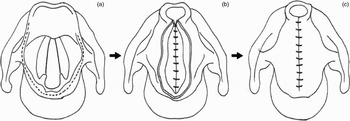
To achieve natural phonation via the patient's larynx and to prevent tracheal aspiration, Biller and LawsonReference Biller and Lawson11 described a technique of forming the epiglottis, aryepiglottic folds and arytenoid mucosa into a tube, leaving a small opening at the tip of the tubed supraglottis for phonation and breathing (Figure 1). In a series of 12 patients studied by Blitzer,Reference Blitzer12 all resumed swallowing without aspiration, although they were tracheostomy-dependent. None of these patients developed dehiscence of the tubed supraglottis.
The original technique of supraglottic laryngoplasty described by Biller. (a) The mucosa of the epiglottis, aryepiglottic folds and arytenoids is undermined after making the mucosal incision. (b & c) The supraglottis is rolled and tubed and secured by a two-layer closure using absorbable sutures, leaving an opening at its tip.

However, our experience of using Biller's technique has been disappointing, with a high failure rate due to dehiscence of the supraglottic closure. This paper describes our experience with Biller's method, and the way in which we have modified it using a tibial periosteal graft to reinforce the supraglottic closure, in order to manage intractable aspiration in patients suffering from oropharyngeal dysphagia.
Surgical technique
A standard tracheostomy was performed under general anaesthesia and a tracheostomy tube placed. This removed the presence of a tube in the pharynx and larynx, and improved visualisation and access to the operative field.
A musculocutaneous apron flap was elevated in the anterior neck from the level of the cricoid to just above the hyoid bone. The right sternocleidomastoid muscle was dissected to expose the carotid sheath and the infrahyoid strap muscles. The omohyoid muscle was divided and the middle thyroid vein ligated. The sternohyoid and sternothyroid muscles were dissected from the hyoid bone to expose the thyrohyoid membrane and thyroid lamina. The internal laryngeal nerve was sacrificed to allow access to the epiglottis through a pharyngotomy. The perichondrium on the medial surface of the right thyroid ala was elevated from the posterior border of the ala and dissected to preserve the mucosa of the right pyriform fossa. A right lateral pharyngotomy was performed by incising the mucosa of the right thyrohyoid membrane just inferior to the hyoid bone, as a right infrahyoid pharyngotomy. The infrahyoid pharyngotomy incision was extended to cross the midline, to allow rotation of the larynx to expose the epiglottis, aryepiglottic folds and arytenoids on both sides. A U-shaped incision was made in the mucosa of the laryngeal surface of the epiglottis, 5 mm medial to the lateral border of the epiglottis, 5 mm medial to the lateral edge of the laryepiglottic folds, and in the interarytenoid mucosa, sparing the superior border of the epiglottis. The mucosa was then elevated and the epiglottis degloved to expose the lateral and superior borders of the epiglottic cartilage. The mucosa of the laryngeal surface of the aryepiglottic folds and arytenoids was elevated sufficiently to allow it to be approximated to the mucosa of the contralateral side without tension when sutured at a later stage. After exposure of the epiglottic cartilage, the lateral one-quarter of the cartilage was trimmed on both sides. The purpose of this trimming was to reduce the elastic recoil of the cartilage after vertical supraglottic closure, and to minimise dehiscence by reducing tension in the wound.
To strengthen the vertical supraglottic wound, a periosteal graft was used to reinforce the mucosal closure; in the presented cases, this was harvested from the left tibia. There was no preference as to which side the graft was taken; the left side was chosen for convenience as a two team approach was used during surgery, one team harvesting the graft and the other performing the laryngeal surgery. To harvest the periosteum, a 4 cm vertical incision was made over the midpoint of the tibia and a skin flap elevated to expose the periosteum. A 2 × 3 cm periosteal graft was elevated, which was adequate for all permeatations of wound reinforcement. The leg wound was closed primarily in two layers and a simple wound dressing applied. Redundant fibroadipose tissue was removed from the periosteal graft, which was stored in normal saline at room temperature until required.
The epiglottis, aryepiglottic folds and arytenoids were rolled to form a tube. This was achieved by suturing together the inner mucosa of the epiglottis, aryepiglottic folds and arytenoids in a vertical fashion. The tibial periosteal graft was trimmed so that it enveloped all of the inner mucosa and did not extend beyond the superior border of the epiglottic cartilage; it was then secured with absorbable sutures to the surrounding soft tissues. The outer mucosa of the epiglottis, aryepiglottic folds and arytenoids was rolled to form a tube which covered the periosteal graft, and was sutured in place with absorbable sutures. In this way, the periosteal graft was sandwiched between the inner and outer mucosa of the epiglottis, aryepiglottic folds and arytenoids. As this now resembled a Chinese steam boat, we have termed this modification of Biller's technique a ‘steam-boat’ supraglottic laryngoplasty.
After the steam-boat supraglottic laryngoplasty was completed, a cricopharyngeal myotomy was performed by dividing the circular fibres of the cricopharyngeus and upper oesophagus, taking care not to perforate the mucosa. The lateral pharyngotomy was closed with absorbable sutures using a Connell suture, and the infrahyoid pharyngotomy was closed with interrupted absorbable sutures. The infrahyoid pharyngeal closure was further reinforced by suturing the upper thyroid cartilage to the hyoid bone: two through and through sutures on either side of the upper border of the thyroid ala were hooked around the body of the hyoid bone. The superior ends of the sternohyoid and sternothyroid muscles were reapproximated to the hyoid bone.
Two suction drains were inserted into the neck, one on each side. The skin flap was then redraped and the skin closed in two layers.
The patient was kept on non-oral feeding for two weeks, being fed by a gastrostomy tube.
Results
Steam-boat supraglottic laryngoplasty was performed on three consecutive patients with ages ranging from 55 to 64 years.
Two patients had oropharyngeal dysphagia and silent aspiration with pneumonia due to long-term complications of radiotherapy for treatment of nasopharyngeal carcinoma. The other patient had previously had a retropharyngeal abscess of the neck; an exploration was performed, complicated by prolonged oropharyngeal dysphagia with silent aspiration and a chest infection.
All patients underwent fibre-optic endoscopic evaluation of their swallowing, which demonstrated gross aspiration of thin liquid, thick liquid and puree into the airway without a choking reflex. All patients subsequently underwent gastrostomy tube placement after the swallowing study.
The surgical options – total laryngectomy or steam-boat supraglottic laryngoplasty – were discussed with the patients; all preferred ‘laryngeal preservation’ surgery.
All three patients resumed oral feeding two weeks after surgery, following a contrast study undertaken on post-operative day 14 to document the integrity of the pharynx and supraglottis. All patients were able to phonate at 4 weeks post-operatively by occluding the tracheostomy tube with a finger, and their speech was comprehensible. All patients had their gastrostomy tube removed when they were able to achieve an adequate oral intake.
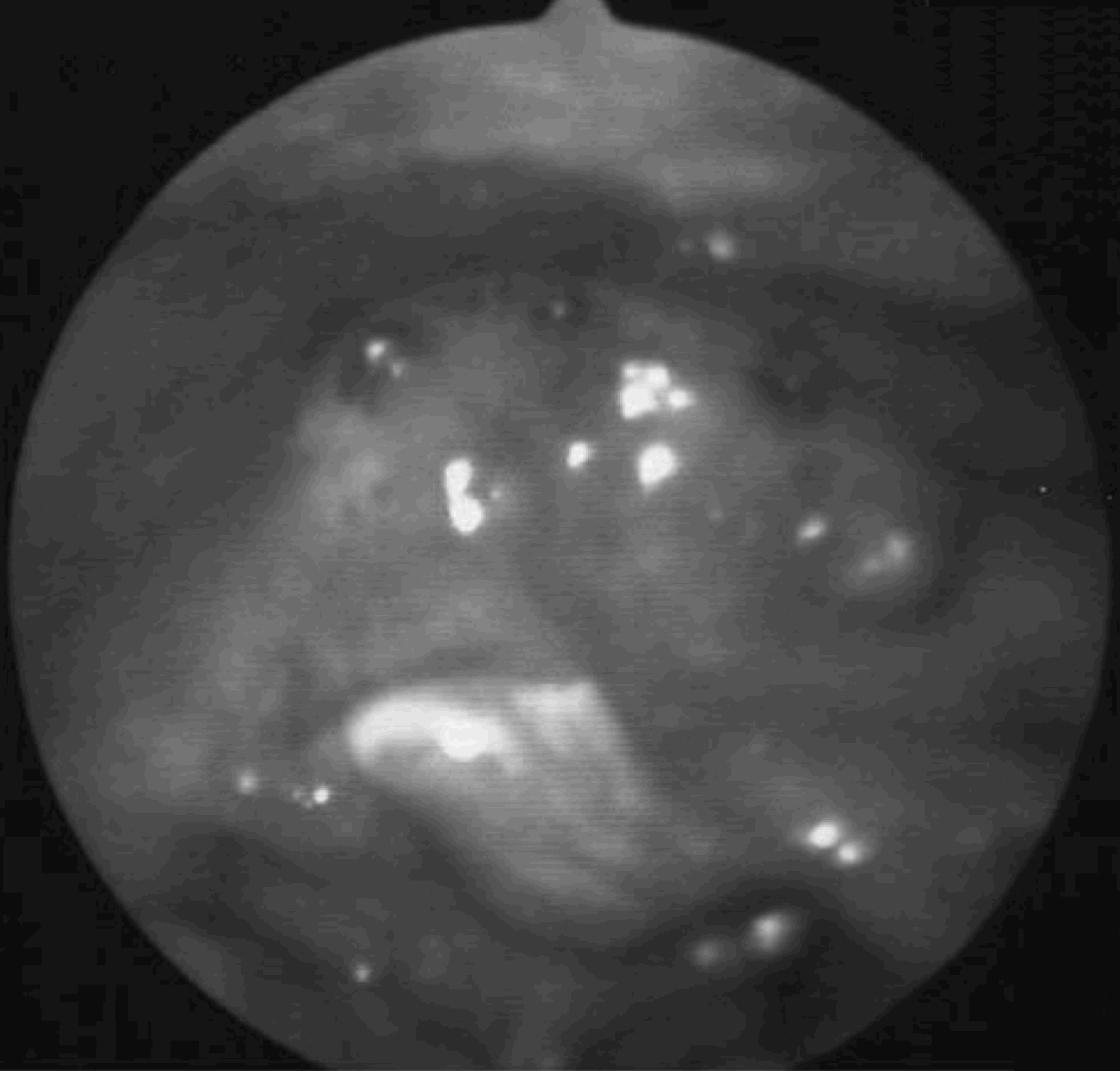
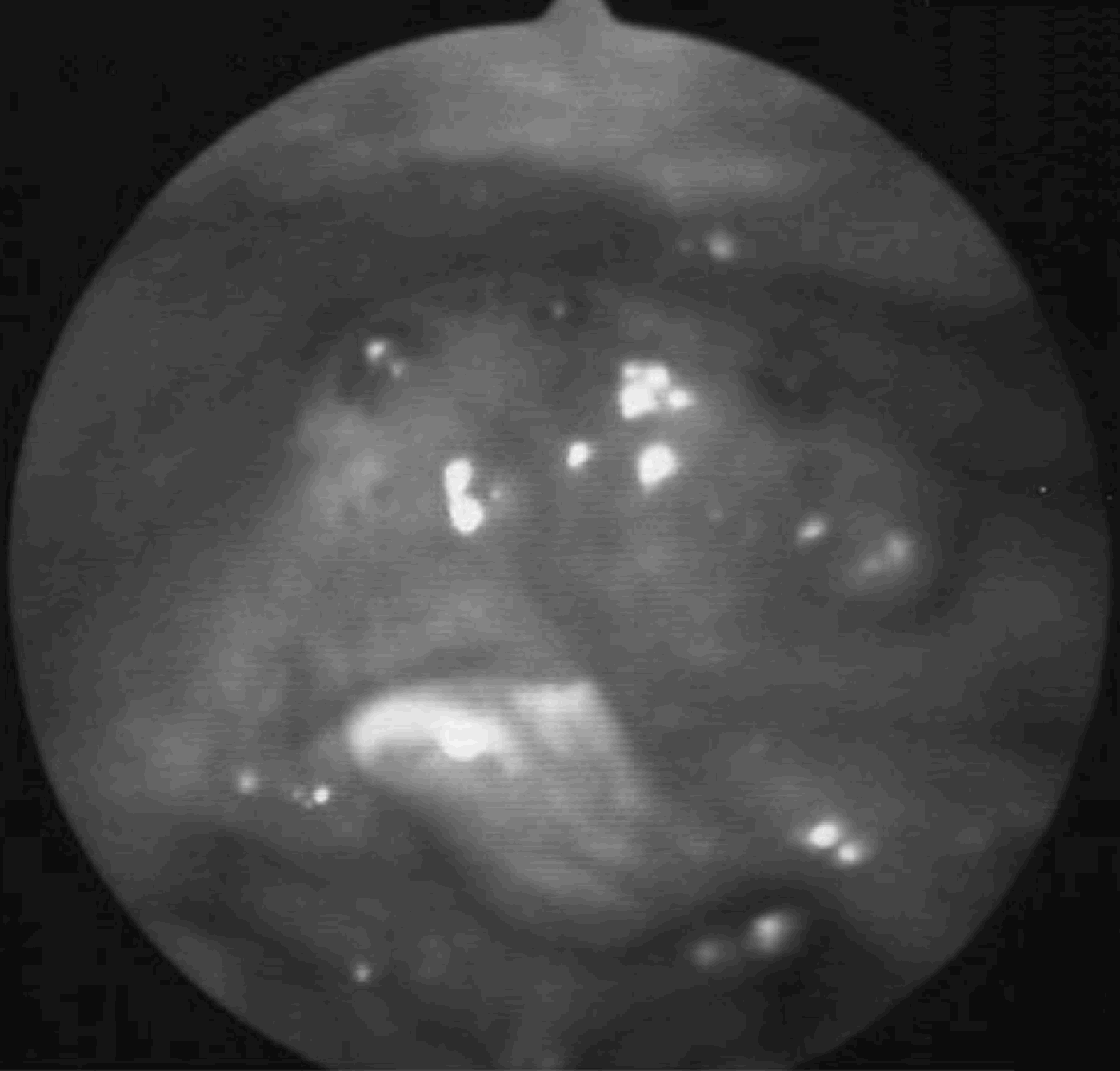
At one-year follow up, no pharyngocutaneous fistula had occurred and the supraglottic closure was intact in all three patients (Figure 2).
The appearance of the supraglottis, one year after surgery.
Discussion
Alternatives to a total laryngectomy or tracheal diversion have been developed to prevent intractable aspiration. However, nearly all surgery sacrifices the natural voice once the larynx is blocked to prevent the entrance of food into the trachea. Ideally, surgery to treat intractable aspiration should: completely prevent entry of food into the airway; allow natural phonation using the larynx; allow breathing through the natural airway without a tracheostomy; be reversible if the cause of the intractable aspiration resolves; and be relatively simple to perform with minimal post-operative complications. Of the factors mentioned, efficacy in controlling aspiration, post-operative voice quality and avoidance of potential complications are the three main factors concerning our patients when they consider aspiration surgery.
Of the surgery that has previously been described to treat intractable aspiration, only the technique described by BillerReference Biller and Lawson11, Reference Blitzer12 fulfils most of these criteria while preserving the voice. In Biller's original description, the epiglottis was rolled into a tube leaving a small hole at its tip for phonation and breathing. While all Biller's patients resumed an oral diet without aspirating, they all needed a long-term tracheostomy. Biller reported that no dehiscence of the epiglottic wound occurred.
We were unable to successfully duplicate these results using Biller's technique, at least in the Chinese population, due to tension which developed in the supraglottic closure, in particular at the level of the mid-aryepiglottic folds and at the tip of the epiglottis. Three of our patients previously treated with an original Biller procedure for intractable aspiration developed either an incomplete supraglottic closure intra-operatively or complete dehiscence of the supraglottic closure after surgery. We postulate that this was due to the elastic recoil of the tubed epiglottic cartilage, which imposed excessive tension on the mucosal wound edges of the epiglottis and aryepiglottic folds after closure, eventually leading to wound breakdown due to a cheese wire cutting effect of the sutures on the epiglottic mucosa. Another postulated mechanism contributing to wound dehiscence was the explosive cough induced by tracheal suction, sputum clearance from the airway, or irritation of the airway by the tracheostomy tube or by dryness. The explosive subglottic pressure generated when coughing would be enough to disrupt the supraglottic closure. The supraglottic closure in this situation is subjected to a high risk of dehiscence, as the integrity of the mucosal tube is maintained only by two thin layers of epiglottic mucosa. One report suggests that intact laryngeal musculature may also cause dehiscence of the supraglottic and glottic closure.Reference Pototschnig, Schneider, Eckel and Thumfart13 To our knowledge, we are the first group to report the use of a tubed supraglottic laryngoplasty to treat intractable aspiration in Chinese patients.
In order to retain the concept of a tubed supraglottic laryngoplasty while solving the problem of wound dehiscence caused by mucosal tension imposed by the epiglottic cartilage on the epiglottic mucosa, we introduced two modifications of Biller's technique. The first modification was to trim the lateral one-quarter of the epiglottic cartilage on both sides, leaving the central one-half to stent the supraglottic tube open on surgical closure. This effectively reduced the mucosal tension of the supraglottic closure. We were careful not to leave too narrow a strip of epiglottic cartilage behind, as this would reduce the diameter of the tube and lead to increased resistance to airflow on phonation, as unsupported mucosa contracts after being mobilised from the epiglottic cartilage.
We found that meticulous closure of both layers of epiglottic mucosa was not enough to prevent air leaking through the wound following a strong and forceful cough. This led us to develop a second modification. We speculated that if the wound closure could be reinforced with autologous fibrous tissue, this would effectively reduce the incidence of wound breakdown of the musculo-mucosal tube after the supraglottic wound was closed. Based on our experience in repairing cleft palates and laryngeal clefts in the paediatric population, we used a tibial periosteal graftReference Garabedian, Ducroz, Roger and Denoyelle14, Reference Raphael, Morand, Bettega, Lesne and Lesne15 to reinforce the inner and outer mucosa of the epiglottis on surgical closure. Our preliminary experience with this supraglottic wound reinforcement in three patients was promising. Tibial periosteal graft has a high metabolic rate and is easily incorporated into the surrounding soft tissue, and hence remains viable in the recipient site. This was demonstrated in our three patients, who had no dehiscence of the epiglottic mucosal wound post-operatively.
Conclusions
Steam-boat supraglottic laryngoplasty, a modification of Biller's technique, is a viable surgical alternative to total laryngectomy or tracheal diversion for controlling intractable aspiration while preserving the larynx. Steam-boat supraglottic laryngoplasty allows patients to phonate with their own larynx, without relying on external devices or internal prostheses. This procedure, performed on three Chinese patients with excellent results, holds promise as a viable option for the surgical treatment of intractable aspiration.