Implications
Supplementary feeding and gastrointestinal nematode (GIN) infection can influence feeding behavior and sheep performance. Energy supplementation may affect the ingestive behavior, nutrient intake and the resilience against GIN infection of hair sheep lambs under silvopastoral conditions but this has not been studied. Moreover, the metabolic cost of GIN natural infections has not been estimated under field conditions. This study showed an improved resilience against GIN infections in maize-supplemented lambs and a reduction of fodder intake in the silvopastoral field (grass + Leucaena leucocephala). The feeding pattern of lambs in the field was not altered by supplementation or GIN infection. The metabolic cost of GIN infections in growing hair sheep was estimated to be equivalent to c. 40 g live weight gain/day. Supplementation was an economically viable tool to control GIN.
Introduction
The performance of sheep grazing tropical rangelands is limited by nutritional restrictions (i.e. reduced availability, poor quality or nutrient unbalance) and the negative impact of gastrointestinal nematode (GIN) infections (Hoste et al., Reference Hoste, Torres-Acosta, Paolini, Aguilar-Caballero, Etter, Lefrileux, Chartier and Broqua2005). Seasonal fluctuations in availability (wet v. dry season) and the diverse chemical composition of the forages available for sheep feeding affect the nutrient supply for growth and production (Romano-Muñoz et al., Reference Romano-Muñoz, Hernández-Gamboa and Castellanos-Ruelas1983; Pfister and Malechek, Reference Pfister and Malechek1986). The role of strategic supplementation as an alternative tool in the control of GIN in small ruminants under semi-intensive systems has been studied in recent years (Knox et al., Reference Knox, Torres-Acosta and Aguilar-Caballero2006; Hoste et al., Reference Hoste, Torres-Acosta and Aguilar-Caballero2008; Torres-Acosta and Hoste, Reference Torres-Acosta and Hoste2008). Infections with GIN can alter the host's feed intake, the nutrient partition (Adams and Liu, Reference Adams and Liu2003; Colditz, Reference Colditz2008) and possibly the metabolism of the host. The extra nutrients provided in the supplement fulfill the daily requirements for maintenance (including repair of damaged tissues due to GIN infection and possibly the development of an immune response; Coop and Holmes, Reference Coop and Holmes1996; Van Houtert and Sykes, Reference Van Houtert and Sykes1996). A number of field trials with goats showed that dietary supplementation (soybean meal and sorghum meal) improved the host's resilience against GIN infections (Torres-Acosta et al., Reference Torres-Acosta, Jacobs, Aguilar-Caballero, Sandoval-Castro, May-Martínez and Cob-Galera2004 and Reference Torres-Acosta, Jacobs, Aguilar-Caballero, Sandoval-Castro, Cob-Galera and May-Martínez2006; Martínez-Ortiz-de-Montellano et al., Reference Martínez-Ortiz-de-Montellano, Vargas-Magaña, Aguilar-Caballero, Sandoval-Castro, Cob-Galera, May-Martínez, Miranda-Soberanis, Hoste, Cámara-Sarmiento and and Torres-Acosta2007). Those trials were performed in tropical rangelands containing abundant legume forages. Under those protein-rich conditions, even dietary energy supplementation alone (sorghum meal) improved the resilience of kids against GIN (Gutiérrez-Segura et al., Reference Gutiérrez-Segura, Torres-Acosta, Aguilar-Caballero, Cob, May and Sandoval–Castro2003) by improving the efficiency of protein (nitrogen) utilization in the rumen. The latter seemed coherent with the idea that goats are considered browsers that can consume fodder from legume bushes. However, sheep are considered grazers and might not show similar results when fed an energy supplement such as ground maize in a silvopastoral field. Thus, the possible effect of energy supplementation on the resilience of sheep against GIN under those protein-rich conditions needs to be determined.
Energy supplementation in sheep can also influence their feeding behavior. The reduction of fodder intake, resulting from different supplementation levels and types of supplements in the diet (Krysl and Hess, Reference Krysl and Hess1993; Bremm et al., Reference Bremm, Gomes da Rocha, Restle, Pilau, Montagner, Kellermann de Freitas, Macari, Elejalde, Roso, Roman, Guterres, Guasso da Costa and Neves2005), might reduce the ingestion of infective larvae from pasture. Parasitism may also modify the animal's diet selection to compensate for the loss of endogenous protein through a change in feed-type selection (i.e. by selecting more high-quality protein feeds) (Kyriazakis and Oldham, Reference Kyriazakis and Oldman1993; Crosgrove and Niezen, Reference Crosgrove and Niezen1999). Hence, understanding the effect of supplementation on GIN infection and the feeding behavior of sheep in the field is paramount in the establishment of an economically viable GIN control program. The objective of this study was to evaluate the effect of maize supplementation on the ingestive behavior, nutrient intake and the resilience against GIN infection of hair sheep in a silvopastoral system containing tropical grasses and legume trees. It also attempted to determine the metabolic cost of the natural GIN infection in supplemented and non-supplemented animals.
Material and methods
Location
The study was performed at the small ruminant production farm of the Campus of Biology and Agricultural Sciences, Faculty of Veterinary Medicine and Animal Science - Autonomous University of Yucatan. The climate of the region is hot sub-humid tropical with summer rainfall. The predominant vegetation of the area is classified as low deciduous and sub-deciduous tropical forest. The field work lasted for 70 days (September to December) and was divided into five periods of 14 days. The total rain fall during the research period was 549.9 mm, occurring mostly during September. The mean temperature during the period was 22.1°C and the average relative humidity was 90%.
Animals
A total of 29 male and female Pelibuey lambs with an average live weight (LW) of 15.0 ± 2 kg were used in the trial. Animals were 4 months old at the beginning of the trial and were raised under conditions that maintained them free of GIN infection using the technique described by Torres-Acosta et al. (Reference Torres-Acosta, Jacobs, Aguilar-Caballero, Sandoval-Castro, May-Martínez and Cob-Galera2004). The lambs were randomly distributed to the four experimental groups balancing for sex and LW. All the groups were formed with four males and three females, except for the I-NS group (infected, not supplemented; four males and four females). The main effects of the experimental groups were the supplementation (supplemented (S) v. non-supplemented (NS)) and the anthelmintic (AH) treatment (treated (T) v. infected (I)). Thus, the experimental groups were T-S, I-S, T-NS and I-NS.
Feeding
From the beginning of the trial, the experimental animals of the different groups grazed daily for 7 h. Grazing took place continuously in a 1.5-ha silvopastoral paddock. The latter was composed of Cynodon nlemfuensis grass (∼65% of the area), Leucaena leucocephala bushes (30% of the area) and other shrubs and herbs (5%). The paddock was located in the vicinity of the pens where the experimental animals received their supplement and were confined during the night. The paddock was irrigated once every week for the duration of the trial. After grazing, the animals in groups I-S and T-S were individually supplemented with ground maize grain (1.5% of the LW/animal). To adjust the amount of maize offered to animals, changes in LW of lambs were assessed every 14 days and the actual LW was used to adjust the supplement accordingly.
AH treatment
Animals from the T-S and T-NS groups were treated subcutaneously with moxidectin (0.2 mg/kg LW moxidectin; Cydectin® Fort Dodge Animal Health, Mexico D.F., Mexico) at 28-day intervals for the duration of the trial to maintain the lambs of these groups free of GIN infection for the duration of the trial (suppressive AH treatment).
Effect on resilience or resistance against GIN infection
Cumulative LW change (CLWC)
Animals were weighed at the beginning of the trial and subsequently at 14-day intervals until the end of the trial. Weighing was carried out in the morning before grazing. An electronic scale (Techno Cor model PP30-CN, Santiago Miahuatlan, Puebla, Mexico) with a capacity of 30 ± 0.01 kg was used. Animals were restricted from food access at least 17 h before each weighing procedure. LWC was estimated as the LW difference between the 14-day intervals. The CLWC was determined as the accumulated weight gain at the end of the trial.
Blood sampling and processing
Blood samples (3 ml) were obtained from each lamb by a jugular puncture in EDTA-impregnated tubes. The samples were obtained on the days the animals were weighed (day 0 and every 14 days). Sampling was performed before weighing. Samples were processed using an automatic hematological analyzer to determine red blood cells (RBC), hematocrit (Ht) and hemoglobin (Hb) (ABX ABCvet®, Horiba, Kyoto, Japan).
Fecal sampling and processing
Fecal samples were obtained directly from the rectum of each animal at 14-day intervals on the day of weighing. The number of eggs per gram of feces (EPG) of each sample was determined using a McMaster technique (Torres-Acosta et al., Reference Torres-Acosta, Jacobs, Aguilar-Caballero, Sandoval-Castro, May-Martínez and Cob-Galera2004). The fecal egg count of each sample was adjusted for its moisture content according to the technique described by Le Jambre et al. (Reference Le Jambre, Dominik, Eady, Henshall and Colditz2007).
Genera of GIN involved in infection
Larval cultures were produced for each experimental group every 28 days; larvae were harvested as described by Corticelli and Lai (Reference Corticelli and Lai1963). The genus of L3 larvae was determined using the keys of identification described by Bowman and Lynn (Reference Bowman and Lynn1999).
Post-mortem worm count
Three animals of each group were slaughtered at the end of the experiment to determine their worm burdens in the abomasums, small and large intestines, using the technique described by Martínez-Ortiz-de-Montellano et al. (2007).
Economical analysis of maize supplementation and suppressive AH treatment
The economic viability of the different interventions was compared against the group with no intervention using a partial budget analysis (Huirne and Dijkhuizen, Reference Huirne and Dijkhuizen1997). The following costs were considered: maize (US$0.25 /kg), moxidentin (US$0.56 /ml), syringe, needles, gloves and labor (US$0.32 /deworming) and the price of mutton (US$1.76 /kg).
Metabolic cost of parasitism
The metabolic cost of GIN infection was considered as the quantity of metabolizable energy (ME) and protein (MP) required by infected sheep to achieve the performance of non-infected lambs (treated with moxidectin). Calculations were carried out separately to compare the two supplemented groups (I-S v. T-S) and the two non-supplemented groups (I-NS v. T-NS). No attempt was made to compare supplemented v. non-supplemented animals. All calculations were based on the Agriculture and Food Research Council (1993) guidelines. The procedure was as follows:
(a) Observed requirement: the calculated requirements of ME and MP to sustain the observed LW gains (ΔLW) of infected animals.
(b) GINΔLW: difference in ΔLW (g/day) among treated and infected groups (GINΔLW).
(c) Over requirement: the requirement (ME and MP) of infected animals to overcome the difference in growth performance (GINΔLW) and hence perform similar to non-infected animals.

Grazing behavior and fodder consumption
Fodder consumption
Fodder consumption was estimated by the LWC before and after grazing. This procedure was performed twice per week every 14 days. Two female lambs from each group were used to monitor fodder intake in all periods. The total production of feces and urine was retained from each animal during grazing using a modification of the technique proposed by Corbett (Reference Corbett1978). For this purpose, a disposable diaper (Depend®, Kimberly Clark de Mexico, Cuautitlan, Estado de México, Mexico) was placed covering the pelvic region of each animal (to retain the feces and the urine). The cranial part of the diaper was fixed with masking tape to the abdominal perimeter of the animal, avoiding mechanic pressure that could affect feed consumption. The diaper was also adjusted to the posterior limbs of the animals, to avoid loss of feces or urine and was then covered with a nylon boxer that was held in position with a plastic harness on the chest. During grazing, animals had no access to drinking water. On account to the high-ambient temperatures in the middle of the day (12 IM), animals returned to their individual pens to rest for 30 min. During that time, individual animals received a bucket of water that was weighed before and after the animal was placed in the pen. After this short break, animals continued grazing.
The fodder intake was calculated using the following formula:

where Wt1 = LW of animal before grazing (at 0730 h); Wt2 =LW of animal after grazing (at 1500 h); and F = Water consumption (gram of water consumed in the resting period).
Initial weight (Wt1) included the LW of the sheep with the new diaper and harness on. The Wt2 considered the final weight of the sheep with the feces and urine collected during grazing time inside the diaper and the harness. These were considered as animal weight to avoid underestimation of the real intake. The insensible weight loss was not accounted for.
Grazing behavior
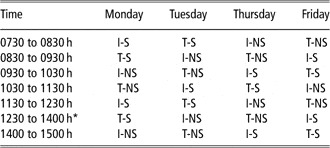
Animal behavior during grazing was recorded by one person according to the instant sampling and focal sampling per animal techniques described by Altman (Reference Altman1979). Animals in the groups under observation on the specific day and time were individually identified with a harness made of cloth with a different color per group. The cloth contained consecutive numbers that could be clearly identified from a distance of 10 m. Observations were carried out every 15 min, 4 days/ week every 14 days according to a pre-established weekly calendar. The latter was designed to enable observations of each animal at 7 different moments of the day, reducing the possibility of bias due to the timing of observation (Table 1). The experiment comprised a total of five periods of observation for each animal.
Schedule of grazing behavior recording

T-S = treated with moxidectin and supplemented with maize at 1.5% of live weight; I-S = infected and supplemented with maize at 1.5% of live weight; T-NS = treated with moxidectin and non-supplemented; I-NS = infected and non-supplemented.
*Resting at the pen from 1300 to 1330 h.
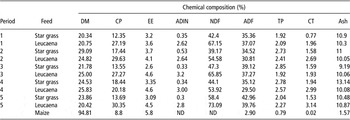
During grazing, samples of the plant parts consumed by animals were obtained using a technique that simulated the grazing behavior of experimental animals (Wallis de Vries, Reference Wallis de Vries1995). The simulated graze/browse samples were useful to estimate the chemical composition of the diet selected by the animals in the field. For each period, samples were pooled and oven dried at 60°C for 72 h. Samples were milled and stored in plastic bags for further analyses. All the samples were analyzed to determine their dry matter (DM), ash, ether extract, CP (AOAC, 1980), NDF, ADF (Van Soest et al., Reference Van Soest, Robertson and Lewis1991), ADF-N (Van Soest et al., Reference Van Soest, Robertson and Lewis1991; AOAC, 2000), condensed tannins (Price et al., Reference Price, Van Scoyoc and Butler1978) and total phenol (Price, Reference Price and Butler1977) content. The chemical composition of maize, grass and foliage is presented in Table 2. The composition of maize and both forage types was similar throughout the experimental period.
Chemical composition of Leucaena leucocephala leafs, star grass (Cynodon nlemfuensis) and the supplement offered (maize)

DM = dry matter; EE = ether extract; ADIN = acid detergent-insoluble nitrogen; TP = total polyphenols; CT = condensed tannis; ND = not determined.
Statistical analysis
The grazing behavior, fodder and total feed intakes (fodder + supplement) were analyzed with ANOVA considering the effect of treatment group, animal and experimental period (1 to 5). Grazing behavior also included the hour of observation in the model. All the analyses were performed using the GLM procedure.
The differences between CLWC were analyzed through ANOVA in a 2 × 2 factorial design. The values of EPG, RBC, Ht and Hb were compared using the repeated measures ANOVA (SPSS version 11.0). Means were compared using Tukey's post-hoc test. Worm burdens were not compared statistically. Pearson correlation coefficients were calculated to investigate possible associations between the type of fodder consumed (grass, L. leucocephala or others) and the EPG count 21 days after fodder consumption. The variables CLWC, EPG and grazing behavior showed no effect of lamb sex, either as a main factor or as an interaction with other factors. Thus, it was not included in the final statistical models. To stabilize the variance, the values of feed selection and EPG were transformed into log10 (n + 1) before the statistical analysis.
In the experiment, two animals from the group I-NS were excluded because of a femur fracture (day 53) and diarrhea and weakness (day 60).
Metabolic cost estimation (ME and MP), worm burdens and the economic analysis results were not subjected to a statistical analysis.
Results
Effect on resilience or resistance against GIN infection
CLWC
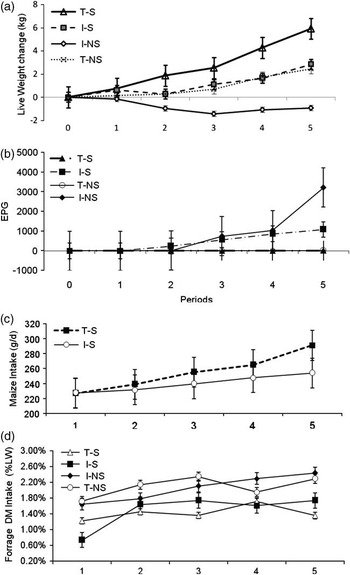
Maize supplementation (1.5% of the LW) improved CLWC compared with the non-supplemented groups (P <0.0001), whereas natural GIN infection reduced CLWC (P < 0.0001). Groups I-S and T-NS were not significantly different (2.84 ± 0.42 kg v. 2.45 ± 0.42 kg; Figure 1a). The T-S group had the highest CLWC (5.91 ± 0.42 kg, P < 0.05). The I-NS group showed the lowest CLWC and even showed weight loss during the trail (−0.92 ± 0.42 kg, P < 0.05).
(a) Average live weight (LW) change (kg), (b) average excretion of nematode EPG, (c) average intake of maize (g/day) and (d) fodder intake (%LW) of sheep in the different experimental groups (T-S = treated with moxidectin and supplemented with maize at 1.5% LW; I-S = infected and supplemented with maize at 1.5% LW; T-NS = treated with moxidectin and non-supplemented; I-NS = infected and non-supplemented; the reported results of the the eggs per gram of feces are re-transformed log10 (n + 1) values).

Hematological values
The values of Ht and Hb in the T-S, I-S and T-NS groups were higher than those obtained for the I-NS group (P < 0.05). However, in the case of RBC, there was no significant difference in the I-S and I-NS groups. In the case of EPG, I-S and I-NS groups showed no significant difference (P > 0.05) (Table 3). The I-NS group showed a decrease in the values of RBC, Hb and Ht with respect to the other groups, throughout the experimental period (P < 0.05).
Values of erythrocytes, hemoglobin, hematocrit and EPG in sheep under different treatments

EPG = eggs per gram of feces; T-S = treated with moxidectin and supplemented with maize at 1.5% live weight; I-S = infected and supplemented with maize at 1.5% live weight; T-NS = treated with moxidectin and non-supplemented; I-NS = infected and non-supplemented.
a,bMeans within a column with different superscript letters are significantly different at P < 0.05.
Values presented in EPG are Log10(n + 1) re-transformed values.
Data are presented as mean ± s.e.
EPG
For the duration of the trial, the I-NS group shed similar quantities of EPG compared with the I-S group (Table 3). However, at the end of the trial, animals of the I-NS group were shedding 30% more EPG than those in the I-S group (Figure 1b). The correlation analysis showed that no association was found between the type of fodder eaten by the animals and their EPG.
Genera of GIN present in larval cultures’ and worm burdens’ post mortem
The genera found in larval cultures were mainly Haemonchus spp., followed by Trichostrongylus spp., Oesophagostomun spp. and small proportions of Cooperia spp. At the end of the experiment, the mean worm burdens of the I-NS group were 1975 Haemonchus contortus, 3800 Trichostrongylus colubriformis and 18 Oesophagostomun columbianum. Meanwhile, the I-S group showed 440 H. contortus, 1465 T. colubriformis and 35 O. columbianum. Cooperia spp. worms were not found in any group at slaughter.
Economic analysis
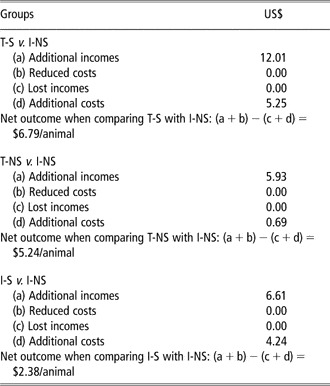
The partial budget analysis for each group compared with the I-NS group showed that higher economic viability was achieved by maintaining animals on a suppressive AH treatment (keeping animals free of infection) with supplementation (US$6.79/animal). The second best economic result was achieved by the suppressive AH treatment alone (US$5.24/animal), followed by the use of supplementary feeding alone (US$2.38/animal; Table 4).
Results of the economic analysis in sheep under different treatments

T-S = treated with moxidectin and supplemented with maize at 1.5% live weight; I-NS = infected and non-supplemented; T-NS = treated with moxidectin and non-supplemented; I-S = infected and supplemented with maize at 1.5% live weight.
Metabolic cost of parasitism
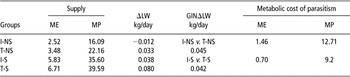
Table 5 shows that ME and MP intakes were greater in the supplemented groups than the non-supplemented groups. In addition, the difference due to the natural infection with GIN (GINΔLW) was similar between the supplemented and the non-supplemented animals (0.045 v. 0.042 g/day). However, the metabolic cost of the GIN infection was greater in the I-NS than in the I-S.
Estimated nutrient supply of grazing area and metabolic cost of parasitism in sheep under different treatments

ME = metabolizable energy (MJ/day); MP = metabolizable protein (g/day); ΔLW = change in LW (kg/day); I-NS = infected and non-supplemented; T-NS = treated with moxidectin and non-supplemented; I-S = infected and supplemented with maize at 1.5% live weight; T-S = treated with moxidectin and supplemented with maize at 1.5% live weight.
Grazing behavior and fodder consumption
Fodder and supplement intakes
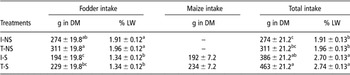
The fodder intake during grazing of the different groups is shown in Table 6. Non-supplemented animals showed a higher fodder intake (from the field) compared with supplemented animals (P < 0.05). However, the total feed intake (DM; fodder from grazing + supplement) was higher in supplemented groups than in the non-supplemented groups (P < 0.05). Fodder intake was not reduced in the GIN-infected lambs (P > 0.05). Figure 1c shows maize consumption in the supplemented groups, which increased throughout the trial as it was offered as a fixed proportion of the LW. Figure 1d shows the forage intake of sheep in the different experimental treatments.
Fodder and total intakes (fodder + supplement) in sheep under different treatments

DM = dry matter; LW = live weight; T-S = treated with moxidectin and supplemented with maize at 1.5% LW; I-S = infected and supplemented with maize at 1.5% LW; T-NS = treated with moxidectin and non-supplemented; I-NS = infected and non-supplemented.
a,b,cMeans within a column with different superscript letters are significantly different at P < 0.05.
Data are presented as mean ± s.e.
Maize intake was not statistically analyzed.
Grazing behavior
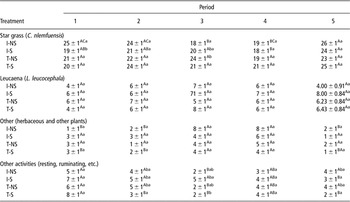
Supplementation as a main factor did not show an effect on plant selection (grass, legumes and others; P>0.05). The grazing behavior of sheep for grass and legumes was constant throughout the sampling period. However, the consumption of other herbaceous plants increased from the third sampling period (Table 7).
Selection frequency of Leucaena leucocephala, star grass (Cynodon nlemfuensis), other herbaceous and other activities in sheep under different treatments

T-S = treated with moxidectin and supplemented with maize at 1.5% live weight; I-S = infected and supplemented with maize at 1.5% live weight; T-NS = treated with moxidectin and non-supplemented; I-NS = infected and non-supplemented.
A,B,CMeans within a row with different superscript letters are significantly different at <0.05.
a,bMeans within a column with different superscript letters are significantly different at <0.05.
*One period is comprised of 35 records per animal.
Data are presented as mean ± s.e.
Comparison was made among plants of the same type not among different plants.
Discussion
The findings of this study indicated that both maize supplementation and GIN parasitism affected the CLWC of grazing lambs grazing in a silvopastoral field. However, fodder intake was only affected by supplementation. No change in selection behavior was observed as a consequence of maize supplementation or parasitism. This study proposes a methodology to determine the metabolic cost of the GIN infection in growing sheep.
Effect on resilience or resistance against GIN infection
The groups supplemented with maize showed an increase in their CLWC independent of GIN parasitism and naturally infected animals without supplementation showed a decrease in their CLWC. This has been reported previously in field studies with browsing goats supplemented with an energy source (sorghum meal; Gutiérrez-Segura et al., Reference Gutiérrez-Segura, Torres-Acosta, Aguilar-Caballero, Cob, May and Sandoval–Castro2003) or a higher plane of nutrition (sorghum meal + soybean meal; Torres-Acosta et al., Reference Torres-Acosta, Jacobs, Aguilar-Caballero, Sandoval-Castro, May-Martínez and Cob-Galera2004). Furthermore, the I-S and T-NS groups showed no difference in their CLWC. This confirms that the amount of surplus nutrients required by the I-S group (naturally infected with GIN) to achieve a growth similar to that of the T-NS group is equivalent to an intake of maize grain of approximately 1.5% of their LW. Similar results were reported in goats by Torres-Acosta et al. (Reference Torres-Acosta, Jacobs, Aguilar-Caballero, Sandoval-Castro, May-Martínez and Cob-Galera2004). Infection affected the hematological values negatively, especially in the I-NS group, as a consequence of the damage caused by the parasites. Meanwhile, the I-S showed better resilience against parasitism. The treated groups (T-S and T-NS) had blood values within the normal levels.
This study showed an unexpected phenomenon: the losses in CLWC or blood parameters in parasitized lambs cannot be attributed to a reduction in the voluntary intake of fodder and/or maize. Relative to LW, intakes were similar for I-NS v. T-NS and I-S v. T-S groups. Several authors have reported that GIN may cause a decreased intake of approximately 30% to 50% with respect to pair-fed animals (Costa et al., Reference Costa, Bueno, Veríssimo, Cunha, Santos, Oliveira, Spósito Filha and Otsuk2007). However, the present results are consistent with previous reports of infected animals under grazing conditions where the voluntary intake was only affected during the first three weeks after infection and normal levels of intake were observed subsequently (Thamsborg et al., Reference Thamsborg, Jørgensen, Waller and Nansen1996; Githigia et al., Reference Githigia, Thamsborg and Larsen2001). Thus, if the feed intake was not affected in the infected animals, it would suggest that all the negative effects of parasite infection on CLWC and blood parameters were apparently the consequence of a change in the partition of utilization of the nutrients consumed, redirecting them toward tissue repair or the production of defense cells (Van Houtert and Sykes, Reference Van Houtert and Sykes1996; Coop and Kyriazakis, Reference Coop and Kyriazakis1999). Supplementation provided a higher supply of nutrients and hence improved the resilience of infected animals and the growth rate of non-infected animals.
Metabolic cost of parasitism
This study estimated the metabolic cost of parasitism by comparing two different conditions: lambs receiving maize supplementation and non-supplemented lambs. In the supplemented lambs, the cost of parasitism was lower than that found in non-supplemented lambs (ME: 0.70 and MP: 9.2 v. ME: 1.46 and MP: 12.71, respectively). This difference could be the result of the differences in the worm burden (higher in the I-NS group than in the I-S group), which might have altered the nutrient partition during infection (Adams and Liu, Reference Adams and Liu2003; Colditz, Reference Colditz2008). In this way, non-supplemented animals used more nutrients to repair the injuries caused by the larger worm burdens and eventually counteract the infection through an immune response, using less nutrients for growth (Coop and Kyriazakis, Reference Coop and Kyriazakis1999). If this response is to be considered as a part of the maintenance requirements, then maintenance requirements are higher in non-supplemented sheep compared with supplemented ones.
Grazing behavior and fodder consumption
Maize supplementation (an energy source) seemed to improve the ruminal environment of the lambs, allowing them to achieve better utilization of N for microbial protein synthesis as they were grazing/browsing an N-rich fodder (L. leucocephala). The inclusion of maize at a level of 1.5% of LW produced a c. 0.30 reduction in fodder intake compared with non-supplemented animals. The reduction suggests that supplemented lambs were eating less fodder when grazing in the paddock, waiting to eat the whole supplement offered after grazing. This reduction is similar to the substitution effect reported for supplemented heifers (Bremm et al., Reference Bremm, Gomes da Rocha, Restle, Pilau, Montagner, Kellermann de Freitas, Macari, Elejalde, Roso, Roman, Guterres, Guasso da Costa and Neves2005) and dairy cows (Bargo et al., Reference Bargo, Muller, Kolver and Odelahoy2003). These authors reported greater rates of substitution especially when supplementation was increased. The reduction of fodder intake due to maize supplementation implies that supplemented animals could have consumed up to 30% less infective larvae from the experimental field. A lower intake of larvae may lead to lower exposure to infection in supplemented animals. This helps to explain why supplemented animals had 30% less EPG than non-supplemented animals (P > 0.05) and seemingly lower worm burdens. Hence, the reduction in worm burden and EPG loads in the supplemented animals might not be the sole consequence of a greater immune response as suggested previously (Steel, Reference Steel2003; Knox et al., Reference Knox, Torres-Acosta and Aguilar-Caballero2006; Phengvichith and Ledin, Reference Phengvichith and Ledin2007) but the combined effect of immunity and less consumption of infective larvae (Steel, Reference Steel2003; Knox et al., Reference Knox, Torres-Acosta and Aguilar-Caballero2006; Phengvichith and Ledin, Reference Phengvichith and Ledin2007). Native sheep of tropical regions possibly have innate resistance against GIN, which can interfere with the benefits of supplementation on resistance against GIN in growing animals. This phenomenon is less common in animals of less resistant species or breeds (Torres-Acosta et al., Reference Torres-Acosta, Jacobs, Aguilar-Caballero, Sandoval-Castro, May-Martínez and Cob-Galera2004; Hoste et al., Reference Hoste, Torres-Acosta and Aguilar-Caballero2008).
The selection of grazing/browsing stratum was similar between experimental groups and was maintained constant throughout the trial. Contrasting results have been reported for lambs under stall-fed conditions by Kyriazakis and Oldham (Reference Kyriazakis and Oldman1993), Cooper et al. (Reference Cooper, Kyriazakis and Nolan1995) and Kyriazakis and Oldham (Reference Kyriazakis and Oldman1997). These authors observed that animals were able to select between two types of feed that had different amounts of protein and energy and to complement their basal diets with more protein when they were infected with GIN. However, the type of infection in the present field trial is different from that used in the pen studies mentioned above. In addition, because our work was conducted in a silvopastoral paddock containing grass and leguminous bushes, multi-factorial interactions could have influenced the composition of the diet selected by animals (Arnold, Reference Arnold1981). As sheep are grazing ruminants, it is possible that they tended to select the grass stratum more than the browse stratum as stated by Ouédraogo-Koné et al. (Reference Ouédraogo-Koné, Kaboré-Zoungrana and Ledin2006). Furthermore, it has been mentioned that supplementation can also affect non-supplemented groups because of a social effect that alters the intake (Arnold, Reference Arnold1981; Demment and Greenwood, Reference Demment and Greenwood1988). As both supplemented and non-supplemented animals were kept in the same paddocks, the social effect might have minimized the difference between groups. These social factors were observed but could not be measured in this study.
Economic analysis of maize supplementation and suppressive AH treatment
The economical analysis showed that under the conditions of this trial, supplementation and suppressive AH treatment combined had a major effect on sheep productivity. In addition, suppressive AH alone (T-NS) had a higher economic viability. Both treated groups were better than supplementation alone (NT-S). However, the suppressive AH treatment scheme was intended only for research purposes and must not be used for production purposes as it will select for moxidectin resistance in the worm population of the farm as suggested by Torres-Acosta et al. (Reference Torres-Acosta, Jacobs, Aguilar-Caballero, Sandoval-Castro, May-Martínez and Cob-Galera2004).
Conclusions
Energy supplementation improved resilience against GIN infection and was economically viable in growing hair sheep. The cost of parasitism (ME and MP) was higher in non-supplemented lambs compared with supplemented animals. Maize supplementation of lambs affected their intake behavior by causing a lower fodder intake compared with non-supplemented animals. However, parasitism did not seem to reduce the voluntary intake during grazing. Supplementation and GIN infection did not appear to modify the selection of the different types of fodder in lambs exposed to grazing/browsing conditions.
Acknowledgements
Cecilia Retama received a scholarship from CONACYT-Mexico to carry out M.Sc. studies. We thank Mr Daniel Gebler, University English Language Department, who kindly reviewed this manuscript.