The educated minority had their eyes fixed staring at the vision of the lean and fat wages haunting some occasional vacant seats in the lower and upper flats of the government office. This mentality sought its natural outlet in the politics of the mendicant and ignored the fundamental necessity of the people who had grown inconspicuously by the deadly pallor of their anaemic existence. Now when in course of time the number of claimants has grown too large and the elasticity of the available government service has been strained almost to its extreme margin, our bhadralouges suddenly have come to realize the enormous gaps in the provision for material needs of the nation.
Rabindranath TagoreFootnote 2Introduction
Most historians of modern Bengal have tended to settle the bhadralokFootnote 3 securely in the urban milieu of Kolkata, implying a gradual decline of their rural connections in the late colonial period. In particular, in the agrarian domain of Eastern Bengal, roughly today's Bangladesh, the bhadralok is considered an ‘outsider’, who extracted agricultural resources with a rather indifferent hand because he had a wide and more remunerative world of different professions in Kolkata and in some growing towns known as mofussil. Discussion of the bhadralok as an agrarian phenomenon has thus remained peripheral to the dominant representation of the same in their metropolitan environment. The attenuated position of the bhadralok in the historiography of agrarian Eastern Bengal has been further highlighted by the discourse of the ‘rich peasant’. According to this discourse, the rich peasant had formed the dominant group in the countryside by the virtue of a peasant ‘autonomy’, which was too strong for the bhadralok to break. Partha Chatterjee placed the peasantry of Eastern Bengal into a stream of ‘consciousness’, which enmeshed them in the strong bonds of religious community; the rural poor were so overwhelmed by this bond that they even failed to identify the enemy within, such as the rich peasant. Thus, Chatterjee interrogated the classical Marxist dialectics and its class-context with a form of acute culturism, with its emphasis on the supposedly ‘organic’ form of community identity. He writes: ‘The notion of community continued to act as a live force in the consciousness of the peasantry, which still treated feudal landlords or agents of the state as outside claimants on their obedience and their produce . . . there were difference in the way a peasant community would view itself vis-à-vis landlords who were clearly outsiders as opposed to those who had risen from the peasantry to become part of the rentier class’.Footnote 4 In this context it has been implicated that the emergence of the rich peasant in agrarian Eastern Bengal coincided with soaring poverty which culminated in the great Bengal famine of 1943 and that the rich peasants were well placed to further expand their base of domination by buying up the holdings of the victims of the famine of 1943.Footnote 5
The peasantization of the historiography of Eastern Bengal is generally linked to the assumption that the rich peasant acquired an upper hand in agrarian relations in the absence of the bhadralok, including zamindars and moneylenders, who left the countryside in order to avail themselves of ‘white collar employment, trade or profession’ especially in the wake of the economic depression in the 1930s. It is noted, with balanced ambiguity, that ‘those whose principal source of livelihood was income from rent of land, upper-caste Hindus formed a large but not overwhelming part, whereas the proportion of Muslims was not by any means insignificant’.Footnote 6 Partha Chatterjee and Sugata Bose suggest this trend became strong following the mobilization of the bhadralok's energy in anti-colonial resistance in the towns, particularly after the first partition of Bengal in 1905. Some of those who are supposed to have remained in the countryside also made their way to the towns following the depression of the 1930s and finally in 1947 when ‘they were forced to pack and begin their trek towards the newly demarcated Indian border’.Footnote 7
Thus on the wreckage of an older historiography that dealt with the zamindar-cum-bhadralok as catalysts for agrarian change or stagnation, the peasant has been revived.Footnote 8 Viewing from a perspective in which the bhadralok has been depicted as a monolithic self-seeking agency of domination from the ‘above’, the focus on the peasant is an important addition to our understanding of the history of modern Bengal which has emerged in the last 20–30 years. This recent peasantization of the historiography of Eastern Bengal raises the question of how the peasant's agency is perceived. The peasant of the new historiography is neither the ‘middle peasant’ with revolutionary potential as expounded by Hamza Alavi and Eric Wolf,Footnote 9 nor is he seen as a collaborator of the ‘petty bourgeoisie’ as dubbed by Antonio Gramsci.Footnote 10 This peasant is largely perceived as an ‘autonomous’ agency of exploitation operating within a ‘communal’ consciousness that softly bridged the gap between the exploiters and exploited within the peasant community. Such an approach to the peasant agency raises further questions that merit explanation. Firstly, how was it possible for the richer peasants to strengthen their exploitative hands as creditors and buyers of lands of poorer peasants at a time when relatively wealthier zamindar–bhadralok failed to do so in the context of the economic depression of the 1930s which affected all, particularly all strata of the peasants who must have suffered from the drastic fall of prices? Secondly, if certain sections of the peasantry were potentially capable of exerting their influence over the poorer peasants, why did they wait until the depression to visit rural Bengal? The new paradigm is also unable to explain how exactly the depression contributed to the rich peasant's sudden rise from ‘small-holder’ to ‘creditors’.
This article argues that the bhadralok was an active catalyst in the agrarian relations of Eastern Bengal, particularly since the turn of the twentieth century. But the role of the bhadralok cannot be fully appreciated by considering them merely as a detached rentier group, with nothing to do with agrarian changes beyond multiplying rent-extracting hand over the peasant. A more important issue that remains unexplored is precisely the way the bhadralok broke into the so called ‘autonomy’ of the small-holding peasant society. In order to examine the dynamics of the bhadralok's engagement in Eastern Bengal agrarian relations, this study takes a political–ecological perspective focusing on the specific agro-ecological regime of Eastern Bengal which informed the patterns of engagement of different social agencies towards ownership of land and organization of production. By the 1840s, Bengal's economy had begun to show some signs of recovery from the agrarian and industrial decline of the early colonial period exemplified by the famine of 1770. Huge tracts of wasteland—in the forms of char or alluvial lands emerging out of fluvial actions of the Ganga and Brahmaputra rivers as well as their numerous tributaries; and the Sundarbans forest systems—were excluded from the purview of the Permanent Settlement of 1793 and were pulled into cultivation. The colonial state tried to attract peasant settlers to the new frontier of cultivation by offering low rates of assessment and favoured terms of tenancies of the vast wasteland most of which were under government control. Tenancy legislations in 1859 and 1885 consolidated the raiyat's occupancy rights. At the same time, the steadily rising trend of prices in the world market of jute and rice ensured a healthy return for small-holders. A peasant society emerged which remained relatively mobile and prosperous throughout most of the nineteenth century, even though population grew at a faster rate than the rate of the growth of cultivation.Footnote 11 The attention of the bhadralok drawn towards Eastern Bengal by the turn of the century could be examined from this vantage point of ecologically induced dynamic agrarian domain of the region.
The tendency I note here of the bhadralok's return to the rural milieu was different to the tendency of the immediate post-Permanent Settlement generation of the rich zamindar–bhadralok who bought up large estates and then generally remained absentee landlord. The new generation of bhadralok, now grown in number and diminished in prosperity, could neither afford to buy up large zamindari nor could afford to stay indifferently aloof from the primary production process. This article examines the process and dynamics of such agrarian engagement by the twentieth-century bhadralok in Eastern Bengal. The first section starts with a note on the circumstances that led the bhadralok to take an active interest in the agrarian domain and the resultant demographic orientation within the specific ecological regimes of Eastern Bengal.
Eastern Bengal Delta and the Demography of the Bhadralok
The imperative for the bhadralok to return to agrarian milieu was associated with their differing opinions on how the renewed engagement in agrarian production process could be fashioned.Footnote 12 Differences in opinion about this emanated from the traditional aversion of the bhadralok to manual work.Footnote 13 Amidst intense internal negotiations and debates on how to qualify their return to agriculture as a means of subsistence, a section of the bhadralok argued that all prejudices had to be discarded in order to actively engage in agriculture. Ramhari Bhatcharya, a contemporary writer, rejected the idea that nothing came out of cultivation by the bhadralok; rather, he felt, some particular advantages arose from the bhadralok's engagement in cultivation. He argued that most peasants had no capital of their own and all the crops they produced were promised to the mahajan before the very beginning of the sowing season. According to Ramhari, if any bhadralok did agricultural work, he did not have the problem of capital and the mahajan could not harm him either. Ramhari went on to tell bhadralok youths how to cultivate different crops and plants and earn at least 15–20 rupees per month. In an attempt to illustrate his project, Ramhari narrated the methods and advantages of the cultivation of potato through the words of a potato itself which, in its ‘autobiography’, rebuked the young bhadralok for their excessive focus on (government) employment and questioned whether their obsession with servitude to others would help them get swaraj. Referring to the enormous possibilities that lay in the cultivation of potato, it went on to demand: ‘Since I have started my story I will not stop until I finish and make you listen in full. I will get you out of the (obsession with) jobs by any means. If I cannot do it by myself, I will do so by the help of my other brothers (plants) and get you out of the (obsession of) employment’.Footnote 14 Another section of the bhadralok, while fully endorsed the idea of a retreat to the agricultural arena, had different opinions about the question of physical involvement in cultivation. Addressing both ‘less’ and ‘highly’ educated youth, another writer, Biseshwar Bhatcharya, noted that ‘mother Bengal’ expected a lot from them and they should start working for themselves and the country by toiling ‘inside the country(side)’. He advised them not to be afraid of malaria in the villages and not to think that life without electric lights and bioscopes was worthless. Biseshwar, however, emphasized that none nurtured the ‘wild idea’ that educated youth bhadraloks from towns would take up ploughs in their own hands right away. But, asserted Biseshwar, it was not right either to think that nothing could be done for the economic well-being of the country unless the bhadralok took up ploughs in their own hands. He felt that there were ‘enough people out there to handle ploughs’, such as bargadars (sharecroppers). What was important for a bhadralok, according to him, was to employ his knowledge, education and goodwill in order to work for the betterment of himself as well as his fellow countrymen.Footnote 15
Writing in 1927, one Rishikesh Sen observed with contempt that the hue and cry of development in the country—be it financial, educational or religious—only related to the so called bhadralok. Sen admitted that the rate of bhadralok unemployment was increasing and observed that they were growing numerically whereas the number of peasants and craftsmen was decreasing. Therefore, as if to fill the vacuum created by nature, the bhadra santaenra (the children of the bhadralok) were taking up the occupation of agriculture and craftsmanship. But Sen, concerned about the unemployment of the ‘surplus’ bhadralok, focused on establishing colonies in those parts of the country where vast wastelands existed. Sen explained that the practice of providing accommodation and employment by the methods of colonization within the country—known as ‘home colonization’—was present in every country and that the establishment of new colonies on the newly discovered islands was in fact the extension of this policy of home colonization. Sen argued that since the colonial government would take them to new external colonies as ‘coolies rather than colonizers’, they should, for the time being, leave the thought of establishing colonies abroad and start setting up settlements in uncultivated wastelands inside the country. The middle-class educated bhadralok, according to Sen, had to be the pioneers in agricultural initiatives in these colonies. Sen wrote that because of unemployment, many bhadralok had taken up agricultural work, which was a ‘very good omen’, but he argued that though some bhadraloks were being employed, existing peasants were becoming unemployed proportionately, their lands being alienated. In this context too, he felt the need to create new employment for the landless peasants by the cultivation of new lands.Footnote 16
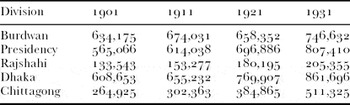
From an ecological point of view, a striking feature of the early twentieth-century history of agrarian Bengal was the unprecedented influx of the upper caste Hindus, viz., Brahmin, Kayastha and Vasyas, who together formed the bhadralok class, in the active deltaic districts of Eastern Bengal.Footnote 17 As late as the 1870s, Henry Beveridge was surprised by the absence of upper class Hindus and Muslims in the littoral district of Bakarganj, for instance. Until about the turn of the century it was also seen that the West Bengal district of Burdwan and Calcutta city and the suburbs were still the popular home of the bhadralok. On the other hand, in Eastern Bengal, except in some pockets of Dhaka and to some extent Mymensingh, they were almost absent. The situation changed considerably by the turn of the century. Between about 1890 and 1930, the bhadralok grew in number in Eastern Bengal at a comparatively faster pace than in Western Bengal. While in the moribund Western deltaic divisions of Burdwan and Presidency, the number of the bhadralok grew by 17% and 42% (Calcutta included), respectively, in the active deltaic divisions of Eastern Bengal, e.g., Rajshahi, Dhaka and Chittagong, their number grew by 53%, 34% and 93%, respectively (see table 1). It was reported in the Census of Bengal in 1931 that in Chittagong almost one-half and in Noakhali nearly one-fifth of the total Hindu population were Kayasthas. In every other district of Eastern Bengal, except in the Chittagong Hill Tracts, their numbers were at least 11% of the total Hindu population, ‘a proportion not elsewhere reached except in Calcutta’.Footnote 18
Bhadralok in the Bengal Delta*

*Data is extrapolated from data on caste as stated in the census reports on Bengal. The bhadralok, according to the census reports, represented the three upper categories of the Hindu caste, i.e., Brahmin, Kayasthas and Vaisyas, who possessed immense political and social authority on the lowest and largest category, the Sudras. In particular, in 1931, 75% of total Kayasthas lived in Eastern Bengal. See also S.P. Chatterjee, Bengal in Maps (Calcutta Orient Longmans, 1949), 54.
Sources: Census of India (Bengal), 1901, 1911, 1921, 1931.
The remarkable mobilization of the bhadralok in the agricultural arena of Eastern Bengal was evidently informed by the relatively better ecological regime in the region. Such mobilization was made possible by a number of evolving strategies, one of them being the way the bhadralok mounted political pressure on the colonial government through the Swadeshi movement that started in the wake of the first partition of Bengal in 1905. The following section focuses on aspects of the bhadralok's political engagement with the colonial administration in their bid to access the agrarian domain.
The Agrarian Bhadralok and the British Raj
The partition of Bengal in 1905 and its annulment six years later placed the Raj in a political dilemma. While the majority of the Muslims of Eastern Bengal considered the administrative-territorial rearrangement through the partition as an opportunity for self-assertion in a wider social and economic realm,Footnote 19 the bhadralok viewed it as a conspiracy to politically weaken the Bangali nation. Writing from South Africa in 1905, Mahatma Gandhi, referring to the news that 20,000 people had gathered in Dhaka to offer thanksgiving prayer to God for saving them from ‘Hindu oppression’, noted that even the real founders of the British empire in India would have been opposed to the idea of partitioning Bengal, if they were to rise from their graves.Footnote 20 When the partition was revoked six years later, Eastern Bengal politicians used the same language to express their anger. An English ICS officer, who viewed the revocation of the partition as an ‘abject surrender to terrorism’ and in some ways ‘the beginning of the end of the British empire in India’, referred to a draft speech of Nawab Salimullah, President of the Muslim League. The draft, written by A.K. Fazlul Huq in 1912, declared that if the revocation was the King–Emperor's command, then they (Muslims) must obey, but it added that ‘Never again can the Englishman in the East put his hand upon his heart and say “This is my word”’.Footnote 21 Meanwhile, the anti-partitionists, even after the revocation of the partition, further strengthened their opposition to an apparently frustrated Raj and thus it was seen that the incident of partition led both the Hindus and the Muslim protagonists to pull the British Raj from two opposing sides.
In response, the government implemented a policy of engagement which was tailored according to popular mood prevailing within each group. The Muslims, who thought they were not well represented in the government services and other representative bodies, were given particular attention. They were promised a university in Dhaka and other concessions and quotas. While the Muslims measured their backwardness in terms of inadequate representation in government jobs, education as well as electoral politics and wanted to catch up with the bhadralok, a large body of the bhadralok sought repatriation to the agrarian world of Bengal. This is particularly revealing as these developments symbolized an intersection in which an influential section of Muslims sought to take the positions which the general rank of the bhadralok considered materially inadequate. The government perhaps promoted these developments in the hope of taking the sting out of anti-colonial politics.
As mentioned earlier, throughout the nineteenth century, khas mahals or government lands were allocated to actual cultivators with special facilities and low revenue rates in the active deltaic regions of Eastern Bengal. By the beginning of the twentieth century, this policy was compounded by a new one of allocating these lands preferentially to the bhadralok. For instance, in the district of Bakarganj, of the 36,004 acres of land settled between 1920 and 1930, most were settled with the bhadralok of different categories.Footnote 22 In 1920, an area of 330 acres in the Char Fasson estate, in the Bhola subdivision, was settled with members of the bhadralok community.Footnote 23 A medical practitioner was promised a huge chunk of land in one of the blocks of char Kukri Mukri on the condition that he would keep a stock of medicine as soon as the ‘colonists’ settled there after reclamation.Footnote 24 A witness informed the Provincial Banking Enquiry Committee that in every village of the Khulna district, the best agricultural lands were possessed by the bhadralok class.Footnote 25 In Noakhali, about 1,360 acres of char lands were settled with three societies of bhadralok youths.Footnote 26 A large tract of the Sundarbans forest was leased to a Young Men's Zamindari Society which attempted to ‘introduce cooperative methods in the cultivation of large areas and in the acquisition of zamindaries’.Footnote 27
A scheme dealing with the ‘serious question’ of unemployment among the middle classes was taken up in the Faridpur district in 1928. The magistrate-cum-collector observed that the number of educated applicants was far in excess of the posts available while ‘the inability of Indian gentlemen of good position to find any sort of employment for their sons’ was ‘positively pathetic’. ‘Back to the land’, noted the magistrate, was one solution to the problem, but it was a solution which both parents and young men were averse to, and which would not be adopted voluntarily without ‘substantial inducement’. The magistrate suggested that parts of the extensive chars or alluvial formations in the khas mahals of Faridpur should be made available for settlement in ‘small, but remunerative quantities’ with selected boys from the bhadralok class.Footnote 28 Accordingly, five bhadralok youths were trained annually at the Faridpur Agricultural Farm. After completion of one-year training, each of them was given 15 bighas of khas mahal land rent-free for the first three years with no salami for zamindars being charged. They were also given an advance of 200 rupees in cash for buying a pair of bulls and the necessary tools. By 1933, the first two groups of youths were provided with 150 bighas of land in one block in the Madaripur subdivision, and the other two batches were given 200 bighas also in one block in the Goalundo subdivision. It was noted in relation to the scheme that:
The boys work in the fields just as ordinary labourers do, bare-footed and bare-bodied; and they prepare their own meals which consist of rice, dal (pulse) and fish which they get in plenty from the river flowing by their land. The local cultivators call them ‘Volunteers’, and some say that they are ‘Swadeshi’ people interned for committing offences against the State.Footnote 29
In the 1916 edition of the Bengal Wasteland Manual, it was stated that in cases where a bhadralok had undergone or was willing to undergo a course of agricultural training, or in cases where a bhadralok with a good working knowledge of agriculture was willing and able to undertake manual labour like an ‘ordinary substantial cultivator’, the Collector was authorized to make a settlement of wastelands with this bhadralok. It was proposed that the settlement would be made on the usual cultivating terms, but with a loan and other support so that the bhadralok could reclaim and develop his holding.Footnote 30 Sixteen years later, the 1932 edition of the Manual emphasized that in the khas mahals the primary object of the administration was to settle and maintain cultivating tenants on self-supporting holdings. Although the manual held that the suitable size of a holding might be five acres, it remarked that it was ‘better to settle fewer people and keep them contented for a greater length of time than to settle more people and have them speedily discontented’. The Manual suggested that settlements should ordinarily be made with the cultivating raiyats but when a bhadralok was willing to undergo agricultural training and was willing to farm the land himself ‘he might be admitted to settlement as an ordinary cultivating raiyat on a non-occupancy raiyati kabuliyat for not more than 10 years’. However, it was made clear that the area to be given to a bhadralok settler should be ‘larger than that of an ordinary cultivator’.Footnote 31 In the 1936 edition of the Manual, it was stipulated that the bhadralok who decided to stay on the land and cultivate by themselves might be given settlement of holdings ‘sufficient to enable them to live in a better style than ordinary cultivators’.Footnote 32 Such preferential treatment of the bhadralok was not entirely surprising because the avowed policy of the government was that of ‘enabling persons who have abandoned terrorism to settle down to a life of productive citizenship’.Footnote 33 Even the apparently objective and institutional process of survey and settlement operations relating to land and revenue was considered useful in terms of the benefit the bhadralok received out of the process. Regarding the necessity of an up-to-date record-of-rights, a government report noted that from the perspective of bhadralok employment, such proceedings were no less important, since the greater part of the cost of revisional operations amounting to about 17 lakhs a year went into the salaries of the employees majority of whom were bhadralok. It was thus considered ‘an important asset to Government in easing the economic situation’.Footnote 34
The open policy of preferential treatment of the bhadralok, however, had limitations. It is true that this policy restricted the opportunity of the growing number of peasants to obtain land on an equal footing with the bhadralok. Equally, fresh khas mahals under government control were not unlimited. The government also had to be cautious in extending concessions to the non-cultivating bhadralok at a time when there were plenty of landless peasants and peasant unrest was growing apace. Therefore, the appeasement policy of the government towards the bhadralok alone may not be taken as a complete index of complex agrarian relations in the first half of the twentieth century. We need to look at the process of how the agrarian system was changing from its roots. This requires us to examine the hotly debated issues of land alienation and the shift of occupancy rights from actual cultivators to non-agricultural people. I turn to these issues in the following two sections.
The Question of Transfer of Land and Occupancy Right
According to Manu, an ancient Indian sage, as the wild deer of the forests became the property of the man who first pierced them with arrows, so did the arable land become the property of the man who first cut down the jungle for cultivation.Footnote 35 It is difficult to decide on whether occupancy rights were transferable or not in ancient and medieval periods. But it is clear that before colonial rule landed property was never sold in India ‘by order of a judge for payment of the debts of the owner . . . voluntary alienation was allowed gradually, but the execution of decrees against a debtor's immovable property was a thing not dreamed of’.Footnote 36 The East India Company introduced the system of land to be sold in case of default which ruined many zamindars and eventually affected the cultivators in the eighteenth century. However, since a somewhat different pattern of land settlement developed in the Eastern Bengal Delta, where the actual cultivators were encouraged to occupy land rather than transfer it, the legal question of transferability of land or occupancy rights did not become a major issue during the nineteenth century.Footnote 37 Referring to the Tenancy Act X of 1859, through which occupancy rights were legally secured to the cultivators who lived on a plot of land for 12 years, a zamindar commented that the right of occupancy was not transferable and that the raiyat could not transfer it by mortgage, sale, gift or exchange, nor was the right saleable in the execution of a decree for money against him.Footnote 38 The Tenancy (amendment) Bill of 1883 proposed to confer the free right of transfer, but the proposal was dropped due to the opposition of the zamindars and the possibility of the growth of non-resident and non-cultivating ‘raiyats’.Footnote 39
Yet the Bengal Tenancy Act of 1885 contained seeds of land-transfer as it left the question of transferability open to local customs, rather than to a regulation to forbid it. After the introduction of the Act, the zamindars initially held an ambiguous position towards the free rights of land transfer. The East Bengal Landholders’ Association pointed out that the Act of 1885 ‘encourages transfer, therefore they are bad. They hinder transfer, therefore they are bad’.Footnote 40 The Zamindars had reason to take this ambivalent position about transfer because if lands were transferred from small-holders to undesirable and financially competitive newcomers, their position might have been challenged. For instance, the Bengal Landholders’ Association noted that the men who were most interested in making occupancy rights transferable were land-jobbers, mahajans and planters. The Association cautioned that if one wanted to ruin occupancy raiyats, one only had to give them the power of transferring their interests. It argued that it was possible to add value to a piece of land by attaching the right of transfer to it, but that could only be done when the raiyat-owner parted with it. For the raiyat himself, its value was never so great when he retained it in his own hands and obtained a good crop out of it. The Association further held that, ‘by making it more valuable in the market you tempt men to turn it into money, and transfer its value to other people. By preventing its transfer, you oblige him to keep its value for himself and his family’.Footnote 41 As late as 1913, some of the Bengal zamindars complained that the Act of 1885 had already widened and enlarged the tenants’ rights on land and ‘artificially increased the value of such right’, and they thought that the proposal for investing occupancy rights with the legal incident of transferability would ‘clearly be a violent innovation for the first time engrafted by law upon proprietary rights in Bengal’.Footnote 42
While these zamindars were apprehensive of the right of transfer being made freely, they were equally aware that if land transfer was not legally sanctioned, they could not obtain a certain fee based on the transfer, therefore losing an opportunity for extra income. It is in this context some leading zamindars pointed out that as far as the registration fees for the transfer were concerned, a fee of 25% on the whole ‘may not be deemed altogether inequitable’.Footnote 43 The 1928 Tenancy (Amendment) Bill confirmed that all occupancy holdings were legally transferable, subject to the payment of a landlord's fee which amounted to 20% of the sale money, or up to five times the annual rent of the holding, whichever was greater.Footnote 44 It was not surprising that it did not take long for the Bengal zamindars to make up their mind about the question of transfer. By this time the zamindars themselves were also securing their place in the mahajani-credit market which fitted well with the growing trend of land transfer from occupancy raiyats to non-cultivating ‘agriculturists’.Footnote 45 On the same ground, the zamindars ‘did not exercise their veto on transfers to prevent genuine cultivators selling their lands to people who are not cultivators’.Footnote 46 The changing attitude of the zamindars contributed enormously to the already established trend of land transfer to non-agricultural people. Between 1885 and 1928, land legislation gradually tended to crystallize around the process of transfer and the development culminated with the introduction of Act of 1939.Footnote 47 The process simultaneously led to the loss of land and occupancy rights to the actual cultivators and the impact of these developments was mostly felt in the comparatively fertile region of Eastern Bengal.Footnote 48
In the process of land transfer, the losers were mostly the small-holding occupancy raiyats who lost both lands and occupancy rights. These (ex)raiyats in most cases ended up as din-mojur (landless day labourer), bargadar and under-raiyat. On the other hand, those who gained by the transfer included the village mahajan, the landlords, the ‘rich peasants’ and the bhadralok—these different groups of people in turn took the dominant position and commanded the dependency of the former group in the agrarian society.Footnote 49 Why, in the first instance, the transfer of land and associated rights had to be given legal validity? And what were the social implications of land transfer? These questions could best be examined by studying the relationship between the growing trend of transfer of land and occupancy rights and the penetration of the bhadralok into the realm of the so called peasant autonomy. We now turn to these questions.
The Bhadralok as ‘Raiyat’ and the Problem of Sharecropping
In 1923, a Cultivators’ Association of Noakhali complained that the ‘greatest mischief’ which was ever done to the cultivating classes of Eastern Bengal, especially Noakhali and Tippera, was the enactment of certain sections of the Bengal Tenancy Act of 1885. The Association explained that in Eastern Bengal, the word ‘raiyat’ was synonymous with the term chashat praja (cultivating tenants/raiyat), and whenever a raiyat would sublet his land to another cultivating tenant, the former would be treated as monib (landlord and rent-receiver) and from that time the latter would be treated as a raiyat (cultivating tenant). Thousands of documents, both registered and unregistered, existed which enabled the raiyat–landlords to grant transferable, heritable and permanent rights to their tenants either for the purpose of cultivation or dwelling or for both. The Association emphasized that neither party ever dreamed of eviction except for non-payment of rent arrears, and that when the accumulated arrears was equal to the value of the land itself. The Association claimed that things had changed after the passing of Bengal Tenancy Act which helped hitherto non-cultivating people gain access to the holding of a raiyat at a time when he had improved the land to a great extent. The Association went on to claim that covetous moneylenders and landlords, who were mostly non-agriculturist bhadralok, had already taken possession of most of the old raiyati holding and the poor raiyats, who were bona-fide cultivators, were compelled to take under-raiyati leases under those ‘neo-raiyats’ who usurped the occupancy rights of the original raiyats, ultimately reducing them to the ‘status of day-labourers and beggars’.Footnote 50 The Association noted that landlords generally would not allow anyone under them to have the status more than a raiyat and these gentlemen were ‘only too willing to assume the lower status for that is very useful for them in ousting the under-tenants’.Footnote 51 One of the reasons of such development, according to the Association, was that there was no safety net for the vulnerable actual raiyat as far as the sale of his holding was concerned. Under Bengal Tenancy Act the under-raiyat was not given a chance to bid for the decretal amount in order to purchase the holding for himself. He was neither given the chance to pay up the whole arrears and cost and reasonable compensation to the auction-purchaser or decree-holder in order to regain control of his own land.
Section 104 of Bengal Tenancy Act led to ‘certain difficulties’ involving the status of the bhadralok. It was reported by a Settlement Officer of Dhaka that if a transfer to a non-cultivator occurred on a temporarily settled estate, it would be difficult to know whether the rent would apply to the transferee or to his tenant. ‘If to the latter’, the officer noted, ‘the Government revenue would be affected; if to the former, the tenant would be paying rent above the rate fixed’. The Collector of Bakarganj thought that by this provision the non-cultivators who sublet their land on a produce rent would succeed in being recognised as raiyats. In this context, both the Collectors of Bakarganj and the Settlement Officer of Dhaka, suggested that the definitions of the terms ‘raiyat’ and ‘tenure-holders’ should be modified.Footnote 52 In 1914, the Collector of Bakarganj reported that the general desire of all transferees in Bakarganj was to be classed as ‘raiyats’. Indeed, even if they sublet all their land to another on the barga (produce rent) system, they would ‘still be entitled to be recognized as raiyats’. The Collector therefore proposed that the provision in the draft Bill (amending 1885 Act) should be so changed as to render a transferee who sublets his land on the barga system liable to be classed not as a raiyat but as a tenure-holder. For this purpose, the Collector proposed that either ‘subletting’ be properly defined or the definition of the ‘raiyat’ in the Bengal Tenancy Act so amended as not to admit a person who did not cultivate two-thirds of the cultivable area of his holding personally or by hired labour or with the aid of his relations being classed as a ‘raiyat’.Footnote 53 The Settlement report pointed out that though Bengal Tenancy Act intended to protect the actual cultivator of the soil, it failed in that area mainly because middlemen were treated both by their landlords and by the Courts as if they were raiyats and treated their tenants as under-raiyats.Footnote 54 The issue was further illustrated by a Settlement Officer from Chittagong who remarked during the Depression era:
Formerly the term chasa (cultivator) used to stink in the nose of the cultivators themselves as being a term of opprobrium. But at the advent of the present century the gradually increasing unemployment among the middle-class youths and the prevailing high prices of agricultural produce brought about a change in the out-look and while a member of middle-class took to agriculture as the only available profession others were tempted to lay out money on lands as a form of safe and lucrative investment . . . In the world of trade, atmosphere of doubt and uncertainty . . . those who have money to invest are acquiring landed property as being the safest mode of investment. This coupled with the comparative opulence of the non-cultivating classes has certainly accelerated the process of transfer of lands from the cultivators to the non-cultivating classes . . . the transfers count among themselves not only the money-lenders, but also landlords and pleaders, muktears and service holders . . . A section of the transferees let out their lands on Bhag or Barga system and take half the produce as rent while they let out on a high rate of money rent.Footnote 55
The bhadralok's attempt to take over the position of the ‘raiyat’ led to an unprecedented displacement of a large section of traditional cultivators—a process that can be termed ‘depeasantization’.Footnote 56 By obtaining the land and occupancy rights of the actual raiyat through both legal and coercive means of land transfer, the bhadralok could now reach the ready-made facilities and privileges that the actual peasant had acquired in the course of the nineteenth century. As the bhadralok became de jure raiyat, they opposed any proposal for offering (or returning) any entitlement to the under-raiyat or bargadars. One of the arguments of the bhadralok about retaining the arrangement of sharecropping was humanitarian in nature. A bhadralok argued that a large number of poor and middle class families who could not cultivate their land for themselves got it cultivated by the sharecroppers. He noted that these families consisted of widows, minors and disabled who might be deprived of their means of subsistence if the system of barga was discontinued.Footnote 57 A pleader from Comilla advised that the right of occupancy should not be granted to under-raiyats and bargadars, and ‘raiyats’ should not be allowed to grant leases for indefinite periods as it would result in lands going out of their control.Footnote 58 Another pleader from Rajshahi argued that a landless class of labourers would always exist in the country and he found ‘nothing inequitable’ in a barga arrangement between members of this class and the ‘middle-class raiyats’.Footnote 59 A zamindar, on behalf of the Landholders’ Association of Bakarganj, observed that the bhadralok who were not accustomed to handling ploughs themselves were in the habit of extensively settling their lands in barga for ‘fear of loss of honour and dignity or for a variety of other reasons’. He argued that the share the bhadralok received from the bargadar as the landlord's portion of the produce constituted the main source of subsistence of himself and his family. Therefore, he felt that if the bargadar was given occupancy rights he would have recourse to ‘convenient expedient of commutation, depriving thereby the landlord of his portion of the produce on which a money value will be put falling far short of its market value’. The consequence, he continued, would certainly mean ‘complete effacement of the mediocre gentry from the social economy of the country at no distant date’.Footnote 60
The argument for retaining the status quo on humanitarian ground was often supported by the plea that the presence of the bhadralok was necessary in the countryside on account of their intellectual superiority. It was argued that if the bhadraloks were deprived of the facilities of barga system, they would lose interest in the village and migrate to towns. By this process, the villagers would be ‘deprived of their intelligentsia’ and at the same time the moneylenders would take advantage of the situation.Footnote 61 Such arguments were bolstered even more by the delicately placed threat of political instability. In the Dhaka district, for instance, it was argued that if the bargadar acquired the status of a ‘tenant’, the owners of these lands would ‘almost certainly cease to let them out in this way’ and that the land would be left fallow benefitting none, resulting in a large number of bargadars being out of cultivation which consequently would lead to unemployment and unrest.Footnote 62 A Munsif to the District Judge of Rajshahi wrote that a large number of clerks had been working on a very low salary only because most of them had their small stock of grains at home to depend on. And if their landed interest was threatened they would have no other alternative but to turn cultivators themselves or to give up their lands and try other pursuits sufficient for their maintenance. The Munsif warned that if no other channel was found open to them they will have to ‘face a community of educated and discontented people and lawlessness started by them would be more difficult to deal with than the disorganized out-burst of ignorant criminals’.Footnote 63
The staunch resistance by the bhadralok against the restoration of any form of entitlement to the sharecroppers is consistent with the process of transfer of land and occupancy rights from actual cultivators. The process would have lost all meaning for the bhadralok should the sharecroppers, who included both landless and land-poor, be legally empowered to fight back for their rights and entitlements to land. The status quo that the bhadralok was able to maintain, however, proved disastrous for the land-poor and the landless who became the major victims of great Bengal famine in 1943. In the next section I will examine the relationship between the changing agrarian relations as narrated above and victimization during the Bengal famine.
The Bhadralok, the Rich Peasant and Social Construction of the Famine of 1943
One of the two well-known facts relating to the Bengal famine of 1943 is that it was considered a ‘class famine’ in which mostly landless labourers and sharecroppers suffered.Footnote 64 Another fact is that the famine victims emerged mostly in the villages but the famine death rates appeared to be higher in the towns and cities, particularly in Calcutta. As far as social organization of agrarian production was concerned, these two issues seem to have been closely connected with the position of both rich peasants and bhadralok in the agrarian relations.
The Land Revenue Commission noted that a man with occupancy right no longer tilled the land and sublet it to an under-raiyat, while retaining all the rights of an occupancy raiyat to himself. The Act of 1928 which was meant to protect the cultivating peasant was being used to protect this new type of rich peasant.Footnote 65 Theoretically, a rich peasant was no different from a poor occupancy raiyat, since both of them possessed occupancy rights. But precisely because the former was rich he could buy up the land of a poor peasant and by the same token he could grow richer while the poor seller of the land grew poorer. Perhaps the latter became a sharecropper or eventually landless, his occupancy rights being forfeited in favour of the rich peasant. Similarly the functions of the bhadralok raiyat–landlords were directed to accumulate as much landed property as possible. Under the 1928 Tenancy Act, when a tenant was evicted and the holding was put up for sale, the landlord had the first option to buy it. In other words, if the landlord wished, he could, instead of having another tenant, take the land into his khas (private) possession. Having taken possession of the land, the landlord did not, of course, cease being an absentee and start the life of an active cultivator. Instead, he arranged for barga settlement which provided ‘a very simple way of raising rents without recourse to Courts’. Instead of getting a fixed rent which could have been between 3 and 7 rupees per acre, he would get half of a crop which might be worth 40 rupees per acre. From the beginning of the 1920s, when price of foodgrain rose phenomenally, landlords rushed to convert their tenancies into sharecropping ones; precisely because prices were good and the peasant could afford to pay his dues. But when prices dropped drastically towards 1930, the landlord had no difficulty in evicting him, and, even though prices were low, found it more profitable.Footnote 66
Another reason for the rise of sharecropping and landlessness in Bengal was the growth of a new type of landlord, the landlord-cum-mahajan. By receiving rents in kind, this type of landlord kept every advantage to himself. Since he was already a trader in grain or jute, it made more sense to him to take jute or grain as produce rent rather than to take cash and then have to buy these raw materials in the open market. In other words, he was ‘rationalizing his business vertically’. The landlord-cum-mahajans, having become ‘raiyats’ after absorbing actual raiyat's occupancy rights, charged as much as 36 rupees per acre as rent where the average rental was 3–4 rupees per acre for occupancy raiyats. The Bengal Tenancy Act offered some protection to the under-raiyat, but the High Court in a ‘legally sound but practically inequitable’ ruling decided that section 48 of the Act did not apply unless the ‘raiyat’ sublet the whole of his holding. In this circumstance, all the ‘raiyat’ had to do was to split up holding, sublet it separately and enhance the rent as he liked. For the under-raiyats, on the other hand, the result was smaller and economically unsustainable holdings.Footnote 67
Not surprisingly, the number of rent-receivers increased markedly in the course of the first half of the twentieth century. During the decade preceding the onslaught of the depression, between 1921 and 1931, rent-receivers increased by 62%. At the same time, the number of sharecroppers increased by 49% and by the turn of the 1940s, they constituted 29% of the total agricultural population.Footnote 68 It is significant that the acute economic vulnerability such as indebtedness, land-poverty and landlessness surfaced mostly in those ecologically endowed regions where the peasants had remained relatively prosperous throughout the nineteenth century. The cultivators of Bengal in the khas mahals and in the areas ‘particularly those of its most fertile and previously most thriving districts’ became involved in debts ‘far beyond their power to repay’.Footnote 69 It was also not surprising that the sale value of occupancy rights in Eastern Bengal ‘doubled or quadrupled with extraordinary rapidity’, whereas the rise in rents had been limited by the law,Footnote 70 which benefitted the new generation of ‘occupancy raiyats’.
Given the vagueness of statistics on the beneficiaries of the colossal scale of land transfer, it was no wonder that some historians of Bengal would tend to attribute most symptoms of rural decline mainly to the rich peasant in the countryside. It has been argued, as mentioned above, that the process of empowerment of the rich peasant became particularly remarkable with the onslaught of the Depression of early 1930s when the bhadralok left the countryside to engage in non-agricultural activities. The far-reaching consequence of the Depression on agrarian Eastern Bengal has been summarized by Partha Chatterjee in the following way:
‘The traditional landlord-moneylender was forced to move out and was replaced by new suppliers of credit from among the better-off section of the cultivators themselves. The usual dynamics of indebtedness leading to the transfer of small-peasant holdings was then set into full motion, helped on by the grant of full rights of transferability in raiyati lands in 1939 . . . between 19 and 36 per cent of the total occupancy holdings in the districts of Noakhali, Tippera, Bogra, Dacca, Mymensingh and Pabna were sold between 1930 and 1938, much higher figures than any other district in Bengal in this period . . . most of these were sales from indebted small peasants to richer cultivators . . . the famine of 1943 struck what was virtually the final blow’.Footnote 71
Chatterjee's statistical observations can be best appreciated by examining questions relating to famine victimization. For instance, why was the mortality rate relatively greater in the towns than in the villages? What prompted the landless and poor cultivators to migrate to towns without trying to mitigate their suffering by appealing to their fellow rich peasants? Such questions can be partially examined in the contemporary famine notes of Bell, an ICS officer. After calculating that the total shortage of rice during the famine period was ‘not more than 5%’, Bell enquired why the famine could occur in response to such a ‘trifling deficit’. Bell found answer in the instance of the battle for possession of rice between the countrymen and the townsfolk. He observed that only a small proportion of the rice grown in Bengal came to market. It was the surplus over the consumption of landed classes, who had immediate access to and possession of food-grains, that came to the towns for sale. If there was a shortage, and even where there was a belief in the possibility of shortage, the cultivators and the landlords met their own requirements first which meant a reduction of supply from the surplus for the town markets. In more serious circumstances, they would ‘hold on to their stocks, and perhaps keep in their hands even larger stocks than they would normally reserve’. In some cases, they will do so with the intention of realising a better price later on, but more often with the ‘human and understandable object of safeguarding themselves and their dependents’. Therefore, a small shortage of the gross production of the province was enough to constitute a very serious shortage in the amount of rice offered for sale. The immediate result was short supply of rice for the towns where a scramble followed to ensure supply. Prices in the town markets then rose and prices in rural areas followed suit. This confirmed the impression of scarcity leading to more hoarding and in turn created or intensified scarcity, so that prices rose still higher, and the process repeated itself in a vicious spiral. Since wealthier people lived in the cities and towns, they did not go short even if they had to pay more for rice. Therefore, it was the market towns that controlled the price of rice throughout the province. In such circumstances, the rentier class fortified their position not only by the stock of the produce rent but also by their purchasing power.
The class which suffered most, as Amartya Sen has observed, was that of the landless agricultural labourers.Footnote 72 The labourer, finding himself without work and without food, tended to migrate to the towns, where he knew that rice was available at a price, and where he hoped to support himself either by work or on charity. This explains, according to Bell, why the mortality rate in the towns was so much higher in 1943 than in the countryside.Footnote 73 Obviously the landless wage labourers were emerging from the category of the under-raiyats and sharecroppers during the previous few decades.Footnote 74 On the contrary, the majority of the ‘non-cultivating owners’ were well off enough to be not in need of selling or mortgaging their land.Footnote 75 Bell's interpretation of the role of the city and town dwellers and markets in the making of the famine appears to have been corroborated also by the effects of the famine in the course of 1943–1944. Mahalanobis worked out that out of about 710,000 acres of rice land changing hands during the famine only about 290,000 had been purchased back in the villages. Roughly 420,000 acres of rice land had thus passed to outsiders, possibly, as Mahalanobis suspected, ‘non-cultivating owners’ residing in urban areas.Footnote 76 It was not surprising that during the famine, Cornelia Sorabji, India's pioneer female lawyer, hoped that the bhadralok would ‘put their stores of Bengal rice at the service of the poor’.Footnote 77
In the light of suffering of mostly the landless and land-poor people the Bengal famine of 1943–1944 has been rightly considered a ‘class famine’. One may ask whether the existence of fewer landless people would have meant lesser loss of life. If that question is even partially valid, could the extent of landlessness and land-poverty have been reduced in Bengal and, therefore, the destructive power of the famine curtailed? In the case of Eastern Bengal one could at least assert that there was remarkable lack of will on the part of the administration, an essentially bhadralok institution by then, in preventing agricultural lands going to the hands of the non-cultivating people. In an attempt to prevent land passing out of the hands of small cultivators to non-cultivating people, a Land Alienation Act was passed in the Punjab in 1901. It took until 1944 to pass the same in Bengal, but it was too late, for the famine had already struck.
Conclusion
The return of the bhadralok to the agrarian domain of Eastern Bengal was foreseeable. The first generation of the ‘investor’ bhadralok who emerged under the auspices of the Company Raj left behind a generation of ‘cultural’ bhadralok who upheld the spirit of the nineteenth-century ‘renaissance’ in Bengal—all happening largely in the metropolitan environment of Kolkata.Footnote 78 The urban turn declined gradually as the ‘elasticity’ of government jobs as well as private capitalist enterprises reached their ‘extreme margin’, to quote Rabindranath Tagore, by the early twentieth century, especially in the wake of the great depression of the 1930s. Rural Bengal and the mofussils—intermediate spatial points between Kolkata and rural bases where the bhadralok settled predominantly—became sites of intense political, economic as well as cultural dialogue and activism during this period.Footnote 79 The bhadralok eyed Eastern Bengal because it was one of the last viable agro-ecological frontiers in India for the production of rice, the irreplaceable staple food of the Bangalis. But the return of the bhadralok came at a time when the frontier fertile rice lands were already becoming subject of a scramble by fast increasing peasant population. The Sundarbans forest system was cleared up to the sea in these fertile regions, especially in Noakhali and Bakarganj. In inland areas, such as Mymensingh, the alluvial char lands were also being contested as demographic pressure mounted. Extensive uses of land also caused fertility decline.Footnote 80 At a time when—at the pick of ecological exhaustion through the nineteenth-century commercialisation of agriculture—agrarian polity in Eastern Bengal began to be characterized by an intense contest between demographic pressure and limited ecologically endowed land resources, the return of the bhadralok into the agrarian production process was bound to complicate the situation. It was no wonder that some of the most serious communal conflicts took place where the ecologically better regions came to be dominated by the bhadralok. The victimization of the peasantry during the great Bengal famine fuelled further conflicts and suspicion between them and the bhadralok, and these developments, along with associated political complexities, culminated in the support for partition. The return of the bhadralok to the agrarian domain of Eastern Bengal and its repercussions have to be seen in this matrix of political ecology at the interface of existing peasant society and a penetrating non-peasant entity amidst limited ecological resources.
One question remains. If the bhadralok invested and involved themselves so intensively in the Eastern Bengal countryside why were so many of them ready to jettison their gains by opting for a truncated Bengal within India in 1947? Partha Chatterjee suggests that the question can be examined with reference to the failure of Muslim political groups to engage and ensure the security of the Hindu minority and to prioritise it in their emerging hegemonic polity. Chatterjee's reading of the problem comes as a reaction to Joya Chatterji's assertion that the bhadralok departed at partition because of the evident impossibility of acquiring higher berths in the power politics of Bengal, particularly in the context of the Communal Award of 1932.Footnote 81 In either count, it seems that the bhadralok's move in the fateful years leading to partition was informed by perceived sense of alienation and ‘fear’ of the majoritarian politics of Bengal's Muslims. In the backdrop of the bhadralok's attempt to articulate their ‘hegemony’ by adroitly manipulating the politics of fear, their departure in 1947 seemed as significant as their return was by the turn of the twentieth century. In the overall context of the historical developments that took place in between, as described in this article, it seems surprising that several decades of efforts to liquidate class by the chemistry of culture remain unchallenged in the historiography of Bengal.