Introduction
Dry bean is an economically important crop for Michigan farmers. On average, Michigan harvests 106,000 ha of dry bean per year, which equates to a farm gate value of US$140 million (USDA-NASS 2018). Ranking second in total production, Michigan plants 8 of the 13 different dry bean classes grown in the United States (USDA-NASS 2018). Black and navy bean are the top two largest dry bean classes grown in Michigan with 48,500 and 29,900 ha, respectively, harvested in 2017 (USDA-NASS 2018). This unique high-value crop is typically planted in June and is harvested in 85 to 100 days (Kelly and Cichy Reference Kelly, Cichy, Siddiq and Uebersax2013). Soybean (Glycine max L. Merr.), corn (Zea mays L.), wheat (Triticum aestivum L.), and sugarbeet (Beta vulgaris L.) are other crops that are grown adjacent to or in rotation with dry bean (Christenson et al. Reference Christenson, Brimhall, Hubbell and Bricker2000).
In recent years, two new soybean technologies have been developed that are resistant to dicamba or 2,4-D (Behrens et al. Reference Behrens, Mutlu, Chakraborty, Dumitru, Jiang, LaVallee and Weeks2007, Wright et al. Reference Wright, Shan, Walsh, Lira, Cui, Song, Zhuang, Arnold, Lin, Yau, Russel, Cicchillo, Peterson, Simpson, Zhou, Ponsamuel and Zhang2010). Issues with herbicide tank-contamination are especially significant with dicamba and 2,4-D, because many broadleaf crops grown in Michigan, including dry bean and sugarbeet, are sensitive to them (Hatterman-Valenti et al. Reference Hatterman-Valenti, Endres, Jenks, Ostlie, Reinhardt, Robinson, Stenger and Zollinger2017; Lyon and Wilson Reference Lyon and Wilson1986; Probst Reference Probst2018). Tank contamination is a risk if application equipment is taken across multiple crop fields in a season. However, applying dicamba and 2,4-D elevates this risk because research has documented that dicamba and 2,4-D residues can remain in tanks even after recommended clean-out procedures (Boerboom Reference Boerboom2004; Osborne et al. Reference Osborne, Xu, Swanson, Walker and Farmer2015). This can lead to the unintentional application of the remaining herbicide residues in the next spray application at rates high enough to cause sensitive crop injury (Boerboom Reference Boerboom2004). Spray equipment can be difficult to clean completely because many components, including tanks, booms, and inductors, require attention. Even after a complete spray system cleanout with an ammonia-water cleaning solution, dicamba levels of 0.63% of an initial concentration of 560 g ae ha−1 have been detected in rinse water (Boerboom Reference Boerboom2004). Similarly, when commercial applicator tanks were rinsed with water three times, average concentrations of 0.16% dicamba and 1% 2,4-D were found in the third rinse (Osborne et al. Reference Osborne, Xu, Swanson, Walker and Farmer2015). Although those studies reported residual levels of dicamba and 2,4-D, it is also possible that residual levels of glyphosate would remain in the spray system, because glyphosate is often applied with both of these herbicides.
Sensitive crop response to these rates has been previously researched; however, little is known on the interaction of other herbicides with dicamba and 2,4-D in the event of tank contamination. Previous research examining tank-contamination levels of dicamba applied with imidazolinone or diphenylether herbicides reported that synergistic responses on soybean are possible (Brown et al. Reference Brown, Robinson, Nurse, Swanton and Sikkema2009; Kelley et al. Reference Kelley, Wax, Hager and Riechers2005). As a result, the synergist effect increased plant injury, reduced soybean yield, and altered soybean maturity in comparison to dicamba applied alone. This is of concern for dry bean farmers because both imidazolinone and diphenylether herbicides are commonly used to control weeds in dry beans (Sprague and Burns Reference Sprague and Burns2018). When these herbicides are used in dry bean they are applied with additional adjuvants, including a crop oil concentrate (COC) and, in some cases, ammonium sulfate (AMS) (Anonymous 2014; Anonymous 2015). Research in soybean also has shown that the addition of a COC to tank-contamination rates of dicamba can increase plant injury and reduce yield (Brown et al. Reference Brown, Robinson, Nurse, Swanton and Sikkema2009).
With the recent commercialization of soybean varieties resistant to dicamba and 2,4-D, we expect an increased use of these herbicides in Michigan. This change will put sensitive crops in Michigan at an elevated risk for exposure by tank contamination. Previous research has documented the negative effects that dicamba and 2,4-D can have on dry bean yield and quality (Hatterman-Valenti et al. Reference Hatterman-Valenti, Endres, Jenks, Ostlie, Reinhardt, Robinson, Stenger and Zollinger2017; Lyon and Wilson Reference Lyon and Wilson1986). However, information is not known about the interaction between postemergence dry bean herbicides and tank-contamination levels of dicamba or 2,4-D and whether the addition of tank-contamination levels of glyphosate influence those results. As we build our knowledge base on the response of dry bean to dicamba and 2,4-D, several research questions remain to be answered. Therefore, the objectives of this research were to understand how multiple factors may influence dry bean response to tank-contamination levels of dicamba and 2,4-D herbicides, including 1) the interaction between postemergence dry bean herbicides and dicamba or 2,4-D, and 2) the impact that the addition of tank-contamination levels of glyphosate has in combination with dicamba or 2,4-D.
Materials and Methods
Field experiments were conducted in 2017 and 2018 at the Michigan State University (MSU) Agronomy Farm in East Lansing, Michigan (42.71°N, −84.47°W) and the MSU Saginaw Valley Research and Extension Center near Richville, Michigan (43.399°N, −83.697°W). The soil types at East Lansing were a Colwood-Brookston loam (fine-loamy, mixed, mesic typic haplaquolls) with pH 7.0 and 2.7% organic matter in 2017, and pH 6.0 and 3.4% organic matter in 2018. Soils at the Richville location were a Tappan-Londo clay loam (fine-loamy, mixed, active, calcareous, mesic typic epiaquolls) with pH 7.0 and 2.7% organic matter in 2017, and pH 7.7 and 2.5% organic matter in 2018. Dry beans were planted into conventionally tilled soils. Soil preparation consisted of either fall chisel or moldboard plowing followed by two passes of a soil finisher in the spring prior to planting. Fertilizer applications were standard for dry bean production in Michigan. In East Lansing, 19-19-19 (N-P-K) fertilizer at 112 kg ha−1 was applied with the planter 5 cm down and 5 cm over from the seed. At Richville, 336 kg ha−1 of 17-8-15 (N-P-K) fertilizer containing 1.5% manganese and 1.5% zinc was broadcast applied prior to spring tillage.
‘Zenith’ black bean (Michigan Crop Improvement Association, Okemos, MI), a Type II (upright indeterminate vine) variety, was planted in 76-cm rows at 269,000 seeds ha−1. Dry beans were planted on June 6, 2017 and June 5, 2018 in East Lansing, and on June 8, 2017 and June 19, 2018 in Richville. Plots were four rows wide by 9.1-m long.
Separate field studies were established for the dicamba and 2,4-D simulated tank-contamination experiments. The dicamba experiment was conducted for 3 site-years (individual locations and years): Richville 2017, Richville 2018, and East Lansing 2018. The 2,4-D experiment was conducted for 2 site-years: East Lansing 2017 and East Lansing 2018. The diglycolamine salt of dicamba (XtendiMax® Bayer Crop Science, Research Triangle Park, NC) and the choline salt of 2,4-D (Enlist One® Dow AgroSciences LLC, Indianapolis, IN) were applied at 1% of their standard-use rates of 560 and 1,120 g ae ha−1 labeled in dicamba- and 2,4-D-resistant soybean, respectively. These rates were 5.6 and 11.2 g ae ha−1 for dicamba and 2,4-D, respectively. Dicamba and 2,4-D were applied alone, and in combination with a 1% field-use rate of glyphosate (8.4 g ae ha−1; Roundup PowerMax® Bayer Crop Science, Research Triangle Park, NC). Dicamba, dicamba + glyphosate, 2,4-D, and 2,4-D + glyphosate were applied with two commonly used postemergence herbicide treatments in dry bean: 1) imazamox at 35 g ai ha−1 (Raptor® BASF, Research Triangle Park, NC) + bentazon at 560 g ai ha−1 (Basagran® WinField United, St. Paul, MN) + COC at 1% v/v + ammonium sulfate at 2.5% w/v; and 2) fomesafen at 280 g ai ha−1 (Reflex®, Syngenta Crop Protection, Greensboro, NC) + COC at 1% v/v. Herbicides were applied to dry beans at two different stages of growth, V2 (two-trifoliate) and V8 (prebloom). Herbicides were applied using a tractor-mounted compressed-air sprayer calibrated to deliver 177 L ha−1 at 206 kPa using AIXR 11003 nozzles (TeeJet Technologies, Wheaton, IL).
Treatments were arranged in a split-plot design with three (East Lansing) or four replications (Richville). The main plot factor was application timing. The subplot factors of dry bean herbicide and tank contaminant (2,4-D, 2,4-D + glyphosate or dicamba, dicamba + glyphosate) were arranged in a randomized complete block design within the main plot factor. All field experiments were maintained weed-free throughout the season with between-row mechanical cultivation supplemented by hand weeding.
Dry bean injury was evaluated 14 and 28 days after treatment (DAT) on a scale from 0% to 100%, with 0% equivalent to no plant response and 100% representing complete plant death. Dry bean maturity was evaluated weekly for 6 wk prior to harvest. A 0% to 100% scale was used, with a 0% indicating all green tissue and 100% indicating complete plant maturity (no green tissue).
Dry bean plots were mechanically harvested after natural plant senescence. Plots were direct harvested using a small-plot research combine (Massey-Ferguson 8XP, AGCO, Duluth, GA) with a 1.5-m header. Excess rainfall near harvest at East Lansing in 2018 led to dry bean regrowth requiring the use of a chemical desiccant prior to harvest. Dry beans were desiccated with saflufenacil (Sharpen®, BASF, Research Triangle Park, NC) at 50 g ha−1 plus 1% v v−1 methylated seed oil 14 d prior to harvest. Dry bean yield was adjusted to 18% moisture. Samples of harvested dry bean seed were taken from each plot during harvest. Seed samples were sorted for mechanical damage and weight per 100 seeds was recorded on undamaged seeds.
Statistical Analysis
Data analysis was conducted using the PROC MIXED procedure in SAS 9.4 (SAS Institute, Cary, NC). The statistical model consisted of dry bean herbicide treatment, tank contaminants, application timing, and their interactions as fixed effects. Site-year (individual year and location), replication nested within site-year, and the interaction between application timing and replication nested within site-year were considered random effects. When dry bean maturity and yield were analyzed, application timing was removed from the model and a separate analysis was conducted for each application timing. Replications were used as an error term for testing the effects of site-year, and data were analyzed separately when an interaction of site-year by one of the fixed effects was significant. Normality assumptions were checked by examining histogram and normal probability plots of the residuals. Unequal variance assumption was assessed by visual inspection of the side-by-side box plot of the residuals followed by the Levene’s test for unequal variances.
Further analysis of dry bean maturity was conducted using nonlinear regression with the drc package in R (version 3.0) (Knezevic et al. Reference Knezevic, Streibig and Ritz2007; R Core Team 2014). Model fit was confirmed using the ModelFit function in R. Nonlinear regression was also used to predict the number of days from planting to 50% dry bean maturity (MR50). The nonlinear model used was the three-parameter log-logistic model [1]
 $${\rm{y}} = {\rm{c}} + {{100{\rm{}} - {\rm{c}}} \over {\matrix{ {1 + \exp \left[ {{\rm{b}}\left( {\log \left( {\rm{x}} \right) - \log \left( {\rm{e}} \right)} \right)} \right]} \cr {} \cr } }}$$
In the log-logistic model for MR50 values y represents dry bean maturity, x represents days after planting, c is the lower limit, b is the slope of the line around e, and e is the MR50. MR50 values were analyzed using the PROC MIXED procedure as previously described separately for each site-year and application timing.
Herbicide activity between dicamba, 2,4-D, or the combinations of glyphosate with dicamba or 2,4-D and the dry bean herbicide treatments was evaluated using the method described by Gowing (Reference Gowing1960) [2], where E is the expected injury value of the herbicide combination, A is the observed percent injury from the dry bean herbicide alone, and B is the observed injury from the tank contaminants alone. The expected values and observed values for each herbicide combination were compared using a paired t-test in PROC MIXED. If the observed value was significantly greater than the expected, the interaction would be synergistic (α ≤ 0.05). If there was no difference between the observed value and the expected value the interaction would be additive, and if the observed value was less than the expected value the combination would be antagonistic.
 $$E = A + \left( {{{B\left( {100 - A} \right)} \over {100}}} \right)$$
Results and Discussion
Dicamba Tank Contamination
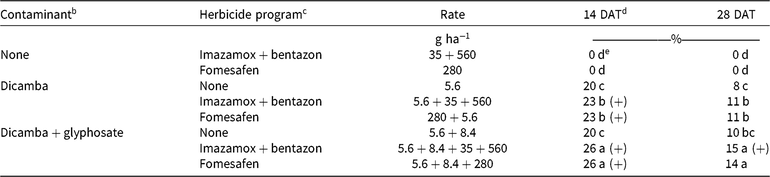
Dry bean injury symptoms from dicamba consisted of leaf crinkling and cupping and were consistent among site-years. Injury symptoms were consistent with those described by Lyon and Wilson (Reference Lyon and Wilson1986). Injury to dry bean from applications of dicamba alone reached a maximum of 20% 14 DAT and declined to 8% by 28 DAT (Table 1). The addition of glyphosate to dicamba did not affect dry bean injury, which is consistent with previous research that used pinto and navy bean (Hatterman-Valenti et al. Reference Hatterman-Valenti, Endres, Jenks, Ostlie, Reinhardt, Robinson, Stenger and Zollinger2017). The treatment of imazamox + bentazon caused minor dry bean leaf necrosis and malformation as soon as 1 DAT, but this injury was not evident by 14 DAT (Table 1). Similarly, dry bean injury from fomesafen was less than 5% 7 DAT (data not shown) and was not apparent by 14 DAT. Symptoms consisted of foliar leaf spotting, bronzing, and crinkling, which are consistent with fomesafen injury symptoms described by Wilson (Reference Wilson2005).
Effect on dry bean of simulated tank contamination of dicamba and dicamba + glyphosate alone and in combination with common postemergence dry bean herbicide programs.a

a Data were combined over application timings, V2 and V8, and the three site-years of the experiment. The effects of herbicide mixtures were tested for the presence of synergy. Expected injury values were calculated using the equation in Gowing (Reference Gowing1960) and were compared with observed injury values using t-tests at α ≤ 0.05. The (+) symbol indicates a synergistic response from the combination.
b Dicamba and dicamba + glyphosate applied at 1% the recommended use rates.
c A crop oil concentrate (COC) at 1% v/v plus ammonium sulfate at 2.5% w/v was included with the imazamox + bentazon tank mixture and a COC at 1% v/v was applied with fomesafen.
d DAT: days after treatment.
e Means followed by the same letter within a column are not significantly different (α ≤ 0.05).
The combination of either of the dry bean herbicide treatments, imazamox + bentazon or fomesafen, with dicamba or dicamba + glyphosate resulted in greater injury than dicamba alone (Table 1). This increase in injury was still apparent 28 DAT, even after dry bean started to recover. These combinations also resulted in synergistic responses 14 DAT, when comparing expected with actual dry bean injury values. Dry bean injury was 3% and 6% higher with the combinations of dry bean herbicides with dicamba and dicamba + glyphosate, respectively, than either of these treatments alone 14 DAT. By 28 DAT, dry bean injury was still higher when dicamba + glyphosate was applied with the dry bean herbicides. However, only the combination of imazamox + bentazon with dicamba + glyphosate resulted in a synergistic response 28 DAT. Previously synergistic responses with respect to dicamba or dicamba + glyphosate have not been reported with combinations of herbicides on dry bean. However, our work does support previous research interactions conducted using soybean. Kelley et al. (Reference Kelley, Wax, Hager and Riechers2005) reported that use of imazamox (44 g ai ha−1), imazethapyr (71 g ai ha−1), and fomesafen (330 g ai ha−1) combined with dicamba (5.6 g ae ha−1) resulted in higher soybean injury compared with dicamba used alone. They found a synergistic response with herbicides that needed to be metabolized to avoid injury, whereas no synergistic response was documented when dicamba was applied with glyphosate in glyphosate-resistant soybean. The synergistic responses that we observed when dicamba or dicamba + glyphosate was added to the dry bean herbicides may have also been caused by the addition of a COC to the dry bean herbicide treatments. Brown et al. (Reference Brown, Robinson, Nurse, Swanton and Sikkema2009) reported that soybean injury was greater from tank-contamination rates of dicamba when COC was added.
In addition to herbicide treatment differences, the main effect of application timing influenced dry bean injury 28 DAT, but not 14 DAT. At 28 DAT, combined over all herbicide treatments, the V8 (16%) application timing resulted in more injury than the V2 (8%) timing. Differences in injury between the two application timings may be due to slower growth at the V8 stage, as dry bean transition from vegetative to reproductive stages (Fageria and Santos Reference Fageria and Santos2008).
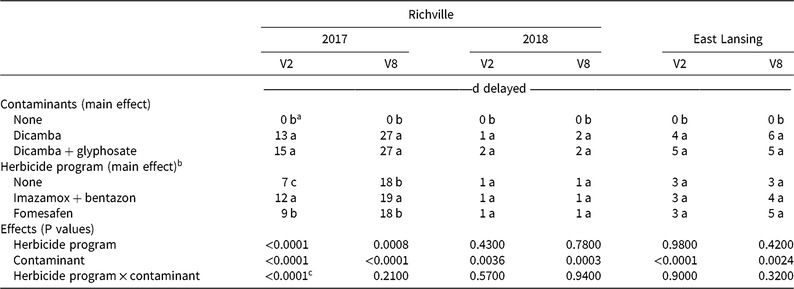
In general, the number of days delayed to MR50 was mostly affected by the main effects of tank contaminant and dry bean herbicide (Table 2). The one exception was at the V2 application timing at Richville 2017, when dicamba and dicamba + glyphosate applied alone caused a 10-d and 13-d delay to MR50, respectively, compared with the no-herbicide control. All other site-years and application timings were mostly affected by the dicamba and dicamba + glyphosate treatments. The longest delays in maturity were from the V8 applications in Richville 2017, where dicamba and dicamba + glyphosate delayed MR50 by 27 d compared with the control (Table 2). At this site-year, the main effect of dry bean herbicide also impacted maturity. Dry bean herbicides delayed MR50 by 19 d, 18 d, and 18 d for imazamox + bentazon, fomesafen, and the no-herbicide control, respectively, when combined over tank contaminants (Table 2). Both locations in 2018 had shorter delays in maturity than Richville 2017. At both 2018 locations dry bean maturity was affected only by tank contaminants and not by dry bean herbicide. At these locations, dicamba and dicamba + glyphosate delayed dry bean maturity by 1 d to 5 d compared with the no-herbicide control (Table 2). The addition of glyphosate to dicamba did not delay maturity any longer than dicamba alone.
Main effects and P values dry bean maturity, measured in days delayed to 50% (MR50), from simulated tank-contamination of dicamba and dicamba + glyphosate alone and in combination with common postemergence dry bean herbicide programs.
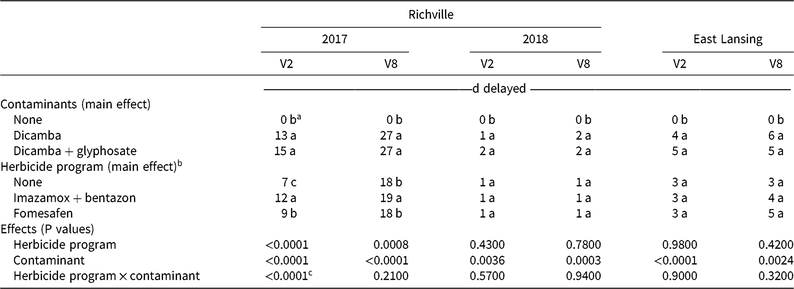
a Means followed by the same letter within a column for each main effect are not significantly different (α ≤ 0.05).
b A crop oil concentrate (COC) at 1% v/v plus ammonium sulfate at 2.5% w/v was included with the imazamox + bentazon tank mixture and a COC at 1% v/v was applied with fomesafen.
c The was an interaction among the main effects of contaminant and dry bean herbicide program for the V2 application timing at Richville in 2017. In general, the interaction followed the main effects, with one exception, in that dry bean maturity was delayed 13 and 10 d from dicamba + glyphosate and dicamba with no-herbicide, respectively.
Other researchers have reported delays in maturity when dry bean have been exposed to dicamba (Hatterman-Valenti et al. Reference Hatterman-Valenti, Endres, Jenks, Ostlie, Reinhardt, Robinson, Stenger and Zollinger2017; Lyon and Wilson Reference Lyon and Wilson1986). Hatterman-Valenti et al. (Reference Hatterman-Valenti, Endres, Jenks, Ostlie, Reinhardt, Robinson, Stenger and Zollinger2017) reported delays in maturity that resulted in crop loss due to the limited length of the growing season when pinto beans were exposed to dicamba (4.48 g ae ha−1) or dicamba (4.48 g ae ha−1) + glyphosate (10 g ae ha−1) at the R1 stage of growth. They also reported that navy bean maturity was delayed when beans at the R1 stage were exposed to dicamba up to 44 g ae ha−1. However, the addition of glyphosate to dicamba did not significantly affect dry bean response.
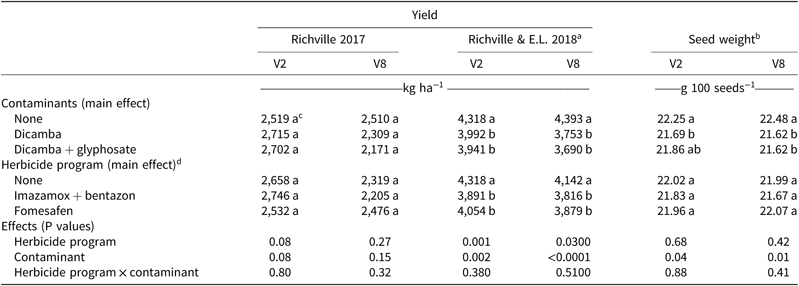
Although herbicide application resulted in delayed maturity, it had no effect on dry bean yield in 2017 (Table 3). In 2018, yield was reduced by applications of dicamba, dicamba + glyphosate, and the dry bean herbicides. Dicamba caused reduced yields up to 8% and 15% for V2 and V8 application timings, respectively (Table 3). The addition of glyphosate to dicamba did not further reduce dry bean yield. In 2018, the main effect of dry bean herbicide also reduced yield up to 10% (Table 3). These findings support research conducted by Kelley et al. (Reference Kelley, Wax, Hager and Riechers2005) who studied soybean. They found that dicamba at rates of 5.6 g ae ha−1 did not always reduce soybean yield, but when combined with other herbicides such as imidazolinone herbicides and fomesafen, yield losses were much more likely to occur. Additionally, we found that the addition of low rates of glyphosate to dicamba did not further increase yield loss, which is supported by Hatterman-Valenti et al. (Reference Hatterman-Valenti, Endres, Jenks, Ostlie, Reinhardt, Robinson, Stenger and Zollinger2017) who found that addition of glyphosate to dicamba did not further affect pinto and navy bean yield.
Main effects and P values for dry bean yield and seed weight from simulated tank contamination of dicamba and dicamba + glyphosate alone and in combination with common postemergence dry bean herbicide programs. Seed weight is combined over the 3 site-years of the experiment.
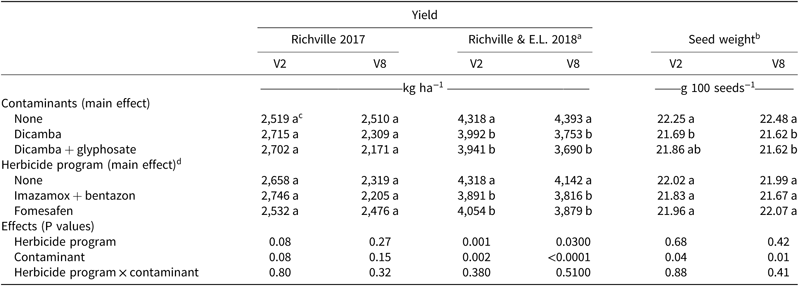
a Data are combined for the Richville and East Lansing 2018 locations.
b Seed weight is combined over the 3 site-years of the experiment.
c Means followed by the same letter within a column for each main effect are not significantly different (α ≤ 0.05).
d A crop oil concentrate (COC) at 1% v/v plus ammonium sulfate at 2.5% w/w was included with the imazamox + bentazon tank-mixture and a COC at 1% v/v was applied with fomesafen.
Dry bean seed weight was affected by the main effect of tank contaminant (Table 3). Combined over years and locations dicamba applied alone at V2 and V8 stages and dicamba + glyphosate applied at V8 reduced black bean seed weight. Seed weight was reduced 2.5% at the V2 stage and 3.8% at the V8 stage. Seed weight was not affected by the main effect of dry bean herbicide. These data support the findings reported by Kelley et al. (Reference Kelley, Wax, Hager and Riechers2005) who also found that soybean seed weight could be reduced from dicamba applications of 5.6 g ae ha−1.
2,4-D Tank Contamination
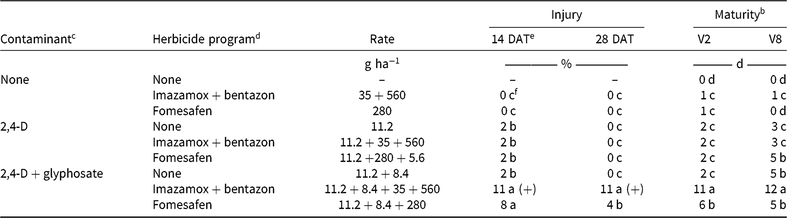
Overall dry bean injury from 2,4-D was extremely low (2% or less) (Table 4). Similar to dicamba, adding glyphosate to 2,4-D did not result in increased injury when there was no dry bean herbicide present. However, when 2,4-D plus glyphosate was applied with either imazamox + bentazon or fomesafen dry bean injury was 11% and 8%, respectively, at 14 DAT. The higher injury from these treatments was still apparent 28 DAT, however, dry bean injury was greatest when imazamox + bentazon was included. This treatment also showed a synergistic response when comparing expected with actual dry bean injury values at 14 DAT and 28 DAT, which may have been caused from the adjuvants applied with the dry bean herbicides.
Effect on dry bean injury and maturity, measured in days delayed to 50% (MR50), of simulated tank-contamination of 2,4-D choline and 2,4-D choline plus glyphosate alone and in combination with common postemergence dry bean herbicide programs.a
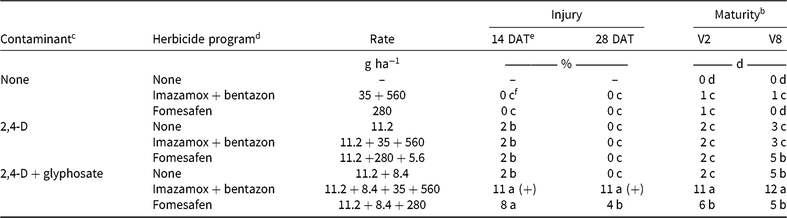
a Injury data are combined over application timings V2 and V8, and the 3 site-years of the experiment. The effects of herbicide mixtures were tested for the presence of synergy. Expected injury values were calculated using the equation in Gowing (Reference Gowing1960) and were compared with observed injury values using t-tests at α ≤ 0.05. The (+) symbol indicates a synergistic response from the combination.
b Maturity data is only from East Lansing 2017.
c 2,4-D and 2,4-D + glyphosate contaminants were applied at 1% the recommended use rates.
d A crop oil concentrate (COC) at 1% v/v plus ammonium sulfate at 2.5% w/v was included with the imazamox + bentazon tank mixture and a COC at 1% v/v was applied with fomesafen.
e DAT: days after treatment.
f Means followed by the same letter within a column are not significantly different (α ≤ 0.05).
Dry bean maturity was affected only in 2017 (Table 4). In most cases, delays to MR50 were 1 to 2 d when any herbicide was applied at the V2 stage. However, greater delays of 11 and 6 d were observed when 2,4-D + glyphosate was applied with either imazamox + bentazon or fomesafen, respectively. These delays in maturity also occurred when they were applied at the V8 stage. At that time, delays (12 d) were also greatest when 2,4-D + glyphosate was applied with imazamox + bentazon. Over the two application timings, this delay in maturity was 6 d longer than any other herbicide combination. This was the only interaction in which imazamox + bentazon caused a delay in maturity that was longer than that of fomesafen. The longer delays caused by imazamox supports findings by Bauer et al. (Reference Bauer, Renner, Penner and Kelly1995) who reported delays in pinto bean maturity by imazethapyr, an herbicide that is in the same chemical family (imidazolinone) as imazamox.
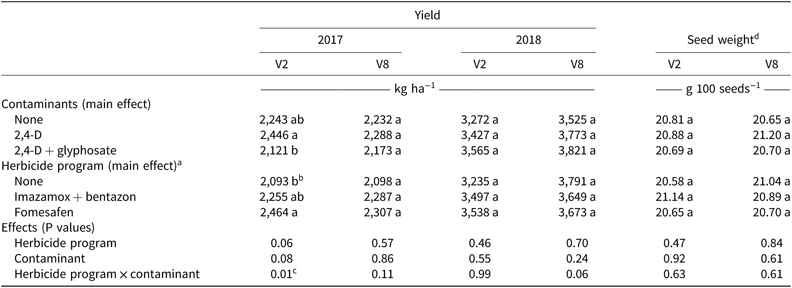
Dry bean yield and seed weight were not affected by 2,4-D or 2,4-D + glyphosate in either year of this experiment (Table 5). However, in 2017, an interaction occurred between the factors of contaminants and dry bean herbicides applied at V2. Results of this interaction showed that application of imazamox + bentazon resulted in lower yields than any other treatment. Dry bean yield was reduced 17% with this treatment compared with the no-herbicide control (data not shown). Others have reported that injury from imidazolinone herbicides can sometimes delay dry bean maturity and reduce yield (Bauer et al. Reference Bauer, Renner, Penner and Kelly1995; Blackshaw and Saindon Reference Blackshaw and Saindon1996; Soltani et al. Reference Soltani, Shropshire, Cowan and Sikkema2017). Although yield results in 2017 and 2018 were not statistically significant, they showed a slight numerical yield increase of 3% to 9% when 2,4-D at 11.2 g ae ha−1 was applied when compared with treatments without 2,4-D. Although research on hormesis in soybean has provided little evidence of a positive effect from exposure to 2,4-D, future research could examine dry edible bean response (Egan et al. Reference Egan, Barlow and Martensen2014). However, the possibility that delays in maturity would result from the effect of low rates of 2,4-D would likely negate any benefit from the herbicide.
Main effects and P values for dry bean yield and seed weight from simulated tank contamination by 2,4-D choline and 2,4-D choline + glyphosate alone and in combination with common postemergence dry bean herbicide programs.
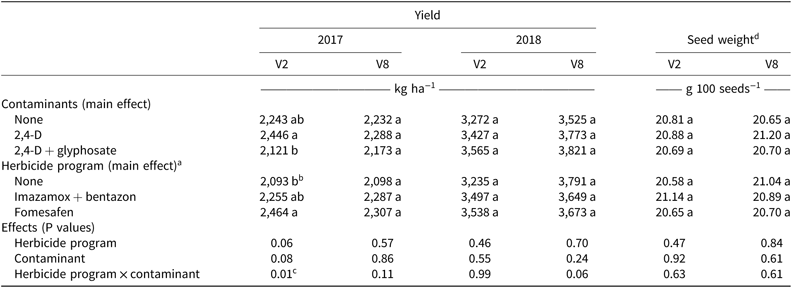
a A crop oil concentrate (COC) at 1% v/v plus ammonium sulfate at 2.5% w/v was included with the imazamox plus bentazon tank-mixture and a COC at 1% v/v was applied with fomesafen.
b Means followed by the same letter within a column for each main effect are not significantly different (α ≤ 0.05).
c The interaction for dry bean yield in 2017 for the V2 timing was a result of lower yields with imazamox + bentazon alone (2,018 kg ha−1) compared with the no-herbicide control (2,435 kg ha−1).
d Seed weight is combined over the 3 site-years of the experiment.
Based on this research we have found that both dicamba and 2,4-D at tank-contamination rates can have synergistic interactions when herbicides are applied to dry bean at postemergence. These interactions could be the result of the addition of adjuvants used with the dry bean herbicides. Tank contamination with dicamba was more severe than that of 2,4-D and the addition of glyphosate to dicamba had very little effect on dry bean with or without application of common postemergence dry bean herbicides. The rates of 2,4-D used to simulate tank contamination had very little effect on dry bean and would likely not be an issue for dry bean farmers. However, dicamba at the 1% rate caused high levels of injury and reduced yield. This is concerning for dry bean producers because the rates tested for dicamba were similar to residue levels found in commercial sprayers after cleanout (Boerboom Reference Boerboom2004; Osborne et al. Reference Osborne, Xu, Swanson, Walker and Farmer2015). Producers should avoid using application equipment in dry beans directly following applications of dicamba to reduce the risk of this exposure.
Acknowledgements
We thank Gary Powell, Brian Stiles, Paul Horny, and Dennis Fleischmann for their technical assistance. This research received no specific grant from any funding agency, commercial or not-for-profit sectors. No conflicts of interest have been declared.