Introduction
The identification of high-acuity patients during calls to an emergency ambulance dispatch center is crucial in prioritizing ambulance response. Providing emergency care to and safe transfer of seriously ill and injured patients to hospitals in remote areas is a significant challenge. The care of patients transported to rural community hospitals is complicated by limited critical care skills and facilities at the initial point of care, coupled with prolonged transfer times to definitive care.Reference Withelaw, Hsu, Corfield and Hearns1 The Medical Priority Dispatch System (MPDS) protocols are used by more than 2,300 Emergency Medical Services systems to interrogate callers, provide prearrival instructions, determine incident priority, and assign appropriate resources to the call. A systematic review found little high-quality literature on criteria-based dispatch protocols.Reference Feldman, Verbeek and Lyons2 Only two articles concluded that dispatch protocols improved patient outcomes.Reference Wilson, Cooke, Morrell, Bridge and Allan3, Reference Eisenberg, Hallstrom, Carter, Cummins, Bergner and Pierce4 Although MPDS has been reported to decrease Advanced Life Support (ALS) ambulance utilization,Reference Bailey, O'Connor and Ross5 a recent conference on Emergency Medical Services (EMS) highlighted the need to develop outcome-based benchmarks for dispatch protocols.Reference Schmidt, Cone and Mann6
A Canadian study measured the performance of MPDS protocols by comparing the dispatch assessment of patients’ acuity (as predicted by EMS dispatchers) with paramedic assessment of patients’ acuity, measured by the out-of-hospital Canadian Triage and Acuity Scale (CTAS). The MPDS exhibits an overall sensitivity of 68.2% with a specificity of 66.2% for detecting high acuity of illness or injury.Reference Feldman, Verbeek and Lyons2 Another article demonstrated only a modest ability of the medical dispatch codes to predict which patients would require prehospital ALS intervention defined as the administration of a medication or a procedure.Reference Sporer, Johnson and Yeh7 In Italy, advanced airways management procedures with medication given and mechanical ventilator use dictate the presence of a physician in the field to initiate the treatment. For this reason, the use of a medical dispatch system to reduce the number of inappropriate scene responses made by Italian emergency physicians is a critical step for the Central Ambulance Communications Centre's performance. Nursing staff often take calls in Italian emergency medical ambulance services; however, there are no data about their performance in detecting prehospital high-acuity patients who need prehospital medications and procedures.
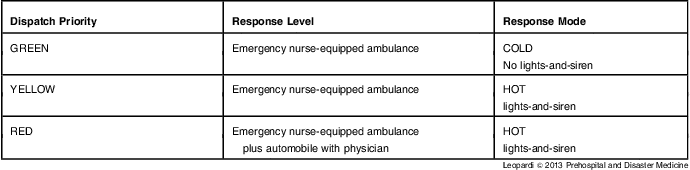
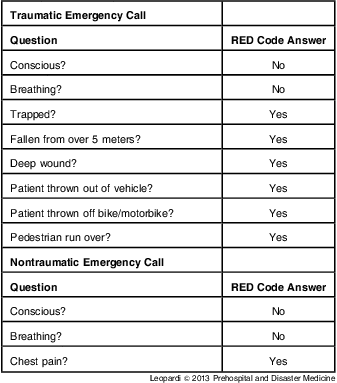
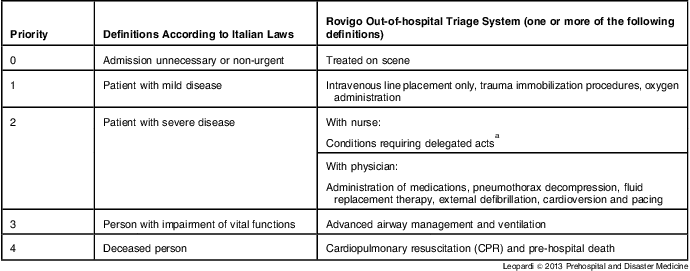
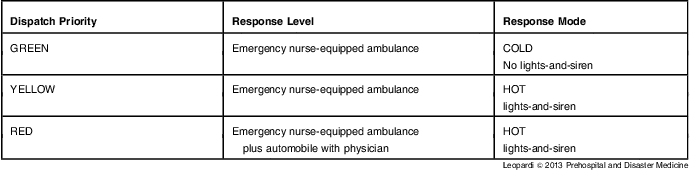
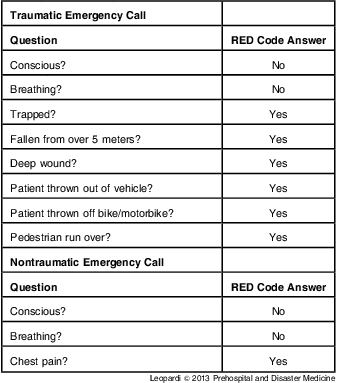
Lengthy, almost exclusively ambulance-based, transfers to the most suitable hospital represent a key management problem in the Province of Rovigo (Italy), which covers a rural geographical area of 1,788.6 km2 with approximately 244,000 inhabitants and a population density varying from 64.9 to 470.9 inhabitants per km2. Rovigo has an emergency ambulance service with two response levels for medical assistance: an emergency nurse-staffed ambulance and a physician-staffed automobile. Since 1992, the Rovigo Ambulance Communications Centre's dispatchers have interrogated callers using a dispatch system staffed by nurses who also work in the field. A subjective decision-making process is used, to assign a dispatch priority. The response model in use is summarized in Table 1. Green and Yellow codes are considered low-risk levels, whereas the Red code is considered high risk. As shown in Table 2, the call coding system used in determining the dispatch code is based on a simple interrogation process, with the additional aid of situation-specific criteria that reflect the risk factors on trauma scene, in accordance with local policies.Reference Guidetti, Serantoni and Menarini8, 9 This framework identifies the criteria for designating a Red code. At the same time, the dispatcher has great freedom to decide whether to assign a Red Code after having identified any of the criteria in the protocol or after having ascertained, for any other reason based on his/her individual medical experience, the need for a physician-staffed response level. In Rovigo Ambulance Service, dispatching nurses do shifts both in the Communication Centre and on call as part of emergency response teams, thus gaining experience from both points of view. In the Communication Centre, the skills needed to carry out criteria-based dispatch are gained by way of a gradual 3-month training process, under the supervision of an instructor with eight years of experience. This training process combines familiarization with the decision-making framework with professional experience gained in the Emergency Unit. At the beginning of the study, 30% of the dispatchers were in training. As defined in Table 3, a generic and subjective system of triage using a 5-level ordinal scale is widely used in Italy in accordance with Italian laws.Reference Guidetti, Serantoni and Menarini8, 9 Unfortunately, this is a non-standard patient severity score without consensus guidelines. Rovigo Ambulance Service uses an out-of-hospital triage system with a 6-level scale developed to classify patient acuity with respect to prehospital physician interventions during ambulance transport. The only difference is in the level “Priority 2,” which is divided into two levels based on the presence or lack of a doctor (“Priority 2 with nurse” and “Priority 2 with physician”). The scale was developed for use by Rovigo Emergency Medical Ambulance Services to classify prehospital patient acuity for the purpose of pre-alerting hospital Emergency Departments. All Rovigo Ambulance Service nurses and physicians are trained to determine patient triage priority. In theory, a trained dispatcher always should identify physician response levels (Priority 2 with physician, Priority 3 or 4), allocating such calls a Red code, which requires an automobile with physician and an emergency nurse-equipped ambulance in lights-and-siren response mode.
Dispatch system priority levels, showing level and mode of response used by Rovigo Ambulance Service. There is also a White response (not shown), in which an ambulance transport to hospital is not required.
Dispatch Interrogation Processes Used To Determine RED Code, in Accordance with Local PoliciesReference Guidetti, Serantoni and Menarini8, 9
The generic and subjective system of triage according to Italian laws,Reference Guidetti, Serantoni and Menarini8, 9 and the out-of-hospital triage system according to need for prehospital medications and procedures, used by response team before ambulance transport in Rovigo.

aDelegated acts are treatments and procedures provided by a non-physician
Objective
This study attempts to undertake a sensitivity/specificity analysis to determine the ability of a dispatch staffed by emergency ambulance nurses to detect prehospital need for physician intervention, in the context of a semi-rural area Emergency Medical Service.
Methods
A retrospective analysis was conducted using data from the Rovigo Ambulance Service's Communications Centre database for the period January 1, 2004 through December 31, 2009. This time period ensured a study sample to provide a margin of error of ±5% or less. The Rovigo SIES118 database was searched to obtain all emergency calls for the study period. Duplicate calls and calls with incomplete data were excluded. Patients who were admitted due to doctor requests, interhospital transfers and calls with no ambulance response were excluded as these patients bypassed dispatch protocols.
Dispatch and patient care records were analyzed using SAS118 version 8.02 software (IBM, Armonk, New York USA) in order to create a specific database. All calls were triaged and assigned a dispatch code on the basis of present guidelines (see Table 2) and on the dispatcher's professional experience in formulating non-scripted key questions. The highest priority level, Red code, represents potential need of physician interventions. Response teams identify the out-of-hospital triage level upon patient transfer, as shown in Table 3. Physicians classify as Priority 4 cases of death before arrival, death following a failed resuscitation attempt or resuscitation with return of spontaneous circulation (ROSC) followed by subsequent prehospital death. Patients admitted to an emergency department after prehospital treatment who receive advanced airway treatments are considered Priority 3, to alert the in-hospital emergency team. The physician on scene carries out evaluation of the indications for prehospital interventions itself in accordance with international and local guidelines (Advanced Life Support - European Resuscitation Council guidelines, Prehospital Trauma Care guidelines, local procedures).Reference Nolan10-Reference Spahn15 Dispatch codes (Red, Yellow, Green and White) of all transported prehospital patient calls by a subjective decision-making process, were matched with out-of-hospital Triage priority (Priorities 0 through 3), to determine the number of correctly-identified cases where physician intervention was needed during ambulance transport. Priority 4 patients were excluded from analysis due to the prevalence of death before physician arrival and because cardiopulmonary resuscitation does not require a physician.
Although it is possible to compare directly the 3-point dispatch scale with the 6-point triage system, the main purpose is to test the ability of a nursing staff dispatcher to detect prehospital need for physician intervention during ambulance transport (high-acuity categories). For this reason, both the dispatch and triage scales have been dichotomized into high- and low- acuity categories. Appropriate categorization of each triage level with respect to dispatch priority is shown in Table 4. For analysis, true-positive cases were those in which the high out-of-hospital triage level (Priority 2 with physician and Priority 3) was prioritized by dispatch as high acuity (Red code), corresponding with physician response to these calls. True-negative cases were those calls in which low triage levels (Priorities 0 through 2 with nurse) were prioritized as low dispatch acuity (White, Green, or Yellow code) and received nursing responses. Sensitivity, specificity, positive predictive value (PPV) and negative predictive value (NPV) as well as 95% confidence intervals (CI) were calculated. All calculations were performed by using Medcalc statistical software (http://www.medcalc.org/calc/diagnostic_test.php).
Assignment of high-acuity patients calls needing prehospital physician interventions (triage priority level 3 and 2 with physician) to high dispatch priority (RED code). Triage priorities 2 (with nurse) to 0 patients were less urgent and merited a lower priority response without need of prehospital physician interventions.

Results
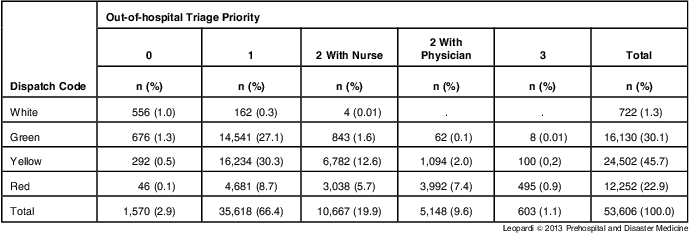
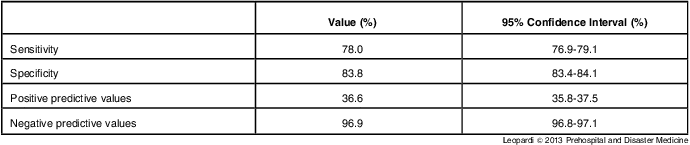
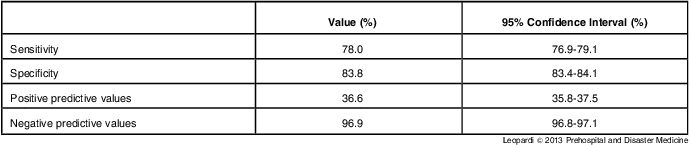
Table 5 shows the number, dispatch code and out-of-hospital Triage priorities of the calls in the dispatch database meeting inclusion criteria. Of the 61,353 emergency calls handled by Rovigo Ambulance Service's Communications Centre, 6,163 calls were excluded due to the following reasons: no patient contact, cancelled-no transport, and missing data. One thousand five hundred eighty-four calls about prehospital deaths cases were excluded. Finally, 53,606 patient transports met inclusion criteria for the analysis, of which 12,252 (22.9% of calls) were coded Red, 24,502 (45.7%) Yellow, 16,130 (30.1%) Green and 722 (1.3%) White. The response team on scene identified 1,570 (2.9%) patients as “Priority 0,” 35,618 (66.4%) were admitted to hospital as “Priority 1,” 10,667 (19.9%) were designated “Priority 2 with nurse on ambulance,” 5,148 (9.6%) “Priority 2 with physician interventions,” and 603 (1.1%) patients were admitted to an emergency department as “Priority 3” and were treated with advanced airway support and ventilation (see Table 5). Appropriate categorization of each triage level with respect to dispatch priority is shown in Table 6. As shown in Table 7, the sensitivity of subjective experience-based nursing dispatch personnel in detecting the need for physician interventions was 78.0% (95% CI, 76.9%-79.1%), with a PPV of 36.6% (95% CI, 35.8%- 37.5%). Specificity was 83.8% (95% CI, 83.4%-84.1%), with an NPV of 96.9% (95% CI, 96.8%-97.1%).
Dispatch code and out-of-hospital triage priority levels for all calls from January 1, 2004 through December 31, 2009. Percentages may not add up to 100 as a result of rounding.
RED code vs Out-of-hospital Triage Priority Levels (Priority 2 with physician and Priority 3 indicated need of prehospital physician interventions), 2004-2009

aRED code = emergency nurse-equipped ambulance plus automobile with physician in hot response mode.
RED Code vs Out-of-hospital Triage Priority Levels, 2004-2009
Discussion
An ideal system in Italy would mobilize physician resources in a manner that is appropriate to patients’ acuity and would positively influence patient outcomes. Determining the performance of an emergency medical dispatch system staffed by nurses is a challenge. No standards or benchmarks currently are defined that can be used to measure nursing dispatch performance in detecting prehospital need for physician interventions during ambulance transport. Various illness-acuity markers have been defined that correlate with a patient's need for acute interventions and outcomes. Out-of-hospital data routinely collected on all ambulance transports are the gold standard for dispatch system analysis.Reference Feldman, Verbeek and Lyons2 Rovigo Ambulance Service uses a 6-level scale developed to classify patient acuity with respect to prehospital physician interventions during ambulance transport. For this reason, it is possible to use the out-of-hospital triage score as a gold standard to determine the ability of a dispatch staffed by emergency ambulance nurses to detect prehospital need for physician interventions. However, a direct correlation between the two scales has limitations because they are instruments designed for different purposes and would not be expected to exhibit a high degree of agreement. The present study shows that 78% of patients needing prehospital physician interventions are correctly designated as Red codes by instructor-trained emergency nurse dispatchers using an experience-based dispatch. This means that 78% of the out-of-hospital critical patients are allocated the maximal ambulance system response. However, a positive predictive value of 36.6% indicates that use of this nursing dispatch model is not able to identified, at the point of call-taking, when there is no need for prehospital physician interventions for high-acuity dispatch code patients. Finally a negative predictive value of 96.9% suggests that the dispatcher is able to correctly identify when not to send a doctor to the scene in the absence of need for physician interventions. As shown in Table 6, there were 1,264 false negatives (ie, Yellow/Green or White codes resulting in prehospital need for physician interventions); in these cases nurse-equipped ambulances asked for physician automobile help on the scene in a second step. Of this cases, 108 patients required advanced airway management and ventilation (out-of-hospital Priority 3 dispatched as Yellow and Green codes, see Table 5).
This system can identify the prehospital need for physician intervention, but doesn't seem to improve the physician over-triage issue at all, with most seriously-ill patients needing time-dependent interventions without a physician on the scene. The small number of calls to the Ambulance Service's Communications Centre probably limits this risk. However, the authors believe that a dispatch center staffed by nurses who also work in the field is a useful resource in a small ambulance service. Past studies have demonstrated the superiority of an automated dispatch system to the dispatcher's subjective decision-making process.Reference Clawson, Olola, Heward, Scott and Patterson16 Unfortunately, there are no data that clearly demonstrate when to change to an expensive automated dispatch system.
Limitations
The findings of this study were obtained in a small semi-rural setting, with a unique dispatch system staffed by nurses who also work in the field, and therefore may not be applicable to other settings.
Conclusion
Dispatch center nursing staff, who also work in the field, and who have three months of training and six years of experience, had the subjective ability to identify correctly when not to send a doctor to the scene in the absence of need for physician interventions in a central ambulance communications centre with a small number of calls. In this dispatch system, the staff of ambulance nurses was not able to predict when there was no need for physician interventions in high-acuity dispatch code patients, resulting in an over-triage use risk of emergency physicians in other prehospital interventions.