The 1840s was a climacteric decade for the United Kingdom, especially Ireland. What made this so was an existential demographic crisis, the Great Famine of 1846–51, caused by potato blight which ruined several annual harvests. Around a million people died in Ireland, and even more than that number fled oversees, mainly to Britain and North America. Consequently, Ireland's population fell from a peak of around 8.5 million in 1845 to 6.5 million in 1851.Footnote 1 The 1840s created lesser but still pronounced trials for the working classes in Britain. Dubbed the ‘hungry forties’ many years later, this was a decade of unemployment, hardship and privation.Footnote 2 In particular, the year 1847, known as ‘Black ’47’ in Ireland, brought acute economic depression in manufacturing areas across Britain.Footnote 3 With British workers already fearful for their livelihoods, mass Irish immigration, which began at the end of 1846, met considerable hostility. In addition to the perceived labour market implications of immigration from Ireland was the more tangible threat of disease. Many of the Irish who landed in Britain in 1847 were carrying a virulent form of typhus fever that, as we shall see, was ravaging famine-stricken parts of Ireland with great intensity. An epidemic soon took root in Britain. The Irish in Britain had long been associated with disease, in part because they tended to reside in the most insalubrious urban locales, and because commentators and political theorists such as J. P. Kay, Thomas Carlyle, Friedrich Engels and many others, presented these immigrants as a sub-human threat to the very body of British social and political life.Footnote 4 However, what went before was dwarfed both by the realities and the cultural production associated with the Famine inrush, and particularly with the great typhus outbreak of 1847. Indeed, this episode remains exceptional in the annals of modern British history as the only epidemic to be universally associated with mass immigration.Footnote 5 It was one of the deadliest episodes of epidemic typhus to occur during the nineteenth century, and so closely were its connections to the Famine Irish that it was widely referred to as ‘Irish fever’.Footnote 6
In Britain, as in North America where masses of fever-stricken Irish arrived on aptly named ‘coffin ships’, the impact of the epidemic on mortality was considerable, as were its social and political implications.Footnote 7 Yet, with few notable exceptions, this episode has received surprisingly little historiographical attention.Footnote 8 The U.S. dimensions of this typhus epidemic have received some attention, like their U.K. counterpart, but not systematically.Footnote 9 Some of the classic studies on the Irish in Britain have described individual cases, offering insights from contemporary accounts of particular rookeries, courts, alleys and yards, such as those in the Walmgate area of York where in 1847 a local surgeon, William Proctor, recounted fears at the risks of typhus spreading among and beyond the Irish who ‘swarm together in the lodging houses’.Footnote 10 Frank Neal's work, particularly on Liverpool where Dr Duncan, the town's first medical officer of health, described a ‘City of Plague’ in 1847, has shown the effects of mass Irish immigration at the major ports of disembarkation along the west coast.Footnote 11 Yet, there has been little attempt to assess the impact of the epidemic nationally, nor has there been any serious attempt to consider the legacy of the epidemic on the Irish in Britain. While John Belchem has acknowledged that typhus shaped both experiences and perceptions of the Irish in Liverpool, and Graham Davis has argued more broadly that Irish migrants faced ‘fervent hostility … as disseminators of killer diseases’, its wider implications remain largely unexplored.Footnote 12 To read the historiography of ‘Irish fever’ in Britain in 1847, one might leave with the impression that this was a relatively short-lived and, though tragic, soon-forgotten affair which was largely confined to a handful of major towns and cities along the west coast. Lynn Hollen Lees’s otherwise excellent study of London is quite typical, describing in close detail the social geography of the slums inhabited by so many Irish in London but saying nothing of the typhus which nevertheless was rife among the Irish in the city.Footnote 13 Similarly, Ruth-Ann Harris’s study of Irish labour migration to Britain finds no reason to consider how disease may have affected worker relations.Footnote 14
To discount the nationwide effects of ‘Irish fever’ in Britain, and to overlook its deep penetration of society beyond the western ports of disembarkation, would be wrong. Serious outbreaks of typhus fever were reported all across the country in 1847; in towns, villages, workhouses and vagrancy wards. Moreover, while the term ‘Irish fever’ was used by medical professionals on both sides of the Atlantic to refer to a severe form of typhus thought to originate in Ireland, it also served, inevitably, as a stigmatising epithet. The events of 1847, we argue, entrenched in the British psyche the association of the Irish with life-threatening pestilence. Indeed, a link between ‘Irish fever’ and the rise of overt restrictive practices against the Irish in the labour market has been indicated elsewhere.Footnote 15 The crystallising image of the Irish poor in Britain as dirty, disease carrying, profligate and, above all, inferior to the British working class – views which found expression in many ‘condition of England’ reports from the 1830s to the 1850s – was fortified by the immigration and disease crisis of the late 1840s. Certainly, the role of disease, in creating a sense of apartness which defined the Irish experience in Britain in the wake of the Famine, deserves much fuller attention.
The present article attempts to do just that. It reappraises what we know about ‘Irish fever’, offering the first national study of the 1847 epidemic. It builds on the valuable work undertaken, particularly by Neal, on the major urban centres around the west coast in which an inextricable link, widely held by contemporaries, between mass Irish immigration and outbreaks of epidemic typhus has been demonstrated.Footnote 16 The story that unfolds here is directly related to the inadequate response of the government to the crisis in Ireland, which encouraged mass immigration. What made the British context worse was the refusal of Westminster to assist local authorities in badly affected parts of the country, despite many importunate communications.Footnote 17
The construction of a national history of the ‘Irish fever’ epidemic requires the bringing together of a wide range of sources from different places. Indeed, while this study takes a national perspective it is, fundamentally, based around a mosaic of local and regional experiences. Much of the material featured in this article was located in regional archives, parliamentary papers and other published and unpublished reports, and national and provincial newspapers. The voluminous MH 12 poor law files, held at the British National Archives, which include all correspondence between regional poor law assistant commissioners and local boards of guardians, have proven particularly valuable. So too has another in this series, MH 32, which includes reports and other correspondence sent by the assistant commissioners to their superiors at Somerset House in London. Taken together, these various sources have allowed us to examine the interconnected local, regional and, above all, national impress of ‘Irish fever’ across Britain during its worst year in 1847. The article is structured in three main parts: the geography of ‘Irish fever’ in 1847; the responses of the authorities to the crisis; and, finally, the legacy of the epidemic on perceptions of the Irish in Britain.
I
Since before the Napoleonic wars the Irish had emigrated to Britain as both permanent settlers and transient labourers. As a consequence, certainly by the 1820s, distinct Irish communities existed well beyond the major ports of disembarkation. Although just under half of Britain's 416,000 Irish-born residents in 1841 lived in one of four cities – Liverpool, London, Manchester and Glasgow – sizeable Irish populations could be found in settlements across the English north and midlands, central Scotland and south Wales. While there was no such thing as a typical Irish immigrant in Britain, the Irish were nonetheless disproportionately represented in low-paid causal occupations, and tended to reside in the more deprived areas of British towns and cities.Footnote 18 Here, in the cheap, densely-populated cellars, lodging houses and rented tenements which characterised Britain's urban slums, squalor and disease abounded as public health commentators at this time knew all too well.Footnote 19
It was into these environments that the Famine Irish flooded from late 1846, as hunger began to bite hard at home. The term ‘flooded’ is, indeed, appropriate, and was frequently used by contemporaries to describe the sudden, unprecedented movement of people from Ireland to Britain in this period.Footnote 20 It was estimated that during ‘Black ’47’, the worst year of the Great Famine, some 116,000 destitute Irish refugees arrived in Liverpool by steamer with the intention of remaining in the country, and a further 50,000 in Glasgow.Footnote 21 This massive and very sudden movement of people overwhelmed the authorities, who were wholly unprepared to manage a crisis on this scale.
Disease was a major factor in Irish Famine deaths, thus providing additional motivation to migration.Footnote 22 Disease tended to finish off those weakened victims of extreme hunger; but it also worked more generally on those whose vitamin C intake had fallen due to the loss of sufficient potatoes.Footnote 23 Epidemic typhus raged in Ireland from early 1847, as the effects of famine became more acute. Its virulence is captured in a report in the Census of Ireland, 1851, which showed that between 1845, when the ‘blight’ first struck, and 1847, the darkest year of the Great Famine, deaths from epidemic disease climbed eightfold, from 7,249 to 57,095. Thereafter, deaths fell but remained shockingly high: 45,948 (1848), 39,316 (1849) and 23,545 (1850).Footnote 24 While migration was a means of escape, disease also spread more quickly among highly mobile populations. As we shall see later, typhus particularly prospered on the bodies of those who, as they travelled around, lacked access to water, cooking utensils, clean clothes, and who could not properly wash.Footnote 25
This was the context within which this ‘Irish fever’, or ‘Irish typhus’, passed rapidly to Britain and was noted for its ‘highly contagious nature’. The carriers also were ‘those who fled in dismay from the famine and the pestilence to the sister kingdom – where it spread throughout Glasgow, Liverpool, Birmingham, Manchester, and other towns and districts to which the Irish emigrants flocked’.Footnote 26 Contemporaries in Britain were convinced that mass Famine-related immigration from Ireland was the cause of the epidemic in Britain. ‘There is every reason’, stated the Manchester Courier in July 1847, ‘to ascribe the introduction of fever to the immigrant Irish … huddled up and over-crowded as they have been in the filthy lodging houses to which they resort.’Footnote 27 Dr Duncan in Liverpool denigrated the Irish ‘in dirty lodging houses … who are least cleanly in their habits’.Footnote 28 In a similar vein, the registrar general's 1847 report on mortality referred to the ‘disastrous effect of the immigration of the Irish poor on the health of English towns’.Footnote 29 Such statements could be repeated almost ad infinitum.
The notion that Irish immigrants brought ‘Irish fever’ to Britain is historiographically uncontroversial. The evidence in support of such an interpretation is overwhelming. Yet, it is only one side of the coin. Typhus is a highly contagious louse-borne disease, and it thrives in insanitary and overcrowded environs. The disease was almost certainly endemic in parts of urban Britain for much of the nineteenth century. When the Famine Irish came to Britain in 1847, destitute and devoid of accommodation, and began cramming into the very worst housing, it did not take long for the tentacles of typhus fever to spread. In times of social crisis, as Anne Hardy argues, ‘patterns of human behaviour alter; and increased mobility, domestic crowding and reduced personal hygiene result in epidemics’.Footnote 30 While many Irish undoubtedly brought ‘Irish fever’ with them to Britain, the 1847 epidemic was also the consequence of their miserable circumstances once they had arrived.
What precisely ‘Irish fever’ was, however, is less clear to us today. While contemporaries in the 1840s diagnosed it as typhus, we must be cautious. At the time of the Great Famine, medical science had not yet established a clinical distinction between typhus and diseases such as typhoid and relapsing fever which display similar symptoms. Only in 1849 was an accepted distinction between typhus and typhoid discovered, and the registrar general did not begin distinguishing between the two diseases in his reports until the late 1860s.Footnote 31 Nor was it known until the early-twentieth century that typhus and relapsing fever were louse-borne diseases, whereas typhoid was transmitted through food and water sources. In our period, all three were associated with the miasmatic theory of disease transmission. What we do know, however, is that Victorian medics and social observers recognised what they believed to be typhus, and acted accordingly. The numbers we use, and the cases we report, are based on the perceptions of these people. They were at the front line of the response. While it is very likely that the term ‘Irish fever’ was widely and, at times, inappropriately used in 1847, particularly to diagnose the Irish, we are not too concerned by this problem for the purposes of our study. What contemporaries thought ‘Irish fever’ was, and how they dealt with it, is more important here. Retrospective diagnosis would, in any case, be futile given the limitations of the evidence available. The deadly nature of the 1847 epidemic, which we explore in the following section, also indicates that ‘Irish fever’ was indeed largely or, as the nineteenth-century medical historian Charles Creighton argued, ‘almost wholly’ typhus.Footnote 32
II
While there was considerable geographical variation in the magnitude of the ‘Irish fever’ crisis, few regions were unaffected. The epidemic was a transnational problem that crossed the Irish Sea. We have already described how severe the Irish situation was. While in Britain, in July 1847, the Monthly Journal of Medical Science predicted no ‘large town in the kingdom will escape the prevalent [fever] epidemic’.Footnote 33 With few exceptions, this grim forecast came true. By this time the epidemic had been raging in and around Britain's west-coast ports for several months, and had started to spread inland. The progress of the epidemic received considerable attention in local newspapers. In January and February 1847, following the arrival (also widely reported) of tens of thousands of ‘half naked and starving’ Irish immigrants during the previous few months, newspapers on both sides of the Irish Sea began reporting serious outbreaks of epidemic disease in Liverpool and Glasgow.Footnote 34 By May, reports had emerged of outbreaks in Birmingham, Cardiff, Leeds, London, Manchester, Newcastle, Newport and many other places in between.Footnote 35
Not restricted to major cities and ports, the epidemic came to the attention of provincial newspapers in areas well away from immediate threat. Readers in Norfolk, on the English east coast (a city that was largely unaffected), were informed in May 1847 that ‘The influx of Irish paupers is introducing the typhus fever in this country to a great extent. Liverpool, Manchester, Rochdale, Doncaster, Hull, Stafford are all suffering from this cause.’Footnote 36 Around the same time, readers in the southern county of Hampshire were given the news that ‘Bristol … is, in common with Newport and other places on the western coast, now suffering from the ravages of the typhus fever imported from Ireland’.Footnote 37 The population of Hampshire, living in a coastal region situated between Bristol and London, may have had some cause for concern, but the local reporting was not alarmist. The same is not true in areas much closer to the scene of pestilence. In Sheffield, for example, readers were warned that ‘fever, which has originated in the Irish Famine [is making] fearful ravages in the towns of Manchester, Rochdale and Leeds’.Footnote 38 Leeds was only thirty miles away from Sheffield, and the newspaper urged the Sheffield poor law guardians to be prepared to open a fever hospital if disease appeared in the town.
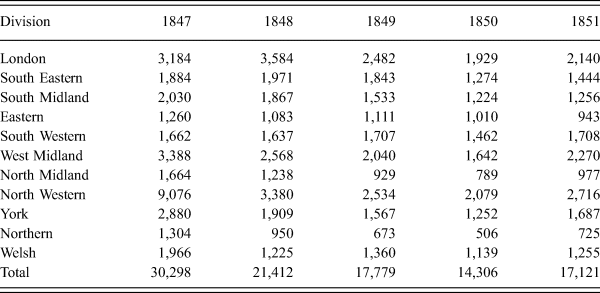
Such fears were not misplaced, for when epidemic typhus struck, the effects could be devastating. The annual reports of the registrar general show that in 1847 over 30,000 people in England and Wales died of typhus fever.Footnote 39 While typhus was endemic in British towns and cities until the late-nineteenth century, these figures suggest considerable excess mortality from this cause in 1847. Table 1 shows the number of deaths attributed to typhus by the registrar general in eleven English and Welsh divisions between 1847 and 1851. It indicates that during the worst year of the crisis, 1847, the number of deaths was roughly double that of relatively normal years of typhus mortality such as 1849-51.Footnote 40 Excess mortality as a consequence of typhus fever in 1847 therefore probably stood at something in the region of 13,000–15,000. Moreover, that Irish immigration was chiefly responsible for the crisis is suggested by the spatial and chronological pattern of the figures. The areas badly affected by typhus in 1847 – London, the three midland divisions, north western, York, northern and Welsh – all included either a main port of entry for the Famine Irish or a concentration of large urban centres containing pre-existing Irish communities. These were the regions to which the Famine Irish flocked in the late 1840s; in the north-western division, where the port of Liverpool acted as the gateway to the region for hundreds of thousands of Irish immigrants, the effects were particularly severe.Footnote 41 Parts of southern England, East Anglia, Devon and Cornwall were relatively undisturbed by the effects of immigration and typhus although some parts of the rural south, as we shall see, did not avoid ‘Irish fever’ entirely. The main difference from Scotland, as well as the north and midlands of England, was that the rural outbreaks were not so dramatically clustered because centres of population were much smaller.
Mortality from typhus fever in eleven English and Welsh divisions, 1847–51

Sources: Tenth annual report of the registrar-general of births, deaths, and marriages in England (London, 1852), pp 288–305; Twelfth annual report of the registrar-general of births, deaths, and marriages in England (London, 1854), pp 258–369; Thirteenth annual report of the registrar-general of births, deaths, and marriages in England (London, 1855), pp 150–67; Fourteenth annual report of the registrar-general of births, deaths, and marriages in England (London, 1856), pp 120–37.
Mortality is, however, only one way of looking at the ‘Irish fever’ epidemic, and it seriously underrepresents the scale of the crisis. Most people who contracted typhus did not die; the mortality rate of typhus sufferers treated by the poor law was, as we shall see, under 10 per cent. As such, mortality figures say nothing of the masses who contracted ‘Irish fever’ but survived. We are fortunate here for the existence of an unpublished series of returns, heretofore unused by historians, which feature data on the number of fever cases treated each week in the forty poor law unions of Lancashire and Yorkshire between June and September 1847. This was the worst phase of the epidemic. The information was obtained at the request of Assistant Poor Law Commissioner Alfred Austin, who sent circulars to all unions in his district asking for weekly updates on the number of people treated for typhus and ‘other’ fevers, as well as the number of such cases that were new (i.e. had not received treatment previously) and the number that had died.
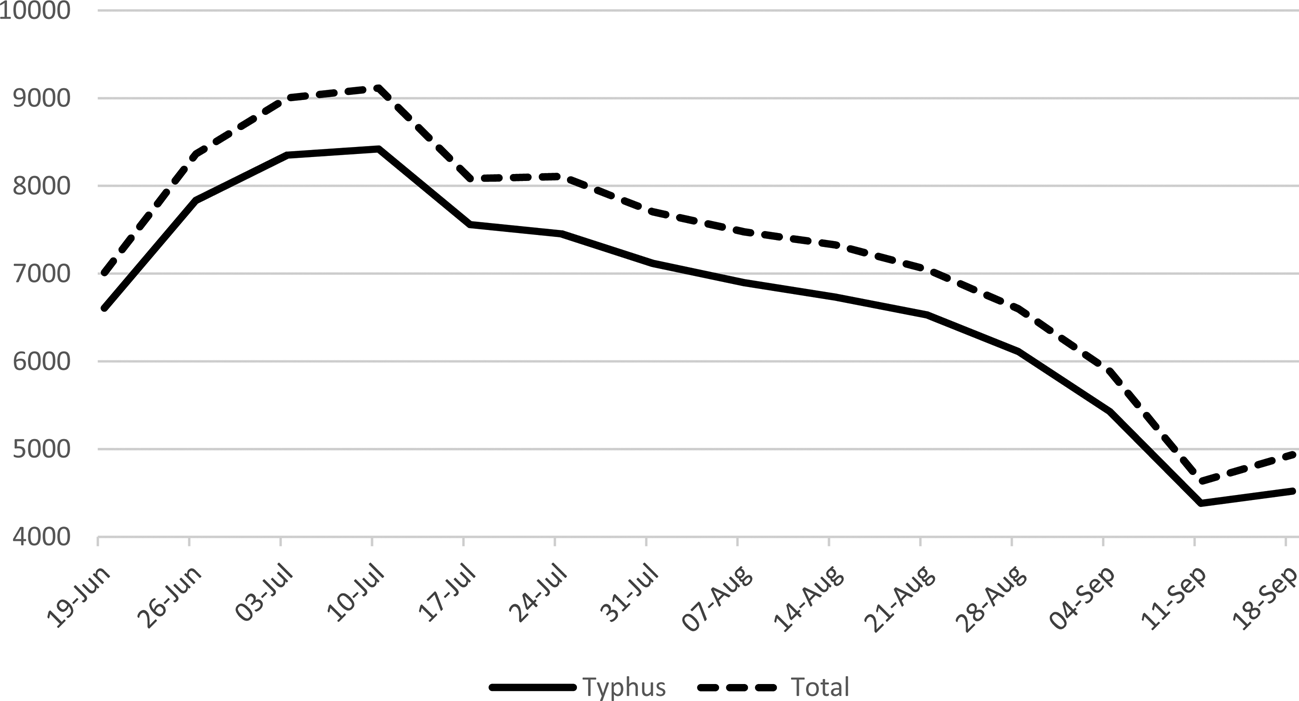
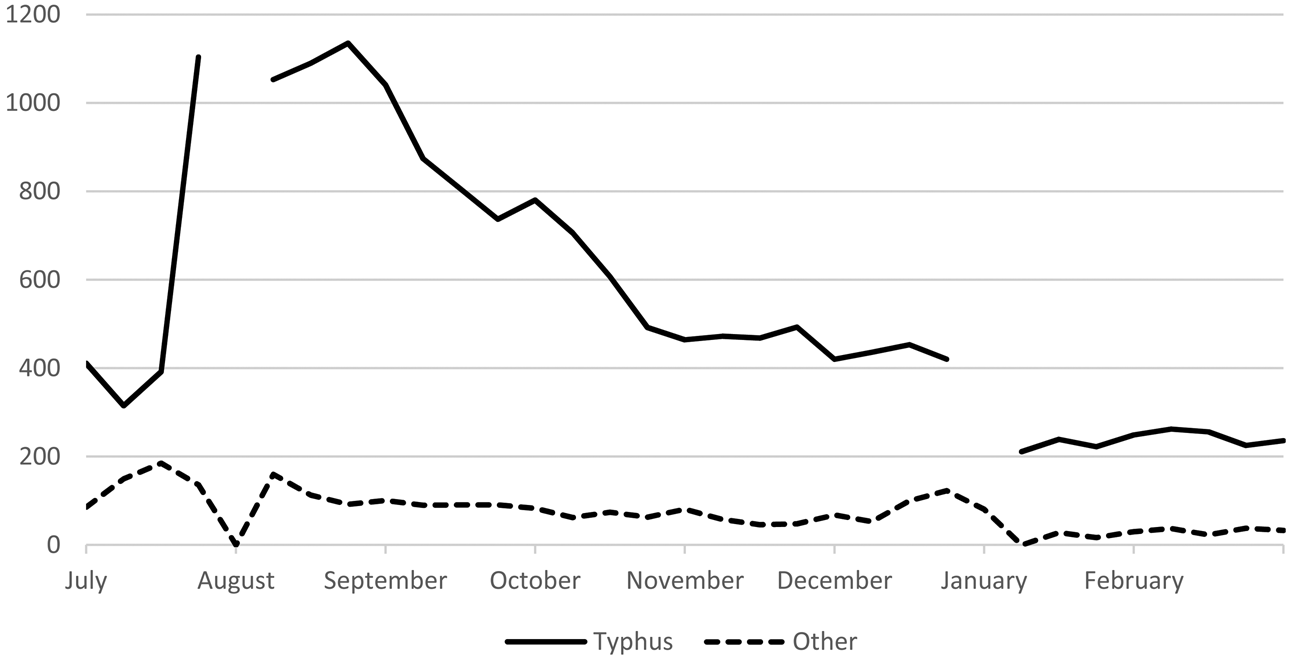
With few exceptions, poor law officials dutifully provided the returns, and the evidence presents a much closer representation of the real scale of the crisis than do mortality figures.Footnote 42 The data shows that, at the aggregate level, between 19 June and 18 September 1847, the number of people treated for fever each week in the forty poor law unions of Lancashire and the West Riding peaked at slightly over 9,000, and never fell below 4,000 (figure 1). These are astonishing numbers. In total, some 35,500 fever-stricken individuals received medical care from the poor law in the region during these three months alone, the overwhelming majority of whom were diagnosed with typhus fever. Moreover, while during the highest period (week ending 10 July) the number of cases was more than double that of the lowest (week ending 11 September), by no means was the epidemic over by the latter date. Separate data from Manchester, published weekly in the town's local newspapers, shows that the number of typhus cases remained considerably above normal levels until March 1848 (figure 2).
Cases of typhus and ‘other’ fevers treated by the poor law in Lancashire and the West Riding, June–Sept. 1847
Source: Alfred Austin, correspondence and papers related to the West Midlands District (including unions in Manchester, Rugby and Sheffield), 1847–9 (T.N.A., MH 32/7). ‘Typhus’ and ‘other’ fever cases have been combined for the ‘total’ figure.

Cases of typhus and ‘other’ fever treated weekly in Manchester, July 1847–Mar. 1848
Source: The data for this graph has been taken from the weekly reports of the Manchester board of guardians’ meetings, published in the Manchester Courier.

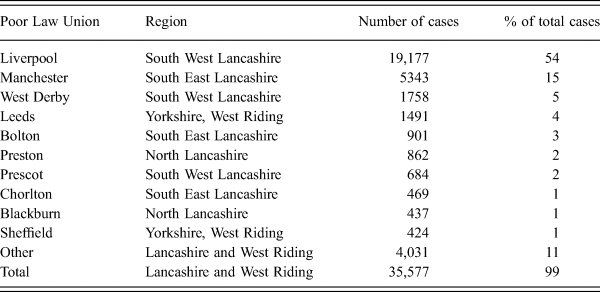
Within these aggregated figures there was marked geographical variation. Table 2 features the ten unions which treated the largest number of fever cases during the three months covered in Austin's returns. It shows that Liverpool, the ‘hospital and cemetery of Ireland’ as the registrar general described the town in 1847, accounted for 54 per cent of the fever cases, and Manchester 15 per cent.Footnote 43 More broadly, unions around Manchester in south-east Lancashire, and around Liverpool in the south west, predominate. Considerable numbers, however, were treated across the region in settlements both large and small, and it might come as some surprise, given the dominant place of Liverpool in the historiography of ‘Irish fever’, that the town only accounted for half of the regional total. What we are seeing here is the arrival and dispersal of the Famine Irish throughout the northern manufacturing districts. We would expect to see large numbers of fever patients treated in Liverpool, Manchester and other major northern towns. That these places drew huge numbers of Irish immigrants in 1847 is well documented. More unexpected is the impact in places like Prescot, a relatively small market town of around 5,500 inhabitants in 1841. Situated some ten miles east of Liverpool, Prescot had long attracted Irish agricultural labourers seeking employment in the expansive rural hinterland which surrounded the township. In 1847, a report by the board of guardians stated that many such people arrived carrying disease.Footnote 44
Regional distribution of the fever cases treated in Lancashire and the West Riding

Source: Alfred Austin, correspondence and papers related to the West Midlands District (including unions in Manchester, Rugby and Sheffield), 1849–9 (T.N.A., MH 32/7).
Yet, of probably greater significance on the spread of fever in the town was that Prescot was used as a staging post by Irish immigrants tramping from Liverpool towards industrial south-east Lancashire and beyond. The Prescot union vagrant ward provided shelter to some 9,800 individuals in 1847, the majority of whom were Irish. Thus, a population around double the size of Prescot's in 1841 passed through the town in 1847. The guardians calculated that a sum of £363 was spent on medical care for non-settled fever-stricken paupers in 1847, and that the Irish accounted for £232 (64 per cent) of this total. Moreover, among the Irish patients it was those who had been in Prescot ‘but a short time’, and who were, presumably, mainly Famine Irish, that proved the greater financial burden, accounting for around 80 per cent of the expenditure.Footnote 45
The movement of Famine Irish across the northern manufacturing districts, and subsequent outbreaks of epidemic disease in the region, represents a microcosm of a much broader pattern in 1847. All major ports down the west coast, from Glasgow to Bristol, attracted unprecedented numbers of Irish immigrants, and these arrivals moved far and wide. In Glasgow, very much the Liverpool of Scotland in terms of Irish immigration, around 11,500 fever patients were admitted to the various hospitals in the city in 1847; at the Glasgow Royal Infirmary, admissions in 1847 were 270 per cent higher than in 1846.Footnote 46 At the port of Newport in south Wales, a medical officer at the temporary fever hospital reported having treated something in the region of 6,000 fever-stricken Irish between May and November 1847.Footnote 47 In London, admissions to the London Fever Hospital increased threefold during the summer of 1847. One physician in the city noted that many fever patients in his hospital had ‘just arrived from Ireland’, and he posited that the epidemic originated ‘among the very lowest orders, [and] emanated from the districts – courts and alleys – densely populated with Irish’.Footnote 48 Over in the north-east, the Newcastle board of guardians reported serious outbreaks of fever in the summer of 1847 ‘inconsequence of the influx of Irish’.Footnote 49
Landlocked towns and cities, away from the major ports of entry, did not escape. In Birmingham, for example, 380 workhouse inmates died between January and September 1847 compared to 232 in the whole of 1846, and this increase was largely the result of the 108 deaths attributed to ‘Irish fever’.Footnote 50 The movement of Irish across Britain, as they tramped for work or to find kin, was even felt in parts of the south where ‘Irish fever’ was largely avoided. A report on vagrancy in several rural southern counties during the first six months of 1847 showed that the number of Irish ‘vagrants’ relieved in workhouses was 11,548, some 476 per cent higher than during the last six months of 1846.Footnote 51 Here, the incidence of typhus fever, while numerically relatively small, increased in the same period from 33 cases in 1846 to 231 in 1847. With no mere hyperbole did W. D. Boase, in a report on vagrancy for the Poor Law Commission in 1848, postulate that ‘The most mischievous disease is a low kind of typhus fever, which particularly attaches itself to the Irish, and was in almost every workhouse last year’.Footnote 52
III
While the ‘Irish fever’ epidemic of 1847 was, in a very real sense, a national crisis with a transnational nature, the responsibility for dealing with the situation fell squarely upon a mosaic of local authorities. The costs of relief became a growing charge on the local rates. In north-west England and in Glasgow, poor law guardians petitioned parliament during the first half of 1847 asking for financial assistance with their relief efforts and for restrictions to be placed on the number of Irish coming over to Britain, but to no avail. At the beginning of the year several boards of guardians in Lancashire and Yorkshire signed a petition which proclaimed that it ‘is neither just nor legal that we should, in addition to our present heavy burdens, be called upon to support in whole or in part the poor who belong to [Ireland]’, but the government refused to interfere.Footnote 53 The Liverpool authorities, who had more reason than any to request assistance from Westminster, were granted some retired war ships to act as temporary lazarettos, but this was the sum of the government's charity.Footnote 54 While assistant poor law commissioners, as the MH 12 and MH 32 volumes show, regularly visited unions in their districts in 1847 to check on how boards of guardians were managing, and maintained frequent written communication throughout the course of the epidemic, local authorities were left, for the most part, alone to deal with the crisis.
Local office-holders had an unequivocal obligation to provide medical care to all people in urgent need (including those who were sick) regardless of their settlement status.Footnote 55 As such, the recently arrived Irish, who did not possess a legal settlement in Britain, had a right to receive medical care if they applied to the poor law when struck down by ‘Irish fever’ or another serious ailment. Moreover, they could not legally be removed back to Ireland while they were sick. The difficulties all this placed on boards of guardians in 1847 has already been indicated by the sheer number of people treated with this disease in the north of England. Indeed, Christine Kinealy is certainly correct in describing Irish immigrants in Britain in 1847 as ‘unwelcome guests’.Footnote 56 But these guests could not be ignored. In normal times, people with fever would have been treated under the poor law in one of two ways; either in an institution (a workhouse or fever hospital) or in their own homes.Footnote 57 Much depended on the facilities available in the localities.Footnote 58 In some larger towns and cities, dedicated fever hospitals, owned or subscribed to by poor law authorities, provided medical treatment in a relatively specialised environment. More often, however, the only institutional medical care available to the poor was in the workhouse, and many had no separate wards for fever patients at all. Home treatment was common, despite the obvious dangers in cases of contagious disease. But whatever the situation, normal practices were soon disrupted in many poor law unions during the first half of 1847 when epidemic fever emerged following the arrival of masses of Irish refugees. Fever hospitals and workhouse fever wards, where they existed, quickly became grossly overcrowded. Moreover, it became far too dangerous to treat large numbers of people with fever in the overpopulated slums where ‘Irish fever’ took root. Many Irish sufferers, of course, were new arrivals and had no homes to speak of.
While a consensus had yet to emerge by the end of the 1840s on the cause(s) of epidemic disease, many agreed that isolating victims was the best course to take once an epidemic had broken out.Footnote 59 The ‘Irish fever’ epidemic of 1847 in Britain demonstrates that this view was generally held by local medical officers. Almost everywhere we look during the first half of 1847, outbreaks of epidemic fever were met with calls to open temporary fever hospitals as an emergency measure. Indeed, what is striking about the medical response to typhus fever in 1847 is its standardisation in a system otherwise prone to considerable local variation.Footnote 60 Some guardians were slower to react than others for reasons peculiar to each locality, the tendency of fever hospitals to isolate victims was common, even in smaller unions well away from the major urban centres. It is worth noting that this trend also occurred in Ireland in response to fever. During the Famine over 200 temporary fever hospitals were opened, although many were too small and the sheer weight of pressure on the rates meant guardians struggled to provide adequate accommodation. Many fever victims had to enter workhouses as a result, and these institutions became, as Cormac Ó Gráda has shown, dens of deadly contagious disease.Footnote 61 Many refused to enter these institutions altogether, so deadly was their reputation.
The opening of fever facilities in Britain typically involved either renting a vacant building in the local area and converting it into a makeshift fever hospital, or erecting a temporary structure, usually out of wood, and selling the materials once the epidemic had passed. This practice was not entirely novel in 1847, but it was certainly unprecedented in scale. In Liverpool, for example, nine emergency fever hospitals (including five lazarettos), with a collective capacity of 1,400 patients, were opened between December 1846 and July 1847, but no such separate institutions appear to have been opened during the previous typhus epidemic a decade earlier. The same is true of Manchester, where three fever hospitals with capacity for over 1,400 patients were opened between April and July 1847. Across Lancashire as a whole, a total of twenty-three temporary fever hospitals were opened in 1847, and many more were opened in towns and cities across Britain in areas of heavy Irish immigration.Footnote 62
London was the unusual case. Alone of the places affected by ‘Irish fever’ in 1847–8, few, if any, temporary fever hospitals appear to have been opened. There were reasons for this. Its location in the south east meant far fewer famine-stricken Irish arrived in the metropolis than arrived on the west coast. Moreover, the range and size of existing institutional medical facilities in London was much greater than almost anywhere else. In the London Fever Hospital, the capital already possessed a large institution dedicated to the treatment of fever patients. At the end of June 1847, Alexander Tweedie, physician at the London Fever Hospital, stated in a letter to the Evening Mail, which he wrote in response to an ‘extensively circulated’ newspaper report claiming epidemic fever was prevalent in the city, that the Fever Hospital was coping adequately with the increased numbers of fever patients. Denying that typhus was in fact epidemic in the capital, Tweedie wrote that ‘London … affords at this time a striking contrast to many of the large provincial towns, in which typhus fever, from causes which it is unnecessary to advert to at present, prevails to such an alarming extent.’Footnote 63 While mortality figures, as we have seen, indicate that typhus was certainly much more prevalent than normal in London in 1847–8, and evidence of Irish immigration and the emergence of disease in the capital can be found in MH 12 and MH 32, Tweedie's letter does highlight a notable distinction between London and those towns and cities at the front line nearer the west coast.Footnote 64
The reason the practice of opening temporary fever hospitals was so widely adopted, relative to previous typhus epidemics, is not immediately apparent. However, two reasons seem to provide plausible explanations. The first is the sheer numbers involved. Typhus fever took the lives of some 50,000 people in England and Wales in 1847–8, compared to 28,000 during the previous epidemic a decade earlier, and the aggregate number of typhus cases ran into several hundred thousand as we have seen. Such numbers simply overwhelmed existing accommodation. But more than this, and secondly, the prevalence of fever among recently arrived Irish immigrants, so many of whom had no homes of their own and were crowding into the most inhospitable slums, meant treating them in their locales posed the very serious danger of perpetuating the spread of disease. There is an inextricable link between Irish immigration and fever hospital construction in 1847, and this is clear when we look at the ethnic composition of fever patients.
While there was no organised central attempt, either by the poor law commissioners or government, to collect information on the ethnic origin of fever patients during the epidemic, evidence where it survives is revealing, despite its patchiness. In Liverpool, Dr Duncan estimated that over 8 in every 10 typhus victims were Irish, and in Manchester a medical officer observed that during the height of the epidemic in the summer of 1847 it was ‘rare to find an English person as a patient’ inside the walls of the town's fever hospitals.Footnote 65 Figures from elsewhere point to the same conclusion. Thus, in Ashton-under-Lyne, near Manchester, 42 of the first 48 cases taken into the temporary fever hospital when it opened in July 1847 were Irish, and over the Pennines in York during the same month the Irish represented 51 of the first 52 fever hospital patients.Footnote 66 It is clear that these institutions were opened in response to the desperate situation caused by Irish immigration.Footnote 67 Figures covering a somewhat longer period, June to September 1847, exist for Rochdale in south-east Lancashire and Huddersfield in the West Riding. The former shows that 108 of 122 admissions during this three-month period were Irish, the latter 117 out of 153.Footnote 68 In Birmingham, 79 out of 90 fever patients admitted to the workhouse medical ward in April 1847 were Irish, and in the London Fever Hospital the Irish accounted for some two-thirds of admissions around the same time.Footnote 69 More evidence could be presented, but it would only repeat this pattern. While it does appear that the proportion of English patients began to rise towards the end of 1847, indicating that the disease was beginning to spread beyond the largely Irish areas in which it emerged, all the evidence we possess reveals a considerable preponderance, usually in the order of 80 per cent or more, of Irish patients in British fever hospitals during the worst phase of the epidemic in the summer of 1847.
A rather more difficult issue is whether the interests of local authorities were directed as much to cure as to prevention. In other words, did the temporary fever hospitals simply act as receptacles in which fever cases could be isolated, with little concern for what happened to them thereafter? As is often the case with historical records, they do not tell us everything we would like to know. Motivations were complex, difficult to untangle, and often unspoken. Poor law guardians lived in a different world to the poor patients admitted to the fever hospitals. Their concerns were necessarily practical. The fever hospitals they opened were often, and unavoidably, extremely rudimentary. Empty mills and warehouses provided the better accommodation, but such buildings were not always available and guardians had to take whatever they could get. At Ashton-under-Lyne, for example, the guardians after much searching reluctantly settled on renting a row of abandoned cottages because they were the only suitable premises available to them, and this was not uncommon.Footnote 70 The temporary wooden constructions guardians often resorted to, usually when no suitable existing accommodation could be obtained, resembled barns or large sheds. Indeed, the term ‘fever shed’ was often used to describe these structures.
Yet, for all this, the care in fever hospitals ensured that the vast majority of patients survived. Beds and other necessary equipment were purchased, and staffs of masters, matrons, doctors and nurses were employed on temporary contracts. Patients were attended to around the clock. The case fatality rate of typhus patients in Lancashire and Yorkshire, according to the statistical information derived from Austin's returns discussed earlier, was 7 per cent; only in Liverpool, an exceptional case, did the figure reach 10 per cent.Footnote 71 These figures should be read against a case fatality rate of up to 40 per cent for untreated epidemic typhus.Footnote 72 While we must exercise caution because some cases of typhus were likely misdiagnosed, it does nonetheless indicate that many lives were saved by the medical attention provided by the poor law. Detailed evidence from Huddersfield shows that patients were often spending many weeks in the fever hospital. Around 20 per cent of the patients were treated in the hospital for a period of one month or more.Footnote 73 They were not being hastily discharged, expensive burden though they were on local rates. Moreover, it would be remiss not to note the efforts of the medical attendants in the fever hospitals, astonishing numbers of whom caught typhus fever and lost their lives in the course of their onerous duties. Like the Catholic clergymen who attended to dying fever patients in the workhouses and fever hospitals, the lives of poor law officials were in serious danger in 1847; those working in fever hospitals particularly so due to their frequent contact with contagious disease in an enclosed environment. Reports of poor law officials dying of typhus fever in 1847 abound in local newspapers and guardians’ minute books. In Lancashire, the deaths of over fifty poor law officials had been reported by the end of the year, and in Birmingham alone over twenty such cases were reported.Footnote 74 These figures almost certainly under-record the number of actual deaths, as the deaths of lowly fever hospital nurses rarely received press attention. There cannot have been many occupations in Britain more hazardous in 1847 than that of a medical attendant in an urban fever hospital.
The fever hospitals, beneficial though they were to the poor, did have a serious drawback: patients invariably went back to their miserable locales, the source of pestilence, when they were discharged. Thus, while these institutions probably helped prevent the spread of disease by isolating the afflicted, the problem of overcrowding, which assisted the transmission of disease, endured. One way in which poor law authorities tackled this problem was through the legal channel of removing Irish paupers back home.Footnote 75 The rigour with which removal legislation was invoked in 1847 varied spatially, but it was increasingly used by poor law unions around the British west coast, particularly after the legal process was simplified in June following a campaign by the Liverpool select vestry.Footnote 76 Although paupers could not be removed while they were sick, they could be when convalescing if a medical officer deemed them fit enough for the journey. Neal has described removal policies against the Irish in 1847 as ‘harsh’ and ‘penny pinching’, and the former is undoubtedly true at the individual level.Footnote 77 Yet, it is important to view removal policies at this time not simply as a means of saving the rates by sending paupers away or deterring them from applying for poor relief, but also as a vital element in the battle against epidemic disease. The Liverpool poor law authorities removed an unprecedented number of Irish paupers, 15,000, in 1847, many of whom had only been in Britain for a few days or weeks.Footnote 78 This was a near threefold increase on 1846. The Manchester Courier newspaper was quick to celebrate the benefits of this process when it began apace at the end of June:
We are happy to say that the Irish paupers are being re-convened from this port to their own country at the average rate of about 100 per day, and that [Liverpool] is, inconsequence, very much less unhealthy than it has been for months past. The Select Vestry are at present engaged in diminishing the number of inmates in the workhouse, the fever hospitals, the fever sheds, and the lazarettos, by drafting them back to Ireland, and this process will be continued until some of the receptacles for disease are emptied and closed.Footnote 79
Many other unions followed this example. Several poor law unions in Lancashire resolved in the summer of 1847 to remove all non-settled Irish paupers who were in a healthy enough condition, as did the authorities in Glasgow who removed some 8,000 Irish in 1847 against 3,000 in 1846.Footnote 80 Evidence from south Wales indicates that removal was also stringently applied. In Cardiff, the guardians resolved to remove all non-settled Irish paupers upon their second application for relief, a policy designed to ensure the destitute Irish did not remain long in the area.Footnote 81
A policy of near-indiscriminate removal of non-settled Irish paupers, which was certainly operating in Liverpool and Glasgow in 1847, was not, however, employed universally during the crisis. The cost of removal increased by distance, so Irish removals were much less common in areas without convenient and cheap access to ports on the British west coast from where they were repatriated. Other policies were, however, adopted at local level in 1847 specifically to deter the Irish from entering and settling in a particular area. Indeed, evidence indicates that the stringent removal policies employed in Liverpool and Glasgow actually encouraged many Famine Irish to move inland. In June 1847, just as Liverpool began removing non-settled Irish paupers en masse, Assistant Poor Law Commissioner Alfred Austin wrote to unions in his district warning them to expect a rise in Irish vagrancy, the assumption being that the Irish, rather than face removal, would try their luck elsewhere.Footnote 82 The measures applied locally to combat Irish vagrancy were legion, and varied from place to place as is true of all aspects of local administration at this time, but it is possible to provide a general impression. It is apparent that restrictions were often placed on the number of nights tramps could spend in vagrant wards each month (usually only two), and outdoor relief was rarely provided except in urgent cases and only for a short period of time.
The situation in Stockport, Cheshire, where relief policy was devised so as not to ‘hold out any inducement for … [Irish] families to come into this already overburdened district’, was quite typical; generous relief would only serve to attract more Irish vagrants.Footnote 83 Evidence indicates that many Irish, understandably, shunned the poor law for fear of being removed and instead turned to begging, but local authorities took a hard line. Vagrants were often arrested for soliciting alms on the street, and might even be given hard labour or, more usually it seems, told by the sitting magistrates to move on. Countless more were simply ushered out of town by the police. The following newspaper report on the small west-midlands town of Burslem in May 1847 is illustrative:
IRISH FEVER – At the police court … Mr D. Ball, of Burslem, surgeon, called the attention of the magistrates to the fact of a great number of Irish immigrants now endeavouring to settle in the town and vicinity of Burslem, and noticed the danger of their introducing fever and other contagious diseases amongst the inhabitants. Mr. Ball considered it necessary that some steps should be taken to supress, at least, begging, which would be one means of deterring them from staying in the neighbourhood. The bench instructed the police-officers and constables of the district to use every exertion to supress vagrancy, and to pass the Irish through and out of the unions.Footnote 84
Conversations such as this, which must have been influenced in part by reports in national and provincial newspapers on the situation in the north-west and elsewhere, took place among local authorities in many parts of the country in 1847. Fear of the Irish vagrant, or perhaps more accurately fear of disease, fuelled local policy decisions in response to Irish immigration in Britain during the Great Famine.
IV
The ‘Irish fever’ epidemic of 1847 had social and political implications which went beyond the immediately tragic consequences for the Famine Irish themselves. That there were enduring legacies is hardly surprising. The sudden and largely unexpected arrival of unprecedented numbers of destitute Irish refugees into Britain in 1847, many of whom were thought to be carrying deadly pestilence, shaped perceptions of the Irish, adding to an air of more general negativity which had been shaping since the 1830s as immigrant numbers grew. Scholars have noted workplace competition and fighting over alleged undercutting of wages. Religious differences also elided with these social and demographic crises. When, in 1850, the pope re-established the Roman Catholic hierarchy in part to provide ministry to this greatly-enlarged Irish Catholic community, the hard-line Protestant response was to dub this the ‘papal aggression’. Set within the ‘year of revolutions’, which frightened ruling elites, and the threat from Chartist agitation, the Irish rising of 1848 also strengthened animus to the ungrateful Irish. The 1847 fever epidemic contributed a precise local and national element to strained British-Irish inter-communal relations in Britain.Footnote 85 Workers had further reasons to focus their own anxieties over the slim pickings of the 1840s on this competitive and increasing type of labour competition, the Irish.Footnote 86 While the Irish by no means lived exclusively in their own ghettos, the combination of all these factors certainly pressurised the Irish population in urban Britain. In Lancashire, it led to a descent into sectarian politics, with ‘Orange’ and ‘Green’, Tory and Liberal divisions accentuated.Footnote 87
The Great Famine brought Ireland's socio-economic problems into sharp focus; indeed, it exported some of them to Britain. Contemporaries at the national and local levels on the larger island demanded the passage of reform through parliament, in part to deter mass immigration. The cry that ‘Irish property must support Irish poverty’ was frequently heard.Footnote 88 Those who wished Ireland to be self-sufficient urged the government to reform the Irish poor law, as it was believed that the harsh workhouse-based system in Ireland was encouraging people to flee to Britain to take advantage of its more liberal welfare system. Tied to this were demands for Irish landlords to support their tenants, rather than callously evicting them from their homes and leaving them with little choice but to enter the workhouse or to emigrate. The petition from several Lancashire poor law unions in early 1847, noted earlier, which declared it to be ‘neither just nor legal’ that they should support Ireland's poor, is indicative of these expressions. ‘Irish fever’ is central to all this. Consider, for example, a May 1847 editorial in the Morning Advertiser, which lamented that the ‘Irish malignant fever has demonstrated its presence within a short distance of the Royal Palace’, and used this circumstance to blame ‘Irish landlordism’ for evicting tenants who then imported fever to Britain.Footnote 89 Or, in similar vein, the Evening Mail, which justified the need for a reformed Irish poor law by arguing, with more than a little sensationalism, that England was suffering ‘no less than Ireland’ as a result of the Famine; ‘English towns’, it stated, ‘groan beneath the burden of Irish immigration, and tremble at the presence of Irish contagion’.Footnote 90
What remains to be explained is the extent to which ‘Irish fever’ influenced short- and long-term perceptions of the Irish in Britain, and, by extension, affected the lived experiences of Irish immigrants themselves. Our conclusions can be only partial. While we know much about middle-class opinion in this period, the British and Irish poor are together a conspicuously silent majority. It would be fascinating to understand what working-class British men and women, particularly those who lived in or near to poor Irish-dominated areas in British towns and cities, thought about Irish immigration and its associated problems during ‘Black ’47’ and beyond, but we simply do not know. One can only imagine that it augmented ethnic tensions between native Britons and Irish immigrants to at least some degree. Evidence sometimes points in this direction. The opening of the temporary fever hospitals in Britain in 1847, for example, often met very fierce opposition from local residents, and many petitions were sent to parliament or the Poor Law Commission in attempts to block their establishment.Footnote 91 The psychological effects of ‘Irish fever’ are apparent here, with locals expressing grave concerns about the spread of pestilence in their streets should these institutions be opened nearby. We might reasonably suppose, given that the Famine Irish were associated with the epidemic outbreaks which necessitated these hospitals, that anti-Irish sentiment lay at least partly behind these local protests. We suggest that such sentiment was heightened when it became clear that most of the fever hospital patients were Irish. Yet, the evidence provides no clear answers. In the town of Bury, Lancashire, in July 1847, an anonymous notice was posted on a wall outside the board of guardians’ offices warning the public against being ‘robbed by those lazy Irish vagabonds, who leave their country uncultured, and come to live upon your rates’.Footnote 92 Still, we are left wondering whether such a statement was indicative of a general view among natives in the town.
The views of local officials, such as poor law guardians and councillors, whose meetings were often reported verbatim in provincial newspapers, are better known, even though ambiguities remain. Many expressed sympathy for the Irish and encouraged humane treatment, and it is important to note that criticism of mass Irish immigration in 1847 was rarely directed towards the Famine Irish themselves. Rather, the failure of parliament to adequately reform the Irish poor law, its refusal to limit the number of Irish immigrants coming over, and the callousness of Irish landlords were the main targets of ire. Calls for humanity were not always heard. Removal strategies adopted by poor law guardians on the west coast, and the wider responses of local authorities to Irish immigration and vagrancy in 1847, shows that harsh measures were employed even though cruelty was not always intentional. Poor law guardians, who had no financial assistance from the government despite requests for such, had only limited options available to them, and the very serious threat posed by epidemic disease meant their policies were geared more towards protecting the resident population than the destitute arrivals from across the Irish Sea. In Manchester, a deputation of local dignitaries attended a meeting of the board of guardians in May 1847 to draw attention to the hardships faced by many Irish who, it was stated, were not applying for poor relief because they feared being removed back to Ireland. ‘There are in this town’, stated one member of the deputation, James Heywood, soon to be the M.P. for North Lancashire, ‘a number of Irish, who are afraid, if they apply for relief, of being moved to Ireland, where there is an absolute famine, and yet many of these poor creatures are starving and dying of fever’.Footnote 93 Heywood's statement met generally sympathetic ears, but the guardians protested that there was little they could do as their resources were so stretched. While they agreed to look into the matter, the number of Irish removals in Manchester actually increased during the months that followed.
Regardless of the motivations of public officials or of wider public sentiments, there can be little doubt that the short-term consequences of Irish immigration and attendant disease was considerable hardship and privation for the Irish in Britain themselves.Footnote 94 The absence of anything more than very short-term support from the poor law, and strict local responses to vagrancy, meant the Famine Irish, who often arrived in Britain with little or nothing to support themselves, must have found it very difficult to manage. Indeed, as the manufacturing districts of England, Scotland and Wales were enduring a period of intense economic distress, employment would have been particularly hard to obtain. Moreover, even the Irish-born who had been resident in Britain for years could be affected by policies adopted in response to Famine-related immigration. Many Irish removals in the late 1840s appear to have been extremely harsh, and some were certainly illegal.Footnote 95 People living in Britain for several years, sometimes decades, were unceremoniously shipped back to a country gripped by famine and pestilence because they received poor relief or medical care without having obtained settlement status. While the Great Famine acted as a trigger for wider discussions on the equity of removal legislation in the 1850s and 1860s, including pressure to abolish settlement and removal altogether, the legacy of the events of the late 1840s also acted as a buffer against significant change.Footnote 96 Concerns over what might happen if famine struck again in Ireland, and more general fears that Britain would be swamped by Irish immigrants should the power to remove non-settled paupers be taken away, stifled attempts at meaningful reform. It was not until the 1860s that the settlement laws were modified, and the power to remove paupers was not abolished until the twentieth century.
In other ways, too, the events of the late 1840s appear to have left a legacy of prejudice and exclusion against the Irish in Britain. Memories of the ‘Irish fever’ epidemic did not fade quickly. The episode featured frequently in public health debates at local level in the 1850s, following the introduction of the Public Health Act in 1848.Footnote 97 With this, the Irish association with disease endured. Moreover, ‘condition of England’ surveys in the 1850s, following a tradition which had its roots in the 1830s, presented highly jaundiced descriptions of the Irish as uncivilised, insanitary and disease-ridden. A description of Oldham, Lancashire, published in the Morning Chronicle newspaper at the end of 1849 as one of a series of social surveys covering England and Wales, suggested:
The poor law authorities of Oldham are making attempts to improve the sanitary state of the worst districts of the town but the Irish puzzle them. ‘No sooner’, I was informed, ‘do we try to make the houses a little decent and wholesome, than the people leave them for other localities’ … Fever—the ‘Irish Fever’—one of the most malignant species of spotted typhus, frequently breaks out.Footnote 98
The notion that the Irish actually preferred to live in a state of filth, thus creating the conditions for pestilence to thrive, was a common trope in such writings. As Lord Shaftsbury, the noted philanthropist and social reformer, stated, ‘was it not found that where the Irish appeared, wages lowered, respectability disappeared, and slovenliness and filth prevailed?’Footnote 99 Although the extent to which this stigma affected the day-to-day lives of the Irish in Britain is not clear, there is little doubt that it contributed towards the isolation and exclusion which historians of Britain's Irish-born population have identified during the 1850s and 1860s.Footnote 100
It is no coincidence that advertising against Irish labour extended greatly in the later 1840s, reaching a peak in the 1850s. The use of the discriminatory term ‘No Irish Need Apply’ (N.I.N.A.) in job advertising was merely the tip of the iceberg. While it applied to farm servants and others, too, it was principally applied in the domestic service sector, both in private homes and in public places, such as hotels and pubs. Consequently, women more than men were excluded. Its manifestations were most marked in London, Liverpool and Manchester, which accounted for 95 per cent of all discovered incidents.Footnote 101 While N.I.N.A. advertising was principally a coded form of anti-Catholicism, it is highly likely that at least some of this activity reflected a fear of contagion. It is surely telling that such advertising in British newspapers occurred most exclusively in London and Lancashire, the two areas with the largest Irish-born populations in the country, and reached its peak in the wake of the Great Famine.Footnote 102
V
As is now well known, Irish immigrants to Britain during the late 1840s stoked fears about the moral and physical decline of the native population in already overcrowded and unhealthy cities. Working people feared their competition, while educational moralists feared a degenerative effect on established British culture; communal disorder and violence seemed to increase in their wake. Ministering to the overwhelmingly Catholic religious needs of these immigrants was an important reason for the pope's restoration of the hierarchy (the ‘papal aggression’), which served to unite elite and plebeian Protestants against the age-old foe of ‘popery’. While the historiography of the Irish in Britain now emphasises that integration and valiant community-making defined the experiences of the new arrivals, against the once-dominant narrative of an outcast Irish Catholic immigrant population, there is nevertheless universal agreement that the 1840s and 1850s were especially fraught for Irish immigrants. This study has sought to demonstrate the importance of Famine-related disease, heretofore generally only mentioned in passing and never until now systematically explored in its Irish dimensions, in fermenting such tensions. For it was not only mass Irish immigration but the deadly epidemic fever which was said to accompanying it across the Irish Sea that shaped responses to the Famine Irish. Two points are crucial here. First, the term ‘Irish fever’ was no misnomer. The evidence presented in this study indicates clearly that the Irish were overwhelmingly predominant among fever patients, at least during the summer months of 1847 when the epidemic was at its worst. Second, despite marked local and regional variation in the scale and intensity of the epidemic, ‘Irish fever’ spread far beyond the western coastal regions which have received the bulk of historiographical attention. Mortality figures for 1847, which reveal considerably elevated typhus deaths in almost every region, provide some indication of this spread, but they seriously underestimate the true scale of the crisis because most people who contracted typhus did not die. If we assume a mortality rate of 10 per cent for those diagnosed with typhus, the c.15,000 excess typhus deaths in England and Wales in 1847 equates to 150,000 additional cases. To add to its starkness, this figure does not include Scotland.
The authorities in many parts of northern and midlands England, central Scotland and south Wales were quickly overwhelmed by disease-ridden Irish immigrants in 1847, and others feared being so. Irish immigration and ‘Irish fever’ received a great deal of press attention. At local level, policies were introduced to remove the non-settled Irish either through repatriation or by forcing them out of town. We are, of course, used to stories of the callousness of British administrations, both national and local, to the problems of Irish migration in the late 1840s. The mass removals back to Ireland – a country which, we must remember, was in the grip of Famine – by poor law authorities on the west coast, particularly in Liverpool and Glasgow, is the most conspicuous example of harsh policies. Yet, under the circumstances, with the powers available to them, it is difficult to see how they could have responded differently. It is unfortunate that 1847 was a year of economic depression, which meant high unemployment and much greater pauperism among natives; ratepayers, who elected guardians each year, would not have accepted excessive expenditure. We must also acknowledge that the medical response to epidemic typhus, primitive though it must have been in the temporary fever hospitals, undoubtedly saved many lives. Nonetheless, for the hundreds of thousands of Irish men, women and children who crossed the Irish Sea in the late 1840s to escape the devastating effects of crop failure at home, life in Britain must have felt like changing misery and suffering in one place for the same in another. In the short term, the policies of local authorities, either to those sent back to Ireland or those who chose to avoid to poor law for fear of being so, must have brought great hardship and distress. In the longer term, the association of the Irish with this deadly disease led to their further marginalisation. For the poorest immigrants – who were at this time the largest part of the Irish community in Britain – it contributed to the economic, social, religious, workplace and national hostility that made the Famine generation more pronouncedly and consistently outcast than any other wave of Irish arrivals on those shores.