Introduction
To acquire limited resources, such as food, territory and mates, individuals always engage in aggression, which has been well studied in many animals (Ewald and Carpenter, Reference Ewald and Carpenter1978; Austad, Reference Austad1983; Chapman and Kramer, Reference Chapman and Kramer1996; Hardy and Briffa, Reference Hardy and Briffa2013). Fighting typically has lifetime consequences (Kemp, Reference Kemp2006), and a general model predicted that the propensity for fighting tends to increase with age (Parker, Reference Parker1974; Kemp Reference Kemp2006). Younger males have higher residual reproductive value than older males and lose more from injuries than older males do. Several empirical reports have yielded findings consistent with this prediction (Haley, Reference Haley1994; Komers et al., Reference Komers, Pelabon and Stenstrom1997; Kemp, Reference Kemp2002; Baxter and Dukas, Reference Baxter and Dukas2017). However, in those empirical reports, individuals could not readily inflict injuries on their opponents, and thus the costs of fighting were not clear. Furthermore, because the injury is energetically costly and potentially damaging (Maynard-Smith, Reference Maynard Smith1982; Mesterton-Gibbons et al., Reference Mesterton-Gibbons, Dai, Goubault and Hardy2017), in nature most individuals may give up before being injured. However, in arthropods, studies found that a few species, mainly belonging to the groups Insecta and Arachnoidea (Hamilton, Reference Hamilton, Blum and Blum1979; Thornhill and Alcock, Reference Thornhill and Alcock1983; Huntingford and Turner, Reference Huntingford and Turner1987; Enquist and Leimar, Reference Enquist and Leimar1990; Reece et al., Reference Reece, Innocent and West2007), engage in dangerous fighting, with a significant proportion of the fights ending with one or both of the contestants being severely injured or killed. For example, in the parasitoid wasp Melittobia genus, male mandibles are highly modified weapons, which sever opponent's limbs and decapitate opponents in fights to the death (Dahms, Reference Dahms1984; Abe et al., Reference Abe, Kamimura, Kondo and Shimada2003; Innocent et al., Reference Innocent, Savage, West and Reece2007). Furthermore, nematodes, Steinernema longicaudum, also exhibit dangerous fighting (Zenner et al., Reference Zenner, O'Callaghan and Griffin2014; Kapranas et al., Reference Kapranas, Maher and Griffin2016, Reference Kapranas, Zenner, Mangan and Griffin2020). Predictions from the ‘hawk-dove’ game theory suggest that dangerous fighting is an evolutionarily stable strategy (ESS) only when the value of the resource (V) far exceeds the costs of fighting (C) (Maynard Smith and Parker, Reference Maynard Smith and Parker1976; Enquist and Leimar, Reference Enquist and Leimar1983, Reference Enquist and Leimar1987). Additionally, individuals must simultaneously be equipped with efficient weapons in order for the strategy to be viable (Enquist and Leimar, Reference Enquist and Leimar1990; Guo and Dukas, Reference Guo and Dukas2020).
Anastatus disparis (Hymenoptera: Eupelmidae) is an important Hymenoptera insect that can parasitize several noxious species of Lepidoptera egg, including Lymantria dispar. To acquire mating opportunities, A. disparis frequently engages in extreme fighting behaviour, which usually ends with contestants being severely injured (Liu et al., Reference Liu, Wei, Tian and Hao2017a; Liu and Hao, Reference Liu and Hao2019). When studying and discussing the characteristics of age-related aggression, empirical reports have usually assumed that individuals may get an injury from fighting, while most species cannot readily inflict injuries on their opponents. To address the above shortcoming, here, A. disparis was used as an experimental model to explore the characteristics of aggression from a life-history perspective, i.e., the effect of male age on aggression. First, the cost of fighting in A. disparis was evaluated. As fighting ends with contestants being severely injured or dead, the costs of fighting are significant, and survival and reproduction are important events for individuals. Thus, to further clarify the cost, we assessed the longevity and mating ability of males injured by fighting.
Second, the effect of age on aggression was tested in A. disparis. We used the fighting frequency and intensity to describe aggression. As many individuals in this species are injured during the fighting, the results are expected to be consistent with the prediction that fighting tends to increase with age (Parker, Reference Parker1974; Kemp, Reference Kemp2006). Alternatively, young individuals may be more willing to fight than older individuals, as resource holding potential (RHP) or sexual attractiveness decline with age (Kemp, Reference Kemp2006). In either case, we expect to see a difference in fighting behaviour between younger and older males.
Third, following the above research attempt, we found that the frequency and intensity of fighting in A. disparis significantly decreased with male age. Then, we attempted to explore potential explanations. Thus, we studied whether the RHP and/or sexual attractiveness declined with age (Kemp, Reference Kemp2006). As proposed by Parker (Reference Parker1974), morphological and physiological traits, such as body size, energy reserves, etc., determining the potential to win these contests are defined as an individual's RHP (Batchelor et al., Reference Batchelor, Santini and Briffa2012). In most parasitoid wasps, morphological traits such body size mainly depends on the host quality (Charnov and Stephens, Reference Charnov and Stephens1988; West et al., Reference West, Flanagan and Godfray1996; Liu et al., Reference Liu, Men, Zhao and Wei2017b) and are unlikely to change with age. Thus, here we mainly studied physiological traits as components of RHP. We utilized RNA-seq, which provided an opportunity to study the physiological changes related to differential gene expression by age, in an attempt to enrich comprehensive knowledge and insights into the life history of aggression in A. disparis.
Materials and methods
Insect cultures
In this study, A. disparis colonies were first established from a population reared on L. dispar egg masses collected in the wild and subsequently maintained on Antheraea pernyi eggs. Approximately 20 hosts were offered to a female for oviposition for 24 h at 26–28°C. Then, we isolated the hosts individually in polyethylene tubes (height: 7.5 cm; diameter: 1 cm), the openings of which were covered with cotton balls to prevent any mating and fighting behaviour before the start of the experiment. The parasitized hosts were incubated at a temperature of 28 ± 1°C, a relative humidity (RH) of 70 ± 5% and a photoperiod of 14 L:10 D. After approximately 18 days (Li and Lou, Reference Li and Lou1992; Liu et al., Reference Liu, Wei, Wang, Liu and Dong2015), females and males started to emerge and were collected daily.
Costs of fighting
Extreme fighting behaviour for mating opportunities frequently occurs in A. disparis males, and fighting is typically dangerous, resulting in severe injury or death (Liu et al., Reference Liu, Wei, Tian and Hao2017a; Liu and Hao, Reference Liu and Hao2019). Obviously, the costs of fighting are enormous. To further clarify the costs, we tested the longevity and mating ability of injured males.
First, to conduct the longevity assays, slightly injured males, severely injured males, and healthy males i.e., non-injured males (1-day-old) were selected. New emergence males were collected at 9:00 a.m., and four healthy males were grouped in a cylindrical arena (height: 1 cm, diameter: 5 cm) to acquire injured males. After 1 h, all males were taken out, and their injury state was checked using a microscope. We scored each visible male injury with the microscope on a criterion (e.g., the loss of an antenna scored 0.5 points) adapted from Murray (Murray and Gerrard, Reference Murray and Gerrard1985; Murray, Reference Murray1987). Slight injuries were those where the score of injury in males was less than 7, while scores greater than 7 were considered to indicate a severe injury. At 10:00 a.m., each male was isolated individually in a cylindrical box (height: 5 cm, diameter: 10 cm) and received honey water daily (honey: water = 2:3 vol/vol). Each male was inspected twice daily, at 10 a.m. and 10 p.m., and the date of death of each male was recorded.
Second, the mating abilities of slightly injured males, severely injured males, and healthy males were tested. Typically, the sex ratio (male %) in A. disparis is 10–20% (Li and Lou, Reference Li and Lou1992; Liu et al., Reference Liu, Wei, Wang, Liu and Dong2015, Reference Liu, Men, Zhao and Wei2017b), and the males of A. disparis are polygynous. A male (healthy or injured) was introduced into a cubical rearing box (length: 18 cm; width: 12 cm; height: 6 cm) containing ten 1-day-old virgin females. After 3 h, each female was isolated individually by being introduced into a cylindrical box (height: 5 cm, diameter: 10 cm) with ten host eggs and allowed to oviposit. After 24 h, all host eggs and parasitoids were removed. The eggs were separately placed in polyethylene tubes (height: 7.5 cm; diameter: 1 cm) with the openings covered by a cotton ball and the tubes were maintained at 28 ± 1°C under a RH of 70 ± 5% and a photoperiod of 14 L:10 D. If the maternal adults had not mated, their offspring would be all males (Li and Lou, Reference Li and Lou1992; Liu et al., Reference Liu, Men, Zhao and Wei2017b). Therefore, by distinguishing whether female offspring were present among ten host eggs, we were able to determine whether the maternal adult had mated.
Effect of male age on aggression
Extreme fighting behaviour for mating opportunities frequently occurs in A. disparis males. Most adults eclosed during the peak eclosion period (from 9:00 a.m. to 12:00 p.m.), and male–male chasing and fighting near the emergence site were frequently observed. Therefore, in this study, the fighting intensity of male combat lasting 3 h was assessed. To estimate fighting intensity, we introduced four males of the same age into a cylindrical arena (height: 1 cm, diameter: 5 cm) that contained a 1-day-old virgin female. A total of 15–21 repetitions were conducted to assess the fighting intensity of 1-, 2-, 3-, 4-, and 6-day-old males. Fighting experiments started at 10:00 a.m. and lasted 3 h. After 3 h, all individuals were removed. All the males (dead, injured, and healthy) were isolated individually in polyethylene tubes (height: 7.5 cm; diameter: 1 cm). In each area, the numbers of dead and injured males were recorded using a microscope; we also scored each visible male injury with the microscope based on a criterion adapted from Murray (Murray and Gerrard, Reference Murray and Gerrard1985; Murray, Reference Murray1987). During the 3 h of male combat, individuals rarely died; thus, we considered only the condition of the injury, which could be classified as either severe (score of one male injury >7) or slight (score of one male injury <7). We calculated the mean score of injuries per wasp and the proportions of injured males as fighting intensity in each arena.
In addition to fighting intensity, the frequency of fighting was measured. Two males were introduced into a cylindrical arena (height: 1 cm, diameter: 5 cm) containing a 1-day-old virgin female. We recorded their fighting condition using a video camera for 5 min. Then, we recorded the number of times the males fought during this period. A total of 6–8 repetitions were conducted to assess the fighting frequency in 1-, 2-, 3-, 4-, and 6-day-old males.
Effect of age on male mating behaviour
The mating behaviour of males with different ages from 1-day-old to 5-days-old was assessed. A tested male was introduced into a cylindrical arena (height: 1 cm, diameter: 5 cm) containing one 1-day-old virgin female. We performed 20 replicates per treatment. We recorded the entire mating progress by video. Female A. disparis only mate once in their lifetime, so each test ended with successful mating while lasting no more than 30 min. Then, both females and males were removed. Successful mating behaviour involved a series of steps: male courting, female reception, ovipositor insertion, and post-mating. Based on the video recording, it was determined whether each step occurred and how long it lasted in each test.
To further determine whether individual mating was successful after the above four steps were completed, each female that successfully mated based on their behaviour was introduced into a cylindrical box (height: 5 cm, diameter: 10 cm) with ten host eggs and allowed to oviposit. After 24 h, all host eggs and parasitoids were removed. The eggs were separately placed into polyethylene tubes (height: 7.5 cm; diameter: 1 cm) with the openings covered by a cotton ball, and the tubes were maintained at 28 ± 1°C under a RH of 70 ± 5% and a photoperiod of 14 L:10 D. By distinguishing whether female offspring were present among ten host eggs, we were able to determine whether the maternal adult had mated.
Transcriptomic analyses
To explore the differentially expressed genes (DEGs) in males of different ages (1, 2, 3, 4 and 6-days-old), we conducted transcriptomic analyses. Each treatment included three replicates, and each replicate included 25 adult virgin males. As most adults (approximately 79.71%; personal observation) emerge daily in the morning, especially from 9:00 a.m. to 10:00 a.m., males were collected during this period. At 12:00 p.m., the whole bodies of adults in the same treatment were pooled in a plastic tube (1.5 ml), snap-frozen in liquid nitrogen, and transferred to a −80°C freezer for long-term storage. RNA from each sample group was extracted with TRIzol Reagent (Invitrogen, USA). A total of 3 μg of total RNA from each sample was converted into cDNA using the NEBNext® Ultra™ RNA Library Prep Kit for Illumina® (NEB, USA). cDNA libraries were constructed and subsequently sequenced with the Illumina HiSeq 2000 platform by Beijing Biomarker Technologies Co., Ltd., yielding raw reads. Clean reads were obtained by removing reads containing the adapter sequence, poly-N reads, and low-quality reads from the raw data using the FASTX-Toolkit (http://hannonlab.cshl.edu/fastx_toolkit/). Then, reads were pooled and assembled using Trinity software (v2.5.1) with the default parameters (Grabherr et al., Reference Grabherr, Haas, Yassour, Levin, Thompson, Amit, Adiconis, Fan, Raychowdhury, Zeng, Chen, Mauceli, Hacohen, Gnirke, Rhind, Palma, Birren, Nusbaum, Lindbladtoh, Friedman and Regev2011). For functional annotation, the pooled assembled unigenes were searched using BLASTX (v2.2.31) against public databases of NCBI non-redundant protein sequences (nr), Gene Ontology (GO), Clusters of Orthologous Groups (COG), euKaryotic Orthologous Groups (KOG), Swiss-Prot, Protein family (Pfam), eggNOG and Kyoto Encyclopedia of Genes and Genomes (KEGG). RSEM software was used to identify putative expressed genes using the RPKM method (Li and Dewey, Reference Li and Dewey2011). DEGs were identified using IDEG6 (Romualdi et al., Reference Romualdi, Bortoluzzi, d'Alessi and Danieli2003).
Statistical analysis
Generalized linear models (GLMs) were applied to analyse the effects of male age on fighting frequency and intensity and the effect of male injury condition on mating ability. The mean score of injuries per wasp and the proportions of injured males were calculated as measures of fighting intensity in each arena. Proportional data often have non-normally distributed error variances and unequal sample sizes. Therefore, GLM was applied with a binomial error structure and a logit link function to analyse the proportional data. Survival analysis was applied to analyse the effect of the male injury condition on longevity using the Wilcoxon rank sum test, which was recommended to analyse the uncensored survival data with a small sample size (Gibbons and Chakraborti, Reference Gibbons and Chakraborti2003; Darilay and Naranjo, Reference Darilay and Naranjo2011). The chi-square test was used to determine the effects of male age on mating-related parameters. These statistical analyses were performed using SPSS software (version 20), and GOseq R package (Young et al., Reference Young, Wakefield, Smyth and Oshlack2010) running in R software (version 3.1.1) was used to implement the statistical enrichment of DEGs in the GO database.
Results
Costs of fighting
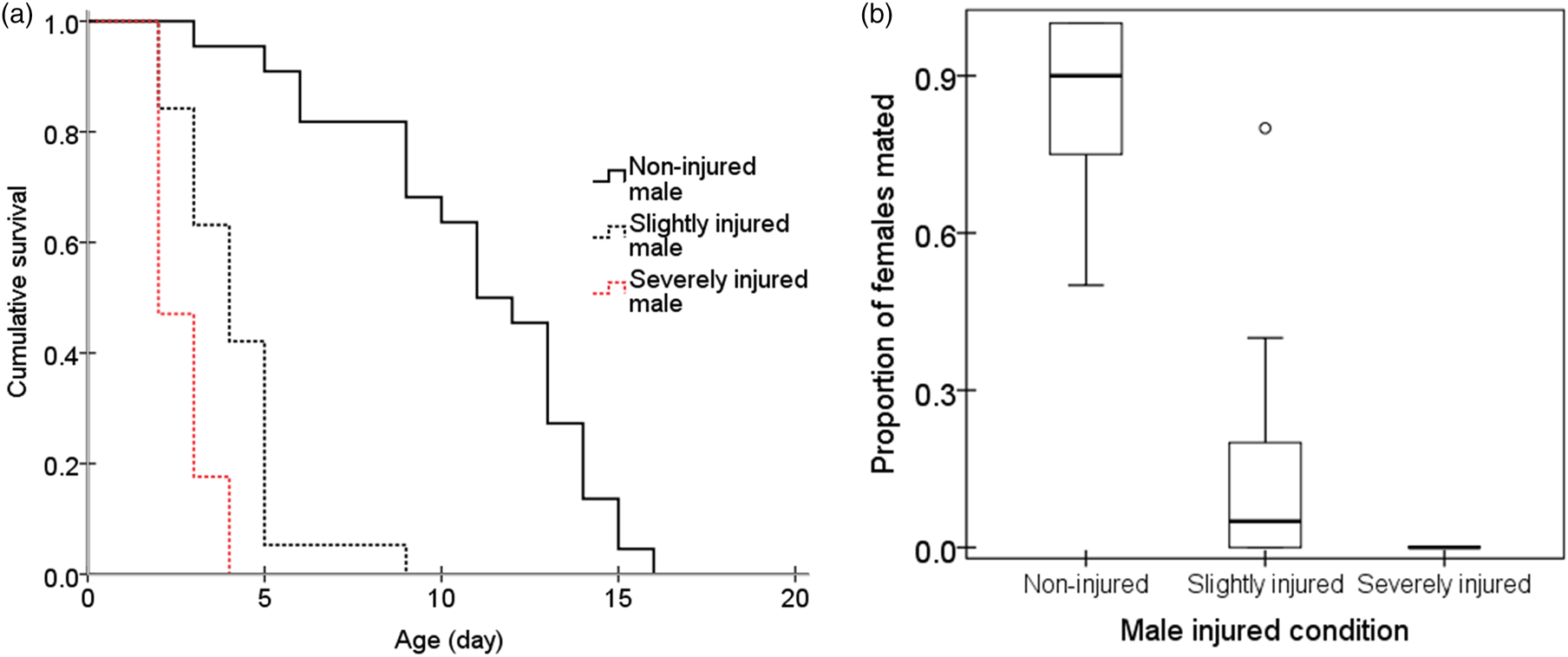
The mean survival time of healthy males was 9.74 ± 0.77 days. The survival time of injured individuals was significantly decreased to 3.11 ± 0.37 days (Wilcoxon = 24.96, P < 0.001) in the case of slight injury and 1.65 ± 0.19 days (Wilcoxon = 27.5, P < 0.001) in the case of severe injury (fig. 1a).
Male fighting resulted in individual injury with reduced longevity (a) and mating capacity (b). Mating capacity was measured as the proportion of ten females that mated with one male in 3 h. Boxes: 25th and 75th percentiles; heavy line: median; whiskers: 1.5 times the interquartile range of the data; data points: outliers.

Additionally, the mating ability of slightly injured males was significantly decreased relative to that of healthy males (Wald  $X_1^2 = 12.36$, P < 0.001). Males of A. disparis are polygynous, and a newly eclosed male can mate with 8.5 ± 0.387 (N = 16) females in 3 h. Males that are severely injured from fighting cannot mate with any females (fig. 1b).
Effect of age on aggression
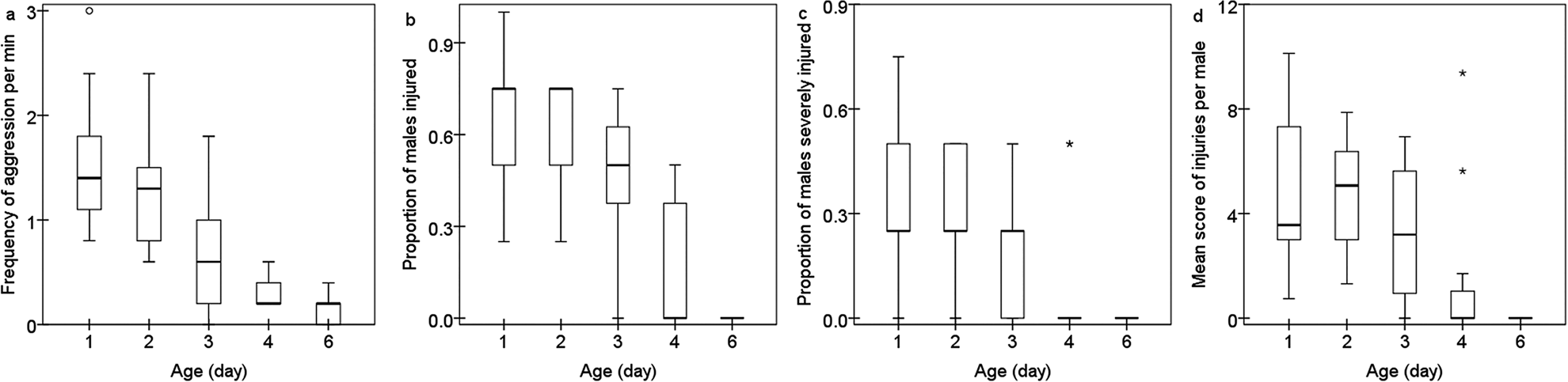
The frequency of fighting between two newly eclosed males (i.e., 1-day-old) was 1.52 ± 0.19 times per min, and the frequency significantly decreased with age (fig. 2a: Wald  $X_4^2 = 26.974$, P < 0.001). Fighting types mainly included a sneak attack by the opponent when courting a female, boxing and chasing each other, and each process lasted only a few seconds, up to a maximum of 5 s.
Effect of male age on aggression. Aggression was assessed based on the frequency and intensity of fighting. Fighting frequency (a) was measured as the number of male fighting events during a 5-min period, and fight intensity was assessed based on the proportion of males injured (b), the proportion of males severely injured (c) and the mean number of injuries per wasp (d) after 3 h. Boxes: 25th and 75th percentiles; heavy line: median; whiskers: 1.5 times the interquartile range of the data; data points: outliers.

Additionally, among the newly emerged males, 63.64 ± 3.94% were injured while fighting for mating opportunities, and 28.41 ± 4.44% were severely injured. The intensity of fighting, as assessed by the proportion of males injured (fig. 2b: Wald  $X_4^2 = 12.36$, P < 0.001), the proportion severely injured (fig. 2c: Wald
 $X_4^2 = 11.463$, P = 0.022) and the mean score of injuries per wasp (fig. 2d: Wald
 $X_4^2 = 62.604$, P < 0.001), significantly decreased with male age.
Effect of age on male mating behaviour
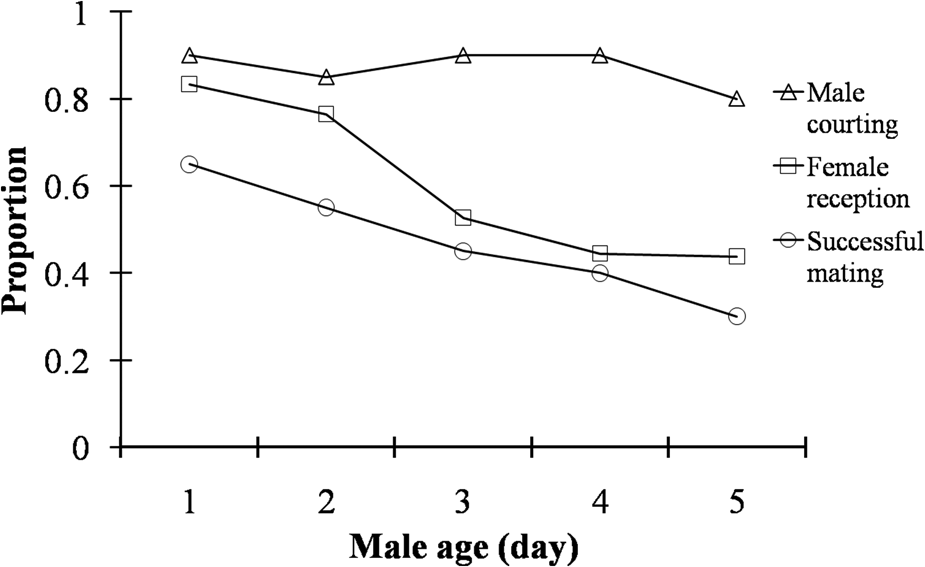
Successful mating behaviour involved a progressive series: male courting, female reception, ovipositor insertion, and post-mating (e.g., male lying on the female back). The progression of mating from receptive to post-mating lasted only approximately 12.34 ± 1.78 s. Most male courting occurred within 5 min after the experiment began. More than 80% of the males courted females, while male age had no significant effect on the incidence of males courting females ( $X_4^2 = 2.462$, P > 0.05). As shown in fig. 3, 83.33% of the courted females (N = 18) were receptive to 1-day-old male courtship, while the proportion significantly decreased with male age (
 $X_4^2 = 10.027$, P < 0.05). Significantly more young males successfully mated with virgin females than older males (
 $X_4^2 = 5.743$, P < 0.05).
Effect of male age on the mating behaviour of male courting, female reception and successful mating.

Transcriptomic analyses in aged males
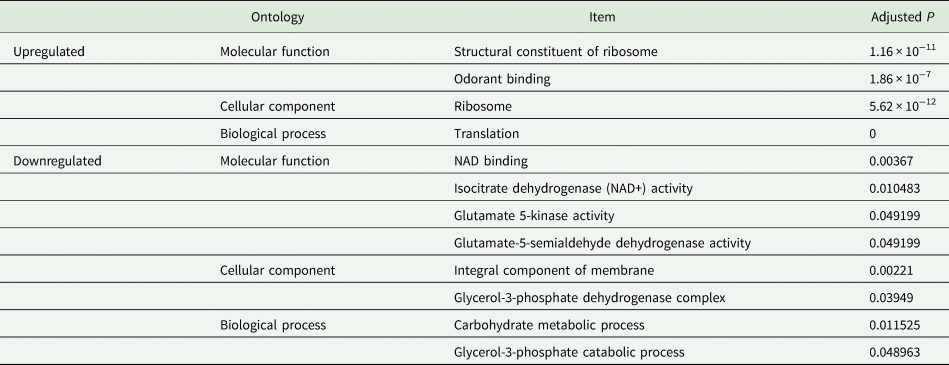
A total of 413 annotated genes were found that were differentially expressed with age. There were 235 and 178 annotated genes that were upregulated and downregulated, respectively, with male age. Among the upregulated genes, GO enrichment analyses identified four enriched subcategories, including the GO terms structural constituent of ribosome (P < 0.001) and odorant binding (P < 0.001) for the molecular function category, ribosome (P < 0.001) for the cellular component category, and translation (P < 0.001) for the biological process category (Table 1).
GO subcategories enriched in differentially expressed genes (DEGs)

Eight enriched subcategories among the downregulated genes were identified (Table 1), many of which are involved in energy-related glucose metabolism, for example, NAD binding (P < 0.01), isocitrate dehydrogenase (NAD+) activity (P < 0.05), glutamate 5-kinase activity (P < 0.05) and glycerol-3-phosphate dehydrogenase complex (P < 0.05).
Discussion
Fighting typically has lifetime consequences (Kemp, Reference Kemp2006; Sato et al., Reference Sato, Rühr, Schmitz, Egas and Blanke2016; Baxter and Dukas, Reference Baxter and Dukas2017), and the life history of aggression with a dangerous fighting pattern was studied in A. disparis. Fighting in A. disparis is typically dangerous, resulting in severe injury or death (Liu et al., Reference Liu, Wei, Tian and Hao2017a; Liu and Hao, Reference Liu and Hao2019). Thus, the costs of fighting are enormous in A. disparis because many individuals would be injured by fighting, and injured males lose most of their reproductive value and have significantly shortened longevity (fig. 1). As prediction, younger males have a higher residual reproductive value, and fighting tends to generally increase with age (Haley, Reference Haley1994; Komers et al., Reference Komers, Pelabon and Stenstrom1997; Kemp, Reference Kemp2002). However, inconsistent with general predictions, A. disparis exhibited the pattern in which the propensity for fighting tends to decrease with age. Our study provided supporting evidence that young individuals showed a higher fighting impulse caused by the decline of RHP and sexual attractiveness with age (Kemp, Reference Kemp2006).
The balance between the value of a contested resource and the cost of fighting for it can mediate fighting behaviour (Maynard Smith and Parker, Reference Maynard Smith and Parker1976; Enquist and Leimar, Reference Enquist and Leimar1983, Reference Enquist and Leimar1987). Access to mating opportunities is important for A. disparis males (Liu et al., Reference Liu, Wei, Tian and Hao2017a; Liu and Hao, Reference Liu and Hao2019), and our study showed that females significantly decreased their reception to old males, which may lead to a decreased probability of successful mating among old males. This result suggested that male attractiveness declines with age, which may be associated with the variation of benefits in aged males. As young males, i.e., 1- and 2-days-old, had a higher probability of female reception and successfully completing mating, they may be very likely to acquire opportunities if they defeat others. Therefore, the potential benefits of winning can exceed the costs of fatal fighting (Maynard-Smith and Price, Reference Maynard Smith and Price1973; Enquist and Leimar, Reference Enquist and Leimar1987, Reference Enquist and Leimar1990), which is likely to result in escalating conflict in younger males. On the contrary, aged males that win fighting may not successfully finish mating and might not experience female reception, thus losing this mating opportunity. Consequently, the large cost and lower benefits, i.e., mating opportunities, for aged males due to uncertainty of successfully mating leads individuals to decrease their aggression with age. In addition, although mating ability significantly decreased, an aged male could still successfully mate with fewer females, which may contribute to aged males still fighting each other with much lower frequency and intensity.
In addition to the sexual attractiveness, the factor of RHP decline with age is also a consideration for younger males showing more aggression (Kemp, Reference Kemp2006). As proposed by Parker (Reference Parker1974), morphological and physiological traits, such as body size, energy reserves, etc., determining the potential to win contests are defined as an individual's RHP (Batchelor et al., Reference Batchelor, Santini and Briffa2012). Transcriptomic analyses of aged males showed that most genes related to energy metabolism were downregulated (Table 1). This suggests that the available energy for fighting might significantly decrease with age and that male RHP decreases with age. Aggressive behaviour is extremely energy consuming and has been considered ‘energetic wars of attrition’ (Payne and Pagel, Reference Payne and Pagel1997; Briffa and Elwood, Reference Briffa and Elwood2004), in which energy expenditure increases as a contest escalates in intensity (DeCarvalho et al., Reference DeCarvalho, Watson and Field2004). Thus, available energy for fighting in aged males significantly decreases, which might lead to aged males showing less aggression. Additionally, as many predictions of assessment strategy, fighting ability, i.e., RHP, of itself and/or an opponent were assessed in a contest, then adjusted with their fighting behaviour (Arnott and Elwood, Reference Arnott and Elwood2009; Chapin et al., Reference Chapin, Peixoto and Briffa2019). As aged males have a lower energy reserve, the possibility of aged males winning in a fight is slim. Thus, aged males might be unwilling to initiate an attack upon others to avoid the cost of fighting, especially A. disapris with its extreme fighting pattern, consequently showing decreased fighting intensity to escape injury.
Overall, our study suggested that, rather than residual reproductive value, RHP and sexual attractiveness decline with A. disparis male age, likely contributing to age-related changes in aggression. Our results provided supporting evidence for the evolution of an early-hawk strategy, i.e., aggressive when young but nonaggressive when old, when RHP is expected to decline with age (Kemp, Reference Kemp2006). Besides the effect of size-dependent RHP (Schuett, Reference Schuett1997; Jenssen et al., Reference Jenssen, Decourcy and Congdon2005), more studies have focused on the physiological constraints on fighting behaviour using a variety of techniques and single measurement indexes (e.g., respirometry, the quantification of ventilator or cardiac rates) (Briffa and Sneddon, Reference Briffa and Sneddon2007). Combined with transcriptomic analysis technology, our study provided more knowledge and insights into the physiological changes accompanying age-affected fighting. In addition to energy reserves, other age-related physiological changes may involve biochemical neurotransmitters (e.g., serotonin, dopamine, dehydroepiandrosterone) (Wong et al., Reference Wong, Wagner, Dannals, Links, Frost, Ravert, Wilson, Rosenbaum, Gjedde and Douglass1984; Hof and Mobbs, Reference Hof and Mobbs2010), which have been widely studied and proved to control or influence the aggression (de Almeida et al., Reference de Almeida, Ferrari, Parmigiani and Miczek2005; Popova, Reference Popova2006; Soma et al., Reference Soma, Scotti, Newman, Charlier and Demas2008). Our transcriptomic data indicated that an annotated gene encoding tyrosine 3-monooxygenase (c41504.graph_c1), which is thought to be the rate-limiting enzyme in dopamine synthesis (Budnik and White, Reference Budnik and White1987), was downregulated in ageing males. Similar to serotonin, dopamine is an important neurotransmitter that is thought to be related to aggression in many species (de Almeida et al., Reference de Almeida, Ferrari, Parmigiani and Miczek2005; Alekseyenko et al., Reference Alekseyenko, Chan, Li and Kravitz2013; Yamaguchi and Lin, Reference Yamaguchi and Lin2018). It suggested that the dopamine decrease with male age in A. disparis may be one cause of age-related changes in aggression, which should be further assessed and verified in further studies.
Ethics
For this type of study, formal consent is not required. This article does not contain any studies with human participants or animals performed by any of the authors.
Acknowledgements
The project was funded by the Young and Middle Ages Scientific and Technological Innovation Talent Project of Shenyang (RC190103), National Science Foundation of China (31870639). The authors gratefully acknowledge undergraduates Ju Luo, Min Li, and Chenxi Zhao of the Nanjing Forestry University and Dukas Reuven of McMaster University for their assistance.
Conflicts of interest
The authors declare no competing interests.