One of the most accomplished historians of Kenya and the Kikuyu to date, John Lonsdale, develops a concept of ‘moral ethnicity’ to describe the internal deliberation over good leadership of an ethnic group. As Lonsdale explains it, moral ethnicity is ‘the common human instinct to create out of the daily habits of social intercourse and material labour a system of moral meaning and ethnical reputation within a more or less imagined community’ (1994: 132). A prime example Lonsdale uses to explain his thesis is the dispute between Stanley Mathenge and Dedan Kimathi, who were both Mau Mau leaders – the former a founder of an illiterate group of fighters and unwilling to engage with the state or conform with the standards of bureaucratic administration. Disagreement erupted within the Mau Mau when those entering into the profile of administrators of the state justified their move with a rejection of Kikuyu custom, accusing it of being a vehicle of elders’ selfishness. As Lonsdale describes it,
the heart of the forest dispute lay in the literates' response to the riigi thesis that power must rest on personal reputation within the small moral community. Kimathi and Njama countered that their unlettered opponents, far from being concerned for the accountability of power, were themselves selfish, clannish intriguers who fanned parochial envy for lack of personal merit. Statesmanship, they self-righteously insisted, was an acquired skill and hard work, not a favour. (1994: 146)Footnote 1
Faced with the alien operation of the colonial state, Kikuyu felt the need to choose between conformity to the state system or retreat into ethnic custom, in turn highlighting how distant and incommunicable the two positions were. Lonsdale explains,
Mau Mau was thus divided by that central issue in all multi-cultural politics – not just in Africa – whether equal citizenship is best preserved by institutions that obey the superior claims of public neutrality or, rather, that recognise the cultural particularities within which people are formed as social beings; even within this parochial forest arena, that was what fired the argument between Parliament and riigi. (1994: 147)
The key mechanism at work in moral ethnicity is the prioritisation of reputation as interpreted through local mores and customs. To depart from this community space of reputation-garnering is thus to reject the soundness of its ways and to splinter methods of evaluating conduct.
Moral ethnicity remains one of precious few concepts in the study of African politics that captures an empirically rich account of ethnicity alongside a positive audit of its contribution. To provide a counter-point, Lonsdale contrasts it against ‘political tribalism’, described in Cheeseman's words as ‘a device used by elite actors to mobilise support based on the manipulation of a community's fear of exclusion from power and access to resources’ (2009: 99–100). Moral ethnicity and political tribalism are framed as a ‘dialectical tension’ (Lonsdale Reference Lonsdale, Berman, Eyoh and Kymlicka2004: 76) that helps explain the tumultuous journey of the nation-state in Africa, though the dichotomy it suggests has been questioned (Lynch Reference Lynch, Branch, Cheeseman and Gardner2010: 185–6). In general, the concepts continue to operate as useful working hypotheses upon which to assess the nature of identity-framed political deliberation. In terms of evaluating an election period, on the one hand political discourse may constitute a process of manipulating competitive fears to win votes (political tribalism) or, instead, a process of evaluating leaders’ reputations through reference to local and historical experiences and traditions (moral ethnicity).
Placing these categories to one side for a moment, within political science there is the general observation that a developing middle class supports the consolidation of democracy. This is a position attributed to Barrington Moore, who famously argued: ‘No bourgeois, no democracy’ (1993: 418). He observed that town-dwelling populations which favour a commercialisation of agriculture are conducive to the development of parliamentary democracy: ‘By and large, the elimination of the peasant question through the transformation of the peasantry into some other kind of social formation appears to augur best for democracy’ (1993: 422). This well known position encourages the observation of a relationship between income and democratisation, leading in turn to the general feeling that a technologically savvy African middle class will be conducive to multi-party democracy. This position is frequently suggested by media outlets, with one example being a Reuters article explaining with regard to Kenya's 2013 election that:
Many analysts believe digital media played a part there [in Kenya] in keeping tribal tensions in check during the vote and allowing a generally peaceful poll which averted a repeat of post-election violence that killed more than 1,200 people in 2007/2008.
Middle class voters are seen more likely to vote according to policies and issues rather than automatic or traditional allegiances to any party or ethnic group. (Fletcher 10.5.2013)
The middle class are, in this way, frequently touted as the key ingredient for moving from identity-oriented to policy-oriented democratic exchange. This assumes, of course, that ‘rational’ political discourse lies outside of intra-communal deliberation, that successful democratisation sheds reliance on moral ethnicity as well as political tribalism. The tension, therefore, between the Africanist Lonsdale and the political scientist Moore, is clear. It seems the development of a middle class either hinders democratic discourse by separating citizens from moral ethnicity or helps liberate citizens from identity-bound political framings, moving towards ‘rational’ evaluations of public policy.
Distinguishing political deliberation as identity-based or policy-based was explored in detail for the 2007 Kenyan election by Bratton and Kimenyi, who described discourse as stuck in ethnic competition: ‘Where voting blocs are polarized, and where polarization revolves around ethnicity, voters are hard pressed to maintain a commitment to policy issues above ethnic origins as a basis for voting’ (2008: 279). This chimes with other research identifying in Kenya the reliance during election campaigns on stirring up ethnic fears (Klopp Reference Klopp2001; Mueller Reference Mueller2008). These findings point to a difficult and tense relationship between identity and democratisation, and there is urgent need to explore such interaction with regard to what ‘the rise and rise of the African middle class’ (Deloitte 2013: 1) really means for democracy in Africa.
Seeking to respond to this research need, the present article delves into the experiences of middle class Kikuyu in Nairobi over the course of the 2013 Kenyan election, asking how voter perceptions changed in the month surrounding election day. Evidence is gathered from the diaries of 12 citizens asked to record their thoughts and feelings on politics across a one month period, noting sources of political information and how these affected their opinions. As opposed to representative survey methods, the aim is to travel closely through the election period with a small number of middle class citizens so as to access changing thought processes. Taking this in-depth look at what it means to experience an election, I find that Kikuyu middle class in Nairobi were under intense pressure to vote on tribalistic lines regardless of their greater socio-economic independence. Applying Lonsdale's distinction between moral ethnicity and political tribalism to middle class Kikuyu voting, I posit how the greater independence of the middle class of Nairobi renders any process of moral ethnicity thin insofar as the group suffers increasing autonomy from communal debates. Turning to the surmised value of the middle class for democratisation, I therefore suggest the development of a middle class in Kenya to involve the dropping of moral ethnicity alongside a pressured endorsement instead of political tribalism. This means Moore is partially right, but that it is a halfway position neither conducive to democratic stability nor something leading to policy-oriented, rather than identity-orientated, debate. This further stands in contrast to the more easily communicable achievements in Kenya of a new constitution, devolution and economic growth. The findings demonstrate that at present research on the middle class in Africa holds insufficient appreciation for the political pressures that may be counter-balancing the democratic deepening expected as a result of higher income levels.
The article is structured as follows. First, explanation is given of the methodology, outlining the process of evidence gathering through diary writing and how this helped capture the moods and opinion-formation of young Kikuyu middle class over time. Second, the article describes the thoughts and feelings of participants under the headings of the issues generally perceived as most salient: ethnicity and identity, the media, the International Criminal Court (ICC) and the lack of middle class consciousness. Finally, the article concludes by relating back to the more general debate on moral ethnicity and political tribalism, the middle class and democratisation.
METHODOLOGY
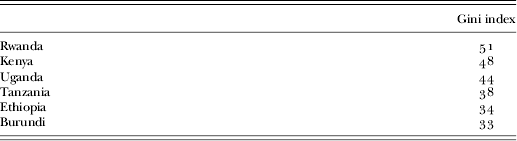
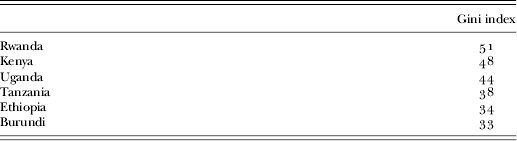
In order to guarantee a consistent sample whose thoughts could be cross-examined, participants were selected to fit a specific profile. First, all participants were of Kikuyu ethnicity and of the middle class. The Kikuyu are Kenya's largest single tribe, constituting 17 per cent of the population (Kenya National Bureau of Statistics 2011), and are generally considered the country's most economically advanced ethnic group (Lynch Reference Lynch, Branch, Cheeseman and Gardner2010: 182). Being of the middle class is, as a category, plagued by difficulty in setting a definitional boundary, dependent as it is on demonstrating relational difference to lower and upper classes. That Kenya does exhibit an in-between economic group is suggested by the country's income inequality, shown in Table I in comparison to other East African countries. The Gini index, or Gini coefficient as it is normally termed, measures the proportionate spread of income across a population (a figure of 100 is reached if all income is in the hands of one person and a figure of 0 if income distribution is perfectly equal).
Gini index by East African country, showing levels of economic inequality (World Bank 2013)Footnote 2
Definitions of the middle class tend to focus on levels of income, with one widely cited African Development Bank report controversially suggesting Africa's middle class to consist of those with a consumption level of between $2 and $20 per day (20.4.2011: 2).Footnote 3 Given that the middle class is also a social and not just an economic category, I incorporate social perceptions in Kenya and define the middle class as those studying in higher education or working in formal employment who are financially stable and therefore able to regularly consume non-essential goods and services. Apart from these criteria, participation was also restricted to those living in Nairobi and between the ages of 18 and 30 so as to further ensure accounts were comparable. This means that the accounts detailed below are expressly the experiences of urban voters who are also yet to reach the height of their professional standing. The respondents are a key subset of the broader category of the Kikuyu middle class. All described themselves as fluent in English and Kiswahili, with five of the 12 confident in conversing in Kikuyu and seven of the 12 confident in Sheng (a Nairobi-based slang language). Under the requirements of being young, middle class and Nairobi-based, participants were selected through a process of snow-balling contacts and referral. In order to provide both confidentiality and to guarantee participants felt at ease in stating their thoughts and feelings, it was explained that all personal information would be anonymised and there was no obligation to state how one voted.Footnote 4
The month-long period covered two weeks prior to the 4 March election date and two weeks following it (18 February to 16 March 2013). Participants were advised to write about twice a week, and yet to feel relaxed in putting down thoughts as and when they felt most moved to do so. The length of entries was not specified as participants were encouraged not to see the process as a task but as an open opportunity to gather and express their thoughts. In order to compensate for the time required, as well as for the need to access the internet to send diary entries in, a remuneration of 500 Kenyan shillings ($5.82) was provided to each participant per diary entry. On average, participants wrote six entries each, with an average word count of 476 words for each entry. In total, therefore, this article presents evidence gathered from 74 such diary entries. The diaries follow the events and experiences of 12 individuals longitudinally across the election period; they constitute a detailed narrative on the impressions and concerns of young middle class Kikuyu of Nairobi, describing the most important aspects of the election period for their opinion formation. Given the aim of offering the thoughts and feelings of voters to wider analysis, preference is given throughout to direct extracts from their writings.Footnote 5
The possibility remained that participants address the listener rather than give their thoughts on an entirely private basis. This dilemma is present in all forms of fieldwork; diary writing should not be seen as an exception. Nevertheless, the method deployed helped meet the general challenge by giving participants a longer time than usual to adjust to the practice of relaying personal information. Unlike interviews which tend to bring participants to a demanding engagement for short bursts of time, diary writing can become normalised in the timetables of participants, in turn helping dissolve levels of self-awareness (and accompanying self-censorship). Second, the process of writing through diaries adds one more medium for researchers attempting to triangulate methods and coalesce an overall picture. In this way, it opens a new door on the thoughts of citizens, providing an additional angle that can be compared against the findings of other methods.
ETHNICITY AND IDENTITY
Two weeks before election day, most participants were either undecided or in support of presidential candidates Peter Kenneth or Martha Karua. Although both the presidential candidates can be considered Kikuyu (with Peter Kenneth of mixed British and Kikuyu parenthood), they were nevertheless widely perceived as leaders who relied less on ethnic-based electoral support. For this reason and others, Kenneth and Karua were considered fresh options, able to turn Kenyan politics in a new direction. This was in contrast to the two leading favourites, Raila Odinga (of Luo ethnicity) and Uhuru Kenyatta (of Kikuyu ethnicity), who were both felt to garner support primarily along ethnic lines. The central dilemma faced by all respondents, therefore, was a choice between supporting the popular Kikuyu candidate Kenyatta or, instead, voting for a third party candidate such as Kenneth or Karua.
A strict identity-based division between Kikuyu and Luo voters had already been set in motion two years prior to the 2013 election. Upon Kenyatta and William Ruto's indictments for crimes against humanity by the ICC in 2011 for suspected roles in Kenya's 2007/8 post-election violence, the two regularly appeared in public together, maintaining their innocence and spinning their prosecution as an international attack on Kenya's sovereignty and a treacherous plot by Odinga. The rhetoric and subsequent turn of events thus solidified an anti-Odinga position, forming an otherwise unlikely alliance between the two main Kikuyu and Kalenjin political candidates, Ruto being of Kalenjin ethnicity and widely described as ‘Lord of the Rift’, that area of Kenya heavily populated by Kalenjin. When petitioning the UN Security Council to delay the ICC trial (Kenyan Government 31.3.2011), Kenyatta, Ruto and Kalonzo Musyoka together formed what came to be described as the ‘KKK’ political alliance after the three ethnic groups the candidates were understood to represent – the Kikuyu, Kalenjin and Kamba, respectively (Obala 17.5.2012; Citizen Television 23.1.2011). This coalition was further solidified in the eyes of the electorate under a newer and more official title, the ‘G7 alliance’. Asked on Facebook what the meaning behind ‘G7’ was, the administrator of Kenya: G7 Alliance replied, ‘Kenya is divided into eight provinces. Do the maths. I could be wrong’ (22.2.2012). The meaning here was that the group brought together everyone who was not of Nyanza Province, the birthplace of Odinga and the home of Odinga's core supporters of Luo ethnicity. Although there was some rumour of a Ruto–Odinga alliance (Makabila 21.10.2012; PM Press Service 2.11.2012), which would have confounded the G7 alliance and swung considerable support in favour of Odinga's candidacy, such political manoeuvring collapsed when Odinga was openly criticised by both Kenyatta and Ruto as lying when he said he supported a local tribunal to try ICC suspects (Njagih 7.11.2012). Nevertheless, the supposed unity between the ‘KKK’ ethnic groups was not entirely present in the Jubilee Alliance, the coalition formed officially by Kenyatta to contest the 2013 election, as Musyoka instead joined Odinga as the latter's presidential running mate in late December 2012 (Daily Nation 22.12.2012).
Given the way these two camps crystallised in the two years running up to the election (preceded, of course, by a longer history of divide), Kikuyu middle class respondents feared that supporting an alternative candidate would increase the chances of their least preferred candidate winning. As one respondent explained:
If I vote for PK [Peter Kenneth], I will effectively express my displeasure at the current system. I will be voting for a proven performer. Everyone knows that [Peter Kenneth's] Gatanga constituency is one of the most developed. So it's not because PK has a distinct Kikuyu accent, notwithstanding his ambiguous name. … Will I be risking my vote? Yes. If I vote for PK, I increase Raila's chances of winning, because his main rival, Uhuru, will have one vote less. So if a large number of the middle class vote for PK … ‘Rui runenehagio ni tuthima’, goes a Kikuyu proverb – The river is made bigger by the small springs. If Uhuru is the river, then the small springs are being directed away from him, and this weakens him. Oh, if only they could all unite! Herein lies my dilemma: the downside of the other candidates running is that they divide the vote against Raila. Sometimes I wonder if one or two of them are Raila's projects intended to scuttle the vote against him. (Respondent 12, 20.2.2013)
The dilemma heightened the sense in which Peter Kenneth especially was seen as a non-tribal option, simultaneously marking him as a genuine alternative with no chance of garnering enough votes. By the sheer nature of polarised political camps, therefore, support of a third party candidate seemed a waste.
Identity rose in importance for respondents through numerous day-to-day encounters with ethnic difference and ethnic hostility. Incidences ranged from difficult conversations at the work place to episodes of direct discrimination, in turn heightening the sense that a threat lay on the horizon depending on how the election period was handled. One respondent surmised:
Just the other day my friends and I were discussing about politics. One of them was a Luo and I was so shocked to learn that tribalism has ruled them to the extent that in their village they do not accept a woman from Kikuyu tribe or even Kamba to be married by a Luo man.
What does this suggest? Don't you think this is contributing to the unlikelihood of peace after election? That is my opinion. (Respondent 3, 1.3.2013)
Two respondents wrote about rumours they heard of residents receiving threats to leave areas where they were a minority; the first, non-Kikuyu to leave Juja and the second, Kikuyu to leave various Luo-dominated areas if the preferred local candidate did not win (Respondent 8, 4.3.2013; Respondent 10, 19.2.2013). Regardless of either the truth of these or the direction of their discrimination, they fostered trepidation amongst middle class respondents for supporting any third-placed presidential candidate.
Respondents also narrated situations which directly heightened awareness of their Kikuyu identity. One writer described how she had observed a Kamba being sent away from Kikuyu shops ‘just because Kalonzo [Musyoka] was one of Raila's supporters’ (Respondent 1, 14.3.2013). Another recounted:
As I do this write up, I have a friend who lives in Ngong road, past Kawangware, a place called Swamp. She has scheduled to live with me as from March. She comes from the Luo community and her area – Swamp, is mainly inhabited by folks from the Kikuyu tribe. She does not feel safe.
On Saturday I attended our job's end of year party – well ours is held at this time. As we continued to wine and dine, through the usual chit-chat folks have while mingling, I got to learn that one of my colleagues was scheduled to move houses. He works in Westlands and lives somewhere around Kinoo or Kikuyu. This is his reason to move to Thika road. One day he went to purchase meat from his local butchery, and was surprised with the question from the vendor: ‘Wee kijana unanunuanga nyama hapa hizo siku zote na hatujawahi kukuskia ukiongea Kikuyu?’ [‘You young man, you buy meat here every day and yet we have never heard you speak Kikuyu?’] (Respondent 7, 20.2.2013)
One respondent explained how people were ‘being questioned about who they are voting for as they enter the matatu [local transport]’ (Respondent 10, 1.3.2013). The vehicles showed stickers of the party supported by the owners, and so for some journeys the respondent was afraid she would be identified with the opposing camp.
It is difficult to capture the tension felt by diary writers as they navigated the election period, conscious of their ethnic identity and the immediate danger that would follow if losing candidates refused to accept defeat. One respondent wrote:
I am really worried about what will happen after the election. I am afraid that what happened after 2007 election may erupt again. This is because the pre-post elections [opinion polls] carried out a few days ago show that Uhuru and Raila are at each other's neck, ‘bampa to bampa’ [‘bumper to bumper’] as my friends say. However this is not what really worries me but what really worries me is the fact that the two leaders show their greed for power such that in case one loses [they] will not be ready to accept defeat. (Respondent 1, 22.2.2013)
On election day the very same writer described how ‘there were some cases reported of some clerks in Kisii who were issuing two ballot papers to voters. What do you expect? Do you expect me to accept defeat after learning of such a situation?’ (4.3.2013). In this way the tightness of the electoral campaigns merged with expectations of fraud and increased identity tensions, pressuring middle class Kikuyu to drop policy-based assessments. As one respondent put it,
I belong to the so-called ‘wrong’ tribe and I have to say I am afraid. After having conversations with my friends, I am also tempted to change my vote to a protest vote [protesting against anti-Kikuyu sentiments]. Why should I be ashamed of my tribe or be victimized because of it? (Respondent 11, 22.2.2013)
Another considered how impossible it was to be understood as supporting a Kikuyu candidate out of thoughtful consideration of their policies: ‘people will always call you a tribalist if you don't support someone from another tribe’ (Respondent 12, 12.3.2013).
These ‘cold war’ social exchanges led to polarisation amongst friends and colleagues as political loyalty based on ethnic affiliation was quickly assumed (Respondent 5, 11.3.2013). At the same time, debate at home with family was also intense. As one respondent wrote a few days before the election: ‘ ‘Tell her if she is voting for PK she should just stay at home!’ That's what my dad told my mum to tell me. Voting for PK is like voting for Raila!’ (Respondent 12, 2.3.2013). At a barbeque, one respondent agreed with his friends how much influence parents were having on the way they were thinking (Respondent 9, 19.2.2013); the effect of family and parental views is multiplied during the election period as many use the time off work to travel home. One respondent wrote about how she was more in favour of Evans Kidero (Luo) than Ferdinand Waititu (Kikuyu) for the position of Governor of Nairobi County, though admitted she was reluctant in supporting Kidero given ‘my parents’ despise for the man due to his Luo background’ (Respondent 10, 8.3.2013).
Because the chances of actually determining the outcome of a national election through one's vote is tiny, there must be other reasons for making the effort (Sen Reference Sen1979: 195). If, instead, it provides a sense of participating in the making of history, one's stance matters not just for the practical outcome but also for the election's wider meaning, as framed by the accompanying social discourse. Perhaps for this reason, respondents felt ongoing pressure to situate their vote in the broader debate on the acceptability of Kikuyu identity as a form of national Kenyan identity.
THE MEDIA
Two media platforms stood out in particular as bearing influence for Kikuyu middle class voting opinions: social media and the televised presidential debates. Both, however, had a complex impact on political perceptions, with neither platform creating anything like a seamless move towards more ‘rational’ policy-based debate. The two are each considered in turn.
Social media was observed as at the same time an enabling and restricting forum for discussion. One respondent explained the importance the medium was playing for her:
With slightly over a week to the elections, I still haven't made up my mind over who I will vote for. I go through my social media timelines and I see so many of my peers declare publicly who they support, although many don't really elaborate on why. Perhaps it's the shortage of characters on Twitter? After all 140 characters are quite limiting to the ordinary user as a platform to declare why a particular candidate has won your heart, or is it your mind? Social media has shaped a lot of my thoughts on this election. Every day you see conflicting opinions on why this candidate is the best and why that candidate would be the biggest disaster to ever happen to Kenya. (Respondent 5, 24.2.2013)
Despite the benefits, an overwhelming number commented on how social media exchanges tended to be polarising and hateful. One respondent complained:
I cannot believe comments from my social media friends talking about them versus us. We have become increasingly polarized by tribe. There seems to be a concerted effort to portray many tribes against one or two. Many of my friends from the seemingly targeted Kikuyu community are changing their votes from other candidates to Uhuru due to fear. (Respondent 11, 22.2.2013)
Particular grievance came through the frequent use of what respondents considered hate speech. As one respondent described after election day,
a famous blogger and Twitter big-wig Robert Alai has tweeted continuously since Saturday about the state of the ‘stolen election’. While one may claim that Mr Alai like everyone else should enjoy freedom of expression, we cannot pretend that any inflammatory remarks he makes in any of his online media would not stir the kind of emotions that caused Kenya to descend into hell in the first place. The rules already set about hate speech seem not to apply to him and I am very angry about that. With a following of 42,000 people, Mr. Alai seems not to understand the potential of his actions, and he is not alone. (Respondent 5, 11.3.2013)
Respondents felt in close proximity to all that was being discussed online, blowing away the more network-selective discourse that normally characterises citizen experiences of elections (Bello Reference Bello2011: 189). One respondent remarked:
Ever since the election period began I have realised there are a number of people I would like to de-friend. Their updates are never short of hate speech and tribal stereotypes that it makes you wonder how in this day and age, a person my age can act as though he were born in the era where tribalism reigned. (Respondent 8, 15.3.2013)
Immediately following the election period, the National Cohesion and Integration Commission moved to prosecute four individuals for incitement to hatred through social media platforms (Ngirachu 20.3.2013); the plethora of online discussion, however, renders any efforts to apply the law consistently extremely difficult (see Ushahidi 2013). Added to these pressures was the organised use of social media by campaign teams, often seeking to shore up voter loyalty as opposed to generating impartial debate on the relative merits of manifesto pledges. One diary writer tried to respond by using her Twitter account to spread ‘peace, love and harmony’ (Respondent 2, 1.3.2013), highlighting how social media's tense and polarising communication was apparent to all respondents. One writer described social media in Kenya to have ‘emerged to become some sort of enigma’, with both good and bad days (Respondent 11, 15.3.2013).
A second important area of media contact for most participants was the two televised presidential debates, hosted jointly by Kenyan news channels on 11 and 25 February 2013, and followed closely on social media. Respondents appreciated the way in which the debates ensured leaders were held to account for the previous parliamentary term and their past actions (Respondent 6, 25.2.2013). There were, however, low expectations that politicians would be able to use the forum to demonstrate good reputation:
As it began, the coaching was obvious. ‘Smile and nod, Uhuru … Acknowledge the role of women, Martha … appeal to the lower class living in Eastlands, PK.’ The works. Then the action began as their real selves came out and you could see the malice in their eyes as their skeletons came out to haunt them. It showed me just how much we can pretend until the veil falls. It also made me question how long the veil of ‘Let us vote peacefully’ will be worn until it is finally discarded. How long will they play the ambassadors for a peaceful, free and fair election until they realise violence is the answer? I am genuinely afraid. (Respondent 5, 18.2.2013)
In terms of whether hearing the debates led respondents to change their minds, only one diary writer stated this, noting how she was previously in support of Kenneth until the debate made her realise he was ‘merely the vote of Facebook and Twitter users’, leading her to switch to Kenyatta (Respondent 10, 19.2.2013). One described how he had taken notes while listening to the first debate but remained ‘undecided as to whether what was said is the honest truth’ (Respondent 9, 19.2.2013). However diligently they weighed the merits of candidates, respondents remained low in their expectations that other voters would do the same. As one diary writer recounted:
Seeing the candidates put to task in an organised forum was quite a sight. They (politicians) are used to shouting and heckling matches out there that carry no substance at all. It was evident that some struggled in the debate while others were actually quite good at thinking on the spot and diplomacy. However, I don't believe the Kenyan population is ready for such forums as deciding factors when it comes to electing leaders. Most minds were made up long before and this debate served no big role in swinging votes. I am in full support of the debates but I like to call myself a realist. I believe issues like tribe, wealth, corruption among other ills will have the biggest influence in this election. (Respondent 3, 22.2.2013)
THE ICC
A key area of tension for middle class Kikuyu voters was the dilemma of voting in Kenyatta and Ruto whilst their status as suspects at the ICC for crimes against humanity remained unresolved. As was widely documented at the time, electing Kenyatta to the presidency carried the prospect of a diplomatic crisis; questions lingered as to whether he would, as president, continue to comply with the ICC trial and, if so, whether he would end up imprisoned during his term of office if found guilty. One diary writer recounted:
Woke up this morning to the sound of my neighbour's TV, she was listening to the news and they must have been showing a presidential campaign rally from what I could hear. The speaker was Uhuru Kenyatta and he was talking about his pending ICC case and how people should not be intimidated by the West … and I could not help but shake my head. I honestly do not know how someone suspected of crimes against humanity can be allowed to run for presidency. Worse than that is he might actually win, if he does a part of me will feel less proud to be Kenyan. (Respondent 8, 22.2.2013)
The added tension this presented for middle class Kikuyu was widely felt. Another respondent conjectured:
My problem is not whether he [Kenyatta] wins or not but my worry is, in case he wins and becomes the president of this country and all of a sudden [is] declared guilty by the ICC, God forbid, the question is will he be willing to step down? What will be the reactions of the people especially his followers? It would be very hard to convince them that their beloved leader has to leave the office and that a new one has to be elected. Most of us Kenyans do not know what forgiveness is. (Respondent 1, 22.2.2013)
Others, however, had lost faith in the ICC process and began to perceive the West in general as pre-judging his culpability (Respondent 11, 11.3.2013, 15.3.2013). Indeed, as the ICC debate was increasingly framed by Kenyatta and Ruto's supporters as a case of ‘Africa versus the West’, most middle class respondents turned towards strongly defending and supporting Kenyatta. Many wrote about how the CNN documentary, which falsely portrayed Kenyans carrying out militant training exercises in the Rift Valley in preparation for violence, seemed part of a Western-led framing of the country as tribal and in need of outside control (Respondent 3, 4.3.2013; Respondent 10, 4.3.2013; Respondent 11, 1.3.2013). As one respondent wrote a day before the election:
I do not understand why they would do that [CNN documentary], when the whole of Kenyan media is pushing towards promoting peace by having constant peace messages by all types of celebrities and influential people. It makes me wonder what their motive could be. Maybe I wouldn't even want to know the truth about that. (Respondent 9, 3.3.2013)
Viewing the West as a single block with the intention of bringing down Kenyatta's attempt at the presidency fanned the flames of an anti-Western and therefore anti-ICC stance. In response to hearing about the YouTube video of US President Barack Obama encouraging free, fair and safe elections (YouTube 5.2.2013), one respondent wrote:
A couple of days ago there was a YouTube video of Obama's message to Kenyans; I did not bother to watch it. Who the hell does he think he is? Barrack Hussein Osama? Yah right, he can go to hell for all I care. Child of the land my foot! When China says something about March 4th [election day] then I shall bother to listen … (Respondent 2, 19.2.2013)
On a more personal level, another recorded in her diary,
I watched hopelessly as one of my favourite lecturers at USIU [United States International University], a French man, signed his papers requesting for leave of absence in the days preceding and after the elections. I watched the doubt and the fear in his eyes as he said goodbye to me, wishing me well, hoping that we would see each other after the election. I could tell that he was trying not to frighten me when he said, ‘Be safe,’ in his thick French accent. Briefly, I saw myself through his eyes. I imagined how he must worry for me and all his friends and colleagues here in Kenya, unsure of what state he will find them should he return. I imagined what they must all see, these foreigners. They don't understand why we would take the path we did in 2007/8. They certainly don't understand why we would take that path again. They sympathise with those of us that are merely victims of our circumstances; the proverbial grass which suffers when the ‘bulls’ fight, according to one Kiswahili proverb. I imagine them watching international news networks broadcasting about the election while they sit safely in their homes and I envy them more than I've envied anyone in my life. You never know how much you value peace until you stare chaos right in the face. (Respondent 5, 28.2.2013)
This in-between state of consuming international media, interacting with foreigners and yet seemingly confined to the category of third-world politics frustrated the Kikuyu middle class, leading in turn to strong agreement with Kenyatta's position of demanding adherence to the principle of innocence until proven guilty. Such was the growing anger towards the West, one respondent wrote after hearing of Kenyatta and Ruto's announced electoral victory:
How will they manage to lead the country with criminal charges hanging over their heads? I'm sure they have it all figured out. Anyway, people believe that this ICC thing is a form of neo-colonialism. Otherwise, how do you explain the fact that they have indicted thirty African leaders and none from Europe and the Americas? The US and Israel aren't even signatories of the Rome Statute, and everyone knows they have committed crimes against humanity – countless times. That's another reason why I am so proud of Uhuruto's [Uhuru Kenyatta and William Ruto's] win – it is our voice, and Africa's, telling the West: ‘F*** off, stop your double standards and hypocrisy, these are the leaders we want.’ It looks foolish, doesn't it? Electing potential convicts into the highest offices just to prove a point. One has to understand that, the Kalenjin see Ruto as their hero; they believe that even if he committed a crime, he did it for them, and so he is their hero. And people say that Uhuru said he cannot just sit and watch his people being butchered and do nothing about it. (Respondent 12, 12.3.2013)
MIDDLE CLASS UNCONSCIOUSNESS
Aware of their middle class status, respondents overwhelmingly described it as a curse rather than a blessing, emphasising their perceived disenfranchisement when engaging in politics. One diary writer elaborated:
I hate being in the middle class, how I wish I was not in the middle class. Can someone get me outta this middle class zone?!!!!! But then where would I belong? The 10 billionaires club or the 10 million paupers? The former would kill me with guilt and the latter … well the latter would kill me literally. So here I am stuck in this middle class dungeon where I am burdened with the tax system but this is not as annoying as the fact that my vote doesn't count! … Last night when talking to a friend of mine, I realized that the lower class swing the vote, are most affected by violence and are always used over and over. (Respondent 2, 26.2.2013)
In this way, realising that winning an election requires appealing to those poorer and less educated, middle class Kikuyu in Nairobi felt their views had little sway with politicians. The sentiment was especially acute when writing about Ferdinand Waititu (Nairobi governor candidate) and Mike Sonko (Nairobi senatorial candidate), who were both viewed as able to relate to the masses from across the ethnic divide through rhetoric and financial hand-outs (Respondent 4, 19.2.2013). Similarly, members of the lower classes were seen as having a certain toughness towards political participation which some members of the middle class felt they could not stomach. One respondent, unsure of which way she would have voted because she did not like either of the two main presidential prospects, wrote that hearing how some people had been standing in queues for seven hours put her off the idea entirely (Respondent 8, 4.3.2013). On the other hand, diary writers also felt they were unable to influence politics in the way the upper classes could because they lacked the financial resources. One respondent complained on election day, ‘Until a certain power hungry, pre-independence group of families passing down the political seat like a monarchy fades away, then I think change is not happening anytime soon’ (Respondent 2, 4.3.2013). Another elaborated,
the elite of Kenya will stay elite. They will spend a few months apart and then find their way back to one another in pursuit of one big deal or another. They will hate one another but will work together to make themselves better because their heritage and family history has taught them how to do so. So what happens to the rest of us? What happens when the ruling class is once again chummy and friendly and we have insulted and enraged our friends and colleagues, breaking our good friendships beyond repair? (Respondent 6, 11.3.2013)
Alongside the personal frustration of being part of a group that did not seem to matter for national politics, middle class respondents felt they also bore a reputation amongst other Kenyans of not caring. The same diary writer evaluated how, with his peers, he had complained about Waititu winning at the primary elections but conceded that ‘the so-called middle class has no right to start saying that people were wrong if they did not come out to vote’. He closed his diary of that day with ‘P.S.: I am ashamed to say that I am one of those middle class people I have mentioned above and I also need to style up!’ (1.3.2013). One lady remarked,
Because I fall in the middle class of this country, I fall under fire every day. We're lazy … we're ‘wanna-be elitist’ who don't have the assets to even back that up … we don't vote … we're apathetic. For the longest time, I thought that was just a pointless attack on us, until I saw Waititu nominated as governor candidate and I had to take a long hard look at myself and ask myself if the political consciousness I purport to have gained was fact or fiction. So far, it seems it was just fiction. Why didn't I attend nominations? Why didn't I encourage others to do the same? Now I feel challenged to really affect my society; no more tweeting about it and then logging out believing I've done my part. That will never break the negative culture. Maybe a little bit of my own blood (metaphorically of course) will have to be shed so that no one has to carry around this dreadful apprehension every time we head to vote. (Respondent 5, 18.2.2013)
Such consciousness of middle class unconsciousness increased apathy in the likelihood of being able to bring about change by voting for a third party candidate. Regardless of one's own commitments, there was no confidence that others like oneself would act similarly, in turn guaranteeing how the only source of collective consciousness lay through ethnic affiliation. As one respondent wrote, ‘it is QUITE DIFFICULT to vote without tribe!’ (Respondent 10, 1.3.2013).
CONCLUSION
Attention has been held on the dense overlap between identity-oriented and policy-oriented factors that influence voting attitudes. Drawing from the diaries of young middle class Kikuyu in Nairobi, the article explored particular areas of opinion-formation and noted the social and political deliberations which traversed the month surrounding Kenya's 2013 election. Middle class Kikuyu opinions were greatly influenced by the way ethnic identity framed voting decisions as a for-or-against between the two main candidates. This was not just in terms of rendering the choice of third party candidates trivial but also, for some, a process of seeing the election as having growing meaning for the acceptability of Kikuyu identity. Although respondents intended initially to vote for Kikuyu candidates in any case, these early choices involved serious selection of the merits of each individual and acknowledgement that substantial change was more likely from Karua and Kenneth. Under the pressures of social exchanges, however, the position quickly morphed into defending the acceptability of voting for Kenyatta in rejoinder to perceived domestic and international aggression. Social media acted as a central platform for middle class deliberations, but worked to further polarise discussion and splinter friendships on the basis of ethnicity. In this vein, there is continued need to question the assumption of social media as a democratic-enhancing tool. The televised debates were considered informative by respondents, though their influence marred by the high expectation that others watching had already made up their minds on who to vote for. Discussion of the ICC in the context of the electoral campaign brought out a strongly anti-Western stance that swung many respondents to support Kenyatta as innocent until proven guilty. Finally, seeing themselves as members of an apathetic and uninfluential class led members of the middle class to feel politically homeless, restricted to choosing the lesser evil between two main candidates.
Returning to Lonsdale's distinction between moral ethnicity and political tribalism, these accounts suggest that the autonomy gained through membership of an urban middle class coexists alongside the relinquishing of political evaluation as based on moral ethnicity. Although this seems at first sight to be in line with viewing higher incomes as associated with less identity-focused voter deliberation, the insights provided in these diaries suggest that in fact the change is mixed. Whilst there is indeed certain detachment from the type of evaluations associated with moral ethnicity, nevertheless ethnicity remains extremely salient under the fear of how other classes are viewing politics through an identity lens. This manifests an intense form of political tribalism and acts as serious counter-evidence to associating the rising African middle class with an advent of liberal democracy in the continent. In Nairobi, the Kikuyu middle class deepened a logic of political tribalism by engaging in hyper-rational evaluations of political faction-building, observing politics as a process of identity manipulation and elite-level application of large financial resources to mass mobilisation. Based on these accounts, the growing middle class in Africa is likely to have a much more complicated effect on democratisation in the continent than is currently surmised. Whilst political science often posits the middle class as a democratic force for independent consideration of policy and effective leadership, the experiences of Kikuyu middle class in Nairobi show that economic independence can help disengage from political association with wider society. This process of disengagement thins interaction as based on moral ethnicity without removing identity categories as a form of political manipulation. Middle class citizens are thus left without meaningful standards of leadership evaluation and do not know how to effectively contribute to their country's political life. Cut from moral discourses, theirs is one man, only one vote.