Milrinone was developed more than 30 years ago as WIN 47203, a non-glycosidic, non-adrenergic cardiotonic agent with a chemical structure analogous to that of amrinone.Reference Maskin, Sinoway, Chadwick, Sonnenblick and Le Jemtel1 Milrinone is a potent cardiac bipyridine with inotropic and vasodilator properties carried out by selective inhibition of the cardiac adenosine 3’,5’-monophosphate (cAMP) phosphodiesterase III isozyme, with resultant increases in cardiac cAMP levels.Reference Alousi, Canter, Montenaro, Fort and Ferrari2 The pharmacologic effects of milrinone include relaxation of the smooth muscle, enhanced myocardial contractility, and improved myocardial relaxation.Reference Silver, Harris and Canniff3, Reference LeJemtel, Scortichini, Levitt and Sonnenblick4 The cardiovascular effects of milrinone were initially characterised in animal models and adult humans by increased cardiac output and decreased left ventricular end-diastolic pressure while significantly decreasing systemic vascular resistance.Reference Alousi, Canter, Montenaro, Fort and Ferrari2, Reference Sinoway, Maskin, Chadwick, Forman, Sonnenblick and Le Jemtel5, Reference Baim, McDowell and Cherniles6
Milrinone has been used for a number of years to mitigate the effects of low cardiac output particularly in patients after congenital heart surgery.Reference Hoffman, Wernovsky and Atz7 The hemodynamic changes induced by milrinone in children appear to be similar to those of adults. However, the physiologic contributors of these changes remain vastly unknown. Furthermore, recent trials in children and adults have demonstrated conflicting results related to patient outcomes, medication effectiveness, and the impact on hemodynamics.Reference Cavigelli-Brunner, Hug and Dave8–Reference Ushio, Egi and Wakabayashi10 Therefore, the primary objective of this study was to determine the effect of milrinone on hemodynamic parameters in critically ill children by comparing hemodynamic data before and after the initiation of milrinone. A systematic review and subsequent meta-analyses were conducted.
Materials and methods
Study identification
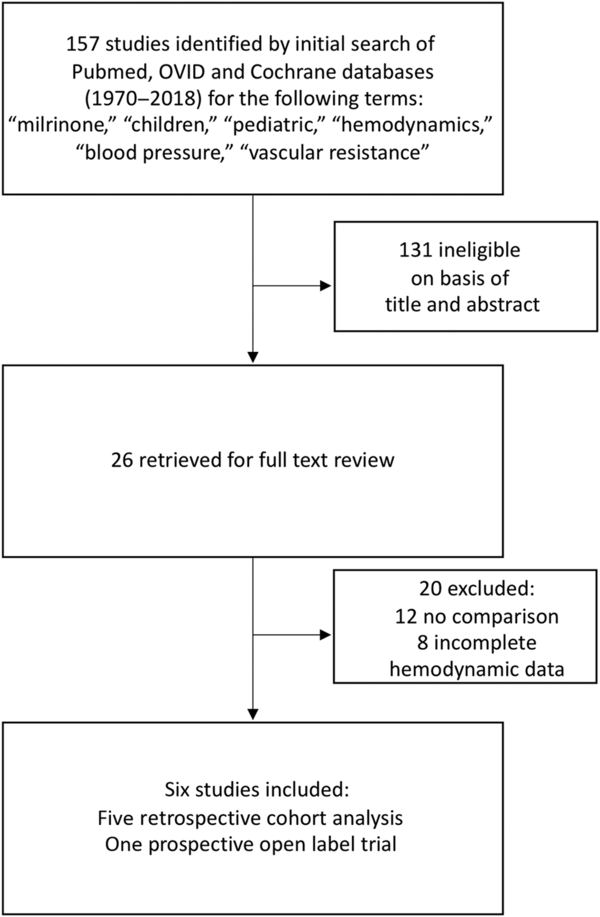
A systematic review was conducted to identify studies pertaining to the hemodynamic effects of milrinone in children. A new review protocol was used for this study as there was no existing protocol. Pubmed, EMBASE, and the Cochrane databases were queried to identify such studies. The following keywords were used in individually and in various combinations with one another: “milrinone,” “children,” “pediatrics,” “hemodynamics,” “blood pressure,” “cardiac output,” “pulmonary artery pressure,” and “vascular resistance” (Supplementary File S1). Both authors (RL, SF) reviewed the abstracts and titles of resulting studies. Full-text manuscripts of studies found to be pertinent to study questions were then obtained. These were reviewed for quality using the Newcastle–Ottawa Scale and assessed for risk of bias using the Cochrane Risk of Bias tool. Any discrepancies in these evaluations between the two authors were then reviewed by both authors and a consensus achieved. Studies of adequate quality and low risk of bias were then considered for inclusion.
Studies were included in the final pooled analyses if they met the following requirements: (1) utilised milrinone; (2) included children (under 18 years of age); (3) contained data for hemodynamic parameters before and after the initiation of milrinone; (4) published data; and (5) English language. Studies that met these criteria were then deemed appropriate for inclusion. Any discrepancies in appropriateness of inclusion between the two authors were reviewed by both authors and a consensus achieved.
Endpoints
Reported endpoints from the studies deemed appropriate for inclusion were outlined. The number of studies reporting each endpoint were then reviewed and a decision was made to include endpoints that had data from two or more studies. The following endpoints were identified for pooled analyses: systolic blood pressure (mmHg), mean arterial blood pressure (mmHg), echocardiographic Doppler-derived cardiac output (ml/kg/minute), left ventricular shortening fraction (%), right ventricular systolic pressure (mmHg), heart rate (beats per minute), arterial oxygen concentration (mmHg), arterial carbon dioxide concentration (mmHg), fraction of inspired oxygen (%), and serum lactate (mmol/L).
Data extraction
Data were extracted using an electronic data extraction tool. Data were extracted by both authors independently. As all variables were continuous, means and standard deviations for the pre- and post-milrinone data were recorded. The individually extracted data were then compared to identify any discrepancies. Discrepancies in the extracted data were then reviewed by the authors together and discrepancies resolved by consensus.
Bias analysis
Bias analysis was performed with specific attention paid to patient selection, intervention selection, endpoint inclusion, and result reporting.
Statistical analysis
Once data were extracted each endpoint underwent evaluation of heterogeneity. A Q-statistic and its resulting p value were calculated as was an I2 statistic. If the p value for the Q-statistic was less than 0.05 or if the I2 value was greater than 50%, heterogeneity was deemed significant. In the absence of significant heterogeneity, a fixed-effects model was used for the pooled analyses while a random-effects model was used if there was significant heterogeneity present. All endpoints were continuous in nature and thus pooled analyses were conducted to determine the mean difference and 95% confidence interval. Publication bias was assessed using an Egger test for endpoints with data from three or more studies. Meta-regression was not conducted due to the low number of pooled studies. Sensitivity analyses were conducted to determine the effect of milrinone dose, duration of milrinone infusion, and study size on the individual endpoints.
Results
Study characteristics
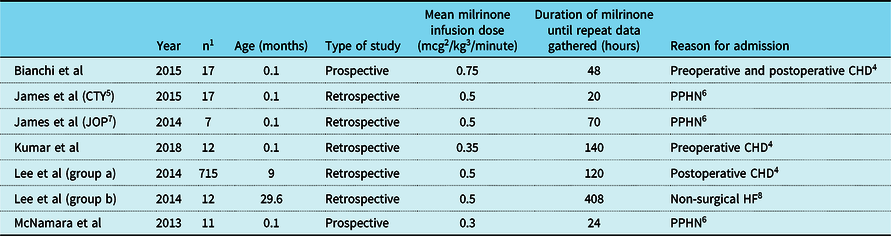
A total of six studies including 791 patients were included in the analyses (Fig 1).Reference James, Bee, Corcoran, McNamara, Franklin and El-Khuffash11–Reference Bianchi, Cheung, Phillipos, Aranha-Netto and Joynt16 Studies were published between the years 2013 and 2018. A majority, four, of the six studies included patients in the first month of life. The mean age of included patients was 8.5 months. Milrinone infusion doses ranged from 0.3 to 0.75 mcg/kg/minute with the mean infusion dose being 0.5 mcg/kg/minute. The duration of milrinone infusion until repeat hemodynamics ranged from 20 to 408 hours with a mean of 119 hours (Table 1).
Study identification methodology.

Characteristics of selected studies

1Sample size, 2micrograms, 3kilograms, 4congenital heart disease, 5Cardiology in the Young, 6persistent pulmonary hypertension of the newborn, 7Journal of Pediatrics, 8heart failure
Systolic blood pressure
A total of five studies with data from 774 patients were included in the pooled analysis of systolic blood pressure. Heterogeneity analysis resulted in a Q-statistic with a p value of less than 0.001 and an I2 value of 90%, indicating the presence of significant heterogeneity. Thus, a random-effects model was used. Systolic blood pressure was not significantly different with milrinone infusion. The mean difference in systolic blood pressure was 3.46 mmHg with a 95% confidence interval −1.20 to 8.12 (p = 0.15) (Fig 2).
Forest plot demonstrating impact of milrinone on systolic blood pressure.

Sensitivity analyses demonstrated that milrinone infusion dose and duration did not impact the pooled result. Study size, however, did. With the removal of data from group A of the study from Lee et al, the change in systolic blood pressure was significantly different with a mean difference of 2.18 mmHg (95% confidence interval 0.36–4.00, p = 0.02).
Mean arterial blood pressure
A total of four studies with data from 52 patients were included in the pooled analysis of mean arterial blood pressure.Reference James, Bee, Corcoran, McNamara, Franklin and El-Khuffash11–Reference McNamara, Shivananda, Sahni, Freeman and Taddio13, Reference Bianchi, Cheung, Phillipos, Aranha-Netto and Joynt16 Heterogeneity analysis resulted in a Q-statistic with a p value of 0.62 and an I2 value of 0%, indicating the absence of significant heterogeneity. Thus, a fixed-effects model was used. Mean arterial blood pressure was not significantly different with milrinone infusion. The mean difference in mean arterial blood pressure was 1.23 mmHg with a 95% confidence interval −0.57 to 3.04 (p = 0.18) (Fig 3).
Forest plot demonstrating impact of milrinone on mean arterial blood pressure.

Sensitivity analyses demonstrated that milrinone infusion dose, milrinone infusion duration, and study size did not impact the pooled result.
Cardiac output
A total of four studies with data from 52 patients were included in the pooled analysis of cardiac output.Reference James, Bee, Corcoran, McNamara, Franklin and El-Khuffash11–Reference McNamara, Shivananda, Sahni, Freeman and Taddio13, Reference Bianchi, Cheung, Phillipos, Aranha-Netto and Joynt16 Heterogeneity analysis resulted in a Q-statistic with a p value of 0.39 and an I2 value of 1%, indicating the absence of significant heterogeneity. Thus, a fixed-effects model was used. Cardiac output was significantly different with milrinone infusion. The mean difference in cardiac output was 52.58 ml/kg/minute with a 95% confidence interval 36.98–68.19 (p < 0.001) (Fig 4). Thus, cardiac output was significantly greater with milrinone.
Forest plot demonstrating impact of milrinone on cardiac output.

Sensitivity analyses demonstrated that milrinone infusion dose, milrinone infusion duration, and study size did not impact the pooled result.
Left ventricular shortening fraction
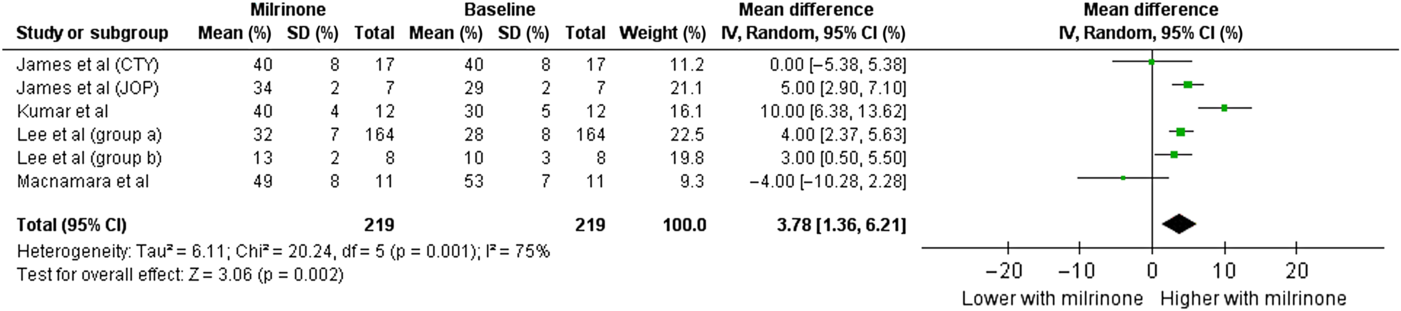
A total of five studies with data from 219 patients were included in the pooled analysis of left ventricular shortening fraction.Reference James, Bee, Corcoran, McNamara, Franklin and El-Khuffash11–Reference Lee, Kim and Kwon15 Heterogeneity analysis resulted in a Q-statistic with a p value of less than 0.001 and an I2 value of 75%, indicating the presence of significant heterogeneity. Thus, a random-effects model was used. Left ventricular shortening fraction was significantly different with milrinone infusion. The mean difference in left ventricular shortening fraction was 3.78% with a 95% confidence interval 1.36–6.21 (p = 0.002) (Fig 5). Thus, left ventricular shortening fraction was significantly greater with milrinone.
Forest plot demonstrating impact of milrinone on left ventricle shortening fraction.

Sensitivity analyses demonstrated that milrinone infusion dose, milrinone infusion duration, and study size did not impact the pooled result.
Right ventricular systolic pressure
A total of three studies with data from 36 patients were included in the pooled analysis of right ventricular systolic pressure. Heterogeneity analysis resulted in a Q-statistic with a p value of <0.001 and an I2 value of 94%, indicating the presence of significant heterogeneity. Thus, a random-effects model was used. Right ventricular systolic pressure was significantly different with milrinone infusion. The mean difference in right ventricular systolic pressure was −17.35 mmHg with a 95% confidence interval −25.15 to −9.54 (p < 0.001) (Fig 6). Thus, right ventricular systolic pressure was significantly lower with milrinone.
Forest plot demonstrating impact of milrinone on right ventricle systolic pressure.

Sensitivity analyses demonstrated that milrinone infusion dose, milrinone infusion duration, and study size did not impact the pooled result.
Heart rate
A total of four studies with data from 772 patients were included in the pooled analysis of heart rate. Heterogeneity analysis resulted in a Q-statistic with a p value of less than 0.001 and an I2 value of 94%, indicating the presence of significant heterogeneity. Thus, a random-effects model was used. Heart rate was significantly different with milrinone infusion. The mean difference in heart rate was −5.14 beats per minute with a 95% confidence interval −16.00 to 5.73 (p = 0.35) (Fig 7).
Forest plot demonstrating impact of milrinone on heart rate.

Sensitivity analyses demonstrated that milrinone infusion dose, milrinone infusion duration, and study size did not impact the pooled result.
Arterial oxygen concentration
A total of five studies with data from 774 patients were included in the pooled analysis of arterial oxygen concentration. Heterogeneity analysis resulted in a Q-statistic with a p value of less than 0.001 and an I2 value of 90%, indicating the presence of significant heterogeneity. Thus, a random-effects model was used. Arterial oxygen concentration was not significantly different with milrinone infusion. The mean difference in arterial oxygen concentration was 3.46 mmHg with a 95% confidence interval −1.20 to 8.12 (p = 0.15) (Fig 8).
Forest plot demonstrating impact of milrinone on arterial concentration of oxygen.

Sensitivity analyses demonstrated that milrinone infusion dose, milrinone infusion duration, and study size did not impact the pooled result.
Arterial carbon dioxide concentration
A total of three studies with data from 45 patients were included in the pooled-analysis of arterial carbon dioxide concentration.Reference James, Corcoran, McNamara, Franklin and El-Khuffash12, Reference McNamara, Shivananda, Sahni, Freeman and Taddio13, Reference Bianchi, Cheung, Phillipos, Aranha-Netto and Joynt16 Heterogeneity analysis resulted in a Q-statistic with a p value of less than 0.001 and an I2 value of 83%, indicating the presence of significant heterogeneity. Thus, a random-effects model was used. Arterial carbon dioxide concentration was not significantly different with milrinone infusion. The mean difference in arterial carbon dioxide concentration was 2.59 mmHg with a 95% confidence interval −4.25 to 9.42 (p = 0.46) (Fig 9).
Forest plot demonstrating impact of milrinone on arterial concentration of carbon dioxide.

Sensitivity analyses demonstrated that milrinone infusion dose, milrinone infusion duration, and study size did not impact the pooled result.
Fraction of inspired oxygen
A total of three studies with data from 35 patients were included in the pooled analysis of fraction of inspired oxygen. Heterogeneity analysis resulted in a Q-statistic with a p value of less than 0.001 and an I2 value of 97%, indicating the presence of significant heterogeneity. Thus, a random-effects model was used. Fraction of inspired oxygen was not significantly different with milrinone infusion. The mean difference in fraction of inspired oxygen was −16.52 with a 95% confidence interval −47.15 to 14.12 (p = 0.29) (Fig 10).
Forest plot demonstrating impact of milrinone on fraction of inspired oxygen.

Sensitivity analyses demonstrated that milrinone infusion dose, milrinone infusion duration, and study size did not impact the pooled result.
Serum lactate
A total of three studies with data from 45 patients were included in the pooled analysis of serum lactate.Reference James, Corcoran, McNamara, Franklin and El-Khuffash12, Reference McNamara, Shivananda, Sahni, Freeman and Taddio13, Reference Bianchi, Cheung, Phillipos, Aranha-Netto and Joynt16 Heterogeneity analysis resulted in a Q-statistic with a p value of less than 0.001 and an I2 value of 97%, indicating the presence of significant heterogeneity. Thus, a random-effects model was used. Serum lactate was significantly different with milrinone infusion. The mean difference in serum lactate was −1.77 mmol/L with a 95% confidence interval −3.01 to −0.52 (p < 0.001) (Fig 11). Thus, serum lactate was significantly lower with milrinone.
Forest plot demonstrating impact of milrinone on serum lactate.

Sensitivity analyses demonstrated that milrinone infusion dose, milrinone infusion duration, and study size did not impact the pooled result.
Discussion
The pooled analysis from six studies contains data for 791 critically ill children with various medical conditions in whom hemodynamic data were captured before and after the initiation of milrinone infusion. Milrinone was found to have several beneficial hemodynamic effects. In terms of cardiac function, the pooled analysis demonstrated that patients whom received milrinone infusion had greater cardiac output, greater left ventricle shortening fraction, and lower right ventricular systolic pressure. It was not surprising to also identified lower heart rate in these patients likely due to a concurrent cardiac output increase during milrinone infusion. Similarly, the pooled analysis demonstrated lower serum lactate levels in patients who received milrinone, presumably as a consequence of better oxygen delivery following cardiac output augmentation.
In terms of blood pressure, although the pooled analysis did not demonstrate a significant difference in systolic or mean arterial blood pressure, sensitivity analyses allowed to uncover a difference in systolic blood pressure of 2.18 mmHg. However, the implications of this difference may not be clinically significant. Furthermore, some of the studies observed echocardiographic changes related to a decrease of pulmonary vascular resistance, but the lack of objective data in the included studies limits our ability to expand further.Reference James, Bee, Corcoran, McNamara, Franklin and El-Khuffash11, Reference James, Corcoran, McNamara, Franklin and El-Khuffash12
The pooled analysis also demonstrated no difference with regards to arterial oxygen concentration, arterial carbon dioxide concentration, and the fraction of inspired oxygen. Collectively, these findings may demonstrate that the physiologic benefits observed with milrinone are primarily related to cardiac output augmentation.
Five of the included studies in this meta-analysis were retrospective in nature and took place in a critical care setting, where patients required vasoactive support for various conditions. The study completed by McNamara et al was the only prospective interventional study found in the literature. This study was primarily set up to obtain pharmacodynamic and pharmacokinetic data of milrinone in children with persistent pulmonary hypertension of the newborn and the hemodynamic information was obtained as a secondary assessment.Reference McNamara, Shivananda, Sahni, Freeman and Taddio13 Two more of the included studies were conducted in children with persistent pulmonary hypertension of the newborn.Reference James, Bee, Corcoran, McNamara, Franklin and El-Khuffash11–Reference McNamara, Shivananda, Sahni, Freeman and Taddio13 Together, these studies identified a modest decrease in right ventricular systolic pressure with no changes in systolic blood pressure, mean arterial blood pressure, or fraction of inspired oxygen. These findings are important, particularly because most of the positive effects seen from milrinone were not impacted by the infusion dose, infusion duration, and study size.
This systematic review and meta-analysis is strengthened by the use of a comprehensive search strategy, by rigorous screening and eligibility criteria and transparent reporting of our findings. However, the studies included in this manuscript were mainly retrospective, relatively small, and not powered to estimate any specific hemodynamic changes. In addition, the studies included had a wide array of diagnoses, as well as significant heterogeneity in hemodynamic outcomes, which limited our capacity for sub-group analyses in selected circumstances. The estimation of cardiac output was derived in most studies from echocardiography which is heavily dependent on loading conditions and contains inherit limitations. Some of the studies included in the meta-analysis had simultaneous cointerventions during the study time; therefore, some of the effects of milrinone may have been potentiated by synergism. Finally, the inclusion of studies with a difference in patient population, diagnosis, and management could limit generalisability of the findings.
Conclusion
The findings from this systematic review and meta-analysis identified significant hemodynamic differences after initiation of milrinone infusions in critically ill children with various medical conditions. Cardiac output, left ventricle shortening fraction, and lower right ventricular systolic pressure are significantly altered, whereas a difference in systolic blood pressure was only uncovered after excluding smaller studies. There was no difference in the fraction of inspired oxygen and the arterial oxygen and carbon dioxide concentration.
Supplementary material
To view supplementary material for this article, please visit https://doi.org/10.1017/S1047951119002865
Acknowledgements
None.
Financial Support
This research received no specific grant from any funding agency commercial, or not-for-profit sectors.
Conflicts of Interest
None.