Ambulatory rhythm monitoring in children is traditionally limited to either Holter monitoring, which captures a rhythm tracing for 24–48 hours continuously, or event recording, which requires patient coordination to connect and record heart rhythm during symptomatic periods. Both of these modalities have limitations in children, including the need for consistent attachment of wires and leads, as well as the executive function required to correctly wear and understand how to activate the trigger to capture symptomatic events.
In 2011, the Food and Drug Administration approved the clinical use of the ZioTM (iRhythm Technologies, San Francisco, California, United States of America), a device that may address both of these limitations. This compact patch ambulatory monitor directly adheres to the chest and allows for up to 14 days of continuous single-channel rhythm monitoring. The device is wireless and water-resistant, and patients can trigger symptoms by pressing a button to mark the recording and correlate symptoms with concurrent rhythm.
There is limited published clinical research on this novel technology, especially in children – a unique population with both congenital and acquired heart disease. Several publications have compared the clinical effectiveness of the ZioTM with traditional rhythm monitors in the adult population and have found high patient satisfaction and completion rates, in addition to similar or higher arrhythmia detection rates.Reference Barrett, Komatireddy and Haaser 1 – Reference Bolourchi and Batra 5 The paediatric cardiologist will commonly evaluate complaints including palpitations, pre-syncope, or syncope that prompt the need for rhythm monitoring. Only one study has been published reviewing the diagnostic yield of the ZioTM in children;Reference Bolourchi and Batra 5 that study examined data in iRhythm’s national database, which did not differentiate the presence or absence of structural heart disease, the complications or negative outcome rate, or the overall impact on clinical management following use.
Our clinical service implemented the ZioTM in November, 2013 and, as of May, 2015, has used this device exclusively in the ambulatory evaluation of children with possible arrhythmias. This paper aims to describe our clinical experience and outcomes with this technology, as well as to present a comprehensive and unbiased perspective on the use of this device in children. We describe the impact on clinical decision-making from ZioTM use in paediatric cardiology patients.
Materials and methods
Patients
This retrospective cross-sectional study was approved by the Walter Reed National Military Medical Center Institutional Review Board. The study was performed using the iRhythm web-based reporting system for ZioTM results, along with outpatient electronic medical records. All children aged 0–18 years who underwent ZioTM monitoring ordered by one of six board-certified general paediatric cardiologists between November, 2013 and June, 2016 were included.
ZioTM application and interpretation process
When application was clinically indicated, a ZioTM device was placed during an outpatient clinic visit with instructions for wear that included a demonstration of how to trigger symptomatic events by pressing the button on the monitor. Patients were given a symptom diary to return with the monitor in pre-paid shipping materials. The length of the monitoring period was determined by the clinical situation. For some patients, the monitoring period was predetermined for a specific time period, e.g., 48 hours, whereas other patients were instructed to wear the device until symptoms occurred. Hence, the length of monitoring did not necessarily correlate with the index of suspicion or severity of disease. At the conclusion of the monitoring period, the patient mailed the ZioTM and symptom diary to iRhyhthm, where the staff downloaded the data and created a preliminary report. The ordering cardiologist was then notified that a PDF report was available for review on iRhythm’s secure website, and the cardiologist then finalised the report and communicated the results to the patient.
Additional clinical data collection
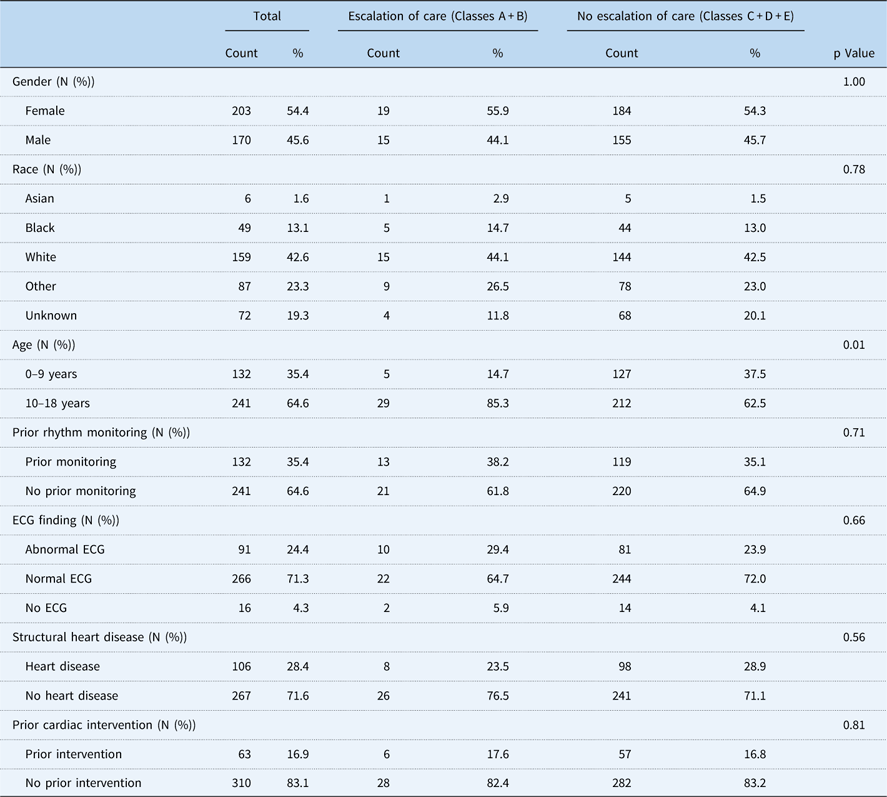
Demographic and clinical data were recorded, including age, gender, ethnicity, history of structural heart disease, any cardiac surgery or intervention, and history of previous rhythm monitoring or previous ZioTM monitoring (see Table 1). Notation was made if the electrocardiogram was abnormal during the related clinical visit, although not all studies had an associated electrocardiogram. Each ZioTM report provided information on duration of wear, number of patient triggers for symptoms, heart rate trends, and significant rhythm findings, with rhythm strips 45 seconds before and after each patient trigger.
Baseline characteristics and results of monitoring among 373 studies in children undergoing ZioTM monitoring.

Class A=arrhythmias requiring new intervention or increased medical management; Class B=arrhythmias requiring increased clinical surveillance; Class C=arrhythmias requiring no change in management; Class D=normal rhythm with symptoms; Class E=normal rhythm without symptoms; ECG=electrocardiogram
The indication for monitoring was drawn from the associated clinical encounter and was categorised into one of the nine groups: tachypalpitations; arrhythmia history, e.g., a follow-up study in a patient with a previously identified arrhythmia; screen for occult arrhythmia, e.g., a study in an asymptomatic patient with no previously identified arrhythmia; pre-syncope or syncope; abnormal electrocardiogram; heart rate trending, e.g., patients undergoing a study to primarily assess heart rate parameters; family history concerns, e.g., patients with a family history of heritable arrhythmias undergoing a study to screen for arrhythmia; irregular rhythm noted by the patient; and an “other” category for indications not otherwise listed. Any patient complications were also noted.
The presence of the following anatomical findings were considered benign: patent foramen ovale, secundum atrial septal defect measuring <4 mm, persistence of a left superior caval vein to an intact coronary sinus, trivial or mild regurgitation of an atrioventricular valve, trivial or mild pulmonary regurgitation, and trivial aortic regurgitation. Findings on electrocardiogram considered to be normal or minor variants included sinus bradycardia, sinus tachycardia, mild intraventricular conduction delay, and early repolarisation.
Findings considered to be normal or minor variants on ZioTM monitoring included the following: sinus tachycardia or bradycardia, sinus arrhythmia, atrial extra-systoles, including couplets and triplets, or 1st-degree atrioventricular block with a PR interval <200 ms.Reference Scott, Williams and Fiddler 6 In addition, the following findings were considered minor variants if they occurred only during sleep or at low resting heart rates: Mobitz type I 2nd-degree atrioventricular block, changes in P-wave morphology, and slow junctional rhythm.Reference Scott, Williams and Fiddler 6 Sustained supraventricular tachycardia or ventricular tachycardia was considered when there were eight or more consecutive beats; fewer than eight beats was considered non-sustained.Reference Bolourchi and Batra 5
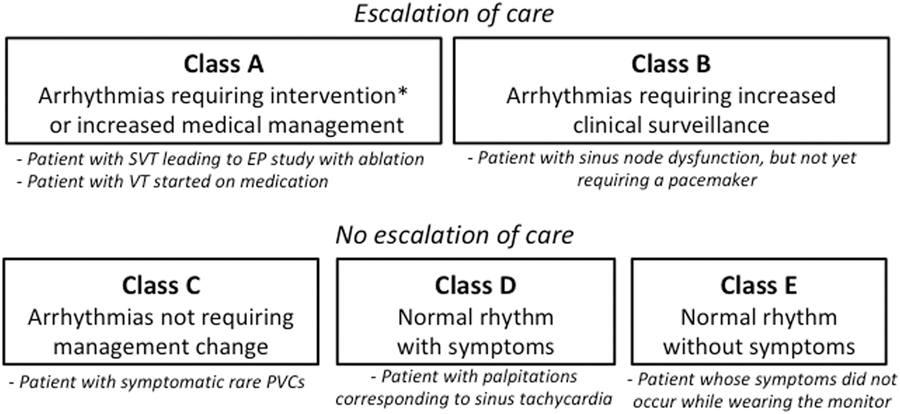
Outcome measures were divided into one of five classes, labelled A to E (see Fig 1). Class A findings included rhythm disorders requiring new intervention or increased medical management, such as supraventricular tachycardia leading to medication management or electrophysiology study with ablation. Class B findings were categorised as rhythm disorders requiring increased surveillance, such as new sinus node dysfunction not yet leading to pacemaker placement. Class C findings were arrhythmias, symptomatic or asymptomatic, that resulted in no change in management. Normal rhythm with symptoms was labelled Class D, and normal rhythm without symptoms was labelled Class E.
Classification system for rhythm finding and clinical management decision. EP=electrophysiology; PVC=premature ventricular contraction; SVT=supraventricular tachycardia; VT=ventricular tachycardia. *Intervention is defined as EP study/ablation, cardiac catheterisation, surgery, or device placement.

Statistical analysis
Statistical analysis was performed using IBM SPSS Statistics for Windows (v 22.0; IRB Corp., Armonk, New York, United States of America). Categorical data are presented as counts with proportions and compared using Fisher’s exact test. Time (days) until the occurrence of a Classes A or B finding is described using Kaplan–Meier analysis. Groups are compared using Cox regression, and differences between groups are described using the hazard ratio with a 95% confidence interval.
Results
A total of 373 ZioTM studies were reviewed on 332 patients; 33 patients had multiple studies performed during this time period, with the most frequent being four times. Two patients were excluded because of insufficient clinical documentation. On average, a ZioTM was used in 11% of all clinical encounters in the paediatric cardiology clinic for patients aged 0–18 years during the study period. The youngest patient was 29 days old, and the median age was 13 years, with an interquartile range of 7–15 years. Other patient demographic and clinical information is listed in Table 1. In total, 28.4% of studies were performed in patients with structural heart disease, and 16.9% had a prior surgical, catheterisation, or electrophysiology procedure.
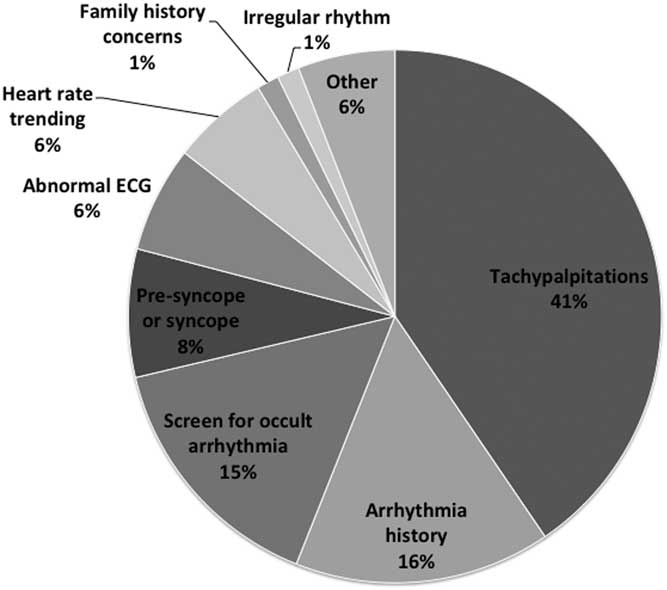
Indications for monitor placement are shown in Figure 2, with the most common indication being tachypalpitations (41%). The median duration of wear was 5 days, and wear times ranged from 1 to 14 days. The ordering paediatric cardiologist agreed with the preliminary interpretation provided by iRhythm in 94.4% of studies; among the 21 studies (5.6%) where there was disagreement, the final interpretation by the paediatric cardiologist consistently resulted in a downgrade in diagnosis severity – e.g., preliminary interpretation of possible supraventricular tachycardia that was overread as sinus tachycardia. Seven studies (1.9%) were associated with complications or patient intolerance. Of those, four were secondary to mild–moderate skin reactions and three lost skin adhesion before the indicated termination of the study and needed a replacement device.
Clinical indications for Zio™ patch ambulatory monitoring. ECG=electrocardiogram.

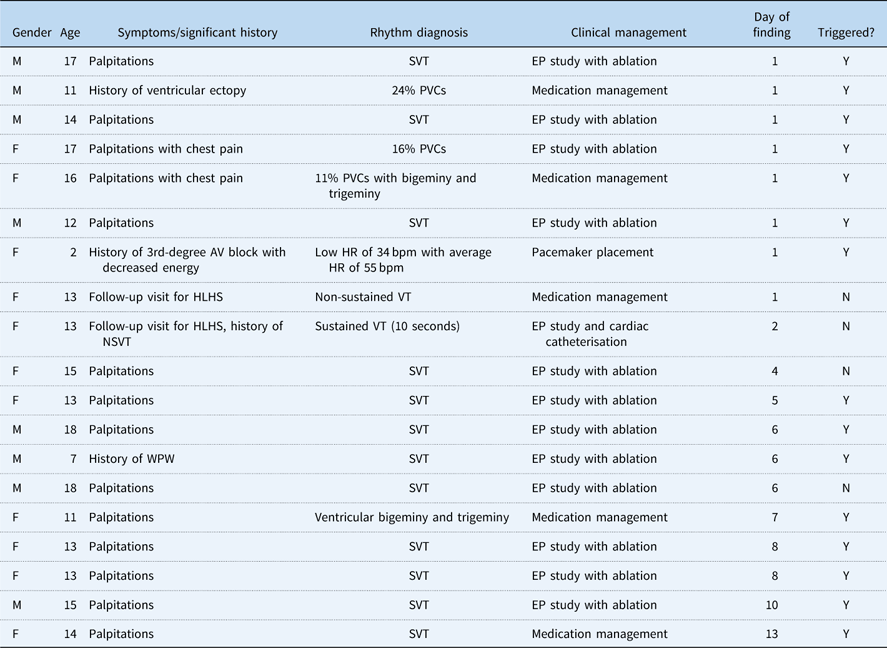
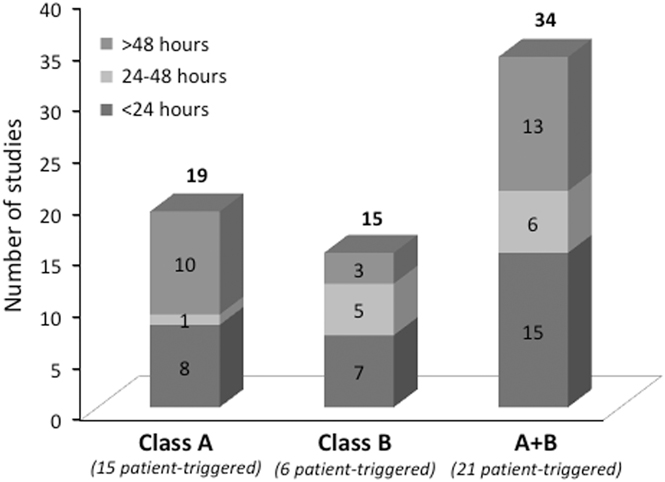
Overall, 19 of 373 ZioTM studies (5.1%) yielded Class A findings or rhythm disorders requiring new intervention or increased medical management (see Table 2). In all, ten of the 19 Class A findings were identified after 48 hours of monitoring; 12 of the 19 Class A findings were supraventricular tachycardia, with 11 of these patients being referred for electrophysiology study with ablation and the other electing for medication management only. The median time to detection of supraventricular tachycardia was 6 days. The remaining patients with Class A results had findings that included a high burden of ventricular ectopy impacting clinical status, ventricular tachyarrhythmias, or 3rd-degree atrioventricular block; all were referred to a paediatric electrophysiologist to assist with management. One teenage patient with hypoplastic left heart syndrome had non-sustained ventricular tachycardia that prompted medication management. On a subsequent study, she had sustained ventricular tachycardia that led to diagnostic catheterisation and electrophysiology procedures.
Summary of Class A findings, including patient demographics, clinical history, rhythm finding, clinical impact, 1st day of major rhythm finding, and whether or not the finding was patient-triggered.

AV=atrioventricular; EP=electrophysiology; HLHS=hypoplastic left heart syndrome; HR=heart rate; NSVT=non-sustained ventricular tachycardia; PVC=premature ventricular contraction; SVT=supraventricular tachycardia; VT=ventricular tachycardia; WPW=Wolff–Parkinson–White syndrome
Class B results were those findings that required increased clinical surveillance but did not directly result in medical or invasive intervention. Of the 373 studies, 15 (4.0%) yielded Class B findings, including ventricular ectopy determined to be clinically significant, atrioventricular block, and non-sustained ventricular tachycardia. Of the 15 Class B findings, three were identified after 48 hours of monitoring. In each case, although therapeutic intervention or invasive diagnostic evaluation was not required, the paediatric cardiologist recommended increased frequency of clinical follow-up.
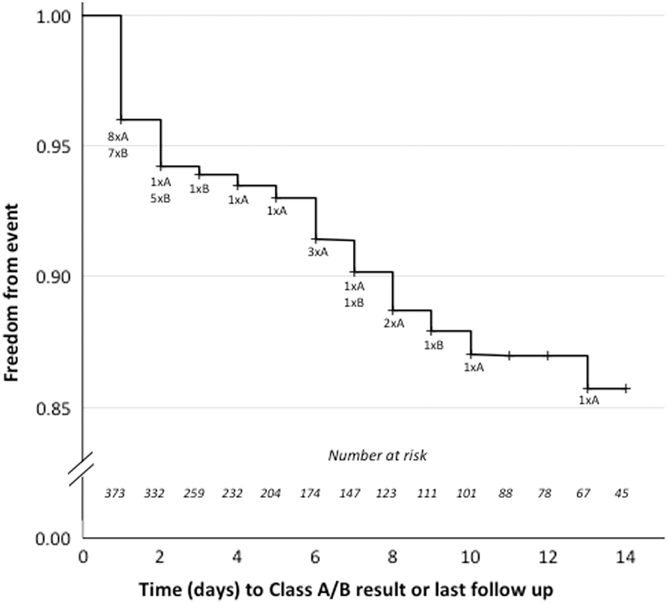
When combining Classes A and B – that is, all findings that resulted in escalation of care – 56% (n=19) had findings first identified after 24 hours of monitoring, and 38% (n=13) had findings after 48 hours (see Fig 3). The timing of all Class A+B findings is shown in Figure 4. Only 62% of Class A+B findings were patient-triggered. Class A+B findings were almost three times more likely in those aged 10 years and older (hazard ratio 2.8; 95% confidence interval 1.1–7.3, p=0.033). Gender, race, prior rhythm monitoring, electrocardiogram finding, presence of structural heart disease, and prior cardiac intervention were not statistically significant variables associated with Class A+B findings.
Number of Class A, Class B, and Class A+B studies according to the timing of first presentation. Data are presented as number of studies. “Patient-triggered” indicates the number of studies for which an arrhythmia event was recorded as symptomatic by the patient.

Kaplan–Meier analysis assessing time to Classes A or B result. # × A=# are the number of positive studies, or censored, per time interval for Class A; # × B=# are the number of positive studies, or censored, per time interval for Class B.

The remainder of the studies did not result in escalation of care. A total of 13.9% (n=52) had Class C findings, which were arrhythmias requiring no change in management. The majority of patients had symptoms that corresponded with normal rhythm, with 61.1% (n=228) falling in Class D. Last, 15.8% (n=59) were asymptomatic and had normal rhythm during the study (Class E).
Symptom–rhythm correlation
When performed for tachypalpitations, 93.5% of ZioTM studies successfully captured the patient’s symptoms during the study window. For 129 studies in patients with tachypalpitations and no structural heart disease, 13.2% had pathological arrhythmias that escalated care (Classes A or B) and 13.9% had findings that did not change management or had no symptoms during the study; however, 94 of these 129 studies (72.9%) showed normal-variant rhythm during symptoms, allowing the patients to be discharged from cardiology care. Among the 373 total studies, 174 (46.6%) studies in symptomatic patients yielded results that allowed the patient to be discharged from any further cardiology follow-up.
Discussion
The ZioTM patch ambulatory rhythm monitor proved to be an effective and well-tolerated means of evaluating suspected rhythm abnormalities in children within a general paediatric cardiology practice. Our study demonstrates that the diagnostic yield of the ZioTM in capturing important arrhythmias leading to escalation of care may be superior to what traditional Holter monitoring and event recording would have provided for these patients. For instance, among patients with findings requiring intervention or increased surveillance, 56% had findings first identified beyond 24 hours, and only 62% were patient-triggered findings. In addition, when performed for tachypalpitations, 93.5% of ZioTM studies successfully captured the patient’s symptoms during the study window. Even among findings that did not result in escalation of care, the ZioTM often served the clinical purpose of either ruling out occult arrhythmias in patients with structural heart disease or other concerning history, or ruling out arrhythmias during symptoms. More than half (55.7%) of all studies performed directly affected patient disposition; 9.1% resulted in escalation of care (Classes A and B), whereas 46.6% led to discharge from cardiology follow-up.
Although structural heart disease or prior cardiac intervention were not associated with an increase in rhythm findings leading to escalation of care, older age was significantly associated with Classes A and B findings. This may reflect a different incidence of arrhythmias in older patients, or perhaps more targeted testing performed in patients who are better able to verbalise symptoms.
Intuitively, and affirmed by numerous studies, the rate of arrhythmia detection increases with a prolonged period of monitoring.Reference Dagres, Kottkamp and Piorkowski 7 , Reference Mulder, Wijffels and Wever 8 In one study evaluating the recurrence of atrial fibrillation in adults following catheter ablation, a 24-hour study detected 59% of arrhythmia recurrence, whereas a 96-hour study detected 91%.Reference Dagres, Kottkamp and Piorkowski 7 However, traditional Holter ambulatory monitoring is typically limited to 24–48 hours because of battery life, as well as inconvenient external leads.
Event recording allows for triggered monitoring over longer time periods, but simple patient-triggering alone may still miss important arrhythmias that are either occult or not correctly triggered by the patient. One study suggests that, despite patient education and test transmissions, 23% of adult patients who had recurrence of their symptoms failed to activate their loop recorder properly;Reference Sivakumaran, Krahn and Klein 9 incorrect device triggering seems even more likely to occur within the paediatric population.
The ZioTM monitor may successfully bridge the limitations of both Holter monitoring and event recording in children. Compliance and study completion were very high, with only 1.9% of the studies terminated prematurely because of failure of monitor adhesion or patient intolerance. Prolonged monitoring is easily accomplished with wear times up to 14 days. Because of the prolonged monitoring, over half (56%) of clinically significant arrhythmias were detected after 24 hours. The monitor includes a patient-triggering function that allows for symptom–rhythm correlation, and it also provides continuous rhythm monitoring and automatic rhythm detection for the duration of the study, which has been shown to greatly increase the diagnostic yield in ambulatory rhythm monitoring.Reference Reiffel, Schwarzberg and Murry 10
As with any technology, the ZioTM has some disadvantages. There is a lack of real-time telemetry, as the device can only be analysed after it is returned to the parent company, with a typical turnaround time of 1–2 weeks. Single-channel leads may provide less reliable P-wave morphology as compared with multi-channel leads. Cost factors could be limiting in implementing this technology. Holter and event monitors may present a fixed cost amortised over the life cycle of the equipment, and analysis can often be performed in-house. ZioTM monitors must be purchased for individual use and require external analysis and reporting by the parent company. Depending on the specific insurance plan, the patient may ultimately incur a higher cost for this service.
Limitations
Limitations of our study include the lack of randomisation in this retrospective design. Chart review limited the ability of the investigators to be blinded to individual patient measures and increases susceptibility to selection bias. We attempted to control this with careful attention to inclusion criteria and strictly defined outcome measures. Because ZioTM reports only present the cardiologist a summary of rhythm findings, rather than a full-disclosure report, there may have been unreported rhythm findings that were missed or not analysed. In addition, this study was not designed to provide a head-to-head comparison of the ZioTM with other forms of ambulatory monitoring, so an improved arrhythmia detection rate can only be inferred.
In conclusion, we found that ZioTM monitoring positively affected clinical decision-making in our practice. This well-tolerated device may improve what traditional Holter monitoring and event recording would provide for children, both in terms of its ability to identify arrhythmias that would likely have been otherwise missed and its ability to definitively rule out arrhythmias as a cause for symptoms and allow for safe discharge from cardiology care. We recommend that future studies directly compare the diagnostic yield and cost-effectiveness of the ZioTM with other forms of ambulatory rhythm monitoring in children.
Financial Support
This research received no specific grant from any funding agency or from commercial or not-for-profit sectors.
Conflicts of Interest
The views expressed in this article are those of the authors and do not reflect the official policy of the Department of Army/Navy/Air Force, Department of Defence, or US Government. The identification of specific products or scientific instrumentation does not constitute endorsement or implied endorsement on the part of the authors, Department of Defence, or any component agency. Although we generally excise references to products, companies, manufacturers, organisations, etc. in government-produced works, this report presents a special circumstance when such product inclusions become an integral part of the scientific endeavour.
Ethical Standards
The authors assert that all procedures contributing to this work comply with the ethical standards of the relevant national guidelines on human experimentation and with the Helsinki Declaration of 1975, as revised in 2008, and has been approved by the institutional committees of Walter Reed National Military Medical Center.
Acknowledgements
The authors thank Robin Howard, MA, from the Department of Research Programs for her assistance in study design and statistical analysis. They also thank Theresa Taylor, CNA, and Dennis Shanta, RN, for their dedication to patient care in managing the ambulatory rhythm monitoring programme at the Children’s Center at Walter Reed National Military Medical Center.