Bovine mastitis is an inflammatory condition of the mammary gland predominantly caused by microbial infection (Leigh, Reference Leigh1999; Akers & Nickerson, Reference Akers and Nickerson2011). Mastitis is a disease of cows which causes significant economic losses (Bennett et al. Reference Bennett, Christiansen and Clifton-Hadley1999; Petrovski et al. Reference Petrovski, Trajcev and Buneski2006; Halasa et al. Reference Halasa, Huijps, Osteras and Hogeveen2007). Approximately AU$130 million is lost annually in the Australian dairy industry due to poor udder health, causing a reduction of milk production and quality associated with mastitis (Tiwari et al. Reference Tiwari, Babra, Tiwari, Williams, De Wet, Gibson, Paxman, Morgan, Costantino, Sunagar, Isloor and Mukkur2013). Without effective mastitis control programmes, affected herds may have mastitis-related morbidity as high as 35% (Petrovski et al. Reference Petrovski, Heuer, Parkinson and Williamson2009).
Streptococcus uberis is a common cause of mastitis in dairy cattle in many countries (Hendriksen et al. Reference Hendriksen, Mevius, Schroeter, Teale, Meunier, Butaye, Franco, Utinane, Amado, Moreno, Greko, Stark, Berghold, Myllyniemi, Wasyl, Sunde and Aarestrup2008; Petrovski et al. Reference Petrovski, Heuer, Parkinson and Williamson2009, Reference Petrovski, Williamson, Lopez-Villalobos, Parkinson and Tucker2011b). The organism has been cited to cause up to 26% of clinical mastitis cases (Leigh, Reference Leigh1999). Streptococcus uberis is recognised as an environmental mastitis pathogen, maintaining an infection reservoir within the farm environment (Zadoks et al. Reference Zadoks, Gillespie, Barkema, Sampimon, Oliver and Schukken2003; Lopez-Benavides et al. Reference Lopez-Benavides, Williamson, Pullinger, Lacy-Hulbert, Cursons and Leigh2007). As such, infection predominantly occurs from the environment rather than directly from cow-to-cow and numerous strains of S. uberis may be present on one farm (Abureema et al. Reference Abureema, Smooker, Malmo and Deighton2014).
A broad range of virulence genes were detected in S. uberis in a variety of combinations (Reinoso et al. Reference Reinoso, Lasagno, Dieser and Odierno2011). Additional studies have shown that some S. uberis strains are more virulent than others and have become more adapted to grow in milk and to adhere to and invade mammary epithelial cells or macrophages of the mammary gland (Tamilselvam et al. Reference Tamilselvam, Almeida, Dunlap and Oliver2006). Significant differences in the success rate of inducing clinical mastitis and a single set of virulence markers of S. uberis mastitis have not been clearly explained. In particular, effects of strain differences and challenge dose size on induction of clinical mastitis are not yet completely understood. Mastitis challenge infection models are required in order to test new intramammary antimicrobial compounds, other novel bovine mastitis treatments (e.g. homeopathic remedies) and study mastitis pathogenesis (Bannerman et al. Reference Bannerman, Paape, Goff, Kimura, Lippolis and Hope2004; Wang et al. Reference Wang, Song, Petrovski, Eats, Trott, Wong, Page, Perry and Garg2015). A reliable S. uberis challenge model is also required to cost-effectively evaluate the safety and efficacy of new antimicrobial compounds being developed for the treatment of mastitis.
The objective of this study was to establish a reliable S. uberis challenge infection model in Holstein Friesian dairy cows in active lactation and to detect the effect of different S. uberis strains and challenge dose size using a consistent inoculum preparation method.
Materials and methods
Streptococcus uberis isolate selection, inoculum preparation and dose determination
Streptococcus uberis isolates used for the mastitis challenge were obtained from a collection of mastitis pathogens obtained from cases of clinical mastitis in dairy cows in South Australia and stored in glycerol (20%) broth at −80 °C in the Infectious Diseases Laboratory, Roseworthy campus, The University of Adelaide. On the basis of selection criteria (single isolate per farm, original isolate coming from a known clinical case of mastitis, sensitivity to β-lactam antimicrobials, rapid growth on solid media and in milk), three S. uberis isolates (MLF1283, BFR6019 and SA002), were chosen for experimental mastitis challenge experiments in dairy cows. All isolates were identified to species level using standard biochemical tests (Gram stain, catalase production, the Christie, Atkins, Munch, Petersen (CAMP) test, and aesculin and hippurate hydrolysis), and 16S rRNA gene sequence analysis (Hogan et al. Reference Hogan, Gonzales, Harmon, Nickerson, Oliver, Pankey and Smith1999; Milinovich et al. Reference Milinovich, Trott, Burrell, van Eps, Thoefner, Blackall, Al Jassim, Morton and Pollitt2006). All three strains were susceptible to β-lactam antimicrobials on the basis of microdilution antimicrobial susceptibility tests performed according to CLSI guidelines (Watts et al. Reference Watts, Papich, Bade, Brown, Fajt, Fritsche, Heine, Hunter, Schwartz, Silley, Wu and Zurenko2013).
For challenge infection studies, aliquots from frozen stock cultures were plated on sheep blood agar (SBA, Oxoid, Australia) and incubated at 36 ± 1 °C for 18 h under 10% CO2-enriched conditions. Bacterial suspensions for each pure culture were aseptically prepared in phosphate buffered saline (PBS, pH 7·2, Sigma, Australia) to an optical density of 0·09, equivalent to 7·5 × 107 colony forming units (cfu)/ml, as determined by a spectrophotometer (Eppendorf, Australia) set at a wavelength of 600 nm. Each culture suspension was diluted in sterile PBS to achieve two inoculum doses of each S. uberis strain (approximately 106 and 104 cfu/quarter) were prepared for each in-vivo mastitis treatment.
Animals
This study was conducted with the approval of an appropriate Animal Ethics Committee (AEN#S-2013-176A). Twelve Holstein Friesian dairy cows, 5 ± 2 years of age in active lactation (167 ± 8 d in milk), were selected on the basis of the following selection criteria: absence of mastitis, a consistent history of somatic cell counts below 200 × 103 cells per ml of milk in the previous 12 months (11 samples approximately from each cow every 5 weeks tested by fossomatic counter at the regular herd tests), four healthy and functional quarters, and no antibiotic treatments within a month prior to the trial. Cows were milked twice at approximately 12-h intervals (7.00 am and 7.00 pm) with average milk production of 22·3 ± 7·4 kg per day.
Groupings for experimental challenge
Cows were randomly assigned into three treatment groups in the dairy research unit at The University of Adelaide and given study identification numbers prior to challenge with each S. uberis strain (Group 1 MLF1283, Group 2 BFR6019 and Group 3 SA002). On day 0, all cows were administered a single standardised dose of S. uberis in 5 ml of sterile PBS via intramammary infusion immediately after the morning milking. Cows in each treatment group received a 104 cfu/quarter dose and a 106 cfu/quarter dose of the corresponding strain in contralateral quarters, for example, front left and rear right, or front right and rear left. The two quarters per cow that were not administered the S. uberis challenge doses served as untreated controls. Cows were examined at each milking visually and by palpation for signs indicating mammary inflammation, elevations in rectal temperature, general health and milk appearance on a milking basis up to 14 d post-challenge.
Diagnosis of clinical mastitis
A clinical mastitis diagnosis was established on the basis of clinical findings including general attitude of the cow, appetite, rectal temperature, changes of udder consistent with mastitis (such as a swollen, hot and/or tender udder/quarter), and milk/secretion appearance (such as clotted and discoloured milk). A scoring system was applied to each group of clinical signs modified from a previously reported study where score 3 and above was classified as clinical mastitis (Petrovski et al. Reference Petrovski, Caicedo-Caldas, Williamson, Lopez-Villalobos, Grinberg, Parkinson and Tucker2011a). Mastitis was also diagnosed based on the milk appearance, with secretion showing signs of flecks, clots, wateriness on more than 3 strips classified as mastitis.
Milk analysis
Milk samples were collected aseptically from challenged and unchallenged quarters twice per day from day -7 to day 14 of the study, and transferred to the laboratory within 1 h for bacteriological culturing and somatic cell count (SCC) determination within 72 h of collection. Ten-fold dilutions of each milk sample were prepared in normal saline and a 100 μl aliquot of each dilution was spread plated onto SBA for bacterial enumeration. Colonies were identified as S. uberis using standard phenotypic tests (Hogan et al. Reference Hogan, Gonzales, Harmon, Nickerson, Oliver, Pankey and Smith1999). SCC was performed for each milk sample using a FOSS Fossomatic 5000 (Hillerød, Denmark) by a commercial laboratory (NHIS, Cohuna, VIC, Australia).
Random Amplified Polymorphic DNA fingerprinting
Bacterial DNA was extracted from 200 μl aliquots of each S. uberis strain (the three selected S. uberis challenge strains, S. uberis strain ATCC 700407, and each isolate obtained from infected mammary quarters in the challenge study) grown overnight in 10 ml brain-heart infusion medium using a DNA extraction kit (Mericon DNA Bacteria Kit, Qiagen, Australia) according to the protocol recommended by the manufacturer. Random amplification of polymorphic DNA (RAPD) was carried out using primer OPE-04 (5′-GTGACATGCC-3′) and primer 1254 (5′-CCGCAGCCAA-3′) to obtain a DNA RAPD profile for each S. uberis strain. The amplification reactions were prepared in 25 μl volumes, made up of 5 × PCR master mix (5 μl) (Bioline, Australia), DNA-grade water (16 μl), Taq DNA polymerase (1 μl) (units/μl, Bioline, Australia), primer (1 μl) (50 pmol/μl, GeneWork, Australia) and genomic DNA (2 μl). All components of the PCR reaction except amplified DNA were included as a negative control and S. uberis strain ATCC 700407 was the positive control. PCR reaction conditions were as follows: the first cycle of amplification at 94 °C for 5 min was followed by 35 subsequent cycles consisting of 94 °C (1 min), 34 °C (1 min), and 72 °C (2 min), with a final extension step at 72 °C for 5 min in a Kyratec SuperCycler SC200 thermal cycler. The PCR products were separated by electrophoresis in 2% (wt/vol) agarose gels (Invitrogen, Australia) in 1 × TAE buffer at 150 V for 3·5 h. The gel was visualised after staining with GelRed (0·5 μg/ml) under a UV transilluminator (Jayarao et al. Reference Jayarao, Gillespie and Oliver1996).
Amplification of different band lengths in MLF1283, BFR6019, SA002 strains as well as ATCC 700407 (as control), in response to primers, were recorded as 1 (existence of band) and 0 (non-existence of band). The generated dataset was used for clustering based on Average Linkage Method and Euclidian distance by Minitab 17.
Statistical analysis
The effect of strains and doses on mastitis was analysed as factorial experiments in the frame of Randomised Block Design (RCBD) where the cows (replications) were supposed as blocks. This allowed exclusion of the effect of differences between cows in response to mastitis to increase the accuracy of comparisons. Analysis of Variance (ANOVA) and factorial design of experiment provided the opportunity to analyse the statistical effects of strain, dose as well as interaction between strain with high and low doses. Mean comparisons was carried out by Tukey Pairwise comparisons test in SAS (Statistical Analysis System, SAS Institute Inc., Cary, NC, USA 2015) version 9.4. For analysis, the SCC were log transformed (log10) and presented as SCS. Pearson correlation was used to measure the association between mastitis occurrence, milking of mastitis diagnosis, and severity score of mastitis by clinical sign, heist SCC, and milk reduction using Minitab version 17.1 (Minitab PTY Ltd, Sydney, NSW, Australia).
Results
Experimental challenge with high and low doses of Streptococcus uberis strains MLF1283, BFR6019 and SA002
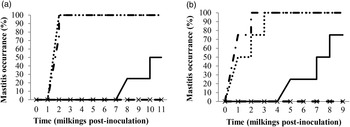
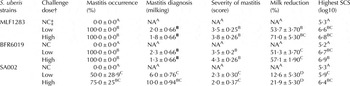
We found that strain BFR6019 induced mastitis in all challenged quarters (100·0% incidence for both high and low doses) within the shortest time from inoculation to detection (within 1·3 and 2·3 milkings after challenge for the high and low dose respectively), followed by strain MLF1283 (100·0% incidence for both doses within 1·8 and 2·0 milkings after challenge for the high and low dose respectively) and severe clinical signs (Table 1; Fig. 1). In contrast, strain SA002 induced mastitis in fewer quarters (75·0 and 50·0% incidence for the high and low dose respectively) the slowest (by 6·0 and 10·0 milkings after challenge for the high and low dose respectively; Fig. 1) and milder clinical sign (less swelling of the quarter and less obvious changes in appearance of the secretion; Table 1). The occurrence of mastitis and the time from challenge to detection of mastitis showed a high significant distinction (P = 0·03) between the low dose and high dose of strain SA002, as well to both doses of strains BFR6019 and MLF1283 (Table 1).
The time post-inoculation to detection of clinical mastitis for S. uberis challenge strains BFR6019 (▬ ■ ▬), MLF1283 (·········), SA002 (───) and unchallenged quarters (▬ x ▬) for low dose (104 cfu/quarter) (a) and high dose (106 cfu/quarter) inocula (b) in Holstein Friesian dairy cows in active lactation (i.e. not during the dry period).

The mean values (±se) obtained by the analysis of variance comparing the effects of different doses and strains of Streptococcus uberis on the incidence of mastitis, milking at which mastitis was diagnosed, mastitis severity score, percentage of milk reduction after challenge and log10 SCS according to Tukey test

† Low dose: 104 cfu/quarter, High dose: 106 cfu/quarter
‡ Non-challenged quarters (control), NA = not applicable. Various superscripts indicate statistical significance (different letters within a column)
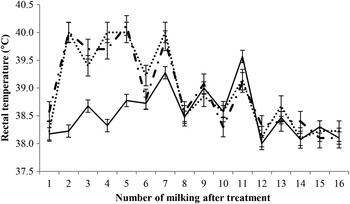
Strains MLF1283 and BFR6019 had very similar effects on SCS kinetics (Table 1). The SCS of strains BFR6019 and MLF1283 for all challenged quarters was greater than that of the non-challenged quarters (SCS of 3·3) with a higher rise in the high dose (SCS of 3·8) than the low dose (SCS of 3·6) by the first milking after challenge, indicative of an inflammatory response. The peak SCS varied between treatment groups (Table 1) and followed the occurrence of clinical mastitis or one milking afterwards. Strains MLF1283 and BFR6019 were also similar in rectal temperatures (Fig. 2) characterised by faster increases and slower decline, mastitis clinical sign score (⩾3, Table 1), and evident depression of the milk production greater than 50·0% for both doses. Similar levels of SCS (3·5–3·6) were obtained in the quarters challenged with strain SA002 by the fifth milking, when quarters showed signs of clinical mastitis. The strain SA002 resulted in a delayed rise and faster decline of SCS, lower rectal temperatures (Fig. 2) and a slighter depression of the milk production (12·6 and 21·9% for the low and high dose respectively; Table 1). All challenged quarters had significantly higher SCS, milk reduction and severity of the clinical sign compared to control quarters from the second milking after infusion (P < 0·01). The challenged quarters with strain SA002 showed significantly less milk reduction and severity of the clinical sign compared to strains MLF1283 and BFR6019 (P < 0·01, Table 1).
The mean (±sd) value of rectal temperature for Holstein Friesian dairy cows after challenging with S. uberis strain BFR6019 (▬ ■ ▬), MLF1283 (········) and SA002 (───) during lactation.

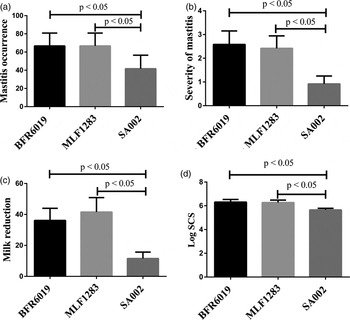
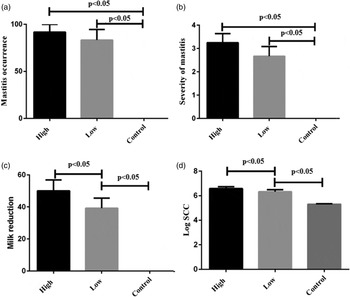
Pearson correlation analysis showed that there were significant differences in the incidence of mastitis, milking of mastitis diagnosis relative to challenge inoculation, mastitis severity score, percentage of milk reduction and the SCS in quarters challenged with both strains BFR6019 and MLF1283 compared to strain SA002 (Fig. 3). Additionally, a strong correlation of the percentage of milk reduction and the SCS was observed, but there was no correlation of the incidence of mastitis and milking of mastitis diagnosis relative to challenge inoculation between the low doses and high doses of all S. uberis strains (Fig. 4).
The effect of Streptococcus uberis strain BFR6019, MLF1283, and SA002 on the incidence of mastitis (a), mastitis severity score (b), percentage of milk reduction (c) and log10 SCS (d) in challenge quarter induced mastitis signs.

The effect of inoculum doses of Streptococcus uberis on the incidence of mastitis (a), mastitis severity score (b), percentage of milk reduction (c) and log10 SCS (d) in challenge quarter induced mastitis signs.

Treatment of experimentally induced mastitis
Once clinical mastitis was detected, the infected quarters were treated immediately after milking according to the manufacturer's recommendation with a commercially available cloxacillin intramammary product (containing 200 mg cloxacillin benzathine) once daily for 3 d per mastitis quarter. Approximately 10 d post-treatment, the mean milk yield markedly increased and SCC dropped to below 250 × 103 cells/ml of milk, coinciding with the cessation of clinical signs of mastitis. At the end of the experimental period (day 14) each quarter was sampled aseptically for culture to confirm bacteriological cure and no bacteria were isolated from samples.
Streptococcus uberis identification and typing
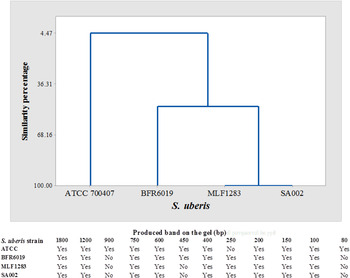
All milk samples collected from challenged quarters with clinical signs and high SCC yielded one type of bacterial colony on SBA and no bacteria were isolated from control samples. Primers OPE-04 and 1254 generated reproducible RAPD band profiles for the three S. uberis challenge strains. Based on RAPD profile, S. uberis BFR6019 and SA002 were closely related, but their banding pattern was distinct from S. uberis MLF1283 and the ATCC 700407 reference S. uberis strain (Fig. 5). Our bacterial identification schemes and RAPD fingerprinting confirmed that each S. uberis isolated from clinical mastitis was identical to each respective challenge S. uberis strain.
Random Amplified Polymorphic DNA fingerprinting of S. uberis strains, BFR6019, MLF1283, SA002, and ATCC 700407 (as control). Clustering carried out based on the amplified bans.

Clustering of S. uberis strains, based on the amplified bands, is presented at Fig. 5 which shows high similarity between the strains BFR6019 and SA002 compared to strain MLF1283. Primers clearly distinguished the study strains BFR6019, SA002, and MLF1283 from a control strain (ATCC 700407).
Discussion
Experimental mastitis challenge studies are expensive and labour intensive, thus identifying a reliable S. uberis challenge strain, inoculum preparation and challenge protocol are essential. In our study, two of three tested S. uberis strains fulfilled our selection criteria. The S. uberis strain MLF1283 was identified as the preferential candidate for further studies based on a 100% success rate of mastitis induction, the time from inoculation to the onset of clinical signs and uniform response to treatment when either 104 or 106 cfu doses of S. uberis MLF1283 were inoculated per quarter. The reliability of our challenge model is confirmed by others in consecutive studies (Wang et al. Reference Wang, Song, Petrovski, Eats, Trott, Wong, Page, Perry and Garg2015).
All quarters that we challenged with a low or high dose of S. uberis MLF1283 or BFR6019 developed clinical signs of mastitis in the early stages (within 1 and 2 d, respectively) of the trial. By contrast, previous studies have reported that the interval from inoculation to clinical response using lower inoculum doses (e.g. ⩽103 cfu/quarter) was variable (Milner et al. Reference Milner, Page and Hillerton1997; McDougall et al. Reference McDougall, Parker, Swift, Harcourt and Sutherland2004; Jackson et al. Reference Jackson, Nickerson, Kautz and Hurley2012). Additionally, others have shown that inoculum doses lower than 600 cfu/quarter yielded more variable mastitis challenge success rates in the range of 42·9% (one inoculum dose of 565 cfu S. uberis/quarter) to 70% (one inoculum dose of 250 cfu S. uberis/quarter) (Paape et al. Reference Paape, Schultze, Corlett and Weinland1988; Nickerson et al. Reference Nickerson, Boddie, Owens and Watts1990) that differs from the results of our study. This may be related to the variation among cows in their immune function, bacteria in their pathogenicity or the inoculum doses. In our study, the third candidate S. uberis strain (SA002) resulted in a poor mastitis challenge success rate, even when administered at the high inoculum dose, in contrast to the high success rates (95·7 and 85·7%, respectively) achieved in previous studies using 10-fold lower inoculum doses (103 cfu/quarter) (Jackson et al. Reference Jackson, Nickerson, Kautz and Hurley2012).
The time from inoculation to detection of clinical mastitis also varied considerably for the two more virulent S. uberis strains MLF1283 or BFR6019 (⩽2 d) compared to SA002 (⩾3 d). The differences in the success rates and time from challenge to detection of clinical mastitis were evident despite the similar doses per strain used for challenge in our study. Hence, when developing a S. uberis mastitis challenge model, our results could suggest that the virulence of the strain appears to be a far more important consideration than the size of the inoculum dose.
The correlation results and significant differences in induced rate of clinical mastitis, the severity of the induced mastitis, SCS and the RAPD fingerprinting data revealed interesting variations of the virulence despite the genetic background of the candidate S. uberis challenge strains observed in previous studies (Phuektes et al. Reference Phuektes, Mansell, Dyson, Hooper, Dick and Browning2001; Zadoks et al. Reference Zadoks, Gillespie, Barkema, Sampimon, Oliver and Schukken2003; Wang et al. Reference Wang, Chen, Zhang and Zhu2013). Despite their close genetic relatedness, S. uberis strains BFR6019 and SA002 showed distinct differences in virulence, as evidenced by the correlation results between strains and mastitis occurrence, time to onset and the severity of clinical signs of mastitis, SCS and effect on the milk production, which varied between the respective strains. In contrast, S. uberis strains MLF1283 and BFR6019 were genetically distinct on the basis of RAPD profile, but shared a high degree of similarity in virulence in terms of inducing similar clinical mastitis signs (both time to onset and severity), SCS and the reduction in milk production. The SCS in the milk of an affected mammary gland is closely related to the severity of inflammation (Harmon, Reference Harmon1994; Sharma et al. Reference Sharma, Singh and Bhadwal2011) and provides an excellent measure of virulence potential of the infecting strain.
In conclusion, our aim of developing a reliable S. uberis mastitis challenge model in dairy cows during active lactation was achieved, and infections were successfully treated by the administration of cloxacillin intramammary product. Whilst the effects of both strain virulence and challenge dose size greatly influence all types of bacterial challenge infection studies, in our S. uberis mastitis challenge infection model, strain virulence seems to be more important.
This project was supported by Luoda Pharma Pty Ltd and BioInnovation SA.