


Large swaths of the Islamic world are engulfed in religious violence. Within Muslim-majority countries, killings perpetrated by terrorist groups numbered at least 25,000 in 2015.Footnote 1 In Nigeria, an ongoing rebellion by Boko Haram has resulted in the displacement of 2.2 million people (Comolli Reference Comolli2015). Taliban fighters continue to frustrate ISAF efforts to bring stability to Afghanistan (Lyall, Blair, and Imai Reference Lyall, Blair and Imai2013), while tensions between Sunni and Shia sects fuel violent insurgencies in Iraq and Yemen (Ahmed Reference Ahmed2011).
Alongside deepening conflict, many countries in the Middle East, North Africa, and southern Asia are charting a course toward greater democracy.Footnote 2 This has kindled anxiety on the part of international policymakers regarding the possible nexus between electoral outcomes and ethnoreligious violence. Many have argued that the best way to mitigate interreligious group conflict in weakly institutionalized democracies is to abet the election of “moderates” and “secularists.” In a 2013 speech before the United Nations General Assembly, for example, President Barack Obama lamented the turmoil in the Middle East that had “laid bare deep divisions within societies.” In response, he noted that “America and others have worked to bolster the moderate opposition.”Footnote 3 The European Union has sought to shore up secular parties in the Maghreb through its European Neighborhood Policy (Laïdi Reference Laïdi2008). The presumption that having moderate forces prevail at the ballot box can help contain the spread of religious strife suffuses policy discussion.
But do secularists in fact curb religious violence when in office? Not only is available evidence scant, but social scientific theory yields ambiguous predictions. On one hand, secular parties—those promoting avowedly nonreligious platforms and subscribing to an inclusive national vision—might face powerful electoral incentives to quell attacks, especially when they rely on the votes of violence-hit minorities (Horowitz Reference Horowitz1985; Wilkinson Reference Wilkinson2004). It is also possible that more competent politicians, and those nursing a deep-seated commitment to preventing bloody disturbances, gravitate toward secular parties. However, electoral victory by secularists might exacerbate conflict if religiously motivated militants target violence on the strongholds of secular opponents (cf. Crost, Felter, and Johnston Reference Crost, Felter and Johnston2014). Meanwhile, capacity-based accounts imply that secularist incumbency will be largely irrelevant in places where state institutions are enfeebled or absent, or where civilian control over the military is tenuous (Fearon and Laitin Reference Fearon and Laitin2003).
In this article, we spell out the channels by which secular-party incumbency might shape religious conflict. We then seek to adjudicate these claims empirically, employing Pakistan—the world’s sixth largest country by population—as a laboratory. Since the late 1980s, Pakistan has operated mostly under democratic institutions. Over the same time period, the country has been convulsed by two types of religious violence: sectarian hostilities between the country’s minority Shia and majority Sunni communities, and Islamist/Jihadist militancy that mushroomed in the wake of the 2001 American invasion of Afghanistan. Terrorism claimed the lives of 35,000 Pakistanis between 2001 and 2011 alone—a situation that many observers liken to a civil war (Jaffrelot Reference Jaffrelot2015; Lieven Reference Lieven2011; Fair and Jones Reference Fair and Jones2009).
Our research design seeks to quantify how levels of local religious violence respond to the election of a member of the Pakistan National Assembly (MNA) belonging to a secular party. Isolating this effect is challenging. Places that experience militant attacks and sectarian riots are likely to differ in systematic ways from more peaceful areas. If these contextual differences themselves influence secular candidates’ propensity to win or lose elections, then any observed relationship between secularist-party incumbency and religious conflict will be spurious.
To overcome these inferential hurdles, we use an instrumental variables design, capitalizing on the occurrence of closely fought elections between secular and nonsecular party candidates. Our identifying assumption is that the outcomes of such close elections are as good as randomly decided (Lee Reference Lee2008). Based on case-study literature, expert surveys, and a probability sample of Pakistani voters, we classify Pakistan’s major political parties as either secularist or nonsecularist. We then combine comprehensive MNA electoral returns with event data on religious violence between 1988 and 2011. Implementing the analysis, we find that an as-if random increase in the share of district seats occupied by secularist incumbents substantially reduces the incidence and severity of militant and sectarian attacks. Moving from a district in which no seats are secularist-held to one where all seats are secularist-held decreases the likelihood of any violence breaking out by 66 percentage points. We observe similarly large point estimates on deaths and injuries. The main result survives numerous specification checks. A battery of prognostic tests buttresses the claim that victory by secular-party candidates in our sample of close races approximates a coin flip.Footnote 4
To gain traction on mechanisms, we run three sets of additional empirical analyses. First, theories of electoral sanctioning imply that victimized voters will harshly penalize a secular-party incumbent for violence that erupts on her watch; secularists should thus invest special efforts to staunch religious hostilities. Focusing on electoral outcomes in the immediate aftermath of religious disorder, we find evidence to substantiate this hypothesis. Second, we compile a trove of information on candidates’ attributes and prior political experience. Difference-in-means tests elicit few measurable differences between secular- and nonsecular-party candidates. In fact, defections between parties are par for the course in Pakistan, refuting the idea that politician selection drives our headline result. Last, the secular-party effect is concentrated in regions with denser police presence, suggesting that influence over the coercive arm of the state may be a necessary input into violence-mitigation activities.
Our findings add to the burgeoning literature on the origins of civil conflict. An extensive body of work documents the economic, informational, and ethnic underpinnings of insurgent recruitment and strategy (Weinstein Reference Weinstein2007; Kalyvas Reference Kalyvas2006; Cederman, Wimmer, and Min Reference Cederman, Wimmer and Min2010; Lyall Reference Lyall2010). Recent research has devoted particular attention to elucidating the implications of international and domestic aid programs for conflict (Beath, Christia, and Enikolopov Reference Beath, Christia and Enikolopov2013; Nunn and Qian Reference Nunn and Qian2014; Dube and Naidu Reference Dube and Naidu2015). Yet, extant studies are largely blind to the effects of political parties and party systems on subnational violence. Closest to our article is Nellis, Weaver, and Rosenzweig (Reference Nellis, Weaver and Rosenzweig2016), who demonstrate the pacifying impact of incumbency by a single party—the Indian National Congress—on Hindu-Muslim rioting in India. Dell (Reference Dell2015) uses a similar design to show that the election of Partido Acción Nacional mayors in Mexico increases homicide rates due to the stricter enforcement of drug laws. Our findings are novel insofar as they zero in on a type of conflict—namely, Islamist and sectarian violence—not addressed by prior studies.
The results contribute to active policy debates. Pakistan’s geostrategic significance—bordering Afghanistan, Iran, India, and China—combined with its reputation for incubating militant groups such as al-Qaeda, place it at the forefront of efforts to enhance international security. Strengthening democratic processes in Pakistan has been a focal point of attempts to stabilize the “Af-Pak” region. In 2011, USAID launched a five-year, $21.5 million program “[t]o help Pakistan’s political parties become more effective and responsive to local concerns” (USAID 2015, 2). We supply the firmest evidence so far about the necessity of heeding not only the structure of party-political competition in fragile democracies, but also the ideational content and social support bases of parties vying for office. Although we should be careful about generalizing from a single case, the findings presented here give cause for optimism that incumbency by secularists is an important tool for curtailing deadly religious violence.
THEORETICAL PERSPECTIVES
A longstanding theoretical and empirical debate investigates partisanship’s effects on such assorted outcomes as public goods provision, crime, taxation, and economic growth.Footnote 5 To date, however, studies have focused on advanced industrialized democracies, and have turned up mixed empirical findings. Substantively, no prior work has theorized the link between secularist-party incumbency and religious violence—our task in what follows.
Integrating insights from several literatures, we hypothesize four reasons for why and how officeholders’ partisanship might impact local religious conflict.
A. Electoral Incentives
We define secular parties as those that publicly affirm an encompassing national vision, forswear exclusionary religious appeals, and court electoral support from a diverse range of religious and sectarian groups (Norris and Inglehart Reference Norris and Inglehart2011). Secularist-party incumbency may affect violence owing to politicians’ electoral incentives (Horowitz Reference Horowitz2001; Wilkinson Reference Wilkinson2004). Political parties exist to win elections and exercise power (Duverger Reference Duverger1959). Under retrospective voting models, citizens reward parties that perform well in office, and punish those that perform poorly (for review, see Ashworth Reference Ashworth2012).
Yet, parties may not be equally responsive to all citizens. Theories of selective accountability imply that secularist-party incumbents will, given certain conditions, face greater incentives to subdue religious violence compared to their nonsecularist counterparts. By selective accountability, we refer to the tendency of parties to cater to the interests not of the whole electorate, but only a subset of it—typically a party’s core constituents (Petrocik Reference Petrocik1996).
Secular parties are expected to face greater incentives to tamp down on violence—compared to nonsecular parties—when two conditions are met: (a) religious violence disproportionately afflicts members of particular social groups (typically religious minorities) and (b) communities victimized by religious violence form cohesive electorates that historically vote en bloc for secular-leaning parties.
Under these circumstances, differential partywise commitment to combating religious violence may emerge. To see why, suppose two parties compete locally. Party A does not rely on the votes of communities hit by religious violence, whereas Party B does. We propose that Party A will devote relatively fewer resources to combating religious violence in this instance. By assumption, such violence poses minimal threat to Party A’s supporters, hence stopping it—a potentially costly endeavor—will yield few electoral dividends. In contrast, Party B’s commitment to religious violence prevention should be steadfast. Like Party A, it wants to curry favor with its base so as to maximize votes. Here, however, that involves extinguishing religious violence whose deleterious effects fall most heavily on Party B’s own followers.
This line of argument has well-known analogs. In Europe, social democratic parties with strong union ties and a worker support base are widely believed to prioritize unemployment reduction over low inflation (Powell Jr. and Whitten Reference Powell and Whitten1993). In the United States, Democrats are thought to invest in programs that benefit African Americans, a primary vote bank (e.g., LeVeaux and Garand Reference LeVeaux and Garand2003). The conjecture equating secular parties with religious-violence mitigation is just one realization of a broader class of propositions linking citizen preferences, partisan policy outcomes, and expectations of electoral sanctioning.
Three further points help clarify the scope of the argument. First, the selective accountability thesis does not imply that secular-party officeholders should be more likely than other incumbents to reduce nonreligious violence or everyday crime. Religious violence is commonly marked by asymmetric, groupwise victimization: the propensity for minority religious groups and sects to be targeted by orthodox or majoritarian extremists. Consequently, the supply of protection against this type of violence is a particularistic benefit in that victimized minorities disproportionately stand to gain. Protection against crime, on the other hand, is a quintessential public good. Since all social groups benefit from safer streets, there are few reasons to believe that parties will be held differentially accountable for lapses in public safety, hence their electoral incentives to reduce crime levels should be the same.
Second, recent literature suggests that religious violence is unique for its brutality, the degree of psychological outrage it provokes in victims, and its resultant potency in hardening boundaries between social groups defined by religious cleavages. The brutality of religious violence appears to emanate from the high commitment levels of followers of groups who prosecute attacks. As Grzymala-Busse (Reference Grzymala-Busse2012, 423) notes [citing Wald, Silverman, and Fridy (Reference Wald, Silverman and Fridy2005)], extremist religious organizations frequently appeal to moral authority and the “fear of damnation or exclusion” in recruiting members; this enables religious groups “to exert on their members pressure unimaginable in most secular organizations.” In some instances it may even be that “those who engage in [religious violence] see it as divinely ordained and feel no taint of shame or guilt.” (Selengut Reference Selengut2017, 44). Thus, religious violence is set apart in its ferocity. The psychological harm inflicted on victims of religious violence—and the attendant sense of outrage it engenders—may also surpass that wrought by other forms of conflict. Religious violence causes injury. But it further constitutes an attack on, and an affront to, victims’ most deeply held beliefs and convictions. Recuperating from religiously-motivated attacks may be an unusually drawn-out process for individual victims, and for communities whose worldviews have been slighted (Juergensmeyer Reference Juergensmeyer1987, 174). A large body of social scientific literature demonstrates that identity-based violence polarizes populations and electorates along ethnoreligious lines (Beber, Roessler, and Scacco Reference Beber, Roessler and Scacco2014; Fearon and Laitin Reference Fearon and Laitin1996), modifying “the core identities of its victims, [and] generating ethnic parochialism” (Lupu and Peisakhin Reference Lupu and Peisakhinforthcoming, 2). The ruthlessness of religious violence, combined with the enduring psychological imprint it leaves on victims, implies that this hardening impact on interreligious group boundaries may be especially acute. These unique social effects bear directly on the electoral incentives theory, implying that religious violence is likely to be highly salient in the minds of those affected by it. In a democratic setting, this increases the probability that the voting behavior of targeted social groups will be influenced by the prevalence of religious attacks.
Last, technologies commonly adopted by perpetrators of religious violence help make it an unusually visible phenomenon. Juergensmeyer (Reference Juergensmeyer2003, 126) argues that religious violence is notable for its “theatrical” nature. Groups deliberately engineer religious conflict to garner maximum public attention. This visibility premium aids electoral accountability. In other, more inscrutable domains—for example, the macroeconomy—voters often struggle to discern the true state of the world. These information deficits are less likely to be operative for religious violence, making it easier for voters to assign blame for government underperformance in this area.
While intuitive, the selective incentives theory is not self-evidently true. The assumption that religious minorities are disproportionately victimized by religious violence—and that such citizens tend to provide crucial votes for secular parties—remains to be validated empirically. Moreover, if, following Hobbes (Reference Hobbes1651), we suppose that citizens are averse to all types of conflict—whether religiously motivated or otherwise—then incumbent partisanship should be immaterial for conflict outcomes. We might expect that all officeholders—whatever their party—will take aggressive measures to preserve law and order, since the mere appearance of chaos, whoever the victims are, may invite next-election defeat.Footnote 6 This theoretical uncertainty highlights the need for empirical testing.
B. Politician Selection
Having a secular party win office may be considered a compound treatment, in statistical parlance, combining the effect of the party brand, the resources available to party-aligned officeholders, as well as the individual characteristics of those officeholders. Another, complementary way in which partisanship may affect violence, therefore, is via political selection. Elites pursue goals not only because of incentives, but also on the basis of innate policy preferences, psychological predispositions, and descriptive characteristics (e.g., Chattopadhyay and Duflo Reference Chattopadhyay and Duflo2004). Politicians also have differing degrees of experience and ability. If individuals with common intrinsic motivations and aptitudes tend to gravitate toward certain parties, the resultant clustering of like-minded, like-abled individuals may produce partywise disparities in violence. Three possibilities come to mind.
First, politicians with conciliatory personalities may join secularist parties whose stated mission is to curb religious conflict, whereas politicians with bellicose inclinations may drift toward nonsecularist outfits. Second, descriptive ethnic representation may be at work. Politicians belonging to groups victimized by violence might band together in secular parties—their presumed defenders. Extensive research demonstrates that ethnic favoritism influences the disbursement of constituency services and public goods (Burgess et al. Reference Burgess, Jedwab, Miguel and Morjaria2015; Franck and Rainer Reference Franck and Rainer2012; Butler and Broockman Reference Butler and Broockman2011). It is conceivable that politicians accord preferential treatment to co-ethnics in the provision of violence-reduction measures, too. Third, politicians with varying wherewithal or experience may tend to congregate in parties of different kinds. These attributes could matter for religious violence, if, say, stopping conflict requires that politicians have long-cultivated practical skills—what Scott (Reference Scott1998) calls metis—or, perhaps, the means to bribe officials up and down the administrative ladder.
Skeptics might counter that political parties are nebulous entities in developing states (Mainwaring and Scully Reference Mainwaring and Scully1995; Hicken Reference Hicken2009). The assortive matching model we outline—whereby politicians select into the party for which they feel the greatest ideological or descriptive affinity—holds little water in places where opportunistic defections across party lines are ubiquitous, and politicians’ interests lie in rent-seeking (Khwaja and Mian Reference Khwaja and Mian2005; Fisman, Schulz, and Vig Reference Fisman, Schulz and Vig2014). Ultimately, though, whether or not politicians evince strong background resemblances by party type is an open question.
It is worth noting that the selection hypothesis and the theory of selective accountability are not necessarily mutually exclusive. For instance, party leaders motivated primarily by re-election concerns may deliberately set out to field candidates whom they believe will be best qualified and most driven to impede religious violence if they win office. Seen in this light, candidate selection can be understood as one important lever parties might use to sway levels of religious conflict.
C. State Capacity
How might legislators themselves shape conflict outcomes? One way is to exploit the perquisites of political office to actively instigate violence. In a detailed ethnography of Aligarh, Northern India, Brass (Reference Brass2003) documents the existence of “institutionalized riot systems” that engineer communal discord with the connivance of Hindu nationalist politicians. However, bankrolling violence is seldom very expensive. Moreover, funds and manpower can be procured from an array of sources—not just state coffers or public-employment rosters. At first blush, it seems improbable that incumbency by a conflict-prone politician is a necessary condition for violence to flare up.
Far more consequential, we argue, is the ability of local officeholders to instruct state security forces either to rein in religious violence if and when it breaks out, and/or to expend state resources on preventive counterinsurgency measures in advance of possible attacks. Seen in this light, state capacity is a critical mediator of partisan effects (Paul Reference Paul and Paul2010; Akbar and Ostermann Reference Akbar and Ostermann2015). Where state infrastructure is extensive—that is, where public institutions are embedded and penetrating, and state security is adequately staffed—secularist party incumbents will be better positioned to intervene effectively to stop religious disturbances. In this connection, Staniland (Reference Staniland2012) argues that political interests dictate where and how state coercion is deployed to affect conflict in South Asia. Naseemullah (Reference Naseemullah2016), too, posits that the “disarticulation” of the state in that region is due to popular disagreements over the appropriate role of state intervention in social conflict. On the flip side, where state apparatus is lacking, the opportunities for parties to use state coercion to their advantage does not exist.Footnote 7 Of course, this hinges on the presupposition that elected officials have discretionary control over state security organs—an issue that we take up later.
D. Militant Strategy
Up to this point, we have focused on politicians’ side of the equation. However, it is also important to consider the impact of incumbent partisanship on militant strategy. In our set-up, nonstate actors utilize militancy to press religious demands—whether the denial of rights to a certain subgroup, public subsidization of religious schooling, the imposition of sharia law, and so forth. Seminal grievance-based accounts of civil war onset maintain that violent social mobilization erupts when such resentments cannot be peacefully channeled through existing claim-making institutions (Gurr Reference Gurr1970).
This insight suggests two processes by which conflict materializes. First, would-be militants might see violence and electoral participation as strategic substitutes (Dunning Reference Dunning2011). On this view, groups harboring religious resentments initially submit to elections, hopeful that their preferred (nonsecular) candidate will scoop victory and go on to enact desired reforms. In the event that their preferred party’s candidate loses the contest, however, these groups change tack, eschewing formal politics, and instead embrace irregular technologies of rebellion to promote their agenda (Kalyvas and Balcells Reference Kalyvas and Balcells2010).Footnote 8
Second, secular-party victory could act as a lightening rod for religious militants, to whom secularist politicians are anathema. Assassinating secular-aligned incumbents dispatches ideological rivals with a proven track record of electoral success; it can also deter would-be candidates from standing under a secular-party banner in future. Militant groups might also unleash indiscriminate violence against civilian populations in constituencies that voted in the “wrong direction” (cf. Kalyvas Reference Kalyvas2006). Such a punishment strategy sends out a credible warning signal to voters elsewhere, increasing the perceived costs of casting a ballot for a pro-secular ticket.
Unlike earlier arguments emphasizing the role of politicians, militant-centered accounts anticipate an increase in local violence following the election of secularist candidates. While novel, the theory resonates with findings in other domains. For example, Crost, Felter, and Johnston (Reference Crost, Felter and Johnston2014) show that the receipt of development funds in Philippine municipalities boosted insurgent violence, as rebels sabotaged potentially successful projects that would have siphoned off support for the insurrection. Secular-party victory might evoke a comparable unanticipated backlash.
CONTEXT
This section introduces Pakistan. A self-described Islamic republic, it gained independence from the British Empire in 1947 as a homeland for the Muslims of the Indian subcontinent.Footnote 9
Religious Violence in Pakistan
Pakistan has been roiled by two types of religious violence. The first is sectarian in character. Approximately three quarters of Pakistani Muslims adhere to a Sunni interpretation (maslak) of Islam; the remaining quarter identify as Shia (Rieck Reference Rieck2016).Footnote 10 Prior to the late 1970s, relations between majority and minority sects had remained relatively peaceful.Footnote 11 The Iranian Revolution of 1979 brought to power a Shia dictatorship on Pakistan’s doorstep. Iran’s new regime channeled funds to Shia religious seminaries and organizations within Pakistan, goading Saudi Arabia to furnish similar assistance to Sunni groups there. Zia ul-Haq, Pakistan’s president (1978–88), further inflamed matters by promulgating a statewide Islamization policy that privileged Deobandi and Ahle Hadith schools of Islam, while diminishing the status of heterodox Shia and Barelvi interpretations.Footnote 12
As sectarian tensions mounted in the 1980s, violent organizations proliferated on both sides of the divide (Zaman Reference Zaman1998). The Sipah-e-Sahaba Pakistan (SSP) and its militant offshoot, Lashkar-e-Jhangvi (LeJ), orchestrated anti-Shia attacks.Footnote 13 Mirroring this arrangement, the Tahrik-i Nifaz-i Fiqh-i Ja‘fariyya (TNFJ) mobilized to demand greater Shia representation in public employment, even as a breakaway faction—the Sipah-e-Muhammad Pakistan—took up arms against Sunnis. Sectarian violence initially entailed tit-for-tat killings of prominent community and militant-group leaders. It became deadlier in the 1990s as riots and bombings multiplied. Data on victimization rates by sect are in short supply. However, the available evidence suggests that Shias have suffered the worst bloodshed.Footnote 14
The second type of religious violence we consider is Jihadist militancy, which surfaced after 9/11 and the subsequent U.S. invasion of Afghanistan. Spearheading Islamist attacks has been the Tehreek-e-Taliban Pakistan (TTP, or Pakistan Taliban), a confederation of tribal militias and armed gangs that joined forces in 2007. Today’s TTP retains links both to the Afghan Taliban and to al-Qaeda. The group has set the Pakistani state in its crosshairs, leading assaults against Karachi’s Jinnah International Airport, the Mehran naval base, and Army General Headquarters in Rawalpindi. It has also rained violence on Pakistani civilians.
Although outside commentary has sometimes depicted sectarian and Jihadist violence as distinct phenomena, in reality they are symbiotic. Ideologically, both camps profess Deobandi supremacism (Rafiq Reference Rafiq2014, 75). Operationally, too, the LeJ shares personnel with the Pakistan Taliban and has engaged in multiple coordinated attacks with al-Qaeda, the most infamous being the beheading of New York Times journalist Daniel Pearl (Rafiq Reference Rafiq2014, 30). Additional details on the intersection between sectarian and Islamist violence are given in the SA.
Political Parties in Pakistan
This study requires that we classify each of Pakistan’s major political parties as secularist or nonsecularist. By secular party we mean one that openly embraces an inclusive national vision, avoids exclusionary appeals based on religion, and seeks to garner support from a broad range of religious and sectarian groups. Into this bin we place the Pakistan People’s Party (PPP), the Awami National Party (ANP), the Muttahida Qaumi Movement (MQM), and their immediate offshoots. All other parties we code as nonsecular. Falling into this latter category are the Pakistan Muslim League-Nawaz (PML-N), the Pakistan Muslim League-Quaid-e-Azam Group (PML-Q), independents, and explicitly religious outfits such as the Jamiat-e-Ulema Islam-Fazlur Rehman (JUI-F) and the Jamaat-e-Islami (JI).Footnote 15
How do we arrive at these coding decisions? We first scrutinize parties’ public pronouncements, in conjunction with the secondary literature. The left-leaning PPP has an “avowedly secular platform” that steers clear of the “emotive power of Islam” (Nasr Reference Nasr1992, 523). From the party’s inception, it has hewed to “essentially liberal positions,” while its high command has “strongly rejected . . . sectarian factionalism” (Jones Reference Jones2003, 296). Resultantly, “voters belonging to Pakistan’s religious minority communities are commonly believed to favour the PPP” (Wilder Reference Wilder1999, 169).Footnote 16 The ANP—a predominantly Pashtun party based in Khyber Pakhtunkhwa—has been unabashed in its vow to continue “its struggle for a secular democratic and pluralistic Pakistan with equal rights and opportunities for all citizens.”Footnote 17 Meanwhile, the Sindh-based MQM has built a stolid reputation as a liberal, “highly secular party” on religious issues (Khan and Jacobsen Reference Khan and Jacobsen2008, 12). It is “deeply antagonistic to the ulema parties” (Fair, Malhotra, and Shapiro Reference Fair, Malhotra and Shapiro2012, 15).Footnote 18
Contrast this with portrayals of Pakistan’s other major parties—those we label nonsecular. The PML-N has a “long-standing claim to be an Islamic democratic party that seeks to Islamize the state” (Fair, Malhotra, and Shapiro Reference Fair, Malhotra and Shapiro2012, 15). Its leader, Nawaz Sharif, has “affinities with conservative, even militant, Sunnism” (Jaffrelot Reference Jaffrelot2015, 615). The party has repeatedly “used religion as a wedge issue and to highlight the differences between the PML-N and the PPP” (Ullah Reference Ullah2013, 65). The military-backed PML-Q emerged in 2002 as an offshoot of the PML-N. On religious questions, it has consistently embraced a conservative social agenda (Ullah Reference Ullah2013, 28). Pakistan’s overtly confessional parties vary in extremism and ideology; each, by definition, spurns secular nationalism (Misra Reference Misra2003).
Further corroboration comes from a reanalysis of nationally representative survey data gathered by Blair et al. (Reference Blair, Fair, Malhotra and Shapiro2013). We test whether Pakistani Muslims identifying as Shia or Barelvi—those sects that have borne the brunt of religious violence—are more likely to support the parties identified as secularist in the ethnographic literature. Consistent with our initial categorization, victimized-group respondents are, on average, 10 percentage points—proportionally, 31%—more likely to support a secular party compared to other Pakistani Muslims (p < 0.001, two-sided t-test).Footnote 19 Moreover, data from a survey which employed a novel strategy to oversample the Shia population in Punjab province similarly finds that Shia were substantially more likely than non-Shia to have voted for the (secular) PPP in the 2013 elections (Kalin and Siddiqui Reference Kalin and SiddiquiForthcoming). Polling data from the same election confirm that Shia respondents were significantly more concerned about the threat of Islamic extremism than Sunni respondents.Footnote 20
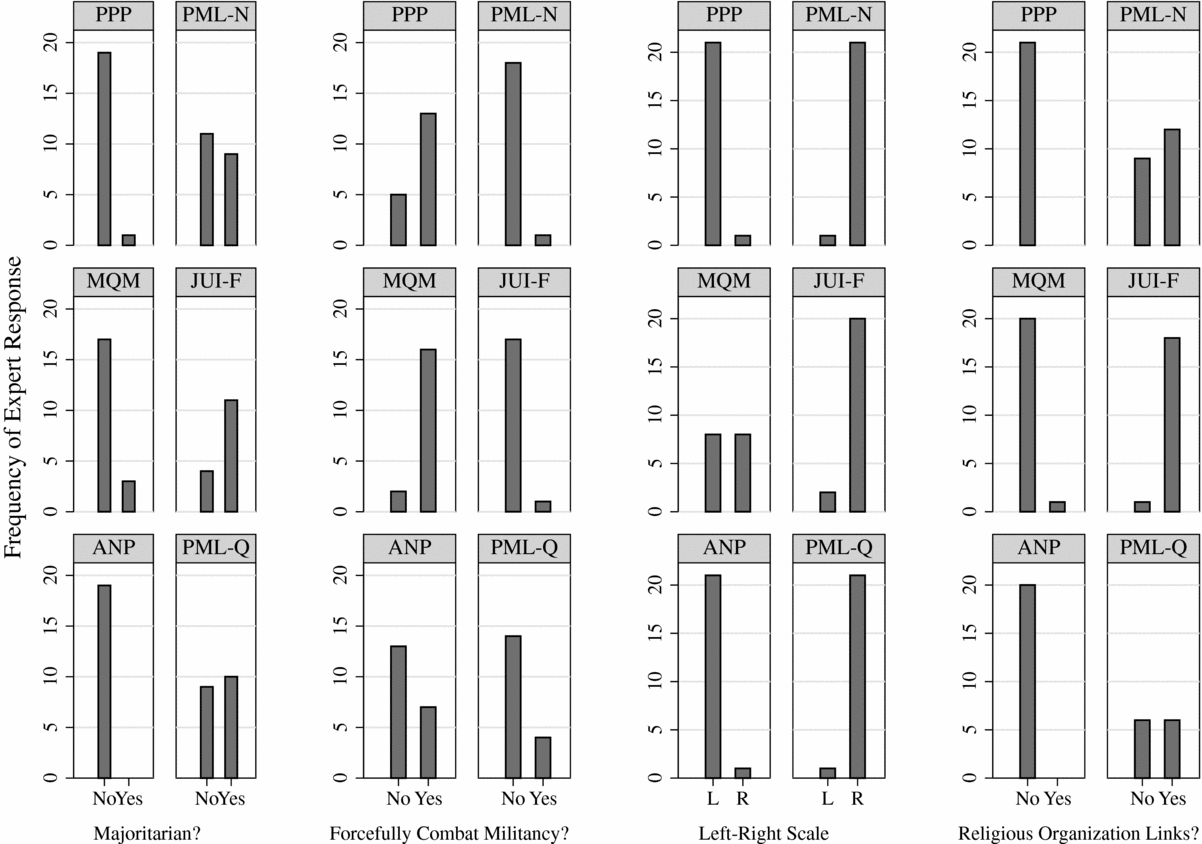
The final evidence we marshal comes from the Democratic Accountability and Linkages Project. As part of a cross-national survey, 22 Pakistan experts were asked to assign scores to the country’s six major political parties on a number of dimensions. Figure 1 presents the data for responses to four questions that bear on parties’ positioning with respect to secularism.Footnote 21 Frequency plots for Pakistan’s three putatively secular-leaning parties are displayed in the left-hand columns; corresponding plots for nonsecular parties are shown in the right-hand columns. The pattern of expert responses again supports our classification. What we claim to be secular-leaning parties are much less likely to be viewed as majoritarian. Virtually none of the surveyed experts believe that these three parties maintain ties to religious organizations. And, with the exception of the ANP, they are also thought to adopt a much tougher stance on militant violence in northwest Pakistan.Footnote 22
Expert Evaluations of Pakistan’s Political Parties

Taken together, then, we find extensive support for the contention that battles over secularism constitute a “master cleavage” in Pakistan’s party system. Reassuringly, too, there is near-unanimity about which parties should be classed as secularist in orientation, and which should not.
Members of the National Assembly (MNAs)
The Pakistan National Assembly—the lower chamber of the Pakistani parliament—is made up of 342 members. Of these, 272 are directly elected to single-member constituencies under first-past-the-post rules.Footnote 23 Constituencies are large, averaging 256,593 registered voters. In a survey of 62 MNAs, 87% ranked either “constituency service” or “knowing and being accessible to constituents” as the most important part of a legislator’s job (Mufti Reference Mufti2011, 256). Citizens make myriad demands of their representatives, including help with thana-katcheri (criminal justice-related) issues, obtaining natural gas connections, and securing job transfers (Wilder Reference Wilder1999, 192). MNAs are further expected to “bring home the pork,” typically in the form of development schemes like rural electrification and public-school construction.
An important facet of legislator performance concerns law and order. MNAs wield far-reaching influence over local police and bureaucracy. De jure power over transfers and promotions of district officials is vested in the provincial governments. However, state leaders routinely abide by the recommendations of local politicians (and their patrons) in reaching personnel decisions. Consequently, district police officials have self-interested reasons to accede to MNAs’ wishes. According to one report, “police officers receive unsolicited instructions from political masters, and are expected to unquestioningly carry them out” (Patil Reference Patil2008, 68). “Bureaucrats who are not sufficiently compliant . . . are ‘OSDed’ (put ‘On Special Duty’) or khuday-lined (side-lined)” (Wilder Reference Wilder1999, 208). Voters themselves appear to set great store by politicians’ connections to local law enforcement agencies; “[i]t makes the voters think that the candidate has enough political clout to afford protection to them” (Mufti Reference Mufti2011, 126).
MNAs by no means possess a monopoly on security provision. The military plays an outsized role in Pakistan, and is widely believed to determine the parameters within which militant groups operate (Haqqani Reference Haqqani2005; Fair Reference Fair2014). Yet, national-level policies set by Pakistan’s generals are primarily crafted to advance Pakistan’s strategic interests in Afghanistan, India, and the Kashmir region. Such policies hold little purchase in explaining subnational variation in violence incidence. Here, anecdotal evidence suggests that individual MNAs and their party affiliations matter a great deal. In 2013, for example, a former terror suspect linked to the anti-Shia LeJ became a PML-N MNA in Gujrat district, Punjab. Since that time, police attempts to foil sectarian violence have reportedly been stymied by ongoing political interference (Ullah Reference Ullah2013, 66). We now present a design that can shed more systematic light on the impact of incumbency by secular-party MNAs on religious conflict.
RESEARCH DESIGN
Data
To investigate the relationship between incumbent partisanship and violence, we combine data on militant and sectarian violence in Pakistan with disaggregated election results for the period 1988–2011.Footnote 24 Outcome data are taken from the BFRS Political Violence in Pakistan Dataset, which tallies all violent political events reported in the Lahore edition of the daily English-language newspaper, Dawn. Constituency-level returns were obtained from the Election Commission of Pakistan.Footnote 25
Prior attempts to infer the impact of electoral politics on violence in Pakistan have been hampered by a key shortcoming of the available data. Violence is recorded at the level of the administrative district, but districts are not always spatially coterminous with political constituencies. In particular, many constituencies are composed of contiguous segments of two or occasionally three districts. An added complication is that the number of districts has grown over time.Footnote 26 Mapping violence data onto electoral boundaries is thus a complex exercise.
We offer a solution to the unit-mismatch conundrum in Pakistan. Our innovation is to create a new unit of analysis, the joined district, which is the smallest amalgamation of districts that perfectly encompasses complete MNA constituencies. By way of illustration, take the administrative district of Khanewal, Punjab province, which was composed of four complete MNA constituencies in 1990. The adjacent district of Multan contained three complete MNA constituencies. One final “crossover” constituency—named Multan-cum-Khanewal—was made up of neighboring portions of both districts. We are able to construct a single joined-district, Multan-Khanewal, within which a total of eight MNA constituencies (and no others) are nested.
Owing to district splits and the redelimitation of constituency boundaries in 2002, joined districts change across election cycles. Permitting these changes maximizes the number of observations in the sample and keeps actually existing administrative units intact as much as possible. However, we also define a second analytic unit—cluster districts—which are the smallest amalgamations of districts that contain complete MNA constituencies and remain geographically unchanged between 1988 and 2013.Footnote 27 We cluster standard errors at the level of cluster districts to account for potential serial autocorrelation in the error terms.Footnote 28
The BFRS data set catalogs diverse kinds of political violence. A limitation of the data is that many of the recorded violent incidents lack detailed information about the motivation and identity of the perpetrator(s). For our purposes, it is necessary to whittle down the sample as well as possible to religiously motivated attacks. To do this, we adopt a principle of exclusion, dropping incidents that are assuredly not sectarian or Islamist in character.Footnote 29 We inquire into the robustness of the results by pruning the outcome data in various ways, and by dropping regions where other types of violence are known to predominate. As a further robustness check, we repeat the analysis employing a second, independently sourced measure of the dependent variable.
The analysis looks at five outcomes. Two of them—Any event and Any killed—are dichotomous; they denote, respectively, whether any violence and any killings took place within the joined district during the MNA’s tenure in office. The three remaining outcomes—Event count, Number killed, and Number days—are count variables that record, respectively, the number of violent events that occurred in a joined district during the election cycle, the number of people killed in those events, and the total number of days of violence. For the primary statistical models, we take the natural log of the counts, adding an arbitrary constant (0.01) to avoid dropping cells where the count is zero.
Identification Strategy and Right-Hand-Side Variables
This article seeks to estimate the effect of secularist party incumbency on religious violence. Expressed formally, we wish to measure the relationship
 $$\begin{equation}
Y_{it}=\alpha +\beta {SecularSeatProp_{it}}+ \varepsilon _{it},
\end{equation}$$
where Y it denotes outcomes in joined-district i in election-cycle t; SecularSeatProp is the independent variable—the proportion of joined-district MNA seats won by secular party candidates; and ε is the error term. In the bivariate correlation of violence on SecularSeatProp, the parameter of interest, β, is almost certain to be estimated with bias. Bias might stem from reverse causality—the possibility that conflict itself sways elections—or from overlooked variables that simultaneously determine both voting behavior and violence.
How should we reckon with these twin threats? One oft-mooted solution is to make post hoc adjustments to the regression model—adding in controls, lagged dependent variables, and fixed effects in a bid to purge major sources of confounding. However, a more promising avenue is to locate exogenous variation in the explanatory variable of interest. This has the core virtue of eliminating all confounding factors—observed and unobserved—by design.
We conjecture that very narrow victory or loss by secularist-party candidates in highly competitive MNA elections entails a strong element of random chance.Footnote 30 Given this assumption, it would ordinarily be possible to compare average violence outcomes across the two clusters of observations that lie immediately on either side of the winning margin-of-victory threshold (Dunning Reference Dunning2012). Yet, the geographical misfit between electoral constituencies and administrative districts in Pakistan precludes this approach. Instead, we integrate the RD design into an instrumental variables framework (Rehavi Reference Rehavi2007; Clots-Figueras Reference Clots-Figueras2011, Reference Clots-Figueras2012). We instrument for the endogenous regressor—the proportion of MNA seats in a district won by secularist candidates by any margin (SecularSeatProp)—using the proportion of district MNA seats won by secularist candidates against nonsecularist candidates in very close elections (SecularCloseWin). For the main specifications, we define close elections as those won or lost by secularist party candidates by three percentage points or less. (We explore the sensitivity of the results to using both smaller and larger bandwidths.)
One caveat with the identification strategy is that, while secularist victory in close races is plausibly as-if random, the actual incidence of close races is not. The design thus requires that we control for the proportion of all district races that were closely won or closely lost by secularist candidates. This leads us to estimate the following two-stage model:
 $$\begin{eqnarray}
Y_{it}&=&\alpha +\beta \widehat{SecularSeatProp_{it}}\nonumber\\
&&+\,\gamma SecularCloseProp_{it}+\theta _{p}+ \varepsilon _{it},
\end{eqnarray}$$
where
 $\widehat{SecularSeatProp_{it}}$
are the predicted values from the first-stage regression:
 $$\begin{eqnarray}
&&SecularSeatProp_{it}=\mu +\lambda SecularCloseWin_{it}\nonumber\\
&&\quad+\,\kappa SecularCloseProp_{it}+\theta _{p}+\nu _{it}.
\end{eqnarray}$$
The main model includes province-level fixed effects, indicated by θ p , because of possible province-wise disparities in the reporting of violence.Footnote 31 Provided certain assumptions are met, β in Equation (2) captures the local average treatment effect of secularist-party victory on violence, identified for closely fought elections. The next order of business is to subject these assumptions to scrutiny.
To begin, we verify that the instrument strongly predicts the endogenous regressor. The F-statistic on the instrument, SecularCloseWin, in the first-stage regression in Equation (3) is 53.91 (see SA Table A1), obviating concerns about weak instrument bias. Next, the instrument must affect outcomes only through the endogenous regressor; per the exclusion restriction requirement, there must be no “back door” paths. We believe this to be highly tenable in our application. After conditioning on the incidence of close elections, narrow victory by secularist party candidates can only affect violence via its effect on the proportion of joined-district seats held by secularist incumbents.
The third and thorniest assumption is that the instrument be uncorrelated with any additional unmeasured determinants of the outcome. Allegations of rigging have marred Pakistani elections (Oldenburg Reference Oldenburg2010, 204).Footnote 32 Electoral malfeasance could invalidate the design if secularist parties—or their nonsecular opponents—were able to precisely and consistently manipulate the results of closely fought races. A priori, this seems improbable, since it would require that parties be able to (a) predict when and where very close elections are going to occur, and (b) then ratchet up fraudulent activities in those areas just enough to tip the election.Footnote 33 Both are difficult. Reliable polling data do not exist in Pakistan. At the constituency level, even the threshold for victory is—in effect—unknowable ex ante, since multiple (>2) candidates tend to stand in each seat, with many candidates filing nomination papers at the very last minute. Further, most of the vote-rigging tools at hand—intimidation, bribery, ballot stuffing, and booth capturing—are blunt, and ill-suited to fine-grained electoral manipulation.Footnote 34 Charges of fraud are also leveled against parties of all stripes; there is little reason to expect lopsidedness on this score. That said, the potential for fraud at the counting and aggregation stages is worrisome from a design perspective, since subtle doctoring of results would (in principle) be feasible once the votes are in (Callen and Long Reference Callen and Long2015). Recognizing this, the Pakistan Electoral Commission has put in place a number of procedures to shield the integrity of the tabulation process. External monitors have vouched for the efficacy of these safeguards.Footnote 35
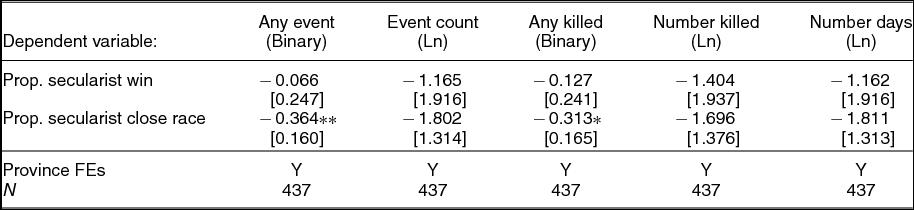
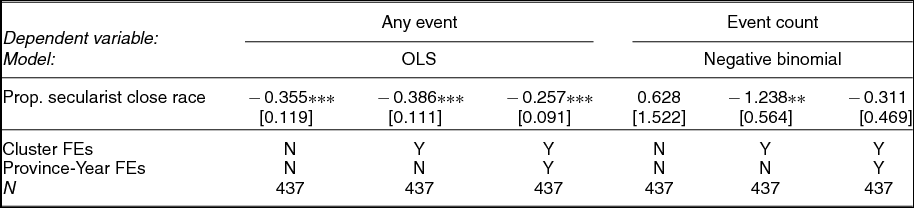
A raft of tests lends credence to the conjecture that victory or loss by secularist MNA candidates in close elections is as good as random. As shown in SA Figs. A3–A4, there is no sign of bunching of observations on one side of the winning threshold (McCrary Reference McCrary2008). Of the 104 close elections involving secular and nonsecular party candidates, secular candidates won 52.8% of the time—a figure that is statistically indistinguishable from a 50/50 coin flip. Next, the instrument does not predict pretreatment characteristics of joined-district areas: constituencies with secularist bare winners and losers appear similar with regard to education and literacy, housing quality and amenities, agricultural productivity, policing, political history, and demography (SA Tables A2–A4). Close secularist wins in time t are uncorrelated with electoral outcomes at time t − 1 (SA Table A5).Footnote 36 The IV model also cannot predict our primary violence measure in the previous election cycle (Table 1)—an especially informative placebo test. These checks boost our confidence that close elections in Pakistan constitute a valid natural experiment.
Placebo Check—Can Secular Victory in Close Elections at Time t Predict Prior Violence (t − 1)?

Notes: Robust standard errors, clustered by cluster-district area, in brackets. ***p < 0.01, **p < 0.05, *p < 0.1.
RESULTS
A. Main Findings
SA Table A6 provides summary statistics. For any joined district/election cycle, the average sample probability of violence occurring is 91% over the period we investigate, with killings recorded in 85% of cases.
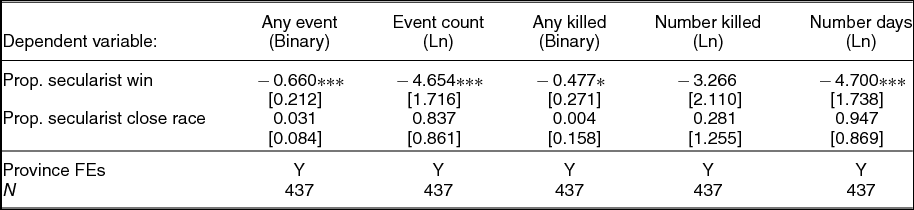
Does incumbency by a secularist party MNA mitigate or amplify local religious conflict? Table 2 reports baseline estimates from the instrumental variables specification described in Equations (2, 3). The coefficients on “Prop. secularist win” are interpretable as the local average treatment effect of moving from a joined district in which no seats are held by a secularist-party incumbent, to a joined district where all seats are held by a secularist-party incumbent. The effect is identified for close elections between secular- and non-secular-party candidates. The clear conclusion to emerge from Table 2 is that secularist incumbency dramatically reduces both incidence and severity of attacks. We find that a 100% increase in the proportion of district seats occupied by secularists causes a 66 percentage point reduction in the chance of violent attacks occurring, and a 48 percentage point reduction in the likelihood of killings. Our estimates for the set of three logged dependent variables turn up similarly large magnitudes.Footnote 37
Instrumental Variables Results

Notes: Robust standard errors, clustered by cluster-district area, in brackets. ***p < 0.01, **p < 0.05, *p < 0.1.
One potential concern is that the instrumental variables results rely on an involved statistical model. To make the data analysis as simple and transparent as possible, we restrict the sample to the 59 joined district/election years that experienced a single close election between a secular and nonsecular party MNA candidate. Under RD assumptions, places where the secular candidate won or lost will—in expectation—be ex ante identical for this subsample. (In practical terms, there is no longer any need to include the control variable, SecularCloseProp.) This parsimonious analysis is presented in Table 3, which regresses outcomes on an indicator for whether or not the secular party candidate competing in the close race ultimately won office. The main findings persist. On the extensive margin, victory by a secularist candidate in joined districts experiencing one secular/nonsecular close election entails an 18 percentage point reduction in the probability of violence subsequently breaking out (p = 0.064). Narrow secularist victories also reduce the number of violent events and the number of violent days, although there is no measurable reduction in killing.
Difference in Means Results for Joined Districts with One Secular/Nonsecular Close Election

Notes: Robust standard errors, clustered by cluster-district area, in brackets. ***p < 0.01, **p < 0.05, *p < 0.1.
B. Robustness and Sensitivity Analysis
Our baseline analysis shows that secular-party incumbency depresses local religious violence. We now turn to interrogate the findings’ sensitivity. The results are robust to defining close elections using both smaller and larger margin-of-secular-victory bandwidths (SA Tables A7–A10). SA Table A15 repeats the main analysis, dropping the 2002 elections, which were held under semi-autocratic rule and may thus have been most tainted by fraud.Footnote 38 We run a reduced-form analysis, enabling the application of count models to the measures of violence intensity (SA Table A19–A20). SA Table A21 excludes province fixed effects, while SA Table A22 includes year fixed effects. SA Table A23 adds in cluster-district fixed effects, an exacting model that absorbs any potentially lurking confounding produced by time-invariant characteristics of cluster-district areas. SA Table 24 includes a linear time trend. Following Clots-Figueras (Reference Clots-Figueras2012), SA Tables A25–A27 incorporate linear and higher-order polynomial controls for the margins of secularist victory in each seat in the joined district. Importantly, SA Table A28 prunes the BFRS data by adjusting the stringency of the event-inclusion criteria; this mitigates the worry that unclassified yet non-religious events are driving the results. In a similar vein, SA Table A17 drops regions of Pakistan where nonreligious violence—for example, separatism and interethnic conflict—are most prevalent, and thus where the danger of mistaken attribution is greatest. In virtually all cases, we observe effects that are substantively similar to the baseline estimates and statistically significant at conventional levels. We do see that effects on killings are less consistently significant than for events and duration. Speculatively, it may be that secular-party incumbents matter most for reducing low-intensity conflict, but are potentially less consequential for more lethal events, the prevention of which demands the intervention of military and intelligence services—something beyond the control of the typical Pakistani MNA.
Finally, we employ a wholly separate measure of the dependent variable. The Global Terrorism Database (GTD) is a longitudinal data set of terrorist incidents compiled by researchers in the United States. Information on terrorist events is drawn from open-source materials—principally coverage in major international newspapers. From the GTD listings, a Pakistan-based team extracted all domestic terrorist attacks that occurred in Pakistan between 1988 and 2011; they then georeferenced these incidents to districts. After linking these observations to our joined-district units, we re-estimated our statistical models. The results, displayed in SA Table A29, line up closely with the findings from the BFRS data. Across specifications, the impact of secular-party incumbency on terrorist violence is uniformly negative. The point estimates are measured with somewhat less precision than was the case for the BFRS outcomes, possibly due to underreporting in international media sources.Footnote 39
C. Generalizability
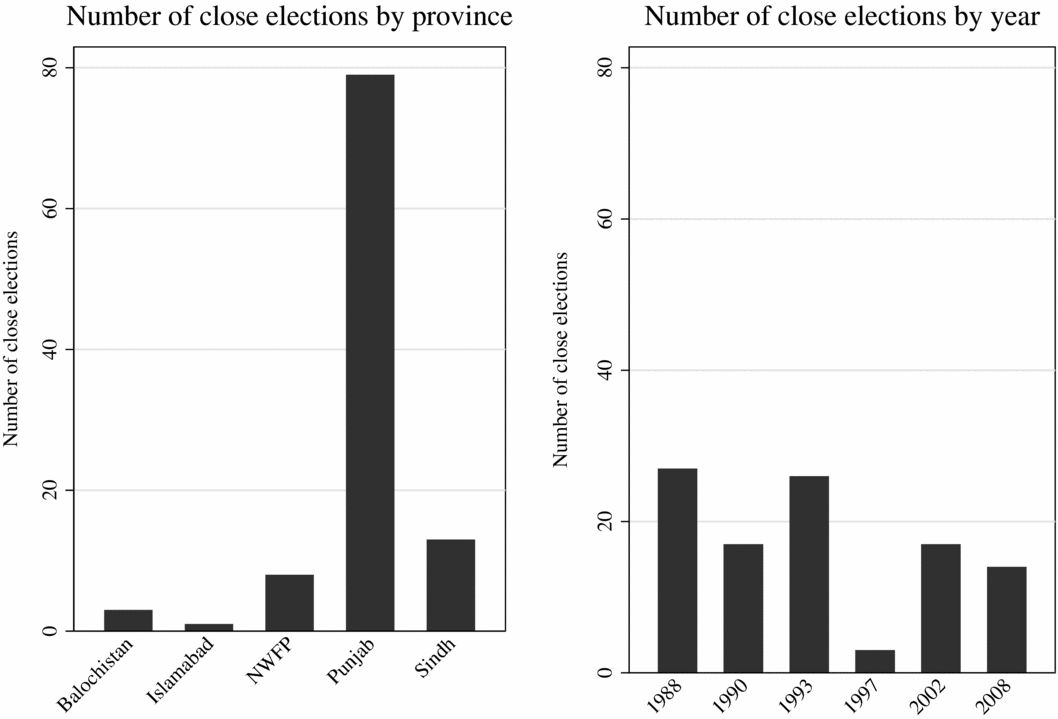
How generalizable are the findings? In particular, when and where do close elections occur, and what might this tell us about the factors needed to sustain the violence-reducing effects of secular-party incumbency? We answer this question in two ways. First, we generate frequency plots of the 104 close elections in our sample, by province and by year. Figure 2 reveals that the preponderance of close elections—76%—are from Punjab. This skew is unsurprising. Punjab is the country’s most populous province, and is home to 47% of Pakistanis and 49% of the population covered by our sample. It has long been a crucible of political competition between the PML-N and the PPP. With 54% of all MNA seats, Punjab usually determines which party secures a national legislative majority. Sectarian conflict first blew up in Punjab in the 1980s, before spreading to other regions.Footnote 40 It remains a breeding ground for Islamist militancy and is the site of numerous high-profile attacks. Punjab’s “military, administrative, economic and demographic predominance” (Talbot Reference Talbot and Jaffrelot2002, 59), and its preeminence with respect to religious violence, make it a vital case in its own right.Footnote 41
When and Where do Close Elections Occur?

A second way to address this question is to inspect the bivariate association between close elections and past violence. Do close secular/nonsecular elections mostly appear in areas that have been more peaceful or more disturbed? In Table 4, we regress violent-event outcomes—lagged by one period—on the proportion of joined-district MNA races that involved a close election between a secular and nonsecular party candidate. The data paint a consistent picture: the correlation is negatively signed almost across the board, and is statistically significant in four out of six specifications. This suggests that our LATE estimates derive from areas that are comparatively less violent on average. This should be borne in mind when interpreting and extrapolating the results: they are unable to speak definitively to the effect of secularist-party incumbents in high-violence areas. As noted above, however, it seems probable that the actions of individual legislators are most efficacious for the reduction of less extreme incidences of religious violence.
Correlation Between Close Secular/Nonsecular Elections and Violence at Time t − 1

Notes: Robust standard errors, clustered by cluster-district area, in brackets. ***p < 0.01, **p < 0.05, *p < 0.1.
MECHANISMS
The major finding of the previous section is that local secularist-party incumbency reduces religious violence. Drawing on the theoretical framework outlined above, we now seek to disentangle the mechanisms at work.
Electoral Incentives
Do electoral incentives best make sense of the effect? As we have shown, secular parties count on the votes of social groups victimized by violence. We posited that secular-party incumbents’ aggressive stance toward religious violence might stem from a fear of electoral reprisal in the event that violence erupts on their watch.Footnote 42
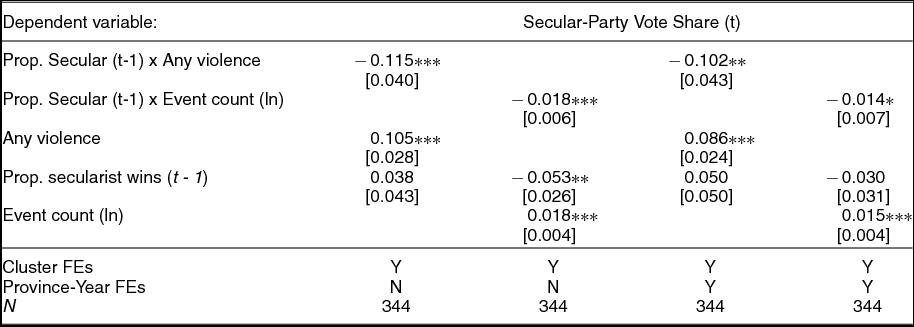
To test this hypothesis, we examine whether Pakistani voters inflict an electoral penalty on secular-party incumbents who preside over violence-struck districts. For the analysis, we use the proportion of total joined-district votes cast for secular-party candidates in time t as the outcome. We then focus on the interaction of two explanatory variables: the proportion of joined-district seats held by secular-party incumbents in the preceding election cycle (i.e., time t − 1), and the incidence of violence in the six months prior to the election.Footnote 43 If the theory of selective accountability is correct, we should expect this interaction to be negatively signed. That is, where violence occurs in the run-up to elections, secular parties will go on to lose more votes in areas where they held more MNA seats (and were thus plausibly responsible for the breakdown of law and order). The effects are estimated using OLS, controlling for cluster-district fixed effects and—in half of the models—province/election year fixed effects. The unit of analysis remains the joined district.
The results are given in Table 5. Consistent with the theory, we observe a negative and statistically significant interaction between pre-election violence and the proportion of secular MNAs in office. For a 10% increase in secular representation at t − 1, we observe a one percentage point reduction in secular-party vote share in violent districts over and above any effect seen in nonviolent districts. To further elucidate this conditional relationship, we subset the data. In joined districts where there was no reported violence in the six months leading up to the election, the correlation between prior secularist incumbency and the subsequent vote share gleaned by secular parties is strongly positive (10.4 percentage points, p = 0.048, N = 120). Conversely, in joined districts where violence was present, this coefficient is negative (−6.9 percentage points, p = 0.033, N = 224); under these conditions, incumbency appears to hinder the electoral prospects of secular parties.Footnote 44 These results suggest that failure to impede religious violence carries severe electoral repercussions for secular incumbents. Anticipating this, they should do all they can to prevent religious attacks.
Mechanisms—Electoral Incentives

Notes: Robust standard errors, clustered by cluster-district area, in brackets. ***p < 0.01, **p < 0.05, *p < 0.1.
Two words of caution are in order. First, the correspondence between theory and empirics is not one-to-one. While we show that secularists do as a matter of fact appear to lose votes when their districts fall prey to conflict, the mechanism stipulates that secular-party politicians perceive that a punishment effect exists. Drawing this inference may be taxing for politicians, since a multitude of factors feed into electoral outcomes. Second, neither violence nor prior incumbency is exogenously assigned in this analysis, hence the effects are not causally identified.Footnote 45 Nonetheless, the strictness of the fixed-effects models in Table 5—which exploit over-time variation within cluster districts while simultaneously accounting for province-specific cyclical shocks—makes it less likely that the results are a mere artifact of omitted variables.
Notably, in SA Table A32 we show that secular incumbency has no discernable effect on nonreligious violence or on regular crime. Further, SA Table A33 reveals no causal impact on religious violence of having an MNA from the prime minister’s party (secular or otherwise) be in power locally.Footnote 46 Both these falsification exercises attest to the uniqueness of the connection between secular parties and the control of religious violence.
The electoral incentives mechanism chimes with case-study evidence. For example, Rieck (Reference Rieck2016, 318) recounts an episode in which a Shia politician, Raja Nasir Abbas Ja’fari, in a speech in Multan, “stated that political parties had always begged votes from Shias but had given nothing to them in return. . .. He accused the PML-N of supporting banned terrorist groups and the PPP of being a silent spectator to the ‘genocide’ of Shias in Quetta.” In concluding, Ja’fari decalared that the “time had gone when Shias were lured to vote for secular parties. From now on Shias would vote for only those parties who would serve their interests.”
Politician Characteristics
A second way incumbent partisanship could affect violence is through politician selection. Individuals with particular personality types or ascriptive traits might self-segregate into secular versus nonsecular parties—or they may be induced to do so by intraparty selection procedures. Sorting dynamics could explain partywise disparities in conflict outcomes if—as seems conceivable—an incumbent’s individual characteristics shape her readiness to suppress religious violence.
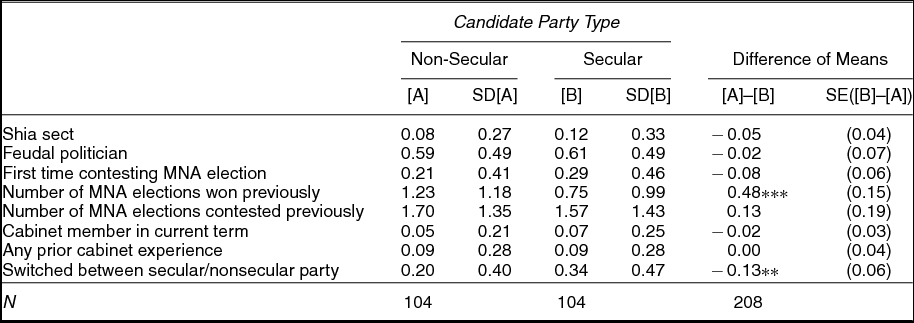
We put this explanation to the test by compiling biographical information on the 208 candidates who were the winners and runners-up in the 104 close elections at the heart of our analysis. The data cover four sets of candidate qualities. First, we attempt to decipher whether or not each politician belonged to a Shia religious sect—the rationale being that politicians may take more robust action to combat violence that disproportionately afflicts “in-group” members.Footnote 47 Second, we tag candidates who are landed elites or “feudals.” Compared to other candidates, landed elites (or “electables”) tend to be wealthier, garner a large personal vote, and profit from access to networks of loyal cadres.Footnote 48 Third, we assemble various metrics of past political experience, including membership in the national cabinet and past runs for office. Finally, our elections data set enables us to code patterns of party switching across the span of politicians’ careers. We create a dummy variable that takes one if the politician at any stage defected from a nonsecular party into a secular party (or vice versa). Across all of these dimensions, our analytical strategy is to check for the existence of average differences between secular- and nonsecular party candidates.
The results of two-sided t-tests are displayed in Table 6. Overall, secular and nonsecular party candidates look strikingly similar, on average. Secular parties are somewhat more likely to recruit Shia candidates. (Note, however, that a mere 12.5% of secular-party candidates appear to be Shia, and the difference across secular/nonsecular parties for this variable is statistically both small and insignificant.) Secular and nonsecular parties put up feudal politicians for election at very similar rates. Regarding experience, the only difference we detect is that nonsecular candidates spent more time as sitting MNAs in the past (1.23 terms versus 0.75 terms for secular parties). This is at variance with our theoretical priors: less experienced secular politicians should be less able to suppress violence, and yet they do.
Mechanisms—Differences in Candidate Characteristics by Secular/Nonsecular Partisanship for Close Elections

Notes: Group means are shown in columns [A] and [B]. SD denotes standard deviation and SE denotes standard error. ***p < 0.01, **p < 0.05, *p < 0.1.
There are other potentially relevant characteristics we cannot measure. Candidates’ latent ideology is a prime example, although the party-switching variable is somewhat informative on this point. Do secular parties tend to enlist more committed ideologues, and are secular parties commensurately more cohesive as organizations? The answer appears to be no. Thirty-four percent of secular candidates switched between party groupings during their careers, compared to 20% of nonsecular-party candidates.Footnote 49 Seen in the aggregate, the data betray few signs that politician selection is what drives the pacifying effect of secular-party incumbency.
State Capacity Explanations
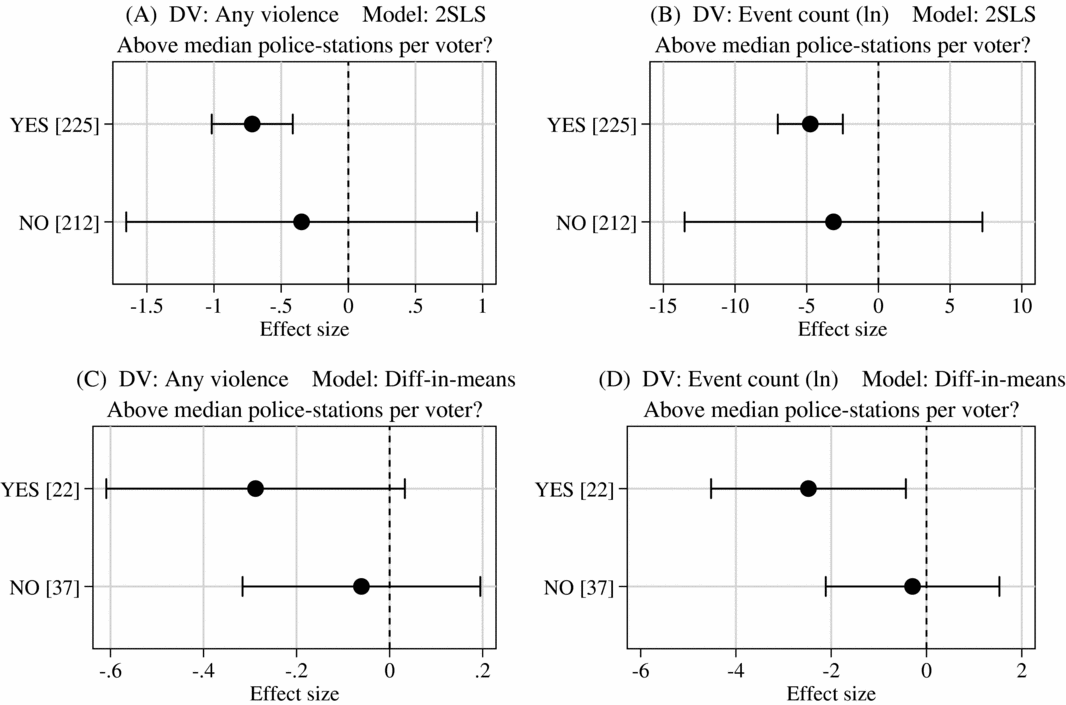
A standard result in the civil war literature is that high levels of state capacity are tied to a reduced likelihood of conflict onset (Fearon and Laitin Reference Fearon and Laitin2003). We assess whether the effect of secular-party incumbency is moderated by local state capacity, focusing on the state’s coercive apparatus. We collected district-level data on the number of police stations for each election year. Dividing this by the number of registered voters in each district yields a per capita measure of police penetration.Footnote 50 The sample median value of this variable was then used to partition the sample into two subgroups.
In Fig. 3, we rerun the main statistical models by subgroup for two dependent variables. Dot-and-whiskers plots show point estimates and their 95% confidence intervals. Prima facie, we find that the statistically significant treatment effect of secular-party incumbency is concentrated in district years in which per-capita police enforcement is greater than the median value. In below-median areas, secularist incumbency does not discernibly impact religious violence, favoring the claim that state capacity modifies the effect of secular-party rule. There are several provisos, however. For one, the groupwise differences are not always clear-cut: the point estimates in above- and below-median districts are substantively similar in the instrumental variables models (Panels A and B), even though their significance differs. Relatedly, a formal test of differential subgroup effects only registers as marginally statistically significant for the difference-in-means model presented in Panel D. Measurementwise, police stations per capita offers a rough gauge of true law enforcement capacity; richer data on manpower and materiel—unavailable for Pakistan—would be preferable. Nevertheless, recall that the theory’s foremost concern is whether or not legislators choose to use the resources at their disposal to reduce religious violence. The police stations per capita variable tells us whether legislators can or cannot intervene to affect conflict in the first place. It is also worth stressing that better-policed areas may be dissimilar in other key respects from places that are less well-policed.Footnote 51 The heterogeneity in effects should thus be treated as suggestive but not dispositive evidence about the contributory role played by state capacity.Footnote 52
Secular Party Effect Conditional on Police-Station Density

CONCLUSION
In this article, we demonstrate that secular-party rule reduces the incidence of sectarian and Islamist violence. We leverage a credible research design that exploits the occurrence of close elections between secularist and nonsecularist candidates in Pakistan between 1988 and 2011. According to our instrumental-variables estimates, increasing secular-party representation by 10% reduces the probability of local religious violence by 6.6 percentage points. Additional analyses indicate that the result comes from electoral pressures to cater to core party supporters, and not from politician selection. The effect is concentrated in regions with denser police presence, suggesting that incumbent partisanship is efficacious, but only when the state’s coercive apparatus is potent enough to sway the security situation on the ground.
Few would dispute the World Bank’s (2011) assessment that “[t]he costs of violence for citizens, communities, countries, and the world are enormous, both in terms of human suffering and social and economic consequences.” Our results advance policy debates about peace-building efforts in societies riven by religious tensions. Support for secularists and moderates has been a backbone of democracy promotion programs in recent years. Our findings help bridge the evidence gap about the realized impact of such parties on conflict-mitigation, and—by extension—democratic stability. We further contribute to theoretical discussion surrounding the determinants of subnational conflict. Whereas an older generation of literature emphasized the macro-institutional and economic drivers of violence outbreak [for a prominent recent example highlighting economic factors, see Jha (Reference Jha2013)], newer studies have homed in on grassroots initiatives to facilitate intergroup cooperation and resilience-building.Footnote 53 Incumbent partisanship constitutes a meso-level factor influencing a country’s ability to keep violence at bay. Although we must remain agnostic about the effect of democracy per se on conflict, we show that who wins elections profoundly shapes a locality’s subsequent exposure to religious disturbances. Pinker (Reference Pinker2011, 680) has famously argued that the advent of the modern state brought about a precipitous decline in criminality and conflict: “[a] state that uses a monopoly on force to protect its citizens from one another may be the most consistent violence-reducer” historically. States are no silver bullet, however. Our findings reveal that states’ attempts to quench violence are not equally distributed among citizens. This underlines the need for reforms to insulate local security forces from political interference and to enhance security protections for society’s most vulnerable groups (Banerjee et al. Reference Banerjee, Chattopadhyay, Duflo, Keniston and Singh2012).
The study faces several limitations. We cannot generate unbiased estimates of the effect of secular rule at the national-governmental level on conflict, nor do we know what might be the consequence of introducing secular parties into a political system for the first time (cf. Ishiyama Reference Ishiyama2009). Next, our results apply to violence in Pakistan’s four main provinces; they do not carry lessons for the situation in the Federally Administered Tribal Areas or Azad Kashmir, where militancy is particularly acute yet where normal democratic institutions are inoperative. Lastly, the method we employ recovers a context-specific average treatment effect: namely, the impact of secularist incumbency pursuant to hard-fought elections. It says nothing about violence dynamics in party strongholds. Future research should seek to fill these gaps.
Although our empirical evidence is from Pakistan, there are reasons to expect that the findings extend elsewhere. For secularist incumbency to curb violence, our evidence implies that three conditions need to be met. First, local incumbents must have discretionary power over police and security forces; while officeholders might employ noncoercive tools to ward off violence, the state’s security apparatus appears to be especially crucial. Second, political competition must be configured so that secular parties square off against nonsecular parties in relatively tight elections; absent such competition, there may be few political advantages to stopping religious conflict. Finally, it seems likely that systems of geographic representation (for example, single-member districts) are more conducive to electoral accountability over violence as compared to proportional-type systems. Without additional studies, however, these scope conditions remain tentative.
SUPPLEMENTARY MATERIAL
To view supplementary material for this article, please visit https://doi.org/10.1017/S0003055417000491.
Replication files can be found on Dataverse at https://doi.org/10.7910/DVN/VHNHHN.





Comments
No Comments have been published for this article.